
How to Answer "Why Do You Want to Work Here?" (2026 Guide)

.webp)
If you've ever frozen on this question, it's not because you're bad at interviews.
It's because the question is secretly doing three jobs at once:
It tests whether you actually understand what the company does (beyond slogans).
It tests whether you want this role for reasons that will survive a rough week.
It tests whether you can translate motivation into impact (why you + why now).
Employers use this question to judge fit and whether what you want matches what the job actually offers. That's true, but it's only part of the picture.
In 2026, hiring managers also use it as an informal AI-detector test. Not to catch whether you used AI, but to catch whether your answer sounds like it came from the internet. Generic answers are the new red flag.
This guide shows you how to build an answer that is:
Specific (can't be copy-pasted to another company)
Balanced (why you want it + why they should want you)
Evidence-backed (not vibes)
Short (30 to 75 seconds, unless they invite more)
And because this is AIApply's blog, we'll also show you how to use AI tools to prepare ethically and effectively. Not to fake competence, but to actually get better at this. If you're still preparing for an interview more broadly, we have a complete guide for that too.
Why Interviewers Ask "Why Do You Want to Work Here?"
Hiring is a high-stakes bet under significant uncertainty.
A company can't directly observe three things about you in an interview: whether you'll do the work well once the honeymoon wears off, whether your motivation is durable, and whether you'll thrive in their specific environment (their pace, their constraints, their team dynamics). So they ask questions designed to produce signals.

"Why do you want to work here?" is one of the highest signal-to-noise questions in any interview. It reveals whether you did real research or just read a few headlines. It reveals whether your motivation is stable (mission, craft, growth in the role) or fragile (prestige, perks, "seems cool"). It reveals whether you understand the tradeoffs of the role. And it reveals whether you can connect your past to their future.
That last one matters more than most people realize.
A strong answer isn't flattery. It's a tiny business case:
"Here's why this company + this role is the best place for me to create value, and here's proof I can."
When you answer well, you're not just saying "I like you." You're saying "I've thought about this seriously, I understand what you're trying to accomplish, and I believe I can help."
The Biggest Mistake That Kills Most Answers
Most weak answers sound something like this:
"I love your culture. I'm excited about the growth opportunities here. I think I'd be a great fit because I'm hardworking and I align with your values."
Even if every word of that is true, it's useless. It's transferable to literally 10,000 other companies. A hiring manager who has heard it three times today hears only one thing: "I didn't pick you specifically. I picked a job."
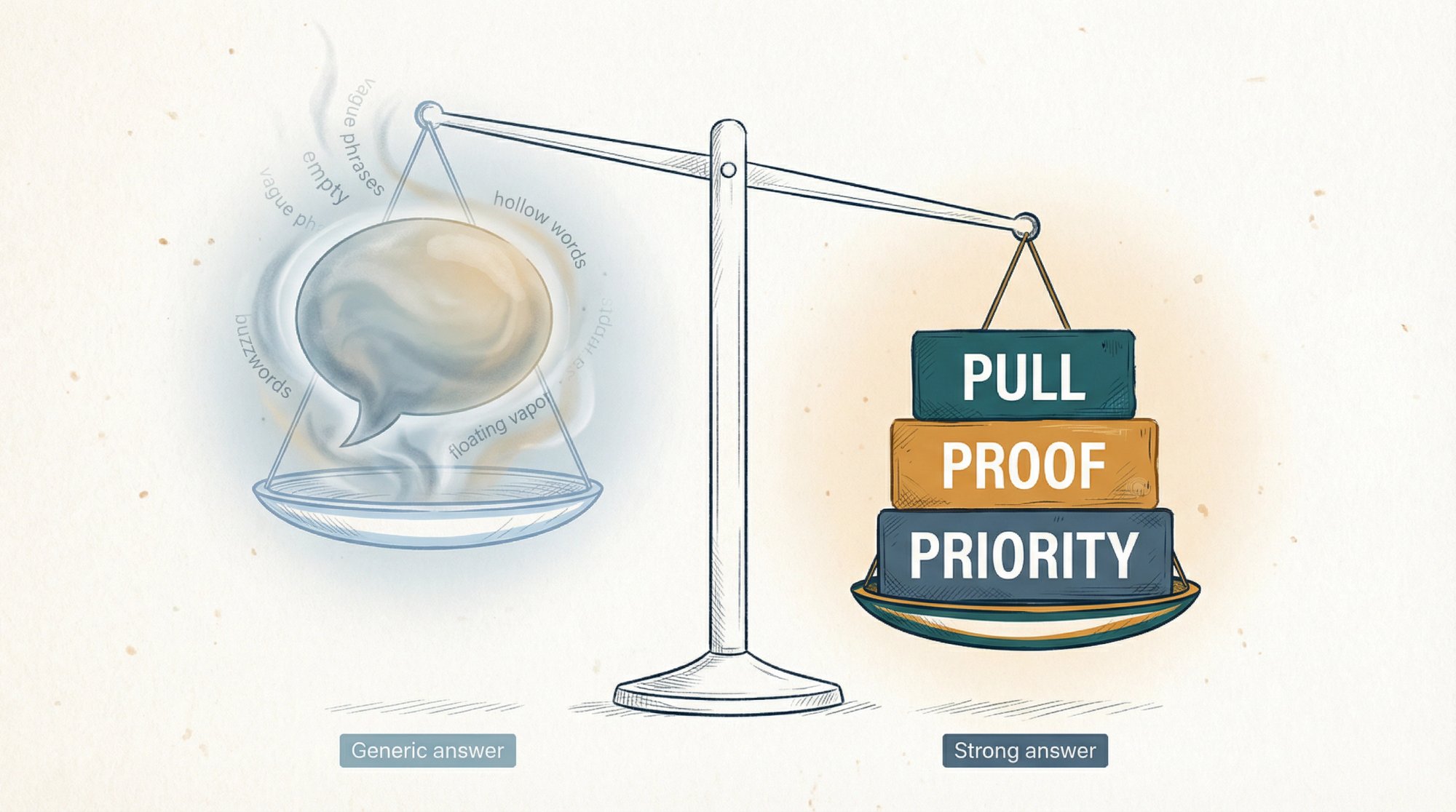
The fix isn't complicated. Your answer needs two halves:
Pull: What specifically pulls you toward this company and this role (not just any company).
Proof: Why that pull maps to your demonstrated ability to deliver outcomes.
Most candidates only do Pull. The best candidates do Pull + Proof + a clear statement of what they'd focus on first.
The moment you add that third piece, your answer becomes almost impossible to copy-paste from a generic prep guide. The same specificity principle applies when crafting a strong interview elevator pitch. Depth always beats breadth.
The 3-Part Framework for Answering "Why Do You Want to Work Here?"
If you remember nothing else from this guide, remember this:
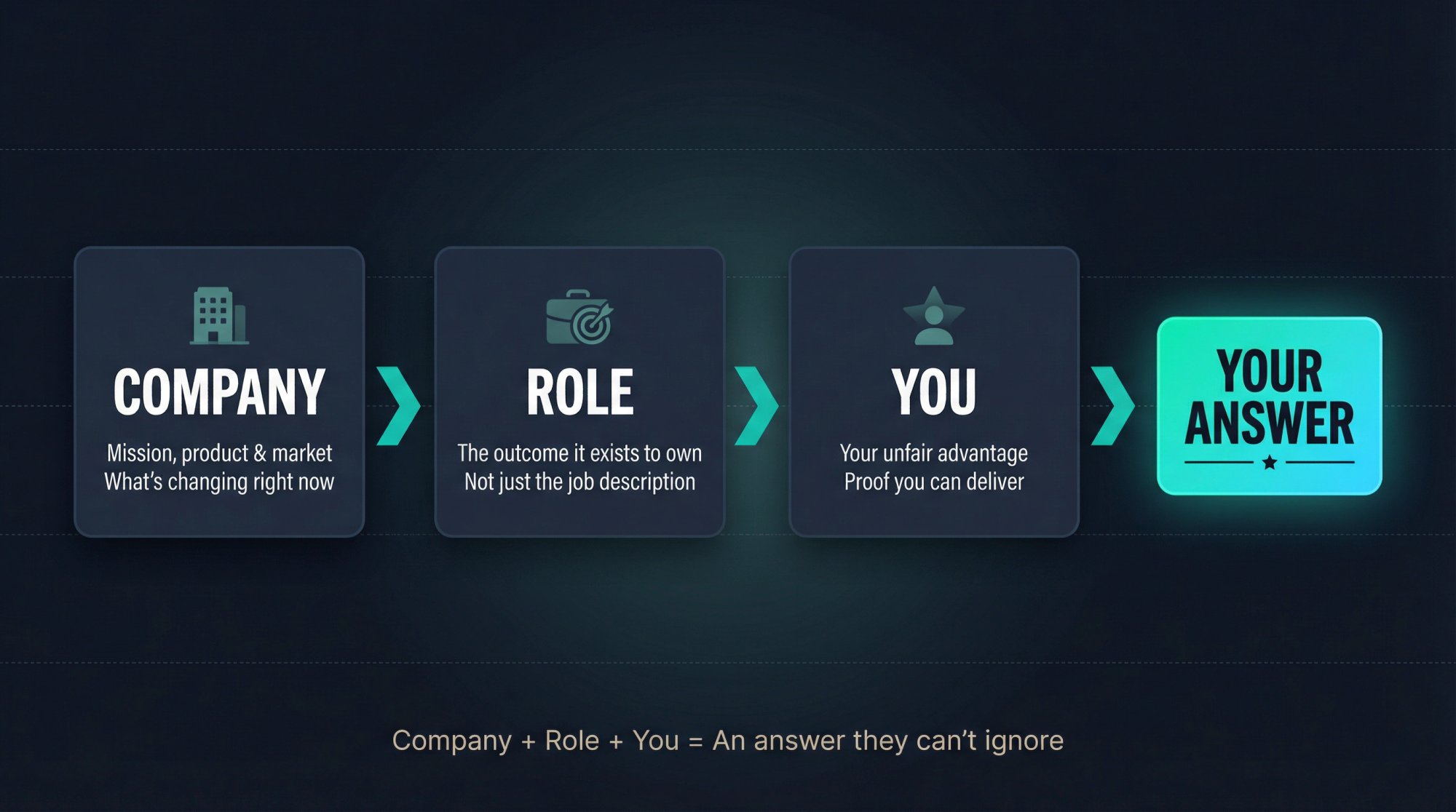
Company → What they do + why it matters + what's changing right now
Role → What the role exists to accomplish (not just the job description)
You → Your unfair advantage and proof you can deliver
Here's the fill-in template:
"I want to work at [Company] because [specific company reason tied to mission/product/strategy].
What excites me about this role is [the outcome the role owns], especially [specific responsibility or challenge].
I'm confident I can contribute because I've done [relevant proof], where I achieved [measurable result].
If I joined, in my first 30 to 60 days I'd focus on [1-2 concrete priorities]."
That last line (the 30-60 day plan) is optional. But it's one of the highest-impact upgrades you can make to any answer. It signals that you've thought beyond the interview itself and you're already thinking like someone who's been hired.
How to Build Your "Why Do You Want to Work Here?" Answer
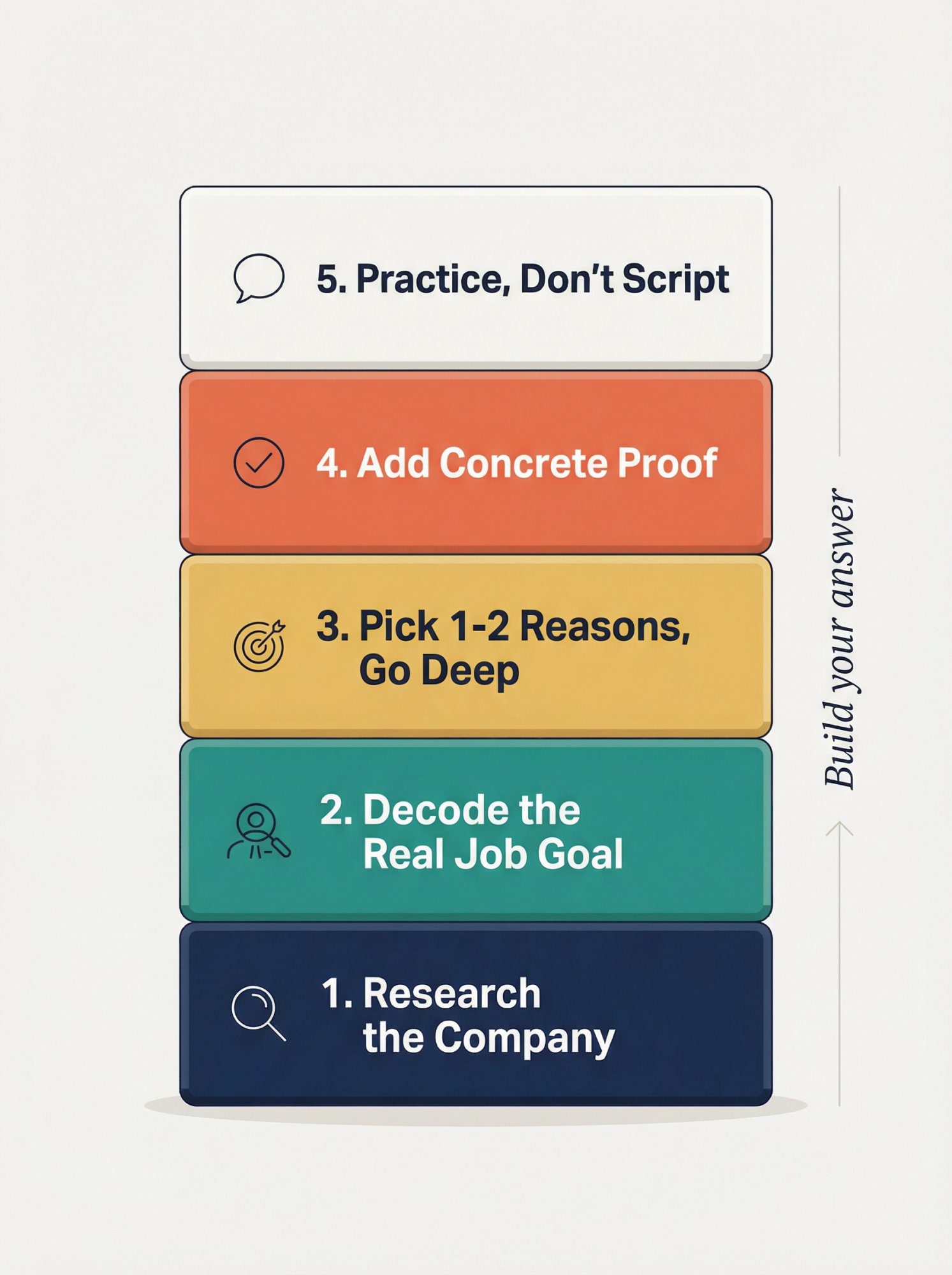
Step 1: Research What the Company Is Really Doing
Your company thesis is your best guess at what the company is really doing. Not their marketing copy. The actual business logic.
Think about it across four dimensions:
→ Who they serve
→ What pain they solve
→ Why they win against alternatives
→ What matters to them right now (not two years ago)
The format that works well: "[Company] helps [customer] achieve [outcome] by [how they do it], and they're currently focused on [growth initiative/constraint/shift]."
For example, if you were applying to AIApply, a useful company thesis might sound like: "AIApply helps job seekers move from application to interview faster by combining tailored resumes and cover letters, automated applications, and real-time interview coaching into one connected workflow. At 1.1 million+ users, retention and interview success are the next major levers."
Those details matter because they force you to say something specific. You can't point to a running counter of 372,241+ roles applied to via the platform and then give a vague answer about innovation. Specificity anchors your interest in reality.
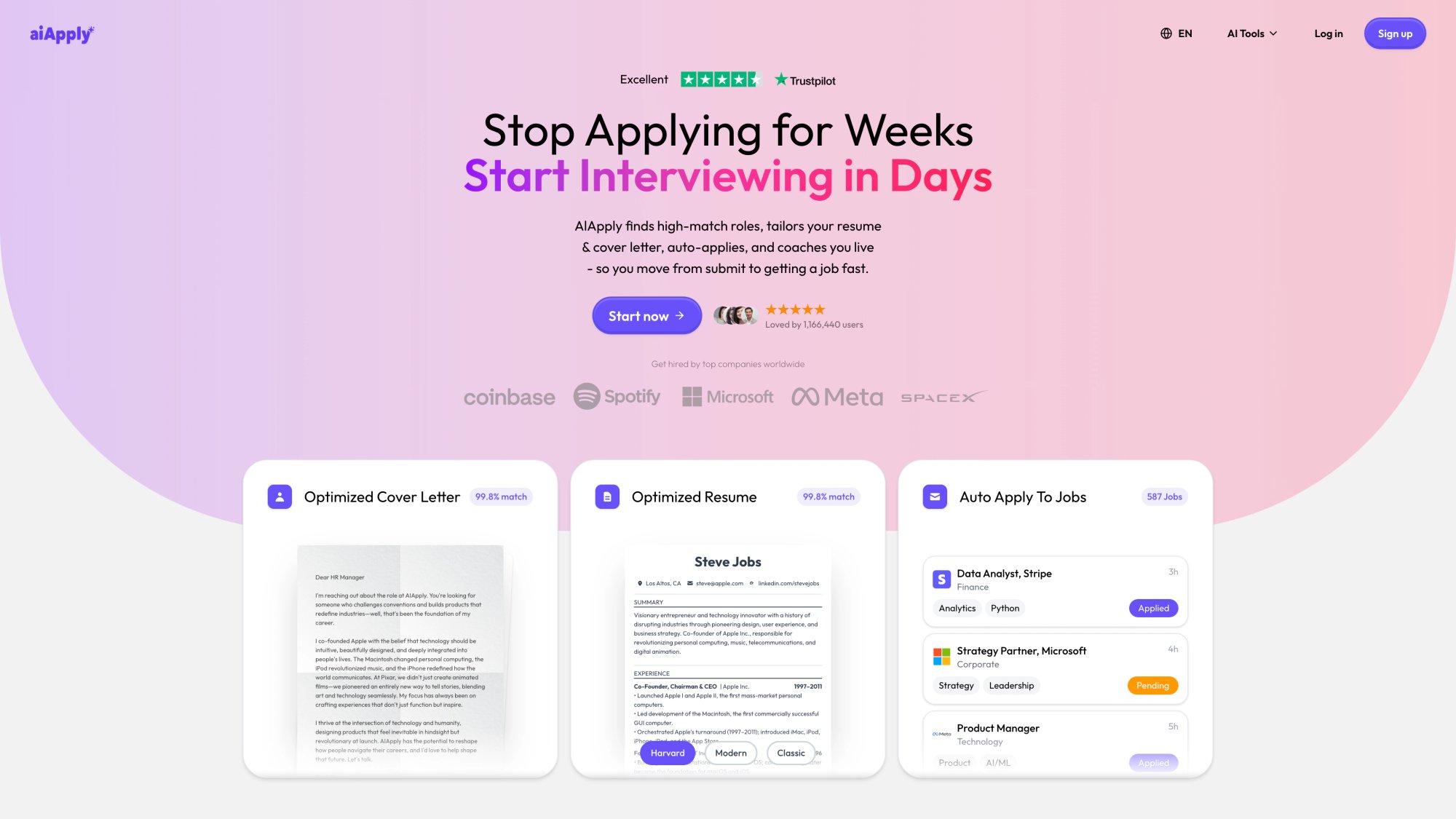
AIApply's homepage — the kind of concrete detail that turns a generic answer into a credible one. Note the Trustpilot "Excellent" badge, the user count, and the product cards. Research like this is what separates candidates who know a company from those who only know about it.
Step 2: Find the Real Business Goal Behind the Job
Every role is hired to reduce a specific pain. The job description is a proxy. It tells you what someone will do, not necessarily why the company is desperate for it.
Ask yourself: what breaks if this role stays unfilled for 90 days? What outcome will the hiring manager be judged on? What would "great" look like six months in?
If you're not sure, use the job description like a detective. Repeated verbs tell you what they actually need: ship, grow, reduce, fix, automate, unblock. Repeated nouns tell you what they care about: activation, retention, pipeline, latency, conversions.
When you understand the business goal behind the role, you can address it directly in your answer. That's far more powerful than describing responsibilities back to them. For a deeper look at decoding what hiring managers actually want, see our guide on how to succeed in a job interview.
Step 3: Choose 1-2 Specific Reasons and Go Deep
Quantity isn't credibility. Depth is.
A reliable rule: 2 reasons max inside the answer, then support with proof. This is exactly why so many "example answers" you find online feel weak: they list six reasons and prove none of them.
One strong reason with a concrete story beats four vague ones every time. Trust that.
Step 4: Add Concrete Evidence to Back Up Your Answer
Proof doesn't have to be a dramatic achievement. It just has to be specific enough to be checkable.
Good proof can be:
A metric you moved (increased activation by 18%, cut support tickets by 30%)
A system you built (automated a process that used to take 4 hours per week)
A process you improved (redesigned an onboarding flow that raised completion from 40% to 70%)
A customer problem you solved (rebuilt a client's pipeline from scratch after it broke)
A hard thing you learned fast (picked up Salesforce in three weeks to ship on a deadline)
If you can't attach evidence, it's not a reason. It's a vibe. And vibes don't survive follow-up questions. This is also why behavioral interview preparation matters so much. Your proof points are exactly what behavioral questions are designed to draw out.
Step 5: Practice Without Memorizing a Script
Scripting is fragile. You'll sound wooden, and the moment the interviewer asks a slight variation, you'll freeze.
Your goal is to sound prepared, not rehearsed. Bullet points give you the structure without locking you into specific words. Know your three-part framework, know your proof, and let the actual sentences form naturally in the room.
The 15-Minute Company Research Plan Before Any Interview
Most people "research" a company by reading the About page and maybe scrolling LinkedIn for five minutes. That's the bare minimum, and hiring managers can tell.
Here's a better 15-minute research sprint you can run before any interview:
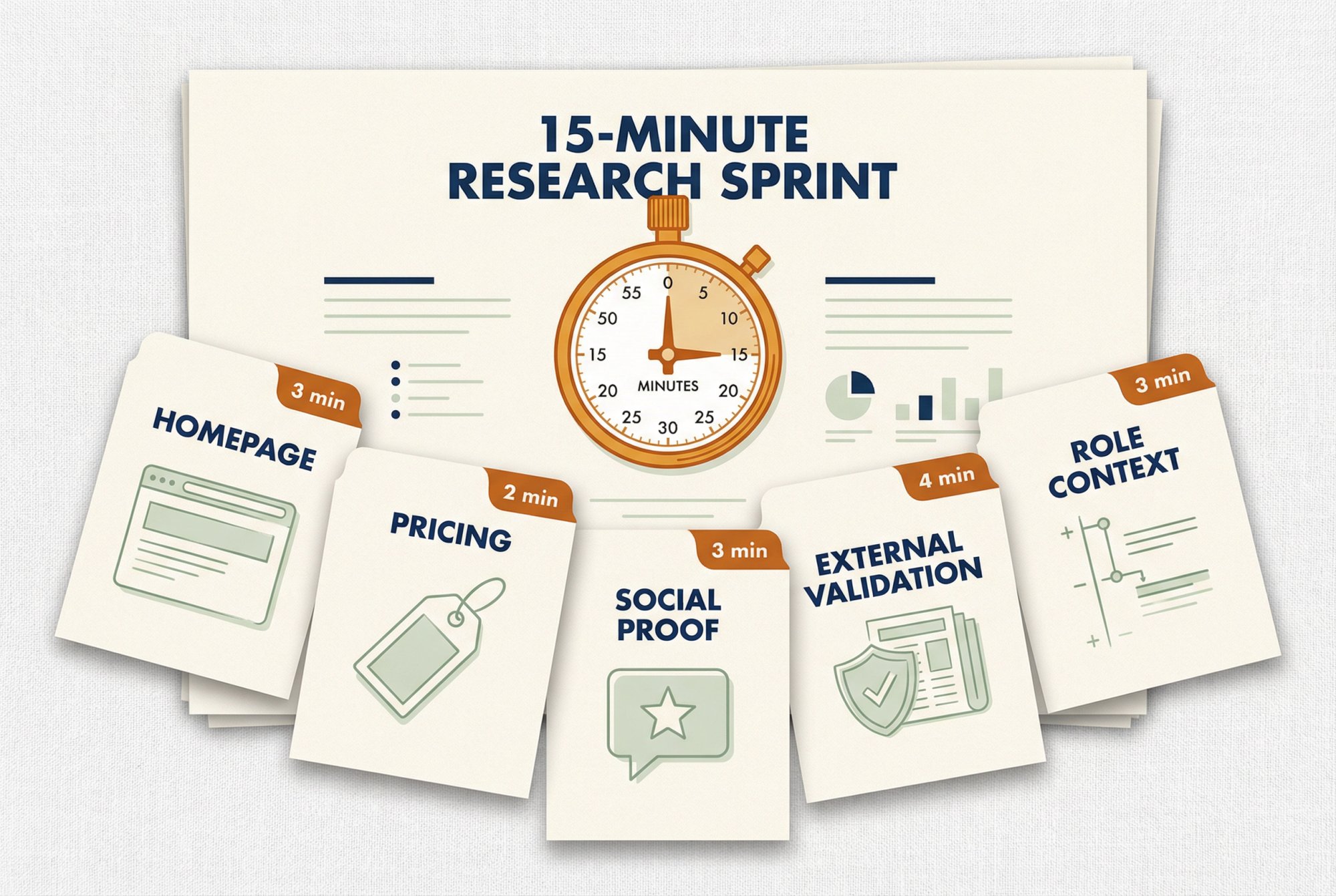
For many companies, even this basic due diligence is surprisingly revealing. Take AIApply as a concrete example. Companies House shows AIAPPLY LIMITED (company number 15200716) is an active UK company incorporated in October 2023. The company's investors list it as a 2024 investment using AI to streamline the discovery, preparation, and application phases of job hunting. And founder interviews name Aidan Cramer and Peter Utekal as co-founders and discuss early traction.
You don't need all of that for every interview. But pulling even one or two concrete facts from real sources instantly elevates your answer from "I read your website" to "I understand your business." Our full guide on how to research a company before an interview walks you through every source worth checking, from company registries to product changelogs.
What Most Candidates Get Wrong About This Question
The standard advice isn't wrong. Research the company. Mention mission and values. Tie it back to your skills. The consensus guidance emphasizes linking a company's mission to your personal plan and showing genuine enthusiasm for where they're headed. Standard interview wisdom focuses on alignment and fit.
All of that still applies. What many guides miss is the specific stuff that makes answers genuinely memorable in 2026.
The insight most candidates skip: It's not enough to know what a company does. The candidates who stand out know what's happening at the company right now.
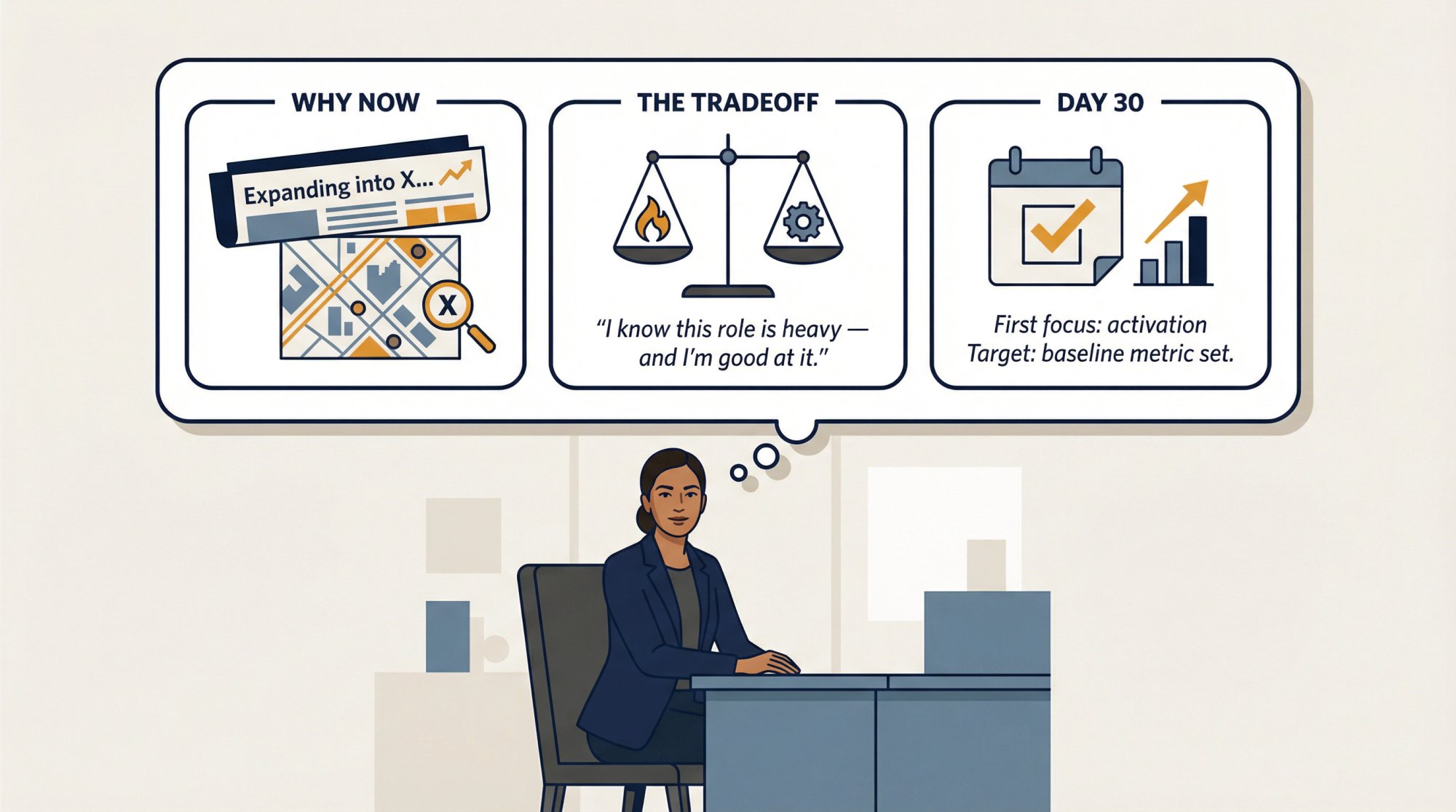
The "why now" signal. Companies change. Markets evolve. Products shift. If you can name what's happening at this company right now, your answer sounds real instead of researched-in-a-vacuum. Even something simple works here: "You're expanding into X..." or "You've proven demand, and now distribution is the next challenge..." That single line separates you from every candidate who only talked about the company's mission statement.
The tradeoff sentence. This is the sentence most candidates skip. It proves you understand reality: "I'm excited about a lean team because I like owning outcomes end-to-end" or "I know this role is heavy on stakeholder work, and I'm actually good at translating ambiguity into decisions." Naming a constraint and saying you accept it signals maturity. It also makes your answer much harder to fake.
One concrete first contribution. Not a full strategy deck. Not "I'd need to learn more first." Just a credible first step. "In my first 30 days I'd focus on [X] so we can establish [baseline metric]" is enough. It shows you've thought beyond the interview.
"Why Do You Want to Work Here?" Answer Templates
These are starting points. The structure is sound; your specifics are what make them land.
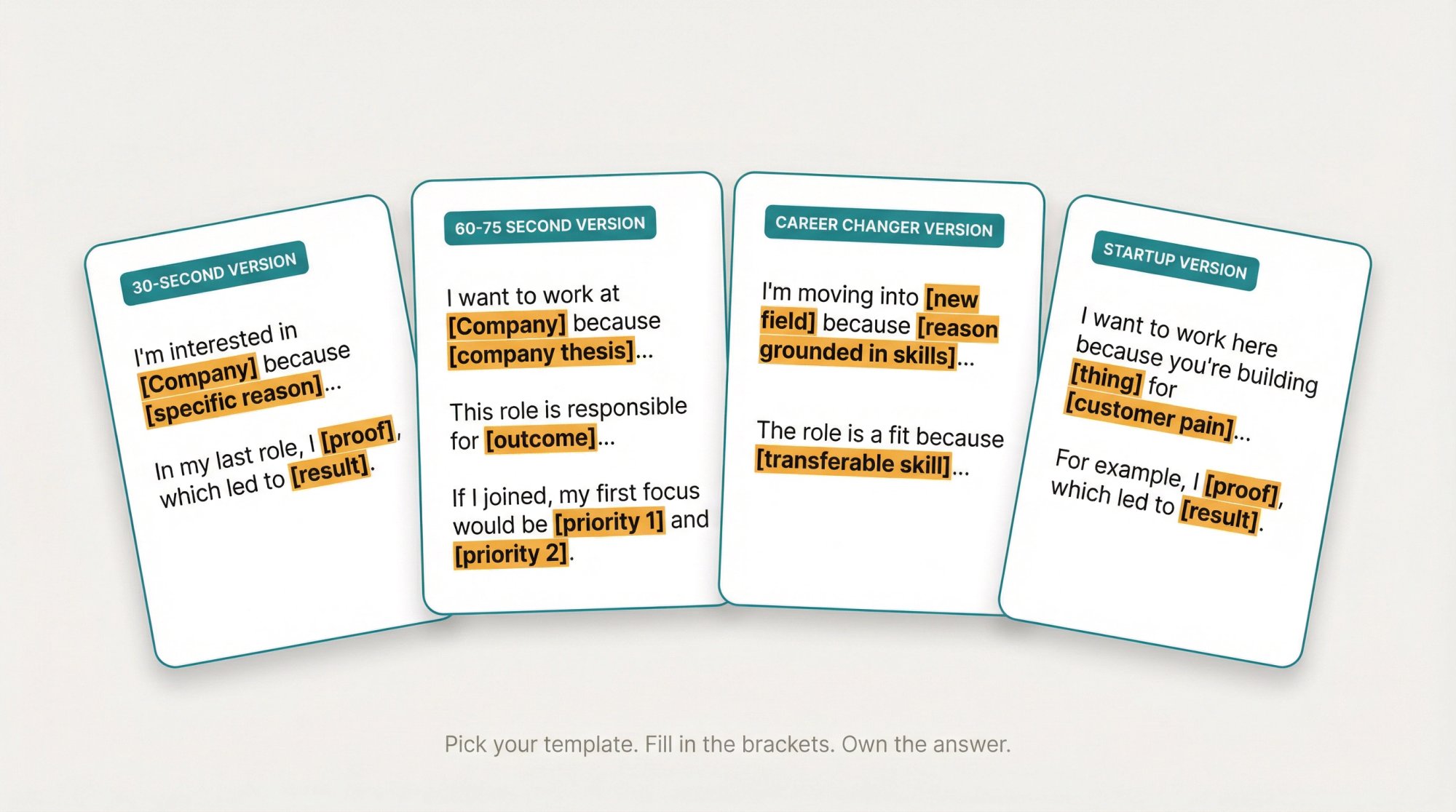
The 30-Second Version (for Phone Screens)
"I'm interested in [Company] because [specific reason tied to product/mission/market move]. I like this role because it's focused on [outcome], and that's where I've had my best results. In my last role, I [proof], which led to [result]. I'd love to bring that same approach here."
The 60-75 Second Version (Most Common Format)
"I want to work at [Company] because [specific company thesis] and I'm especially interested in [current initiative or shift].
This role stands out because it's responsible for [outcome] and the problem you're solving is [hard thing].
I've done something similar at [company or project] where I [action], resulting in [metric].
If I joined, my first focus would be [priority 1] and [priority 2], so I can make an impact quickly."
The Career Changer Version
"I'm moving into [new field] because [reason grounded in skills or values], and [Company] is one of the few places where that switch actually makes sense because [specific overlap between your past and their need].
The role is a fit because [transferable skill] is central to it, and I've proved that through [proof].
What I'm excited about specifically is [company-specific detail], and I'd plan to ramp fast by [how]."
The Early-Stage Startup Version
"I want to work here because you're building [thing] for [customer pain] and you've already shown real demand. I'm drawn to early-stage teams where speed and ownership matter.
In this role, the goal seems to be [outcome], and that's exactly the kind of work I do best.
For example, I [proof], which led to [result]. I'd love to bring that builder mindset here."
"Why Do You Want to Work Here?" Example Answers
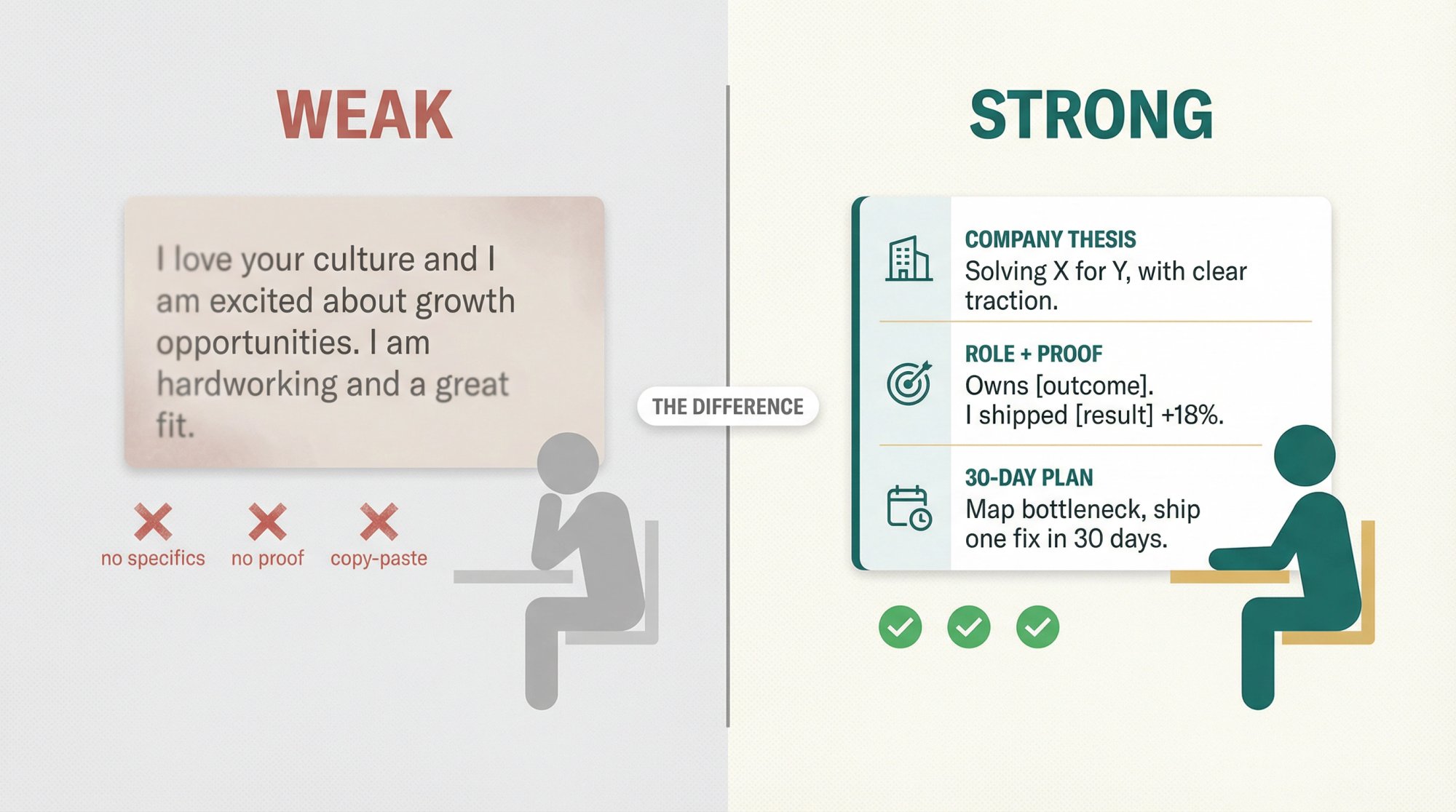
Example 1: The Weak Answer (What Not to Do)
"I want to work here because I love your culture and I'm excited about growth opportunities. I think I'd be a great fit because I'm hardworking and dedicated."
What's wrong: Nothing specific, no proof, and it could apply to thousands of companies. A hiring manager who has heard three of these back-to-back starts tuning out.
Example 2: The Strong Answer (Specific + Proof)
"I'm excited about this company because you're solving [specific customer pain] in a space where speed and clarity matter, and you've clearly built real momentum in it.
What I like about this role is that it owns [outcome], not just tasks. That's how I like to work.
In my last role, I [did the specific thing], which improved [metric] by [measurable number].
If I joined, I'd start by mapping the top bottleneck in [process] and shipping one improvement that moves [metric] within the first month."
What works: Specific, proof-backed, role-aligned, and ends with a concrete first action.
Example 3: A Tailored Answer for a Specific Company
(Useful even if you're not applying to AIApply specifically. It shows you how to adapt the framework to any company.)
"I'm drawn to AIApply because it's not just a resume builder. It's an end-to-end job search workflow: tailored documents, automated applications, and interview prep in one place. That's genuinely hard to build well, and the traction shows it's working.
I'm excited about this role because it focuses on [outcome], and that's the lever that makes the whole funnel work better.
I've worked on [relevant area] before, where I [action], and we saw [measurable result].
In my first 30 days, I'd focus on [one funnel metric or user pain] and ship [one concrete improvement] to reduce friction quickly."
AIApply's product pages emphasize exactly that full-pipeline approach: resume and cover letter tools, the Auto Apply feature for scaling applications, and interview prep that includes both practice sessions and real-time coaching during live interviews.
How to Use AI to Prepare for This Question
The market has shifted noticeably. More candidates are using AI to draft interview answers. And more hiring managers are getting good at recognizing AI-shaped phrasing instantly.
The best use of AI isn't "generate a perfect script and memorize it." That approach tends to fall apart under follow-up questions, because you're defending something you didn't actually think through.
A smarter approach:
① Generate options. Use AI to brainstorm three different angles for your "why here" answer. Then pick the one that's actually true for you.
② Stress test your logic. Paste your draft answer and ask: "What follow-up questions would a skeptical hiring manager ask?" Then answer those too.
③ Find your weak points. Where does your answer get vague? Where do you say something you can't fully back up?
④ Practice until it's yours. Read it out loud until it sounds like you talking, not like you reciting.
There's a reason smart candidates use AI differently for interview prep. The goal is to become more fluent in your own story, not to outsource it entirely.

At AIApply, our Mock Interview Simulator is built for exactly this kind of preparation. You paste a job description, and our GPT-4 powered AI generates interview questions tailored to that specific role. You answer them, and you get immediate, practical feedback. You can run through a complete mock session in 15 to 30 minutes. That's more focused practice than most candidates get before walking into a room.
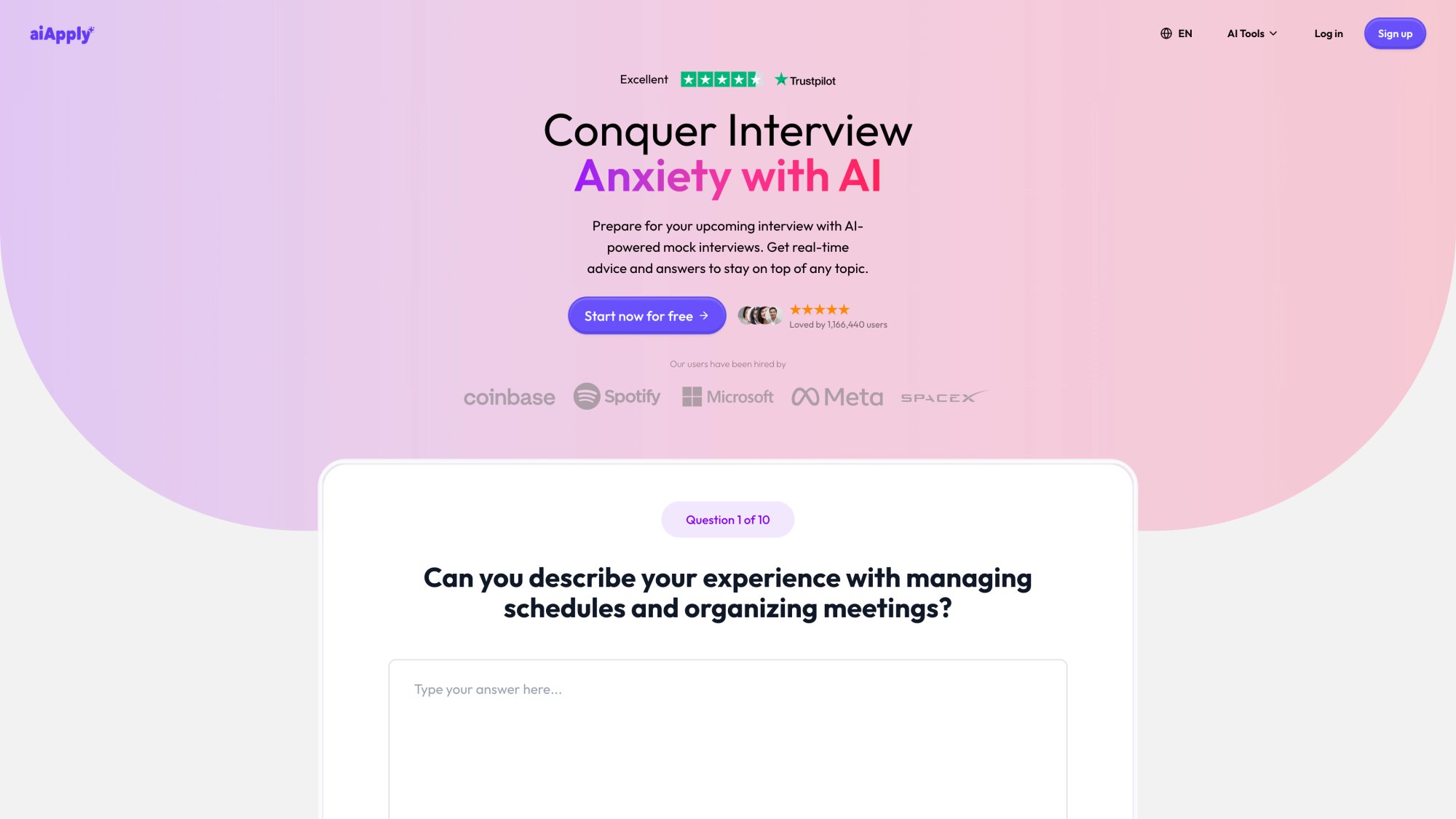
The AIApply Mock Interview Simulator — paste your job description, get tailored practice questions, and receive instant feedback. The "Question 1 of 10" UI shown here is what you'll use to rehearse answers like "Why do you want to work here?" before the real thing.
Our Interview Buddy takes it a step further: it provides real-time on-screen coaching during live video interviews on Zoom, Google Meet, and similar platforms. It listens to what's being asked and surfaces personalized suggestions based on your job description and background. Discreetly. Visible only to you.
And if you're still in the application phase, our Auto Apply tool handles the volume work so you can spend your prep time getting sharper on answers like this one.
The key rule when using any AI for interview prep: never claim a reason you can't defend with evidence. If it isn't actually true, a single follow-up question will expose it. AI is excellent for helping you find the right story and sharpen how you tell it. It can't invent a story worth telling.
A Quick Self-Check Before Your Interview
Before you walk in, run this quick checklist:
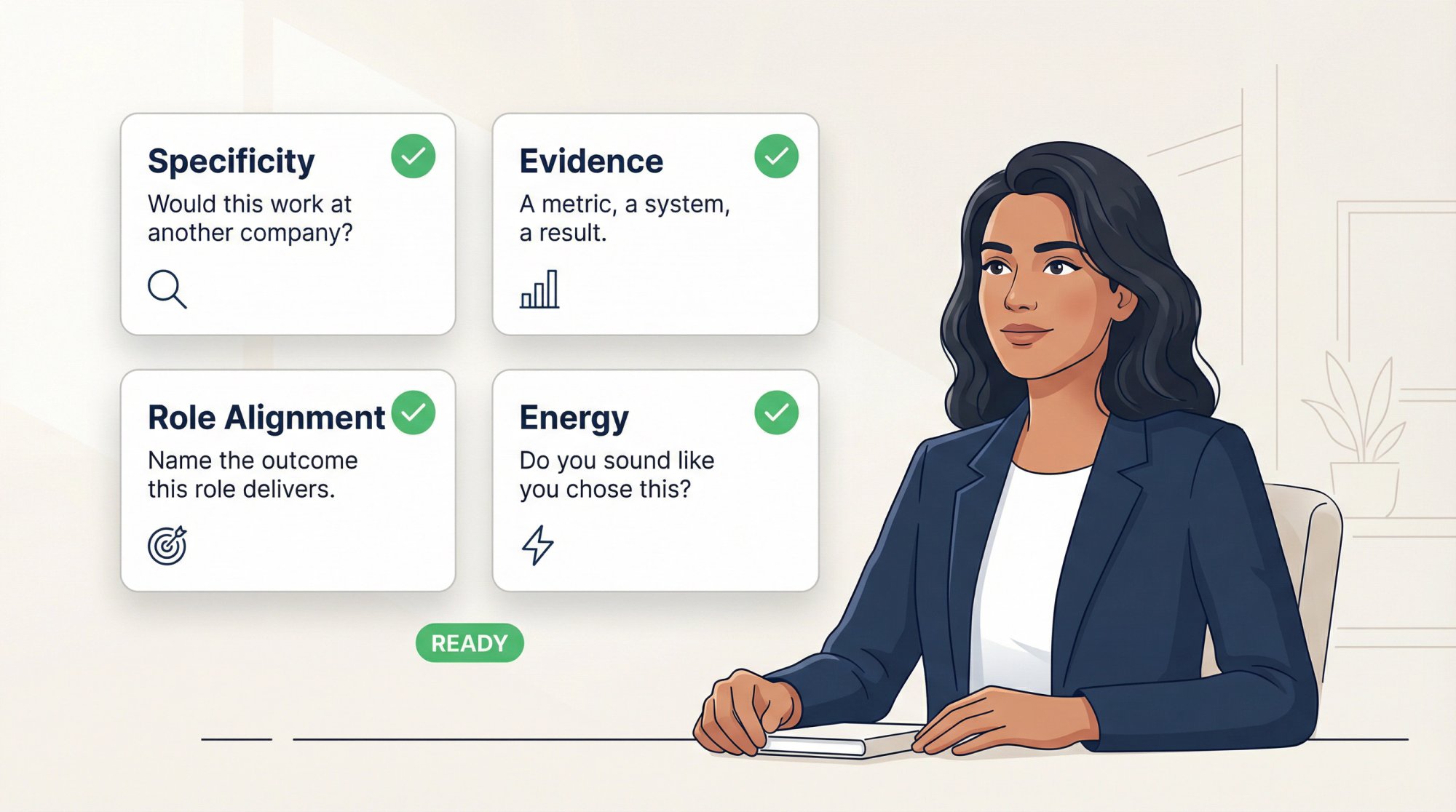
Specificity: If I swapped the company name in my answer, would it still work? If yes, it's too generic. Rework it.
Evidence: Have I included at least one concrete proof point? A metric, a system, a result?
Role alignment: Did I name the specific outcome this role is hired to deliver?
Energy: Do I sound like I genuinely chose this on purpose? Or does it sound obligatory?
If you can honestly tick all four, you're already ahead of the majority of candidates. Use our job interview cheat sheet as a broader pre-interview checklist alongside this self-check.
Advanced Tactics to Make Your Answer Stand Out
These aren't required. But they separate the good answers from the memorable ones.

Reference a real constraint. Most candidates talk about what's exciting. Try naming something hard: "I know scaling quality while increasing volume is genuinely difficult..." or "I'm aware this is a lean team, so priorities will need to be defended." It shows you've thought beyond the pitch.
Name a metric you'd care about. Even if you don't know their internal numbers, you can name the category. Activation rate. Retention. Time-to-value. Conversion rate. Support ticket volume. Interview-to-offer rate (useful if you're applying to an HR or recruiting product company). Naming the metric signals analytical thinking, and it's something most candidates skip entirely.
Make a tiny 30-day plan. One sentence is enough: "First I'd learn X, then I'd ship Y, then I'd measure Z." This reframes you from someone being evaluated to someone who's already planning how to add value.
End with a smart question. After your answer, ask something like: "What would make you say this hire was a clear win after 90 days?" It flips the dynamic. You're thinking like an owner, not a candidate hoping to pass a test. Our guide on killer questions to ask at the end of an interview has 10+ options ready to use, including exactly this type of performance-framing question. And for a broader set of thoughtful questions that signal genuine curiosity, our post on good questions to ask at an interview covers questions organized by category.
Frequently Asked Questions About "Why Do You Want to Work Here?"
What If You Don't Feel Passionate About the Company?
Don't fake passion. It almost always reads as hollow, and experienced interviewers notice.
You can build a strong, credible answer on professional interest instead. Respect for how a company executes on a hard problem is legitimate. Interest in the technical or strategic challenge of the role is legitimate. Excitement about the craft of the work itself, regardless of the industry, is legitimate.
Passion is optional. Clarity is not. If you can articulate why this role and this company make sense for your goals right now, that's sufficient.
Can You Mention Salary or Benefits in Your Answer?
Not in this specific answer. This question is about motivation and fit. If you lead with compensation, you signal that you'd take a better offer elsewhere immediately. That's the opposite of what interviewers want to hear here.
Save the compensation conversation for later in the process, when it's appropriate and expected. Lead with value first. If you're unsure how to approach salary discussions when they do come up, our guide on how to answer salary expectations walks through timing and framing in detail.
How Long Should Your Answer Be?
The right length depends on where you are in the process:
When in doubt, err on the shorter side. You can always be asked to expand. Getting cut off mid-story is harder to recover from.

What If You're Making a Career Change?
Use the career switch template above and lean into the transferable angle explicitly. Name the skill that crosses over, show where you've demonstrated it, and explain why this specific company is the right place to apply it in a new context.
The biggest mistake career changers make is apologizing for the gap. Don't. Own the unusual path and show why it gives you a different lens on the problem they're trying to solve. If you're navigating a larger transition, our guides on career change at 40 and the best jobs for career changers can help you identify which new directions are worth pursuing and how to position your experience for them.
What If You're Applying to Multiple Companies?
Good. That's exactly what you should have. One version for each company means you've done real research on each one. The framework stays the same; the specifics change. The moment your answers start sounding interchangeable, go back and do another 15 minutes of company-specific research.
Should You Memorize a Script for This Answer?
No. Practice the structure and the key facts (your proof point, the company detail you want to reference, your first-priority idea), and let the actual sentences form naturally.
A memorized script creates two problems: you sound robotic when you deliver it perfectly, and you freeze when the interviewer's phrasing is slightly different from what you rehearsed. Bullet points and genuine understanding are far more robust.
Can You Use AI to Help Write Your Interview Answer?
You can use AI as a preparation tool, but not as a ghostwriter for your in-person delivery.
Use AI to generate multiple angles, surface follow-up questions you hadn't considered, and identify where your logic gets thin. Then rewrite the answer in your own voice until you could defend every sentence of it. Our Mock Interview Simulator is specifically built for this kind of iterative practice. You get tailored questions based on the job description and instant feedback on your answers.
What you want to avoid is memorizing an AI-generated script without internalizing it. Hiring managers in 2026 are increasingly good at spotting answers that feel polished but hollow.
What Follow-Up Questions Should You Expect?
The most common follow-ups:
→ "Can you tell me more about [the specific thing you mentioned]?" (Be ready to go deeper on any proof point you cited.)
→ "What do you know about our competitors?" (Shows whether your research was surface-level.)
→ "Where do you see yourself in [X] years?" (Tests whether your stated motivation is connected to a longer arc.)
→ "Why are you leaving your current role?" (Closely related. Make sure your answers don't contradict each other.)
Prepare for these in advance. If you've used our Mock Interview Simulator, you've likely already practiced several of them. For a more complete picture of what to expect, our post on how to prepare for a behavioral interview covers the structured frameworks that underpin most follow-up questions. And for a primer on the related question that trips up many candidates, see our guide on how to answer "tell me about yourself".
Over 1.1 million job seekers use AIApply to prepare for applications and interviews. Our tools include an AI Resume Builder, AI Cover Letter Generator, Mock Interview Simulator, real-time Interview Buddy, and Auto Apply. If you're preparing for an upcoming interview, our AI Resume Scanner can also ensure your application materials are strong before you even walk into the room. Browse our resume examples and cover letter examples to strengthen your application from every angle.
If you've ever frozen on this question, it's not because you're bad at interviews.
It's because the question is secretly doing three jobs at once:
It tests whether you actually understand what the company does (beyond slogans).
It tests whether you want this role for reasons that will survive a rough week.
It tests whether you can translate motivation into impact (why you + why now).
Employers use this question to judge fit and whether what you want matches what the job actually offers. That's true, but it's only part of the picture.
In 2026, hiring managers also use it as an informal AI-detector test. Not to catch whether you used AI, but to catch whether your answer sounds like it came from the internet. Generic answers are the new red flag.
This guide shows you how to build an answer that is:
Specific (can't be copy-pasted to another company)
Balanced (why you want it + why they should want you)
Evidence-backed (not vibes)
Short (30 to 75 seconds, unless they invite more)
And because this is AIApply's blog, we'll also show you how to use AI tools to prepare ethically and effectively. Not to fake competence, but to actually get better at this. If you're still preparing for an interview more broadly, we have a complete guide for that too.
Why Interviewers Ask "Why Do You Want to Work Here?"
Hiring is a high-stakes bet under significant uncertainty.
A company can't directly observe three things about you in an interview: whether you'll do the work well once the honeymoon wears off, whether your motivation is durable, and whether you'll thrive in their specific environment (their pace, their constraints, their team dynamics). So they ask questions designed to produce signals.
"Why do you want to work here?" is one of the highest signal-to-noise questions in any interview. It reveals whether you did real research or just read a few headlines. It reveals whether your motivation is stable (mission, craft, growth in the role) or fragile (prestige, perks, "seems cool"). It reveals whether you understand the tradeoffs of the role. And it reveals whether you can connect your past to their future.
That last one matters more than most people realize.
A strong answer isn't flattery. It's a tiny business case:
"Here's why this company + this role is the best place for me to create value, and here's proof I can."
When you answer well, you're not just saying "I like you." You're saying "I've thought about this seriously, I understand what you're trying to accomplish, and I believe I can help."
The Biggest Mistake That Kills Most Answers
Most weak answers sound something like this:
"I love your culture. I'm excited about the growth opportunities here. I think I'd be a great fit because I'm hardworking and I align with your values."
Even if every word of that is true, it's useless. It's transferable to literally 10,000 other companies. A hiring manager who has heard it three times today hears only one thing: "I didn't pick you specifically. I picked a job."
The fix isn't complicated. Your answer needs two halves:
Pull: What specifically pulls you toward this company and this role (not just any company).
Proof: Why that pull maps to your demonstrated ability to deliver outcomes.
Most candidates only do Pull. The best candidates do Pull + Proof + a clear statement of what they'd focus on first.
The moment you add that third piece, your answer becomes almost impossible to copy-paste from a generic prep guide. The same specificity principle applies when crafting a strong interview elevator pitch. Depth always beats breadth.
The 3-Part Framework for Answering "Why Do You Want to Work Here?"
If you remember nothing else from this guide, remember this:
Company → What they do + why it matters + what's changing right now
Role → What the role exists to accomplish (not just the job description)
You → Your unfair advantage and proof you can deliver
Here's the fill-in template:
"I want to work at [Company] because [specific company reason tied to mission/product/strategy].
What excites me about this role is [the outcome the role owns], especially [specific responsibility or challenge].
I'm confident I can contribute because I've done [relevant proof], where I achieved [measurable result].
If I joined, in my first 30 to 60 days I'd focus on [1-2 concrete priorities]."
That last line (the 30-60 day plan) is optional. But it's one of the highest-impact upgrades you can make to any answer. It signals that you've thought beyond the interview itself and you're already thinking like someone who's been hired.
How to Build Your "Why Do You Want to Work Here?" Answer
Step 1: Research What the Company Is Really Doing
Your company thesis is your best guess at what the company is really doing. Not their marketing copy. The actual business logic.
Think about it across four dimensions:
→ Who they serve
→ What pain they solve
→ Why they win against alternatives
→ What matters to them right now (not two years ago)
The format that works well: "[Company] helps [customer] achieve [outcome] by [how they do it], and they're currently focused on [growth initiative/constraint/shift]."
For example, if you were applying to AIApply, a useful company thesis might sound like: "AIApply helps job seekers move from application to interview faster by combining tailored resumes and cover letters, automated applications, and real-time interview coaching into one connected workflow. At 1.1 million+ users, retention and interview success are the next major levers."
Those details matter because they force you to say something specific. You can't point to a running counter of 372,241+ roles applied to via the platform and then give a vague answer about innovation. Specificity anchors your interest in reality.
AIApply's homepage — the kind of concrete detail that turns a generic answer into a credible one. Note the Trustpilot "Excellent" badge, the user count, and the product cards. Research like this is what separates candidates who know a company from those who only know about it.
Step 2: Find the Real Business Goal Behind the Job
Every role is hired to reduce a specific pain. The job description is a proxy. It tells you what someone will do, not necessarily why the company is desperate for it.
Ask yourself: what breaks if this role stays unfilled for 90 days? What outcome will the hiring manager be judged on? What would "great" look like six months in?
If you're not sure, use the job description like a detective. Repeated verbs tell you what they actually need: ship, grow, reduce, fix, automate, unblock. Repeated nouns tell you what they care about: activation, retention, pipeline, latency, conversions.
When you understand the business goal behind the role, you can address it directly in your answer. That's far more powerful than describing responsibilities back to them. For a deeper look at decoding what hiring managers actually want, see our guide on how to succeed in a job interview.
Step 3: Choose 1-2 Specific Reasons and Go Deep
Quantity isn't credibility. Depth is.
A reliable rule: 2 reasons max inside the answer, then support with proof. This is exactly why so many "example answers" you find online feel weak: they list six reasons and prove none of them.
One strong reason with a concrete story beats four vague ones every time. Trust that.
Step 4: Add Concrete Evidence to Back Up Your Answer
Proof doesn't have to be a dramatic achievement. It just has to be specific enough to be checkable.
Good proof can be:
A metric you moved (increased activation by 18%, cut support tickets by 30%)
A system you built (automated a process that used to take 4 hours per week)
A process you improved (redesigned an onboarding flow that raised completion from 40% to 70%)
A customer problem you solved (rebuilt a client's pipeline from scratch after it broke)
A hard thing you learned fast (picked up Salesforce in three weeks to ship on a deadline)
If you can't attach evidence, it's not a reason. It's a vibe. And vibes don't survive follow-up questions. This is also why behavioral interview preparation matters so much. Your proof points are exactly what behavioral questions are designed to draw out.
Step 5: Practice Without Memorizing a Script
Scripting is fragile. You'll sound wooden, and the moment the interviewer asks a slight variation, you'll freeze.
Your goal is to sound prepared, not rehearsed. Bullet points give you the structure without locking you into specific words. Know your three-part framework, know your proof, and let the actual sentences form naturally in the room.
The 15-Minute Company Research Plan Before Any Interview
Most people "research" a company by reading the About page and maybe scrolling LinkedIn for five minutes. That's the bare minimum, and hiring managers can tell.
Here's a better 15-minute research sprint you can run before any interview:
For many companies, even this basic due diligence is surprisingly revealing. Take AIApply as a concrete example. Companies House shows AIAPPLY LIMITED (company number 15200716) is an active UK company incorporated in October 2023. The company's investors list it as a 2024 investment using AI to streamline the discovery, preparation, and application phases of job hunting. And founder interviews name Aidan Cramer and Peter Utekal as co-founders and discuss early traction.
You don't need all of that for every interview. But pulling even one or two concrete facts from real sources instantly elevates your answer from "I read your website" to "I understand your business." Our full guide on how to research a company before an interview walks you through every source worth checking, from company registries to product changelogs.
What Most Candidates Get Wrong About This Question
The standard advice isn't wrong. Research the company. Mention mission and values. Tie it back to your skills. The consensus guidance emphasizes linking a company's mission to your personal plan and showing genuine enthusiasm for where they're headed. Standard interview wisdom focuses on alignment and fit.
All of that still applies. What many guides miss is the specific stuff that makes answers genuinely memorable in 2026.
The insight most candidates skip: It's not enough to know what a company does. The candidates who stand out know what's happening at the company right now.
The "why now" signal. Companies change. Markets evolve. Products shift. If you can name what's happening at this company right now, your answer sounds real instead of researched-in-a-vacuum. Even something simple works here: "You're expanding into X..." or "You've proven demand, and now distribution is the next challenge..." That single line separates you from every candidate who only talked about the company's mission statement.
The tradeoff sentence. This is the sentence most candidates skip. It proves you understand reality: "I'm excited about a lean team because I like owning outcomes end-to-end" or "I know this role is heavy on stakeholder work, and I'm actually good at translating ambiguity into decisions." Naming a constraint and saying you accept it signals maturity. It also makes your answer much harder to fake.
One concrete first contribution. Not a full strategy deck. Not "I'd need to learn more first." Just a credible first step. "In my first 30 days I'd focus on [X] so we can establish [baseline metric]" is enough. It shows you've thought beyond the interview.
"Why Do You Want to Work Here?" Answer Templates
These are starting points. The structure is sound; your specifics are what make them land.
The 30-Second Version (for Phone Screens)
"I'm interested in [Company] because [specific reason tied to product/mission/market move]. I like this role because it's focused on [outcome], and that's where I've had my best results. In my last role, I [proof], which led to [result]. I'd love to bring that same approach here."
The 60-75 Second Version (Most Common Format)
"I want to work at [Company] because [specific company thesis] and I'm especially interested in [current initiative or shift].
This role stands out because it's responsible for [outcome] and the problem you're solving is [hard thing].
I've done something similar at [company or project] where I [action], resulting in [metric].
If I joined, my first focus would be [priority 1] and [priority 2], so I can make an impact quickly."
The Career Changer Version
"I'm moving into [new field] because [reason grounded in skills or values], and [Company] is one of the few places where that switch actually makes sense because [specific overlap between your past and their need].
The role is a fit because [transferable skill] is central to it, and I've proved that through [proof].
What I'm excited about specifically is [company-specific detail], and I'd plan to ramp fast by [how]."
The Early-Stage Startup Version
"I want to work here because you're building [thing] for [customer pain] and you've already shown real demand. I'm drawn to early-stage teams where speed and ownership matter.
In this role, the goal seems to be [outcome], and that's exactly the kind of work I do best.
For example, I [proof], which led to [result]. I'd love to bring that builder mindset here."
"Why Do You Want to Work Here?" Example Answers
Example 1: The Weak Answer (What Not to Do)
"I want to work here because I love your culture and I'm excited about growth opportunities. I think I'd be a great fit because I'm hardworking and dedicated."
What's wrong: Nothing specific, no proof, and it could apply to thousands of companies. A hiring manager who has heard three of these back-to-back starts tuning out.
Example 2: The Strong Answer (Specific + Proof)
"I'm excited about this company because you're solving [specific customer pain] in a space where speed and clarity matter, and you've clearly built real momentum in it.
What I like about this role is that it owns [outcome], not just tasks. That's how I like to work.
In my last role, I [did the specific thing], which improved [metric] by [measurable number].
If I joined, I'd start by mapping the top bottleneck in [process] and shipping one improvement that moves [metric] within the first month."
What works: Specific, proof-backed, role-aligned, and ends with a concrete first action.
Example 3: A Tailored Answer for a Specific Company
(Useful even if you're not applying to AIApply specifically. It shows you how to adapt the framework to any company.)
"I'm drawn to AIApply because it's not just a resume builder. It's an end-to-end job search workflow: tailored documents, automated applications, and interview prep in one place. That's genuinely hard to build well, and the traction shows it's working.
I'm excited about this role because it focuses on [outcome], and that's the lever that makes the whole funnel work better.
I've worked on [relevant area] before, where I [action], and we saw [measurable result].
In my first 30 days, I'd focus on [one funnel metric or user pain] and ship [one concrete improvement] to reduce friction quickly."
AIApply's product pages emphasize exactly that full-pipeline approach: resume and cover letter tools, the Auto Apply feature for scaling applications, and interview prep that includes both practice sessions and real-time coaching during live interviews.
How to Use AI to Prepare for This Question
The market has shifted noticeably. More candidates are using AI to draft interview answers. And more hiring managers are getting good at recognizing AI-shaped phrasing instantly.
The best use of AI isn't "generate a perfect script and memorize it." That approach tends to fall apart under follow-up questions, because you're defending something you didn't actually think through.
A smarter approach:
① Generate options. Use AI to brainstorm three different angles for your "why here" answer. Then pick the one that's actually true for you.
② Stress test your logic. Paste your draft answer and ask: "What follow-up questions would a skeptical hiring manager ask?" Then answer those too.
③ Find your weak points. Where does your answer get vague? Where do you say something you can't fully back up?
④ Practice until it's yours. Read it out loud until it sounds like you talking, not like you reciting.
There's a reason smart candidates use AI differently for interview prep. The goal is to become more fluent in your own story, not to outsource it entirely.
At AIApply, our Mock Interview Simulator is built for exactly this kind of preparation. You paste a job description, and our GPT-4 powered AI generates interview questions tailored to that specific role. You answer them, and you get immediate, practical feedback. You can run through a complete mock session in 15 to 30 minutes. That's more focused practice than most candidates get before walking into a room.
The AIApply Mock Interview Simulator — paste your job description, get tailored practice questions, and receive instant feedback. The "Question 1 of 10" UI shown here is what you'll use to rehearse answers like "Why do you want to work here?" before the real thing.
Our Interview Buddy takes it a step further: it provides real-time on-screen coaching during live video interviews on Zoom, Google Meet, and similar platforms. It listens to what's being asked and surfaces personalized suggestions based on your job description and background. Discreetly. Visible only to you.
And if you're still in the application phase, our Auto Apply tool handles the volume work so you can spend your prep time getting sharper on answers like this one.
The key rule when using any AI for interview prep: never claim a reason you can't defend with evidence. If it isn't actually true, a single follow-up question will expose it. AI is excellent for helping you find the right story and sharpen how you tell it. It can't invent a story worth telling.
A Quick Self-Check Before Your Interview
Before you walk in, run this quick checklist:
Specificity: If I swapped the company name in my answer, would it still work? If yes, it's too generic. Rework it.
Evidence: Have I included at least one concrete proof point? A metric, a system, a result?
Role alignment: Did I name the specific outcome this role is hired to deliver?
Energy: Do I sound like I genuinely chose this on purpose? Or does it sound obligatory?
If you can honestly tick all four, you're already ahead of the majority of candidates. Use our job interview cheat sheet as a broader pre-interview checklist alongside this self-check.
Advanced Tactics to Make Your Answer Stand Out
These aren't required. But they separate the good answers from the memorable ones.
Reference a real constraint. Most candidates talk about what's exciting. Try naming something hard: "I know scaling quality while increasing volume is genuinely difficult..." or "I'm aware this is a lean team, so priorities will need to be defended." It shows you've thought beyond the pitch.
Name a metric you'd care about. Even if you don't know their internal numbers, you can name the category. Activation rate. Retention. Time-to-value. Conversion rate. Support ticket volume. Interview-to-offer rate (useful if you're applying to an HR or recruiting product company). Naming the metric signals analytical thinking, and it's something most candidates skip entirely.
Make a tiny 30-day plan. One sentence is enough: "First I'd learn X, then I'd ship Y, then I'd measure Z." This reframes you from someone being evaluated to someone who's already planning how to add value.
End with a smart question. After your answer, ask something like: "What would make you say this hire was a clear win after 90 days?" It flips the dynamic. You're thinking like an owner, not a candidate hoping to pass a test. Our guide on killer questions to ask at the end of an interview has 10+ options ready to use, including exactly this type of performance-framing question. And for a broader set of thoughtful questions that signal genuine curiosity, our post on good questions to ask at an interview covers questions organized by category.
Frequently Asked Questions About "Why Do You Want to Work Here?"
What If You Don't Feel Passionate About the Company?
Don't fake passion. It almost always reads as hollow, and experienced interviewers notice.
You can build a strong, credible answer on professional interest instead. Respect for how a company executes on a hard problem is legitimate. Interest in the technical or strategic challenge of the role is legitimate. Excitement about the craft of the work itself, regardless of the industry, is legitimate.
Passion is optional. Clarity is not. If you can articulate why this role and this company make sense for your goals right now, that's sufficient.
Can You Mention Salary or Benefits in Your Answer?
Not in this specific answer. This question is about motivation and fit. If you lead with compensation, you signal that you'd take a better offer elsewhere immediately. That's the opposite of what interviewers want to hear here.
Save the compensation conversation for later in the process, when it's appropriate and expected. Lead with value first. If you're unsure how to approach salary discussions when they do come up, our guide on how to answer salary expectations walks through timing and framing in detail.
How Long Should Your Answer Be?
The right length depends on where you are in the process:
When in doubt, err on the shorter side. You can always be asked to expand. Getting cut off mid-story is harder to recover from.
What If You're Making a Career Change?
Use the career switch template above and lean into the transferable angle explicitly. Name the skill that crosses over, show where you've demonstrated it, and explain why this specific company is the right place to apply it in a new context.
The biggest mistake career changers make is apologizing for the gap. Don't. Own the unusual path and show why it gives you a different lens on the problem they're trying to solve. If you're navigating a larger transition, our guides on career change at 40 and the best jobs for career changers can help you identify which new directions are worth pursuing and how to position your experience for them.
What If You're Applying to Multiple Companies?
Good. That's exactly what you should have. One version for each company means you've done real research on each one. The framework stays the same; the specifics change. The moment your answers start sounding interchangeable, go back and do another 15 minutes of company-specific research.
Should You Memorize a Script for This Answer?
No. Practice the structure and the key facts (your proof point, the company detail you want to reference, your first-priority idea), and let the actual sentences form naturally.
A memorized script creates two problems: you sound robotic when you deliver it perfectly, and you freeze when the interviewer's phrasing is slightly different from what you rehearsed. Bullet points and genuine understanding are far more robust.
Can You Use AI to Help Write Your Interview Answer?
You can use AI as a preparation tool, but not as a ghostwriter for your in-person delivery.
Use AI to generate multiple angles, surface follow-up questions you hadn't considered, and identify where your logic gets thin. Then rewrite the answer in your own voice until you could defend every sentence of it. Our Mock Interview Simulator is specifically built for this kind of iterative practice. You get tailored questions based on the job description and instant feedback on your answers.
What you want to avoid is memorizing an AI-generated script without internalizing it. Hiring managers in 2026 are increasingly good at spotting answers that feel polished but hollow.
What Follow-Up Questions Should You Expect?
The most common follow-ups:
→ "Can you tell me more about [the specific thing you mentioned]?" (Be ready to go deeper on any proof point you cited.)
→ "What do you know about our competitors?" (Shows whether your research was surface-level.)
→ "Where do you see yourself in [X] years?" (Tests whether your stated motivation is connected to a longer arc.)
→ "Why are you leaving your current role?" (Closely related. Make sure your answers don't contradict each other.)
Prepare for these in advance. If you've used our Mock Interview Simulator, you've likely already practiced several of them. For a more complete picture of what to expect, our post on how to prepare for a behavioral interview covers the structured frameworks that underpin most follow-up questions. And for a primer on the related question that trips up many candidates, see our guide on how to answer "tell me about yourself".
Over 1.1 million job seekers use AIApply to prepare for applications and interviews. Our tools include an AI Resume Builder, AI Cover Letter Generator, Mock Interview Simulator, real-time Interview Buddy, and Auto Apply. If you're preparing for an upcoming interview, our AI Resume Scanner can also ensure your application materials are strong before you even walk into the room. Browse our resume examples and cover letter examples to strengthen your application from every angle.
.webp)
%20(1).webp)
.webp)
Don't miss out on
your next opportunity.
Create and send applications in seconds, not hours.


