
How to Write a Letter of Recommendation (+Templates 2026)

%20(1).webp)
A letter of recommendation solves one problem: uncertainty.
An applicant can describe their own skills all day long. A recommender provides something different. They provide third-party evidence. And the person reading that letter isn't really asking, "Do you like this person?" They're asking something more specific: Have you actually seen this person perform, and should I trust your judgment?
That distinction changes everything about how you write one.
Great recommendation letters aren't second resumes. They aren't lists of adjectives or feel-good platitudes. According to guidance from Stanford's Humanities & Sciences, strong letters come from people who know the candidate well, add information the application doesn't already show, and support every claim with concrete, tailored examples.
Before you write anything, though, check whether a letter is even what's being asked for. In hiring, people say "reference" and "recommendation letter" like they're interchangeable, but they're often not. Many employers want a list of references they can call later, not a pre-written letter. In the UK, employers may provide either a basic or detailed reference, and they generally aren't required to provide one unless there's a specific obligation.
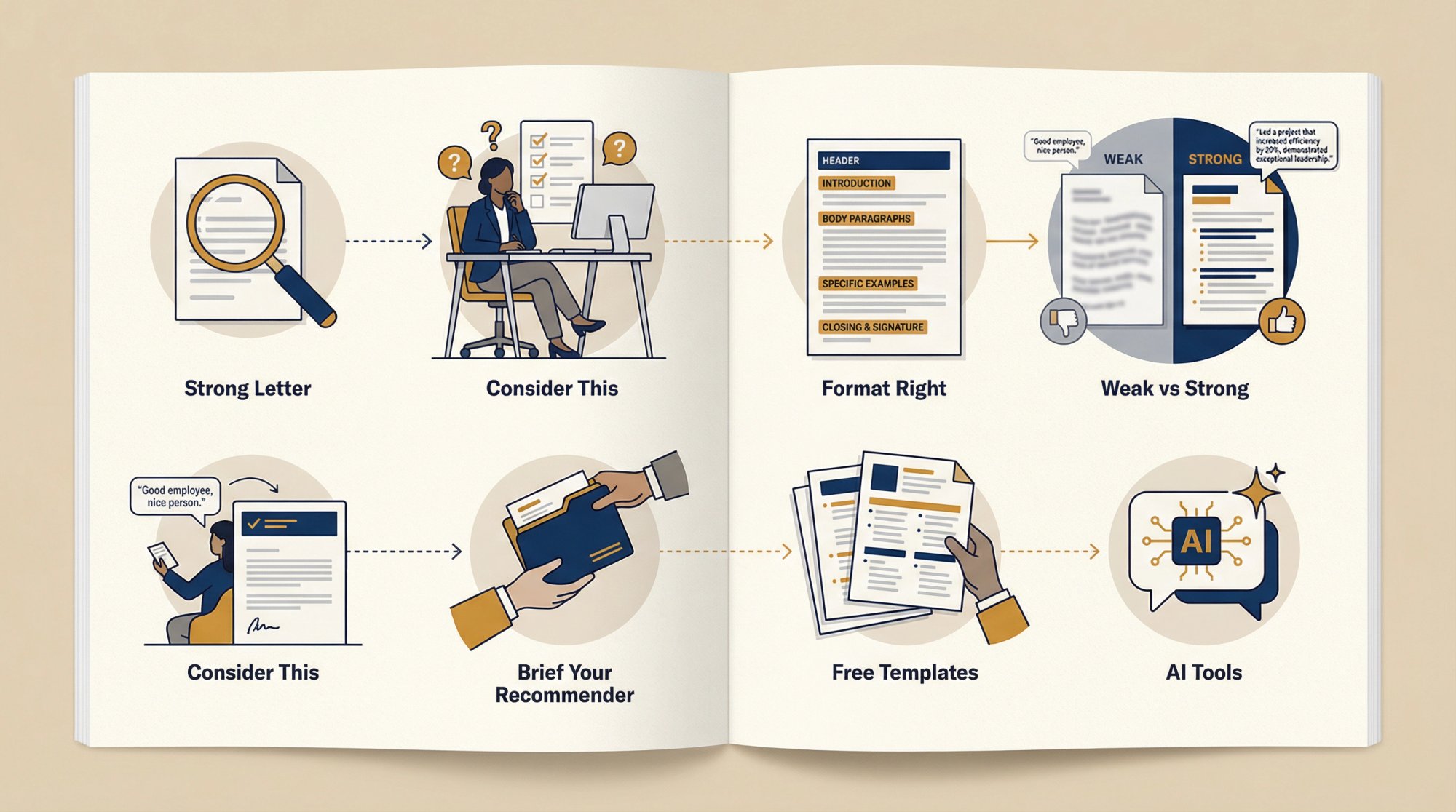
This guide walks you through exactly how to write a strong recommendation letter, what to ask for before you start, what mistakes to avoid, and includes free copy-paste templates for jobs, grad school, scholarships, character references, and recommendation requests.

Quick Navigation
What Makes a Strong Letter of Recommendation
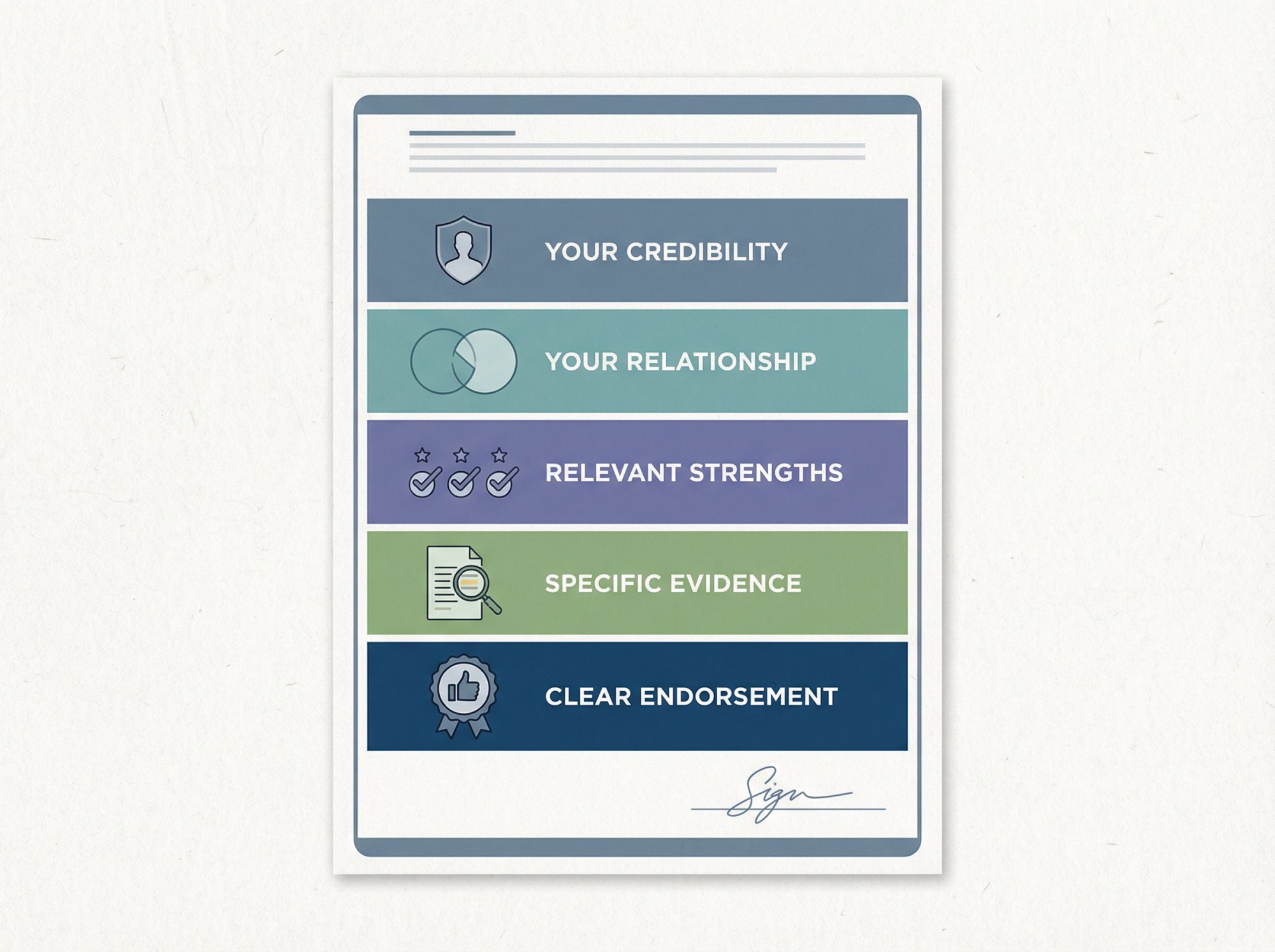
A strong letter accomplishes five things, and it does them quickly:
It explains who you are and why your opinion matters.
It shows how you know the candidate, and for how long.
It isolates two or three strengths that are directly relevant to this opportunity.
It proves those strengths with specific examples.
It ends with a clear, unambiguous endorsement.
That structure is consistent across university and career-center guidance. UChicago's career office recommends a concise opening that defines your relationship and the candidate's key strengths, body paragraphs with examples and anecdotes, and a closing that clearly restates your support. Iowa and Santa Clara similarly emphasize evidence, context, and honest comparison to a reference group when that comparison is credible.
Keep it tight. For a normal free-form letter, one page is usually the sweet spot unless the application says otherwise. Some programs don't use a standard letter at all. Many business schools, for example, use GMAC's Common Letter of Recommendation, which combines ratings and required narrative questions instead of giving you a blank page.
The blind spot most people miss: A vague positive letter is not neutral. It can actively hurt the applicant. Stanford, Yale, UNC, and Berkeley all warn, in slightly different ways, that superficial, sparse, or lukewarm letters weaken an application. If you can't be specific and clearly supportive, it's better to decline early.
What to Consider Before Writing a Recommendation Letter
Writing a recommendation letter is a real commitment. Work through these questions honestly before you say yes. They're not just formalities.

Can You Write a Strong Letter?
Don't just ask yourself, "Can I write a letter?" Ask, "Can I write a strong one?" Stanford explicitly advises applicants to ask recommenders whether they can write a strong letter, and multiple university guides say it's better to decline than to submit a thin or hesitant endorsement.
Are You the Right Recommender?
Specificity beats status every time. A famous professor, senior executive, or high-ranking manager who barely knows the candidate is often weaker than a direct supervisor, research mentor, or instructor with firsthand evidence. Cornell and Stanford both stress that the best recommender is the person who knows the applicant's relevant work well, not the person with the biggest title.
Do You Understand What the Letter Is For?
A job, a graduate program, a scholarship, and a character reference are not the same thing. UChicago notes that employers and graduate programs often care about skills, qualifications, professionalism, and soft skills. Scholarship guidance from Syracuse stresses alignment to the mission and criteria of the award itself.
Do You Have Enough Time to Write a Good Letter?
Common App's current guidance advises students to ask before sending recommender invites and to give recommenders at least three weeks when possible. Yale similarly warns recommenders not to accept if they're being asked too close to the deadline to do the job well.
Have You Gotten the Background Materials?
Before you draft, ask for: the job description or program page, a resume or CV, a personal statement or cover letter if relevant, the submission instructions, the deadline, and any specific prompt or rubric the letter is supposed to address. UChicago recommends many of these materials directly. Common App encourages students to prepare a brag sheet so letters can be more personal and effective, and Stanford advises applicants to supply program details, a summary of strengths, and supporting materials.
Will Your Letter Stay Legally Clean and Unbiased?
Focus on observed performance, conduct, and potential. Avoid protected or irrelevant personal details. Berkeley specifically warns against including race, religion, age, disability, marital status, appearance, and similar details. Acas notes that employment references should not include certain absence information related to disability or family-related leave rights.
What to Give Your Recommender Before They Start Writing
The best letters usually come from the best input. If you're the one writing, ask the candidate for a simple support packet before you start. If you're the candidate, prepare this proactively so your recommender doesn't have to chase you for details.
That packet should include:
The exact role, program, or scholarship they're applying to
The deadline and submission link
A resume or CV
A personal statement or cover letter, if relevant
Any transcript, work sample, or project summary that helps
A short "brag sheet" with 2 or 3 strengths and concrete examples
Anything the application explicitly asks the recommender to address
That checklist lines up closely with current guidance from UChicago, Common App, and Stanford.

A simple one-page brief works beautifully. Here's a format you can send directly to the candidate (or fill in yourself if you're the one requesting):
Recommendation BriefCandidate:Opportunity:Deadline / submission link:How we know each other:Top 3 strengths to emphasize:2 proof points or stories:Any criteria from the job/program/scholarship:Attached materials:For job applications specifically, the packet is much stronger when the candidate sends a clean, tailored resume and cover letter. AIApply's AI Resume Builder and AI Cover Letter Generator can help candidates assemble polished materials before the request ever reaches the recommender. Running your resume through AIApply's AI Resume Scanner first ensures it's ATS-optimized and keyword-matched to the role before you share it with your reference.
How to Format and Structure a Recommendation Letter
You've agreed to write the letter, and you have the candidate's materials in hand. Now you need to actually write the thing. Here's the structure that consistently produces strong, credible letters.
Use a Professional Format
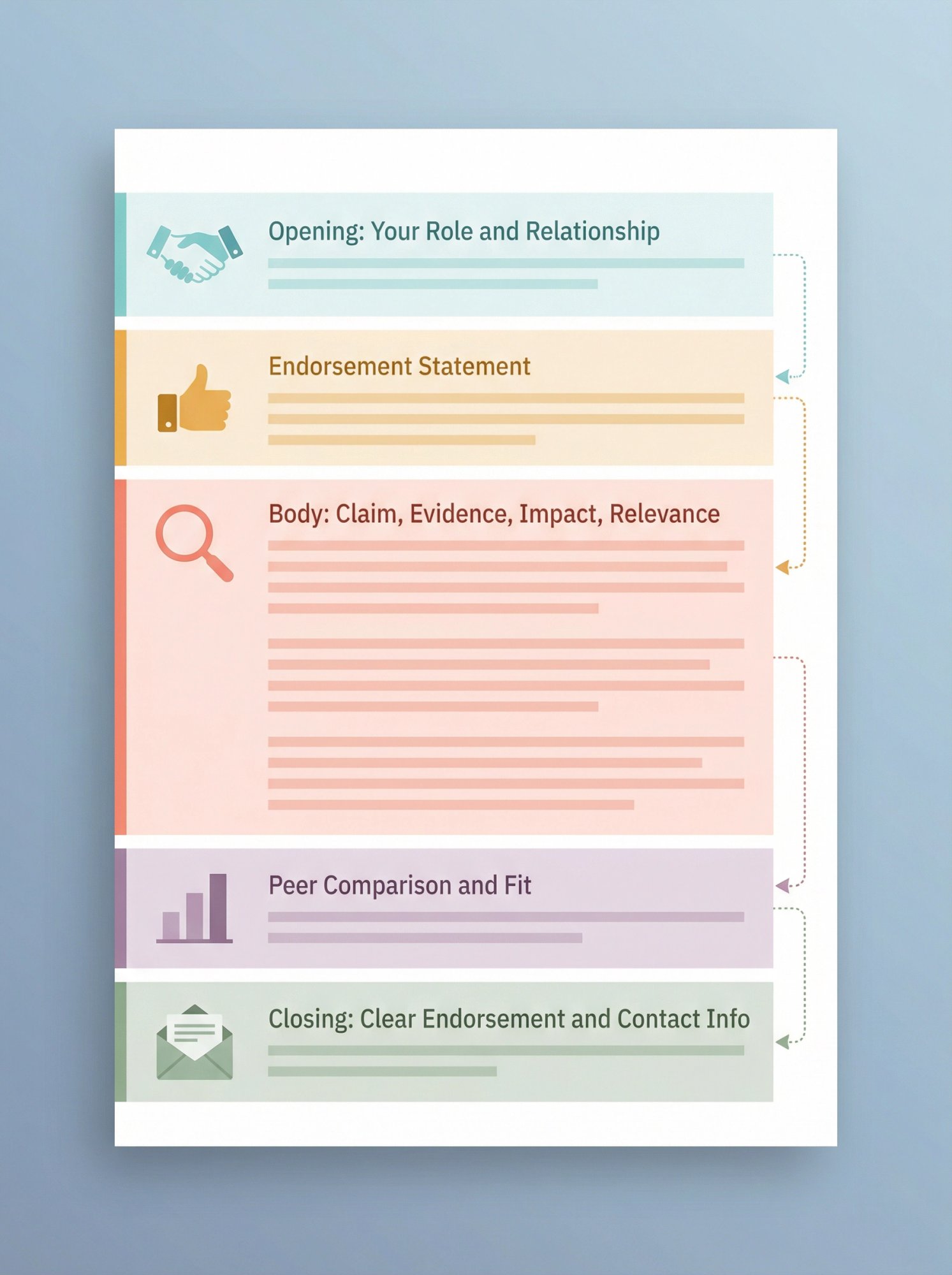
For formal academic or employment recommendations, use letterhead if appropriate, include the date, address the reader by name when possible, and include your contact information. UChicago recommends saving as PDF unless the application says otherwise. Berkeley and UW Bothell both emphasize professional formatting, signature, and contact details.
Start With Your Relationship and a Clear Endorsement
Your opening paragraph should answer four questions fast:
Who are you?
What is your role?
How do you know the candidate?
How strongly do you recommend them?
Here's what a strong opening looks like:
I am pleased to recommend [Candidate Name] for [role/program]. I am [Your Name], [Title] at [Organization], and I have known [Candidate] for [length of time] as [context]. During that time, I have been consistently impressed by [2 to 3 relevant strengths].
That kind of opening matches current guidance from UChicago and Santa Clara, which both emphasize identifying your relationship to the candidate, the length of that relationship, and your initial assessment.
Use the Body to Prove Your Claims
This is where most letters fail. They praise instead of proving.
The strongest mental model is:
Claim → Evidence → Impact → Relevance
Here's what that looks like in practice:
| Step | Example |
|---|---|
| Claim | Maya is unusually dependable under pressure. |
| Evidence | During our busiest quarter, she took over onboarding after two teammates left unexpectedly. |
| Impact | She reorganized the checklist, reduced setup errors, and kept all client deadlines on track. |
| Relevance | That is exactly the kind of operational ownership this role requires. |
That logic tracks closely with Iowa's advice to explain why a trait is real instead of just asserting it, and with UChicago's guidance to use examples and anecdotes.
How to Use Peer Comparison Effectively
Peer comparison can make a letter significantly stronger when it's honest and grounded. A line like "Among the 60 analysts I have supervised, Jordan ranks in the top 10% for initiative and follow-through" tells the reader far more than "Jordan is excellent."
UChicago, Iowa, Santa Clara, and GMAC all point recommenders toward some version of comparison or benchmarking when they can do it credibly.
Tie the Letter to the Specific Opportunity
This matters more than most people realize. Scholarship and fellowship guidance from Syracuse repeatedly emphasizes fit to the mission of the award. A glowing general letter can still be weak if the scholarship values service and your letter only talks about grades, or if the job needs cross-functional communication and your letter only talks about raw output.
Think about what the reader needs to hear, not just what you want to say.
How to Close With a Clear Endorsement
End with a direct endorsement and an invitation to contact you for more information.
Strong closing examples:
"I recommend [Name] enthusiastically and without reservation."
"I am confident [Name] will make a meaningful contribution to your program."
"I would gladly hire [Name] again."
Then include your name, title, organization, email, and phone number if appropriate.
Weak vs. Strong Recommendation Letter Wording (With Examples)
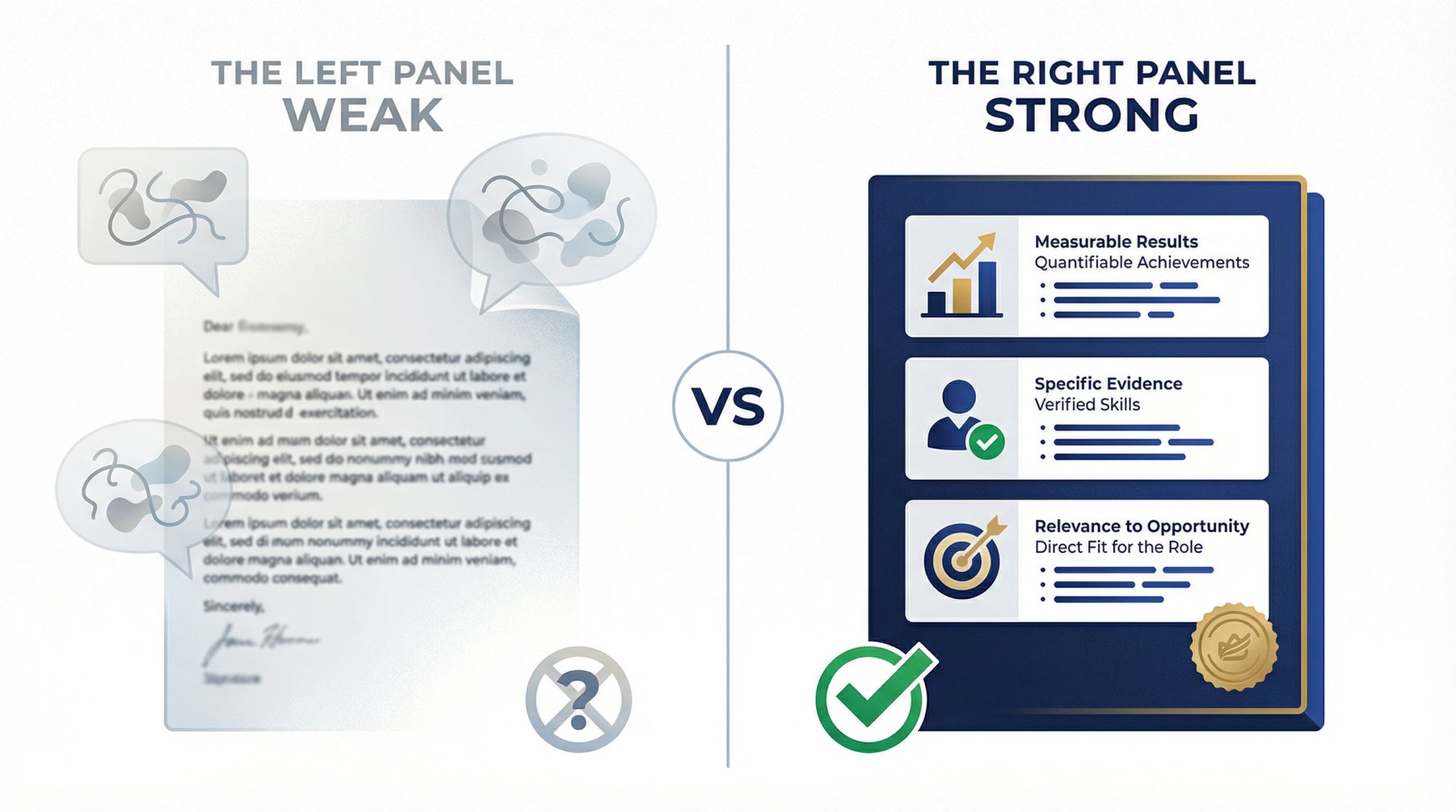
This is the single biggest difference between a recommendation letter that helps and one that wastes everyone's time. Look at the difference:
| Weak | Strong |
|---|---|
| "Nina is hardworking and responsible." | "When a supplier mistake threatened our launch timeline, Nina rebuilt the delivery plan across three vendors and kept the launch on schedule without raising budget." |
| "Marcus is one of my best students." | "In 11 years of teaching upper-level economics, Marcus ranks among the top 10% of students I have taught for analytical writing and research independence." |
| "Aisha is a leader." | "When her tutoring program began losing volunteers mid-semester, Aisha designed a peer-mentor rotation that stabilized coverage and improved volunteer retention." |
| "Omar would be a good fit." | "Because this scholarship prioritizes service and initiative, Omar's work organizing weekend delivery routes for homebound seniors is directly relevant." |
The difference is simple: the strong version gives the reader something they can believe. Weak letters assert. Strong letters prove.
Free Letter of Recommendation Templates
Below are seven templates covering the most common scenarios. Each one is ready to customize. Copy what you need, replace the bracketed fields with real information, and personalize with your own examples and voice.
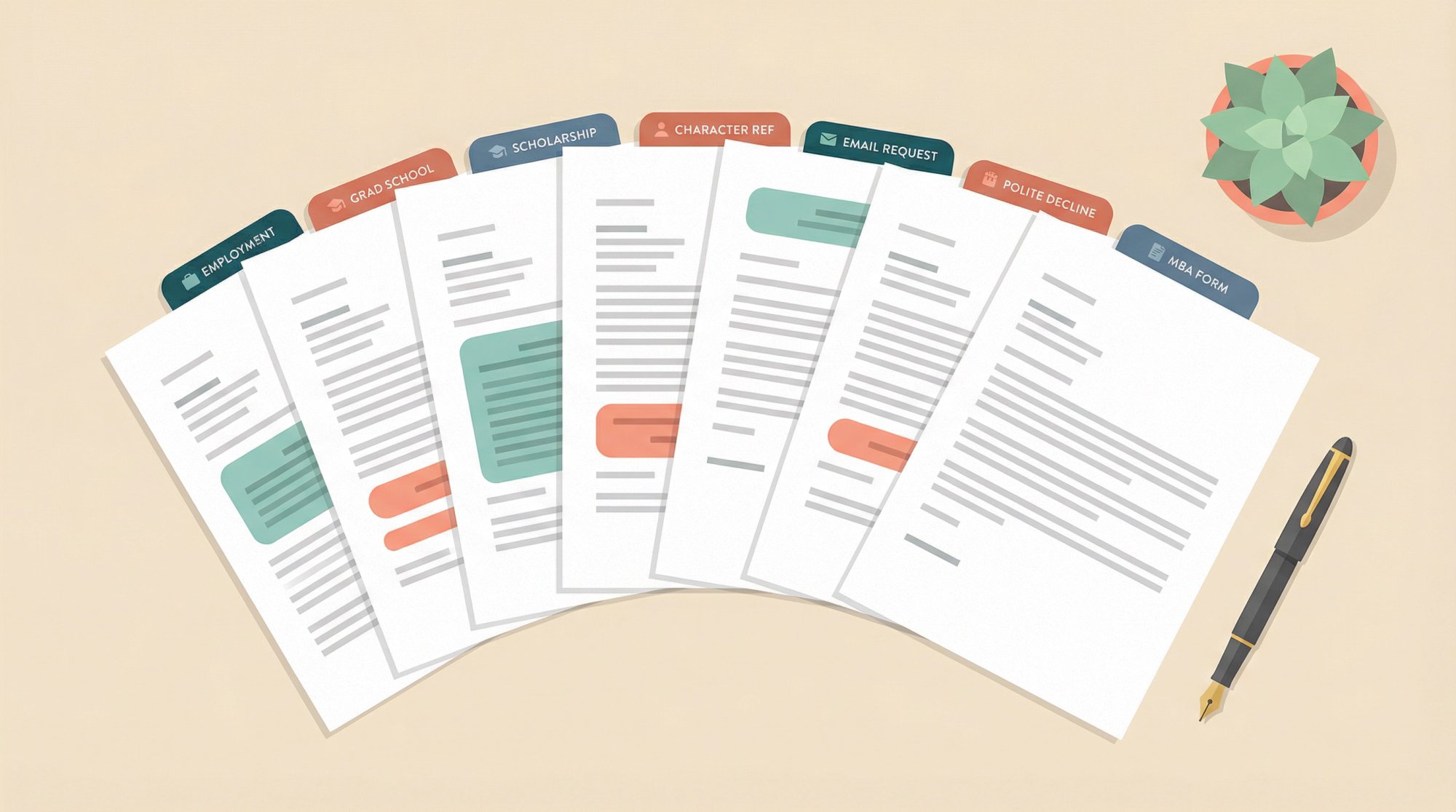
Template 1: Recommendation Letter for an Employee or Job Candidate
For employment letters, focus on results, reliability, professionalism, collaboration, and the specific skills required for the target role. Career offices also recommend including examples and, where appropriate, honest comparison to peers. If you're writing on behalf of a marketing manager or software engineer, review the role's typical skill requirements before you draft so your letter speaks directly to what hiring teams look for.
[Date][Recipient Name][Recipient Title][Company/Organization][Address]Dear [Recipient Name or Hiring Manager],I am pleased to recommend [Candidate Name] for the [Role] position at[Company]. I am [Your Name], [Your Title] at [Organization], and I workedwith [Candidate] for [length of time] as [relationship].During that time, [Candidate] consistently stood out for [strength 1],[strength 2], and [strength 3]. What impressed me most was [brief overallassessment].One example of [strength 1] came when [specific situation]. [Candidate][specific action]. As a result, [observable outcome, metric, or impact].That experience showed me that [Candidate] can [relevant job demand].[Candidate] also demonstrated [strength 2] when [second example]. Iespecially valued this because [why it mattered to the team, client, orproject]. [Optional peer comparison: Among the [number] employees I havesupervised, [Candidate] ranks in the top [x%] for [trait], if truthful.]Beyond results, [Candidate] is [relevant professional qualities such ascoachable, dependable, collaborative, calm under pressure]. I would beconfident placing [Candidate] in a role that requires [relevantresponsibilities], and I believe [Candidate] would contribute quickly at[Company].I recommend [Candidate] enthusiastically and without reservation. Pleasefeel free to contact me at [email] or [phone] if I can provide anyadditional information.Sincerely,[Your Name][Title][Organization]Template 2: Recommendation Letter for Graduate School or Academic Programs
For academic letters, focus on intellectual ability, writing or research strength, independence, curiosity, discussion quality, and readiness for advanced study. Stanford and Cornell both emphasize choosing recommenders who can speak to real academic or research performance rather than just repeating grades.
If the candidate is applying to research-focused programs, look at what skills a research assistant or research scientist role typically demands. It helps frame which strengths to emphasize in your letter. Candidates preparing their own supporting materials can also use AIApply's resume examples for recent graduates to create stronger supporting packets.
[Date][Admissions Committee / Recipient Name][Program Name][University]Dear [Recipient Name or Admissions Committee],I am writing to strongly recommend [Candidate Name] for admission to[Program Name] at [University]. I am [Your Name], [Title] in the[Department] at [Institution], and I have known [Candidate] for [lengthof time] as [professor / thesis advisor / research supervisor / mentor].In my experience, [Candidate] stands out for [2 to 3 academic strengths,such as analytical rigor, originality, writing ability, researchindependence, intellectual curiosity]. In [course / lab / project],[Candidate] distinguished [himself/herself/themselves] through [specificcontribution].A clear example came during [class, paper, research project, thesis, orlab work]. [Candidate] [specific action]. What made this especiallyimpressive was [why it mattered, why it was difficult, or how it comparedwith peers]. [Optional comparison sentence: Among the students I havetaught over the past [x] years, [Candidate] ranks in the top [x%] for[specific trait], if truthful.][Candidate] also impressed me through [second example involving writing,research, leadership, collaboration, or resilience]. This demonstrated[relevant graduate-level qualities such as persistence, independentthinking, precision, maturity, or intellectual ambition].For a graduate program in [field], I believe [Candidate] is particularlywell prepared because [connection between evidence and program fit]. I amconfident [Candidate] will contribute meaningfully to your academiccommunity.I recommend [Candidate] strongly and without reservation. Please contactme at [email] or [phone] if I can provide further information.Sincerely,[Your Name][Title][Department / Institution]Template 3: Recommendation Letter for a Scholarship or Fellowship
Scholarship letters should map directly to the award's criteria. Syracuse's scholarship guidance makes this point clearly: the strongest letter isn't the most glowing general letter, but the one that proves the applicant fits the award's actual mission, whether that mission is leadership, service, research, public impact, or something else.
Students applying for scholarships can strengthen their full application package using AIApply's student tools, which offer dedicated resources for early-career and academic applicants alongside discounted access to the full platform.
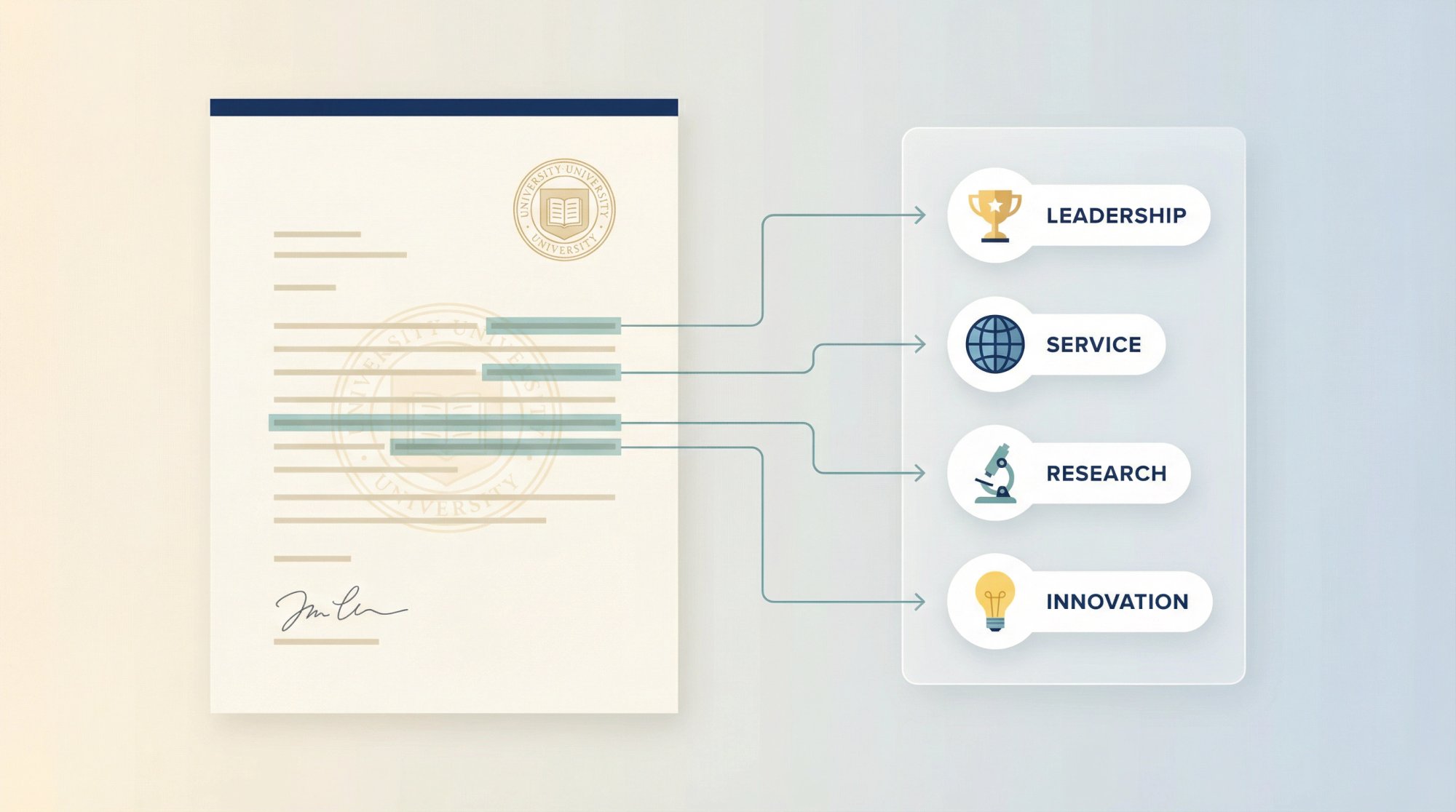
[Date][Scholarship Committee][Scholarship Name]Dear Scholarship Committee,It is my pleasure to recommend [Candidate Name] for the [ScholarshipName]. I am [Your Name], [Title] at [Organization / Institution], and Ihave known [Candidate] for [length of time] as [relationship].I believe [Candidate] is an excellent fit for this scholarship because of[2 to 3 qualities that match the scholarship criteria]. In particular,[Candidate] has demonstrated [quality 1] through [specific example].During [project / service activity / research initiative / leadershiprole], [Candidate] [specific action]. The result was [impact, outcome, orbenefit to others]. This matters for [Scholarship Name] because [directconnection to the scholarship's mission].[Candidate] has also shown [quality 2] in [second example]. What standsout to me is not just accomplishment, but [deeper trait such asinitiative, integrity, perseverance, or commitment to service].I am confident that [Candidate] will continue to [future contributionrelevant to scholarship goals], and I recommend [him/her/them]enthusiastically for the [Scholarship Name].Please contact me at [email] or [phone] if I can provide more detail.Sincerely,[Your Name][Title][Organization / Institution]Template 4: Character Reference Letter
Character references aren't a substitute for academic or professional references unless the application specifically allows or requests them. Drexel and UNC recommend using professional or academic references by default and turning to a character reference only when that's what the situation calls for.
[Date][Recipient Name][Organization]Dear [Recipient Name or To Whom It May Concern],I am writing to provide a character reference for [Person's Name]. I haveknown [him/her/them] for [length of time] through [community, volunteerwork, coaching, neighborhood, mentorship, religious/communityorganization, etc.].In that time, I have come to know [Person's Name] as someone who is [2 to3 relevant personal qualities such as honest, dependable, respectful,compassionate, mature]. A good example of this came when [specificsituation]. [Person's Name] [specific action], which showed [what qualityit revealed].I have also seen [Person's Name] demonstrate [second quality] through[second example]. Based on my experience, [he/she/they] is someone who[relevant conclusion tied to the opportunity].I am happy to recommend [Person's Name] for [purpose]. Please feel freeto contact me at [email] or [phone] if you need further information.Sincerely,[Your Name][Relationship to Person]
Template 5: Email to Ask Someone for a Recommendation
Common App's current guidance says students should ask before sending recommender invites, preferably in person when possible, though email is fine. Stanford and AIApply both reinforce the value of asking directly, asking for a strong recommendation, and giving the recommender enough context and room to decline.
Before you send this request, make sure your resume and cover letter are polished. Your recommender may want to reference them. The AIApply cover letter examples hub has hundreds of role-specific examples you can use as a starting point, and the AI Cover Letter Generator can tailor one to your specific job or program in minutes.
Subject: Request for a strong recommendation for [role/program/scholarship]Hi [Name],I hope you're doing well. I'm applying to [role/program/scholarship] at[organization], and because you know my work from [specific context], Iwanted to ask whether you would feel comfortable writing a strongrecommendation on my behalf.The deadline is [date]. I've attached my [resume/CV], [personal statementor cover letter], [job/program link], and a short note with a fewexamples and points that may be helpful.I completely understand if your schedule is too full or if you don't feelyou know my work closely enough for this. I'd rather give you an easy outthan put you in a difficult spot.Thank you for considering it, and thank you for everything you'vetaught/helped me with.Best,[Your Name]
Template 6: Polite Decline for Recommenders
Sometimes the honest thing is to say no. Yale, Berkeley, and UNC all make the same point in substance: if you can't write a positive, detailed, enthusiastic recommendation, it's better to decline than to submit a weak one.
Subject: Re: Recommendation requestHi [Name],Thank you for thinking of me. I'm honored that you asked.After considering it, I don't think I'm the best person to write the kindof detailed, enthusiastic recommendation you deserve. I would rather behonest now so you have time to ask someone who knows your[work/research/leadership] more closely.If it would be helpful, I'm happy to suggest a few alternatives.Wishing you the best with your application,[Your Name]Bonus: Structured Recommendation Forms (Including MBA-Style Prompts)
Some business school applications use structured questionnaires rather than open letters. GMAC's Common Letter of Recommendation asks about your relationship with the applicant, how the applicant compares with other well-qualified people, the most important constructive feedback you gave them, how they responded, and anything else the committee should know. Check the portal before writing a traditional one-page letter.
1. Nature of relationshipI have known [Applicant] for [length of time] as [manager / client /professor / mentor]. Our primary interactions involved [specific work].2. Performance compared to peersCompared with other well-qualified [employees/students/professionals] Ihave known in similar roles, [Applicant] stands out for [specificstrengths]. A clear example is [specific situation + action + outcome].If accurate, include a benchmark such as top 10%, top 5%, or strongestin a specific area.3. Most important constructive feedback given, and responseThe most important developmental feedback I gave [Applicant] was[feedback]. [Applicant] responded by [specific behavior change], whichled to [observable improvement or outcome].4. Anything elseAnything else the committee should know should add new signal, not repeatthe resume. Use this space for context, resilience, unusual initiative,leadership under pressure, or fit for the program.How to Ask for a Letter of Recommendation
Everything above has been for the person writing the letter. But if you're on the other side of the equation (the one who needs the recommendation), you have more influence over the outcome than you might think.

→ Choose the Person With the Best Evidence, Not the Biggest Title
This is the assumption many applicants get wrong. Prestige feels safer. But specific knowledge is stronger. A direct supervisor, faculty mentor, or instructor who can describe your work in detail will almost always beat a more senior person who barely remembers you. Cornell's fellowship guidance makes this point directly.
→ Ask for a Strong Recommendation
That one word matters. It gives the other person an honest chance to say no if they can't genuinely support you. Stanford and UNC both recommend this directly.
→ Ask Early, Before You Send Portal Invites
Common App's current guidance says to ask before you assign the recommender in the application system and give at least three weeks when possible. Yale gives similar timing advice. Nobody writes their best work when they feel ambushed by a deadline.
→ Send a Real Packet, Not Just a Deadline
A useful packet usually includes your resume or CV, the job or program link, your personal statement or cover letter if relevant, instructions, the deadline, and a short brag sheet or recommendation brief. Common App's brag sheet materials are built for exactly this purpose, and AIApply's guide on how to ask someone to be a reference covers many of the same support materials.
→ Thank Them and Update Them on the Outcome
Common App explicitly reminds students to thank recommenders, and it's good practice to let them know the outcome later. People who write strong letters are doing you a meaningful favor. Close the loop.
Not sure whether you need letters or just references for a job? AIApply's guide on how many references you need for a job can help you figure that out before you start asking people.
→ Strengthen Your Full Application Before You Ask
The recommendation letter is one piece of a larger picture. Before making the ask, take time to polish every component. AIApply's Auto Apply helps candidates cast a wider net across thousands of roles, while the AI Mock Interview prepares you for what comes after your application lands. A strong letter gets you in the door. Preparation gets you the offer.
Can AI Write a Letter of Recommendation?
Yes, but only in the right role.
AI is useful for turning bullet points into a rough draft, tightening wording, and catching awkward phrasing. But recent faculty guidance from Temple and Indiana warns against letting generative AI become the actual author of official letters, because it can invent details, flatten your voice, introduce bias, and raise privacy concerns. In a 2025 Stanford Report interview, professor Russ Altman said he still writes recommendation letters himself because he wants them fully in his own voice.
The safe rule is simple: AI may assist the drafting process, but the signer must verify every fact and fully own the final letter.
A good AI workflow looks like this:
① Start with your own bullet points and real examples.
② Let AI help organize or polish them.
③ Remove anything you did not personally observe.
④ Watch for bias or overstatement.
⑤ Rewrite until it sounds like you.
⑥ Treat the final version as your responsibility, not the model's.

For a fast first draft, AIApply's free AI Reference Letter Generator can turn the basics of the relationship, skills, accomplishments, and tone into a starting point that you then personalize heavily. It's free, requires no registration, and gives you instant results you can shape into something genuine. Tone options include Professional, Enthusiastic, Formal, and Warm, so you're not stuck with one voice.
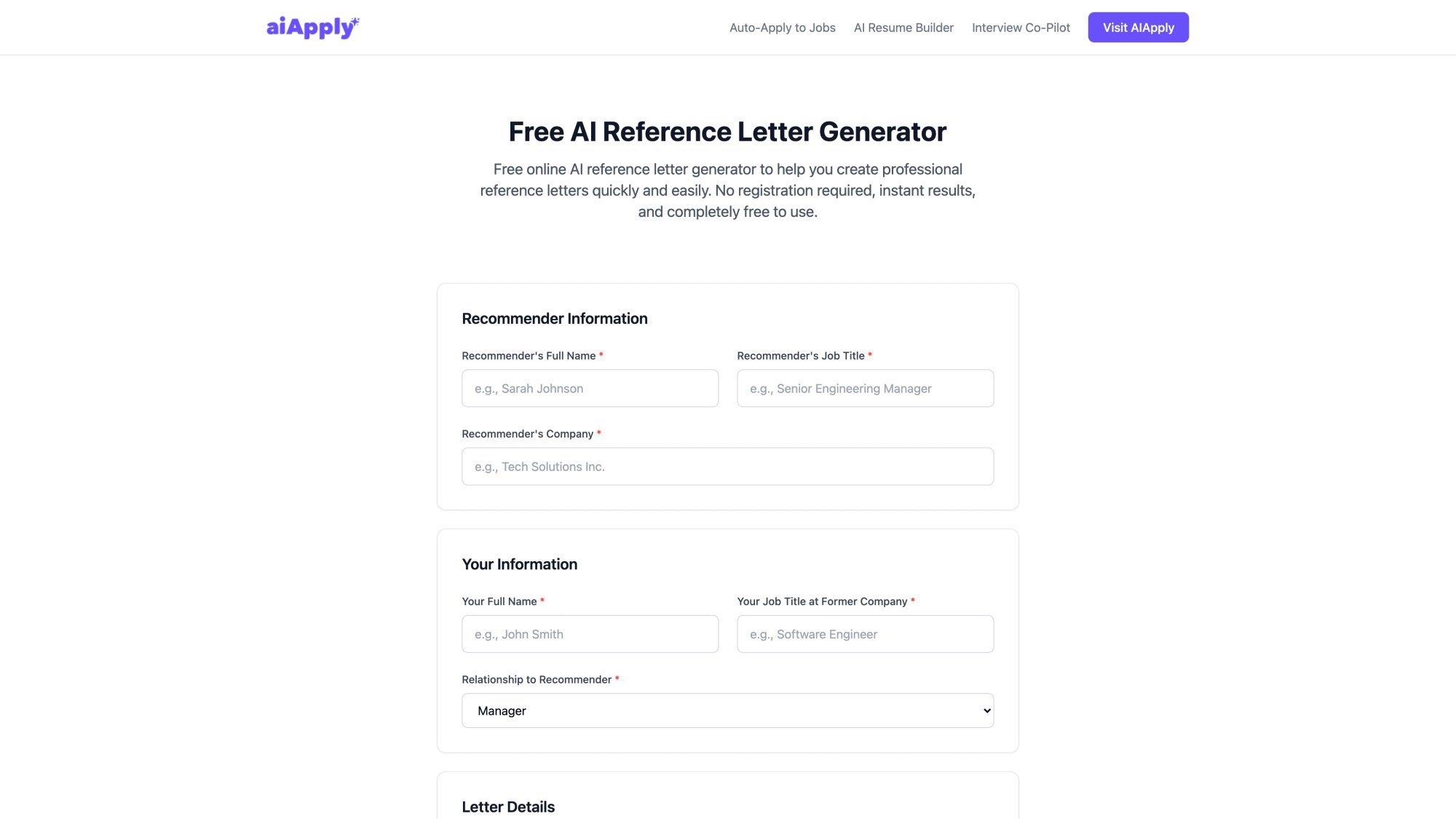
What matters most: the tool creates a starting point. The final letter should sound like you, contain only things you've personally observed, and carry your signature with your full confidence behind it.
If you're writing a reference letter for someone applying to a teaching role, this guide on writing an application letter for a teaching job provides additional context on what hiring panels look for. That's useful background when you're framing the candidate's classroom skills and impact. For candidates in education, AIApply's teacher career page outlines the qualifications and skills most relevant to that field, which can help you identify which strengths to highlight in the letter.
7 Common Recommendation Letter Mistakes to Avoid
Even well-intentioned letters can fall flat. These are the seven most common problems, and each one is avoidable.
| Mistake | Why It Hurts | The Fix |
|---|---|---|
| Generic praise with no proof | "Nice" and "hardworking" mean nothing without evidence | Every positive claim needs a real example |
| Repeating the resume | Adds no new information | Show how they think, work, and respond |
| Wrong recommender | Prestige without knowledge is still thin | Firsthand evidence beats a famous name |
| Ignoring the specific target | Irrelevant strengths waste persuasive power | Match your examples to the mission |
| Biased or irrelevant personal details | Can introduce legal risk and bias | Stick to competence, conduct, and potential |
| Letting AI invent specifics | Fiction, not recommendation | Verify every example before signing |
| Letter when only references were requested | Misreads what employers actually want | Ask what format they need first |
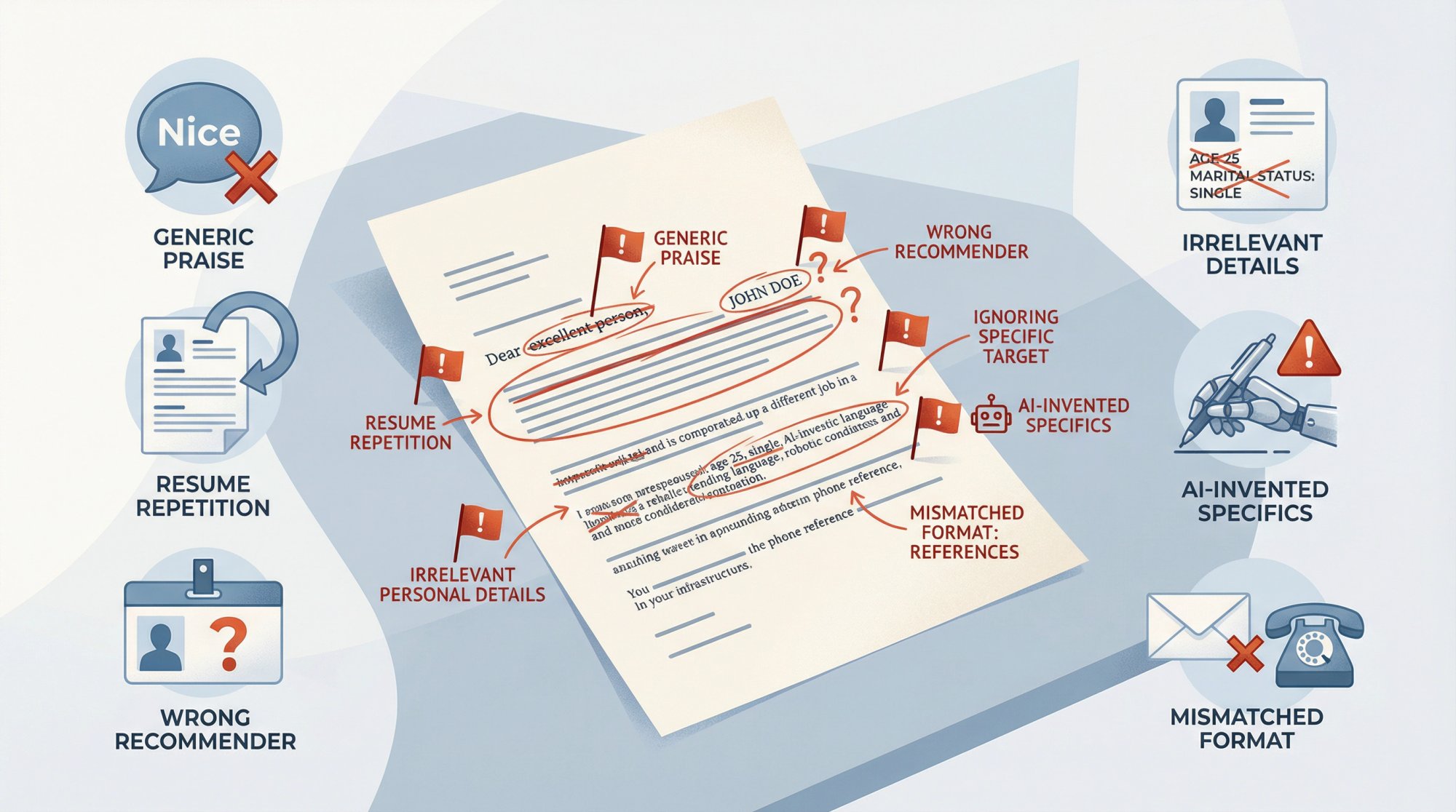
Here's a bit more context on a few of those worth expanding.
Generic Praise With No Proof
Words like "nice," "good," "hardworking," and "pleasant" aren't useless, but on their own they're weak. Berkeley explicitly warns against bland descriptors. Every positive claim needs an example behind it.
Repeating the Resume or Transcript
The application already has titles, dates, and grades. A recommendation letter should add new signal: how the candidate thinks, works, responds to feedback, handles difficulty, leads others, or contributes to a team. Stanford specifically warns against letters that do little more than report grades.
Using the Wrong Recommender
A prestigious name with thin evidence is still thin evidence. Direct knowledge is the asset that matters. Cornell makes this point clearly.
Ignoring the Specific Job or Program
A scholarship letter that never addresses the award's mission, or a job letter that ignores the role's actual requirements, wastes most of its persuasive power. Syracuse's scholarship guidance hammers this point home.
Including Biased or Irrelevant Personal Details
This is more common than people realize. Universities such as Berkeley, Georgetown, and Michigan warn that recommendation letters can drift into biased or irrelevant language. Keep the focus on competence, conduct, potential, and evidence.
Letting AI Invent Specifics You Didn't Observe
If the model writes a vivid example you didn't observe, the letter stops being a recommendation and starts becoming fiction. That's the line not to cross. Temple's faculty guide covers this risk directly.
Sending a Letter When Only References Were Requested
For jobs, this is a surprisingly common mistake. If the employer wants references, give references. Don't submit a narrative letter unless asked. UNC's guide on references and recommendations explains the distinction clearly.
Frequently Asked Questions

How long should a letter of recommendation be?
For most free-form letters, aim for one page. Be concise, specific, and stop once you've made the case. If the application uses required prompts or a structured form, follow that format instead. UChicago's guidance supports this approach.
Who is the best person to write a recommendation letter?
The best recommender is the person who knows the candidate's relevant work best and can provide detailed examples. That matters more than title, seniority, or fame. Cornell's fellowship resources emphasize this point.
Can a family member write a recommendation letter?
Usually not for jobs, admissions, or scholarships. Family members are generally appropriate only when a true character reference is specifically requested. Drexel's reference guide covers the different types of references and when each applies.
What if I only know the person a little?
Either decline or explain that someone else would be a stronger recommender. Several university guides say it's better to say no than to submit a vague letter based mainly on grades or brief contact. Stanford's guidance supports this directly.
Do I need letterhead, a signature, and a PDF?
For formal academic or employment recommendations, letterhead, a signature, and contact information are good practice. PDF is often the safest file type unless the portal says otherwise. UW Bothell's reference letter template provides a good example of professional formatting.
Why won't my employer give a detailed recommendation?
Some employers only provide basic factual references (dates of employment, job title, salary). In the UK, they generally don't have to provide one unless there's a specific obligation. That's why many job seekers rely on a former manager, team lead, or colleague for a fuller professional recommendation. If you're building out your full application package while you wait, the AIApply Resume Builder and AI Resume Checker can help you make the rest of your materials as strong as possible.
What's the difference between a reference and a recommendation letter?
A reference is typically someone an employer can contact to verify your work history and character. A recommendation letter is a written document where the author proactively makes a case for the candidate. Many job applications ask for references (a list of contacts), not pre-written letters. If you're unsure which one you need, AIApply's guide on how many references you need for a job can help clarify.
Can I use the same recommendation letter for multiple applications?
You can, but it's not ideal. The strongest letters are tailored to the specific opportunity. A letter written for a marketing role won't hit the same notes as one written for a graduate program in public health. If you're asking the same recommender for multiple letters, give them the specific details for each application so they can adjust the focus.
Final Takeaway
A great recommendation letter is short, specific, relevant, and honest.
It doesn't try to tell the reader everything about the candidate. It picks the two or three facts that best predict future success, proves them with firsthand evidence, and connects those facts to the opportunity in front of the reader.
That's what turns a polite note into a persuasive recommendation.

Whether you're writing one or requesting one, the process works best when both sides come prepared. Recommenders need real examples and clear context. Candidates need to ask the right people, ask early, and send a complete packet that makes the recommender's job easy.
And if you need help assembling your application materials before making the ask, AIApply has free tools to help. Our AI Resume Builder and AI Cover Letter Generator can create polished, tailored documents in minutes, and our free AI Reference Letter Generator gives recommenders a solid starting draft they can personalize with real examples and their own voice. Once your materials are ready and your recommendation letters are secured, the Interview Answer Buddy can help you prepare for what comes next, so your application lands and you're ready to perform in the interview.
A letter of recommendation solves one problem: uncertainty.
An applicant can describe their own skills all day long. A recommender provides something different. They provide third-party evidence. And the person reading that letter isn't really asking, "Do you like this person?" They're asking something more specific: Have you actually seen this person perform, and should I trust your judgment?
That distinction changes everything about how you write one.
Great recommendation letters aren't second resumes. They aren't lists of adjectives or feel-good platitudes. According to guidance from Stanford's Humanities & Sciences, strong letters come from people who know the candidate well, add information the application doesn't already show, and support every claim with concrete, tailored examples.
Before you write anything, though, check whether a letter is even what's being asked for. In hiring, people say "reference" and "recommendation letter" like they're interchangeable, but they're often not. Many employers want a list of references they can call later, not a pre-written letter. In the UK, employers may provide either a basic or detailed reference, and they generally aren't required to provide one unless there's a specific obligation.
This guide walks you through exactly how to write a strong recommendation letter, what to ask for before you start, what mistakes to avoid, and includes free copy-paste templates for jobs, grad school, scholarships, character references, and recommendation requests.
Quick Navigation
What Makes a Strong Letter of Recommendation
A strong letter accomplishes five things, and it does them quickly:
It explains who you are and why your opinion matters.
It shows how you know the candidate, and for how long.
It isolates two or three strengths that are directly relevant to this opportunity.
It proves those strengths with specific examples.
It ends with a clear, unambiguous endorsement.
That structure is consistent across university and career-center guidance. UChicago's career office recommends a concise opening that defines your relationship and the candidate's key strengths, body paragraphs with examples and anecdotes, and a closing that clearly restates your support. Iowa and Santa Clara similarly emphasize evidence, context, and honest comparison to a reference group when that comparison is credible.
Keep it tight. For a normal free-form letter, one page is usually the sweet spot unless the application says otherwise. Some programs don't use a standard letter at all. Many business schools, for example, use GMAC's Common Letter of Recommendation, which combines ratings and required narrative questions instead of giving you a blank page.
The blind spot most people miss: A vague positive letter is not neutral. It can actively hurt the applicant. Stanford, Yale, UNC, and Berkeley all warn, in slightly different ways, that superficial, sparse, or lukewarm letters weaken an application. If you can't be specific and clearly supportive, it's better to decline early.
What to Consider Before Writing a Recommendation Letter
Writing a recommendation letter is a real commitment. Work through these questions honestly before you say yes. They're not just formalities.
Can You Write a Strong Letter?
Don't just ask yourself, "Can I write a letter?" Ask, "Can I write a strong one?" Stanford explicitly advises applicants to ask recommenders whether they can write a strong letter, and multiple university guides say it's better to decline than to submit a thin or hesitant endorsement.
Are You the Right Recommender?
Specificity beats status every time. A famous professor, senior executive, or high-ranking manager who barely knows the candidate is often weaker than a direct supervisor, research mentor, or instructor with firsthand evidence. Cornell and Stanford both stress that the best recommender is the person who knows the applicant's relevant work well, not the person with the biggest title.
Do You Understand What the Letter Is For?
A job, a graduate program, a scholarship, and a character reference are not the same thing. UChicago notes that employers and graduate programs often care about skills, qualifications, professionalism, and soft skills. Scholarship guidance from Syracuse stresses alignment to the mission and criteria of the award itself.
Do You Have Enough Time to Write a Good Letter?
Common App's current guidance advises students to ask before sending recommender invites and to give recommenders at least three weeks when possible. Yale similarly warns recommenders not to accept if they're being asked too close to the deadline to do the job well.
Have You Gotten the Background Materials?
Before you draft, ask for: the job description or program page, a resume or CV, a personal statement or cover letter if relevant, the submission instructions, the deadline, and any specific prompt or rubric the letter is supposed to address. UChicago recommends many of these materials directly. Common App encourages students to prepare a brag sheet so letters can be more personal and effective, and Stanford advises applicants to supply program details, a summary of strengths, and supporting materials.
Will Your Letter Stay Legally Clean and Unbiased?
Focus on observed performance, conduct, and potential. Avoid protected or irrelevant personal details. Berkeley specifically warns against including race, religion, age, disability, marital status, appearance, and similar details. Acas notes that employment references should not include certain absence information related to disability or family-related leave rights.
What to Give Your Recommender Before They Start Writing
The best letters usually come from the best input. If you're the one writing, ask the candidate for a simple support packet before you start. If you're the candidate, prepare this proactively so your recommender doesn't have to chase you for details.
That packet should include:
The exact role, program, or scholarship they're applying to
The deadline and submission link
A resume or CV
A personal statement or cover letter, if relevant
Any transcript, work sample, or project summary that helps
A short "brag sheet" with 2 or 3 strengths and concrete examples
Anything the application explicitly asks the recommender to address
That checklist lines up closely with current guidance from UChicago, Common App, and Stanford.
A simple one-page brief works beautifully. Here's a format you can send directly to the candidate (or fill in yourself if you're the one requesting):
Recommendation BriefCandidate:Opportunity:Deadline / submission link:How we know each other:Top 3 strengths to emphasize:2 proof points or stories:Any criteria from the job/program/scholarship:Attached materials:For job applications specifically, the packet is much stronger when the candidate sends a clean, tailored resume and cover letter. AIApply's AI Resume Builder and AI Cover Letter Generator can help candidates assemble polished materials before the request ever reaches the recommender. Running your resume through AIApply's AI Resume Scanner first ensures it's ATS-optimized and keyword-matched to the role before you share it with your reference.
How to Format and Structure a Recommendation Letter
You've agreed to write the letter, and you have the candidate's materials in hand. Now you need to actually write the thing. Here's the structure that consistently produces strong, credible letters.
Use a Professional Format
For formal academic or employment recommendations, use letterhead if appropriate, include the date, address the reader by name when possible, and include your contact information. UChicago recommends saving as PDF unless the application says otherwise. Berkeley and UW Bothell both emphasize professional formatting, signature, and contact details.
Start With Your Relationship and a Clear Endorsement
Your opening paragraph should answer four questions fast:
Who are you?
What is your role?
How do you know the candidate?
How strongly do you recommend them?
Here's what a strong opening looks like:
I am pleased to recommend [Candidate Name] for [role/program]. I am [Your Name], [Title] at [Organization], and I have known [Candidate] for [length of time] as [context]. During that time, I have been consistently impressed by [2 to 3 relevant strengths].
That kind of opening matches current guidance from UChicago and Santa Clara, which both emphasize identifying your relationship to the candidate, the length of that relationship, and your initial assessment.
Use the Body to Prove Your Claims
This is where most letters fail. They praise instead of proving.
The strongest mental model is:
Claim → Evidence → Impact → Relevance
Here's what that looks like in practice:
| Step | Example |
|---|---|
| Claim | Maya is unusually dependable under pressure. |
| Evidence | During our busiest quarter, she took over onboarding after two teammates left unexpectedly. |
| Impact | She reorganized the checklist, reduced setup errors, and kept all client deadlines on track. |
| Relevance | That is exactly the kind of operational ownership this role requires. |
That logic tracks closely with Iowa's advice to explain why a trait is real instead of just asserting it, and with UChicago's guidance to use examples and anecdotes.
How to Use Peer Comparison Effectively
Peer comparison can make a letter significantly stronger when it's honest and grounded. A line like "Among the 60 analysts I have supervised, Jordan ranks in the top 10% for initiative and follow-through" tells the reader far more than "Jordan is excellent."
UChicago, Iowa, Santa Clara, and GMAC all point recommenders toward some version of comparison or benchmarking when they can do it credibly.
Tie the Letter to the Specific Opportunity
This matters more than most people realize. Scholarship and fellowship guidance from Syracuse repeatedly emphasizes fit to the mission of the award. A glowing general letter can still be weak if the scholarship values service and your letter only talks about grades, or if the job needs cross-functional communication and your letter only talks about raw output.
Think about what the reader needs to hear, not just what you want to say.
How to Close With a Clear Endorsement
End with a direct endorsement and an invitation to contact you for more information.
Strong closing examples:
"I recommend [Name] enthusiastically and without reservation."
"I am confident [Name] will make a meaningful contribution to your program."
"I would gladly hire [Name] again."
Then include your name, title, organization, email, and phone number if appropriate.
Weak vs. Strong Recommendation Letter Wording (With Examples)
This is the single biggest difference between a recommendation letter that helps and one that wastes everyone's time. Look at the difference:
| Weak | Strong |
|---|---|
| "Nina is hardworking and responsible." | "When a supplier mistake threatened our launch timeline, Nina rebuilt the delivery plan across three vendors and kept the launch on schedule without raising budget." |
| "Marcus is one of my best students." | "In 11 years of teaching upper-level economics, Marcus ranks among the top 10% of students I have taught for analytical writing and research independence." |
| "Aisha is a leader." | "When her tutoring program began losing volunteers mid-semester, Aisha designed a peer-mentor rotation that stabilized coverage and improved volunteer retention." |
| "Omar would be a good fit." | "Because this scholarship prioritizes service and initiative, Omar's work organizing weekend delivery routes for homebound seniors is directly relevant." |
The difference is simple: the strong version gives the reader something they can believe. Weak letters assert. Strong letters prove.
Free Letter of Recommendation Templates
Below are seven templates covering the most common scenarios. Each one is ready to customize. Copy what you need, replace the bracketed fields with real information, and personalize with your own examples and voice.
Template 1: Recommendation Letter for an Employee or Job Candidate
For employment letters, focus on results, reliability, professionalism, collaboration, and the specific skills required for the target role. Career offices also recommend including examples and, where appropriate, honest comparison to peers. If you're writing on behalf of a marketing manager or software engineer, review the role's typical skill requirements before you draft so your letter speaks directly to what hiring teams look for.
[Date][Recipient Name][Recipient Title][Company/Organization][Address]Dear [Recipient Name or Hiring Manager],I am pleased to recommend [Candidate Name] for the [Role] position at[Company]. I am [Your Name], [Your Title] at [Organization], and I workedwith [Candidate] for [length of time] as [relationship].During that time, [Candidate] consistently stood out for [strength 1],[strength 2], and [strength 3]. What impressed me most was [brief overallassessment].One example of [strength 1] came when [specific situation]. [Candidate][specific action]. As a result, [observable outcome, metric, or impact].That experience showed me that [Candidate] can [relevant job demand].[Candidate] also demonstrated [strength 2] when [second example]. Iespecially valued this because [why it mattered to the team, client, orproject]. [Optional peer comparison: Among the [number] employees I havesupervised, [Candidate] ranks in the top [x%] for [trait], if truthful.]Beyond results, [Candidate] is [relevant professional qualities such ascoachable, dependable, collaborative, calm under pressure]. I would beconfident placing [Candidate] in a role that requires [relevantresponsibilities], and I believe [Candidate] would contribute quickly at[Company].I recommend [Candidate] enthusiastically and without reservation. Pleasefeel free to contact me at [email] or [phone] if I can provide anyadditional information.Sincerely,[Your Name][Title][Organization]Template 2: Recommendation Letter for Graduate School or Academic Programs
For academic letters, focus on intellectual ability, writing or research strength, independence, curiosity, discussion quality, and readiness for advanced study. Stanford and Cornell both emphasize choosing recommenders who can speak to real academic or research performance rather than just repeating grades.
If the candidate is applying to research-focused programs, look at what skills a research assistant or research scientist role typically demands. It helps frame which strengths to emphasize in your letter. Candidates preparing their own supporting materials can also use AIApply's resume examples for recent graduates to create stronger supporting packets.
[Date][Admissions Committee / Recipient Name][Program Name][University]Dear [Recipient Name or Admissions Committee],I am writing to strongly recommend [Candidate Name] for admission to[Program Name] at [University]. I am [Your Name], [Title] in the[Department] at [Institution], and I have known [Candidate] for [lengthof time] as [professor / thesis advisor / research supervisor / mentor].In my experience, [Candidate] stands out for [2 to 3 academic strengths,such as analytical rigor, originality, writing ability, researchindependence, intellectual curiosity]. In [course / lab / project],[Candidate] distinguished [himself/herself/themselves] through [specificcontribution].A clear example came during [class, paper, research project, thesis, orlab work]. [Candidate] [specific action]. What made this especiallyimpressive was [why it mattered, why it was difficult, or how it comparedwith peers]. [Optional comparison sentence: Among the students I havetaught over the past [x] years, [Candidate] ranks in the top [x%] for[specific trait], if truthful.][Candidate] also impressed me through [second example involving writing,research, leadership, collaboration, or resilience]. This demonstrated[relevant graduate-level qualities such as persistence, independentthinking, precision, maturity, or intellectual ambition].For a graduate program in [field], I believe [Candidate] is particularlywell prepared because [connection between evidence and program fit]. I amconfident [Candidate] will contribute meaningfully to your academiccommunity.I recommend [Candidate] strongly and without reservation. Please contactme at [email] or [phone] if I can provide further information.Sincerely,[Your Name][Title][Department / Institution]Template 3: Recommendation Letter for a Scholarship or Fellowship
Scholarship letters should map directly to the award's criteria. Syracuse's scholarship guidance makes this point clearly: the strongest letter isn't the most glowing general letter, but the one that proves the applicant fits the award's actual mission, whether that mission is leadership, service, research, public impact, or something else.
Students applying for scholarships can strengthen their full application package using AIApply's student tools, which offer dedicated resources for early-career and academic applicants alongside discounted access to the full platform.
[Date][Scholarship Committee][Scholarship Name]Dear Scholarship Committee,It is my pleasure to recommend [Candidate Name] for the [ScholarshipName]. I am [Your Name], [Title] at [Organization / Institution], and Ihave known [Candidate] for [length of time] as [relationship].I believe [Candidate] is an excellent fit for this scholarship because of[2 to 3 qualities that match the scholarship criteria]. In particular,[Candidate] has demonstrated [quality 1] through [specific example].During [project / service activity / research initiative / leadershiprole], [Candidate] [specific action]. The result was [impact, outcome, orbenefit to others]. This matters for [Scholarship Name] because [directconnection to the scholarship's mission].[Candidate] has also shown [quality 2] in [second example]. What standsout to me is not just accomplishment, but [deeper trait such asinitiative, integrity, perseverance, or commitment to service].I am confident that [Candidate] will continue to [future contributionrelevant to scholarship goals], and I recommend [him/her/them]enthusiastically for the [Scholarship Name].Please contact me at [email] or [phone] if I can provide more detail.Sincerely,[Your Name][Title][Organization / Institution]Template 4: Character Reference Letter
Character references aren't a substitute for academic or professional references unless the application specifically allows or requests them. Drexel and UNC recommend using professional or academic references by default and turning to a character reference only when that's what the situation calls for.
[Date][Recipient Name][Organization]Dear [Recipient Name or To Whom It May Concern],I am writing to provide a character reference for [Person's Name]. I haveknown [him/her/them] for [length of time] through [community, volunteerwork, coaching, neighborhood, mentorship, religious/communityorganization, etc.].In that time, I have come to know [Person's Name] as someone who is [2 to3 relevant personal qualities such as honest, dependable, respectful,compassionate, mature]. A good example of this came when [specificsituation]. [Person's Name] [specific action], which showed [what qualityit revealed].I have also seen [Person's Name] demonstrate [second quality] through[second example]. Based on my experience, [he/she/they] is someone who[relevant conclusion tied to the opportunity].I am happy to recommend [Person's Name] for [purpose]. Please feel freeto contact me at [email] or [phone] if you need further information.Sincerely,[Your Name][Relationship to Person]
Template 5: Email to Ask Someone for a Recommendation
Common App's current guidance says students should ask before sending recommender invites, preferably in person when possible, though email is fine. Stanford and AIApply both reinforce the value of asking directly, asking for a strong recommendation, and giving the recommender enough context and room to decline.
Before you send this request, make sure your resume and cover letter are polished. Your recommender may want to reference them. The AIApply cover letter examples hub has hundreds of role-specific examples you can use as a starting point, and the AI Cover Letter Generator can tailor one to your specific job or program in minutes.
Subject: Request for a strong recommendation for [role/program/scholarship]Hi [Name],I hope you're doing well. I'm applying to [role/program/scholarship] at[organization], and because you know my work from [specific context], Iwanted to ask whether you would feel comfortable writing a strongrecommendation on my behalf.The deadline is [date]. I've attached my [resume/CV], [personal statementor cover letter], [job/program link], and a short note with a fewexamples and points that may be helpful.I completely understand if your schedule is too full or if you don't feelyou know my work closely enough for this. I'd rather give you an easy outthan put you in a difficult spot.Thank you for considering it, and thank you for everything you'vetaught/helped me with.Best,[Your Name]
Template 6: Polite Decline for Recommenders
Sometimes the honest thing is to say no. Yale, Berkeley, and UNC all make the same point in substance: if you can't write a positive, detailed, enthusiastic recommendation, it's better to decline than to submit a weak one.
Subject: Re: Recommendation requestHi [Name],Thank you for thinking of me. I'm honored that you asked.After considering it, I don't think I'm the best person to write the kindof detailed, enthusiastic recommendation you deserve. I would rather behonest now so you have time to ask someone who knows your[work/research/leadership] more closely.If it would be helpful, I'm happy to suggest a few alternatives.Wishing you the best with your application,[Your Name]Bonus: Structured Recommendation Forms (Including MBA-Style Prompts)
Some business school applications use structured questionnaires rather than open letters. GMAC's Common Letter of Recommendation asks about your relationship with the applicant, how the applicant compares with other well-qualified people, the most important constructive feedback you gave them, how they responded, and anything else the committee should know. Check the portal before writing a traditional one-page letter.
1. Nature of relationshipI have known [Applicant] for [length of time] as [manager / client /professor / mentor]. Our primary interactions involved [specific work].2. Performance compared to peersCompared with other well-qualified [employees/students/professionals] Ihave known in similar roles, [Applicant] stands out for [specificstrengths]. A clear example is [specific situation + action + outcome].If accurate, include a benchmark such as top 10%, top 5%, or strongestin a specific area.3. Most important constructive feedback given, and responseThe most important developmental feedback I gave [Applicant] was[feedback]. [Applicant] responded by [specific behavior change], whichled to [observable improvement or outcome].4. Anything elseAnything else the committee should know should add new signal, not repeatthe resume. Use this space for context, resilience, unusual initiative,leadership under pressure, or fit for the program.How to Ask for a Letter of Recommendation
Everything above has been for the person writing the letter. But if you're on the other side of the equation (the one who needs the recommendation), you have more influence over the outcome than you might think.
→ Choose the Person With the Best Evidence, Not the Biggest Title
This is the assumption many applicants get wrong. Prestige feels safer. But specific knowledge is stronger. A direct supervisor, faculty mentor, or instructor who can describe your work in detail will almost always beat a more senior person who barely remembers you. Cornell's fellowship guidance makes this point directly.
→ Ask for a Strong Recommendation
That one word matters. It gives the other person an honest chance to say no if they can't genuinely support you. Stanford and UNC both recommend this directly.
→ Ask Early, Before You Send Portal Invites
Common App's current guidance says to ask before you assign the recommender in the application system and give at least three weeks when possible. Yale gives similar timing advice. Nobody writes their best work when they feel ambushed by a deadline.
→ Send a Real Packet, Not Just a Deadline
A useful packet usually includes your resume or CV, the job or program link, your personal statement or cover letter if relevant, instructions, the deadline, and a short brag sheet or recommendation brief. Common App's brag sheet materials are built for exactly this purpose, and AIApply's guide on how to ask someone to be a reference covers many of the same support materials.
→ Thank Them and Update Them on the Outcome
Common App explicitly reminds students to thank recommenders, and it's good practice to let them know the outcome later. People who write strong letters are doing you a meaningful favor. Close the loop.
Not sure whether you need letters or just references for a job? AIApply's guide on how many references you need for a job can help you figure that out before you start asking people.
→ Strengthen Your Full Application Before You Ask
The recommendation letter is one piece of a larger picture. Before making the ask, take time to polish every component. AIApply's Auto Apply helps candidates cast a wider net across thousands of roles, while the AI Mock Interview prepares you for what comes after your application lands. A strong letter gets you in the door. Preparation gets you the offer.
Can AI Write a Letter of Recommendation?
Yes, but only in the right role.
AI is useful for turning bullet points into a rough draft, tightening wording, and catching awkward phrasing. But recent faculty guidance from Temple and Indiana warns against letting generative AI become the actual author of official letters, because it can invent details, flatten your voice, introduce bias, and raise privacy concerns. In a 2025 Stanford Report interview, professor Russ Altman said he still writes recommendation letters himself because he wants them fully in his own voice.
The safe rule is simple: AI may assist the drafting process, but the signer must verify every fact and fully own the final letter.
A good AI workflow looks like this:
① Start with your own bullet points and real examples.
② Let AI help organize or polish them.
③ Remove anything you did not personally observe.
④ Watch for bias or overstatement.
⑤ Rewrite until it sounds like you.
⑥ Treat the final version as your responsibility, not the model's.
For a fast first draft, AIApply's free AI Reference Letter Generator can turn the basics of the relationship, skills, accomplishments, and tone into a starting point that you then personalize heavily. It's free, requires no registration, and gives you instant results you can shape into something genuine. Tone options include Professional, Enthusiastic, Formal, and Warm, so you're not stuck with one voice.
What matters most: the tool creates a starting point. The final letter should sound like you, contain only things you've personally observed, and carry your signature with your full confidence behind it.
If you're writing a reference letter for someone applying to a teaching role, this guide on writing an application letter for a teaching job provides additional context on what hiring panels look for. That's useful background when you're framing the candidate's classroom skills and impact. For candidates in education, AIApply's teacher career page outlines the qualifications and skills most relevant to that field, which can help you identify which strengths to highlight in the letter.
7 Common Recommendation Letter Mistakes to Avoid
Even well-intentioned letters can fall flat. These are the seven most common problems, and each one is avoidable.
| Mistake | Why It Hurts | The Fix |
|---|---|---|
| Generic praise with no proof | "Nice" and "hardworking" mean nothing without evidence | Every positive claim needs a real example |
| Repeating the resume | Adds no new information | Show how they think, work, and respond |
| Wrong recommender | Prestige without knowledge is still thin | Firsthand evidence beats a famous name |
| Ignoring the specific target | Irrelevant strengths waste persuasive power | Match your examples to the mission |
| Biased or irrelevant personal details | Can introduce legal risk and bias | Stick to competence, conduct, and potential |
| Letting AI invent specifics | Fiction, not recommendation | Verify every example before signing |
| Letter when only references were requested | Misreads what employers actually want | Ask what format they need first |
Here's a bit more context on a few of those worth expanding.
Generic Praise With No Proof
Words like "nice," "good," "hardworking," and "pleasant" aren't useless, but on their own they're weak. Berkeley explicitly warns against bland descriptors. Every positive claim needs an example behind it.
Repeating the Resume or Transcript
The application already has titles, dates, and grades. A recommendation letter should add new signal: how the candidate thinks, works, responds to feedback, handles difficulty, leads others, or contributes to a team. Stanford specifically warns against letters that do little more than report grades.
Using the Wrong Recommender
A prestigious name with thin evidence is still thin evidence. Direct knowledge is the asset that matters. Cornell makes this point clearly.
Ignoring the Specific Job or Program
A scholarship letter that never addresses the award's mission, or a job letter that ignores the role's actual requirements, wastes most of its persuasive power. Syracuse's scholarship guidance hammers this point home.
Including Biased or Irrelevant Personal Details
This is more common than people realize. Universities such as Berkeley, Georgetown, and Michigan warn that recommendation letters can drift into biased or irrelevant language. Keep the focus on competence, conduct, potential, and evidence.
Letting AI Invent Specifics You Didn't Observe
If the model writes a vivid example you didn't observe, the letter stops being a recommendation and starts becoming fiction. That's the line not to cross. Temple's faculty guide covers this risk directly.
Sending a Letter When Only References Were Requested
For jobs, this is a surprisingly common mistake. If the employer wants references, give references. Don't submit a narrative letter unless asked. UNC's guide on references and recommendations explains the distinction clearly.
Frequently Asked Questions
How long should a letter of recommendation be?
For most free-form letters, aim for one page. Be concise, specific, and stop once you've made the case. If the application uses required prompts or a structured form, follow that format instead. UChicago's guidance supports this approach.
Who is the best person to write a recommendation letter?
The best recommender is the person who knows the candidate's relevant work best and can provide detailed examples. That matters more than title, seniority, or fame. Cornell's fellowship resources emphasize this point.
Can a family member write a recommendation letter?
Usually not for jobs, admissions, or scholarships. Family members are generally appropriate only when a true character reference is specifically requested. Drexel's reference guide covers the different types of references and when each applies.
What if I only know the person a little?
Either decline or explain that someone else would be a stronger recommender. Several university guides say it's better to say no than to submit a vague letter based mainly on grades or brief contact. Stanford's guidance supports this directly.
Do I need letterhead, a signature, and a PDF?
For formal academic or employment recommendations, letterhead, a signature, and contact information are good practice. PDF is often the safest file type unless the portal says otherwise. UW Bothell's reference letter template provides a good example of professional formatting.
Why won't my employer give a detailed recommendation?
Some employers only provide basic factual references (dates of employment, job title, salary). In the UK, they generally don't have to provide one unless there's a specific obligation. That's why many job seekers rely on a former manager, team lead, or colleague for a fuller professional recommendation. If you're building out your full application package while you wait, the AIApply Resume Builder and AI Resume Checker can help you make the rest of your materials as strong as possible.
What's the difference between a reference and a recommendation letter?
A reference is typically someone an employer can contact to verify your work history and character. A recommendation letter is a written document where the author proactively makes a case for the candidate. Many job applications ask for references (a list of contacts), not pre-written letters. If you're unsure which one you need, AIApply's guide on how many references you need for a job can help clarify.
Can I use the same recommendation letter for multiple applications?
You can, but it's not ideal. The strongest letters are tailored to the specific opportunity. A letter written for a marketing role won't hit the same notes as one written for a graduate program in public health. If you're asking the same recommender for multiple letters, give them the specific details for each application so they can adjust the focus.
Final Takeaway
A great recommendation letter is short, specific, relevant, and honest.
It doesn't try to tell the reader everything about the candidate. It picks the two or three facts that best predict future success, proves them with firsthand evidence, and connects those facts to the opportunity in front of the reader.
That's what turns a polite note into a persuasive recommendation.
Whether you're writing one or requesting one, the process works best when both sides come prepared. Recommenders need real examples and clear context. Candidates need to ask the right people, ask early, and send a complete packet that makes the recommender's job easy.
And if you need help assembling your application materials before making the ask, AIApply has free tools to help. Our AI Resume Builder and AI Cover Letter Generator can create polished, tailored documents in minutes, and our free AI Reference Letter Generator gives recommenders a solid starting draft they can personalize with real examples and their own voice. Once your materials are ready and your recommendation letters are secured, the Interview Answer Buddy can help you prepare for what comes next, so your application lands and you're ready to perform in the interview.
.webp)
.webp)
Don't miss out on
your next opportunity.
Create and send applications in seconds, not hours.


