
50 Common Interview Questions (AI Answers Included)

.webp)
Most interview guides do the same thing. They hand you a pile of questions, slap some generic advice on top ("be confident," "be yourself," "smile more"), and leave you to figure out the actual answers by yourself at 11pm the night before.
That doesn't work anymore.
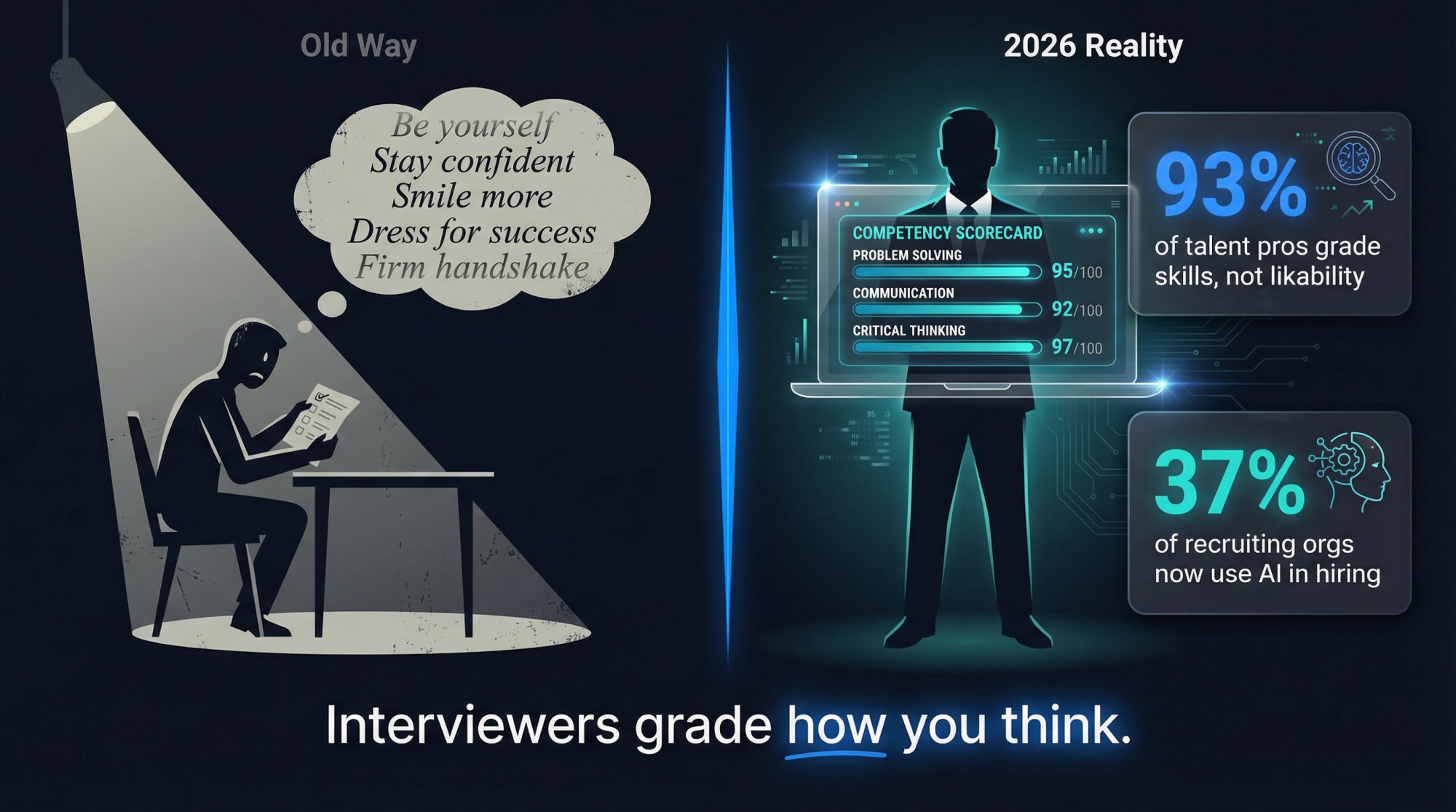
Hiring in 2026 is sharper, faster, and more evidence-driven than it used to be. LinkedIn's Future of Recruiting report shows that 93% of talent professionals believe accurately assessing a candidate's skills is crucial to quality of hire, and AI is now being actively integrated or tested in roughly 37% of recruiting organizations, up from 27% a year earlier. On the competency side, the NACE Job Outlook 2025 research ranks communication, critical thinking, and teamwork as the top career-readiness skills employers want to see. In plain English: interviewers aren't grading your likability. They're grading how you think, how you solve problems, and how clearly you can connect your past to their future.
This guide is built for that reality.
Below, we break down the 50 most common interview questions you should actually prepare for, with AI-quality sample answers, the "real question behind the question," and a one-line tip to make each answer stronger. These answers are deliberately flexible so you can adapt them to your own role, industry, and level. We (AIApply) built this guide from our own 2026 interview-prep library plus current research on hiring trends, so it reflects how interviews actually flow today, not how they worked five years ago.
One promise: you won't find generic "passion and drive" fluff here. You'll find blueprints you can customize and use tomorrow.
A quick note before you read on: the goal isn't to memorize these answers. Memorized answers sound memorized, and hiring managers tune them out within 10 seconds. Treat these as scaffolding. Add your real numbers, your real stories, and the exact job description you're prepping for. That's the version that actually works.
How to Answer Interview Questions Without Sounding Scripted
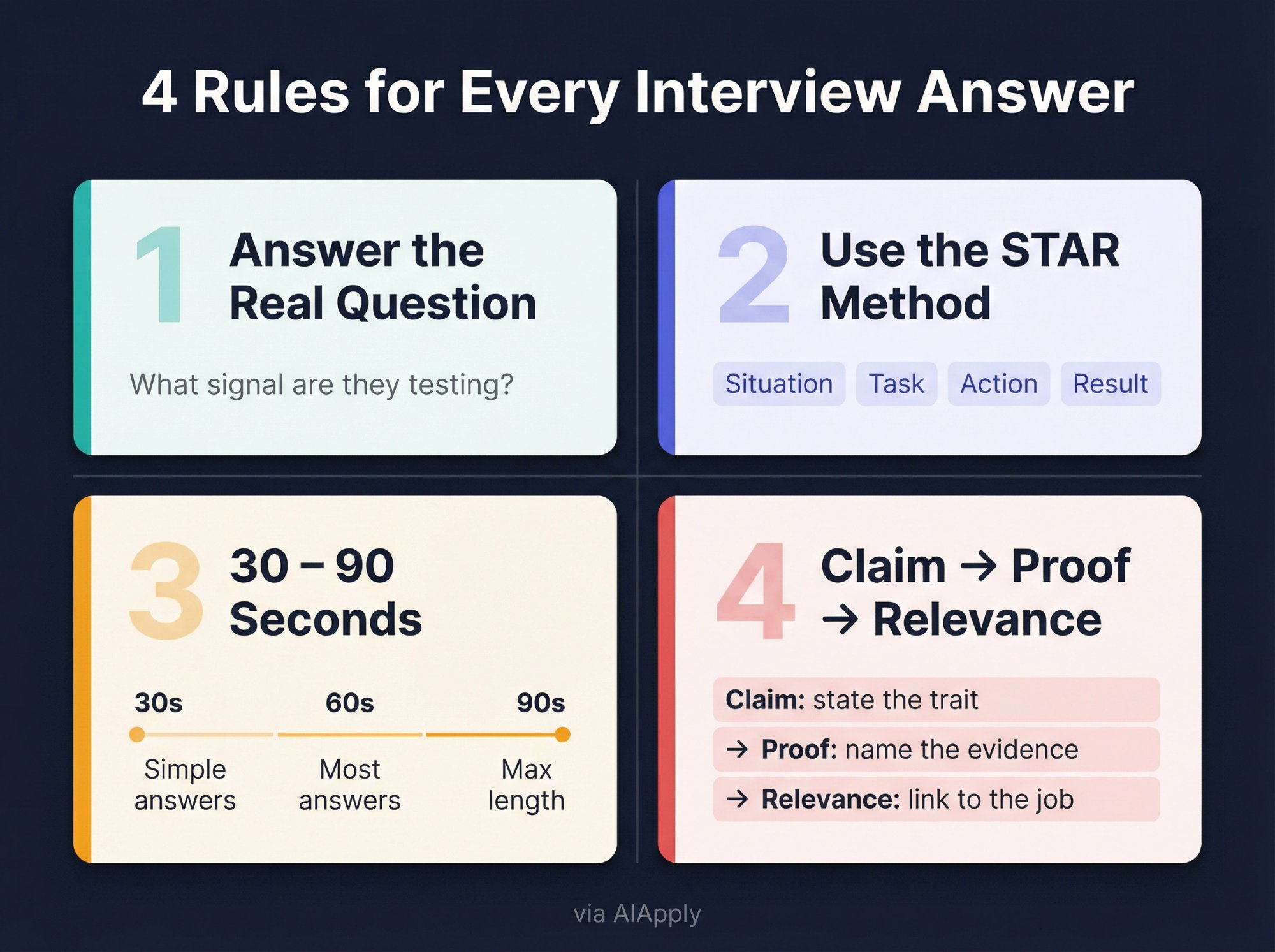
Before we get into the 50 questions, lock in these four rules. Every answer below is built on them.
1. Answer the Question Behind the Question
Interviewers rarely care about the literal question. They're testing signal. When they ask "Tell me about a time you failed," they're not collecting trivia. They want to know whether you take ownership, whether you learn, and whether you're safe to work with when things go sideways.
Before you answer any question, take half a second and ask yourself: what are they actually trying to find out? Then answer that.
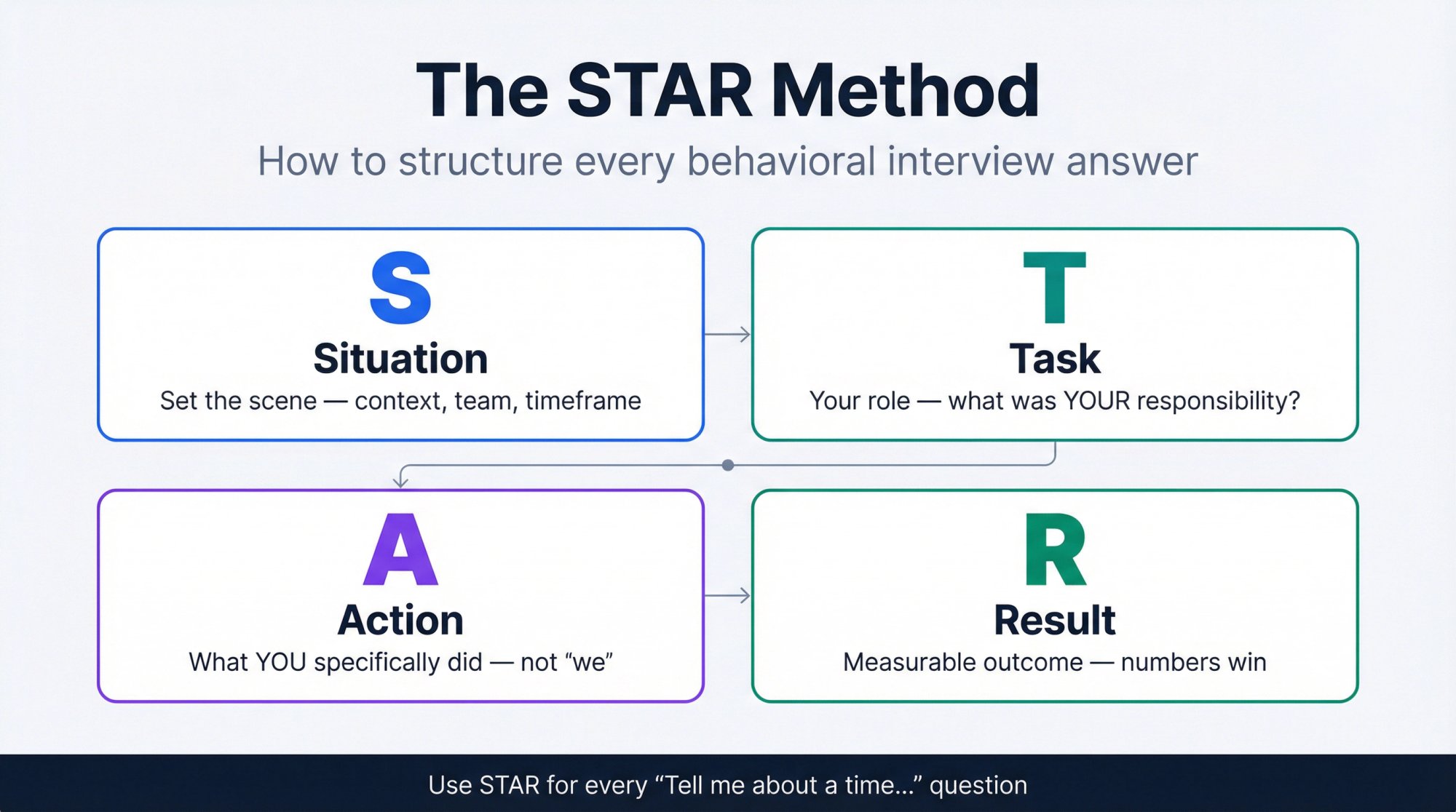
2. Use the STAR Structure for Behavioral Questions
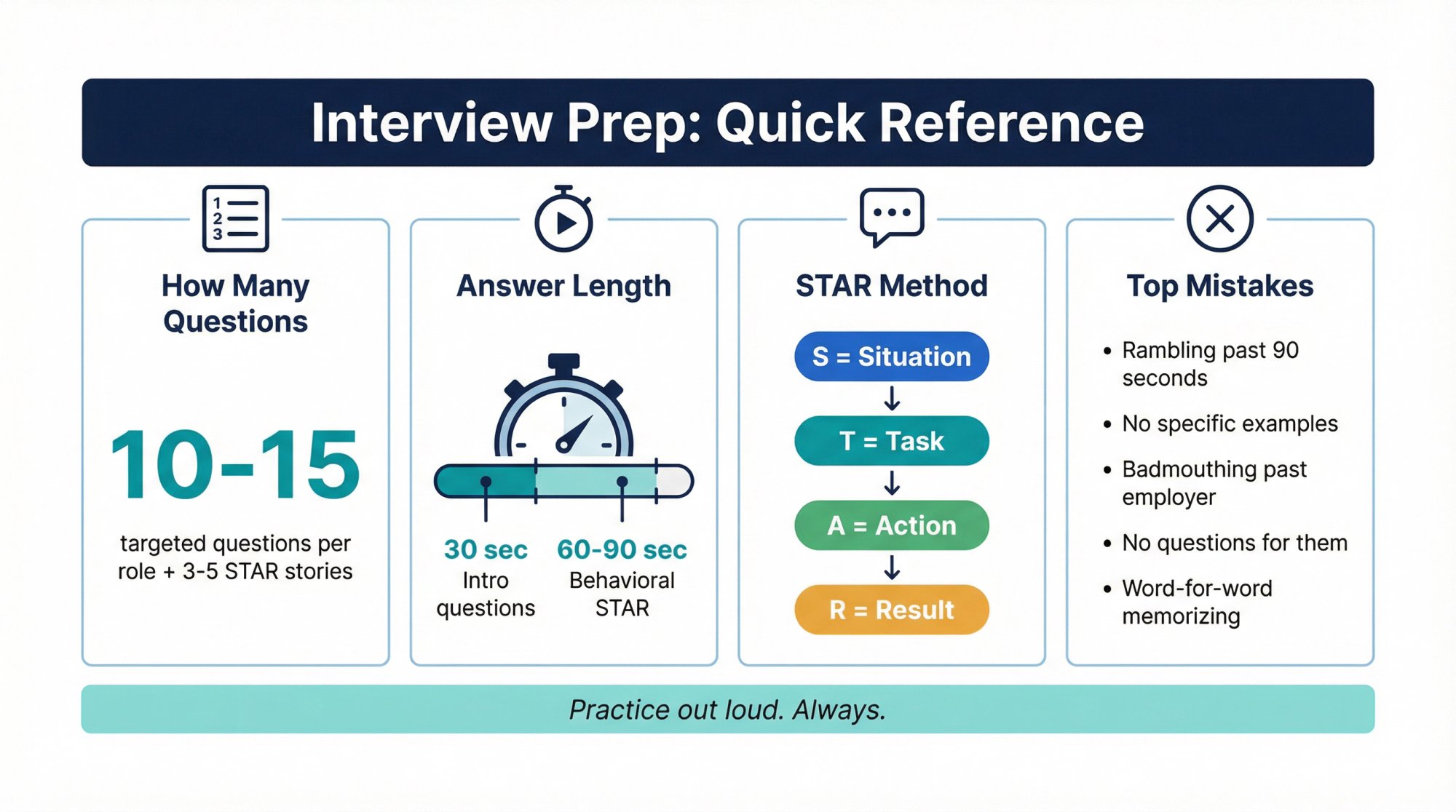
For any "Tell me about a time when..." question, the cleanest format is still STAR: Situation, Task, Action, Result. Harvard Business Review's 2025 piece on the STAR method makes the case that structured, example-based answers consistently beat freestyling, especially when you're nervous. STAR forces you to include the stuff interviewers are actually grading (the action you personally took and the measurable result) while cutting the stuff they don't care about.
3. Keep Most Answers Between 30 and 90 Seconds
Too short feels underprepared. Too long feels unfocused and self-indulgent. A good rule of thumb is 30 seconds for simple intro answers like "Tell me about yourself," and 60 to 90 seconds for behavioral and strength-focused ones. If you haven't made your point by the 90-second mark, you've lost the room.
4. Claim → Proof → Relevance
Never claim a trait you can't prove.
"I'm a strong leader." "I'm great under pressure." "I'm detail-oriented."
These mean absolutely nothing on their own. Every hiring manager has heard them 10,000 times. The pattern that works is claim, proof, relevance:
"I'm strong at cross-functional coordination. In my last role, I rebuilt the handoff between sales and onboarding, which reduced first-week churn by 14%. That matters here because this role sits between customer success and product."
Claim. Evidence. Link to the job. Every answer below follows this shape.
50 Most Common Interview Questions with Sample Answers
A quick framing note before we get into the list: the answers below are intentionally role-flexible. If you're a student, career changer, or early-career applicant, swap full-time work examples for internships, class projects, freelance work, volunteer gigs, or leadership moments from campus. The structure stays the same; only the content changes. Students can also take advantage of AIApply's 40% student discount when preparing for their first interviews.
We've grouped the 50 questions into six natural buckets. Feel free to jump to the section that matches what you're prepping for.
Background and Self-Introduction Questions (Questions 1–6)
This first batch is what almost every interview opens with. They look easy. They're not. These are the questions where most candidates either set themselves up well or quietly lose the room in the first two minutes.

1) Tell me about yourself.
What they're really asking: Can you summarize your story clearly and make it relevant to this role?
AI answer:
"I'm a customer-focused operations professional with four years of experience improving processes, coordinating across teams, and solving workflow bottlenecks. In my current role, I've focused on reducing turnaround times and improving accuracy, most recently helping redesign an intake process that cut delays by 22%. What interests me about this role is the chance to bring that mix of problem-solving and cross-functional collaboration into a faster-growing environment."
Make it stronger: Use a present → past → future structure. Who you are now, what you've done, why this role makes sense next. For a more detailed walkthrough, our guide to answering "Tell me about yourself" in a job interview covers the 30-second version step by step.
2) Walk me through your resume.
What they're really asking: Is your career path coherent, intentional, and relevant?
AI answer:
"I started in support, where I built a strong foundation in customer needs and issue resolution. From there, I moved into operations because I found I was most energized by fixing the systems behind recurring problems. Over the last three years, I've taken on more ownership around reporting, process design, and stakeholder communication. That progression is why this role stood out to me. It combines the customer context I started with and the systems thinking I've developed since."
Make it stronger: Don't recite every bullet on your resume. Highlight the turning points. Interviewers can read. What they can't read is why you made the moves you made. If your resume could use some strengthening before interviews start, AIApply's AI Resume Builder can tailor it to each role in minutes.
3) How would you describe yourself?
What they're really asking: Are you self-aware, and does your self-image match the role?
AI answer:
"I'd describe myself as calm, analytical, and reliable. I tend to be the person who can step back, break down a messy problem, and move it forward without creating drama around it. Colleagues have especially relied on me when priorities shift quickly, because I'm good at staying organized and communicating clearly while things are changing."
Make it stronger: Pick two or three traits only, then back each one up with an example of behavior. "Calm under pressure" is a claim. "I handled a last-minute product launch without a single escalation" is proof.
4) What makes you a strong fit for this role?
What they're really asking: Did you actually read the job description, and can you connect your background to it?
AI answer:
"This role seems to need three things: strong project ownership, clear stakeholder communication, and the ability to improve processes without losing sight of the customer experience. Those are the areas where I've done my best work. In my current position, I manage cross-functional projects, translate needs between teams, and look for repeatable improvements. That combination is why I think I could contribute quickly here."
Make it stronger: Mirror the language of the job description, then translate each requirement into a measurable business outcome you've actually delivered. Our free Job Description Keyword Finder can extract the key terms from any posting so your language mirrors theirs exactly.
5) Why should we hire you?
What they're really asking: Can you make the business case for yourself in one paragraph?
AI answer:
"You should hire me because I can add value quickly in the exact areas this role owns. I have a track record of improving processes, building trust across teams, and staying focused on measurable outcomes. I'm also not coming in with a 'just assign me tasks' mindset. I like understanding what success looks like, taking ownership, and helping the team move faster with less friction."
Make it stronger: Think like a hiring manager for a minute. Why are you lower-risk than the next candidate? Lower-risk usually wins over flashier. A strong AI-optimized resume that echoes the job description gives hiring managers exactly the evidence they need to say yes.
6) What do you know about our company?
What they're really asking: Did you do real research, or are you improvising?
AI answer:
"From what I've read, your company stands out in three ways: the product direction, the customer problem you're solving, and the speed at which the team seems to be evolving. I noticed your recent expansion into enterprise accounts and the emphasis on customer retention, which tells me this role is probably more strategic than transactional. That matters to me because I'm looking for a company where the work has visible business impact, not just output for the sake of output."
Make it stronger: Cite one specific, recent signal: a product launch, a funding round, a new customer segment, a hire on the leadership team. Vague "I love your mission" answers die on contact.
Motivation and Job Fit Questions (Questions 7–12)
This batch is where "why" questions start stacking up. Interviewers ask them in different ways on purpose, because they want to see if your answers hold up under slightly different framings. If you have a real reason for wanting this role, these questions are easy. If you don't, they expose you fast.
7) Why do you want to work here?
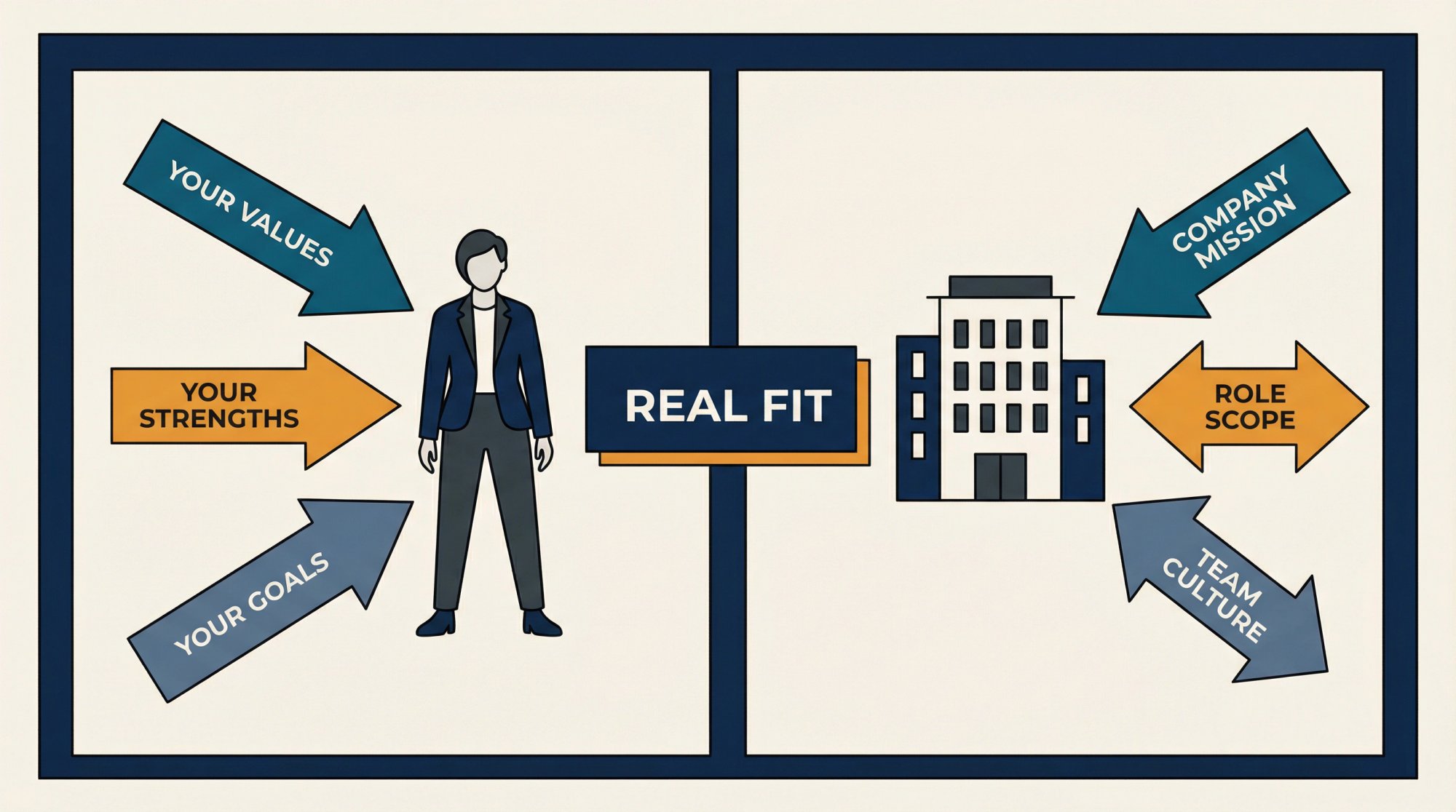
What they're really asking: Is your motivation specific and durable, or did you copy-paste this answer from the last interview?
AI answer:
"I want to work here because the company is solving a problem I think matters, and it's doing it in a way that feels thoughtful rather than superficial. What stands out to me is the combination of product ambition and operational discipline. I'm drawn to teams that are still building, still improving, and still moving fast. This role is appealing because it looks like a place where I could contribute immediately while also growing with the business."
Make it stronger: Use the company → role → you framework. Start with what the company is building, connect it to what the role owns, then prove why you fit. Our full breakdown of how to answer "Why do you want to work here?" goes deeper on this.
8) Why do you want this role?
What they're really asking: Do you understand the actual work, not just the title?
AI answer:
"I want this role because it sits at the intersection of work I'm already good at and work I want to do more of. I'm strongest when I'm solving problems, improving workflows, and helping teams execute more clearly. From the description, this role seems to own exactly that. It also looks like a step up in scope, which matters to me because I'm looking for a role where I can contribute strategically, not just tactically."
Make it stronger: Talk about the work itself, not the perks. "I love your remote policy" isn't a reason.
9) What are your greatest strengths?
What they're really asking: Do your strengths match our needs?
AI answer:
"My two strongest areas are structured problem-solving and communication. I'm good at taking something vague or messy, breaking it down, and building a workable plan. I'm also good at keeping stakeholders aligned while that work is moving. In practice, that has helped me reduce delays, avoid rework, and keep projects from stalling when priorities shift."
Make it stronger: Pick strengths that actually matter for the role, not the ones you're just proud of in general. Attach proof to each one. Before interviews, use our Skills Gap Analyzer to see exactly which of your strengths align with what employers are prioritizing.
10) What is your biggest weakness?
What they're really asking: Are you self-aware, coachable, and improving?
AI answer:
"One area I've worked on is delegating earlier. My instinct used to be to hold onto too much because I wanted to make sure things were done well. Over time, I realized that slows the team down and limits scale. I've gotten better by clarifying ownership earlier, setting clearer checkpoints, and trusting others with execution. That's made me more effective and a better teammate."
Make it stronger: Pick a real weakness, not a disguised strength ("I care too much"). But don't pick one that disqualifies you for the role itself. And always, always talk about what you're doing to improve it.
11) What motivates you?
What they're really asking: What kind of work brings out your best effort?
AI answer:
"I'm most motivated by meaningful progress. I like being able to see that something I worked on made a process cleaner, helped a team move faster, or improved the customer experience in a measurable way. I also stay energized when I'm learning, especially in environments where the pace is high but the standards are still thoughtful."
Make it stronger: Skip vague answers like "success" or "people." Everybody says those. Pick something specific you actually feel about your work.
12) What type of work environment helps you do your best work?
What they're really asking: Will you thrive here, or fight the environment all year?
AI answer:
"I do my best work in environments that are clear on goals, open in communication, and comfortable with ownership. I don't need constant direction, but I do value alignment on priorities and feedback when something needs adjusting. I also enjoy teams that are collaborative but efficient, where people are supportive without overcomplicating decisions."
Make it stronger: Describe a realistic workplace, not a fantasy one. "I thrive when everyone is nice and there are no deadlines" isn't a thing.
Career History and Job Change Questions (Questions 13–16)
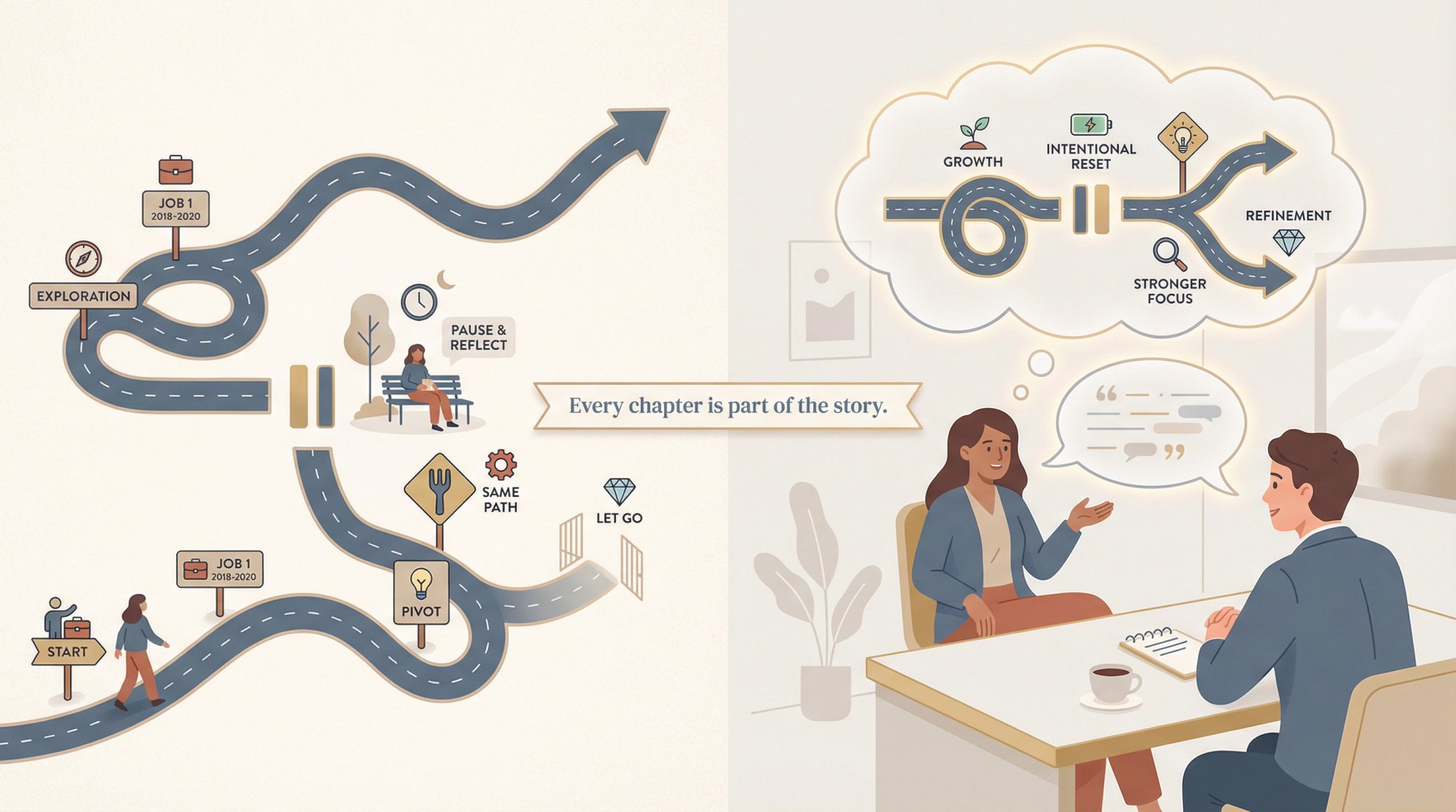
These are the questions most candidates dread. Gaps, firings, and "why are you leaving" questions feel loaded because they are. The good news is that interviewers aren't looking for a perfect story. They're looking for someone who can discuss imperfect things like an adult.
13) Why are you leaving your current job?
What they're really asking: Are you leaving for healthy reasons, and are you likely to stay if we hire you?
AI answer:
"I've learned a lot in my current role, especially around process improvement and stakeholder management, but I've reached a point where growth has become limited. I'm looking for a role with broader scope, more ownership, and a stronger connection between my work and business outcomes. This opportunity feels like a logical next step because it offers both challenge and room to grow."
Make it stronger: Keep it forward-looking. Don't vent about your manager. Ever.
14) Why did you leave your last job?
What they're really asking: Was there a red flag?
AI answer:
"I left because the role had stopped aligning with where I wanted to grow professionally. It was a useful chapter, and I'm grateful for what I learned there, but I wanted to move toward work that involved more ownership and clearer progression. Since then, I've been intentional about targeting roles where my strengths in execution and problem-solving can have more impact."
Make it stronger: Positive, brief, honest. You're not on trial. You're selecting your next chapter.
15) Why is there a gap in your resume?
What they're really asking: Is the gap understandable, and did you handle it well?
AI answer:
"I took that time away intentionally. Part of it was to handle a personal priority, and part of it was to reset and think more carefully about the kind of role I wanted next. During that period, I stayed active by updating my skills, doing independent learning, and sharpening the direction of my job search. I'm now focused, ready, and clear on the value I want to bring in my next role."
Make it stronger: You don't owe a dramatic autobiography. Give enough context to reassure them, then pivot to what you're ready for now. If you updated your resume during a gap, AIApply's AI Resume Rewriter can instantly modernize and tailor it so the gap itself becomes part of a purposeful narrative.
16) Why were you fired?
What they're really asking: Can you take accountability without becoming defensive?
AI answer:
"That experience was difficult, but it taught me a lot. There was a mismatch between expectations and how I was operating at the time, and I take responsibility for my part in that. Since then, I've been much more proactive about clarifying expectations early, communicating progress, and asking for feedback before small issues become larger ones. I've taken the lesson seriously, and it's made me more mature and more effective."
Make it stronger: No blame spiral. No victim script. Just accountability, lesson, evidence of change. If this is the question you dread most, our dedicated guide on how to explain being fired in an interview walks through tone, structure, and specific phrases to avoid.
Pause and practice this block. Questions 13 through 16 are the ones candidates most often flub, not because they're unanswerable, but because they trigger defensiveness. If you've had a layoff, a firing, or a gap, say the answer out loud five times before your interview. Better yet, practice it with our AI-powered Interview Buddy, which listens to your answer live on Zoom, Google Meet, or Microsoft Teams and gives you real-time coaching so you don't freeze when the real question comes.
Work Style and Pressure-Handling Questions (Questions 17–18)
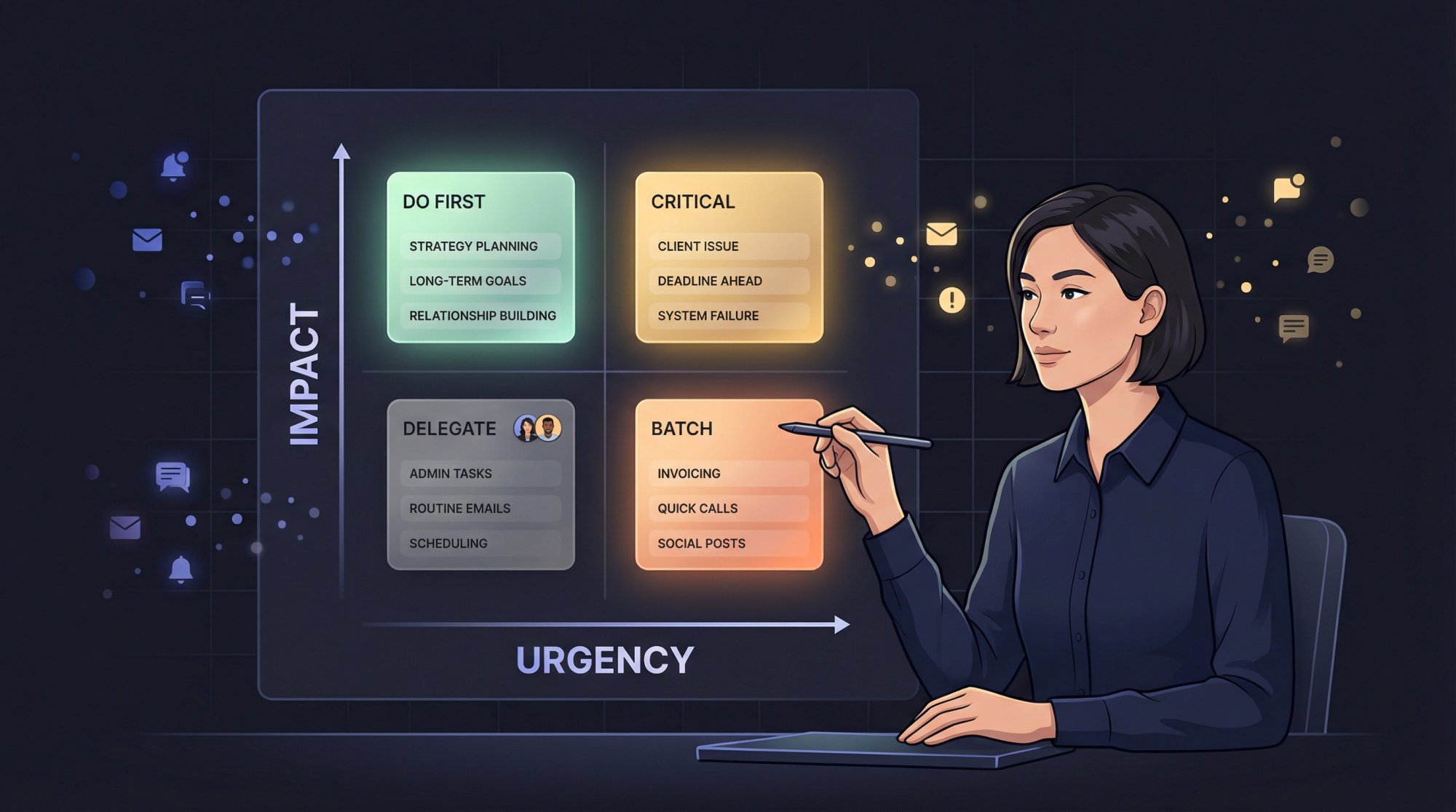
Short section, two of the most commonly asked "how do you operate" questions. These are judgment questions in disguise.
17) How do you prioritize your work?
What they're really asking: Can you handle complexity without dropping the ball?
AI answer:
"I prioritize based on business impact, urgency, and dependency. First I identify what is truly time-sensitive, then what has the biggest downstream effect if it slips, and then what can be bundled or delegated. I also like to confirm priorities early with stakeholders so I'm solving the right problem, not just doing the loudest task first."
Make it stronger: Show that you don't confuse urgent with important. That distinction alone separates strong operators from reactive ones.
18) How do you handle pressure?
What they're really asking: Do you stay useful when stress is high?
AI answer:
"I handle pressure best when I slow down just enough to create structure. In high-pressure situations, I focus on three things: clarifying what matters most, communicating early, and breaking the work into the next few critical steps. Pressure usually gets worse when people panic or go silent. I try to do the opposite. I create visibility, protect quality, and keep moving."
Make it stronger: Pressure tolerance isn't macho language. It's decision quality under strain. Frame it that way.
Behavioral Interview Questions Using the STAR Method (Questions 19–32)
Behavioral territory starts here. Everything from question 19 to question 32 is a "tell me about a time" question, and every single one of them calls for the STAR format. Situation, Task, Action, Result. Always.
One tip before you start: have three to five strong stories ready from your career that you can reshape to answer most of these questions. The same "I rebuilt the intake process" story can answer questions about initiative, process improvement, leadership, and conflict, just by shifting which part you emphasize. Prep the stories, not every individual question. Our free AI Interview Simulator lets you practice these live with instant AI feedback so you nail the delivery, not just the structure.
19) Tell me about a time you faced a difficult challenge.
What they're really asking: Can you solve hard problems without getting stuck?
AI answer:
"In my last role, we had a recurring backlog issue that was frustrating both customers and internal teams. I looked into the causes and found that the real problem wasn't volume alone. It was inconsistent intake criteria and unclear ownership. I built a simpler intake workflow, clarified decision rules, and set up a weekly review. Within six weeks, backlog volume dropped by about 30% and response times improved noticeably."
Make it stronger: Don't just describe the challenge. Show your diagnosis. Interviewers want to see how you think, not just what happened.
20) Tell me about a time you made a mistake.
What they're really asking: Do you own errors and learn fast?
AI answer:
"Early in one project, I assumed a stakeholder was aligned because we had discussed the goal informally. I moved forward too quickly and had to redo part of the work when I realized we weren't aligned on scope. I corrected it by resetting expectations, documenting decisions more clearly, and building a short approval checkpoint into future projects. It was a useful reminder that speed without alignment often creates slower work later."
Make it stronger: Avoid fake mistakes ("I care too much," "I work too hard"). Pick a real one where the fix was concrete.
21) Tell me about a time you failed.
What they're really asking: What happens when things don't go your way?
AI answer:
"I once led an initiative that didn't hit the adoption target we expected. The work itself was solid, but I underestimated how much change management would matter for rollout. Adoption lagged because I focused too much on building the solution and not enough on helping people use it. After that, I became much more deliberate about stakeholder buy-in, training, and feedback loops. The project taught me that a good solution isn't enough if implementation is weak."
Make it stronger: Failure stories are strong when the lesson is specific and operational, not philosophical.
22) Tell me about a time you resolved conflict at work.
What they're really asking: Are you safe to work with?
AI answer:
"I had a situation where another team and ours disagreed on who owned a recurring issue. Rather than keep arguing in Slack, I scheduled a working session and mapped the handoff points together. That made it obvious that the problem was less about effort and more about an unclear process boundary. We agreed on a cleaner ownership split and response standard, which reduced friction and repeat escalations."
Make it stronger: Focus on the resolution, not on who was annoying. Interviewers grade you on your ability to de-escalate, not your side of the argument.
23) Tell me about a time you worked with a difficult person.
What they're really asking: Can you handle friction without becoming friction?
AI answer:
"I worked with a colleague whose communication style was much more abrupt than mine, and early on that created tension. Instead of personalizing it, I tried to understand what they needed to work effectively. I realized they cared most about speed and clarity, so I adjusted by being more direct and more structured in updates. Once we aligned on how to work together, collaboration improved a lot and the project moved faster."
Make it stronger: Never make yourself the saint and them the villain. That's the fastest way to sound difficult yourself.
24) Tell me about a time you showed leadership.
What they're really asking: Do you create direction and momentum, even without a title?
AI answer:
"During a period of team turnover, I stepped in to coordinate a project that didn't yet have clear ownership. I aligned stakeholders, created a timeline, surfaced risks early, and kept updates moving so people could make decisions quickly. We delivered on time, and more importantly, the team had a clearer working rhythm afterward. For me, leadership is less about title and more about reducing confusion and helping people move."
Make it stronger: Leadership doesn't require direct reports. If you've ever reduced confusion and increased momentum, you've led something. If you're targeting a leadership role, check out our Operations Manager resume example or Project Manager resume example for the kind of leadership proof points that resonate with hiring managers in those tracks.
25) Tell me about a time you took initiative.
What they're really asking: Do you wait to be told, or do you improve things proactively?
AI answer:
"I noticed that a weekly report everyone relied on was taking hours to compile manually and still created confusion because the format changed often. I standardized the logic, automated part of the reporting flow, and added a short summary section so the data was easier to interpret. That saved time every week and made the report more useful for actual decision-making."
Make it stronger: Initiative is strongest when it solves a real business problem, not a personal preference.
26) Tell me about a time you improved a process.
What they're really asking: Can you make systems better, not just live inside them?
AI answer:
"One onboarding workflow had too many handoffs and too little clarity, which caused delays and duplicate work. I mapped the process, found the bottlenecks, and simplified the approval path. I also created a checklist so each step was clearer and less dependent on memory. The result was faster turnaround, fewer follow-ups, and a smoother experience for both the internal team and the customer."
Make it stronger: Process answers are stronger when they show diagnosis, not just action. Anyone can change a workflow. Good operators diagnose why it was broken first. A strong Business Analyst resume or Operations Manager resume demonstrates this diagnostic thinking to hiring managers before you even get to the interview.
27) Tell me about a time you managed competing priorities.
What they're really asking: Can you stay strategic when everything feels urgent?
AI answer:
"At one point I was supporting a time-sensitive launch while also handling a recurring reporting cycle and an escalation from a major account. I triaged the work based on impact and deadlines, aligned with my manager on what could move, and communicated realistic timelines instead of pretending everything would happen at once. By being transparent early and protecting the highest-impact work first, I got the critical pieces done without creating avoidable surprises."
Make it stronger: The signal here is judgment, not hustle. Show that you made hard trade-offs deliberately.
28) Tell me about a time you worked under a tight deadline.
What they're really asking: Can you move fast without losing quality?
AI answer:
"We had a last-minute client request that compressed a project timeline significantly. I quickly broke the work into must-have and nice-to-have pieces, reassigned ownership where needed, and set tighter communication checkpoints so blockers surfaced early. We met the deadline, and although the pace was intense, the work held up because we simplified intelligently instead of trying to do everything at once."
Make it stronger: Show how you protected quality. Anyone can meet a deadline. Few people do it without the work falling apart.
29) Tell me about a time you learned something quickly.
What they're really asking: How fast can you get effective in unfamiliar territory?
AI answer:
"I had to get up to speed on a new platform with very little ramp time because the person who usually handled it was unavailable. I focused first on the core workflows, documented what I learned, and asked targeted questions instead of broad ones. Within a short period, I was able to manage the work independently and later shared the documentation so the team had a better backup system going forward."
Make it stronger: Show your learning process, not just the result. "I figured it out fast" is a claim. "I focused on the 20% of the platform that handled 80% of the work" is proof.
30) Tell me about a time you received difficult feedback.
What they're really asking: Are you coachable, or fragile?
AI answer:
"I once received feedback that my updates were thorough but too detailed for senior stakeholders. That was hard to hear at first because I was trying to be helpful, but the feedback was fair. I adjusted by separating executive summaries from detailed notes and being clearer on what each audience actually needed. The result was better alignment and faster decisions, and it improved how I communicate across levels."
Make it stronger: The best answers show behavior change, not just emotional acceptance of the feedback.
31) Tell me about a time you persuaded someone.
What they're really asking: Can you influence without authority?
AI answer:
"I wanted to change a reporting process that people were used to, and there was understandable resistance because the old version felt familiar. Instead of pushing harder, I showed where the old process was creating delays and presented a simpler alternative with a small pilot. Once people saw that the new approach saved time and reduced confusion, adoption became much easier."
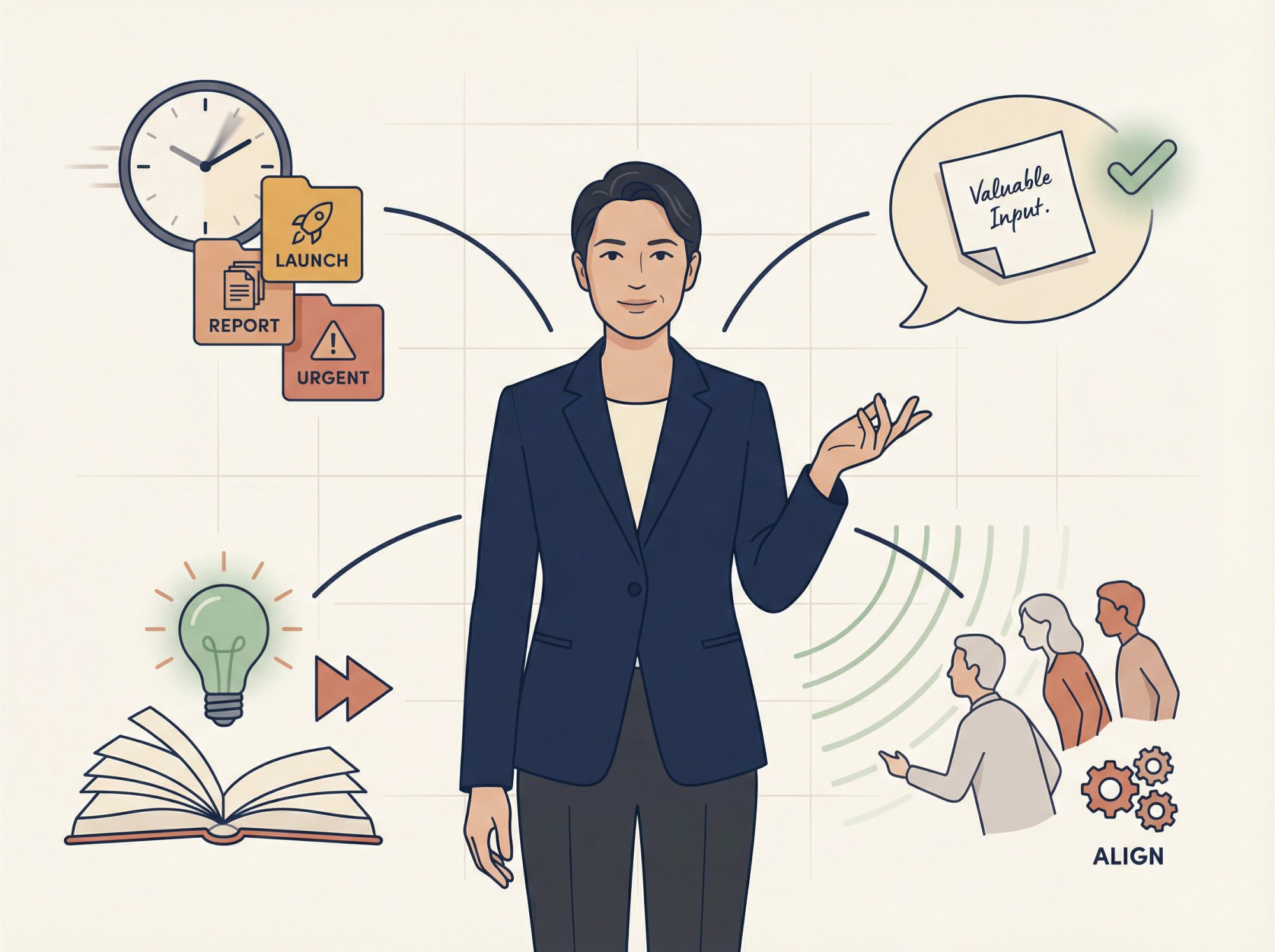
Make it stronger: Persuasion answers are strongest when they're evidence-based, not charisma-based.
32) Tell me about a time you adapted to change.
What they're really asking: Are you rigid, or resilient?
AI answer:
"In a previous role, priorities shifted significantly after a leadership change, and a project I had been driving had to be reframed almost overnight. Instead of getting attached to the original plan, I stepped back, re-evaluated the new goals, and adjusted the execution plan to fit the updated direction. That experience made me better at separating ego from outcome and focusing on what the business needs now."
Make it stronger: Adaptability isn't passive. It's intelligent recalibration. Make sure your answer sounds active.
Achievement and Self-Awareness Questions (Questions 33–40)
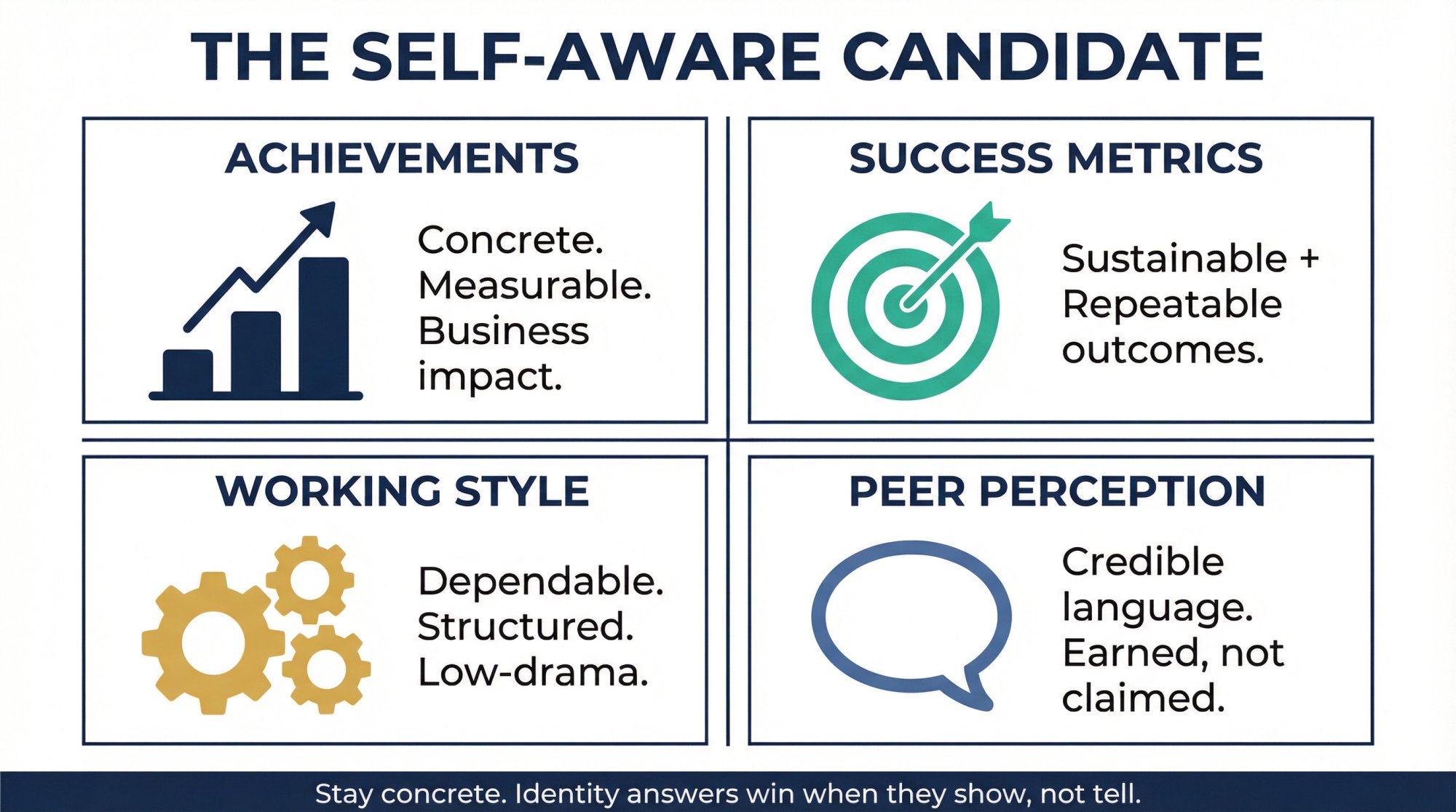
These questions are about identity and working style. Interviewers are trying to figure out what you value, what you're proud of, and how you operate day to day. A lot of candidates get philosophical here. Don't. Stay concrete.
33) What's your greatest professional achievement?
What they're really asking: What kind of impact are you proud of?
AI answer:
"My proudest achievement was leading a workflow improvement initiative that reduced turnaround time and improved cross-team clarity at the same time. I'm proud of it not just because the numbers improved, but because it solved a frustration people had been living with for a long time. It was one of those projects where better thinking created better results for both the business and the people doing the work."
Make it stronger: Pick an achievement with measurable impact. A number makes it real. If you're a data professional, our Data Analyst resume example shows exactly how to quantify analytics achievements in a way that resonates with hiring managers.
34) Describe a project you're most proud of.
What they're really asking: What kind of work do you do best?
AI answer:
"I'm most proud of a project where I helped redesign a broken handoff between teams. It was messy at the start because everyone had a different view of the problem, but I like that kind of ambiguity when there's a real opportunity to improve things. By the end, we had a clearer workflow, better accountability, and fewer downstream issues. It stands out to me because it required analysis, communication, and execution all at once."
Make it stronger: Pride signals identity. Pick something that reveals how you work, not just what you delivered.
35) How do you define success?
What they're really asking: What do you optimize for?
AI answer:
"I define success as creating meaningful outcomes in a way that's sustainable and repeatable. It's not just about hitting a number once. It's about building trust, improving the process, and leaving the team stronger than before. In most roles, that means combining results with reliability."
Make it stronger: Avoid purely personal definitions ("success is happiness"). Tie success to business value interviewers can relate to.
36) What would your manager say about you?
What they're really asking: How are you actually experienced by other people?
AI answer:
"I think my manager would say I'm dependable, thoughtful, and low-drama. When something is ambiguous or high-pressure, I'm usually someone they can trust to bring structure and move it forward. They'd probably also say I ask good questions early, which helps prevent misalignment later."
Make it stronger: Use credible language. "They'd say I'm amazing at everything" instantly loses you the room.
37) How do you stay organized?
What they're really asking: Do you have a real system, or just good intentions?
AI answer:
"I stay organized by keeping a small number of priority buckets visible at all times rather than maintaining one giant list that becomes noise. I review deadlines, dependencies, and stakeholder expectations at the start of the week, then re-prioritize daily as needed. The system matters less than consistency. I make sure I always know what is due, what matters most, and what could block progress."
Make it stronger: Specific beats fancy. Interviewers want a real, repeatable system, not buzzwords about tools. Our free Job Application Tracker uses the same logic, track what matters and eliminate the noise, which is also a good mental model to reference in this answer.
38) What do you do when you don't know something?
What they're really asking: Are you honest, resourceful, and calm under uncertainty?
AI answer:
"If I don't know something, I'm straightforward about it and then move quickly into problem-solving mode. I usually clarify exactly what needs to be answered, gather the most relevant information, and check assumptions before acting. I think it's far better to be transparently thoughtful than confidently wrong."
Make it stronger: Confidence isn't pretending to know. Confidence is being calm while you figure it out.
39) How do you make decisions with incomplete information?
What they're really asking: Can you make judgment calls under real-world conditions?
AI answer:
"I start by identifying what information is essential versus nice to have. Then I look at the downside risk of waiting versus acting, gather the best available signal, and make a decision that can be adjusted if new data appears. In fast-moving environments, perfect information usually doesn't exist. What matters is making reasoned decisions with clear assumptions and staying willing to update them."
Make it stronger: This is a judgment question, not an IQ puzzle. Show your reasoning framework, not your cleverness.
40) How do you stay current in your field?
What they're really asking: Are you actively improving, or standing still?
AI answer:
"I stay current through a mix of structured and practical learning. I follow industry newsletters and credible operators, but I also try to connect what I'm reading to real work so it becomes usable rather than just interesting. If I notice a recurring trend, tool, or tactic affecting my area, I usually test it in a low-risk way before deciding whether it's actually valuable."
Make it stronger: Show curiosity plus discernment. "I read everything" isn't a strategy.
Career Goals and AI Questions (Questions 41–44)
This batch is increasingly common in 2026 because employers genuinely care about how you use AI and where your career is heading. If you haven't thought about question 41 specifically, stop and think about it before your next interview. It's no longer optional.

41) How do you use AI in your work?
What they're really asking: Are you AI-literate, responsible, and productive?
AI answer:
"I use AI as a force multiplier, not a substitute for judgment. It's useful for first drafts, summarizing information, brainstorming options, and speeding up repetitive tasks, but I still validate accuracy, tailor the output, and make the final decisions myself. My goal is to use it to move faster on low-leverage work so I can spend more time on the thinking, prioritization, and communication that still require human context."
Make it stronger: This question matters more every month. LinkedIn's 2025 recruiting research shows AI adoption is rising fast in hiring itself, and employers want people who can use these tools responsibly, not people who are either allergic to them or who blindly trust their output. Hit both the productivity angle and the human-oversight angle.
42) Where do you see yourself in five years?
What they're really asking: Are your ambitions aligned with a path we can realistically offer?
AI answer:
"In five years, I want to be in a role where I've deepened my expertise, taken on more ownership, and become known for delivering high-quality work in an area that matters to the business. I'm ambitious, but I'm not attached to a title-for-title's-sake story. What matters most is growing into someone who can solve bigger problems, support others, and create measurable value."
Make it stronger: Ambition is good. Delusion is not. Don't answer "CEO" unless you're applying to a company where that is plausible. Understanding what roles typically evolve to from your current position can help frame this answer, and our career path guides map progression timelines and required skills for dozens of roles.
43) What are your career goals?
What they're really asking: Are you intentional, and will this role move you forward?
AI answer:
"My near-term goal is to keep building depth in this function while increasing the scope of problems I can own independently. Longer term, I want to be someone who combines strong execution with strategic thinking, whether that leads into senior individual contributor work or people leadership. Right now, I'm focused on getting into the right environment to build that foundation."
Make it stronger: Keep the timeline believable and the path flexible.
44) What are you looking for in your next role?
What they're really asking: Does this job actually match your real priorities?
AI answer:
"I'm looking for a role where expectations are clear, ownership is real, and the work has visible impact. I want to be on a team that values thoughtful execution, moves with purpose, and gives people room to grow by taking on meaningful problems. I'm also looking for a role that stretches me, not just one that feels comfortable on day one."
Make it stronger: This is about alignment, not a wishlist. Frame your needs in a way that benefits the employer too.
End-of-Interview Logistics Questions (Questions 45–50)
You made it to the final batch. These are the end-of-interview questions. They feel procedural, but they often decide whether you get the offer or the "we went with someone else" email. Interviewers remember how you closed.
45) Are you interviewing with other companies?
What they're really asking: How active is your search, and how interested are you in us specifically?
AI answer:
"Yes, I'm in conversation with a few companies, but I'm being selective. I'm not looking to make a move just to make one. I'm focused on roles where the scope, team, and growth opportunity genuinely make sense. That's why I've been thoughtful about where I invest time, and this role is one I'm taking seriously."
Make it stronger: Calm confidence. No games. Never lie about having other offers if you don't. If you want to build genuine interview pipeline, AIApply's Auto Apply can submit tailored applications to hundreds of relevant roles so you actually have options in play.
46) What are your salary expectations?
What they're really asking: Are your expectations aligned with our budget, and can you handle money conversations like a professional?
AI answer:
"Based on the scope of the role, the level of responsibility, and the market range for similar positions, I'm targeting a range of [X to Y]. That said, I'm flexible depending on the full package, including bonus, equity, benefits, and growth opportunity. I'd also be happy to hear the range budgeted for the role so we can see whether we're aligned."
Make it stronger: Research market value before you walk in, give a range rather than a single number, and when possible delay or reverse the question in early rounds. By the final round, though, you should be ready to discuss compensation clearly and confidently. Use our free Salary Expectation Calculator to build a defensible range before your interview, or check our comprehensive guide to salary negotiation for the exact phrasing we recommend for each round. Our final interview prep guide also covers compensation conversations in detail.
47) When can you start?
What they're really asking: How fast can you join, and how professionally will you transition?
AI answer:
"I can start as soon as I complete a professional handoff with my current employer. I want to be respectful and leave things in good shape, so my timeline would likely be about [X weeks], though I'm happy to discuss what the team needs and see whether there's flexibility."
Make it stronger: Don't sound desperate ("I can start tomorrow!") or careless ("whenever"). Both hurt you.
48) What would your first 30, 60, and 90 days look like?
What they're really asking: Can you think like someone already in the seat?
AI answer:
"In the first 30 days, I'd focus on learning: the product, the team, the workflows, the metrics, and where the biggest friction points are. By 60 days, I'd want to be contributing independently on core responsibilities and identifying a few quick wins based on what I've learned. By 90 days, I'd aim to be fully operational, trusted by stakeholders, and improving at least one meaningful area of the role rather than just maintaining it."
Make it stronger: Our final interview guide nails the structure here: learning first, contribution second, optimization third. Don't walk in on day one promising to redesign their business. That lands badly.
49) Do you have any questions for us?
What they're really asking: Are you engaged, thoughtful, and evaluating us seriously?
AI answer:
"Yes, I do. I'd love to understand what success looks like in this role during the first 90 days, what the biggest challenges are right now, and how this team works cross-functionally when priorities change. I'd also be curious about what tends to separate people who do well here from people who struggle."
Make it stronger: Penn State's Business Career Center recommends preparing three to five meaningful questions, and they're right that some interviewers weigh question quality heavily in their final decision. Never answer this one with "No, I think you covered everything." It's the cheapest unforced error in interviewing.

50) Is there anything else you'd like us to know?
What they're really asking: Can you close strongly and fill any gaps?
AI answer:
"The main thing I'd want to leave you with is that I care a lot about doing useful work well. I'm someone who learns quickly, takes ownership seriously, and tries to make the team better, not just complete my own tasks. If hired, I'd bring a thoughtful, low-ego, high-accountability approach, and I'd be excited to apply that here."
Make it stronger: Treat this as your closing argument, not a recap of the whole interview. One strong, concise note that sums up why you are the right choice.
Best Questions to Ask the Interviewer at the End of an Interview
When they ask "Do you have any questions for us?", don't waste the moment. It's often the most revealing part of the interview for both sides. Here are five strong options you can adapt:
→ "What does success look like in this role in the first 90 days?"
→ "What are the biggest problems you want this person to solve?"
→ "How does this team make decisions when priorities conflict?"
→ "What tends to separate strong performers here from average ones?"
→ "What are the next steps in the process?"
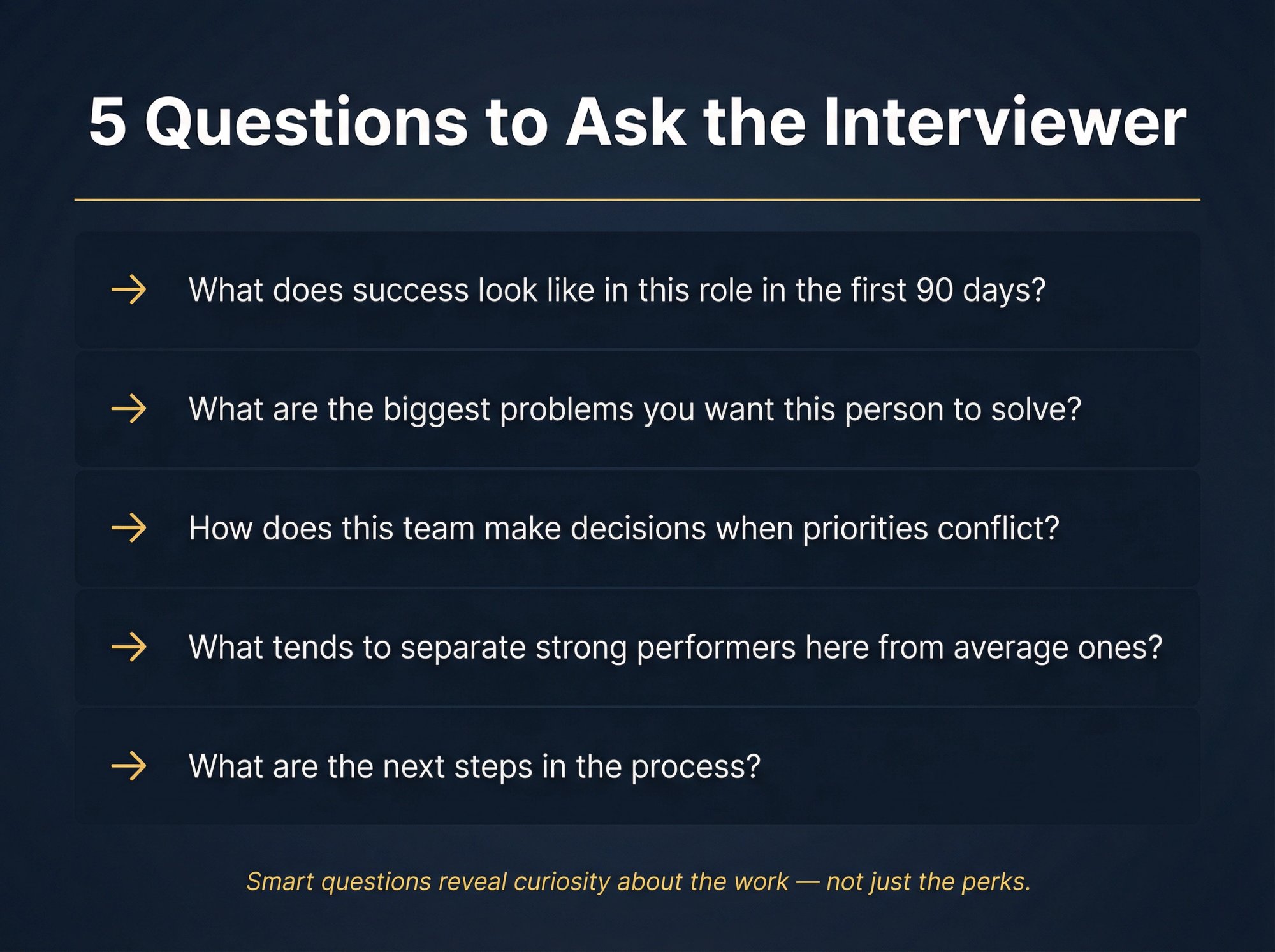
These work because they help you evaluate the role while also signaling that you think about ownership, culture, and decision-making. Penn State's 2025 interview guidance explicitly recommends role-focused questions like these and warns against asking anything you could have found on the company website. The rule of thumb: questions should reveal curiosity about the work, not just the perks. Our free Interview Question Generator can also surface smart, role-specific questions you might not think to ask on your own.
Common Mistakes Candidates Make When Using AI for Interview Prep
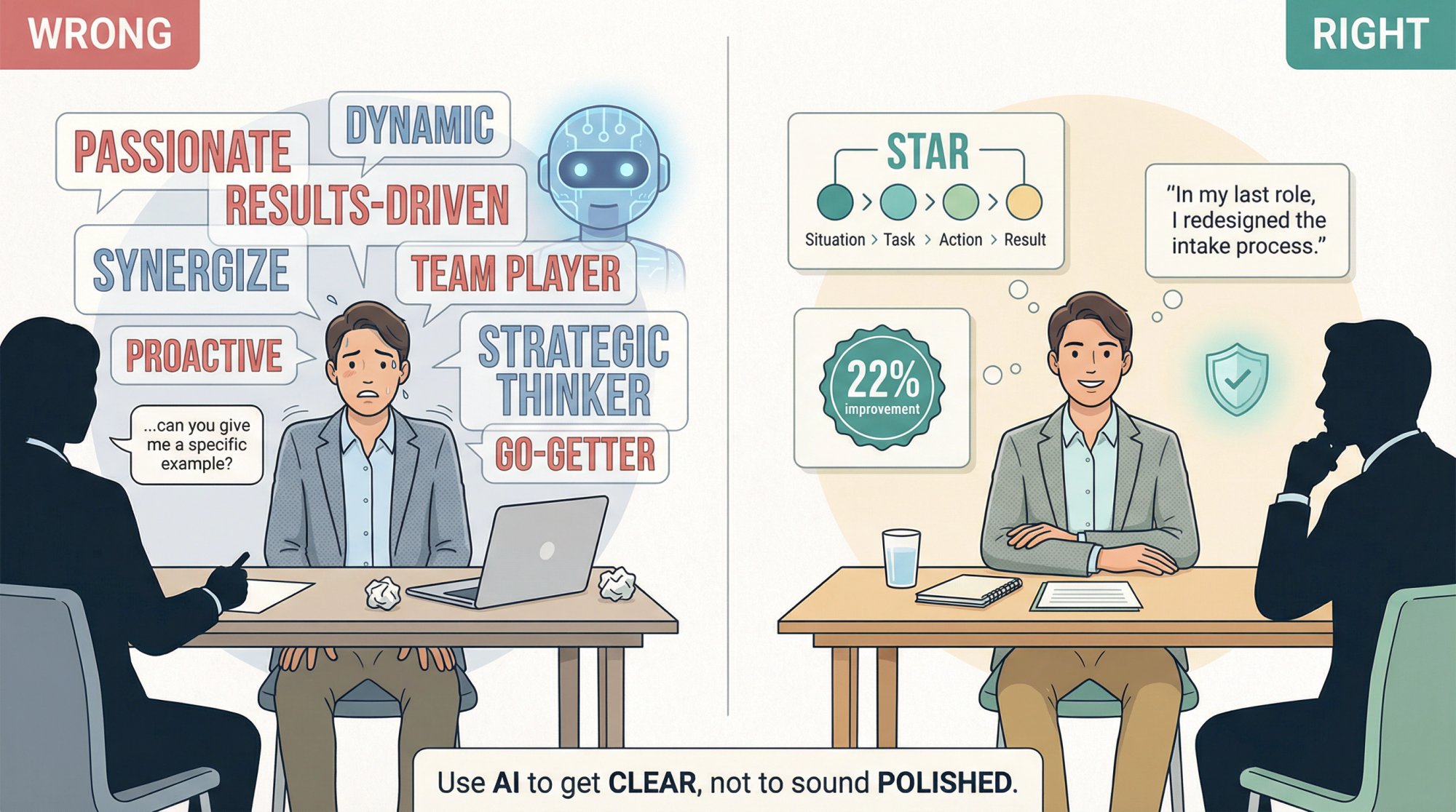
Here's the trap we see most often: candidates use AI to sound polished instead of using AI to get clear.
That's backwards.
A strong interview answer sounds like a sharper, better-organized version of you, based on your real experience, adapted to the exact company and role in front of you. A weak AI answer sounds vague, overwritten, stuffed with words like "passionate," "dynamic," and "results-driven," and completely impossible to believe because it contains no specifics. The difference is huge, and hiring managers hear it instantly.
The safest rule is simple:
Never say anything in an interview that you couldn't defend with a follow-up question.
If you'd panic when the interviewer asks "Can you give me a specific example of that?", the sentence is too vague. Tighten it until you could answer the follow-up in your sleep.
How to Practice Interview Questions and Actually Improve
Reading answers is useful. Practicing them out loud is what actually changes outcomes. There's a massive gap between "I know the right answer" and "I can deliver that answer calmly when a hiring manager at my dream company is staring at me on Zoom."
That gap is exactly where AIApply fits in.
We built two tools specifically for this workflow, and together they turn this guide from passive reading into active preparation:
| Tool | What it does | When to use it | Where it lives |
|---|---|---|---|
| AI Mock Interview | Generates a tailored mock interview from any job description or job post URL, asks you role-specific questions, and gives instant feedback on your answers | Days before your interview, when you are practicing and refining | Runs inside AIApply, takes 15 to 30 minutes per session |
| Interview Buddy | Listens to questions during a live interview on Zoom, Google Meet, or Microsoft Teams, and shows personalized answer suggestions live on your screen | During the real interview, for on-the-spot support | Runs as a desktop app on Windows and macOS with a one-click hide button |
Our Mock Interview has been used by over a million job seekers and carries a 4.8-star rating from 250,000 reviews. It works for any role, from entry-level to executive, and you can run a complete mock session in roughly 15 to 30 minutes. The core loop is: paste the job description, answer the tailored questions the AI generates, read the feedback, refine, repeat. That's the fastest way we know to turn "I sort of have an answer" into "I can deliver this one cold."
Interview Buddy is the other half. It gives you a safety net during the real interview. It transcribes the interviewer's questions in real time and suggests personalized answers based on your resume and the job description you uploaded. One click hides everything before a screen share, so your interviewer never sees it. Think of it as having a career coach whispering in your ear, except the coach has read the job description more carefully than you did.
A simple five-step workflow you can run with this article starting today:
① Paste the job description into our Mock Interview tool.
② Practice your answers to the 10 questions from this guide most likely to come up for that specific role.
③ Tighten every answer until it has proof, not just claims. Every answer should be defensible with a follow-up question.
④ Use Interview Buddy during the real interview if you want real-time support for tough questions.
⑤ Review your answers afterward and improve the weak spots before your next round.
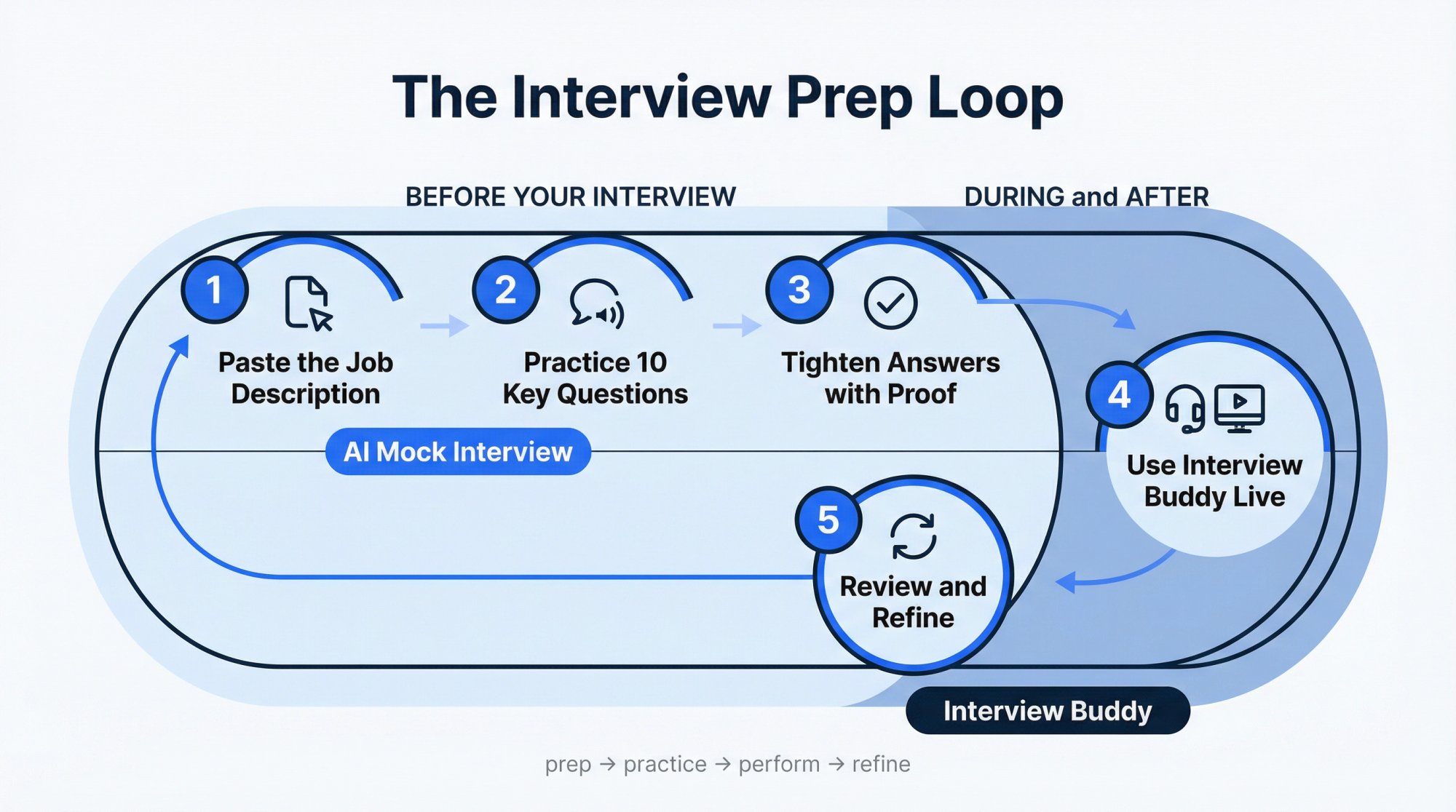
That's the closed loop: prep, practice, perform, refine. Repeat it across a few interviews and you'll notice a different kind of calm walking in. Not because the questions got easier, but because you actually know your answers.
Frequently Asked Questions About Interview Preparation
We get these questions constantly from job seekers using AIApply for interview prep. Here are the straight answers.
How many common interview questions should I actually prepare for?
Preparing for all 50 in this guide is overkill for a single interview. A realistic target is to have strong answers to the 10 to 15 questions most likely for your specific role and level, plus three to five strong STAR stories you can reshape to fit any behavioral question. Quality beats quantity, especially because most interviews only cover 8 to 12 questions total.
What's the best way to practice common interview questions?
Out loud. Always out loud. Silent preparation in your head creates a false sense of readiness because your brain skips the hard parts ("um," "wait, let me rephrase that," panic). Speaking your answers out loud forces real delivery. Better still, practice with an AI tool that gives you feedback, like our AI Mock Interview, or with a friend who can ask follow-ups. The worst practice method is re-reading your notes the morning of. Our interview practice online guide also covers the best formats and approaches for different interview stages.
Can I use AI to answer interview questions in real time during the interview?
Yes, and job seekers do it constantly now. Our Interview Buddy is designed specifically for this. It works on Zoom, Google Meet, and Microsoft Teams, transcribes questions live, and gives you personalized answer suggestions on screen. There's a one-click hide feature before screen sharing, so the interviewer never sees it. It's especially useful for curveball behavioral questions and anything unexpected.
How long should my interview answers be?
For most questions, aim for 30 to 90 seconds. "Tell me about yourself" should land around 30 seconds. Behavioral STAR answers usually run 60 to 90 seconds because they need context and a result. Anything longer than two minutes and the interviewer is probably tuning out or planning their next question.
What are the most common interview mistakes candidates make?
The top five, in order:
Rambling past the 90-second mark
Failing to give specific examples
Badmouthing a former employer
Asking "No, I think you covered everything" when they offer questions
Memorizing answers so heavily that you can't adjust when the question shifts slightly
Every one of these is avoidable with honest practice.
Should I memorize my answers to interview questions word for word?
No. Memorized answers sound memorized, and the second the interviewer phrases the question slightly differently than you rehearsed, you freeze. Memorize the structure (STAR, claim-proof-relevance) and the key data points (numbers, names, outcomes) instead. Let the actual wording come naturally each time. That's how you sound confident but human.
How do I handle an interview question I'm not prepared for?
Buy yourself a few seconds. Say "That's a great question, let me think about that for a moment." Then use a framework. For behavioral questions, default to STAR. For opinion questions, acknowledge the trade-off, pick a side, and justify it. The interviewer is watching your thinking process, not just your answer, so composure under uncertainty often impresses more than a perfect rehearsed response.
What is the STAR method and when should I use it?
STAR stands for Situation, Task, Action, Result. Use it for any behavioral question that starts with "Tell me about a time when..." or "Describe a situation where..." Harvard Business Review's 2025 article on STAR walks through the structure in detail, but the short version is: set the scene quickly, explain your role, spend most of your airtime on the specific actions you took, and end with a measurable result. Skip any of the four steps and the answer falls flat.
Where can I find more AIApply interview prep resources?
Our full interview-prep library covers the specific questions most people struggle with. The deepest guides are on how to answer "Tell me about yourself", how to answer "Why do you want to work here?", how to explain being fired in an interview, and how to prepare for a final interview. Pair any of those with our Mock Interview and Interview Buddy and you have a complete prep system.
Final Tips to Remember Before Your Interview
The best interview answer isn't the most impressive one. It isn't the most polished. It isn't the one that uses the most buzzwords.
It's the one that makes the hiring manager lean back, nod slightly, and think:
"I can picture this person actually doing the job."
That's the real standard. Everything in this guide, every blueprint, every "make it stronger" tip, every STAR story, is in service of that one sentence.
Use these 50 common interview questions to build answers that are clear, specific, and believable. Customize them with your real experience, your real numbers, and the real job description in front of you. Practice them out loud with our Mock Interview until the words feel natural. Then walk in calm, knowing you have Interview Buddy as a safety net if you need it.
Most interview guides do the same thing. They hand you a pile of questions, slap some generic advice on top ("be confident," "be yourself," "smile more"), and leave you to figure out the actual answers by yourself at 11pm the night before.
That doesn't work anymore.
Hiring in 2026 is sharper, faster, and more evidence-driven than it used to be. LinkedIn's Future of Recruiting report shows that 93% of talent professionals believe accurately assessing a candidate's skills is crucial to quality of hire, and AI is now being actively integrated or tested in roughly 37% of recruiting organizations, up from 27% a year earlier. On the competency side, the NACE Job Outlook 2025 research ranks communication, critical thinking, and teamwork as the top career-readiness skills employers want to see. In plain English: interviewers aren't grading your likability. They're grading how you think, how you solve problems, and how clearly you can connect your past to their future.
This guide is built for that reality.
Below, we break down the 50 most common interview questions you should actually prepare for, with AI-quality sample answers, the "real question behind the question," and a one-line tip to make each answer stronger. These answers are deliberately flexible so you can adapt them to your own role, industry, and level. We (AIApply) built this guide from our own 2026 interview-prep library plus current research on hiring trends, so it reflects how interviews actually flow today, not how they worked five years ago.
One promise: you won't find generic "passion and drive" fluff here. You'll find blueprints you can customize and use tomorrow.
A quick note before you read on: the goal isn't to memorize these answers. Memorized answers sound memorized, and hiring managers tune them out within 10 seconds. Treat these as scaffolding. Add your real numbers, your real stories, and the exact job description you're prepping for. That's the version that actually works.
How to Answer Interview Questions Without Sounding Scripted
Before we get into the 50 questions, lock in these four rules. Every answer below is built on them.
1. Answer the Question Behind the Question
Interviewers rarely care about the literal question. They're testing signal. When they ask "Tell me about a time you failed," they're not collecting trivia. They want to know whether you take ownership, whether you learn, and whether you're safe to work with when things go sideways.
Before you answer any question, take half a second and ask yourself: what are they actually trying to find out? Then answer that.
2. Use the STAR Structure for Behavioral Questions
For any "Tell me about a time when..." question, the cleanest format is still STAR: Situation, Task, Action, Result. Harvard Business Review's 2025 piece on the STAR method makes the case that structured, example-based answers consistently beat freestyling, especially when you're nervous. STAR forces you to include the stuff interviewers are actually grading (the action you personally took and the measurable result) while cutting the stuff they don't care about.
3. Keep Most Answers Between 30 and 90 Seconds
Too short feels underprepared. Too long feels unfocused and self-indulgent. A good rule of thumb is 30 seconds for simple intro answers like "Tell me about yourself," and 60 to 90 seconds for behavioral and strength-focused ones. If you haven't made your point by the 90-second mark, you've lost the room.
4. Claim → Proof → Relevance
Never claim a trait you can't prove.
"I'm a strong leader." "I'm great under pressure." "I'm detail-oriented."
These mean absolutely nothing on their own. Every hiring manager has heard them 10,000 times. The pattern that works is claim, proof, relevance:
"I'm strong at cross-functional coordination. In my last role, I rebuilt the handoff between sales and onboarding, which reduced first-week churn by 14%. That matters here because this role sits between customer success and product."
Claim. Evidence. Link to the job. Every answer below follows this shape.
50 Most Common Interview Questions with Sample Answers
A quick framing note before we get into the list: the answers below are intentionally role-flexible. If you're a student, career changer, or early-career applicant, swap full-time work examples for internships, class projects, freelance work, volunteer gigs, or leadership moments from campus. The structure stays the same; only the content changes. Students can also take advantage of AIApply's 40% student discount when preparing for their first interviews.
We've grouped the 50 questions into six natural buckets. Feel free to jump to the section that matches what you're prepping for.
Background and Self-Introduction Questions (Questions 1–6)
This first batch is what almost every interview opens with. They look easy. They're not. These are the questions where most candidates either set themselves up well or quietly lose the room in the first two minutes.
1) Tell me about yourself.
What they're really asking: Can you summarize your story clearly and make it relevant to this role?
AI answer:
"I'm a customer-focused operations professional with four years of experience improving processes, coordinating across teams, and solving workflow bottlenecks. In my current role, I've focused on reducing turnaround times and improving accuracy, most recently helping redesign an intake process that cut delays by 22%. What interests me about this role is the chance to bring that mix of problem-solving and cross-functional collaboration into a faster-growing environment."
Make it stronger: Use a present → past → future structure. Who you are now, what you've done, why this role makes sense next. For a more detailed walkthrough, our guide to answering "Tell me about yourself" in a job interview covers the 30-second version step by step.
2) Walk me through your resume.
What they're really asking: Is your career path coherent, intentional, and relevant?
AI answer:
"I started in support, where I built a strong foundation in customer needs and issue resolution. From there, I moved into operations because I found I was most energized by fixing the systems behind recurring problems. Over the last three years, I've taken on more ownership around reporting, process design, and stakeholder communication. That progression is why this role stood out to me. It combines the customer context I started with and the systems thinking I've developed since."
Make it stronger: Don't recite every bullet on your resume. Highlight the turning points. Interviewers can read. What they can't read is why you made the moves you made. If your resume could use some strengthening before interviews start, AIApply's AI Resume Builder can tailor it to each role in minutes.
3) How would you describe yourself?
What they're really asking: Are you self-aware, and does your self-image match the role?
AI answer:
"I'd describe myself as calm, analytical, and reliable. I tend to be the person who can step back, break down a messy problem, and move it forward without creating drama around it. Colleagues have especially relied on me when priorities shift quickly, because I'm good at staying organized and communicating clearly while things are changing."
Make it stronger: Pick two or three traits only, then back each one up with an example of behavior. "Calm under pressure" is a claim. "I handled a last-minute product launch without a single escalation" is proof.
4) What makes you a strong fit for this role?
What they're really asking: Did you actually read the job description, and can you connect your background to it?
AI answer:
"This role seems to need three things: strong project ownership, clear stakeholder communication, and the ability to improve processes without losing sight of the customer experience. Those are the areas where I've done my best work. In my current position, I manage cross-functional projects, translate needs between teams, and look for repeatable improvements. That combination is why I think I could contribute quickly here."
Make it stronger: Mirror the language of the job description, then translate each requirement into a measurable business outcome you've actually delivered. Our free Job Description Keyword Finder can extract the key terms from any posting so your language mirrors theirs exactly.
5) Why should we hire you?
What they're really asking: Can you make the business case for yourself in one paragraph?
AI answer:
"You should hire me because I can add value quickly in the exact areas this role owns. I have a track record of improving processes, building trust across teams, and staying focused on measurable outcomes. I'm also not coming in with a 'just assign me tasks' mindset. I like understanding what success looks like, taking ownership, and helping the team move faster with less friction."
Make it stronger: Think like a hiring manager for a minute. Why are you lower-risk than the next candidate? Lower-risk usually wins over flashier. A strong AI-optimized resume that echoes the job description gives hiring managers exactly the evidence they need to say yes.
6) What do you know about our company?
What they're really asking: Did you do real research, or are you improvising?
AI answer:
"From what I've read, your company stands out in three ways: the product direction, the customer problem you're solving, and the speed at which the team seems to be evolving. I noticed your recent expansion into enterprise accounts and the emphasis on customer retention, which tells me this role is probably more strategic than transactional. That matters to me because I'm looking for a company where the work has visible business impact, not just output for the sake of output."
Make it stronger: Cite one specific, recent signal: a product launch, a funding round, a new customer segment, a hire on the leadership team. Vague "I love your mission" answers die on contact.
Motivation and Job Fit Questions (Questions 7–12)
This batch is where "why" questions start stacking up. Interviewers ask them in different ways on purpose, because they want to see if your answers hold up under slightly different framings. If you have a real reason for wanting this role, these questions are easy. If you don't, they expose you fast.
7) Why do you want to work here?
What they're really asking: Is your motivation specific and durable, or did you copy-paste this answer from the last interview?
AI answer:
"I want to work here because the company is solving a problem I think matters, and it's doing it in a way that feels thoughtful rather than superficial. What stands out to me is the combination of product ambition and operational discipline. I'm drawn to teams that are still building, still improving, and still moving fast. This role is appealing because it looks like a place where I could contribute immediately while also growing with the business."
Make it stronger: Use the company → role → you framework. Start with what the company is building, connect it to what the role owns, then prove why you fit. Our full breakdown of how to answer "Why do you want to work here?" goes deeper on this.
8) Why do you want this role?
What they're really asking: Do you understand the actual work, not just the title?
AI answer:
"I want this role because it sits at the intersection of work I'm already good at and work I want to do more of. I'm strongest when I'm solving problems, improving workflows, and helping teams execute more clearly. From the description, this role seems to own exactly that. It also looks like a step up in scope, which matters to me because I'm looking for a role where I can contribute strategically, not just tactically."
Make it stronger: Talk about the work itself, not the perks. "I love your remote policy" isn't a reason.
9) What are your greatest strengths?
What they're really asking: Do your strengths match our needs?
AI answer:
"My two strongest areas are structured problem-solving and communication. I'm good at taking something vague or messy, breaking it down, and building a workable plan. I'm also good at keeping stakeholders aligned while that work is moving. In practice, that has helped me reduce delays, avoid rework, and keep projects from stalling when priorities shift."
Make it stronger: Pick strengths that actually matter for the role, not the ones you're just proud of in general. Attach proof to each one. Before interviews, use our Skills Gap Analyzer to see exactly which of your strengths align with what employers are prioritizing.
10) What is your biggest weakness?
What they're really asking: Are you self-aware, coachable, and improving?
AI answer:
"One area I've worked on is delegating earlier. My instinct used to be to hold onto too much because I wanted to make sure things were done well. Over time, I realized that slows the team down and limits scale. I've gotten better by clarifying ownership earlier, setting clearer checkpoints, and trusting others with execution. That's made me more effective and a better teammate."
Make it stronger: Pick a real weakness, not a disguised strength ("I care too much"). But don't pick one that disqualifies you for the role itself. And always, always talk about what you're doing to improve it.
11) What motivates you?
What they're really asking: What kind of work brings out your best effort?
AI answer:
"I'm most motivated by meaningful progress. I like being able to see that something I worked on made a process cleaner, helped a team move faster, or improved the customer experience in a measurable way. I also stay energized when I'm learning, especially in environments where the pace is high but the standards are still thoughtful."
Make it stronger: Skip vague answers like "success" or "people." Everybody says those. Pick something specific you actually feel about your work.
12) What type of work environment helps you do your best work?
What they're really asking: Will you thrive here, or fight the environment all year?
AI answer:
"I do my best work in environments that are clear on goals, open in communication, and comfortable with ownership. I don't need constant direction, but I do value alignment on priorities and feedback when something needs adjusting. I also enjoy teams that are collaborative but efficient, where people are supportive without overcomplicating decisions."
Make it stronger: Describe a realistic workplace, not a fantasy one. "I thrive when everyone is nice and there are no deadlines" isn't a thing.
Career History and Job Change Questions (Questions 13–16)
These are the questions most candidates dread. Gaps, firings, and "why are you leaving" questions feel loaded because they are. The good news is that interviewers aren't looking for a perfect story. They're looking for someone who can discuss imperfect things like an adult.
13) Why are you leaving your current job?
What they're really asking: Are you leaving for healthy reasons, and are you likely to stay if we hire you?
AI answer:
"I've learned a lot in my current role, especially around process improvement and stakeholder management, but I've reached a point where growth has become limited. I'm looking for a role with broader scope, more ownership, and a stronger connection between my work and business outcomes. This opportunity feels like a logical next step because it offers both challenge and room to grow."
Make it stronger: Keep it forward-looking. Don't vent about your manager. Ever.
14) Why did you leave your last job?
What they're really asking: Was there a red flag?
AI answer:
"I left because the role had stopped aligning with where I wanted to grow professionally. It was a useful chapter, and I'm grateful for what I learned there, but I wanted to move toward work that involved more ownership and clearer progression. Since then, I've been intentional about targeting roles where my strengths in execution and problem-solving can have more impact."
Make it stronger: Positive, brief, honest. You're not on trial. You're selecting your next chapter.
15) Why is there a gap in your resume?
What they're really asking: Is the gap understandable, and did you handle it well?
AI answer:
"I took that time away intentionally. Part of it was to handle a personal priority, and part of it was to reset and think more carefully about the kind of role I wanted next. During that period, I stayed active by updating my skills, doing independent learning, and sharpening the direction of my job search. I'm now focused, ready, and clear on the value I want to bring in my next role."
Make it stronger: You don't owe a dramatic autobiography. Give enough context to reassure them, then pivot to what you're ready for now. If you updated your resume during a gap, AIApply's AI Resume Rewriter can instantly modernize and tailor it so the gap itself becomes part of a purposeful narrative.
16) Why were you fired?
What they're really asking: Can you take accountability without becoming defensive?
AI answer:
"That experience was difficult, but it taught me a lot. There was a mismatch between expectations and how I was operating at the time, and I take responsibility for my part in that. Since then, I've been much more proactive about clarifying expectations early, communicating progress, and asking for feedback before small issues become larger ones. I've taken the lesson seriously, and it's made me more mature and more effective."
Make it stronger: No blame spiral. No victim script. Just accountability, lesson, evidence of change. If this is the question you dread most, our dedicated guide on how to explain being fired in an interview walks through tone, structure, and specific phrases to avoid.
Pause and practice this block. Questions 13 through 16 are the ones candidates most often flub, not because they're unanswerable, but because they trigger defensiveness. If you've had a layoff, a firing, or a gap, say the answer out loud five times before your interview. Better yet, practice it with our AI-powered Interview Buddy, which listens to your answer live on Zoom, Google Meet, or Microsoft Teams and gives you real-time coaching so you don't freeze when the real question comes.
Work Style and Pressure-Handling Questions (Questions 17–18)
Short section, two of the most commonly asked "how do you operate" questions. These are judgment questions in disguise.
17) How do you prioritize your work?
What they're really asking: Can you handle complexity without dropping the ball?
AI answer:
"I prioritize based on business impact, urgency, and dependency. First I identify what is truly time-sensitive, then what has the biggest downstream effect if it slips, and then what can be bundled or delegated. I also like to confirm priorities early with stakeholders so I'm solving the right problem, not just doing the loudest task first."
Make it stronger: Show that you don't confuse urgent with important. That distinction alone separates strong operators from reactive ones.
18) How do you handle pressure?
What they're really asking: Do you stay useful when stress is high?
AI answer:
"I handle pressure best when I slow down just enough to create structure. In high-pressure situations, I focus on three things: clarifying what matters most, communicating early, and breaking the work into the next few critical steps. Pressure usually gets worse when people panic or go silent. I try to do the opposite. I create visibility, protect quality, and keep moving."
Make it stronger: Pressure tolerance isn't macho language. It's decision quality under strain. Frame it that way.
Behavioral Interview Questions Using the STAR Method (Questions 19–32)
Behavioral territory starts here. Everything from question 19 to question 32 is a "tell me about a time" question, and every single one of them calls for the STAR format. Situation, Task, Action, Result. Always.
One tip before you start: have three to five strong stories ready from your career that you can reshape to answer most of these questions. The same "I rebuilt the intake process" story can answer questions about initiative, process improvement, leadership, and conflict, just by shifting which part you emphasize. Prep the stories, not every individual question. Our free AI Interview Simulator lets you practice these live with instant AI feedback so you nail the delivery, not just the structure.
19) Tell me about a time you faced a difficult challenge.
What they're really asking: Can you solve hard problems without getting stuck?
AI answer:
"In my last role, we had a recurring backlog issue that was frustrating both customers and internal teams. I looked into the causes and found that the real problem wasn't volume alone. It was inconsistent intake criteria and unclear ownership. I built a simpler intake workflow, clarified decision rules, and set up a weekly review. Within six weeks, backlog volume dropped by about 30% and response times improved noticeably."
Make it stronger: Don't just describe the challenge. Show your diagnosis. Interviewers want to see how you think, not just what happened.
20) Tell me about a time you made a mistake.
What they're really asking: Do you own errors and learn fast?
AI answer:
"Early in one project, I assumed a stakeholder was aligned because we had discussed the goal informally. I moved forward too quickly and had to redo part of the work when I realized we weren't aligned on scope. I corrected it by resetting expectations, documenting decisions more clearly, and building a short approval checkpoint into future projects. It was a useful reminder that speed without alignment often creates slower work later."
Make it stronger: Avoid fake mistakes ("I care too much," "I work too hard"). Pick a real one where the fix was concrete.
21) Tell me about a time you failed.
What they're really asking: What happens when things don't go your way?
AI answer:
"I once led an initiative that didn't hit the adoption target we expected. The work itself was solid, but I underestimated how much change management would matter for rollout. Adoption lagged because I focused too much on building the solution and not enough on helping people use it. After that, I became much more deliberate about stakeholder buy-in, training, and feedback loops. The project taught me that a good solution isn't enough if implementation is weak."
Make it stronger: Failure stories are strong when the lesson is specific and operational, not philosophical.
22) Tell me about a time you resolved conflict at work.
What they're really asking: Are you safe to work with?
AI answer:
"I had a situation where another team and ours disagreed on who owned a recurring issue. Rather than keep arguing in Slack, I scheduled a working session and mapped the handoff points together. That made it obvious that the problem was less about effort and more about an unclear process boundary. We agreed on a cleaner ownership split and response standard, which reduced friction and repeat escalations."
Make it stronger: Focus on the resolution, not on who was annoying. Interviewers grade you on your ability to de-escalate, not your side of the argument.
23) Tell me about a time you worked with a difficult person.
What they're really asking: Can you handle friction without becoming friction?
AI answer:
"I worked with a colleague whose communication style was much more abrupt than mine, and early on that created tension. Instead of personalizing it, I tried to understand what they needed to work effectively. I realized they cared most about speed and clarity, so I adjusted by being more direct and more structured in updates. Once we aligned on how to work together, collaboration improved a lot and the project moved faster."
Make it stronger: Never make yourself the saint and them the villain. That's the fastest way to sound difficult yourself.
24) Tell me about a time you showed leadership.
What they're really asking: Do you create direction and momentum, even without a title?
AI answer:
"During a period of team turnover, I stepped in to coordinate a project that didn't yet have clear ownership. I aligned stakeholders, created a timeline, surfaced risks early, and kept updates moving so people could make decisions quickly. We delivered on time, and more importantly, the team had a clearer working rhythm afterward. For me, leadership is less about title and more about reducing confusion and helping people move."
Make it stronger: Leadership doesn't require direct reports. If you've ever reduced confusion and increased momentum, you've led something. If you're targeting a leadership role, check out our Operations Manager resume example or Project Manager resume example for the kind of leadership proof points that resonate with hiring managers in those tracks.
25) Tell me about a time you took initiative.
What they're really asking: Do you wait to be told, or do you improve things proactively?
AI answer:
"I noticed that a weekly report everyone relied on was taking hours to compile manually and still created confusion because the format changed often. I standardized the logic, automated part of the reporting flow, and added a short summary section so the data was easier to interpret. That saved time every week and made the report more useful for actual decision-making."
Make it stronger: Initiative is strongest when it solves a real business problem, not a personal preference.
26) Tell me about a time you improved a process.
What they're really asking: Can you make systems better, not just live inside them?
AI answer:
"One onboarding workflow had too many handoffs and too little clarity, which caused delays and duplicate work. I mapped the process, found the bottlenecks, and simplified the approval path. I also created a checklist so each step was clearer and less dependent on memory. The result was faster turnaround, fewer follow-ups, and a smoother experience for both the internal team and the customer."
Make it stronger: Process answers are stronger when they show diagnosis, not just action. Anyone can change a workflow. Good operators diagnose why it was broken first. A strong Business Analyst resume or Operations Manager resume demonstrates this diagnostic thinking to hiring managers before you even get to the interview.
27) Tell me about a time you managed competing priorities.
What they're really asking: Can you stay strategic when everything feels urgent?
AI answer:
"At one point I was supporting a time-sensitive launch while also handling a recurring reporting cycle and an escalation from a major account. I triaged the work based on impact and deadlines, aligned with my manager on what could move, and communicated realistic timelines instead of pretending everything would happen at once. By being transparent early and protecting the highest-impact work first, I got the critical pieces done without creating avoidable surprises."
Make it stronger: The signal here is judgment, not hustle. Show that you made hard trade-offs deliberately.
28) Tell me about a time you worked under a tight deadline.
What they're really asking: Can you move fast without losing quality?
AI answer:
"We had a last-minute client request that compressed a project timeline significantly. I quickly broke the work into must-have and nice-to-have pieces, reassigned ownership where needed, and set tighter communication checkpoints so blockers surfaced early. We met the deadline, and although the pace was intense, the work held up because we simplified intelligently instead of trying to do everything at once."
Make it stronger: Show how you protected quality. Anyone can meet a deadline. Few people do it without the work falling apart.
29) Tell me about a time you learned something quickly.
What they're really asking: How fast can you get effective in unfamiliar territory?
AI answer:
"I had to get up to speed on a new platform with very little ramp time because the person who usually handled it was unavailable. I focused first on the core workflows, documented what I learned, and asked targeted questions instead of broad ones. Within a short period, I was able to manage the work independently and later shared the documentation so the team had a better backup system going forward."
Make it stronger: Show your learning process, not just the result. "I figured it out fast" is a claim. "I focused on the 20% of the platform that handled 80% of the work" is proof.
30) Tell me about a time you received difficult feedback.
What they're really asking: Are you coachable, or fragile?
AI answer:
"I once received feedback that my updates were thorough but too detailed for senior stakeholders. That was hard to hear at first because I was trying to be helpful, but the feedback was fair. I adjusted by separating executive summaries from detailed notes and being clearer on what each audience actually needed. The result was better alignment and faster decisions, and it improved how I communicate across levels."
Make it stronger: The best answers show behavior change, not just emotional acceptance of the feedback.
31) Tell me about a time you persuaded someone.
What they're really asking: Can you influence without authority?
AI answer:
"I wanted to change a reporting process that people were used to, and there was understandable resistance because the old version felt familiar. Instead of pushing harder, I showed where the old process was creating delays and presented a simpler alternative with a small pilot. Once people saw that the new approach saved time and reduced confusion, adoption became much easier."
Make it stronger: Persuasion answers are strongest when they're evidence-based, not charisma-based.
32) Tell me about a time you adapted to change.
What they're really asking: Are you rigid, or resilient?
AI answer:
"In a previous role, priorities shifted significantly after a leadership change, and a project I had been driving had to be reframed almost overnight. Instead of getting attached to the original plan, I stepped back, re-evaluated the new goals, and adjusted the execution plan to fit the updated direction. That experience made me better at separating ego from outcome and focusing on what the business needs now."
Make it stronger: Adaptability isn't passive. It's intelligent recalibration. Make sure your answer sounds active.
Achievement and Self-Awareness Questions (Questions 33–40)
These questions are about identity and working style. Interviewers are trying to figure out what you value, what you're proud of, and how you operate day to day. A lot of candidates get philosophical here. Don't. Stay concrete.
33) What's your greatest professional achievement?
What they're really asking: What kind of impact are you proud of?
AI answer:
"My proudest achievement was leading a workflow improvement initiative that reduced turnaround time and improved cross-team clarity at the same time. I'm proud of it not just because the numbers improved, but because it solved a frustration people had been living with for a long time. It was one of those projects where better thinking created better results for both the business and the people doing the work."
Make it stronger: Pick an achievement with measurable impact. A number makes it real. If you're a data professional, our Data Analyst resume example shows exactly how to quantify analytics achievements in a way that resonates with hiring managers.
34) Describe a project you're most proud of.
What they're really asking: What kind of work do you do best?
AI answer:
"I'm most proud of a project where I helped redesign a broken handoff between teams. It was messy at the start because everyone had a different view of the problem, but I like that kind of ambiguity when there's a real opportunity to improve things. By the end, we had a clearer workflow, better accountability, and fewer downstream issues. It stands out to me because it required analysis, communication, and execution all at once."
Make it stronger: Pride signals identity. Pick something that reveals how you work, not just what you delivered.
35) How do you define success?
What they're really asking: What do you optimize for?
AI answer:
"I define success as creating meaningful outcomes in a way that's sustainable and repeatable. It's not just about hitting a number once. It's about building trust, improving the process, and leaving the team stronger than before. In most roles, that means combining results with reliability."
Make it stronger: Avoid purely personal definitions ("success is happiness"). Tie success to business value interviewers can relate to.
36) What would your manager say about you?
What they're really asking: How are you actually experienced by other people?
AI answer:
"I think my manager would say I'm dependable, thoughtful, and low-drama. When something is ambiguous or high-pressure, I'm usually someone they can trust to bring structure and move it forward. They'd probably also say I ask good questions early, which helps prevent misalignment later."
Make it stronger: Use credible language. "They'd say I'm amazing at everything" instantly loses you the room.
37) How do you stay organized?
What they're really asking: Do you have a real system, or just good intentions?
AI answer:
"I stay organized by keeping a small number of priority buckets visible at all times rather than maintaining one giant list that becomes noise. I review deadlines, dependencies, and stakeholder expectations at the start of the week, then re-prioritize daily as needed. The system matters less than consistency. I make sure I always know what is due, what matters most, and what could block progress."
Make it stronger: Specific beats fancy. Interviewers want a real, repeatable system, not buzzwords about tools. Our free Job Application Tracker uses the same logic, track what matters and eliminate the noise, which is also a good mental model to reference in this answer.
38) What do you do when you don't know something?
What they're really asking: Are you honest, resourceful, and calm under uncertainty?
AI answer:
"If I don't know something, I'm straightforward about it and then move quickly into problem-solving mode. I usually clarify exactly what needs to be answered, gather the most relevant information, and check assumptions before acting. I think it's far better to be transparently thoughtful than confidently wrong."
Make it stronger: Confidence isn't pretending to know. Confidence is being calm while you figure it out.
39) How do you make decisions with incomplete information?
What they're really asking: Can you make judgment calls under real-world conditions?
AI answer:
"I start by identifying what information is essential versus nice to have. Then I look at the downside risk of waiting versus acting, gather the best available signal, and make a decision that can be adjusted if new data appears. In fast-moving environments, perfect information usually doesn't exist. What matters is making reasoned decisions with clear assumptions and staying willing to update them."
Make it stronger: This is a judgment question, not an IQ puzzle. Show your reasoning framework, not your cleverness.
40) How do you stay current in your field?
What they're really asking: Are you actively improving, or standing still?
AI answer:
"I stay current through a mix of structured and practical learning. I follow industry newsletters and credible operators, but I also try to connect what I'm reading to real work so it becomes usable rather than just interesting. If I notice a recurring trend, tool, or tactic affecting my area, I usually test it in a low-risk way before deciding whether it's actually valuable."
Make it stronger: Show curiosity plus discernment. "I read everything" isn't a strategy.
Career Goals and AI Questions (Questions 41–44)
This batch is increasingly common in 2026 because employers genuinely care about how you use AI and where your career is heading. If you haven't thought about question 41 specifically, stop and think about it before your next interview. It's no longer optional.
41) How do you use AI in your work?
What they're really asking: Are you AI-literate, responsible, and productive?
AI answer:
"I use AI as a force multiplier, not a substitute for judgment. It's useful for first drafts, summarizing information, brainstorming options, and speeding up repetitive tasks, but I still validate accuracy, tailor the output, and make the final decisions myself. My goal is to use it to move faster on low-leverage work so I can spend more time on the thinking, prioritization, and communication that still require human context."
Make it stronger: This question matters more every month. LinkedIn's 2025 recruiting research shows AI adoption is rising fast in hiring itself, and employers want people who can use these tools responsibly, not people who are either allergic to them or who blindly trust their output. Hit both the productivity angle and the human-oversight angle.
42) Where do you see yourself in five years?
What they're really asking: Are your ambitions aligned with a path we can realistically offer?
AI answer:
"In five years, I want to be in a role where I've deepened my expertise, taken on more ownership, and become known for delivering high-quality work in an area that matters to the business. I'm ambitious, but I'm not attached to a title-for-title's-sake story. What matters most is growing into someone who can solve bigger problems, support others, and create measurable value."
Make it stronger: Ambition is good. Delusion is not. Don't answer "CEO" unless you're applying to a company where that is plausible. Understanding what roles typically evolve to from your current position can help frame this answer, and our career path guides map progression timelines and required skills for dozens of roles.
43) What are your career goals?
What they're really asking: Are you intentional, and will this role move you forward?
AI answer:
"My near-term goal is to keep building depth in this function while increasing the scope of problems I can own independently. Longer term, I want to be someone who combines strong execution with strategic thinking, whether that leads into senior individual contributor work or people leadership. Right now, I'm focused on getting into the right environment to build that foundation."
Make it stronger: Keep the timeline believable and the path flexible.
44) What are you looking for in your next role?
What they're really asking: Does this job actually match your real priorities?
AI answer:
"I'm looking for a role where expectations are clear, ownership is real, and the work has visible impact. I want to be on a team that values thoughtful execution, moves with purpose, and gives people room to grow by taking on meaningful problems. I'm also looking for a role that stretches me, not just one that feels comfortable on day one."
Make it stronger: This is about alignment, not a wishlist. Frame your needs in a way that benefits the employer too.
End-of-Interview Logistics Questions (Questions 45–50)
You made it to the final batch. These are the end-of-interview questions. They feel procedural, but they often decide whether you get the offer or the "we went with someone else" email. Interviewers remember how you closed.
45) Are you interviewing with other companies?
What they're really asking: How active is your search, and how interested are you in us specifically?
AI answer:
"Yes, I'm in conversation with a few companies, but I'm being selective. I'm not looking to make a move just to make one. I'm focused on roles where the scope, team, and growth opportunity genuinely make sense. That's why I've been thoughtful about where I invest time, and this role is one I'm taking seriously."
Make it stronger: Calm confidence. No games. Never lie about having other offers if you don't. If you want to build genuine interview pipeline, AIApply's Auto Apply can submit tailored applications to hundreds of relevant roles so you actually have options in play.
46) What are your salary expectations?
What they're really asking: Are your expectations aligned with our budget, and can you handle money conversations like a professional?
AI answer:
"Based on the scope of the role, the level of responsibility, and the market range for similar positions, I'm targeting a range of [X to Y]. That said, I'm flexible depending on the full package, including bonus, equity, benefits, and growth opportunity. I'd also be happy to hear the range budgeted for the role so we can see whether we're aligned."
Make it stronger: Research market value before you walk in, give a range rather than a single number, and when possible delay or reverse the question in early rounds. By the final round, though, you should be ready to discuss compensation clearly and confidently. Use our free Salary Expectation Calculator to build a defensible range before your interview, or check our comprehensive guide to salary negotiation for the exact phrasing we recommend for each round. Our final interview prep guide also covers compensation conversations in detail.
47) When can you start?
What they're really asking: How fast can you join, and how professionally will you transition?
AI answer:
"I can start as soon as I complete a professional handoff with my current employer. I want to be respectful and leave things in good shape, so my timeline would likely be about [X weeks], though I'm happy to discuss what the team needs and see whether there's flexibility."
Make it stronger: Don't sound desperate ("I can start tomorrow!") or careless ("whenever"). Both hurt you.
48) What would your first 30, 60, and 90 days look like?
What they're really asking: Can you think like someone already in the seat?
AI answer:
"In the first 30 days, I'd focus on learning: the product, the team, the workflows, the metrics, and where the biggest friction points are. By 60 days, I'd want to be contributing independently on core responsibilities and identifying a few quick wins based on what I've learned. By 90 days, I'd aim to be fully operational, trusted by stakeholders, and improving at least one meaningful area of the role rather than just maintaining it."
Make it stronger: Our final interview guide nails the structure here: learning first, contribution second, optimization third. Don't walk in on day one promising to redesign their business. That lands badly.
49) Do you have any questions for us?
What they're really asking: Are you engaged, thoughtful, and evaluating us seriously?
AI answer:
"Yes, I do. I'd love to understand what success looks like in this role during the first 90 days, what the biggest challenges are right now, and how this team works cross-functionally when priorities change. I'd also be curious about what tends to separate people who do well here from people who struggle."
Make it stronger: Penn State's Business Career Center recommends preparing three to five meaningful questions, and they're right that some interviewers weigh question quality heavily in their final decision. Never answer this one with "No, I think you covered everything." It's the cheapest unforced error in interviewing.
50) Is there anything else you'd like us to know?
What they're really asking: Can you close strongly and fill any gaps?
AI answer:
"The main thing I'd want to leave you with is that I care a lot about doing useful work well. I'm someone who learns quickly, takes ownership seriously, and tries to make the team better, not just complete my own tasks. If hired, I'd bring a thoughtful, low-ego, high-accountability approach, and I'd be excited to apply that here."
Make it stronger: Treat this as your closing argument, not a recap of the whole interview. One strong, concise note that sums up why you are the right choice.
Best Questions to Ask the Interviewer at the End of an Interview
When they ask "Do you have any questions for us?", don't waste the moment. It's often the most revealing part of the interview for both sides. Here are five strong options you can adapt:
→ "What does success look like in this role in the first 90 days?"
→ "What are the biggest problems you want this person to solve?"
→ "How does this team make decisions when priorities conflict?"
→ "What tends to separate strong performers here from average ones?"
→ "What are the next steps in the process?"
These work because they help you evaluate the role while also signaling that you think about ownership, culture, and decision-making. Penn State's 2025 interview guidance explicitly recommends role-focused questions like these and warns against asking anything you could have found on the company website. The rule of thumb: questions should reveal curiosity about the work, not just the perks. Our free Interview Question Generator can also surface smart, role-specific questions you might not think to ask on your own.
Common Mistakes Candidates Make When Using AI for Interview Prep
Here's the trap we see most often: candidates use AI to sound polished instead of using AI to get clear.
That's backwards.
A strong interview answer sounds like a sharper, better-organized version of you, based on your real experience, adapted to the exact company and role in front of you. A weak AI answer sounds vague, overwritten, stuffed with words like "passionate," "dynamic," and "results-driven," and completely impossible to believe because it contains no specifics. The difference is huge, and hiring managers hear it instantly.
The safest rule is simple:
Never say anything in an interview that you couldn't defend with a follow-up question.
If you'd panic when the interviewer asks "Can you give me a specific example of that?", the sentence is too vague. Tighten it until you could answer the follow-up in your sleep.
How to Practice Interview Questions and Actually Improve
Reading answers is useful. Practicing them out loud is what actually changes outcomes. There's a massive gap between "I know the right answer" and "I can deliver that answer calmly when a hiring manager at my dream company is staring at me on Zoom."
That gap is exactly where AIApply fits in.
We built two tools specifically for this workflow, and together they turn this guide from passive reading into active preparation:
| Tool | What it does | When to use it | Where it lives |
|---|---|---|---|
| AI Mock Interview | Generates a tailored mock interview from any job description or job post URL, asks you role-specific questions, and gives instant feedback on your answers | Days before your interview, when you are practicing and refining | Runs inside AIApply, takes 15 to 30 minutes per session |
| Interview Buddy | Listens to questions during a live interview on Zoom, Google Meet, or Microsoft Teams, and shows personalized answer suggestions live on your screen | During the real interview, for on-the-spot support | Runs as a desktop app on Windows and macOS with a one-click hide button |
Our Mock Interview has been used by over a million job seekers and carries a 4.8-star rating from 250,000 reviews. It works for any role, from entry-level to executive, and you can run a complete mock session in roughly 15 to 30 minutes. The core loop is: paste the job description, answer the tailored questions the AI generates, read the feedback, refine, repeat. That's the fastest way we know to turn "I sort of have an answer" into "I can deliver this one cold."
Interview Buddy is the other half. It gives you a safety net during the real interview. It transcribes the interviewer's questions in real time and suggests personalized answers based on your resume and the job description you uploaded. One click hides everything before a screen share, so your interviewer never sees it. Think of it as having a career coach whispering in your ear, except the coach has read the job description more carefully than you did.
A simple five-step workflow you can run with this article starting today:
① Paste the job description into our Mock Interview tool.
② Practice your answers to the 10 questions from this guide most likely to come up for that specific role.
③ Tighten every answer until it has proof, not just claims. Every answer should be defensible with a follow-up question.
④ Use Interview Buddy during the real interview if you want real-time support for tough questions.
⑤ Review your answers afterward and improve the weak spots before your next round.
That's the closed loop: prep, practice, perform, refine. Repeat it across a few interviews and you'll notice a different kind of calm walking in. Not because the questions got easier, but because you actually know your answers.
Frequently Asked Questions About Interview Preparation
We get these questions constantly from job seekers using AIApply for interview prep. Here are the straight answers.
How many common interview questions should I actually prepare for?
Preparing for all 50 in this guide is overkill for a single interview. A realistic target is to have strong answers to the 10 to 15 questions most likely for your specific role and level, plus three to five strong STAR stories you can reshape to fit any behavioral question. Quality beats quantity, especially because most interviews only cover 8 to 12 questions total.
What's the best way to practice common interview questions?
Out loud. Always out loud. Silent preparation in your head creates a false sense of readiness because your brain skips the hard parts ("um," "wait, let me rephrase that," panic). Speaking your answers out loud forces real delivery. Better still, practice with an AI tool that gives you feedback, like our AI Mock Interview, or with a friend who can ask follow-ups. The worst practice method is re-reading your notes the morning of. Our interview practice online guide also covers the best formats and approaches for different interview stages.
Can I use AI to answer interview questions in real time during the interview?
Yes, and job seekers do it constantly now. Our Interview Buddy is designed specifically for this. It works on Zoom, Google Meet, and Microsoft Teams, transcribes questions live, and gives you personalized answer suggestions on screen. There's a one-click hide feature before screen sharing, so the interviewer never sees it. It's especially useful for curveball behavioral questions and anything unexpected.
How long should my interview answers be?
For most questions, aim for 30 to 90 seconds. "Tell me about yourself" should land around 30 seconds. Behavioral STAR answers usually run 60 to 90 seconds because they need context and a result. Anything longer than two minutes and the interviewer is probably tuning out or planning their next question.
What are the most common interview mistakes candidates make?
The top five, in order:
Rambling past the 90-second mark
Failing to give specific examples
Badmouthing a former employer
Asking "No, I think you covered everything" when they offer questions
Memorizing answers so heavily that you can't adjust when the question shifts slightly
Every one of these is avoidable with honest practice.
Should I memorize my answers to interview questions word for word?
No. Memorized answers sound memorized, and the second the interviewer phrases the question slightly differently than you rehearsed, you freeze. Memorize the structure (STAR, claim-proof-relevance) and the key data points (numbers, names, outcomes) instead. Let the actual wording come naturally each time. That's how you sound confident but human.
How do I handle an interview question I'm not prepared for?
Buy yourself a few seconds. Say "That's a great question, let me think about that for a moment." Then use a framework. For behavioral questions, default to STAR. For opinion questions, acknowledge the trade-off, pick a side, and justify it. The interviewer is watching your thinking process, not just your answer, so composure under uncertainty often impresses more than a perfect rehearsed response.
What is the STAR method and when should I use it?
STAR stands for Situation, Task, Action, Result. Use it for any behavioral question that starts with "Tell me about a time when..." or "Describe a situation where..." Harvard Business Review's 2025 article on STAR walks through the structure in detail, but the short version is: set the scene quickly, explain your role, spend most of your airtime on the specific actions you took, and end with a measurable result. Skip any of the four steps and the answer falls flat.
Where can I find more AIApply interview prep resources?
Our full interview-prep library covers the specific questions most people struggle with. The deepest guides are on how to answer "Tell me about yourself", how to answer "Why do you want to work here?", how to explain being fired in an interview, and how to prepare for a final interview. Pair any of those with our Mock Interview and Interview Buddy and you have a complete prep system.
Final Tips to Remember Before Your Interview
The best interview answer isn't the most impressive one. It isn't the most polished. It isn't the one that uses the most buzzwords.
It's the one that makes the hiring manager lean back, nod slightly, and think:
"I can picture this person actually doing the job."
That's the real standard. Everything in this guide, every blueprint, every "make it stronger" tip, every STAR story, is in service of that one sentence.
Use these 50 common interview questions to build answers that are clear, specific, and believable. Customize them with your real experience, your real numbers, and the real job description in front of you. Practice them out loud with our Mock Interview until the words feel natural. Then walk in calm, knowing you have Interview Buddy as a safety net if you need it.
%20(1).webp)
.webp)
Don't miss out on
your next opportunity.
Create and send applications in seconds, not hours.


