
Best Hobbies to Put on a Resume (2026)

.webp)
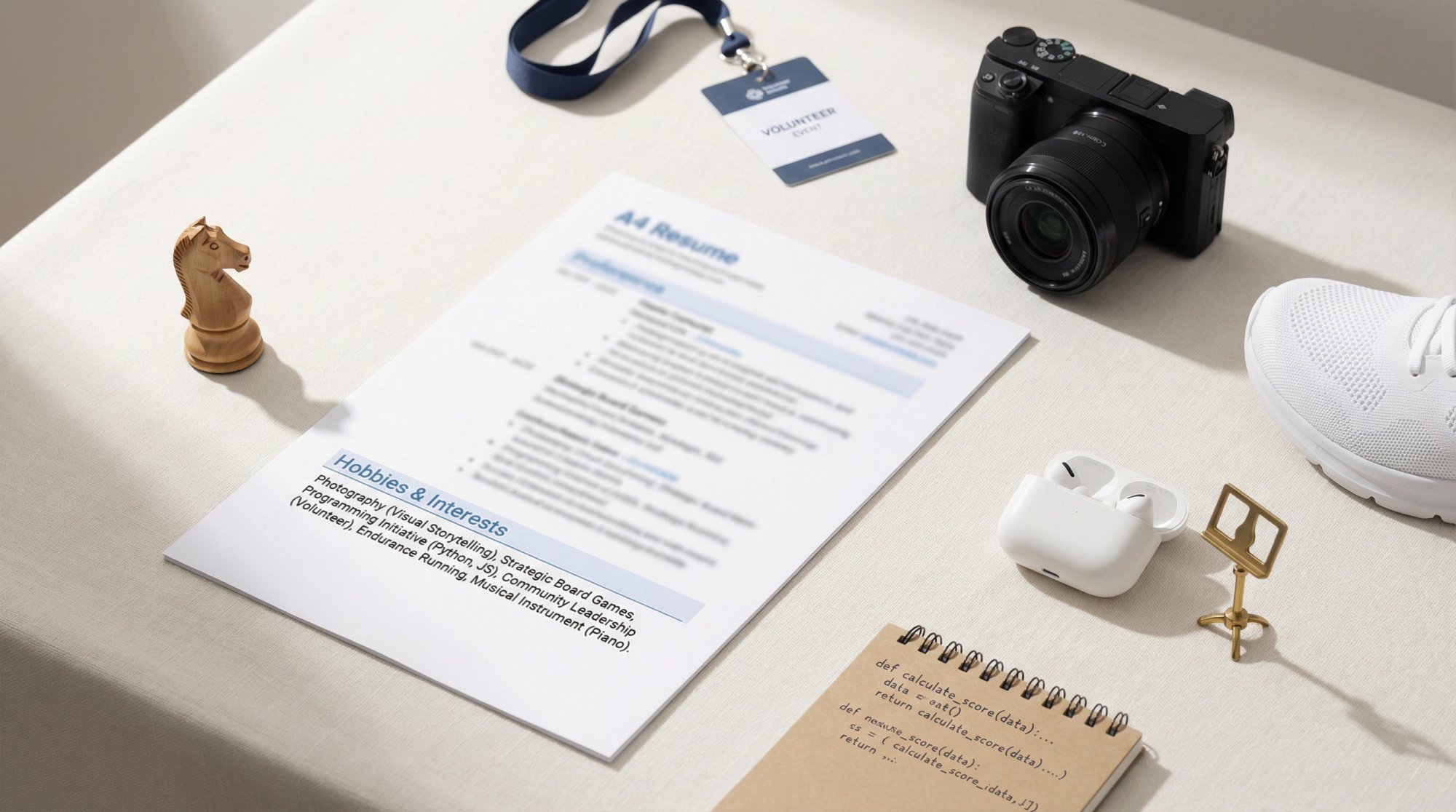
Yes, you can put hobbies on a resume. But only the ones that earn their spot.
That's the part most people get wrong. They treat the hobbies section like a personality quiz, tossing in "reading" and "traveling" and hoping it makes them look well-rounded. It doesn't. A resume is a proof document. Every line needs to make a hiring manager think, "This person can do the job." Hobbies only help when they strengthen that conclusion by showing real skills, genuine initiative, or believable cultural fit.
Hiring is also shifting fast. According to NACE's February 2026 guidance, 70% of employers in the Job Outlook 2026 survey now use skills-based hiring. NACE specifically tells candidates to connect extracurricular activities to professional skills and be ready to show how those skills solved real problems. Your hobbies section is one of the best places to do exactly that.
So the real question isn't "What hobby looks impressive?"
It's: What hobby gives evidence that I can do this job?
This guide walks you through the best hobbies to put on a resume, how to write them so they actually land, and when to leave them off entirely. We'll cover specific examples for every major category, show you how to turn vague hobbies into strong resume lines, and explain how to keep the section ATS-friendly. Once you've got your hobbies nailed down, AIApply's Resume Builder can help you put together a job-specific resume that puts every section in the best possible light.
Why Employers Care About Hobbies on Your Resume
Hobbies aren't there to make you seem interesting. They're there to reinforce signals that matter to the person reading your resume.
According to NACE's press FAQ, the top five attributes employers want to see on a college graduate's resume are problem-solving, teamwork, written communication, initiative, and strong work ethic. NACE's December 2025 career-readiness framework groups employability into eight broader competencies: career and self-development, leadership, communication, professionalism, critical thinking, teamwork, equity and inclusion, and technology.
That should shape everything about how you think about this section.
In the Job Outlook 2025 survey (the last detailed public breakdown NACE published with specific percentages), employers most often sought problem-solving, teamwork, written communication, initiative, strong work ethic, and technical skills. The exact numbers are 2025 data, but the pattern hasn't changed: execution skills matter more than personality fluff.
Understanding which skills carry the most weight is exactly why it helps to review a skills for resume list before deciding which hobby to highlight.
A hobby is strongest when it shows one of these things:
You can work with people and collaborate toward goals
You communicate clearly (written or spoken)
You stick with hard things over time
You take initiative without being told
You solve problems independently
You learn fast and adapt
You care enough to build something outside of work or school
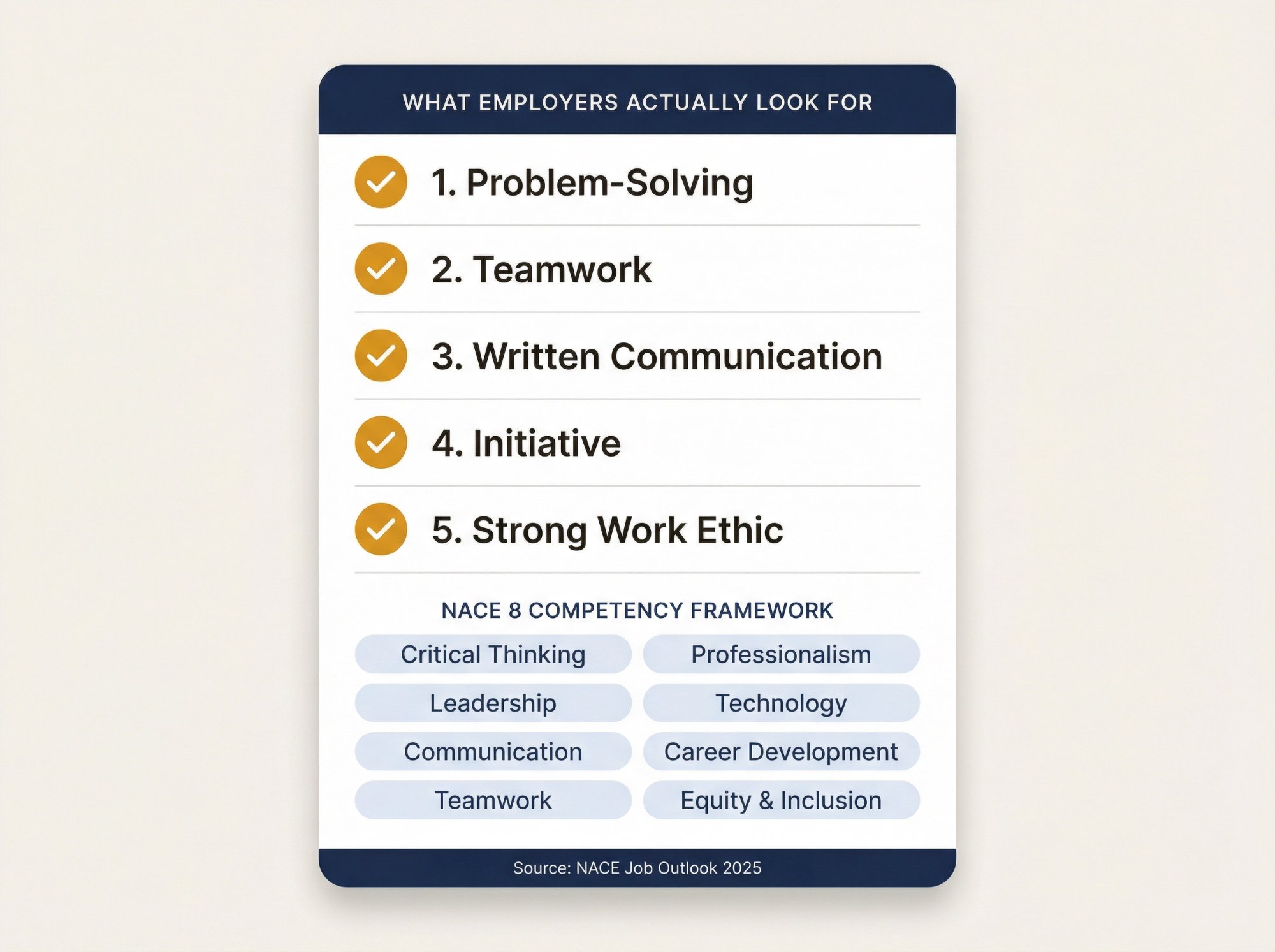
If a hobby doesn't demonstrate at least one of those qualities, it probably isn't pulling its weight on your resume. For a deeper look at how these connect to professional value, see our guide on transferable skills.
When to Include Hobbies on Your Resume
Not every resume needs a hobbies section. Hobbies are optional, best used when they're relevant and specific, and especially helpful when you're early in your career or light on directly relevant experience.
Hobbies are most useful when:
The job posting specifically mentions interests or cultural fit
You have limited work experience (recent grads, career changers, first-job seekers)
The employer clearly values personality and uniqueness
The company culture makes personal interests more relevant
The employer directly asks about hobbies or interests
They should always sit near the bottom of your resume, after your stronger sections like experience, skills, and education.
If you're a recent graduate building your first resume, hobbies can do a lot of heavy lifting. The same applies if you're making a career change and your experience doesn't yet map directly to your target role.
Before adding any hobby, run it through this quick filter:
Does this hobby prove a skill the role actually needs?
Does it add something my experience section doesn't already show?
Can I describe it specifically, not vaguely?
Would I be comfortable talking about it for two minutes in an interview?
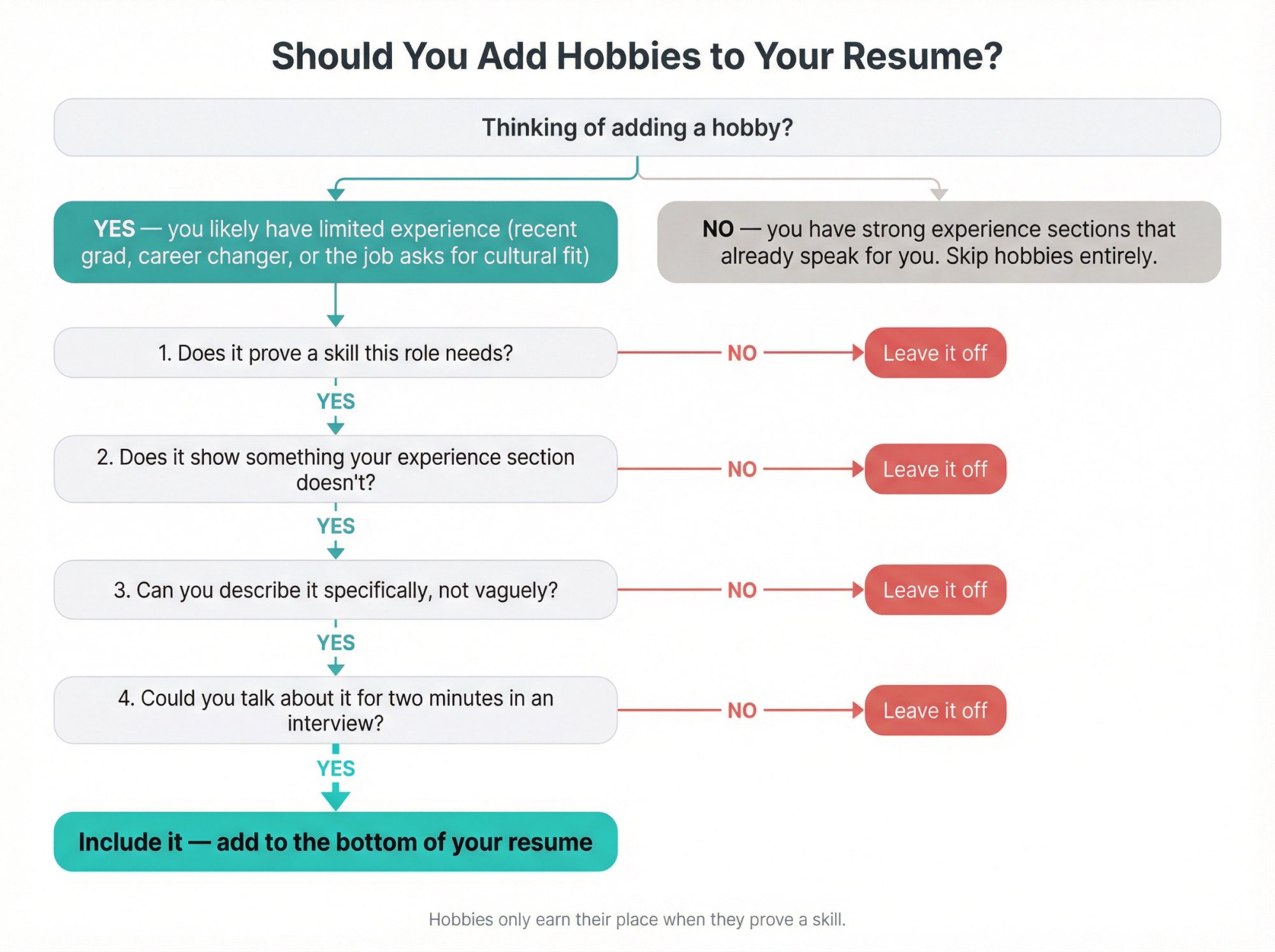
Answering "no" to most of those? Leave it off. A clean, focused resume beats a cluttered one every time.
Hobbies vs. Interests: What's the Difference?
This distinction actually matters more than people realize.
A hobby is active and recurring. You do it. Coding side projects, coaching youth football, weekly volunteering, photography, debate club, and language study all count as hobbies. There's effort, consistency, and usually some kind of output.
An interest is broader and more passive. You follow it, read about it, or care about it. Artificial intelligence, climate policy, fintech, urban design, and sustainability are interests. You can put both in the same section on your resume, but hobbies usually carry more weight because they create clearer evidence of actual skills.
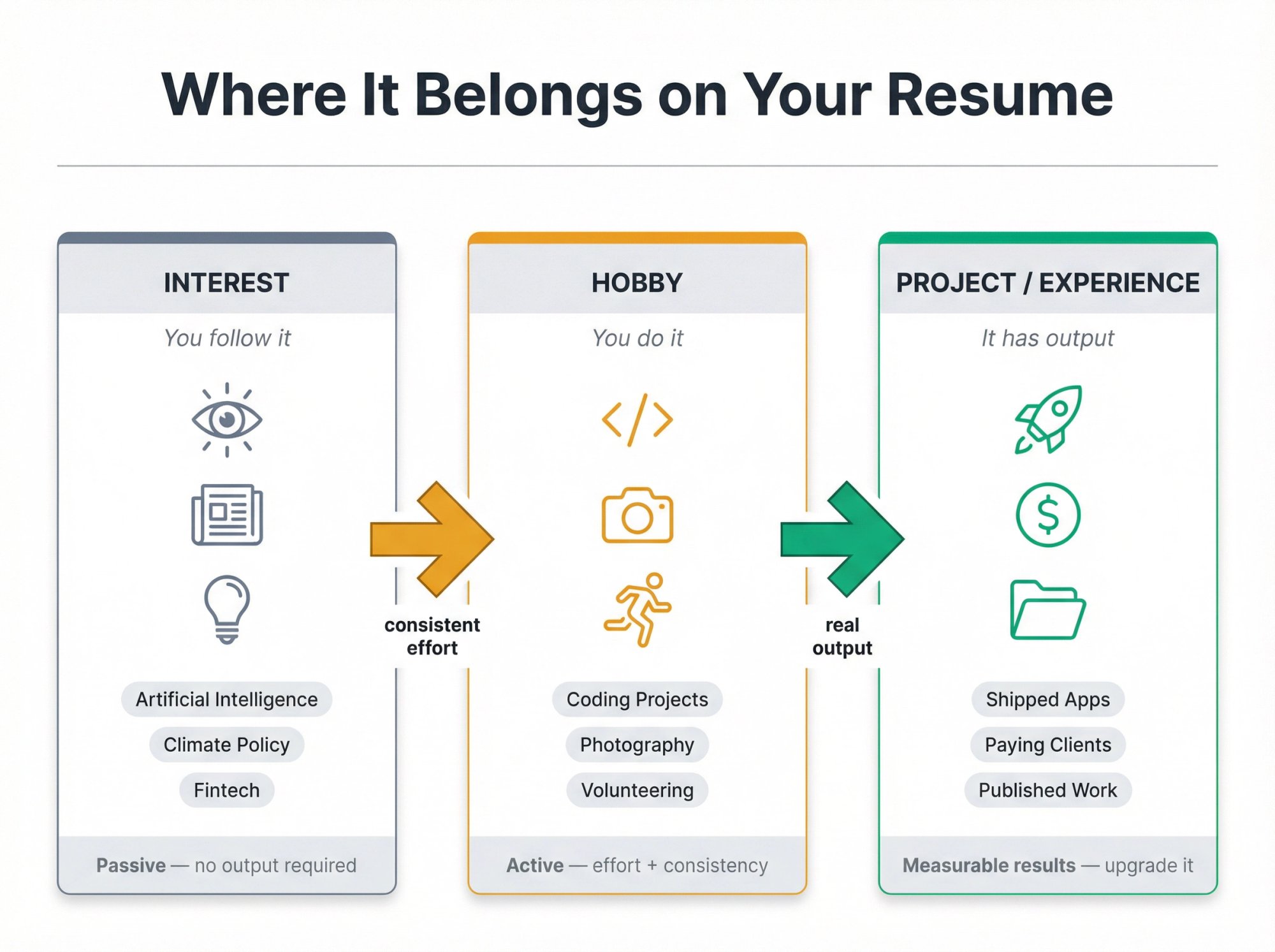
There's one upgrade rule worth knowing here. If your "hobby" has produced real, measurable output (clients, revenue, published work, an audience, competition results, or a portfolio), it might not belong under "Hobbies" at all. Personal projects can serve as portfolio material for first-job candidates, and we recommend choosing resume sections that best showcase relevant skills when experience is thin.
So if your blog has readers, your photos are getting paid gigs, or your coding hobby has shipped actual apps, move that material into Projects, Experience, Leadership, or Volunteer Work. It'll be much stronger there. For guidance on structuring that kind of experience, see our post on how to make a resume for your first job.
12 Best Hobbies to Put on a Resume (by Skill Category)
The best hobby for your resume depends entirely on what you need it to prove. Think of these categories like a menu, not a checklist. Pick the ones that support the role you're applying for.
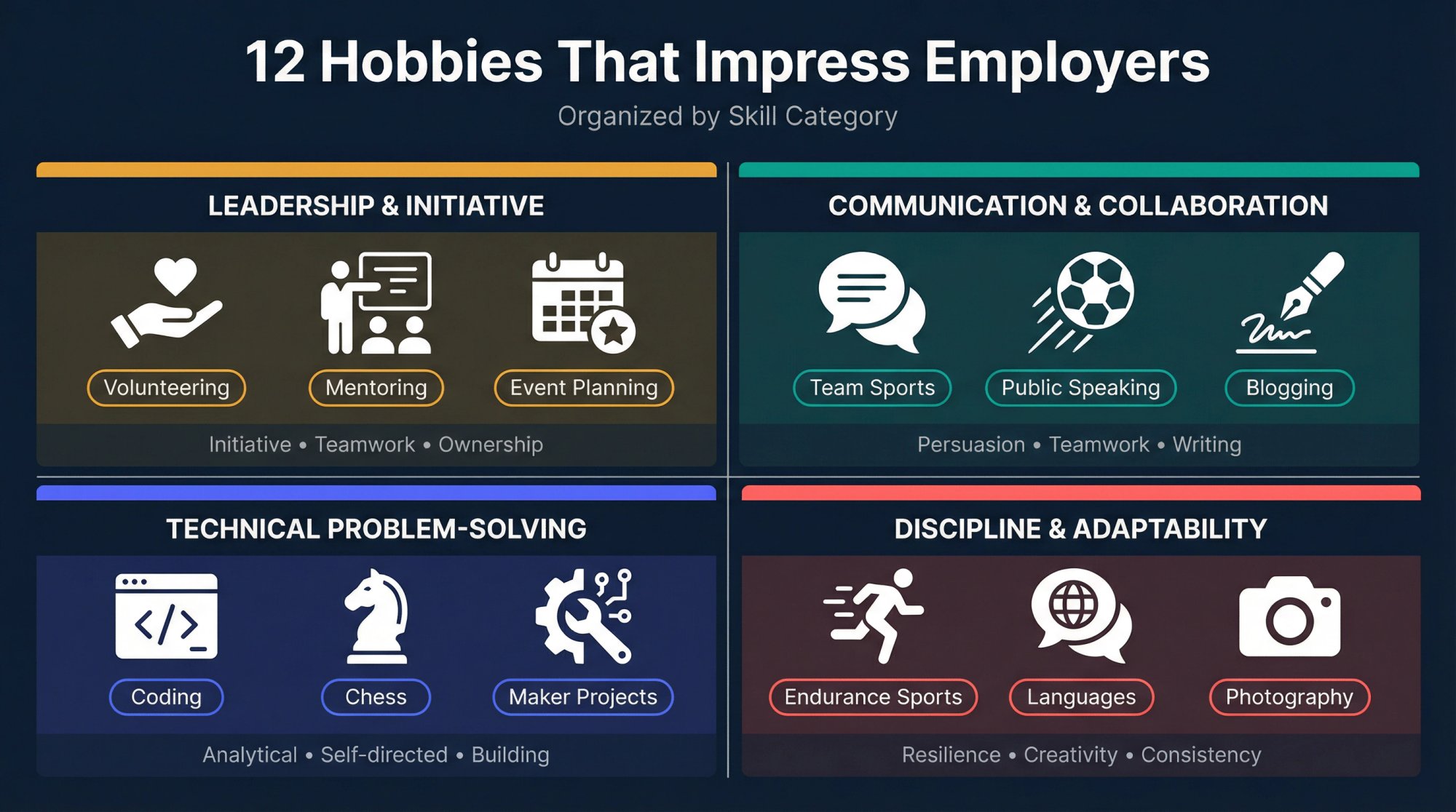
Hobbies That Show Leadership and Initiative
These work because they show you take action, work with others, and follow through on commitments. Volunteering, mentoring, coaching, and organized leadership roles are especially strong because they're easy for a recruiter to translate into workplace behavior, which aligns directly with the competencies employers seek most.
→ Volunteering or community organizing
Shows initiative, teamwork, reliability, and service mindset.
Example: Volunteer coordinator, community food pantry; schedule 18 volunteers twice monthly and manage donation sorting.
→ Mentoring, tutoring, or coaching
Shows communication, patience, leadership, and responsibility.
Example: Volunteer math tutor; support 6 middle-school students each Saturday and track weekly progress.
→ Event planning or club leadership
Shows organization, ownership, planning, and stakeholder management.
Example: President, university entrepreneurship club; organized 5 speaker events and doubled attendance in one semester.
Hobbies That Show Communication and Teamwork
The principle is straightforward: hobbies that require you to speak, coordinate, persuade, or publish are usually more useful than hobbies you do entirely alone with no visible output.
These are strong picks for roles that involve clients, teammates, presentations, persuasion, writing, or any public-facing work.
→ Team sports
Shows teamwork, discipline, coachability, and shared accountability.
Example: Captain, local futsal team; coordinate practice schedules and role assignments for 10 players.
→ Debate, Toastmasters, or public speaking
Shows confidence, communication, composure under pressure, and persuasion.
Example: Toastmasters member for 2 years; deliver monthly speeches and mentor first-time speakers.
→ Blogging, newsletter writing, or content creation
Shows writing skill, consistency, audience awareness, and digital fluency.
Example: Publish a weekly fintech newsletter for 600 subscribers and write short breakdowns of market trends.
Content creation hobbies can also open doors to content creator careers, a field where a demonstrated writing or publishing habit is often more persuasive than a degree.
Hobbies That Show Technical Skills and Problem-Solving
These hobbies work best when you want to show analytical thinking, self-directed learning, or comfort with technical tools. They're especially useful for tech, product, operations, data, and finance-adjacent roles.
→ Coding, open-source, or robotics
Shows technical initiative, structured thinking, and a habit of building.
Example: Build small React and Python side projects and contribute documentation fixes to open-source repositories.
If your coding hobby has involved real work with React or Python, that's worth noting specifically. Recruiters at tech companies recognize those skills immediately, and your side projects could be the differentiator that gets you into a software engineer role.
→ Chess, strategy games, or competitive puzzles
Shows patience, pattern recognition, long-range thinking, and analytical discipline.
Example: Compete in local chess club tournaments and review weekly games to improve decision-making.
→ Maker or DIY projects
Shows hands-on problem-solving, persistence, and practical troubleshooting.
Example: Build custom mechanical keyboards and troubleshoot soldering, firmware, and component issues.
Hobbies That Show Discipline, Creativity, and Adaptability
These hobbies are useful when you want to signal consistency, taste, self-management, or learning ability. They're particularly helpful for creative roles, fast-changing environments, and jobs where follow-through matters.
→ Endurance sports
Shows work ethic, consistency, resilience, and long-term discipline.
Example: Completed two half-marathons in 2025 while following a four-day-per-week training plan.
→ Learning languages
Shows adaptability, cross-cultural awareness, and sustained learning effort.
Example: Study Spanish through weekly conversation sessions and completed B1 coursework in 2025.
→ Photography, videography, or design projects
Shows visual judgment, detail orientation, and creative execution.
Example: Shoot and edit event photography in Lightroom and Photoshop for student organizations and community events.
Photography is one of those hobbies that can quite easily outgrow the hobbies section. See our photographer career guide if you're applying for creative roles where visual output matters. If you've built a real portfolio of work, your photography resume should reflect that.
How to Turn a Weak Hobby into a Strong One
Most people don't have a "bad hobby" problem. They have a vagueness problem.
Be specific. "Reading," "traveling," "music," and "gaming" aren't automatically useless, but they're too broad to do any heavy lifting on their own. The stronger version always shows level of involvement, output, context, or impact.
Here's what that looks like in practice:
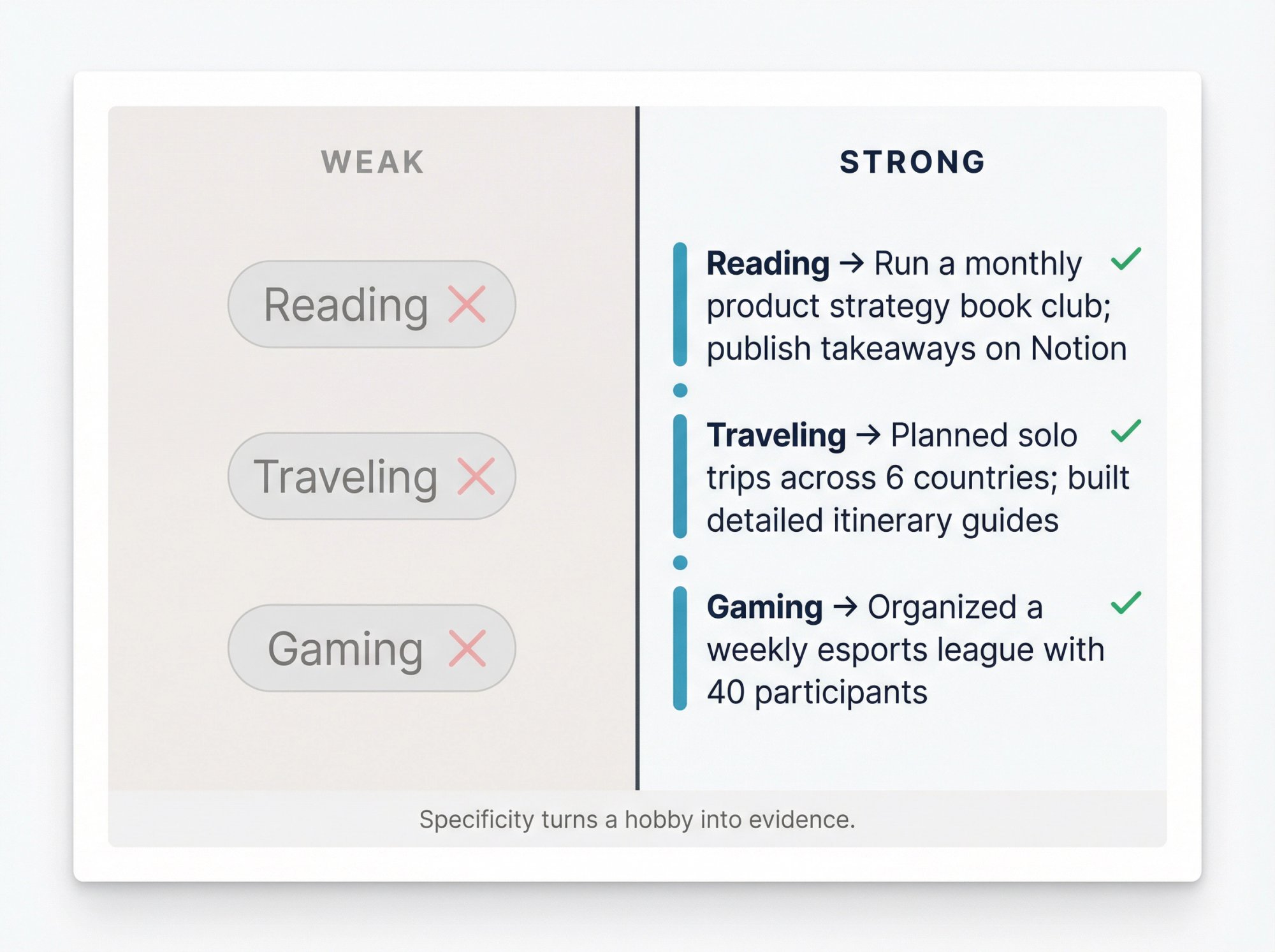
| Weak Version | Stronger Version | Why It Works |
|---|---|---|
| Reading | Run a monthly product strategy book club and publish short takeaways on Notion | Shows initiative, consistency, and written communication |
| Traveling | Planned and documented solo trips across 6 countries, creating detailed itineraries and budget guides | Shows planning, independence, and attention to detail |
| Gaming | Organized a weekly esports league with 40 participants and volunteer moderators | Shows leadership, coordination, and community building |
| Photography | Freelance event photographer; completed 12 shoots in 2025 | Shows professionalism, reliability, and creative skill |
| Coding | Built 3 React side projects and maintain public GitHub documentation | Shows technical initiative, shipping ability, and consistency |
Notice the pattern. The stronger version always answers one or more of these questions:
What did you actually do?
How serious were you about it?
What came out of it?
Why should an employer care?
That's the entire framework. If you can answer those four questions for any hobby, you've got a strong resume line. For more ways to sharpen the language you use throughout your resume, our guide to how to list soft skills on your resume covers this in detail.
Hobbies That Can Hurt Your Resume
Some hobbies do more harm than good. Avoid hobbies that are random, divisive, risky, overly personal, or so generic they look like filler.
That usually means leaving out things like:
Politics, religion, or controversial activism (unless directly relevant to the role)
Gambling, nightlife, or anything that reads as reckless
"Watching TV," "listening to music," or "social media" (too passive, no evidence of skill)
High-risk activities framed in a way that raises reliability concerns
Anything you can't discuss intelligently if the interviewer asks about it
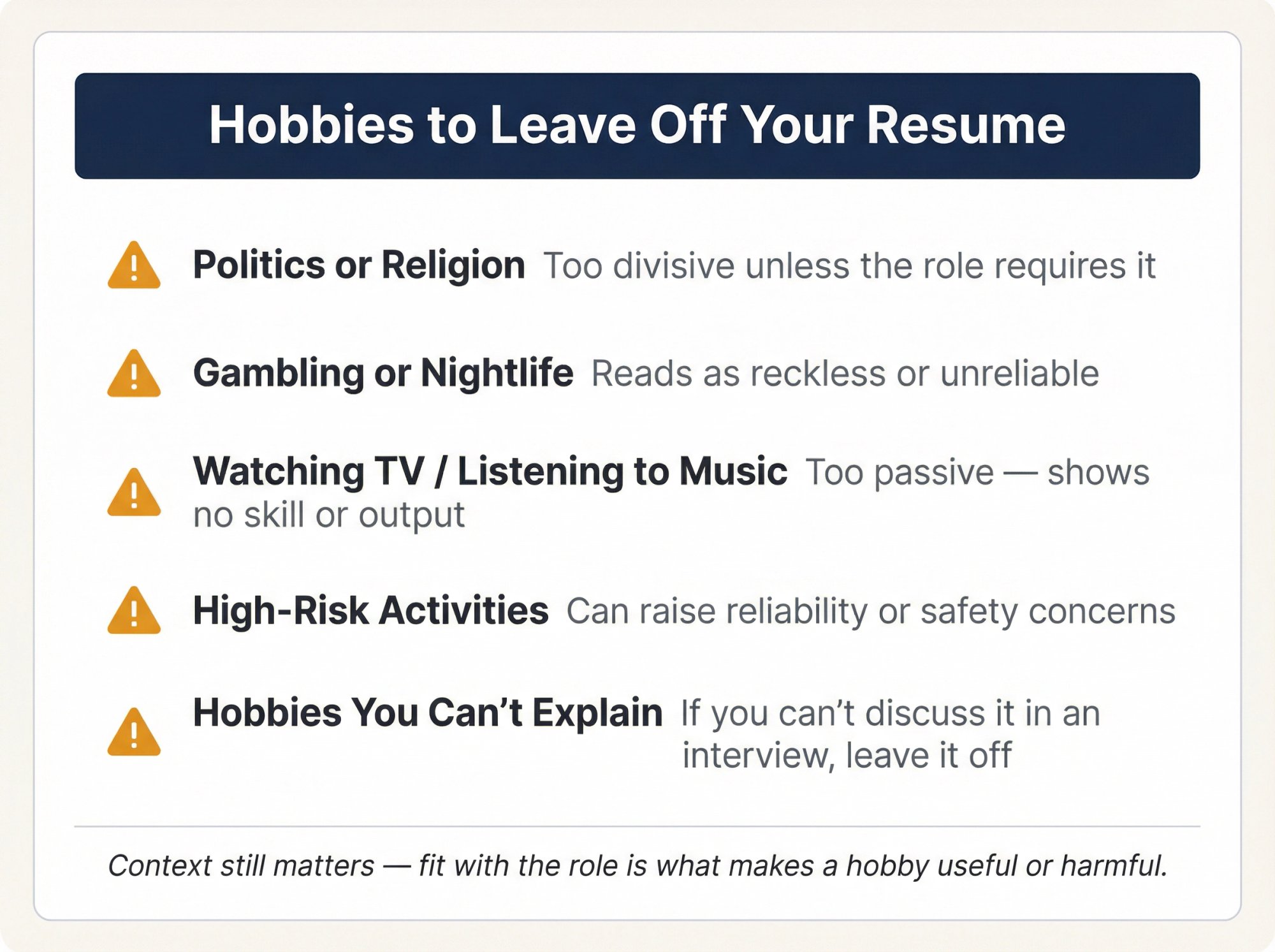
But context matters more than the hobby itself. UMGC's career guidance gives a useful example: watching movies may be meaningless for most roles, but it's directly relevant for a video editor position. UMGC also notes that hobbies like video games or comic collecting can feel off-topic for one employer and perfectly on-brand for another.
The takeaway: A hobby isn't good or bad in the abstract. Fit with the role and company is what makes it useful or harmful.
How to Write a Hobbies Section on Your Resume
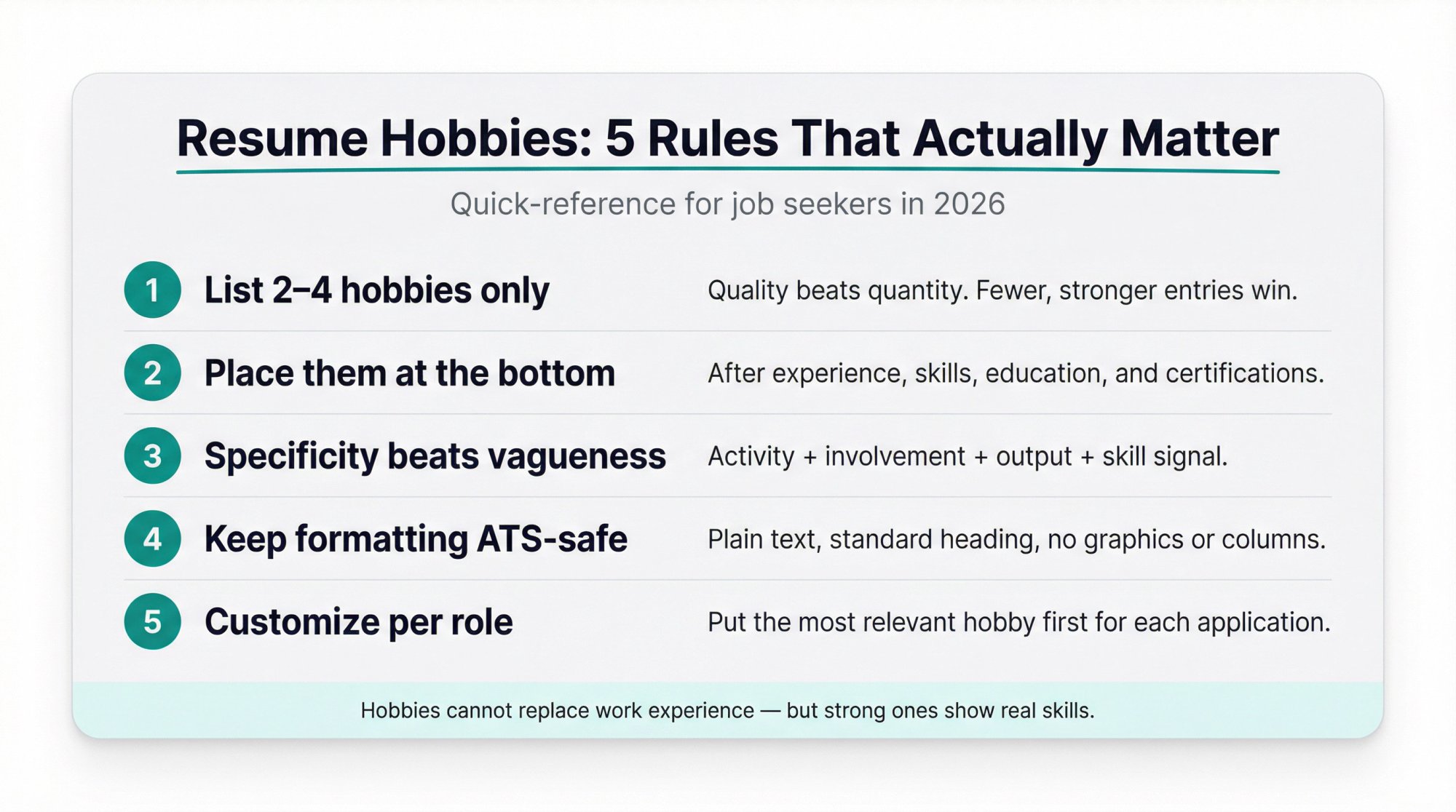
Put the section at the bottom of your resume. Use a straightforward heading like Hobbies & Interests or simply Interests. Keep it short. Most guidance suggests around 2 to 4 items, with some guides allowing up to 5 if they're all genuinely relevant. The point isn't to build a personality museum. It's to add a few sharp signals.
Use this formula for each entry:
Activity + level of involvement + proof or output + skill signal
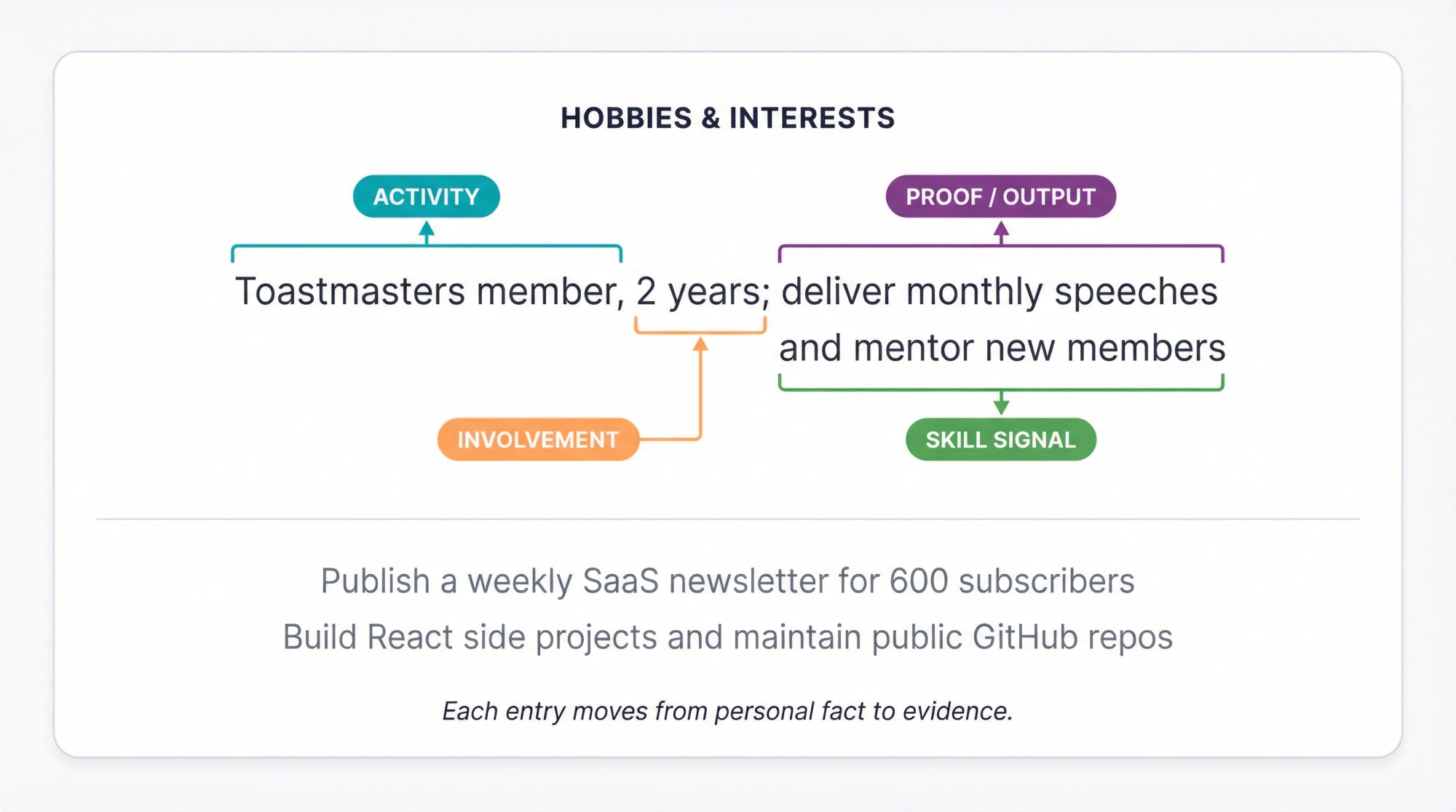
Here's what that looks like:
Toastmasters member, 2 years; deliver monthly speeches and mentor new members
Volunteer math tutor; support 6 students every Saturday
Publish a weekly SaaS newsletter for 600 subscribers
Completed two half-marathons in 2025
Build React side projects and maintain public GitHub repos
That format works because it moves each line from "personal fact" to "evidence." A hiring manager can read any of those and immediately understand what skill you're demonstrating.
For even more ways to sharpen your resume language overall, our post on best adjectives to use on your resume is worth a read. And if you want to see how a well-structured resume comes together, check out resume format tips for a clear breakdown of how to organize every section.
How to Make Your Hobbies Section ATS-Friendly
Your hobbies section should never be the most complicated part of your resume. And it definitely shouldn't be the thing that trips up an Applicant Tracking System.
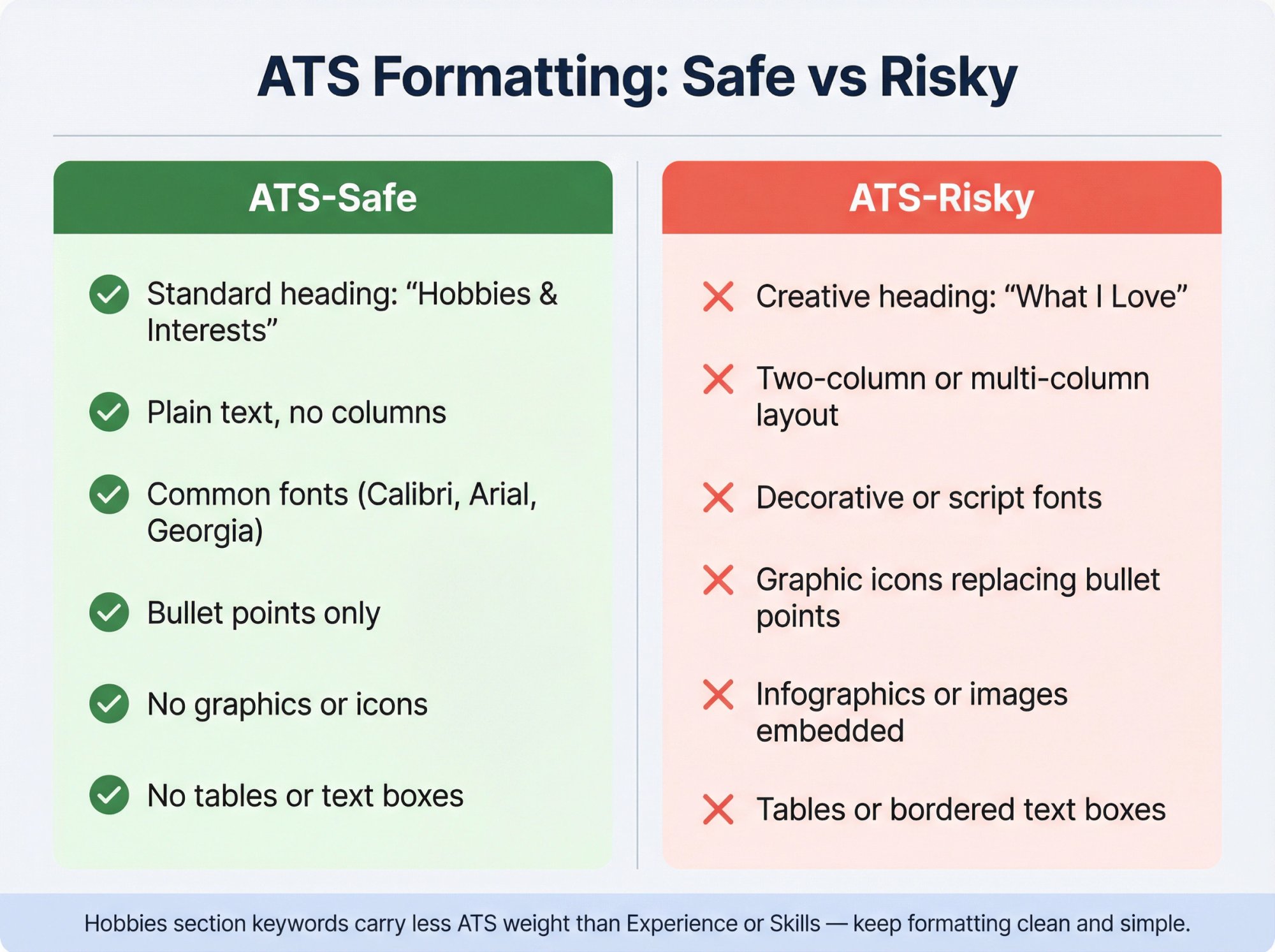
ATS-friendly resume guidance recommends simple formatting, standard headings, common fonts, and no tables, graphics, or unusual design choices that confuse parsers. Some ATS tools weight keywords in your work experience or skills sections more heavily than keywords in a hobbies section. That means hobbies should reinforce your fit, not carry your application.
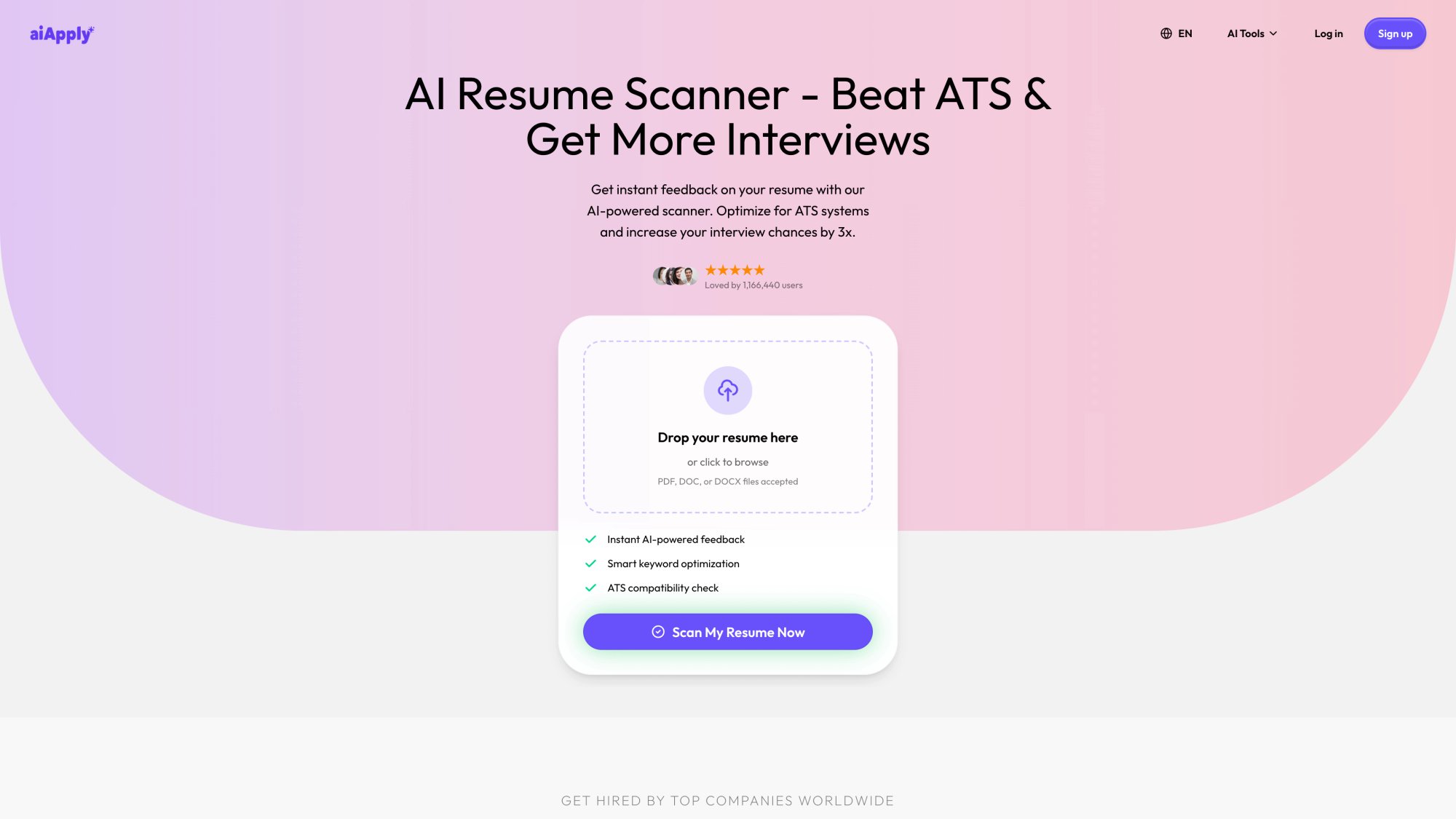
The AIApply Resume Scanner interface below shows exactly what ATS-readiness review looks like in practice — you drop in your resume file and get instant feedback on keyword gaps, formatting issues, and ATS compatibility.
Don't keyword-stuff this section to make up for missing qualifications elsewhere. It won't work, and it'll look desperate to a human reviewer. For a deep look at how ATS systems work and what they're scanning for, our post on what is an ATS and how to beat it explains it clearly. You can also browse ATS-friendly resume templates that are already optimized for the most common systems.
A good rule: write the core resume first, then add hobbies only if they still improve the document.
If you want a quick compatibility check before you hit submit, our AI Resume Builder can tailor wording to match a specific job description, and our AI Resume Scanner can review your entire resume for ATS compatibility, keyword gaps, and formatting issues. It's a fast way to catch problems before they cost you an interview.
Hobbies Section Resume Examples You Can Adapt
Sometimes the best way to understand good formatting is to see it in context. Here are three examples of hobbies sections for different career situations.
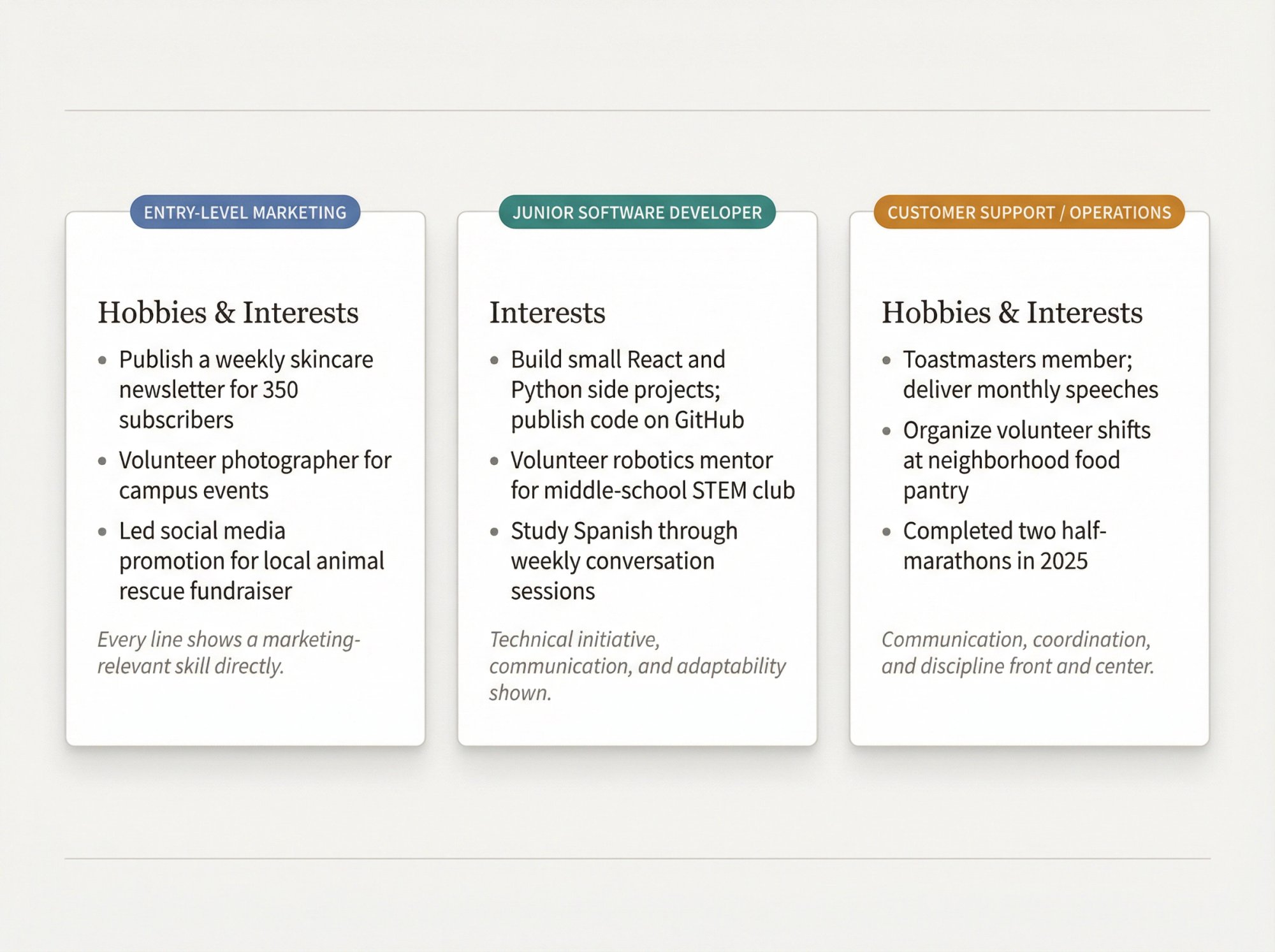
Entry-Level Marketing Resume
Hobbies & Interests
Publish a weekly skincare newsletter for 350 subscribers
Volunteer photographer for campus events
Led social media promotion for local animal rescue fundraiser
Why it works: Every line demonstrates marketing-relevant skills (content creation, visual storytelling, social media) without stating them directly.
This kind of resume pairs naturally with a strong marketing manager resume example if you want to see how the full document should be structured. And if you need a cover letter to go with it, the cover letter examples hub has templates tailored to marketing roles.
Junior Software Developer Resume
Interests
Build small React and Python side projects; publish code on GitHub
Volunteer robotics mentor for middle-school STEM club
Study Spanish through weekly conversation sessions
Why it works: The coding projects prove technical initiative, mentoring shows communication, and language study signals adaptability.
For anyone applying to software engineering roles, check out the software engineer resume example to see how technical hobbies and side projects can be integrated into a complete, cohesive document.
Customer Support or Operations Resume
Hobbies & Interests
Toastmasters member; deliver monthly speeches
Organize volunteer shifts at neighborhood food pantry
Completed two half-marathons in 2025
Why it works: Communication, coordination, and discipline are all front and center, which maps perfectly to customer-facing and operations roles.
For this resume type, the customer service associate resume example shows how to structure the experience section around similar competencies.
Each of these sections works because every line shows action, commitment, or output. None of them are just generic labels.
When to Move a Hobby Out of the Hobbies Section
This is a rule that most resume articles skip, and it's actually one of the most important ones.
If your hobby is impressive enough to help a lot, it might be too strong for the hobbies section.
That sounds backwards, but think about it. If your side activity has measurable results (real users, customers, published work, competition wins, or leadership responsibility), keeping it buried at the bottom of your resume is a waste. Personal projects can serve as portfolio material, especially for first-job candidates.
The stronger the evidence, the higher it should sit on your resume. Don't bury your best material under a generic heading.
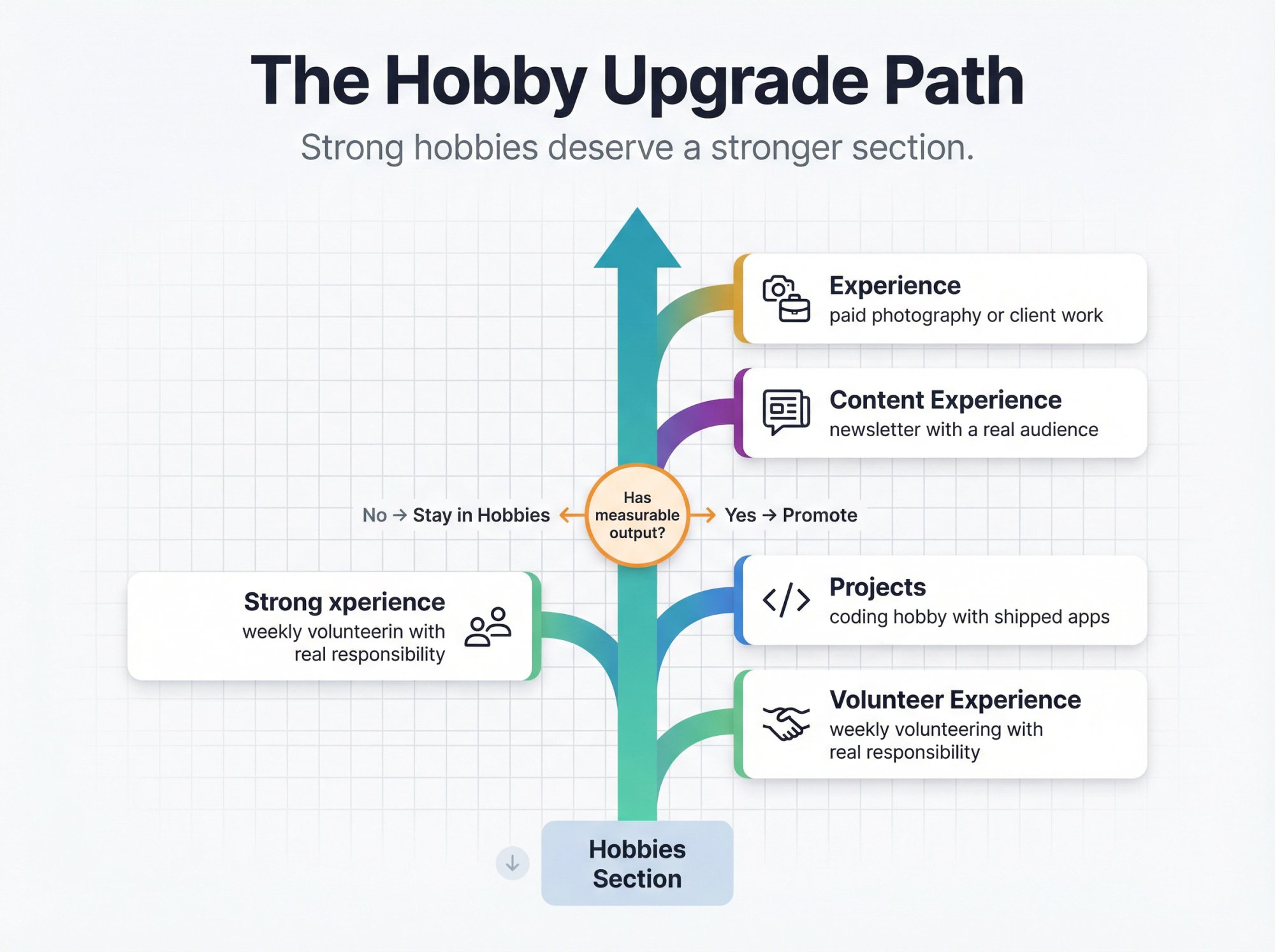
Here's the upgrade path:
A coding hobby with shipped apps becomes a Projects section
Paid photography becomes Experience
Weekly volunteering with management responsibility becomes Volunteer Experience
A newsletter with a real audience becomes either Projects or Content Experience
If you're wondering how to present project-based or non-traditional experience, our guide on experience on a resume covers exactly that. And if this kind of side activity is what's launching your career, check out how to create a professional portfolio to make the strongest case.
How to Add Hobbies to Your Resume the Right Way
Getting hobbies right is really just one piece of a larger puzzle. The full workflow looks like this:
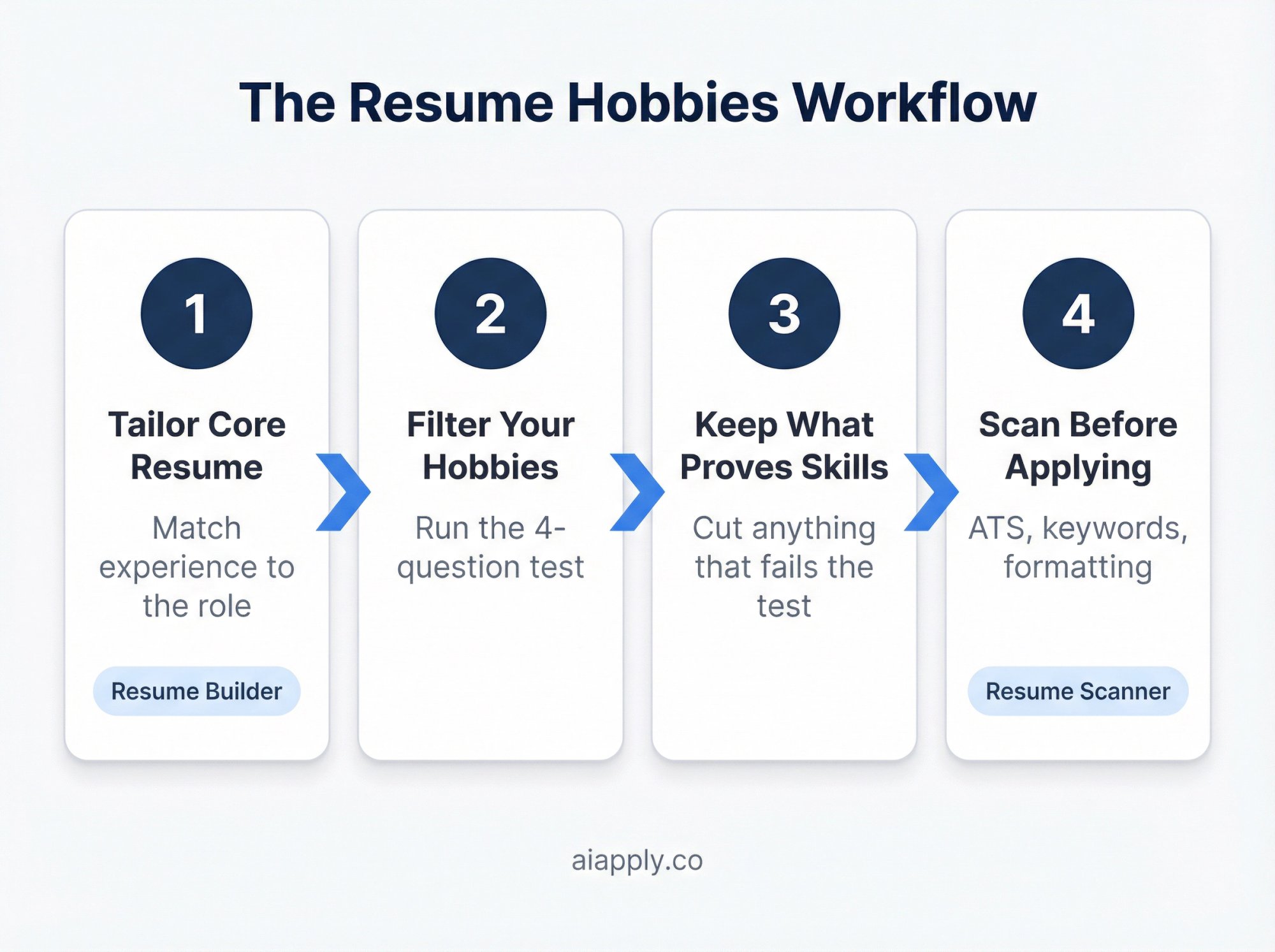
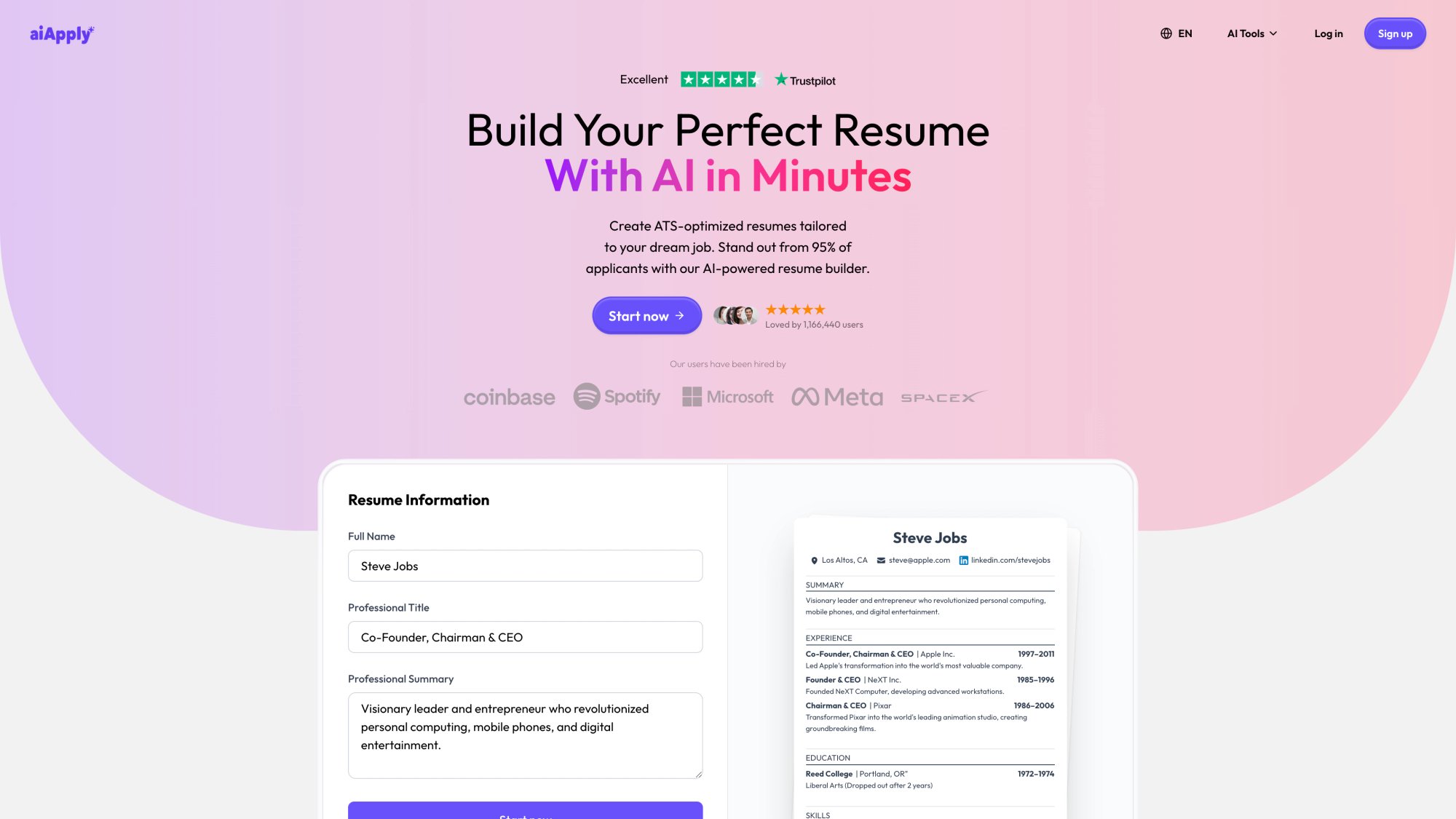
The AIApply Resume Builder is where step one happens. You input your experience and the tool generates a tailored, ATS-optimized resume in under two minutes — including the right structure for every section, hobbies included.
① Tailor the core resume to the job. Match your experience and skills to the specific role before thinking about hobbies. Our guide on how to tailor your resume to a job description walks through this step by step.
② Decide whether hobbies add anything useful. Run each one through the four-question filter from earlier in this guide.
③ Keep only the hobbies that prove relevant skills. Cut anything that doesn't pass the test.
④ Scan the finished resume before you apply. Check for ATS compatibility, keyword coverage, and formatting problems.
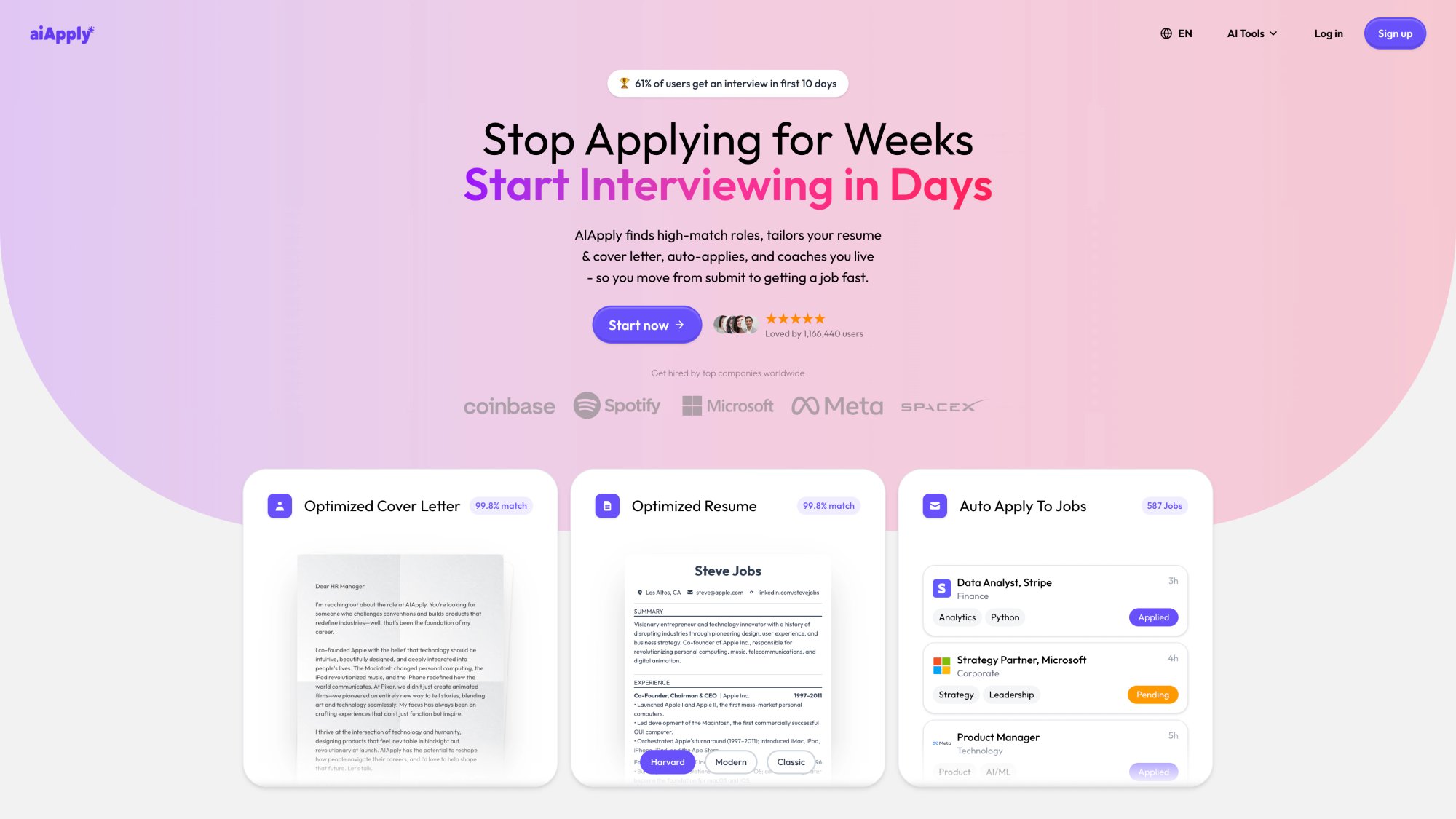
Our AI Resume Builder can help with step one by tailoring phrasing to match the job description automatically. And our AI Resume Scanner handles step four by catching keyword gaps, formatting issues, and ATS compatibility problems before your resume reaches a recruiter. Together, they give you a fast way to build a polished, job-specific resume that includes the right hobbies in the right format.
If you're starting from scratch (especially as a recent grad or first-time job seeker), AIApply offers resume examples and role-specific templates to give you a solid starting structure. Students can also access a student discount to get premium tools at reduced cost. From there, you can focus on the details that make the difference.
For more complete guidance on building each part of your resume, our post on resume optimization techniques is a good place to go next.
Frequently Asked Questions About Hobbies on a Resume
Should I Include Hobbies on My Resume If I Already Have a Lot of Experience?
Usually only if they're directly relevant to the role or unusually distinctive. If your resume already has strong, relevant achievements filling the page, hobbies are often the first section to cut. Current guidance especially reserves hobbies for early-career candidates, people with limited experience, or cases where the hobby clearly supports the specific role you're targeting.
How Many Hobbies Should I List?
Aim for 2 to 4. Some guides allow up to 5, but fewer is usually stronger because it keeps the section sharp and prevents clutter. Quality beats quantity here. Each hobby should be specific enough to demonstrate a skill, not just fill a line.
What Is the Difference Between Hobbies and Interests on a Resume?
Hobbies are recurring activities you actively do (like coding, volunteering, or playing team sports). Interests are broader subjects you follow or care about (like artificial intelligence, climate policy, or fintech). Both can appear in the same section, but hobbies usually carry more weight because they create more evidence of actual skills.
Are Hobbies ATS-Friendly?
Yes, as long as the section uses simple formatting. Stick with a standard heading like "Hobbies & Interests," use plain text (no graphics, columns, or fancy design elements), and keep entries clean. But remember that ATS tools and recruiters usually care more about keywords and evidence in your experience and skills sections than in hobbies. Our AI Resume Scanner can help verify that your overall resume is ATS-safe, including the hobbies section. Our post on what is an ATS and how to beat it has solid formatting advice as well.
Can I List Reading, Traveling, or Gaming as Hobbies?
Only if you make them specific and relevant. "Reading" by itself is weak. "Run a monthly product book club and publish takeaways" is much better. "Traveling" is weak. "Document solo international trips and build detailed itineraries" is better. Gaming can be irrelevant in one context and perfectly useful in another (think game design, esports management, or UX testing), depending on the role and company. The key is always specificity.
Can Hobbies Replace Work Experience on a Resume?
No. Hobbies can support your story, especially if you're early in your career or changing fields, but they don't replace solid work experience. If a hobby has real output or measurable impact (paying clients, published work, competition results), it's actually stronger when you move it out of the hobbies section entirely and into Projects, Volunteer Experience, or Experience. If you're navigating a career change and need to figure out how to position limited experience, our post on best jobs for career change covers strategies that apply here.
Where Should Hobbies Go on a Resume?
At the very bottom, after your experience, skills, education, and certifications sections. The hobbies section is supplementary, so it should never compete with your core qualifications for prime resume real estate. See our post on resume components for a full breakdown of how to order every section.
Should I Customize My Hobbies Section for Each Job Application?
If you're listing multiple hobbies, it's worth reordering them so the most relevant one for each specific role comes first. You don't necessarily need to rewrite the section from scratch for every application, but putting the strongest match at the top can make a difference. Our AI Resume Builder can help you quickly tailor your entire resume (including the hobbies section) to match a specific job description.
Yes, you can put hobbies on a resume. But only the ones that earn their spot.
That's the part most people get wrong. They treat the hobbies section like a personality quiz, tossing in "reading" and "traveling" and hoping it makes them look well-rounded. It doesn't. A resume is a proof document. Every line needs to make a hiring manager think, "This person can do the job." Hobbies only help when they strengthen that conclusion by showing real skills, genuine initiative, or believable cultural fit.
Hiring is also shifting fast. According to NACE's February 2026 guidance, 70% of employers in the Job Outlook 2026 survey now use skills-based hiring. NACE specifically tells candidates to connect extracurricular activities to professional skills and be ready to show how those skills solved real problems. Your hobbies section is one of the best places to do exactly that.
So the real question isn't "What hobby looks impressive?"
It's: What hobby gives evidence that I can do this job?
This guide walks you through the best hobbies to put on a resume, how to write them so they actually land, and when to leave them off entirely. We'll cover specific examples for every major category, show you how to turn vague hobbies into strong resume lines, and explain how to keep the section ATS-friendly. Once you've got your hobbies nailed down, AIApply's Resume Builder can help you put together a job-specific resume that puts every section in the best possible light.
Why Employers Care About Hobbies on Your Resume
Hobbies aren't there to make you seem interesting. They're there to reinforce signals that matter to the person reading your resume.
According to NACE's press FAQ, the top five attributes employers want to see on a college graduate's resume are problem-solving, teamwork, written communication, initiative, and strong work ethic. NACE's December 2025 career-readiness framework groups employability into eight broader competencies: career and self-development, leadership, communication, professionalism, critical thinking, teamwork, equity and inclusion, and technology.
That should shape everything about how you think about this section.
In the Job Outlook 2025 survey (the last detailed public breakdown NACE published with specific percentages), employers most often sought problem-solving, teamwork, written communication, initiative, strong work ethic, and technical skills. The exact numbers are 2025 data, but the pattern hasn't changed: execution skills matter more than personality fluff.
Understanding which skills carry the most weight is exactly why it helps to review a skills for resume list before deciding which hobby to highlight.
A hobby is strongest when it shows one of these things:
You can work with people and collaborate toward goals
You communicate clearly (written or spoken)
You stick with hard things over time
You take initiative without being told
You solve problems independently
You learn fast and adapt
You care enough to build something outside of work or school
If a hobby doesn't demonstrate at least one of those qualities, it probably isn't pulling its weight on your resume. For a deeper look at how these connect to professional value, see our guide on transferable skills.
When to Include Hobbies on Your Resume
Not every resume needs a hobbies section. Hobbies are optional, best used when they're relevant and specific, and especially helpful when you're early in your career or light on directly relevant experience.
Hobbies are most useful when:
The job posting specifically mentions interests or cultural fit
You have limited work experience (recent grads, career changers, first-job seekers)
The employer clearly values personality and uniqueness
The company culture makes personal interests more relevant
The employer directly asks about hobbies or interests
They should always sit near the bottom of your resume, after your stronger sections like experience, skills, and education.
If you're a recent graduate building your first resume, hobbies can do a lot of heavy lifting. The same applies if you're making a career change and your experience doesn't yet map directly to your target role.
Before adding any hobby, run it through this quick filter:
Does this hobby prove a skill the role actually needs?
Does it add something my experience section doesn't already show?
Can I describe it specifically, not vaguely?
Would I be comfortable talking about it for two minutes in an interview?
Answering "no" to most of those? Leave it off. A clean, focused resume beats a cluttered one every time.
Hobbies vs. Interests: What's the Difference?
This distinction actually matters more than people realize.
A hobby is active and recurring. You do it. Coding side projects, coaching youth football, weekly volunteering, photography, debate club, and language study all count as hobbies. There's effort, consistency, and usually some kind of output.
An interest is broader and more passive. You follow it, read about it, or care about it. Artificial intelligence, climate policy, fintech, urban design, and sustainability are interests. You can put both in the same section on your resume, but hobbies usually carry more weight because they create clearer evidence of actual skills.
There's one upgrade rule worth knowing here. If your "hobby" has produced real, measurable output (clients, revenue, published work, an audience, competition results, or a portfolio), it might not belong under "Hobbies" at all. Personal projects can serve as portfolio material for first-job candidates, and we recommend choosing resume sections that best showcase relevant skills when experience is thin.
So if your blog has readers, your photos are getting paid gigs, or your coding hobby has shipped actual apps, move that material into Projects, Experience, Leadership, or Volunteer Work. It'll be much stronger there. For guidance on structuring that kind of experience, see our post on how to make a resume for your first job.
12 Best Hobbies to Put on a Resume (by Skill Category)
The best hobby for your resume depends entirely on what you need it to prove. Think of these categories like a menu, not a checklist. Pick the ones that support the role you're applying for.
Hobbies That Show Leadership and Initiative
These work because they show you take action, work with others, and follow through on commitments. Volunteering, mentoring, coaching, and organized leadership roles are especially strong because they're easy for a recruiter to translate into workplace behavior, which aligns directly with the competencies employers seek most.
→ Volunteering or community organizing
Shows initiative, teamwork, reliability, and service mindset.
Example: Volunteer coordinator, community food pantry; schedule 18 volunteers twice monthly and manage donation sorting.
→ Mentoring, tutoring, or coaching
Shows communication, patience, leadership, and responsibility.
Example: Volunteer math tutor; support 6 middle-school students each Saturday and track weekly progress.
→ Event planning or club leadership
Shows organization, ownership, planning, and stakeholder management.
Example: President, university entrepreneurship club; organized 5 speaker events and doubled attendance in one semester.
Hobbies That Show Communication and Teamwork
The principle is straightforward: hobbies that require you to speak, coordinate, persuade, or publish are usually more useful than hobbies you do entirely alone with no visible output.
These are strong picks for roles that involve clients, teammates, presentations, persuasion, writing, or any public-facing work.
→ Team sports
Shows teamwork, discipline, coachability, and shared accountability.
Example: Captain, local futsal team; coordinate practice schedules and role assignments for 10 players.
→ Debate, Toastmasters, or public speaking
Shows confidence, communication, composure under pressure, and persuasion.
Example: Toastmasters member for 2 years; deliver monthly speeches and mentor first-time speakers.
→ Blogging, newsletter writing, or content creation
Shows writing skill, consistency, audience awareness, and digital fluency.
Example: Publish a weekly fintech newsletter for 600 subscribers and write short breakdowns of market trends.
Content creation hobbies can also open doors to content creator careers, a field where a demonstrated writing or publishing habit is often more persuasive than a degree.
Hobbies That Show Technical Skills and Problem-Solving
These hobbies work best when you want to show analytical thinking, self-directed learning, or comfort with technical tools. They're especially useful for tech, product, operations, data, and finance-adjacent roles.
→ Coding, open-source, or robotics
Shows technical initiative, structured thinking, and a habit of building.
Example: Build small React and Python side projects and contribute documentation fixes to open-source repositories.
If your coding hobby has involved real work with React or Python, that's worth noting specifically. Recruiters at tech companies recognize those skills immediately, and your side projects could be the differentiator that gets you into a software engineer role.
→ Chess, strategy games, or competitive puzzles
Shows patience, pattern recognition, long-range thinking, and analytical discipline.
Example: Compete in local chess club tournaments and review weekly games to improve decision-making.
→ Maker or DIY projects
Shows hands-on problem-solving, persistence, and practical troubleshooting.
Example: Build custom mechanical keyboards and troubleshoot soldering, firmware, and component issues.
Hobbies That Show Discipline, Creativity, and Adaptability
These hobbies are useful when you want to signal consistency, taste, self-management, or learning ability. They're particularly helpful for creative roles, fast-changing environments, and jobs where follow-through matters.
→ Endurance sports
Shows work ethic, consistency, resilience, and long-term discipline.
Example: Completed two half-marathons in 2025 while following a four-day-per-week training plan.
→ Learning languages
Shows adaptability, cross-cultural awareness, and sustained learning effort.
Example: Study Spanish through weekly conversation sessions and completed B1 coursework in 2025.
→ Photography, videography, or design projects
Shows visual judgment, detail orientation, and creative execution.
Example: Shoot and edit event photography in Lightroom and Photoshop for student organizations and community events.
Photography is one of those hobbies that can quite easily outgrow the hobbies section. See our photographer career guide if you're applying for creative roles where visual output matters. If you've built a real portfolio of work, your photography resume should reflect that.
How to Turn a Weak Hobby into a Strong One
Most people don't have a "bad hobby" problem. They have a vagueness problem.
Be specific. "Reading," "traveling," "music," and "gaming" aren't automatically useless, but they're too broad to do any heavy lifting on their own. The stronger version always shows level of involvement, output, context, or impact.
Here's what that looks like in practice:
| Weak Version | Stronger Version | Why It Works |
|---|---|---|
| Reading | Run a monthly product strategy book club and publish short takeaways on Notion | Shows initiative, consistency, and written communication |
| Traveling | Planned and documented solo trips across 6 countries, creating detailed itineraries and budget guides | Shows planning, independence, and attention to detail |
| Gaming | Organized a weekly esports league with 40 participants and volunteer moderators | Shows leadership, coordination, and community building |
| Photography | Freelance event photographer; completed 12 shoots in 2025 | Shows professionalism, reliability, and creative skill |
| Coding | Built 3 React side projects and maintain public GitHub documentation | Shows technical initiative, shipping ability, and consistency |
Notice the pattern. The stronger version always answers one or more of these questions:
What did you actually do?
How serious were you about it?
What came out of it?
Why should an employer care?
That's the entire framework. If you can answer those four questions for any hobby, you've got a strong resume line. For more ways to sharpen the language you use throughout your resume, our guide to how to list soft skills on your resume covers this in detail.
Hobbies That Can Hurt Your Resume
Some hobbies do more harm than good. Avoid hobbies that are random, divisive, risky, overly personal, or so generic they look like filler.
That usually means leaving out things like:
Politics, religion, or controversial activism (unless directly relevant to the role)
Gambling, nightlife, or anything that reads as reckless
"Watching TV," "listening to music," or "social media" (too passive, no evidence of skill)
High-risk activities framed in a way that raises reliability concerns
Anything you can't discuss intelligently if the interviewer asks about it
But context matters more than the hobby itself. UMGC's career guidance gives a useful example: watching movies may be meaningless for most roles, but it's directly relevant for a video editor position. UMGC also notes that hobbies like video games or comic collecting can feel off-topic for one employer and perfectly on-brand for another.
The takeaway: A hobby isn't good or bad in the abstract. Fit with the role and company is what makes it useful or harmful.
How to Write a Hobbies Section on Your Resume
Put the section at the bottom of your resume. Use a straightforward heading like Hobbies & Interests or simply Interests. Keep it short. Most guidance suggests around 2 to 4 items, with some guides allowing up to 5 if they're all genuinely relevant. The point isn't to build a personality museum. It's to add a few sharp signals.
Use this formula for each entry:
Activity + level of involvement + proof or output + skill signal
Here's what that looks like:
Toastmasters member, 2 years; deliver monthly speeches and mentor new members
Volunteer math tutor; support 6 students every Saturday
Publish a weekly SaaS newsletter for 600 subscribers
Completed two half-marathons in 2025
Build React side projects and maintain public GitHub repos
That format works because it moves each line from "personal fact" to "evidence." A hiring manager can read any of those and immediately understand what skill you're demonstrating.
For even more ways to sharpen your resume language overall, our post on best adjectives to use on your resume is worth a read. And if you want to see how a well-structured resume comes together, check out resume format tips for a clear breakdown of how to organize every section.
How to Make Your Hobbies Section ATS-Friendly
Your hobbies section should never be the most complicated part of your resume. And it definitely shouldn't be the thing that trips up an Applicant Tracking System.
ATS-friendly resume guidance recommends simple formatting, standard headings, common fonts, and no tables, graphics, or unusual design choices that confuse parsers. Some ATS tools weight keywords in your work experience or skills sections more heavily than keywords in a hobbies section. That means hobbies should reinforce your fit, not carry your application.
The AIApply Resume Scanner interface below shows exactly what ATS-readiness review looks like in practice — you drop in your resume file and get instant feedback on keyword gaps, formatting issues, and ATS compatibility.
Don't keyword-stuff this section to make up for missing qualifications elsewhere. It won't work, and it'll look desperate to a human reviewer. For a deep look at how ATS systems work and what they're scanning for, our post on what is an ATS and how to beat it explains it clearly. You can also browse ATS-friendly resume templates that are already optimized for the most common systems.
A good rule: write the core resume first, then add hobbies only if they still improve the document.
If you want a quick compatibility check before you hit submit, our AI Resume Builder can tailor wording to match a specific job description, and our AI Resume Scanner can review your entire resume for ATS compatibility, keyword gaps, and formatting issues. It's a fast way to catch problems before they cost you an interview.
Hobbies Section Resume Examples You Can Adapt
Sometimes the best way to understand good formatting is to see it in context. Here are three examples of hobbies sections for different career situations.
Entry-Level Marketing Resume
Hobbies & Interests
Publish a weekly skincare newsletter for 350 subscribers
Volunteer photographer for campus events
Led social media promotion for local animal rescue fundraiser
Why it works: Every line demonstrates marketing-relevant skills (content creation, visual storytelling, social media) without stating them directly.
This kind of resume pairs naturally with a strong marketing manager resume example if you want to see how the full document should be structured. And if you need a cover letter to go with it, the cover letter examples hub has templates tailored to marketing roles.
Junior Software Developer Resume
Interests
Build small React and Python side projects; publish code on GitHub
Volunteer robotics mentor for middle-school STEM club
Study Spanish through weekly conversation sessions
Why it works: The coding projects prove technical initiative, mentoring shows communication, and language study signals adaptability.
For anyone applying to software engineering roles, check out the software engineer resume example to see how technical hobbies and side projects can be integrated into a complete, cohesive document.
Customer Support or Operations Resume
Hobbies & Interests
Toastmasters member; deliver monthly speeches
Organize volunteer shifts at neighborhood food pantry
Completed two half-marathons in 2025
Why it works: Communication, coordination, and discipline are all front and center, which maps perfectly to customer-facing and operations roles.
For this resume type, the customer service associate resume example shows how to structure the experience section around similar competencies.
Each of these sections works because every line shows action, commitment, or output. None of them are just generic labels.
When to Move a Hobby Out of the Hobbies Section
This is a rule that most resume articles skip, and it's actually one of the most important ones.
If your hobby is impressive enough to help a lot, it might be too strong for the hobbies section.
That sounds backwards, but think about it. If your side activity has measurable results (real users, customers, published work, competition wins, or leadership responsibility), keeping it buried at the bottom of your resume is a waste. Personal projects can serve as portfolio material, especially for first-job candidates.
The stronger the evidence, the higher it should sit on your resume. Don't bury your best material under a generic heading.
Here's the upgrade path:
A coding hobby with shipped apps becomes a Projects section
Paid photography becomes Experience
Weekly volunteering with management responsibility becomes Volunteer Experience
A newsletter with a real audience becomes either Projects or Content Experience
If you're wondering how to present project-based or non-traditional experience, our guide on experience on a resume covers exactly that. And if this kind of side activity is what's launching your career, check out how to create a professional portfolio to make the strongest case.
How to Add Hobbies to Your Resume the Right Way
Getting hobbies right is really just one piece of a larger puzzle. The full workflow looks like this:
The AIApply Resume Builder is where step one happens. You input your experience and the tool generates a tailored, ATS-optimized resume in under two minutes — including the right structure for every section, hobbies included.
① Tailor the core resume to the job. Match your experience and skills to the specific role before thinking about hobbies. Our guide on how to tailor your resume to a job description walks through this step by step.
② Decide whether hobbies add anything useful. Run each one through the four-question filter from earlier in this guide.
③ Keep only the hobbies that prove relevant skills. Cut anything that doesn't pass the test.
④ Scan the finished resume before you apply. Check for ATS compatibility, keyword coverage, and formatting problems.
Our AI Resume Builder can help with step one by tailoring phrasing to match the job description automatically. And our AI Resume Scanner handles step four by catching keyword gaps, formatting issues, and ATS compatibility problems before your resume reaches a recruiter. Together, they give you a fast way to build a polished, job-specific resume that includes the right hobbies in the right format.
If you're starting from scratch (especially as a recent grad or first-time job seeker), AIApply offers resume examples and role-specific templates to give you a solid starting structure. Students can also access a student discount to get premium tools at reduced cost. From there, you can focus on the details that make the difference.
For more complete guidance on building each part of your resume, our post on resume optimization techniques is a good place to go next.
Frequently Asked Questions About Hobbies on a Resume
Should I Include Hobbies on My Resume If I Already Have a Lot of Experience?
Usually only if they're directly relevant to the role or unusually distinctive. If your resume already has strong, relevant achievements filling the page, hobbies are often the first section to cut. Current guidance especially reserves hobbies for early-career candidates, people with limited experience, or cases where the hobby clearly supports the specific role you're targeting.
How Many Hobbies Should I List?
Aim for 2 to 4. Some guides allow up to 5, but fewer is usually stronger because it keeps the section sharp and prevents clutter. Quality beats quantity here. Each hobby should be specific enough to demonstrate a skill, not just fill a line.
What Is the Difference Between Hobbies and Interests on a Resume?
Hobbies are recurring activities you actively do (like coding, volunteering, or playing team sports). Interests are broader subjects you follow or care about (like artificial intelligence, climate policy, or fintech). Both can appear in the same section, but hobbies usually carry more weight because they create more evidence of actual skills.
Are Hobbies ATS-Friendly?
Yes, as long as the section uses simple formatting. Stick with a standard heading like "Hobbies & Interests," use plain text (no graphics, columns, or fancy design elements), and keep entries clean. But remember that ATS tools and recruiters usually care more about keywords and evidence in your experience and skills sections than in hobbies. Our AI Resume Scanner can help verify that your overall resume is ATS-safe, including the hobbies section. Our post on what is an ATS and how to beat it has solid formatting advice as well.
Can I List Reading, Traveling, or Gaming as Hobbies?
Only if you make them specific and relevant. "Reading" by itself is weak. "Run a monthly product book club and publish takeaways" is much better. "Traveling" is weak. "Document solo international trips and build detailed itineraries" is better. Gaming can be irrelevant in one context and perfectly useful in another (think game design, esports management, or UX testing), depending on the role and company. The key is always specificity.
Can Hobbies Replace Work Experience on a Resume?
No. Hobbies can support your story, especially if you're early in your career or changing fields, but they don't replace solid work experience. If a hobby has real output or measurable impact (paying clients, published work, competition results), it's actually stronger when you move it out of the hobbies section entirely and into Projects, Volunteer Experience, or Experience. If you're navigating a career change and need to figure out how to position limited experience, our post on best jobs for career change covers strategies that apply here.
Where Should Hobbies Go on a Resume?
At the very bottom, after your experience, skills, education, and certifications sections. The hobbies section is supplementary, so it should never compete with your core qualifications for prime resume real estate. See our post on resume components for a full breakdown of how to order every section.
Should I Customize My Hobbies Section for Each Job Application?
If you're listing multiple hobbies, it's worth reordering them so the most relevant one for each specific role comes first. You don't necessarily need to rewrite the section from scratch for every application, but putting the strongest match at the top can make a difference. Our AI Resume Builder can help you quickly tailor your entire resume (including the hobbies section) to match a specific job description.
.webp)
.webp)
Don't miss out on
your next opportunity.
Create and send applications in seconds, not hours.


