
How to Use ChatGPT for Job Search (2026)

.webp)
Hiring in 2026 is a numbers game that's gone completely sideways. Greenhouse reported an average of 228 applications per job posting as of early 2024, up 45% year-over-year. Recruiters aren't just busier. They're drowning.
And the context that makes this more complicated: AI is on both sides of the table now. A ZipRecruiter survey of new hires found that just over 53% of job seekers used ChatGPT or similar GenAI tools in their most recent search. An Insight Global survey of 1,005 U.S. hiring managers found that 99% use AI in hiring, 88% say they can tell when candidates use AI, and 54% say they care when applicants submit AI-written materials.
So the question isn't whether you should use ChatGPT for your job search. Most people already do. The question is whether you're using it in a way that makes you look better, or just like everyone else.
The goal isn't "use ChatGPT." The goal is to use ChatGPT in a way that produces more signal (proof, clarity, relevance) and less noise (generic, robotic, inflated).
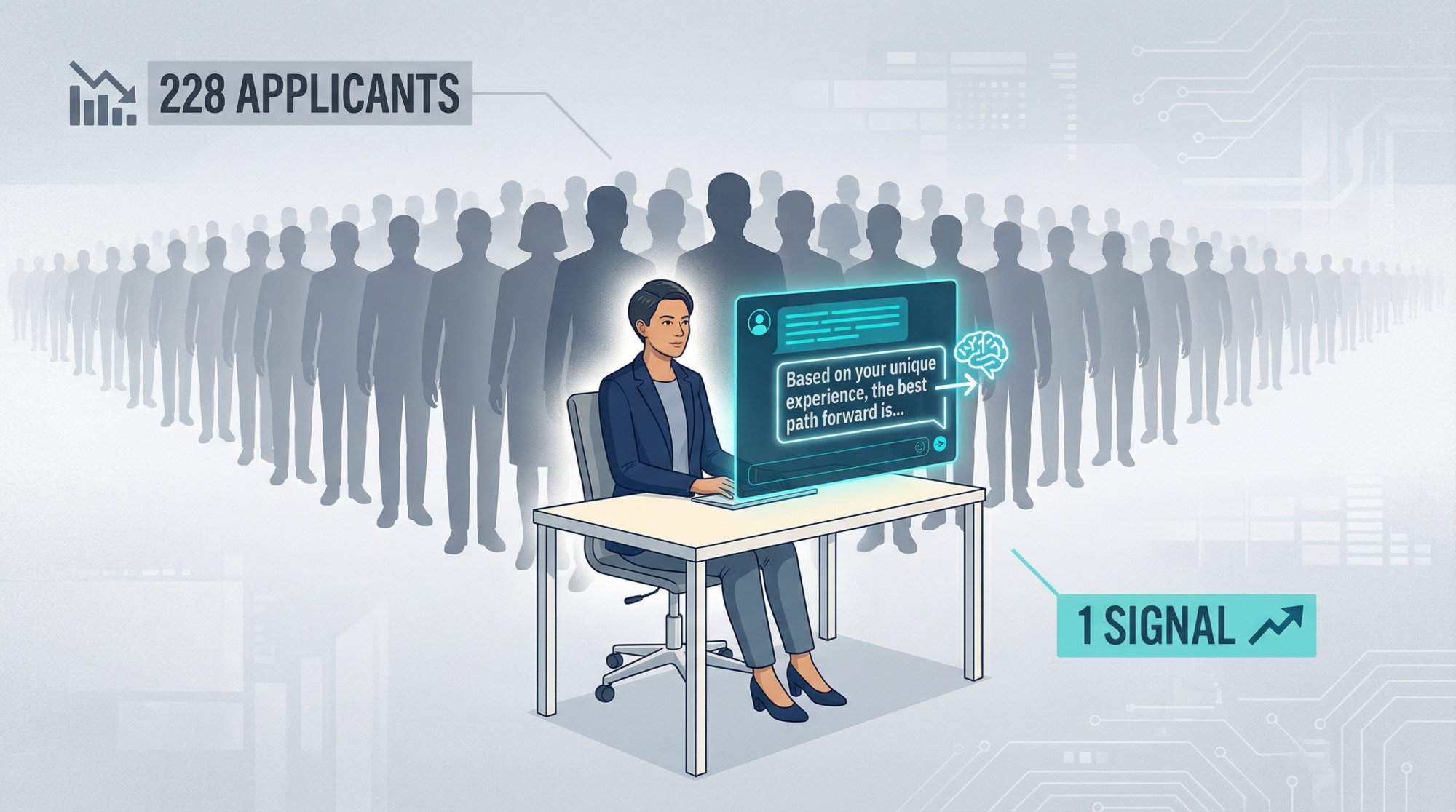
This guide gives you a complete 9-step system with copy-paste prompts you can use today. By the end, you'll know how to:
→ Generate a targeted, evidence-backed resume for a specific role in 15 to 30 minutes
→ Write cover letters that don't sound like they came off an assembly line
→ Build networking scripts that actually get replies
→ Walk into interviews with a story bank, not just vibes
→ Stay safe on privacy and avoid the hallucination trap
What can ChatGPT actually do for your job search?
Most people searching "how to use ChatGPT for job search" are trying to solve one of these:
"I need more interviews, not just more applications."
"I keep tailoring, but it takes forever. I need speed without sounding fake."
"I don't know what jobs I fit. I need clarity and a plan."
"I'm worried employers will hate AI-written applications. I need safe, human results."

Those are the real problems. This guide is organized around solving them, not around showcasing ChatGPT features.
Where ChatGPT helps in your job search (and where it falls short)
Think of job search as a three-stage filtering system:
① ATS + recruiter skim filters for relevance and clarity
② Hiring manager review filters for credibility, results, and fit
③ Interview filters for real competence and communication
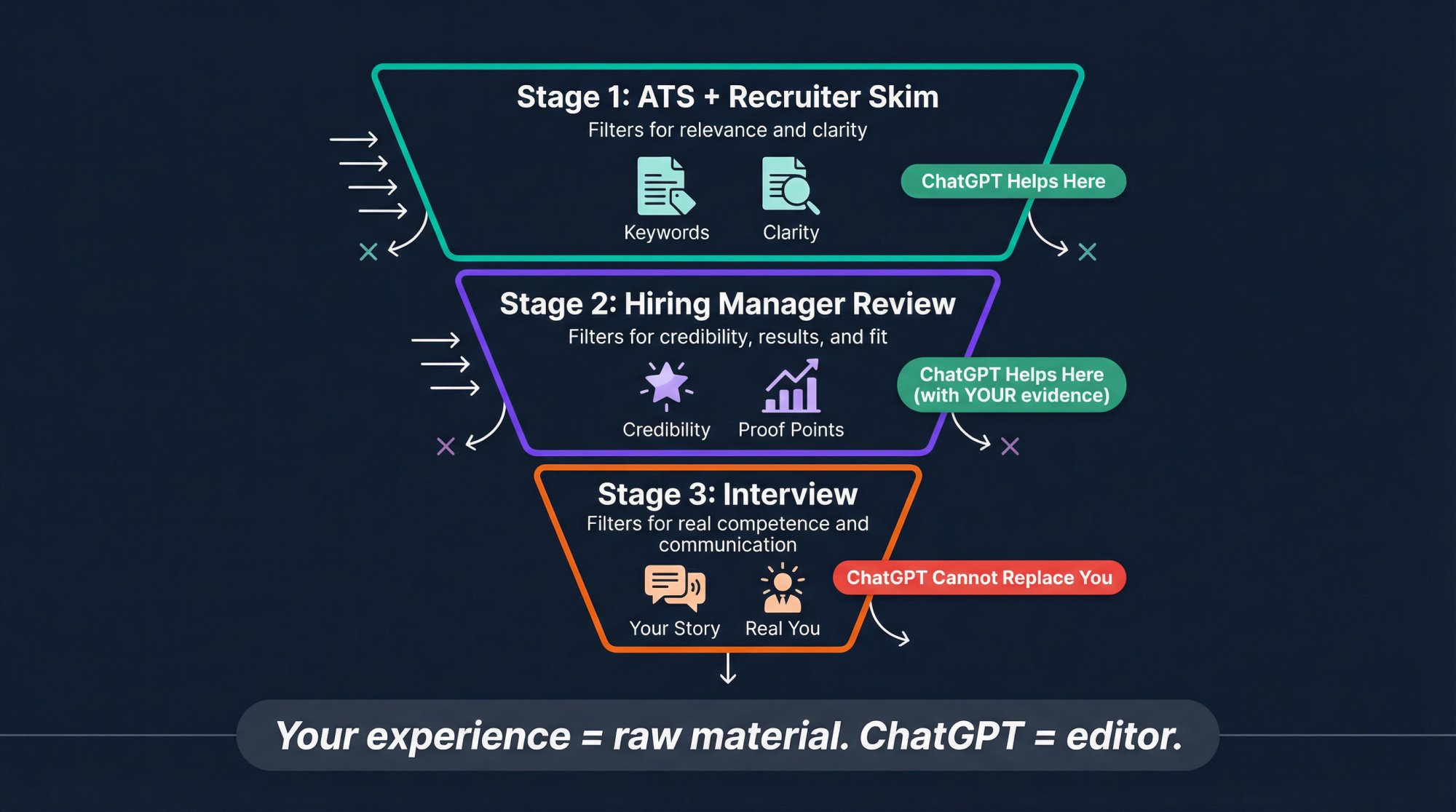
ChatGPT is genuinely useful for several things in that funnel:
Turning messy, scattered experience into clean, structured communication
Extracting keywords and requirements from job descriptions
Generating variations fast: bullet rewrites, message drafts, interview drills
Simulating a recruiter or interviewer and stress-testing your story before it counts
But ChatGPT has real limitations that matter here. It doesn't know your actual facts unless you give them (and it will confidently fill in blanks with plausible-sounding fiction). It can't write a distinctive, credible voice from vague input. And it can't make your application credible if the underlying content lacks real evidence.
The right mental model: Your experience is the raw material. ChatGPT is the editor. If the raw material is thin, the output is polished emptiness.
Keep this in mind throughout every step below. The prompts are designed to pull out your specifics, not manufacture them.
How to protect your privacy when using ChatGPT
If you're going to paste your resume, work history, or anything personally identifying into ChatGPT, spend 90 seconds understanding the controls first.
For personal ChatGPT accounts: OpenAI's Data Controls settings let you turn off "Improve the model for everyone." Your chats stay in history but stop being used for model training. OpenAI also offers Temporary Chat, where conversations won't appear in history, won't create memory, and won't be used for training at all.
For business accounts (ChatGPT Team, Business, Enterprise, or API): OpenAI states that business data is not used for training by default.
Even with these controls in place, apply this practical rule before pasting anything work-related:
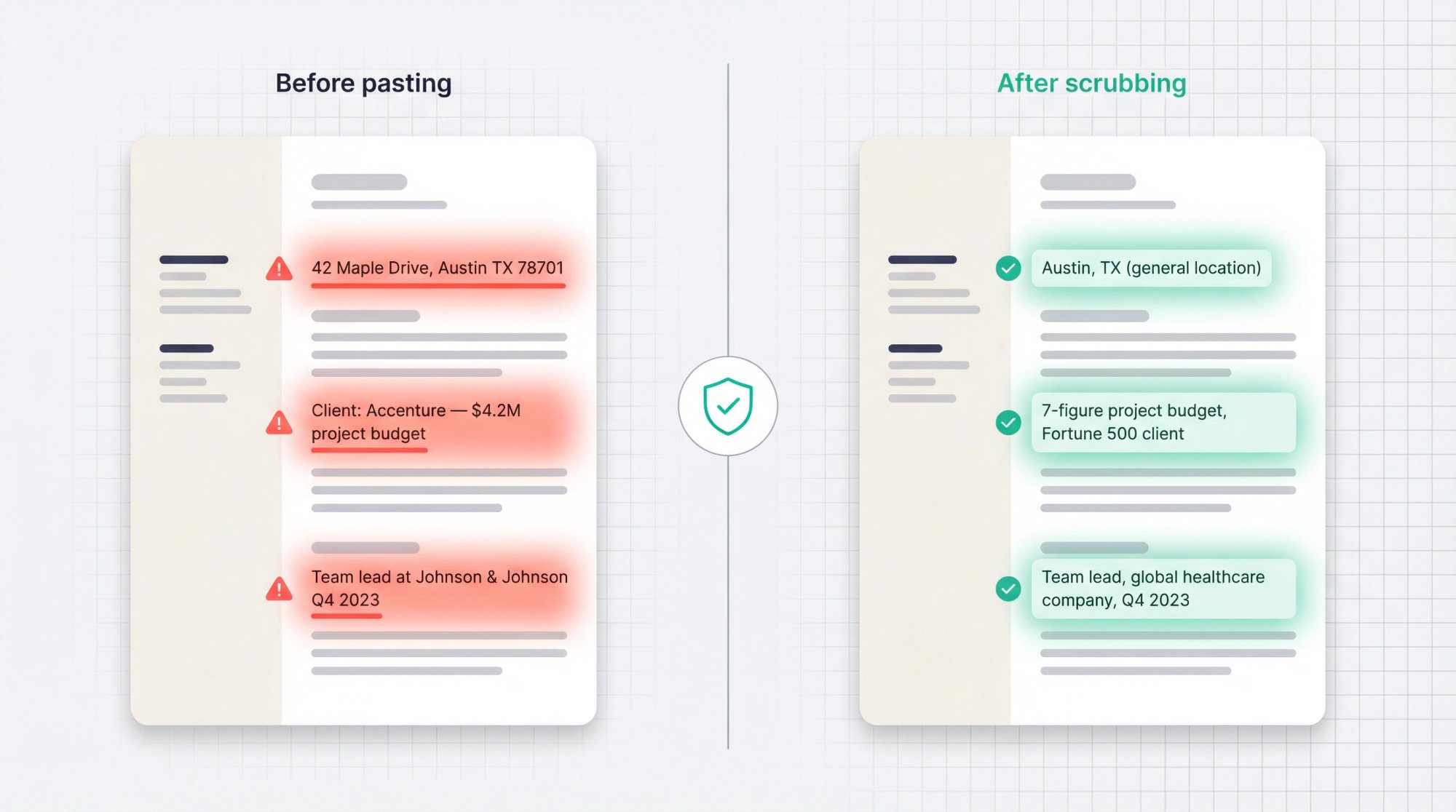
Keep everything about: outcomes, scope, tools used, problems you solved, measurable impact. This takes 2 minutes to scrub and it's worth doing.
What's new in ChatGPT in 2026 for job seekers
Based on OpenAI's February 13, 2026 release notes, there are a few updates worth knowing:
File attachments: You can now attach up to 20 files in a single message. This is useful for comparing multiple job descriptions, reviewing different resume versions, and working with portfolio pieces side-by-side in one session.
Deep research: Updated in February 2026 to produce more credible research reports and focus on specific websites. For job search, this helps with company research before interviews.
Pricing tiers: OpenAI introduced three plans at different commitment levels:
US pricing; localized in some markets.
You don't need a paid plan to use the 9-step system in this guide. But if you're doing heavy file-based work or company research, paid tiers smooth things out.
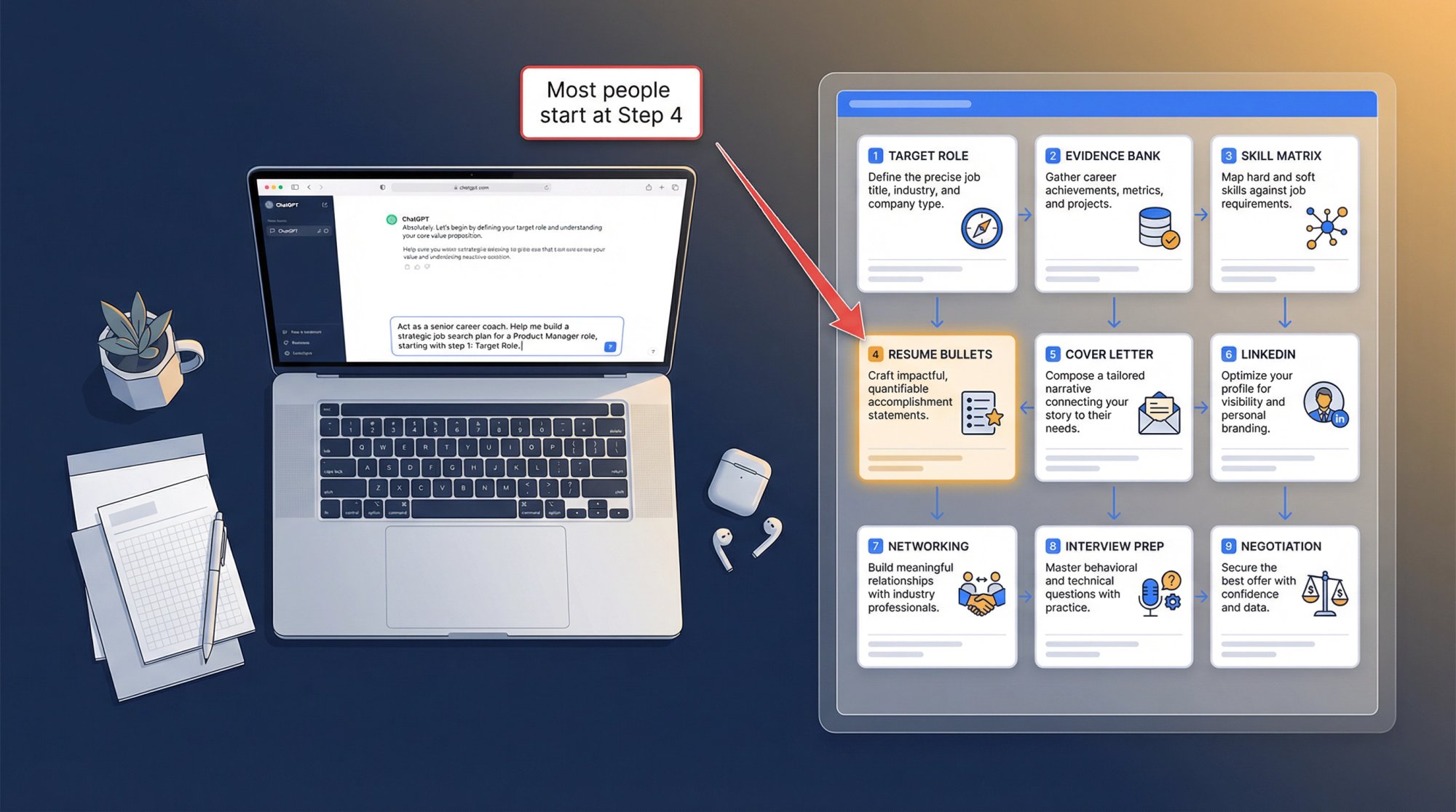
A 9-step ChatGPT system to land more interviews
This is the core of the playbook. Follow these steps in order. The reason most people get generic results is they skip to "write my resume bullet" without doing the foundational work first.
Step 1: Define your target role before applying anywhere
If you can't explain what you're targeting in one paragraph, your resume will read as incoherent. Because it is.
Most candidates apply to 10 different job types and wonder why nothing sticks. The problem isn't the resume. It's the lack of a target. Hiring teams don't hire "smart generalists." They hire the person who seems built for this specific job. Your Target Role Spec is how you force specificity upstream, so everything downstream becomes obvious.
What you want to produce:
→ 2 to 3 target job titles (and 3 adjacent ones)
→ Seniority level
→ Your "must-have" skills (8-12 items)
→ Your "proof points" (real projects and metrics you'll show)
→ Your deal-breakers (what you'll say no to)
Common target roles our users define include software engineer, data analyst, product manager, and marketing manager, each with distinct skill sets and hiring criteria worth understanding before you start applying.
Copy-paste this prompt:
Act as my career strategist.Goal: Help me define a Target Role Spec for my job search.First, ask me 12 questions (one at a time) to clarify:- my strengths, constraints, and preferences- my current experience level- roles I keep getting pulled toward- roles I should avoid- industries and company size preferences- compensation and location constraintsAfter the Q&A, output:1) A one-paragraph target role statement2) 3 target titles + 3 adjacent titles3) A "must-have skills" list (8–12)4) A "proof I can do this" list (5–8 evidence bullets)5) A "deal-breakers" list (5–8)Keep it concrete. No generic advice.This prompt forces a real conversation rather than generic output. ChatGPT asks you questions, and your answers become the specificity that makes everything else better.
Once you have your target titles, browse resume examples and cover letter examples filtered by role to see what top candidates in those positions actually include.
Step 2: Build your evidence bank to stop sounding AI-generated
"AI-sounding" applications usually fail for one specific reason: they're polished but empty. All structure, no substance.
Employers can detect an entirely AI-generated resume or cover letter quickly, and recommend using GenAI for drafts and improvements rather than as a replacement for your actual experience. And if 88% of hiring managers say they can tell when candidates used AI, you should assume that "generic" equals "caught."
Your Evidence Bank is the antidote. It's a structured list of your real achievements: the raw material you'll paste into ChatGPT (and into our tools at AIApply) to produce output that's both polished and backed by genuine proof.
Copy-paste this prompt:
You are my accomplishment mining interviewer.Rules:- Do not invent facts, metrics, tools, or scope.- If I don't know a metric, propose 3 ways to estimate it and ask follow-up questions.Interview me to extract 15 strong achievements across:- impact (revenue, cost, time, risk, quality)- leadership (influence, alignment, conflict)- execution (delivery, speed, constraints)- technical/functional depth (tools, methods)Ask one question at a time.After the interview, output an "Evidence Bank" as a table with columns:- Achievement headline (1 line)- Situation (context)- Actions (what I did)- Tools/skills used- Result (with metric or proxy)- Proof source (where I can verify it)Once you have this Evidence Bank, your job search gets dramatically simpler. Every resume bullet, networking message, and interview answer becomes a recombination of proof you already own. This is the single most valuable hour you can spend before applying anywhere.
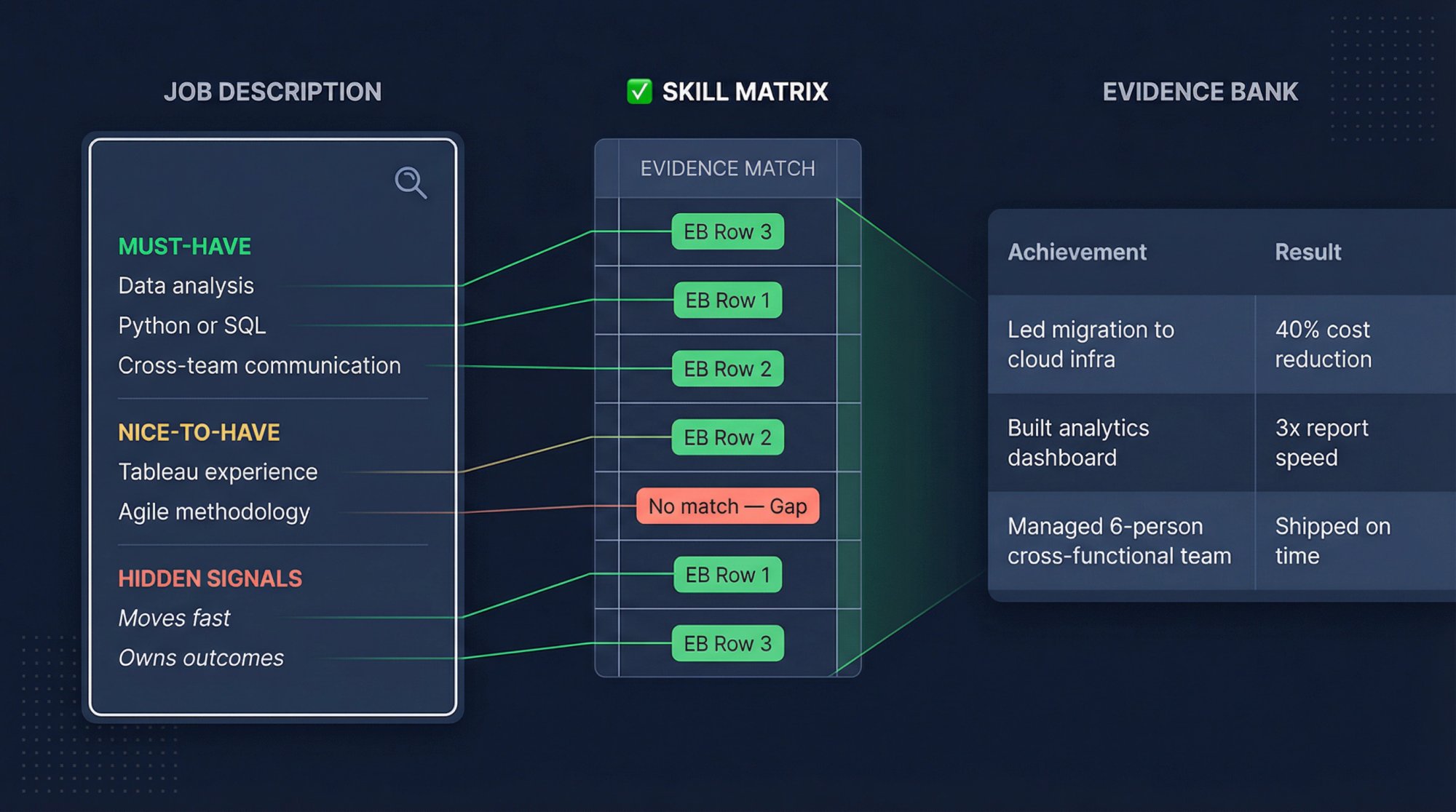
Step 3: How to turn any job description into a skill matrix
Most candidates "tailor" by sprinkling keywords into their resume. That's backwards.
The right approach is to map the job's requirements to your evidence. Keywords matter, but keywords plus proof is what survives both the ATS and the human reviewer who reads the shortlist.
Worth noting: For roles requiring technical skills (say, Python development, SQL and data work, or digital marketing management), the Skill Matrix step is especially critical because hiring managers test these claims directly in interviews.
Copy-paste this prompt:
I will paste a job description and my Evidence Bank.Task:1) Extract the job's requirements into:- Must-have (top 8)- Nice-to-have (top 6)- Hidden signals (5 things implied by wording)2) Create a Skill Matrix:For each must-have and nice-to-have:- What the employer likely means- What evidence from my Evidence Bank matches (cite the row)- A suggested resume bullet angle3) Identify gaps:- What's missing- Whether it's a deal-breaker- The fastest honest mitigation (project, course, narrative framing)Output must be a clean table plus a 10-line summary.The Skill Matrix output tells you exactly what to emphasize, where to add proof, and where your gaps are, so you can decide whether to address them honestly or move to a better-fit role.
Step 4: Write resume bullets that pass ATS and impress recruiters
A resume bullet isn't a diary entry. It's a claim of value. And every claim of value needs to answer four questions:
① What did you do?
② How did you do it?
③ What changed because of it?
④ How significant was the change?
The bullet formula that works almost everywhere:
Action (strong verb) + Object (what) + Method (how) + Impact (result)
Example: "Reduced customer churn by 22% over two quarters by redesigning the onboarding flow and implementing proactive check-in sequences."
Copy-paste this prompt:
You are an expert resume editor.Inputs I will provide:- Target Role Spec- Job Description- Evidence Bank- My current resume bullets (optional)Rules:- Do not add tools, metrics, or responsibilities I did not provide.- Prefer numbers. If missing, ask me for the missing number.- Avoid clichés: "passionate", "results-driven", "synergy", "fast-paced".- Keep bullets 1–2 lines max.Task:1) Generate 6–10 bullets for my most relevant experience.2) For each bullet, also output:- the keyword(s) it targets from the JD- which Evidence Bank item it maps to3) Provide a "weakness report":- Where my evidence is thin- Which bullets feel like fluff and whyThe "weakness report" component is underrated. It forces ChatGPT to be honest about where your evidence is thin rather than papering over it with confident-sounding emptiness.
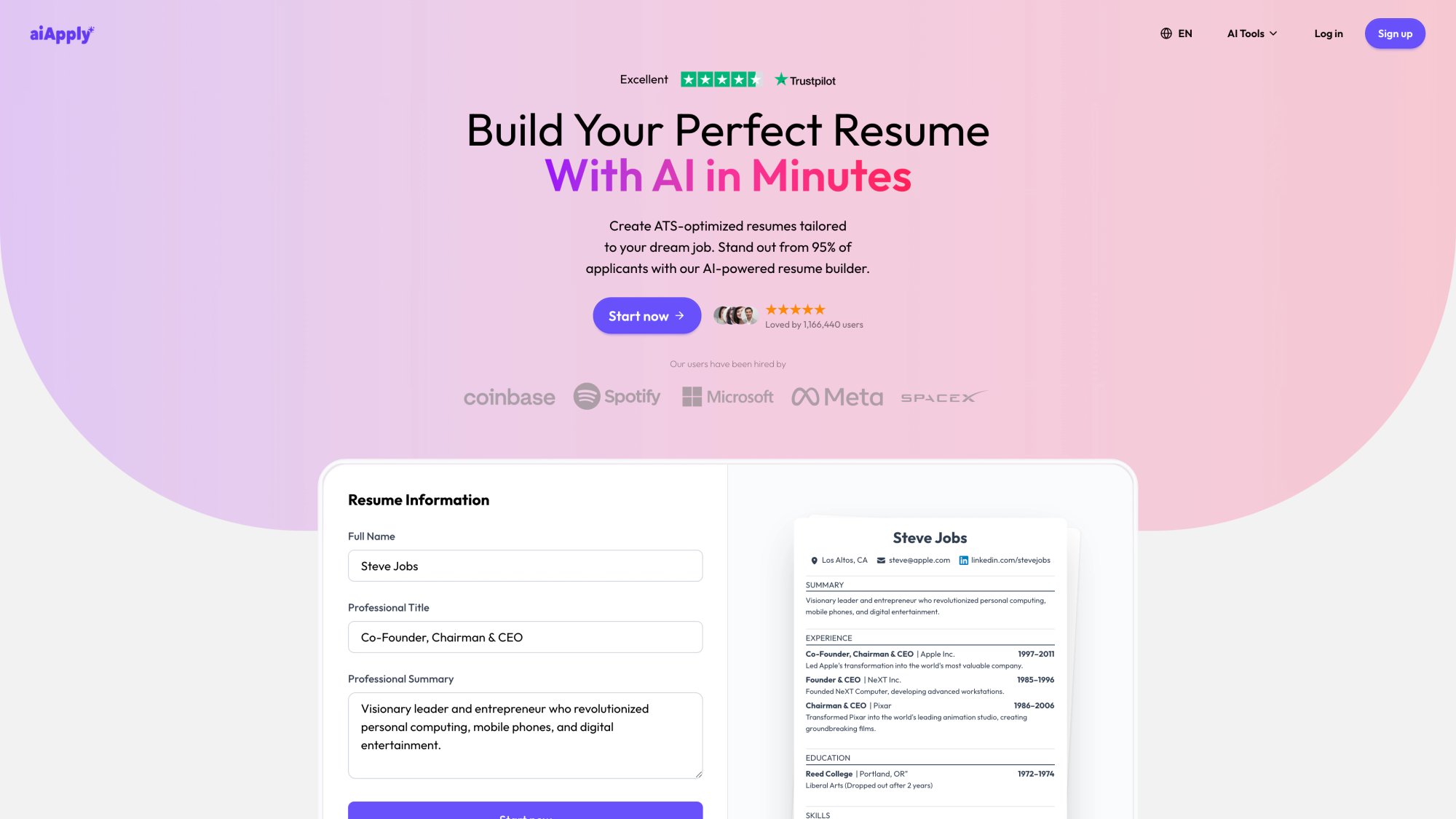
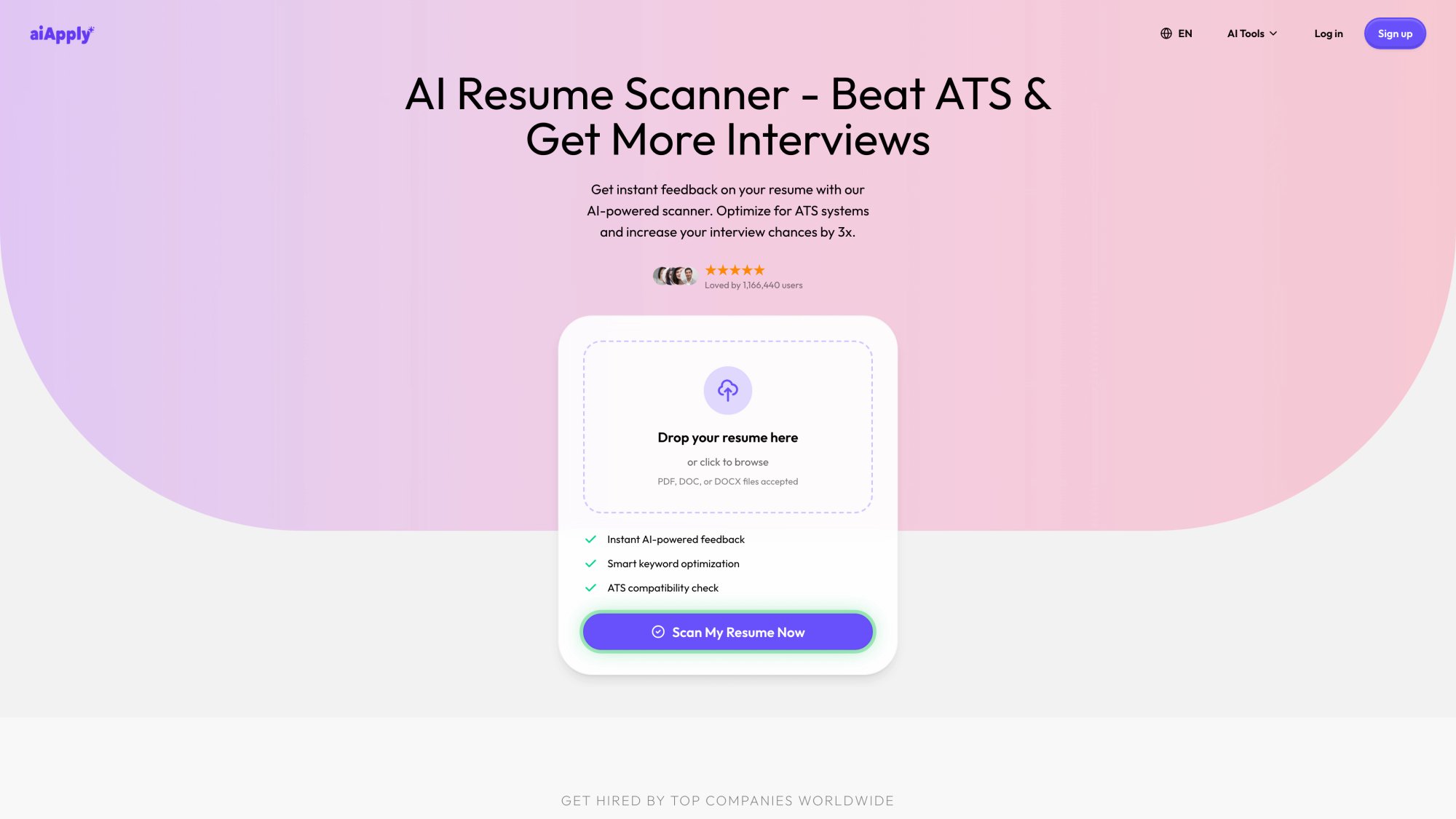
Where our tools fit in: If you want to handle the "tailoring + formatting + ATS optimization" loop faster, our AI Resume Builder and AI Resume Scanner are built for exactly this. The Resume Builder keeps your templates ATS-compatible while letting you iterate versions per role, and the Resume Scanner checks your resume against 50+ ATS systems and flags keyword gaps before you submit. You can also use our AI Resume Rewriter to rapidly refresh an existing resume and align its language with the job description you're targeting.
Browse AI resume templates to find a layout that fits your industry and seniority level. All templates are ATS-compatible by design.
Step 5: How to write a cover letter that doesn't sound like AI
A cover letter has one job: add signal that isn't already obvious in your resume. If it just restates what's in your resume with different words, it's not a cover letter. It's padding.
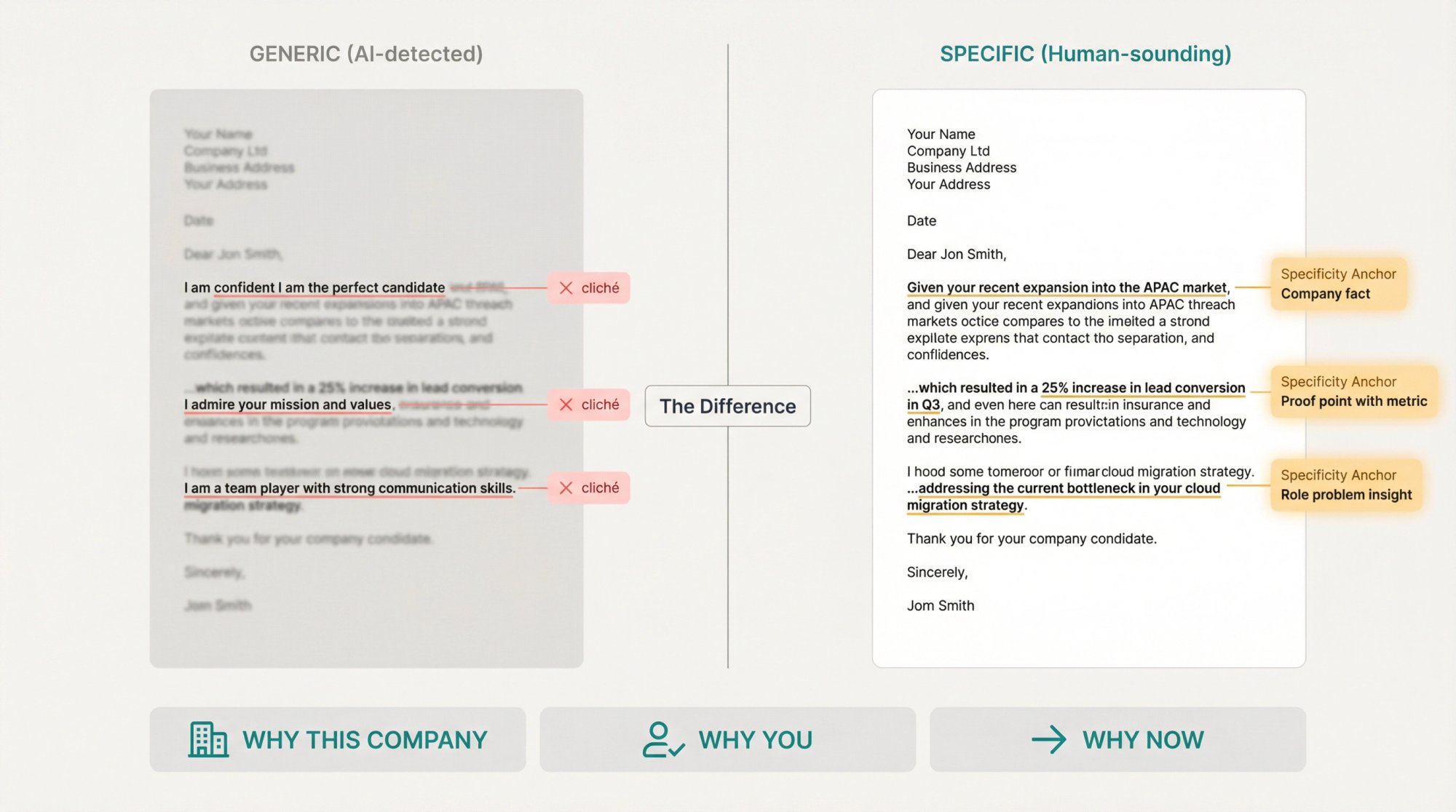
The "detector" for AI-written cover letters isn't usually a sophisticated algorithm. It's a human being who has read 200 letters that all start the same way, contain the same filler phrases, and say nothing that couldn't apply to any company. Generic output is the real problem, and AI-written letters are most detectable when they lack company-specific hooks.
Structure that works:
Why this team/company: a specific hook based on something real (not "I admire your mission")
Why you: 2 concrete proof points mapped to the role's real problem
Why now: what you want to build or solve next, aligned to what they're working on
Copy-paste this prompt:
Write a cover letter that sounds human and specific.Inputs:- Job description- 2–3 company facts I provide (product, metric, news, leadership quote, etc.)- My Evidence BankConstraints:- 220–320 words- No clichés, no filler- Use 2 proof points with concrete outcomes- Include one sentence that shows I understand the role's real problem- End with a low-pressure close (not "I am confident I'm the perfect candidate")Output:1) The cover letter2) A list of "specificity anchors" used (so I can verify them)3) 5 lines that are still too generic (if any) and how to fix themThe "specificity anchors" output is key. It shows you exactly which sentences are grounded in real facts and which ones ChatGPT manufactured. Fix the manufactured ones with your own details.
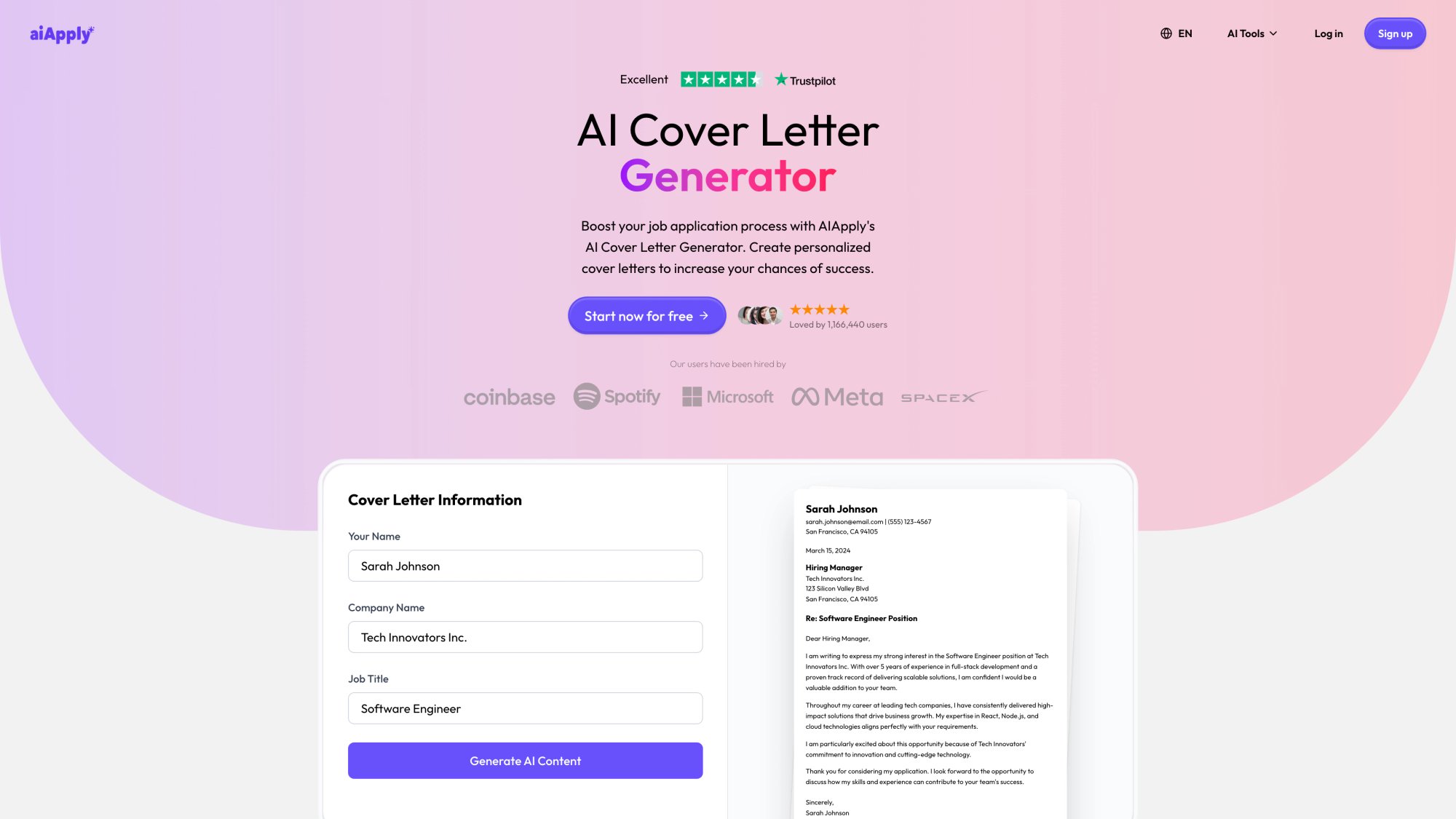
For a strong first-pass draft that's already structured and ready to personalize, our AI Cover Letter Generator produces role-specific letters in minutes using your experience and the job description. Users report a 3x increase in interview invites. You still humanize it with your specifics. That's what makes it yours.
For examples of how strong cover letters look across different roles, see our cover letter examples library. Or go directly to a role-specific page like software engineer cover letters or engineering cover letters if that's your target field.
Students and early-career candidates with limited experience should check out our guide to writing a cover letter with no experience, which covers how to surface transferable skills and academic accomplishments effectively.
Step 6: How to optimize your LinkedIn profile with ChatGPT
If your resume says one thing and your LinkedIn says something different, you create doubt. Recruiters check both. Hiring managers check both. Doubt kills otherwise strong applications.
Your consistency checklist before you apply anywhere:
Job title and scope match between resume and LinkedIn
Skills and tools are aligned
Timeline and achievements are consistent (no date gaps or contradictions)
Language is coherent (not copy-pasted, but recognizably the same person)
Copy-paste this prompt:
You are my LinkedIn optimization coach.Inputs:- Target Role Spec- Resume (or key bullets)- A list of 20 keywords from job descriptions I'm targetingTask:1) Write 5 headline options (each < 220 characters) optimized for recruiter search.2) Rewrite my About section in 3 versions:- concise- narrative- metrics-heavy3) Suggest 10 Featured section items I should add (portfolio, project, post, etc.)4) Provide a consistency check: anything on LinkedIn that contradicts my resume.Our LinkedIn-to-Resume builder lets you import your LinkedIn profile and instantly generate a polished, job-tailored resume without starting from scratch, which is useful when your LinkedIn is already strong and your resume needs catching up.
Step 7: How to write networking messages that get replies
Most people underinvest in networking because it feels awkward and the ROI seems uncertain. But from first principles, networking changes your odds in three concrete ways:
Less competition: you're not applicant #228 in the pile
More trust: someone internally vouches for you, which shifts the default from skeptical to interested
More context: you learn what the team actually needs before you apply
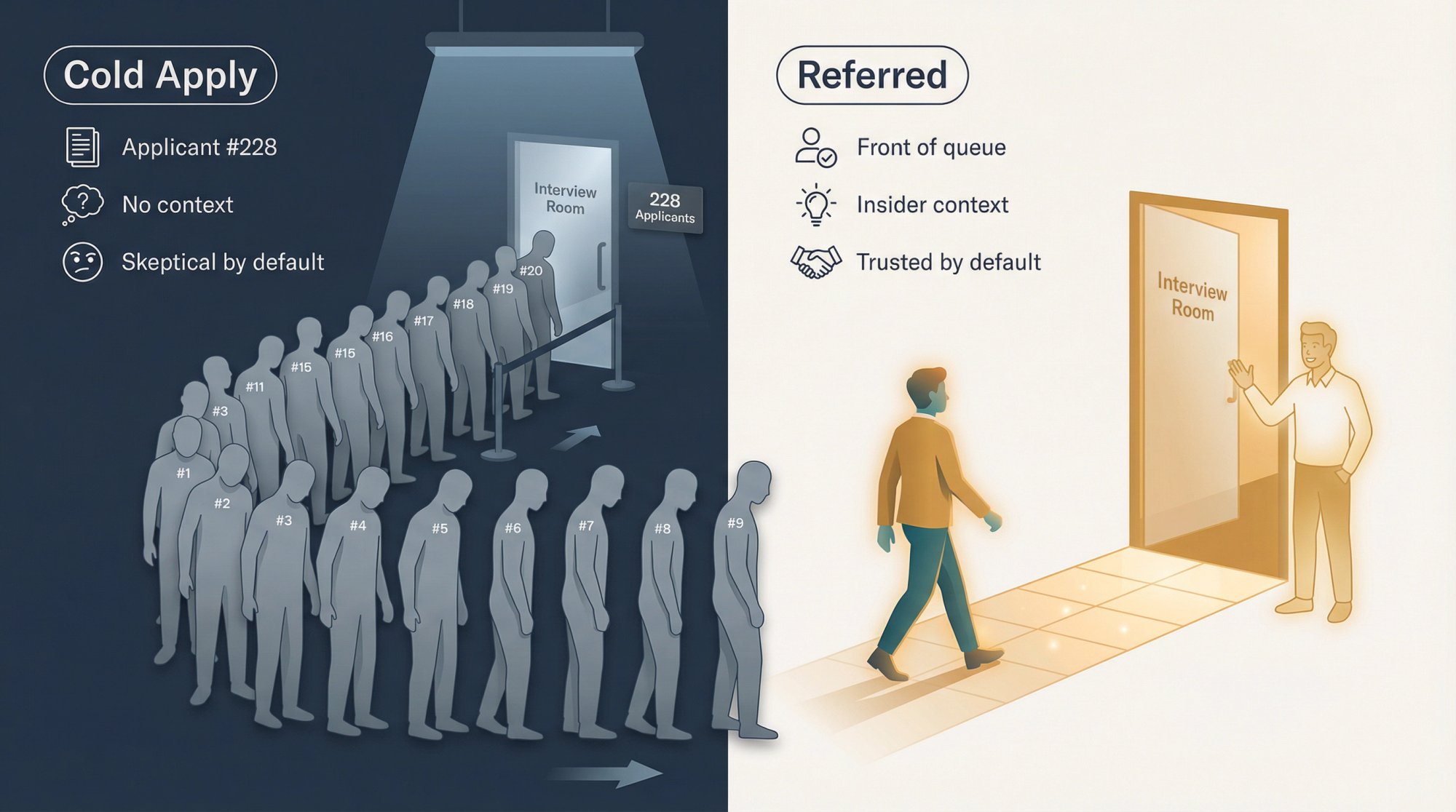
Axios quotes Greenhouse's co-founder explaining that being early and having an internal referral helps you stand out, and that candidates are generally reviewed in order of application. A referral that moves you to the front of that queue is worth more than most people realize.
Looking for open roles to target your outreach? Our job board aggregates 1M+ unique open roles across industries. Use it to identify active hiring at specific companies before reaching out to your network.
Copy-paste this prompt (referral ask):
Write 3 versions of a referral request message.Inputs:- My relationship to the person (weak tie / former colleague / friend)- The role and company- 2 evidence points from my Evidence Bank relevant to the roleConstraints:- Under 700 characters- Clear ask in one sentence- No guilt, no desperation- Include an easy "out" lineOutput:- Version A: direct- Version B: warmer- Version C: ultra-shortCopy-paste this prompt (informational interview):
Write an informational interview request.Constraints:- Under 500 characters- Ask for 12 minutes (not 30)- Show I did basic homework- Ask one sharp question about the role/team- Make it easy to say noThe "12 minutes" constraint in the second prompt is intentional. Asking for 30 minutes is a big ask. Asking for 12 minutes feels specific, respectful of their time, and much easier to say yes to.
Step 8: How to use ChatGPT to prepare for job interviews
Interview performance is mostly three things: story selection, structure (STAR or similar), and practice under pressure. None of that requires AI assistance in the moment. All of it can be done through preparation.
There's a real line you shouldn't cross here. Axios reports that Greenhouse's co-founder explicitly described using generative AI on the side during a live Zoom interview as "not OK." Business Insider has reported that some Fortune 500 companies may disqualify candidates caught using real-time AI tools during evaluations.
Everything in this step is about preparation, which is completely legitimate and how the best candidates have always operated.
Copy-paste this prompt (build your story bank):
You are my interview coach.Inputs:- Target Role Spec- Evidence BankTask:1) Select 8 stories that cover 80% of behavioral questions:- conflict- failure- leadership- ambiguity- learning- ownership- influencing without authority- high-pressure delivery2) For each story, produce:- STAR outline- 45-second version- 2-minute version- "risk points" (where I might sound weak)3) Give me a 7-day practice plan.Copy-paste this prompt (mock interview):
Run a mock interview for this job.Rules:- Ask one question at a time.- After each answer, score me 1–10 on:clarity, relevance, evidence, conciseness, confidence- Then rewrite my answer in my voice, keeping facts unchanged.- Push back like a skeptical interviewer if my answer is vague.Start with: "Tell me about yourself."The scoring system in that second prompt is what makes it useful for real improvement rather than just going through the motions.
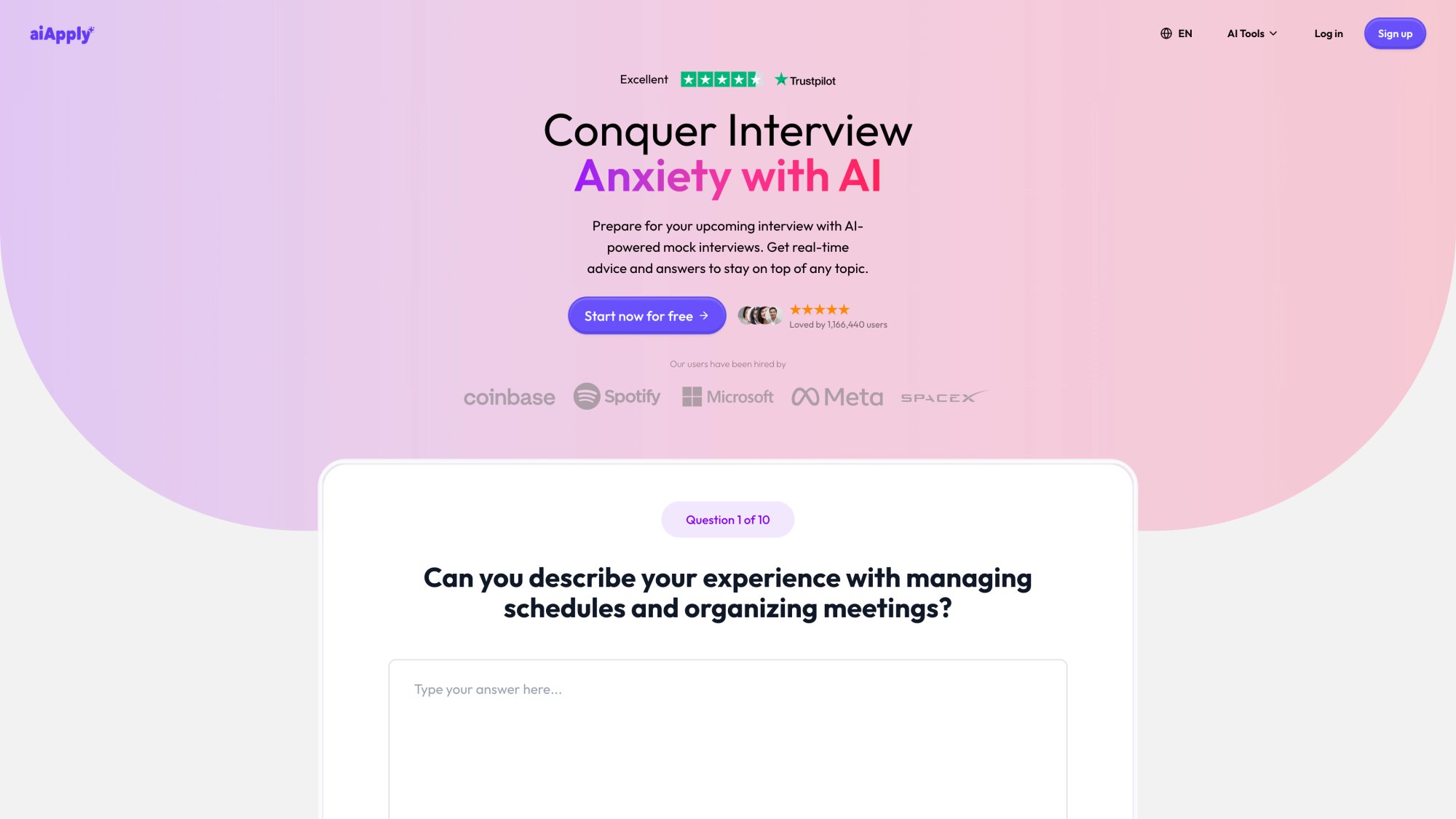
Where our tools fit in: Our AI Mock Interview generates job-specific practice sessions from a job description, scoring your answers and giving you actionable feedback. A full session takes 15 to 30 minutes. We also offer Interview Answer Buddy, a desktop tool that provides real-time coaching during live interviews. If you use anything like this, follow the employer's stated rules for assessments and interviews. Ethics matter, and so does your reputation.
Step 9: How to use ChatGPT to negotiate your salary
Negotiation isn't about being aggressive. It's about knowing three things: your range, your priorities, and how to trade intelligently. Comp, title, start date, remote flexibility, equity, and learning budget are all negotiable. You just need a plan before you pick up the phone.
Before you negotiate, benchmark your market rate. Our salary guides cover roles across industries: see the software engineer salary guide, product manager salary guide, or data analyst salary guide for experience-based ranges, regional breakdowns, and negotiation prep tips.
Copy-paste this prompt:
You are my negotiation strategist.Inputs:- Offer details (salary, equity, bonus, benefits, location, level)- My current compensation (optional)- My top 3 priorities- Market context I provide (range or comparable roles)Task:1) Propose a negotiation plan with:- my target ask- my walk-away- 3 trade options2) Draft:- an email negotiation script- a phone call script3) Provide "risk checks":- where I might sound entitled- where I might undervalue myselfThe "risk checks" output is genuinely useful. Most people either undersell and accept the first number, or they push too hard on the wrong thing. Having an AI flag those failure modes before you're in the room is a real edge.
How to stop your application from sounding AI-generated
Before you submit anything, run it through these four filters. Hiring managers aren't just judging writing quality. They're judging credibility.
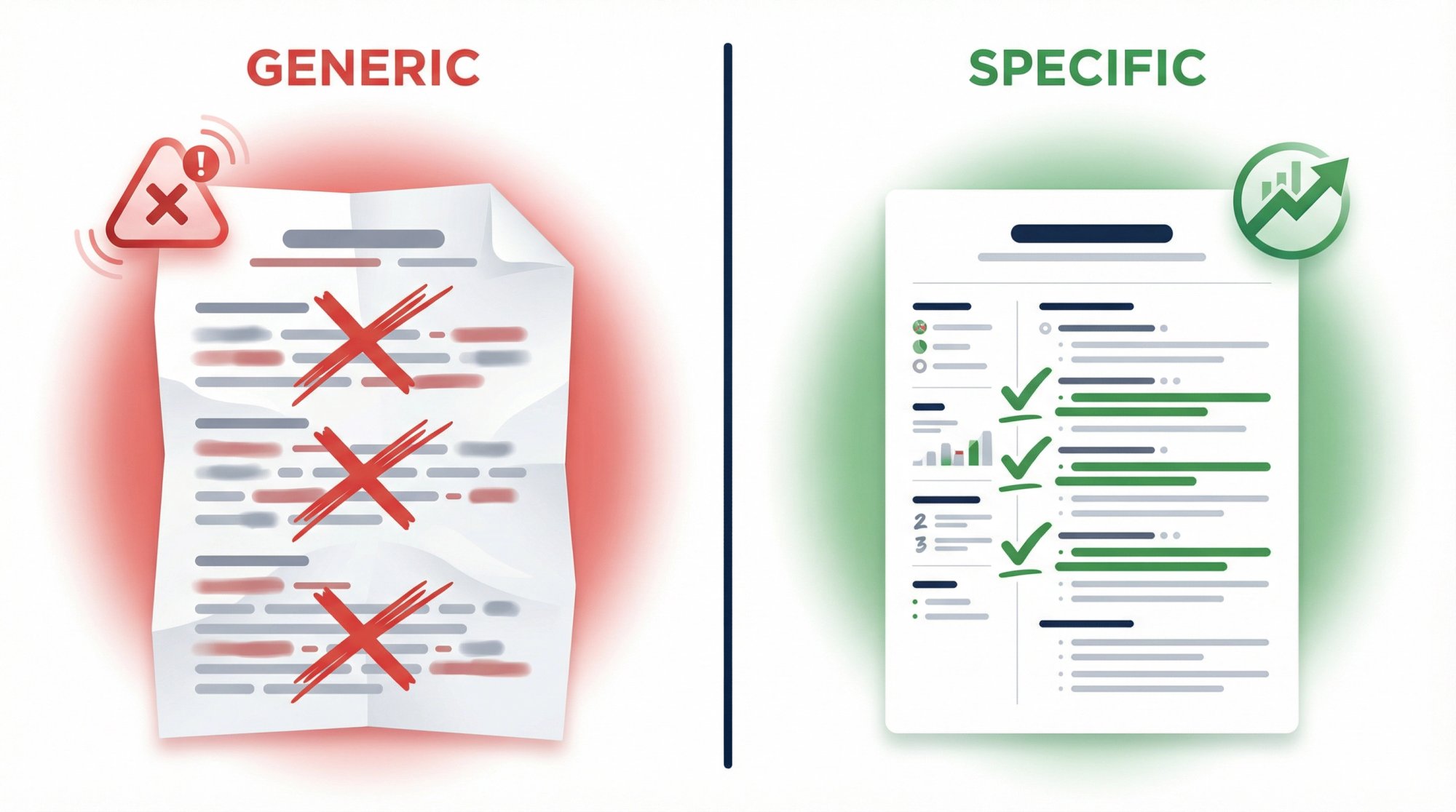
1. Specificity anchors
Does your application mention 1-2 real, named projects?
Do you include actual numbers or concrete scope?
Do you name real tools or methods you actually used?
2. Consistency check
Do your resume, LinkedIn, cover letter, and interview stories align?
Are titles, dates, and scope consistent across everything?
3. Anti-generic filter
Rewrite or remove any line that contains:
→ "I am excited to apply..."
→ "I am passionate about..."
→ "Results-driven..."
→ "Fast-paced environment..."
→ "I believe I would be a great fit..."
None of these say anything. Any candidate could write them. They signal that you didn't think carefully about this specific role.
4. Truth check
Did ChatGPT invent anything in your materials? If you can't prove a claim, don't make it. Inaccuracies and AI-generated content are detectable. Run your resume through our free AI Resume Checker to catch issues before a recruiter does, or use the Resume Summary Generator to sharpen a weak summary section. Fabricated credentials or metrics are a fast path to disqualification or worse.
How AIApply and ChatGPT work together for job search
ChatGPT is a general-purpose thinking partner. AIApply is a purpose-built job-search pipeline. They serve different functions, and used together, they cover the whole job search from research to offer.
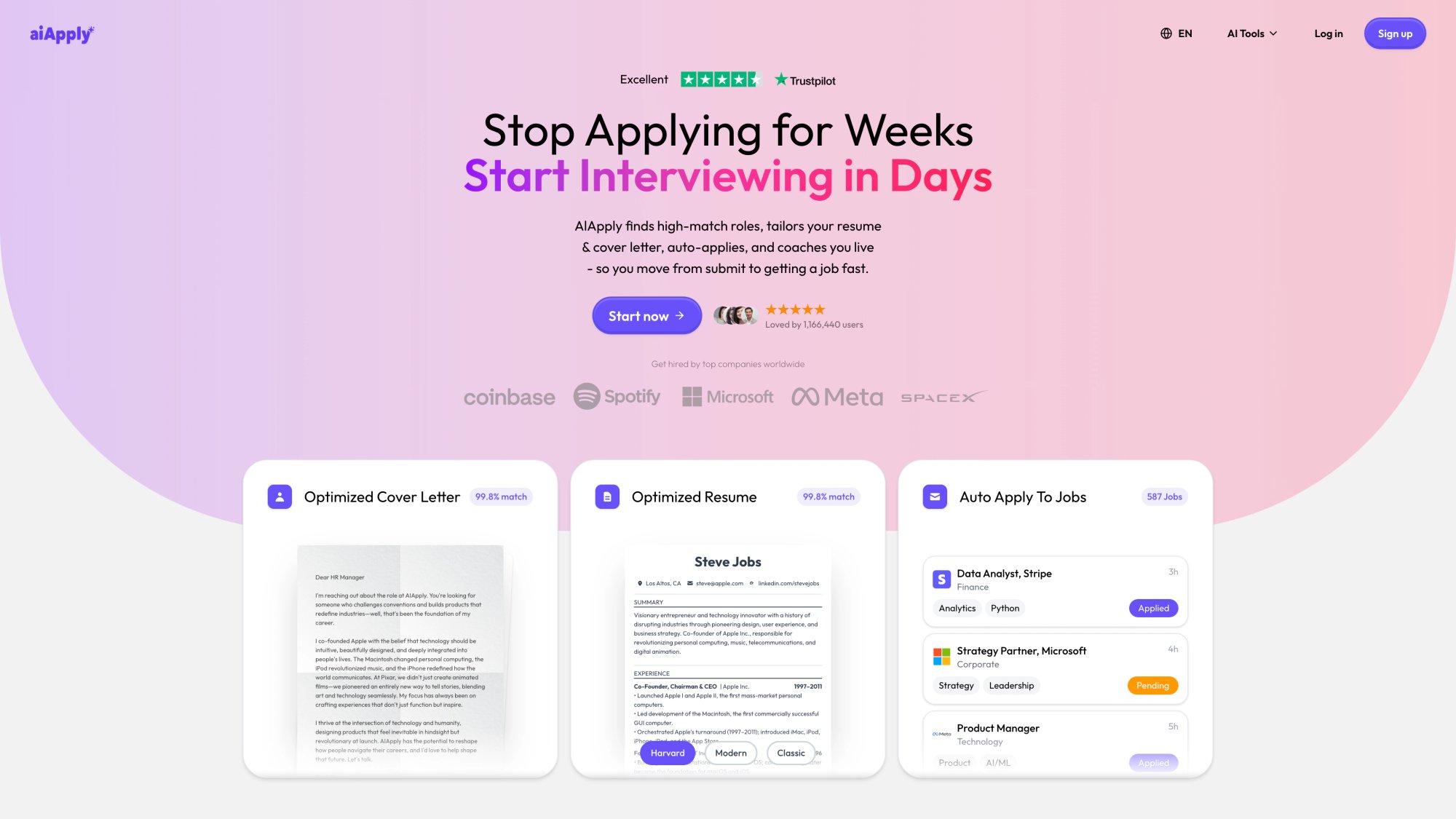
A clean combined workflow:
Define your strategy first. Use ChatGPT to build your Target Role Spec and Evidence Bank (clarity and proof foundation).
Build and store resume versions. Use our AI Resume Builder to create multiple tailored versions for different roles. The Harvard-inspired templates are built specifically for ATS compatibility.
Catch ATS issues before you apply. Run each resume version through our AI Resume Scanner, which checks against 50+ ATS systems and flags keyword gaps in real time.
Generate strong cover letter drafts. Use our AI Cover Letter Generator for a fast first pass, then personalize with the ChatGPT prompts from Step 5 above.
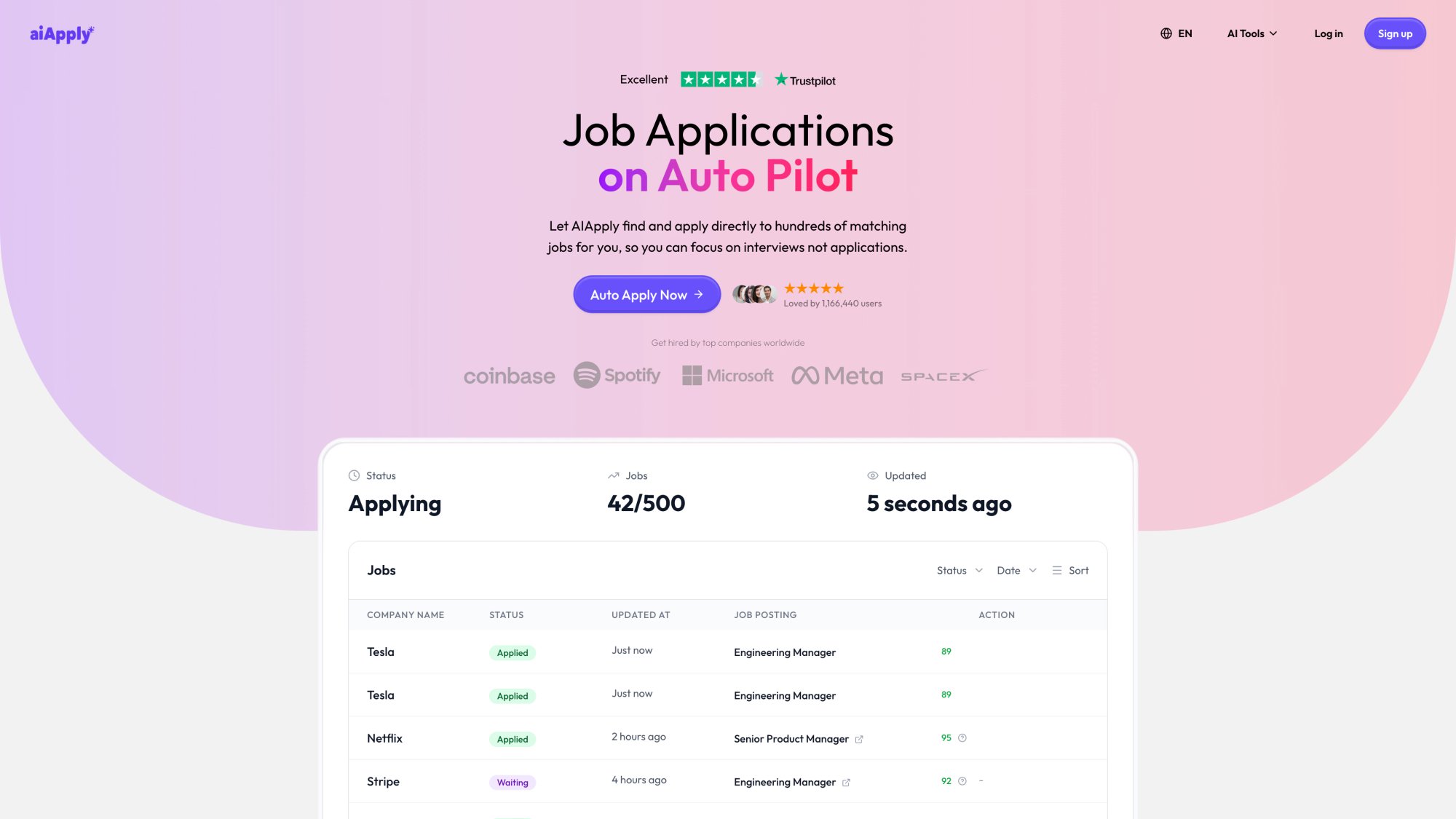
Scale volume if needed. If volume is your bottleneck, our Auto Apply feature scans 1M+ job postings and submits tailored applications on your behalf (up to 500 per month). Use good filters. Scale targeted, not random.
Prepare for every interview. Combine our AI Mock Interview (job-specific practice in 15-30 minutes, with real scoring) with your ChatGPT story bank drills from Step 8.
Understand what's processed. If you're going to store application data anywhere, read AIApply's privacy policy once so you understand what's being processed across the website, apps, and extension.
Over 1.1 million job seekers have used AIApply, and users are reported to be 80% more likely to get hired faster. That's not from using more tools. It's from having a system that connects the dots from first application to offer.
If you're a student or recent graduate, AIApply offers a 40% student discount across all premium features. Worth checking before you subscribe.
ChatGPT job search: your questions answered
Is it normal to use ChatGPT for job search now?
Yes, and broadly. A ZipRecruiter survey of new hires found that just over 53% used ChatGPT or similar GenAI tools in their most recent search. Research from global AI surveys puts GenAI tool usage for tasks like company research and cover letter drafting at 70% of job seekers. The question isn't whether to use AI. It's how to use it so that you come across as human and credible rather than generic.
Can employers tell if you used AI?
Often, yes, especially when the output is generic. Insight Global's survey of 1,005 U.S. hiring managers found that 88% say they can tell when candidates use AI, and 54% say they care. Employers can detect an entirely generated resume or cover letter quickly.
The practical takeaway: AI is fine. Generic is what kills applications. The system in this guide is designed to use AI in a way that makes you more specific and credible, not less.
Should you disclose that you used ChatGPT?
Most application processes don't ask. If you're directly asked whether you used AI assistance, don't lie. You can frame it accurately: you used AI to improve clarity and structure, and you validated every claim personally. That's honest, and it's also what sophisticated hiring teams actually want to hear.

What ChatGPT plan do you need for job search?
Any plan can work for this system. The free tier handles the core prompts in this guide. If you're doing heavy file-based work (comparing multiple job descriptions, attaching portfolio pieces, running deep research on companies), a paid plan helps.
OpenAI's current pricing is US-based; localized in some markets.
How do you keep your data private in ChatGPT?
Turn off "Improve the model for everyone" in Data Controls settings. Use Temporary Chat when you're working with anything sensitive. It generates no history, creates no memory, and is not used for training. And apply the personal scrubbing rule from the Privacy section above before pasting any work details.
Can you use ChatGPT to search for jobs directly?
Sort of. ChatGPT's browsing mode can surface job listings, but it's not a dedicated job board and doesn't have real-time indexing of current postings. Better to use a dedicated job board for finding open roles. Our Job Board at AIApply aggregates 1M+ unique open roles, and our Auto Apply feature handles the search-and-apply process automatically once you've set your filters.
What if ChatGPT invents facts in my application?
This is a real risk, especially if your prompts are vague. The reason the system in this guide starts with the Evidence Bank (Step 2) is precisely to prevent this. When you give ChatGPT a table of specific facts (real numbers, real tools, real outcomes), it has less room to fill in blanks with fiction. Always read the output before submitting and check every factual claim against your own experience.
Is it ethical to use ChatGPT for job applications?
Using AI to help structure, draft, and improve your application materials is legitimate. It's functionally similar to working with a career coach or editor. What crosses the line is fabricating credentials or experience, submitting materials you can't speak to in an interview, or using covert real-time AI assistance during assessments that prohibit it. The goal is to represent your real experience and capabilities more clearly and effectively, not to misrepresent them.
Does AIApply use ChatGPT?
Our tools are powered by GPT via Azure OpenAI for language generation and semantic matching. So rather than running ChatGPT separately and then copying output into job applications manually, our AI Resume Builder, Cover Letter Generator, and other tools integrate that intelligence directly into the job application workflow, with ATS-optimized templates, job description parsing, and application tracking built in.
Hiring in 2026 is a numbers game that's gone completely sideways. Greenhouse reported an average of 228 applications per job posting as of early 2024, up 45% year-over-year. Recruiters aren't just busier. They're drowning.
And the context that makes this more complicated: AI is on both sides of the table now. A ZipRecruiter survey of new hires found that just over 53% of job seekers used ChatGPT or similar GenAI tools in their most recent search. An Insight Global survey of 1,005 U.S. hiring managers found that 99% use AI in hiring, 88% say they can tell when candidates use AI, and 54% say they care when applicants submit AI-written materials.
So the question isn't whether you should use ChatGPT for your job search. Most people already do. The question is whether you're using it in a way that makes you look better, or just like everyone else.
The goal isn't "use ChatGPT." The goal is to use ChatGPT in a way that produces more signal (proof, clarity, relevance) and less noise (generic, robotic, inflated).
This guide gives you a complete 9-step system with copy-paste prompts you can use today. By the end, you'll know how to:
→ Generate a targeted, evidence-backed resume for a specific role in 15 to 30 minutes
→ Write cover letters that don't sound like they came off an assembly line
→ Build networking scripts that actually get replies
→ Walk into interviews with a story bank, not just vibes
→ Stay safe on privacy and avoid the hallucination trap
What can ChatGPT actually do for your job search?
Most people searching "how to use ChatGPT for job search" are trying to solve one of these:
"I need more interviews, not just more applications."
"I keep tailoring, but it takes forever. I need speed without sounding fake."
"I don't know what jobs I fit. I need clarity and a plan."
"I'm worried employers will hate AI-written applications. I need safe, human results."
Those are the real problems. This guide is organized around solving them, not around showcasing ChatGPT features.
Where ChatGPT helps in your job search (and where it falls short)
Think of job search as a three-stage filtering system:
① ATS + recruiter skim filters for relevance and clarity
② Hiring manager review filters for credibility, results, and fit
③ Interview filters for real competence and communication
ChatGPT is genuinely useful for several things in that funnel:
Turning messy, scattered experience into clean, structured communication
Extracting keywords and requirements from job descriptions
Generating variations fast: bullet rewrites, message drafts, interview drills
Simulating a recruiter or interviewer and stress-testing your story before it counts
But ChatGPT has real limitations that matter here. It doesn't know your actual facts unless you give them (and it will confidently fill in blanks with plausible-sounding fiction). It can't write a distinctive, credible voice from vague input. And it can't make your application credible if the underlying content lacks real evidence.
The right mental model: Your experience is the raw material. ChatGPT is the editor. If the raw material is thin, the output is polished emptiness.
Keep this in mind throughout every step below. The prompts are designed to pull out your specifics, not manufacture them.
How to protect your privacy when using ChatGPT
If you're going to paste your resume, work history, or anything personally identifying into ChatGPT, spend 90 seconds understanding the controls first.
For personal ChatGPT accounts: OpenAI's Data Controls settings let you turn off "Improve the model for everyone." Your chats stay in history but stop being used for model training. OpenAI also offers Temporary Chat, where conversations won't appear in history, won't create memory, and won't be used for training at all.
For business accounts (ChatGPT Team, Business, Enterprise, or API): OpenAI states that business data is not used for training by default.
Even with these controls in place, apply this practical rule before pasting anything work-related:
Keep everything about: outcomes, scope, tools used, problems you solved, measurable impact. This takes 2 minutes to scrub and it's worth doing.
What's new in ChatGPT in 2026 for job seekers
Based on OpenAI's February 13, 2026 release notes, there are a few updates worth knowing:
File attachments: You can now attach up to 20 files in a single message. This is useful for comparing multiple job descriptions, reviewing different resume versions, and working with portfolio pieces side-by-side in one session.
Deep research: Updated in February 2026 to produce more credible research reports and focus on specific websites. For job search, this helps with company research before interviews.
Pricing tiers: OpenAI introduced three plans at different commitment levels:
US pricing; localized in some markets.
You don't need a paid plan to use the 9-step system in this guide. But if you're doing heavy file-based work or company research, paid tiers smooth things out.
A 9-step ChatGPT system to land more interviews
This is the core of the playbook. Follow these steps in order. The reason most people get generic results is they skip to "write my resume bullet" without doing the foundational work first.
Step 1: Define your target role before applying anywhere
If you can't explain what you're targeting in one paragraph, your resume will read as incoherent. Because it is.
Most candidates apply to 10 different job types and wonder why nothing sticks. The problem isn't the resume. It's the lack of a target. Hiring teams don't hire "smart generalists." They hire the person who seems built for this specific job. Your Target Role Spec is how you force specificity upstream, so everything downstream becomes obvious.
What you want to produce:
→ 2 to 3 target job titles (and 3 adjacent ones)
→ Seniority level
→ Your "must-have" skills (8-12 items)
→ Your "proof points" (real projects and metrics you'll show)
→ Your deal-breakers (what you'll say no to)
Common target roles our users define include software engineer, data analyst, product manager, and marketing manager, each with distinct skill sets and hiring criteria worth understanding before you start applying.
Copy-paste this prompt:
Act as my career strategist.Goal: Help me define a Target Role Spec for my job search.First, ask me 12 questions (one at a time) to clarify:- my strengths, constraints, and preferences- my current experience level- roles I keep getting pulled toward- roles I should avoid- industries and company size preferences- compensation and location constraintsAfter the Q&A, output:1) A one-paragraph target role statement2) 3 target titles + 3 adjacent titles3) A "must-have skills" list (8–12)4) A "proof I can do this" list (5–8 evidence bullets)5) A "deal-breakers" list (5–8)Keep it concrete. No generic advice.This prompt forces a real conversation rather than generic output. ChatGPT asks you questions, and your answers become the specificity that makes everything else better.
Once you have your target titles, browse resume examples and cover letter examples filtered by role to see what top candidates in those positions actually include.
Step 2: Build your evidence bank to stop sounding AI-generated
"AI-sounding" applications usually fail for one specific reason: they're polished but empty. All structure, no substance.
Employers can detect an entirely AI-generated resume or cover letter quickly, and recommend using GenAI for drafts and improvements rather than as a replacement for your actual experience. And if 88% of hiring managers say they can tell when candidates used AI, you should assume that "generic" equals "caught."
Your Evidence Bank is the antidote. It's a structured list of your real achievements: the raw material you'll paste into ChatGPT (and into our tools at AIApply) to produce output that's both polished and backed by genuine proof.
Copy-paste this prompt:
You are my accomplishment mining interviewer.Rules:- Do not invent facts, metrics, tools, or scope.- If I don't know a metric, propose 3 ways to estimate it and ask follow-up questions.Interview me to extract 15 strong achievements across:- impact (revenue, cost, time, risk, quality)- leadership (influence, alignment, conflict)- execution (delivery, speed, constraints)- technical/functional depth (tools, methods)Ask one question at a time.After the interview, output an "Evidence Bank" as a table with columns:- Achievement headline (1 line)- Situation (context)- Actions (what I did)- Tools/skills used- Result (with metric or proxy)- Proof source (where I can verify it)Once you have this Evidence Bank, your job search gets dramatically simpler. Every resume bullet, networking message, and interview answer becomes a recombination of proof you already own. This is the single most valuable hour you can spend before applying anywhere.
Step 3: How to turn any job description into a skill matrix
Most candidates "tailor" by sprinkling keywords into their resume. That's backwards.
The right approach is to map the job's requirements to your evidence. Keywords matter, but keywords plus proof is what survives both the ATS and the human reviewer who reads the shortlist.
Worth noting: For roles requiring technical skills (say, Python development, SQL and data work, or digital marketing management), the Skill Matrix step is especially critical because hiring managers test these claims directly in interviews.
Copy-paste this prompt:
I will paste a job description and my Evidence Bank.Task:1) Extract the job's requirements into:- Must-have (top 8)- Nice-to-have (top 6)- Hidden signals (5 things implied by wording)2) Create a Skill Matrix:For each must-have and nice-to-have:- What the employer likely means- What evidence from my Evidence Bank matches (cite the row)- A suggested resume bullet angle3) Identify gaps:- What's missing- Whether it's a deal-breaker- The fastest honest mitigation (project, course, narrative framing)Output must be a clean table plus a 10-line summary.The Skill Matrix output tells you exactly what to emphasize, where to add proof, and where your gaps are, so you can decide whether to address them honestly or move to a better-fit role.
Step 4: Write resume bullets that pass ATS and impress recruiters
A resume bullet isn't a diary entry. It's a claim of value. And every claim of value needs to answer four questions:
① What did you do?
② How did you do it?
③ What changed because of it?
④ How significant was the change?
The bullet formula that works almost everywhere:
Action (strong verb) + Object (what) + Method (how) + Impact (result)
Example: "Reduced customer churn by 22% over two quarters by redesigning the onboarding flow and implementing proactive check-in sequences."
Copy-paste this prompt:
You are an expert resume editor.Inputs I will provide:- Target Role Spec- Job Description- Evidence Bank- My current resume bullets (optional)Rules:- Do not add tools, metrics, or responsibilities I did not provide.- Prefer numbers. If missing, ask me for the missing number.- Avoid clichés: "passionate", "results-driven", "synergy", "fast-paced".- Keep bullets 1–2 lines max.Task:1) Generate 6–10 bullets for my most relevant experience.2) For each bullet, also output:- the keyword(s) it targets from the JD- which Evidence Bank item it maps to3) Provide a "weakness report":- Where my evidence is thin- Which bullets feel like fluff and whyThe "weakness report" component is underrated. It forces ChatGPT to be honest about where your evidence is thin rather than papering over it with confident-sounding emptiness.
Where our tools fit in: If you want to handle the "tailoring + formatting + ATS optimization" loop faster, our AI Resume Builder and AI Resume Scanner are built for exactly this. The Resume Builder keeps your templates ATS-compatible while letting you iterate versions per role, and the Resume Scanner checks your resume against 50+ ATS systems and flags keyword gaps before you submit. You can also use our AI Resume Rewriter to rapidly refresh an existing resume and align its language with the job description you're targeting.
Browse AI resume templates to find a layout that fits your industry and seniority level. All templates are ATS-compatible by design.
Step 5: How to write a cover letter that doesn't sound like AI
A cover letter has one job: add signal that isn't already obvious in your resume. If it just restates what's in your resume with different words, it's not a cover letter. It's padding.
The "detector" for AI-written cover letters isn't usually a sophisticated algorithm. It's a human being who has read 200 letters that all start the same way, contain the same filler phrases, and say nothing that couldn't apply to any company. Generic output is the real problem, and AI-written letters are most detectable when they lack company-specific hooks.
Structure that works:
Why this team/company: a specific hook based on something real (not "I admire your mission")
Why you: 2 concrete proof points mapped to the role's real problem
Why now: what you want to build or solve next, aligned to what they're working on
Copy-paste this prompt:
Write a cover letter that sounds human and specific.Inputs:- Job description- 2–3 company facts I provide (product, metric, news, leadership quote, etc.)- My Evidence BankConstraints:- 220–320 words- No clichés, no filler- Use 2 proof points with concrete outcomes- Include one sentence that shows I understand the role's real problem- End with a low-pressure close (not "I am confident I'm the perfect candidate")Output:1) The cover letter2) A list of "specificity anchors" used (so I can verify them)3) 5 lines that are still too generic (if any) and how to fix themThe "specificity anchors" output is key. It shows you exactly which sentences are grounded in real facts and which ones ChatGPT manufactured. Fix the manufactured ones with your own details.
For a strong first-pass draft that's already structured and ready to personalize, our AI Cover Letter Generator produces role-specific letters in minutes using your experience and the job description. Users report a 3x increase in interview invites. You still humanize it with your specifics. That's what makes it yours.
For examples of how strong cover letters look across different roles, see our cover letter examples library. Or go directly to a role-specific page like software engineer cover letters or engineering cover letters if that's your target field.
Students and early-career candidates with limited experience should check out our guide to writing a cover letter with no experience, which covers how to surface transferable skills and academic accomplishments effectively.
Step 6: How to optimize your LinkedIn profile with ChatGPT
If your resume says one thing and your LinkedIn says something different, you create doubt. Recruiters check both. Hiring managers check both. Doubt kills otherwise strong applications.
Your consistency checklist before you apply anywhere:
Job title and scope match between resume and LinkedIn
Skills and tools are aligned
Timeline and achievements are consistent (no date gaps or contradictions)
Language is coherent (not copy-pasted, but recognizably the same person)
Copy-paste this prompt:
You are my LinkedIn optimization coach.Inputs:- Target Role Spec- Resume (or key bullets)- A list of 20 keywords from job descriptions I'm targetingTask:1) Write 5 headline options (each < 220 characters) optimized for recruiter search.2) Rewrite my About section in 3 versions:- concise- narrative- metrics-heavy3) Suggest 10 Featured section items I should add (portfolio, project, post, etc.)4) Provide a consistency check: anything on LinkedIn that contradicts my resume.Our LinkedIn-to-Resume builder lets you import your LinkedIn profile and instantly generate a polished, job-tailored resume without starting from scratch, which is useful when your LinkedIn is already strong and your resume needs catching up.
Step 7: How to write networking messages that get replies
Most people underinvest in networking because it feels awkward and the ROI seems uncertain. But from first principles, networking changes your odds in three concrete ways:
Less competition: you're not applicant #228 in the pile
More trust: someone internally vouches for you, which shifts the default from skeptical to interested
More context: you learn what the team actually needs before you apply
Axios quotes Greenhouse's co-founder explaining that being early and having an internal referral helps you stand out, and that candidates are generally reviewed in order of application. A referral that moves you to the front of that queue is worth more than most people realize.
Looking for open roles to target your outreach? Our job board aggregates 1M+ unique open roles across industries. Use it to identify active hiring at specific companies before reaching out to your network.
Copy-paste this prompt (referral ask):
Write 3 versions of a referral request message.Inputs:- My relationship to the person (weak tie / former colleague / friend)- The role and company- 2 evidence points from my Evidence Bank relevant to the roleConstraints:- Under 700 characters- Clear ask in one sentence- No guilt, no desperation- Include an easy "out" lineOutput:- Version A: direct- Version B: warmer- Version C: ultra-shortCopy-paste this prompt (informational interview):
Write an informational interview request.Constraints:- Under 500 characters- Ask for 12 minutes (not 30)- Show I did basic homework- Ask one sharp question about the role/team- Make it easy to say noThe "12 minutes" constraint in the second prompt is intentional. Asking for 30 minutes is a big ask. Asking for 12 minutes feels specific, respectful of their time, and much easier to say yes to.
Step 8: How to use ChatGPT to prepare for job interviews
Interview performance is mostly three things: story selection, structure (STAR or similar), and practice under pressure. None of that requires AI assistance in the moment. All of it can be done through preparation.
There's a real line you shouldn't cross here. Axios reports that Greenhouse's co-founder explicitly described using generative AI on the side during a live Zoom interview as "not OK." Business Insider has reported that some Fortune 500 companies may disqualify candidates caught using real-time AI tools during evaluations.
Everything in this step is about preparation, which is completely legitimate and how the best candidates have always operated.
Copy-paste this prompt (build your story bank):
You are my interview coach.Inputs:- Target Role Spec- Evidence BankTask:1) Select 8 stories that cover 80% of behavioral questions:- conflict- failure- leadership- ambiguity- learning- ownership- influencing without authority- high-pressure delivery2) For each story, produce:- STAR outline- 45-second version- 2-minute version- "risk points" (where I might sound weak)3) Give me a 7-day practice plan.Copy-paste this prompt (mock interview):
Run a mock interview for this job.Rules:- Ask one question at a time.- After each answer, score me 1–10 on:clarity, relevance, evidence, conciseness, confidence- Then rewrite my answer in my voice, keeping facts unchanged.- Push back like a skeptical interviewer if my answer is vague.Start with: "Tell me about yourself."The scoring system in that second prompt is what makes it useful for real improvement rather than just going through the motions.
Where our tools fit in: Our AI Mock Interview generates job-specific practice sessions from a job description, scoring your answers and giving you actionable feedback. A full session takes 15 to 30 minutes. We also offer Interview Answer Buddy, a desktop tool that provides real-time coaching during live interviews. If you use anything like this, follow the employer's stated rules for assessments and interviews. Ethics matter, and so does your reputation.
Step 9: How to use ChatGPT to negotiate your salary
Negotiation isn't about being aggressive. It's about knowing three things: your range, your priorities, and how to trade intelligently. Comp, title, start date, remote flexibility, equity, and learning budget are all negotiable. You just need a plan before you pick up the phone.
Before you negotiate, benchmark your market rate. Our salary guides cover roles across industries: see the software engineer salary guide, product manager salary guide, or data analyst salary guide for experience-based ranges, regional breakdowns, and negotiation prep tips.
Copy-paste this prompt:
You are my negotiation strategist.Inputs:- Offer details (salary, equity, bonus, benefits, location, level)- My current compensation (optional)- My top 3 priorities- Market context I provide (range or comparable roles)Task:1) Propose a negotiation plan with:- my target ask- my walk-away- 3 trade options2) Draft:- an email negotiation script- a phone call script3) Provide "risk checks":- where I might sound entitled- where I might undervalue myselfThe "risk checks" output is genuinely useful. Most people either undersell and accept the first number, or they push too hard on the wrong thing. Having an AI flag those failure modes before you're in the room is a real edge.
How to stop your application from sounding AI-generated
Before you submit anything, run it through these four filters. Hiring managers aren't just judging writing quality. They're judging credibility.
1. Specificity anchors
Does your application mention 1-2 real, named projects?
Do you include actual numbers or concrete scope?
Do you name real tools or methods you actually used?
2. Consistency check
Do your resume, LinkedIn, cover letter, and interview stories align?
Are titles, dates, and scope consistent across everything?
3. Anti-generic filter
Rewrite or remove any line that contains:
→ "I am excited to apply..."
→ "I am passionate about..."
→ "Results-driven..."
→ "Fast-paced environment..."
→ "I believe I would be a great fit..."
None of these say anything. Any candidate could write them. They signal that you didn't think carefully about this specific role.
4. Truth check
Did ChatGPT invent anything in your materials? If you can't prove a claim, don't make it. Inaccuracies and AI-generated content are detectable. Run your resume through our free AI Resume Checker to catch issues before a recruiter does, or use the Resume Summary Generator to sharpen a weak summary section. Fabricated credentials or metrics are a fast path to disqualification or worse.
How AIApply and ChatGPT work together for job search
ChatGPT is a general-purpose thinking partner. AIApply is a purpose-built job-search pipeline. They serve different functions, and used together, they cover the whole job search from research to offer.
A clean combined workflow:
Define your strategy first. Use ChatGPT to build your Target Role Spec and Evidence Bank (clarity and proof foundation).
Build and store resume versions. Use our AI Resume Builder to create multiple tailored versions for different roles. The Harvard-inspired templates are built specifically for ATS compatibility.
Catch ATS issues before you apply. Run each resume version through our AI Resume Scanner, which checks against 50+ ATS systems and flags keyword gaps in real time.
Generate strong cover letter drafts. Use our AI Cover Letter Generator for a fast first pass, then personalize with the ChatGPT prompts from Step 5 above.
Scale volume if needed. If volume is your bottleneck, our Auto Apply feature scans 1M+ job postings and submits tailored applications on your behalf (up to 500 per month). Use good filters. Scale targeted, not random.
Prepare for every interview. Combine our AI Mock Interview (job-specific practice in 15-30 minutes, with real scoring) with your ChatGPT story bank drills from Step 8.
Understand what's processed. If you're going to store application data anywhere, read AIApply's privacy policy once so you understand what's being processed across the website, apps, and extension.
Over 1.1 million job seekers have used AIApply, and users are reported to be 80% more likely to get hired faster. That's not from using more tools. It's from having a system that connects the dots from first application to offer.
If you're a student or recent graduate, AIApply offers a 40% student discount across all premium features. Worth checking before you subscribe.
ChatGPT job search: your questions answered
Is it normal to use ChatGPT for job search now?
Yes, and broadly. A ZipRecruiter survey of new hires found that just over 53% used ChatGPT or similar GenAI tools in their most recent search. Research from global AI surveys puts GenAI tool usage for tasks like company research and cover letter drafting at 70% of job seekers. The question isn't whether to use AI. It's how to use it so that you come across as human and credible rather than generic.
Can employers tell if you used AI?
Often, yes, especially when the output is generic. Insight Global's survey of 1,005 U.S. hiring managers found that 88% say they can tell when candidates use AI, and 54% say they care. Employers can detect an entirely generated resume or cover letter quickly.
The practical takeaway: AI is fine. Generic is what kills applications. The system in this guide is designed to use AI in a way that makes you more specific and credible, not less.
Should you disclose that you used ChatGPT?
Most application processes don't ask. If you're directly asked whether you used AI assistance, don't lie. You can frame it accurately: you used AI to improve clarity and structure, and you validated every claim personally. That's honest, and it's also what sophisticated hiring teams actually want to hear.
What ChatGPT plan do you need for job search?
Any plan can work for this system. The free tier handles the core prompts in this guide. If you're doing heavy file-based work (comparing multiple job descriptions, attaching portfolio pieces, running deep research on companies), a paid plan helps.
OpenAI's current pricing is US-based; localized in some markets.
How do you keep your data private in ChatGPT?
Turn off "Improve the model for everyone" in Data Controls settings. Use Temporary Chat when you're working with anything sensitive. It generates no history, creates no memory, and is not used for training. And apply the personal scrubbing rule from the Privacy section above before pasting any work details.
Can you use ChatGPT to search for jobs directly?
Sort of. ChatGPT's browsing mode can surface job listings, but it's not a dedicated job board and doesn't have real-time indexing of current postings. Better to use a dedicated job board for finding open roles. Our Job Board at AIApply aggregates 1M+ unique open roles, and our Auto Apply feature handles the search-and-apply process automatically once you've set your filters.
What if ChatGPT invents facts in my application?
This is a real risk, especially if your prompts are vague. The reason the system in this guide starts with the Evidence Bank (Step 2) is precisely to prevent this. When you give ChatGPT a table of specific facts (real numbers, real tools, real outcomes), it has less room to fill in blanks with fiction. Always read the output before submitting and check every factual claim against your own experience.
Is it ethical to use ChatGPT for job applications?
Using AI to help structure, draft, and improve your application materials is legitimate. It's functionally similar to working with a career coach or editor. What crosses the line is fabricating credentials or experience, submitting materials you can't speak to in an interview, or using covert real-time AI assistance during assessments that prohibit it. The goal is to represent your real experience and capabilities more clearly and effectively, not to misrepresent them.
Does AIApply use ChatGPT?
Our tools are powered by GPT via Azure OpenAI for language generation and semantic matching. So rather than running ChatGPT separately and then copying output into job applications manually, our AI Resume Builder, Cover Letter Generator, and other tools integrate that intelligence directly into the job application workflow, with ATS-optimized templates, job description parsing, and application tracking built in.
.webp)
%20(1).webp)
.webp)
Don't miss out on
your next opportunity.
Create and send applications in seconds, not hours.


