
How to Get Hired When You're Overqualified (2026)

.webp)
Getting rejected for being "overqualified" feels like a slap in the face. You did everything right, built the experience, developed the skills, put in the years. And now someone's telling you that you're too good for the job?
Not quite. That's not what's happening.
When a hiring manager labels you overqualified, they're not complimenting you. They're flagging risk. Specifically, they're worried about four things:
"They'll leave as soon as something better comes along."
"They'll be bored or resentful."
"They'll want more pay than we can offer."
"They won't take direction, especially from a less experienced manager."
These aren't fringe concerns. In an Express Employment Professionals and Harris Poll survey (published October 2025), 70% of hiring managers said their company typically considers overqualified candidates. That sounds encouraging until you hear the other number: 75% of those same managers believed overqualified hires struggle to stay motivated in lower-level roles.
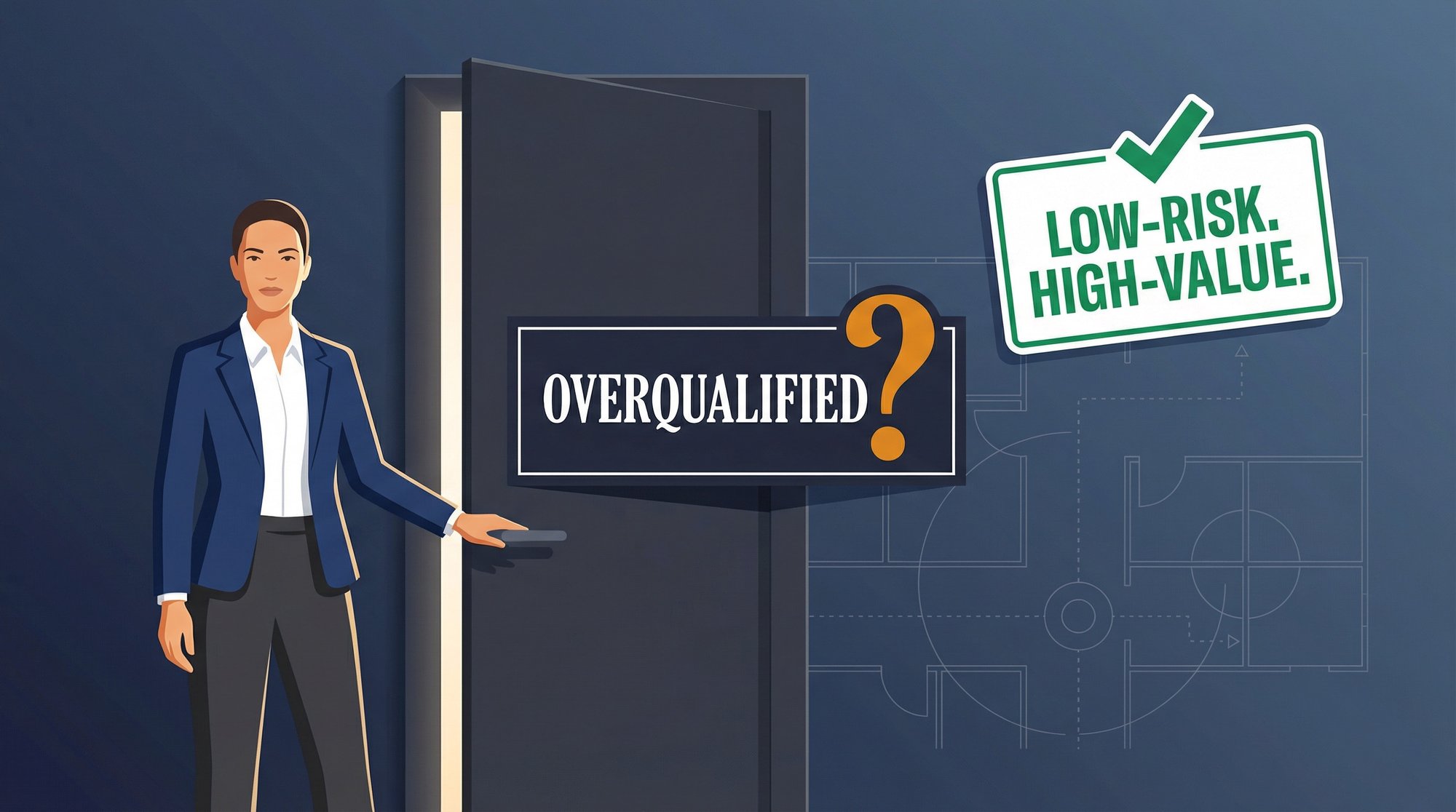
So the door is open, but there's a giant question mark hanging over your head.
Your job, and the entire focus of this guide, is to replace that question mark with a clear answer: "I'm a low-risk, high-value hire at this level."
We built this playbook at AIApply to give you a complete system for doing exactly that. No games, no lying, no pretending you have less experience than you do. Just smart positioning, sharp materials, and scripts you can use word-for-word.
What you'll find in this guide:
① What "overqualified" actually means from the employer's side
② The 3 specific risks you need to neutralize
③ How to target roles that want your extra experience
④ How to rewrite your story so it sounds intentional
⑤ Resume rules that make you look like a fit, not a flight risk
⑥ A cover letter template that removes doubt in seconds
⑦ A channel strategy that bypasses the "overqualified" reflex
⑧ Interview scripts for the 7 hardest questions you'll face
⑨ How to handle salary and level conversations
⑩ How to avoid burnout after you get hired
⑪ A 14-day copy-paste action plan
⑫ How AIApply fits into the workflow
What "Overqualified" Really Means to Employers
Hiring isn't a fairness contest. It's a risk decision.
Every hiring manager, whether they'd put it this way or not, is asking one question: "If I hire this person, what's the chance I regret it?"
When your resume looks overqualified, you trigger a very specific set of regret calculations. Think of it as the employer's mental math:
These aren't imaginary worries. A 2025 study in the Journal of Business and Psychology (N=2,473) found that perceived overqualification reduced growth satisfaction, which in turn predicted actual turnover in longitudinal data. In plain English: when people feel overqualified, they become less satisfied, and that dissatisfaction makes them more likely to quit.
So yes, employers have reason to be cautious. And you should assume they are.

The key shift you need to make right now:
Your goal is not to prove you're qualified. You already are. That's the whole problem.
Your goal is to prove you're a stable, motivated fit at this level. Every piece of your application, from resume to interview, needs to communicate safety, not superiority.
Why Employers Reject Overqualified Candidates (And How to Fix It)
If you do nothing else from this entire guide, solve these three concerns. They're behind almost every "overqualified" rejection.
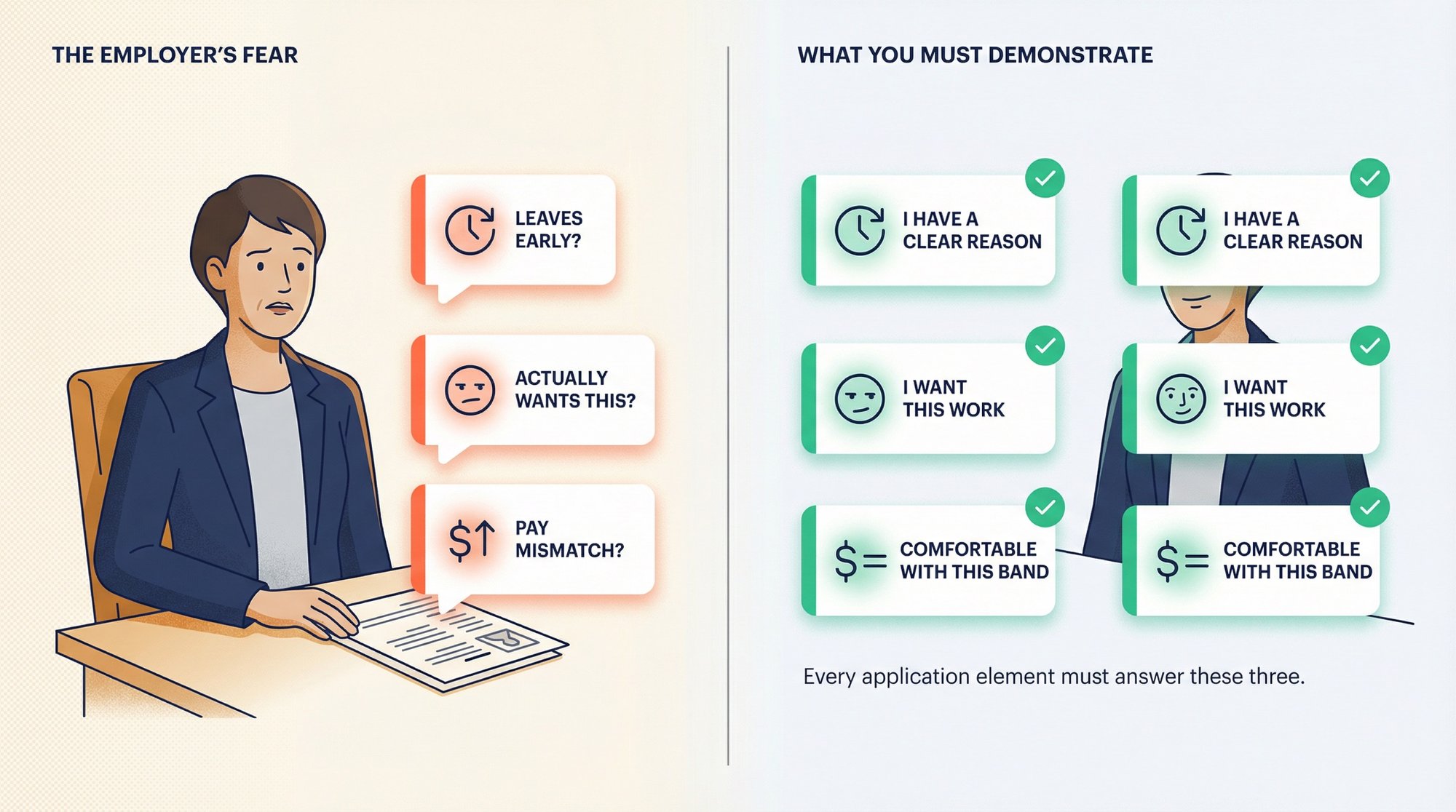
Risk 1: Show You Won't Leave Early
You need to show:
A believable reason you want this role specifically
A time horizon (even a simple one)
A reason this role fits your current life priorities
The most effective way to make this case is through your materials. A well-crafted operations coordinator resume that demonstrates commitment to execution-focused work speaks louder than any reassurance you give in words.
Risk 2: Show You Actually Want This Work
You need to show:
You actually enjoy the core work (not just the title or the paycheck)
You're not secretly hoping to reshape the job into something bigger
Risk 3: Show You're Comfortable With the Pay
You need to show:
You understand the compensation range for this level
You're comfortable with it (otherwise, why are you applying?)
That last point matters more than you'd think. Many employers assume a pay mismatch the moment they see senior titles on your resume. Employer hiring guidance explicitly calls out fears around salary disputes, commitment, and willingness to take direction when a candidate appears overqualified. Anchoring your conversations around the typical operations coordinator salary or project coordinator salary can help you demonstrate you've done your homework and aligned your expectations to the role.
Every step that follows maps back to neutralizing these three risks. If a tactic doesn't address at least one of them, it probably won't do much.
Step 1: How to Find Roles That Welcome Overqualified Candidates
Most "overqualified" problems are actually targeting problems.
Think about it. If you're trying to convince a role that wants a cheap junior to hire someone who looks like a premium senior, that's a hard sell no matter how good your cover letter is. The mismatch is baked in.
So the first move is to stop fighting uphill. Pick roles where your extra experience is seen as an asset, not a liability.

Target "High-Variance" Roles Where Experience Is an Asset
These roles love maturity because the day-to-day is unpredictable:
Operations coordinator and program coordinator roles, project coordination
Customer success and account management in messy environments
Compliance and quality assurance, and process improvement
Small teams where "owning outcomes" matters more than title
Any role that mentions ambiguity, autonomy, firefighting, or stakeholder management
How to Spot Teams That Need Experienced Hires
Ironically, teams in pain are more likely to hire you. They need someone who can stabilize, not someone who needs to learn the basics:
High-churn teams that keep losing people
Backlogged teams drowning in work
Teams with broken processes that need someone to fix them
Teams needing a stabilizer, not a trainee
Red Flags: Job Postings to Avoid When You're Overqualified
Red flags to watch for:
"Perfect for a recent graduate"
Heavily scripted work with minimal judgment
Very rigid pay bands with minimal growth runway
Hiring managers who emphasize wanting someone "moldable" or with "no bad habits"
You can still apply to these, but you'll need a much stronger risk-reversal story to pull it off.
Step 2: How to Explain Why You're Taking a Lower-Level Role
Most overqualified candidates fail here before they even get to the resume. Their story, the narrative running through their application, sounds like one of these:
"I'm settling."
"I got rejected everywhere else."
"This is temporary."
Even if some of that is partly true, you absolutely can't let it be the employer's takeaway. You need to sound like someone making a deliberate choice, not accepting a consolation prize.
How to Write Your "Intentional Downshift" Statement
This is a single sentence you'll use everywhere: resume summary, cover letter opening, first 30 seconds of any interview. The formula:
"I'm intentionally optimizing for [priority], so I'm targeting roles where I can [do specific work] and contribute consistently in a [type of environment]."
Two examples to make it concrete:
"I'm optimizing for stability and predictable hours, so I'm targeting roles where I can run tight operations and deliver reliable execution week to week."
"I'm optimizing for hands-on work again, so I'm targeting IC-heavy roles where I can build and ship instead of managing layers."
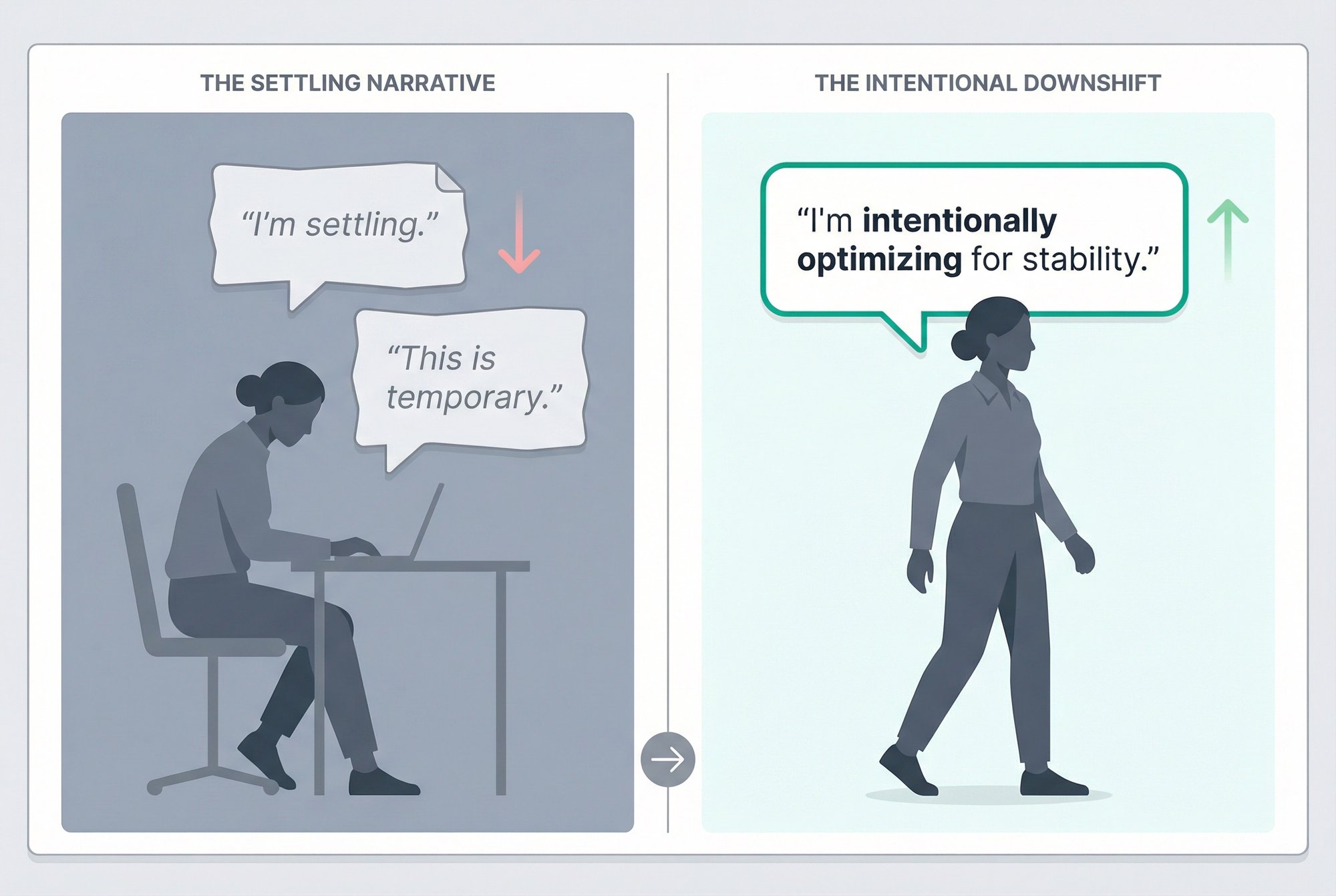
See the difference? Now you sound like someone who chose this, not someone who ran out of options. Reviewing a program coordinator cover letter example can show you how professionals at this level frame exactly this kind of deliberate positioning.
Reasons for Stepping Down That Employers Trust
From the 2025 Express and Harris Poll findings, job seekers said they apply to "overqualified" roles for these reasons:
59% need for income
56% better work-life balance
41% passion for the industry
Notice what's missing from that list: "Because I couldn't get anything else." Employers know the real reasons people step down in level, and they respect the honest ones. Use reasons that fit your reality:
Schedule flexibility
Geographic preference
Mission alignment
Stability
Less travel
Returning to the workforce after a break
Switching industries
Step 3: How to Write an Overqualified Resume That Doesn't Get Rejected
This is where most overqualified candidates make the wrong move.
They "dumb down" their resume. They strip out accomplishments, remove senior titles, and try to look less experienced than they are. That backfires almost every time because it creates confusion. Reviewers can tell something's off, and confusion is just another form of risk.
The correct approach is to narrow, not shrink.
Your resume isn't a biography. It's a decision document. It should answer three questions:
Can you do this job?
Will you be happy doing this job?
Is it safe to hire you?
Here's how to build those signals, rule by rule.
Resume Rule 1: Lead With the Target Role Title
Your headline is the first thing a recruiter reads. Guide their interpretation from the very first line.
Do this:
Operations Coordinator | Process Improvement | Stakeholder Management
Not this:
Senior Director of Operations | Strategy | Leadership
Same person. Completely different first impression. See how a strong operations coordinator resume frames experience around execution rather than leadership scope.
Resume Rule 2: Remove Senior-Level Signals That Scare Employers
If you're applying for an individual contributor role, stacking statements like these can scare people:
"Managed 80 people"
"Owned $50M budget"
"Reported to CEO"
"Led global transformation"
You can keep one big credibility signal. But don't stack them. Pick the single most relevant proof point that also feels level-aligned with the job you're targeting.
Resume Rule 3: Prove You're Still Hands-On
A lot of overqualified candidates get screened out because their resume reads like a delegation manifesto: "I used to do work. Now I supervise people who do work."
Fix it with bullets that prove you're still in the weeds:
"Built weekly reporting in Excel/Sheets and automated monthly rollups"
"Handled escalations directly and wrote playbooks for the team"
"Owned QA checks and closed the loop with engineering"
Resume Rule 4: Compress Your Early Career History
Your goal is relevance and recency. A common pattern that works:
Detailed bullets for the last 8 to 12 years
One-line entries or "Additional experience available upon request" for older roles
This reduces the "age math" some reviewers instinctively do when they see a long work history. And yes, age bias is real. A Resume Builder survey (April 2024) found that 42% of hiring managers said age is a factor when reviewing resumes. You can't eliminate bias, but you can avoid handing reviewers an easy excuse.
Resume Rule 5: Don't Use Inflated Founder Titles
If you freelanced or ran a small operation, don't call yourself "CEO" unless you were genuinely operating at executive scope with that title. Our own resume guidance at AIApply warns that "CEO/Founder" titles can make you look overqualified for non-leadership roles and raise questions about whether you'll be satisfied in a traditional team.
A cleaner approach:
"Independent Consultant" or "Freelance [Role]"
Then list what you actually delivered
Resume Rule 6: Add a "Why This Role" Section
This is uncommon advice, which is exactly why it works. Add a small section to your resume titled something like "Why This Role" and include a few lines:
"Seeking an execution-focused role in a stable team"
"Prefer hands-on work over people management"
"Comfortable with structured environments and set priorities"
This answers the question nobody asks out loud but everyone is thinking. Reviewing a project coordinator resume example can show you how professionals in execution-focused roles frame exactly this kind of positioning.
Before and After: What a Good Overqualified Resume Summary Looks Like
Here's what the difference looks like in practice.
Same person. Radically different risk profile.
The AIApply Resume Builder makes it straightforward to build the "after" version: you bring the strategy and intentional positioning from the rules above, and the AI handles ATS-optimized formatting and structure from the start.
If building a resume from scratch feels overwhelming, our Resume Builder can generate a tailored first draft in about two minutes. You bring the strategy (everything above); the AI handles the formatting, ATS optimization, and structure. Then you edit for intentionality and level alignment. Browse our resume examples library to see dozens of professionally designed formats that work with ATS systems, which makes for a great starting point when finding the right structure for an execution-focused application.
Step 4: How to Write a Cover Letter When You're Overqualified
If you're overqualified, your cover letter is not optional. It's your single best tool for neutralizing the "flight risk" label before an interview even happens.
A cover letter is your opportunity to anticipate concerns about overqualification and show genuine interest and alignment. Skip it, and the hiring manager is left to fill in the blanks with their worst assumptions.
The Four-Paragraph Cover Letter Structure That Works
Four short paragraphs. That's it.
Why this role now (your intentional reason)
Why you'll stay (commitment signal)
Proof you'll crush the core job (2 relevant wins)
Pay and level alignment (one sentence)
The Cover Letter Generator builds a tailored first draft using this exact four-paragraph structure, so you spend your time adding the specifics — your intentional reason, your commitment signal — rather than wrestling with formatting and flow.

Cover Letter Template for Overqualified Candidates
Hi [Name],
I'm applying for [Role] because I'm intentionally optimizing for [priority], and this position is exactly the kind of hands-on, execution-focused work I want to do next.
You may notice I've held more senior titles in the past. That's not a mismatch here. I'm specifically looking for a role where I can [do the core work], contribute reliably, and build depth in a team I can stay with. I'm comfortable taking direction and I'm not seeking to "redo" the job into something else.
In my last role at [Company], I [relevant accomplishment] resulting in [result]. Previously, I [second relevant accomplishment] which improved [metric/outcome]. These map directly to [2-3 requirements from the job description].
I also want to be transparent that I understand the compensation range for this level, and I'm comfortable with it. If it seems helpful, I'd love to share how I'd approach the first 30-60 days to make your team's workload lighter.
Best,
[Name]
No drama. No apology. Just clarity.
For role-specific inspiration, reviewing an operations coordinator cover letter example or a project coordinator cover letter example can help you see exactly how to frame the commitment and alignment signals for the level you're targeting.
Our Cover Letter Generator can produce a tailored first draft in minutes. Use it to get the structure right, then layer in the intentional downshift language and commitment signals we covered above.
Step 5: Job Search Channels That Work Best When You're Overqualified
Overqualification rejections spike when you rely entirely on cold online applications. The resume screener has zero context about you. They see senior titles, make an assumption, and move on.
You need context. And context comes from warm channels.
Our 2026 funnel guidance at AIApply makes a blunt point: when you're getting no interviews, one of the biggest levers is shifting effort toward warmer channels like referrals and direct outreach rather than only sending applications into the void.
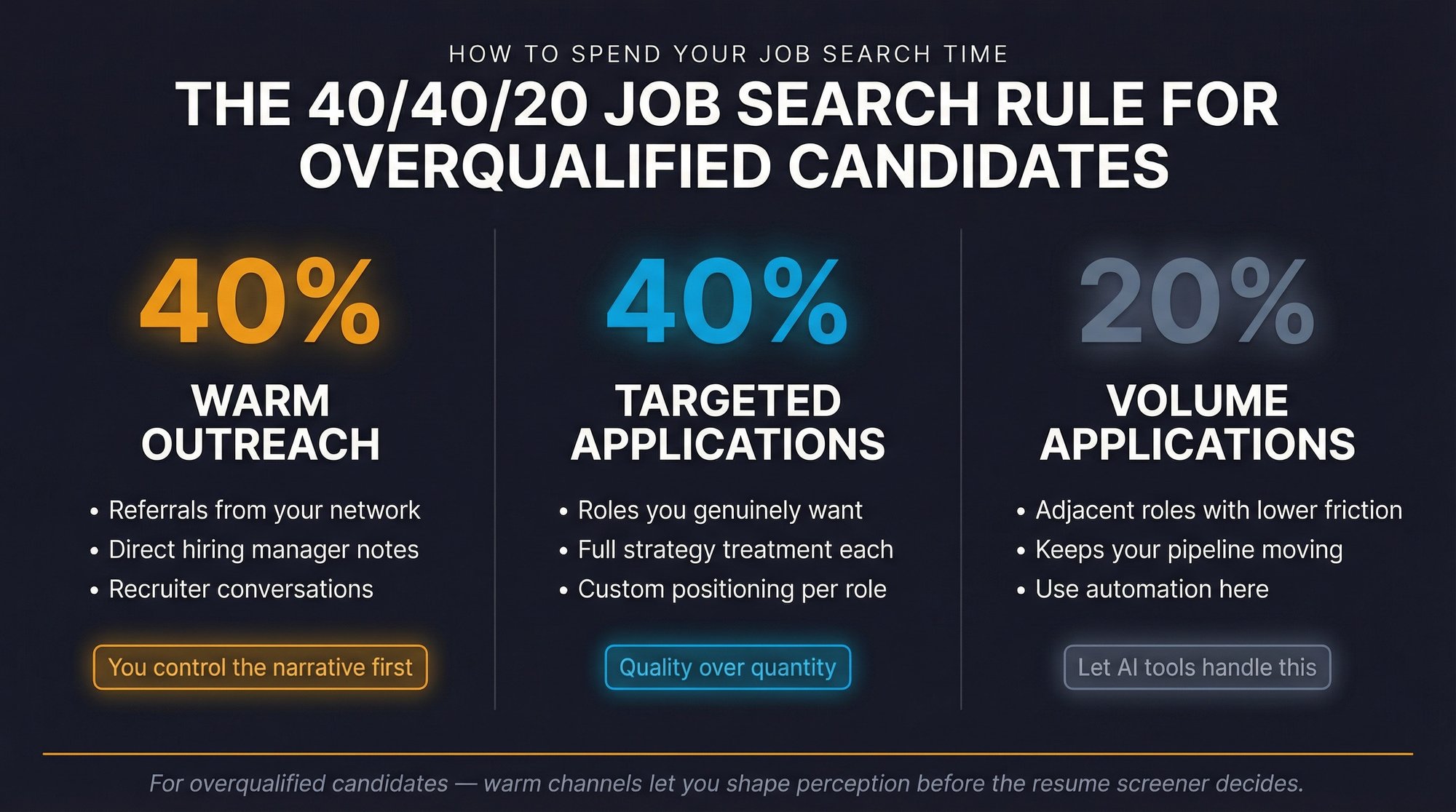
How to Split Your Job Search Effort (The 40/40/20 Rule)
Here's a practical breakdown of how to spend your job search time:
How to Ask for a Referral When You're Overqualified
Hey [Name],
Quick one. I'm applying for [Role] at [Company]. I'm intentionally moving into a more hands-on [function] role, and this team's work on [specific thing] is exactly what I want to do next.
If you're comfortable, could you refer me or point me to the right hiring manager? I can send a 3-bullet summary of why I'm a fit to make it easy.
The phrase "intentionally moving" is doing heavy lifting in that message. It preempts the "why would they want a lower-level job?" question before it forms.
How to Reach Out to Hiring Managers Directly
Hi [Name],
I applied for [Role]. Quick context: I've held more senior titles, but I'm intentionally targeting this level because I want to focus on hands-on execution in [area].
If helpful, here are 3 relevant wins:
[win 1 with metric]
[win 2 with metric]
[win 3 with metric]
Either way, thanks for reading.
This preempts the "flight risk" conclusion before the hiring manager even opens your full application.
Step 6: How to Answer Overqualified Interview Questions
If you're getting interviews but not offers, this is almost certainly where things are going wrong.
At this stage, they already believe you can do the job. That's not what they're evaluating anymore. They're evaluating fit and retention. Can they trust you to stay? Will you be happy? Will you be easy to manage?
Here are the seven questions you'll face most often, what the interviewer is really asking, and scripts you can adapt and use word-for-word.
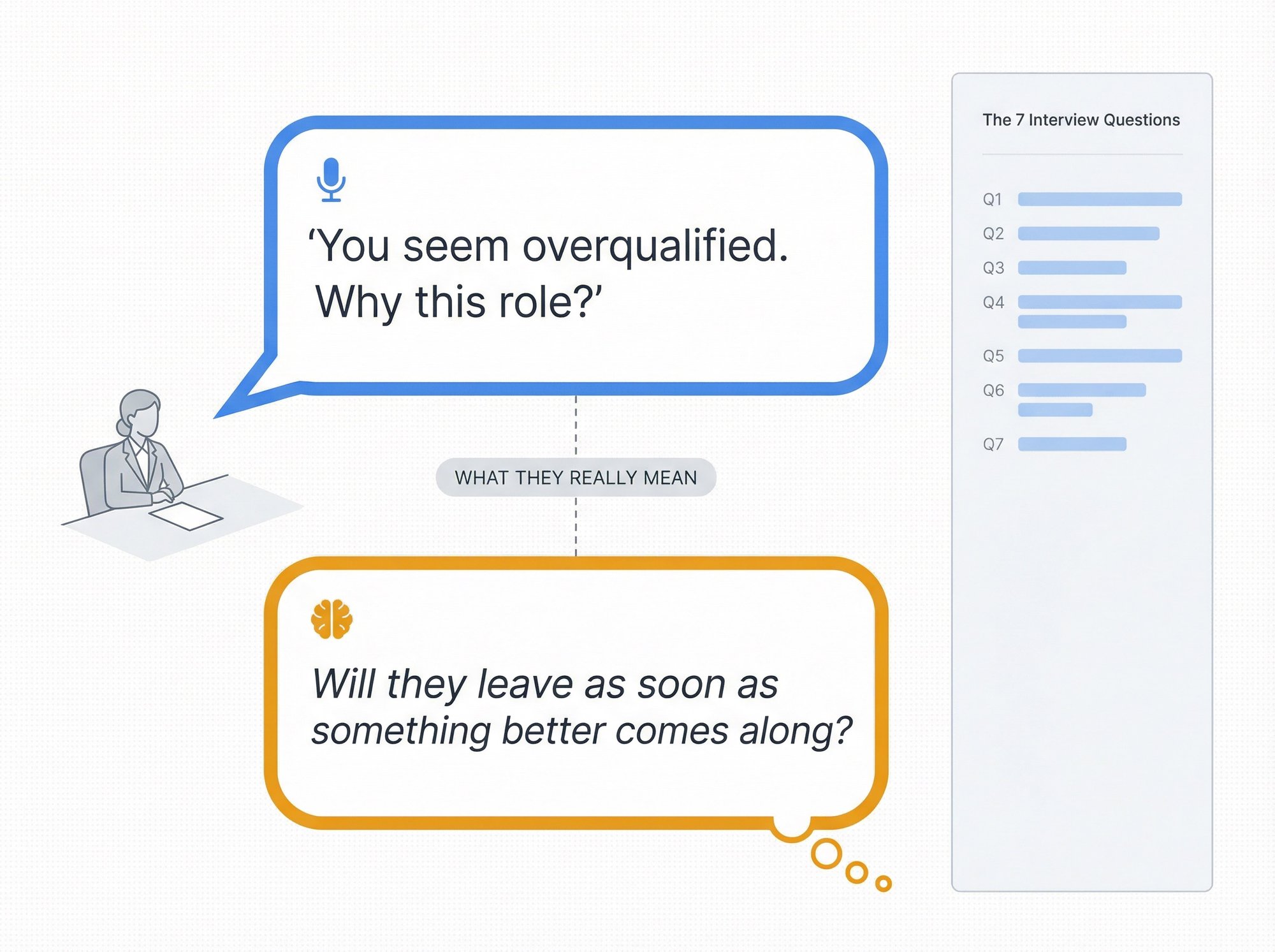
Q1: How to Answer "You Seem Overqualified. Why This Role?"
What they're really asking: "Are you going to leave?"
Script (3-part structure: intentional reason, what you enjoy, commitment signal):
Totally fair question. I have held more senior titles, but I'm intentionally optimizing for [priority], and I'm looking for a role where I can stay close to the work.
What I like about this role is that the core job is [core responsibilities]. That's what I'm strongest at and what I want to be doing day to day.
I'm not using this as a stopgap. I'm looking for a stable team where I can contribute consistently for the next few years, and this role fits that.
Q2: How to Answer "Won't You Get Bored?"
What they're really asking: "Will you disengage?"
I don't think so, because what energizes me isn't title or scope, it's [the core work]. I actually like building repeatable processes, keeping things clean, and being accountable for execution.
Also, I'm not coming in expecting constant promotion. I'm happy to grow through depth and mastery, and I'm looking for a role where doing the fundamentals well really matters.
This directly addresses the motivation concern that many employers raise when evaluating overqualified candidates.
Q3: How to Answer "Are You Okay Reporting to Someone Less Experienced?"
What they're really asking: "Will you be difficult?"
Short answer: no, you won't be. Here's how to say it convincingly:
Yes. I'm very comfortable being led, as long as expectations are clear. My style is to align on outcomes, communicate early, and then execute.
I don't need to be the most senior person in the room. I care about doing good work, helping the team win, and making my manager's life easier.
Q4: How to Answer "Why Not Apply for a More Senior Job?"
What they're really asking: "Is something wrong here?"
I could, but I'm choosing not to right now. At this stage, I'm prioritizing [priority], and I'm intentionally targeting roles where I can focus on [hands-on work] without the overhead of [thing you're stepping away from, like heavy people management].
It's less about what I can do and more about what I want to do next.
Q5: How to Handle Salary Questions When You're Overqualified
What they're really asking: "Are we wasting time?"
Best approach: anchor to the role's band, not your previous salary. Before your interview, research typical ranges for the level you're targeting. The operations coordinator salary and project coordinator salary are good reference points if you're targeting coordination roles.
I'm aware this role is scoped at [level], and I'm comfortable with that band. If you can share the range you've budgeted, I can confirm alignment.
My focus is fit and stability, not trying to force a higher-level package into a lower-level role.
If they insist on a specific number, give a range that fits the band and add: "based on total comp and role fit."
Q6: How to Answer "How Long Would You Stay?"
Don't dodge this one.
I'm looking for a long-term fit. Realistically, I'm targeting a 2-3 year horizon at minimum, assuming the role matches what we've discussed.
What makes me stay is clear priorities, a good manager relationship, and work I can take pride in. That's what I'm optimizing for.
Q7: How to Answer "Why Hire You Over Someone More Junior?"
This is your chance to flip overqualification into pure upside.
Use these angles: speed to productivity, quality of output, low supervision needed, calm under pressure.
You'll get someone who ramps fast, needs less supervision, and has already seen the common failure modes. That means fewer mistakes, fewer escalations, and a more stable day-to-day for the team.
And because I'm intentionally choosing this level, you're not just getting experience. You're getting experience that actually wants this job.
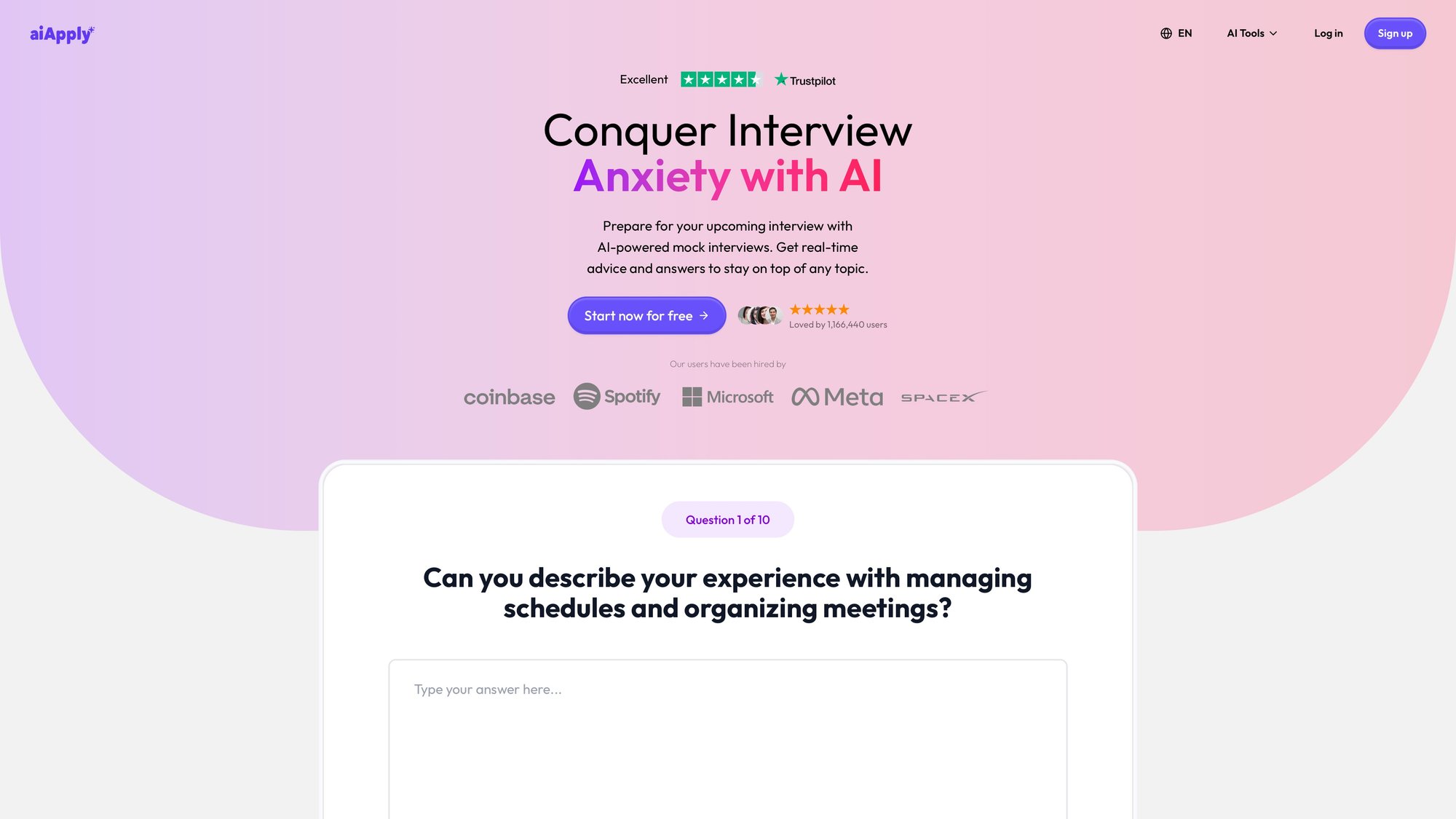
If you want extra prep before your interviews, our Mock Interview tool lets you paste a job description and rehearse role-specific questions with AI-generated feedback. And for live interviews, Interview Buddy provides real-time on-screen coaching through a Chrome extension. Use it responsibly as a memory and structure aid, not to invent experience you don't have.
Step 7: How to Handle Salary Conversations When You're Overqualified
This is the trap that catches a lot of overqualified candidates:
If you push for more money early, they think you're not really aligned with the level. If you never address money at all, they assume you're not aligned.
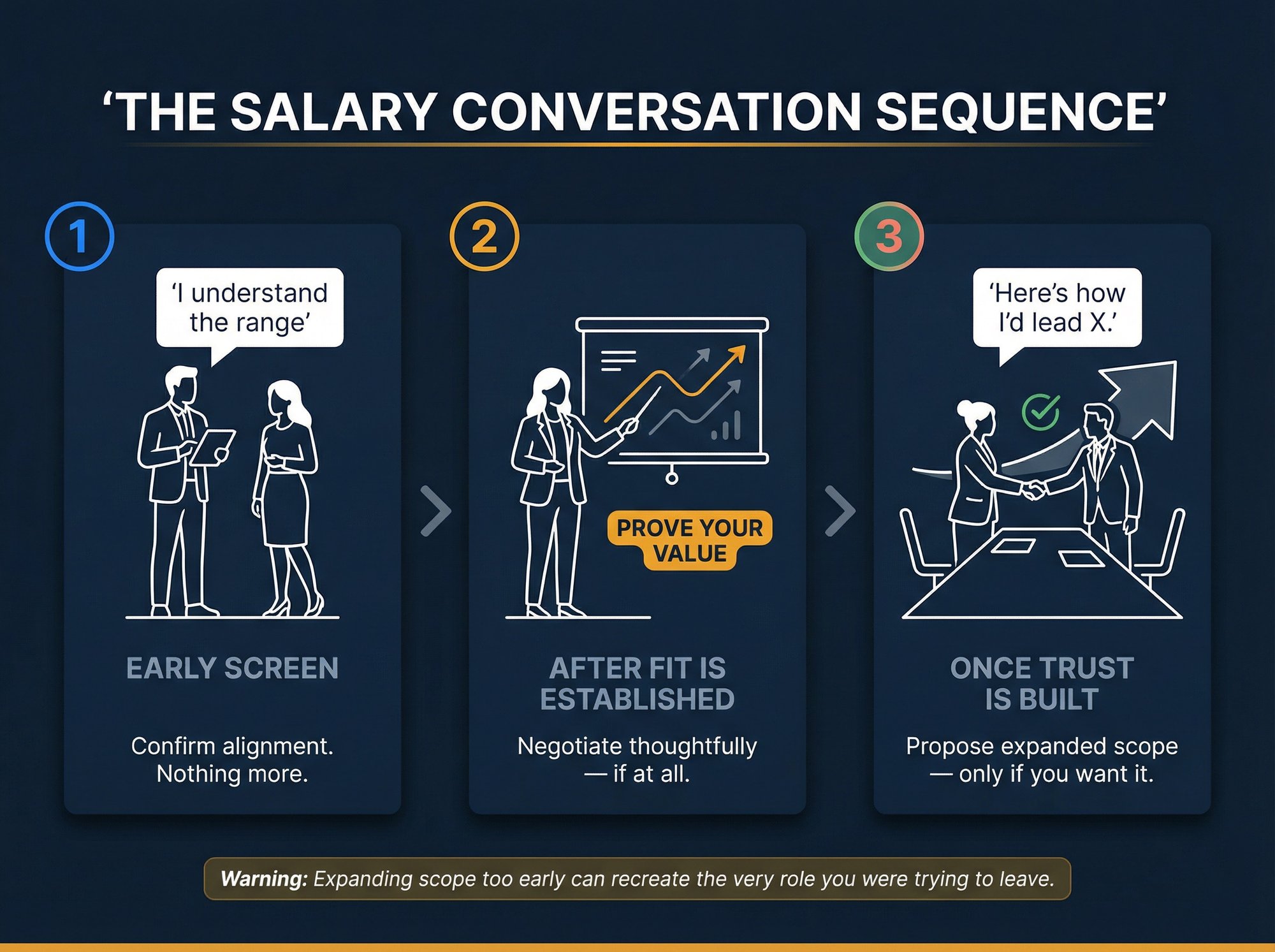
The Right Order for Salary Conversations
① During the early screen: Confirm you understand the level and compensation range. That's it. No negotiating yet.
② After you prove fit: This is when you negotiate thoughtfully, if at all.
③ If you want a higher level: Only propose it after trust is built and the team sees your value firsthand.
How to Ask for More Scope After You're Hired
Frame it as a business case, not a demand:
"If you need someone to also own X, I can do that."
"If the team wants Y outcome, here's how I'd lead it."
But be careful with this. The second-order effect is real: you might accidentally reshape the job back into the very role you were trying to leave. Make sure you actually want expanded scope before you ask for it. Understanding what customer success managers earn versus account managers can help you calibrate what "expanded scope" means financially before making that ask.
How to Avoid Overqualified Burnout After You Get Hired
Getting the offer is only half the challenge. Staying engaged and building a real career at this level requires its own strategy.
Remember the turnover research from the Journal of Business and Psychology: growth dissatisfaction is a key mechanism behind overqualified employees eventually leaving. If you don't actively manage your own engagement, the same cycle that employers feared during hiring will actually play out.
The 90-Day "Permission-Based Impact" Framework
Earn the right to lead change. Don't assume it. The first 90 days are about trust-building, not impact-proving. Come in too strong and you'll trigger the exact manager friction you worked so hard to remove during interviews.
This is a 90-day framework that lets you build influence without triggering the "they're trying to take over" alarm.
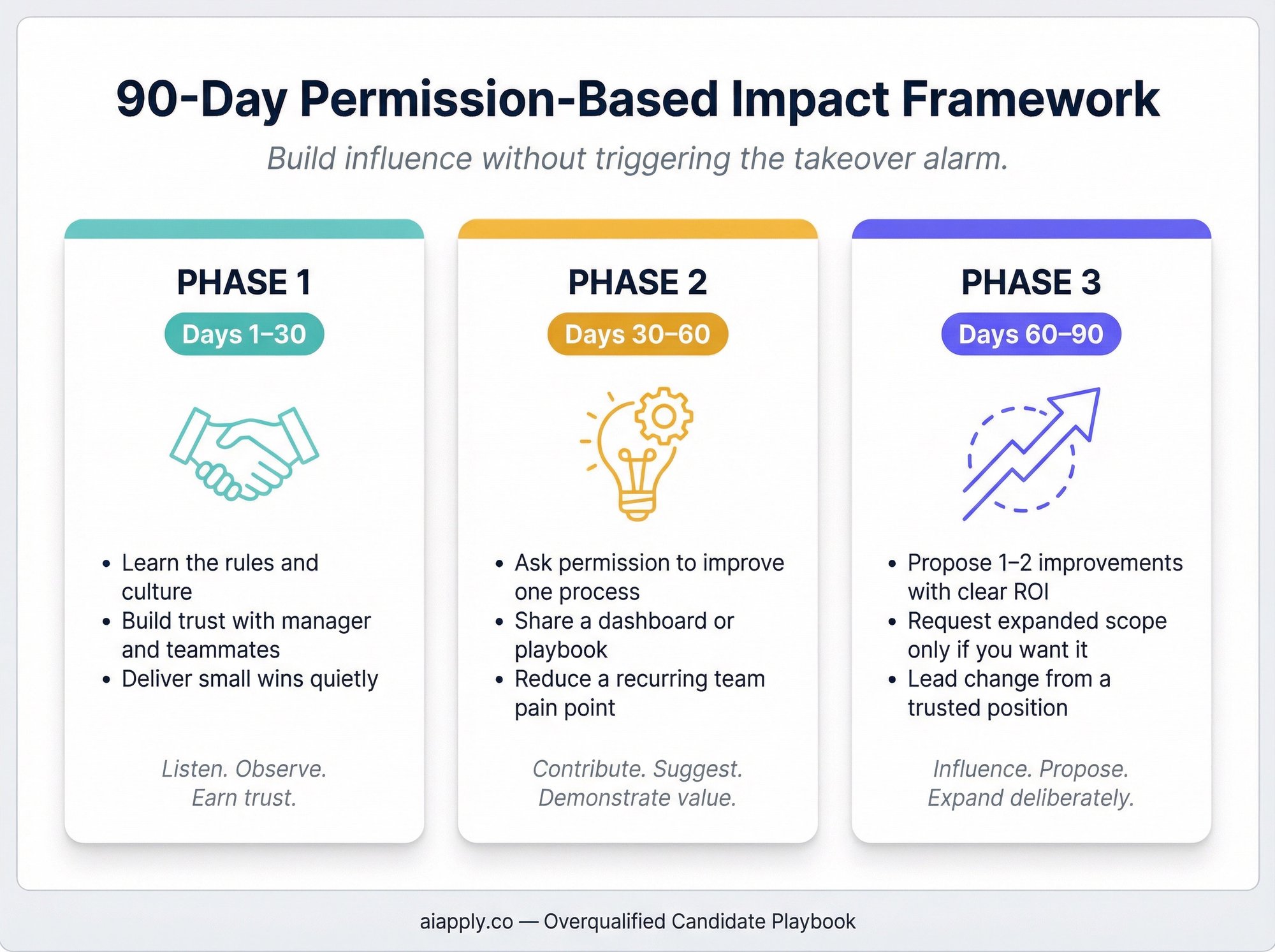
First 30 Days
Learn the rules and the culture
Build trust with your manager and teammates
Deliver small wins quietly. Don't announce. Just do.
Days 30-60
Ask permission to improve one process
Share a simple dashboard or playbook that saves the team time
Reduce a recurring pain point that everyone complains about
Days 60-90
Propose 1-2 bigger improvements with clear ROI
Request expanded scope only if you genuinely still want it
Tools like our AI Resume Editor can help you refresh your resume when you're ready to explore new opportunities after growing into the role.
14-Day Action Plan for Overqualified Job Seekers
You've got the strategy. Now here's how to execute it in two weeks.
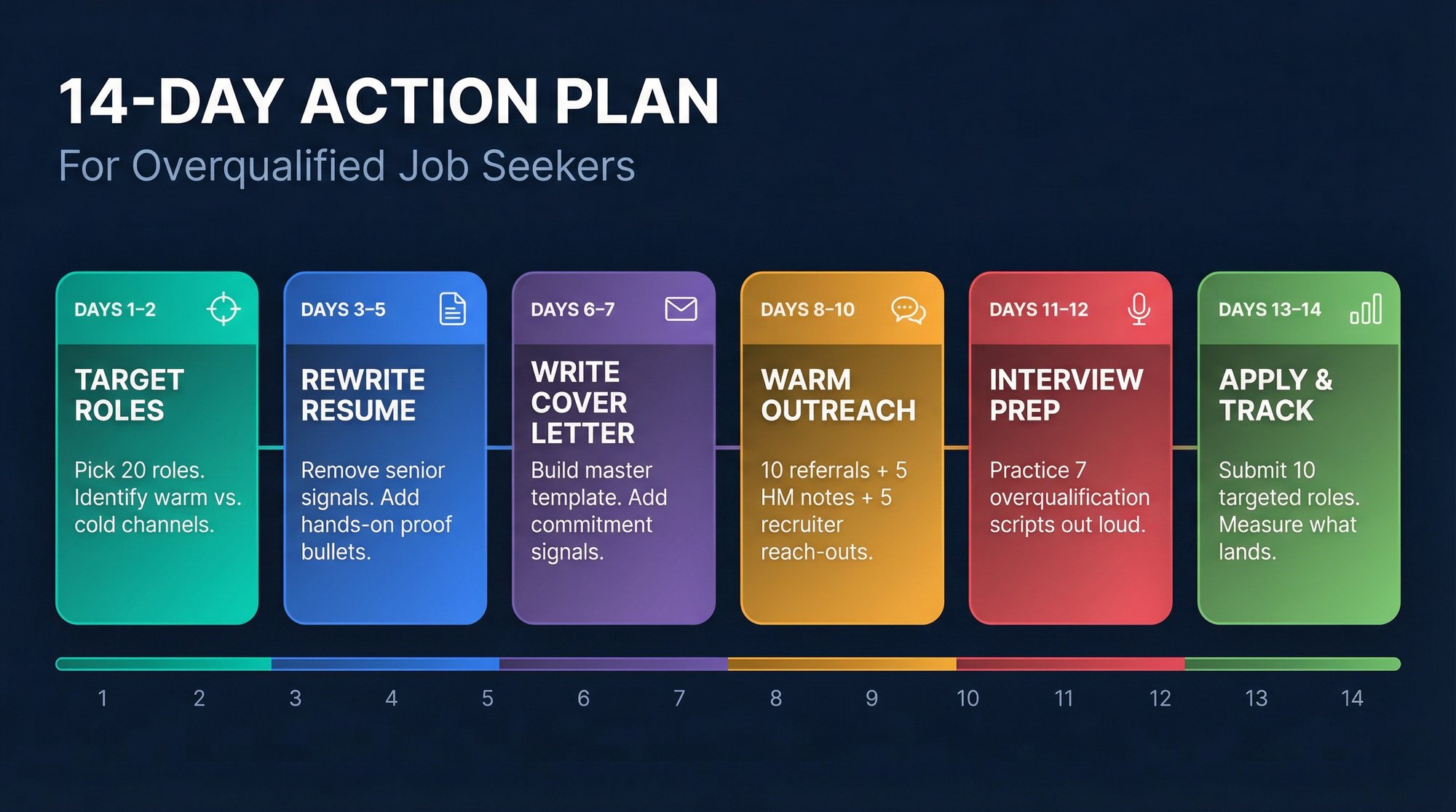
Days 1-2: Target the Right Roles
Pick 20 roles where you can credibly say "I want this level"
Highlight 3 reasons per role why you would stay
Separate roles into "warm outreach possible" vs. "cold application only"
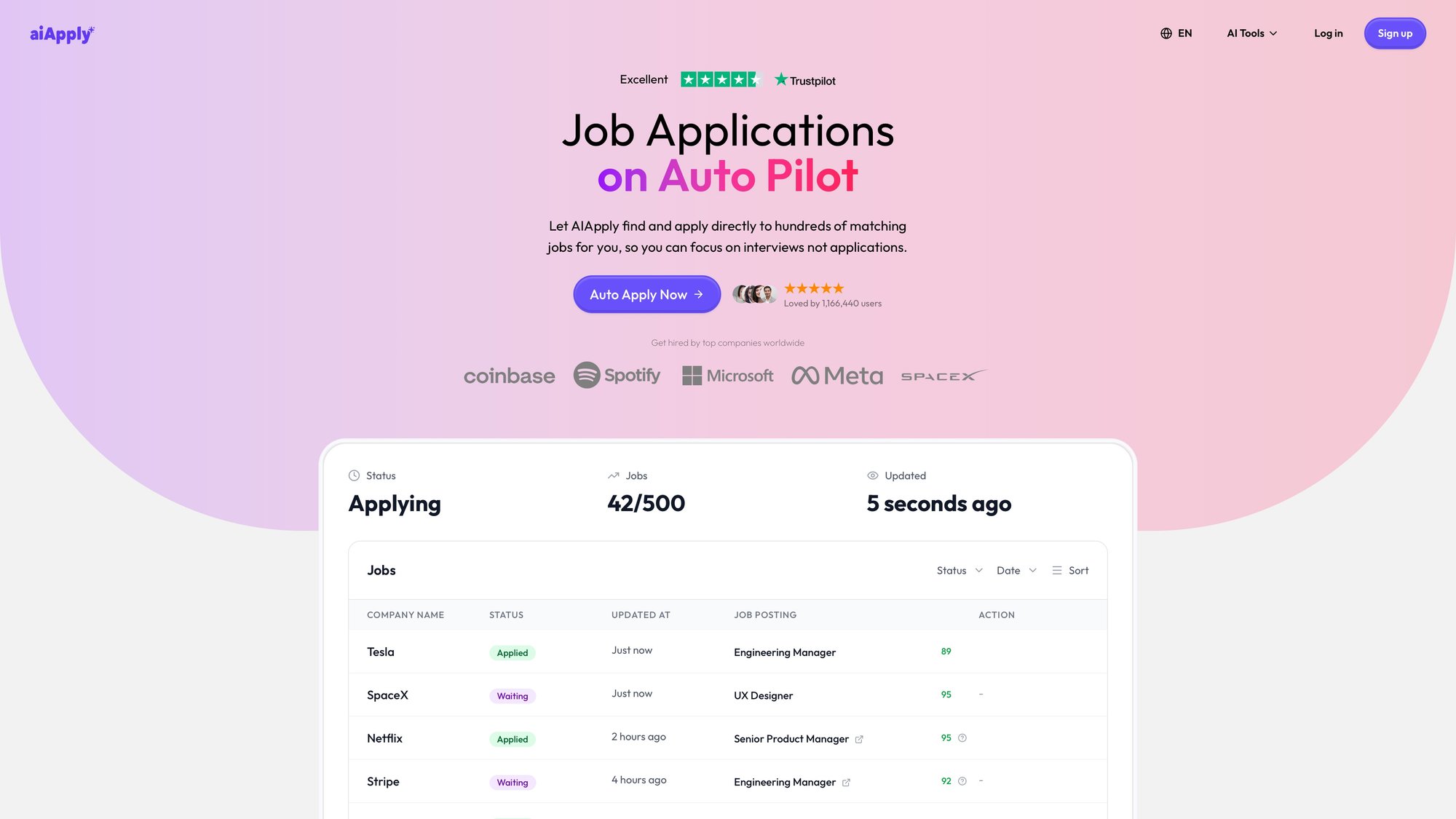
Use AIApply's Auto Apply to discover and apply to operations, coordination, and account management roles where your experience is an asset rather than a red flag.
Days 3-5: Rewrite Your Resume
Build one resume version per role family (not per individual job yet)
Remove irrelevant senior signals using the rules above
Add hands-on proof bullets
Include a "fit signal" section
Run it through an ATS-focused scan before you send anything. Our AI Resume Checker gives you formatting and keyword feedback for free.
Need a starting point? The operations coordinator skills page outlines what employers actually look for in this role, which is useful reference material when writing your resume bullets.
Days 6-7: Write Your Overqualification Cover Letter
Create one master template using the structure above
Swap in company and role specifics each time you apply
Our Cover Letter Generator can build a tailored draft fast, then you edit to keep it honest and human
Days 8-10: Start Warm Outreach
Send 10 referral messages using the template above
Send 5 hiring manager notes
Send 5 recruiter reach-outs
Days 11-12: Prepare for Overqualified Interview Questions
Write your 60-second "why this role" story using the Intentional Downshift formula
Practice the 7 interview scripts above out loud (not just in your head)
If you do virtual interviews, our Interview Buddy provides real-time on-screen support on Windows and macOS. Use it responsibly as a memory and structure aid.
Days 13-14: Apply and Track What Works
Apply to 10 targeted roles
Measure responses and track which messaging lands
Adjust your Intentional Downshift statement based on feedback
If volume is part of your strategy, our Auto Apply can handle high-match applications while you focus on interviews and warm channels
How AIApply Helps Overqualified Candidates Land Jobs Faster
Here's the clean workflow that puts all of this together with our tools:
Step 1: Generate a "fit-first" resume
Use our Resume Builder to build the first draft fast. The AI handles ATS formatting and structure; you edit for intentionality and level alignment using the resume rules above.
Step 2: Run it through the Resume Checker
Our AI Resume Checker catches parsing issues, formatting problems, and keyword gaps before you apply. Fix those before your resume hits a human's desk. You can also use the AI Resume Scanner to check how well your resume matches the specific job description you're targeting.
Step 3: Create a cover letter that answers the unasked questions
Use our Cover Letter Generator to get a strong first draft, then add the 1-sentence pay alignment line and the commitment signal from the template above.
Step 4: Practice the overqualified interview questions
Use Mock Interview for rehearsal. Paste in the job description and practice the exact questions you'll face. Then use Interview Buddy for real-time live support when the actual interview happens.
Step 5: Scale applications without losing quality
Use Auto Apply for your "adjacent roles" bucket (the 20% volume applications). Keep your manual effort focused on your top targets and warm outreach.
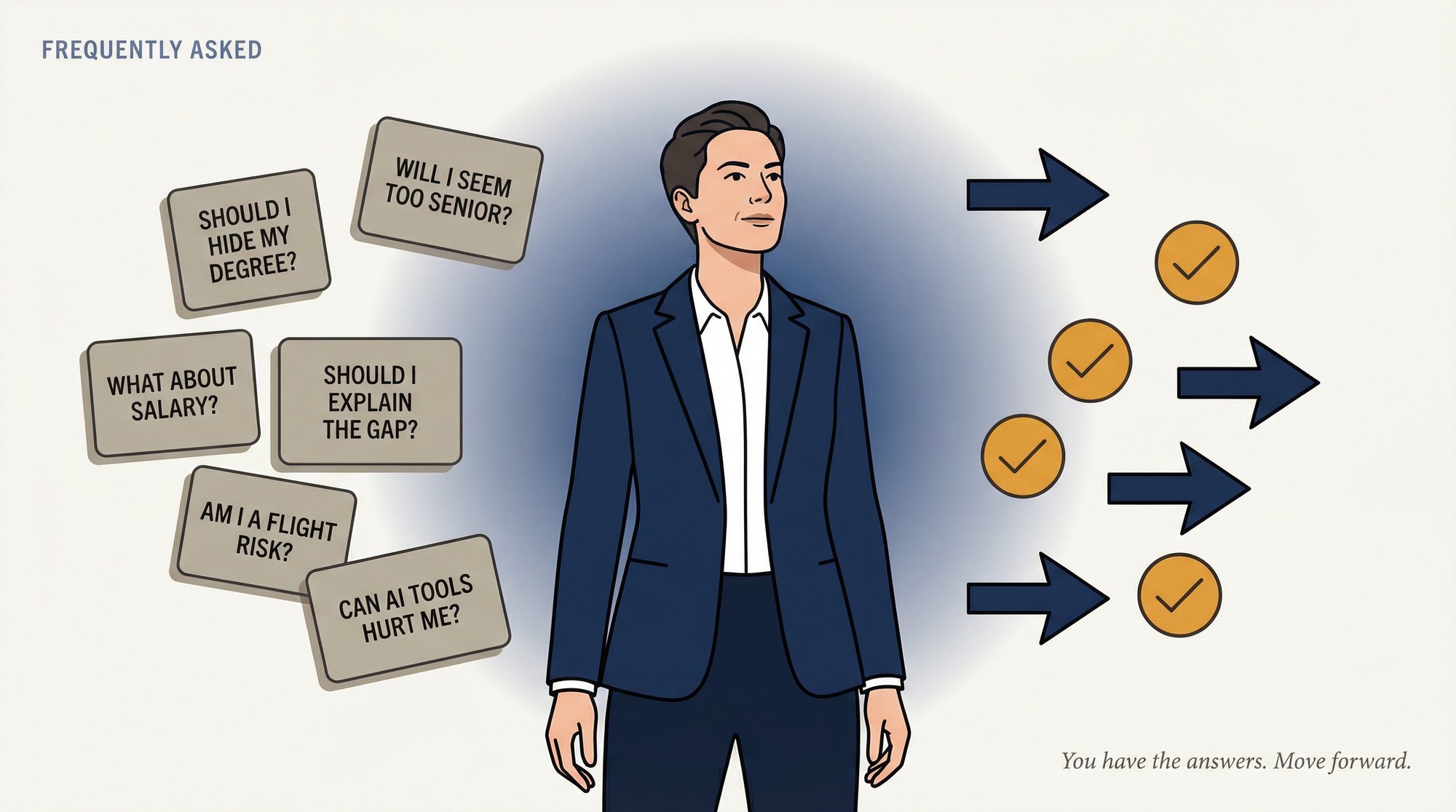
Frequently Asked Questions About Getting Hired When Overqualified
Should I Remove Advanced Degrees from My Resume?
Only if the degree is completely irrelevant and actively confusing for the role. If the job requires it, or if it's core to your professional credibility, keep it. Your bigger win isn't hiding qualifications. It's controlling the narrative. Frame the degree as context for your expertise, and pair it with a clear "I'm choosing this level" message in your summary and cover letter.
Should I Hide My Age or Graduation Year?
In some markets, people do remove graduation years to reduce age-related bias. Age discrimination is illegal in many places. In the U.S., the Age Discrimination in Employment Act (ADEA) protects workers 40 and older. In the UK, job applicants are protected under the Equality Act 2010, and ACAS provides practical guidance on age discrimination (updated March 2025).
But legal protections don't eliminate bias entirely. Simple rule: keep your resume focused on recent, role-relevant proof and avoid unnecessary age signals like graduation years from decades ago.
What If I Want a Temporary Job as an Overqualified Candidate?
Don't lie about it. Temporary intent leaks in interviews, and it's a trust killer if discovered. Instead, target contract roles, project-based positions, or explicitly short-term roles where "temporary" is the norm and expected. That way your intent matches the role's design, and nobody feels misled.
How Common Is Being Overqualified for a Job?
Very common. OECD reporting for England (December 2024) notes that about 37% of workers are over-qualified (compared to the OECD average of 23%), and wages for overqualified workers are roughly 18% lower than well-matched peers with similar educational attainment. You're not an edge case. This is a structural issue in modern labor markets.
Should I Address My Overqualification Directly in Interviews?
Yes, and you probably should. Avoiding the elephant in the room makes you look evasive. The interview scripts in this guide are built around naming the overqualification directly, then reframing it. When you say "I know I've held more senior titles" before they bring it up, you take control of the conversation. It shows self-awareness and eliminates the awkwardness of the interviewer having to ask.
What If I'm Overqualified and Switching Industries?
This is actually easier in some ways. Industry switching gives you a built-in, believable reason for stepping down in seniority: "I'm starting fresh in a new field, so a more junior title makes sense while I build domain expertise." Lean into the transferable skills angle, highlight process, communication, and execution abilities that translate across industries, and use the Intentional Downshift statement with industry change as your priority. Browse the project coordinator skills page to identify transferable competencies that carry across sectors.
Will Using AI Tools for My Resume and Cover Letter Hurt My Chances?
Not if you use them correctly. AI tools like our Resume Builder and Cover Letter Generator are designed to create documents that sound natural and role-appropriate. The key is to always edit the output. Add your own voice, your specific examples, and the intentional positioning we covered in this guide. The AI handles the structure and optimization; you bring the authenticity.
How Do I Explain a Career Gap When I'm Also Overqualified?
Address both directly, but separately. The career gap gets its own brief explanation ("I took time for family/health/education"), and the overqualification gets the Intentional Downshift treatment. Don't conflate them into a single messy narrative. Two clean stories are better than one confusing one. And make sure both stories point toward the same conclusion: "I'm ready, I'm intentional, and I'm here to stay."
Getting rejected for being "overqualified" feels like a slap in the face. You did everything right, built the experience, developed the skills, put in the years. And now someone's telling you that you're too good for the job?
Not quite. That's not what's happening.
When a hiring manager labels you overqualified, they're not complimenting you. They're flagging risk. Specifically, they're worried about four things:
"They'll leave as soon as something better comes along."
"They'll be bored or resentful."
"They'll want more pay than we can offer."
"They won't take direction, especially from a less experienced manager."
These aren't fringe concerns. In an Express Employment Professionals and Harris Poll survey (published October 2025), 70% of hiring managers said their company typically considers overqualified candidates. That sounds encouraging until you hear the other number: 75% of those same managers believed overqualified hires struggle to stay motivated in lower-level roles.
So the door is open, but there's a giant question mark hanging over your head.
Your job, and the entire focus of this guide, is to replace that question mark with a clear answer: "I'm a low-risk, high-value hire at this level."
We built this playbook at AIApply to give you a complete system for doing exactly that. No games, no lying, no pretending you have less experience than you do. Just smart positioning, sharp materials, and scripts you can use word-for-word.
What you'll find in this guide:
① What "overqualified" actually means from the employer's side
② The 3 specific risks you need to neutralize
③ How to target roles that want your extra experience
④ How to rewrite your story so it sounds intentional
⑤ Resume rules that make you look like a fit, not a flight risk
⑥ A cover letter template that removes doubt in seconds
⑦ A channel strategy that bypasses the "overqualified" reflex
⑧ Interview scripts for the 7 hardest questions you'll face
⑨ How to handle salary and level conversations
⑩ How to avoid burnout after you get hired
⑪ A 14-day copy-paste action plan
⑫ How AIApply fits into the workflow
What "Overqualified" Really Means to Employers
Hiring isn't a fairness contest. It's a risk decision.
Every hiring manager, whether they'd put it this way or not, is asking one question: "If I hire this person, what's the chance I regret it?"
When your resume looks overqualified, you trigger a very specific set of regret calculations. Think of it as the employer's mental math:
These aren't imaginary worries. A 2025 study in the Journal of Business and Psychology (N=2,473) found that perceived overqualification reduced growth satisfaction, which in turn predicted actual turnover in longitudinal data. In plain English: when people feel overqualified, they become less satisfied, and that dissatisfaction makes them more likely to quit.
So yes, employers have reason to be cautious. And you should assume they are.
The key shift you need to make right now:
Your goal is not to prove you're qualified. You already are. That's the whole problem.
Your goal is to prove you're a stable, motivated fit at this level. Every piece of your application, from resume to interview, needs to communicate safety, not superiority.
Why Employers Reject Overqualified Candidates (And How to Fix It)
If you do nothing else from this entire guide, solve these three concerns. They're behind almost every "overqualified" rejection.
Risk 1: Show You Won't Leave Early
You need to show:
A believable reason you want this role specifically
A time horizon (even a simple one)
A reason this role fits your current life priorities
The most effective way to make this case is through your materials. A well-crafted operations coordinator resume that demonstrates commitment to execution-focused work speaks louder than any reassurance you give in words.
Risk 2: Show You Actually Want This Work
You need to show:
You actually enjoy the core work (not just the title or the paycheck)
You're not secretly hoping to reshape the job into something bigger
Risk 3: Show You're Comfortable With the Pay
You need to show:
You understand the compensation range for this level
You're comfortable with it (otherwise, why are you applying?)
That last point matters more than you'd think. Many employers assume a pay mismatch the moment they see senior titles on your resume. Employer hiring guidance explicitly calls out fears around salary disputes, commitment, and willingness to take direction when a candidate appears overqualified. Anchoring your conversations around the typical operations coordinator salary or project coordinator salary can help you demonstrate you've done your homework and aligned your expectations to the role.
Every step that follows maps back to neutralizing these three risks. If a tactic doesn't address at least one of them, it probably won't do much.
Step 1: How to Find Roles That Welcome Overqualified Candidates
Most "overqualified" problems are actually targeting problems.
Think about it. If you're trying to convince a role that wants a cheap junior to hire someone who looks like a premium senior, that's a hard sell no matter how good your cover letter is. The mismatch is baked in.
So the first move is to stop fighting uphill. Pick roles where your extra experience is seen as an asset, not a liability.
Target "High-Variance" Roles Where Experience Is an Asset
These roles love maturity because the day-to-day is unpredictable:
Operations coordinator and program coordinator roles, project coordination
Customer success and account management in messy environments
Compliance and quality assurance, and process improvement
Small teams where "owning outcomes" matters more than title
Any role that mentions ambiguity, autonomy, firefighting, or stakeholder management
How to Spot Teams That Need Experienced Hires
Ironically, teams in pain are more likely to hire you. They need someone who can stabilize, not someone who needs to learn the basics:
High-churn teams that keep losing people
Backlogged teams drowning in work
Teams with broken processes that need someone to fix them
Teams needing a stabilizer, not a trainee
Red Flags: Job Postings to Avoid When You're Overqualified
Red flags to watch for:
"Perfect for a recent graduate"
Heavily scripted work with minimal judgment
Very rigid pay bands with minimal growth runway
Hiring managers who emphasize wanting someone "moldable" or with "no bad habits"
You can still apply to these, but you'll need a much stronger risk-reversal story to pull it off.
Step 2: How to Explain Why You're Taking a Lower-Level Role
Most overqualified candidates fail here before they even get to the resume. Their story, the narrative running through their application, sounds like one of these:
"I'm settling."
"I got rejected everywhere else."
"This is temporary."
Even if some of that is partly true, you absolutely can't let it be the employer's takeaway. You need to sound like someone making a deliberate choice, not accepting a consolation prize.
How to Write Your "Intentional Downshift" Statement
This is a single sentence you'll use everywhere: resume summary, cover letter opening, first 30 seconds of any interview. The formula:
"I'm intentionally optimizing for [priority], so I'm targeting roles where I can [do specific work] and contribute consistently in a [type of environment]."
Two examples to make it concrete:
"I'm optimizing for stability and predictable hours, so I'm targeting roles where I can run tight operations and deliver reliable execution week to week."
"I'm optimizing for hands-on work again, so I'm targeting IC-heavy roles where I can build and ship instead of managing layers."
See the difference? Now you sound like someone who chose this, not someone who ran out of options. Reviewing a program coordinator cover letter example can show you how professionals at this level frame exactly this kind of deliberate positioning.
Reasons for Stepping Down That Employers Trust
From the 2025 Express and Harris Poll findings, job seekers said they apply to "overqualified" roles for these reasons:
59% need for income
56% better work-life balance
41% passion for the industry
Notice what's missing from that list: "Because I couldn't get anything else." Employers know the real reasons people step down in level, and they respect the honest ones. Use reasons that fit your reality:
Schedule flexibility
Geographic preference
Mission alignment
Stability
Less travel
Returning to the workforce after a break
Switching industries
Step 3: How to Write an Overqualified Resume That Doesn't Get Rejected
This is where most overqualified candidates make the wrong move.
They "dumb down" their resume. They strip out accomplishments, remove senior titles, and try to look less experienced than they are. That backfires almost every time because it creates confusion. Reviewers can tell something's off, and confusion is just another form of risk.
The correct approach is to narrow, not shrink.
Your resume isn't a biography. It's a decision document. It should answer three questions:
Can you do this job?
Will you be happy doing this job?
Is it safe to hire you?
Here's how to build those signals, rule by rule.
Resume Rule 1: Lead With the Target Role Title
Your headline is the first thing a recruiter reads. Guide their interpretation from the very first line.
Do this:
Operations Coordinator | Process Improvement | Stakeholder Management
Not this:
Senior Director of Operations | Strategy | Leadership
Same person. Completely different first impression. See how a strong operations coordinator resume frames experience around execution rather than leadership scope.
Resume Rule 2: Remove Senior-Level Signals That Scare Employers
If you're applying for an individual contributor role, stacking statements like these can scare people:
"Managed 80 people"
"Owned $50M budget"
"Reported to CEO"
"Led global transformation"
You can keep one big credibility signal. But don't stack them. Pick the single most relevant proof point that also feels level-aligned with the job you're targeting.
Resume Rule 3: Prove You're Still Hands-On
A lot of overqualified candidates get screened out because their resume reads like a delegation manifesto: "I used to do work. Now I supervise people who do work."
Fix it with bullets that prove you're still in the weeds:
"Built weekly reporting in Excel/Sheets and automated monthly rollups"
"Handled escalations directly and wrote playbooks for the team"
"Owned QA checks and closed the loop with engineering"
Resume Rule 4: Compress Your Early Career History
Your goal is relevance and recency. A common pattern that works:
Detailed bullets for the last 8 to 12 years
One-line entries or "Additional experience available upon request" for older roles
This reduces the "age math" some reviewers instinctively do when they see a long work history. And yes, age bias is real. A Resume Builder survey (April 2024) found that 42% of hiring managers said age is a factor when reviewing resumes. You can't eliminate bias, but you can avoid handing reviewers an easy excuse.
Resume Rule 5: Don't Use Inflated Founder Titles
If you freelanced or ran a small operation, don't call yourself "CEO" unless you were genuinely operating at executive scope with that title. Our own resume guidance at AIApply warns that "CEO/Founder" titles can make you look overqualified for non-leadership roles and raise questions about whether you'll be satisfied in a traditional team.
A cleaner approach:
"Independent Consultant" or "Freelance [Role]"
Then list what you actually delivered
Resume Rule 6: Add a "Why This Role" Section
This is uncommon advice, which is exactly why it works. Add a small section to your resume titled something like "Why This Role" and include a few lines:
"Seeking an execution-focused role in a stable team"
"Prefer hands-on work over people management"
"Comfortable with structured environments and set priorities"
This answers the question nobody asks out loud but everyone is thinking. Reviewing a project coordinator resume example can show you how professionals in execution-focused roles frame exactly this kind of positioning.
Before and After: What a Good Overqualified Resume Summary Looks Like
Here's what the difference looks like in practice.
Same person. Radically different risk profile.
The AIApply Resume Builder makes it straightforward to build the "after" version: you bring the strategy and intentional positioning from the rules above, and the AI handles ATS-optimized formatting and structure from the start.
If building a resume from scratch feels overwhelming, our Resume Builder can generate a tailored first draft in about two minutes. You bring the strategy (everything above); the AI handles the formatting, ATS optimization, and structure. Then you edit for intentionality and level alignment. Browse our resume examples library to see dozens of professionally designed formats that work with ATS systems, which makes for a great starting point when finding the right structure for an execution-focused application.
Step 4: How to Write a Cover Letter When You're Overqualified
If you're overqualified, your cover letter is not optional. It's your single best tool for neutralizing the "flight risk" label before an interview even happens.
A cover letter is your opportunity to anticipate concerns about overqualification and show genuine interest and alignment. Skip it, and the hiring manager is left to fill in the blanks with their worst assumptions.
The Four-Paragraph Cover Letter Structure That Works
Four short paragraphs. That's it.
Why this role now (your intentional reason)
Why you'll stay (commitment signal)
Proof you'll crush the core job (2 relevant wins)
Pay and level alignment (one sentence)
The Cover Letter Generator builds a tailored first draft using this exact four-paragraph structure, so you spend your time adding the specifics — your intentional reason, your commitment signal — rather than wrestling with formatting and flow.
Cover Letter Template for Overqualified Candidates
Hi [Name],
I'm applying for [Role] because I'm intentionally optimizing for [priority], and this position is exactly the kind of hands-on, execution-focused work I want to do next.
You may notice I've held more senior titles in the past. That's not a mismatch here. I'm specifically looking for a role where I can [do the core work], contribute reliably, and build depth in a team I can stay with. I'm comfortable taking direction and I'm not seeking to "redo" the job into something else.
In my last role at [Company], I [relevant accomplishment] resulting in [result]. Previously, I [second relevant accomplishment] which improved [metric/outcome]. These map directly to [2-3 requirements from the job description].
I also want to be transparent that I understand the compensation range for this level, and I'm comfortable with it. If it seems helpful, I'd love to share how I'd approach the first 30-60 days to make your team's workload lighter.
Best,
[Name]
No drama. No apology. Just clarity.
For role-specific inspiration, reviewing an operations coordinator cover letter example or a project coordinator cover letter example can help you see exactly how to frame the commitment and alignment signals for the level you're targeting.
Our Cover Letter Generator can produce a tailored first draft in minutes. Use it to get the structure right, then layer in the intentional downshift language and commitment signals we covered above.
Step 5: Job Search Channels That Work Best When You're Overqualified
Overqualification rejections spike when you rely entirely on cold online applications. The resume screener has zero context about you. They see senior titles, make an assumption, and move on.
You need context. And context comes from warm channels.
Our 2026 funnel guidance at AIApply makes a blunt point: when you're getting no interviews, one of the biggest levers is shifting effort toward warmer channels like referrals and direct outreach rather than only sending applications into the void.
How to Split Your Job Search Effort (The 40/40/20 Rule)
Here's a practical breakdown of how to spend your job search time:
How to Ask for a Referral When You're Overqualified
Hey [Name],
Quick one. I'm applying for [Role] at [Company]. I'm intentionally moving into a more hands-on [function] role, and this team's work on [specific thing] is exactly what I want to do next.
If you're comfortable, could you refer me or point me to the right hiring manager? I can send a 3-bullet summary of why I'm a fit to make it easy.
The phrase "intentionally moving" is doing heavy lifting in that message. It preempts the "why would they want a lower-level job?" question before it forms.
How to Reach Out to Hiring Managers Directly
Hi [Name],
I applied for [Role]. Quick context: I've held more senior titles, but I'm intentionally targeting this level because I want to focus on hands-on execution in [area].
If helpful, here are 3 relevant wins:
[win 1 with metric]
[win 2 with metric]
[win 3 with metric]
Either way, thanks for reading.
This preempts the "flight risk" conclusion before the hiring manager even opens your full application.
Step 6: How to Answer Overqualified Interview Questions
If you're getting interviews but not offers, this is almost certainly where things are going wrong.
At this stage, they already believe you can do the job. That's not what they're evaluating anymore. They're evaluating fit and retention. Can they trust you to stay? Will you be happy? Will you be easy to manage?
Here are the seven questions you'll face most often, what the interviewer is really asking, and scripts you can adapt and use word-for-word.
Q1: How to Answer "You Seem Overqualified. Why This Role?"
What they're really asking: "Are you going to leave?"
Script (3-part structure: intentional reason, what you enjoy, commitment signal):
Totally fair question. I have held more senior titles, but I'm intentionally optimizing for [priority], and I'm looking for a role where I can stay close to the work.
What I like about this role is that the core job is [core responsibilities]. That's what I'm strongest at and what I want to be doing day to day.
I'm not using this as a stopgap. I'm looking for a stable team where I can contribute consistently for the next few years, and this role fits that.
Q2: How to Answer "Won't You Get Bored?"
What they're really asking: "Will you disengage?"
I don't think so, because what energizes me isn't title or scope, it's [the core work]. I actually like building repeatable processes, keeping things clean, and being accountable for execution.
Also, I'm not coming in expecting constant promotion. I'm happy to grow through depth and mastery, and I'm looking for a role where doing the fundamentals well really matters.
This directly addresses the motivation concern that many employers raise when evaluating overqualified candidates.
Q3: How to Answer "Are You Okay Reporting to Someone Less Experienced?"
What they're really asking: "Will you be difficult?"
Short answer: no, you won't be. Here's how to say it convincingly:
Yes. I'm very comfortable being led, as long as expectations are clear. My style is to align on outcomes, communicate early, and then execute.
I don't need to be the most senior person in the room. I care about doing good work, helping the team win, and making my manager's life easier.
Q4: How to Answer "Why Not Apply for a More Senior Job?"
What they're really asking: "Is something wrong here?"
I could, but I'm choosing not to right now. At this stage, I'm prioritizing [priority], and I'm intentionally targeting roles where I can focus on [hands-on work] without the overhead of [thing you're stepping away from, like heavy people management].
It's less about what I can do and more about what I want to do next.
Q5: How to Handle Salary Questions When You're Overqualified
What they're really asking: "Are we wasting time?"
Best approach: anchor to the role's band, not your previous salary. Before your interview, research typical ranges for the level you're targeting. The operations coordinator salary and project coordinator salary are good reference points if you're targeting coordination roles.
I'm aware this role is scoped at [level], and I'm comfortable with that band. If you can share the range you've budgeted, I can confirm alignment.
My focus is fit and stability, not trying to force a higher-level package into a lower-level role.
If they insist on a specific number, give a range that fits the band and add: "based on total comp and role fit."
Q6: How to Answer "How Long Would You Stay?"
Don't dodge this one.
I'm looking for a long-term fit. Realistically, I'm targeting a 2-3 year horizon at minimum, assuming the role matches what we've discussed.
What makes me stay is clear priorities, a good manager relationship, and work I can take pride in. That's what I'm optimizing for.
Q7: How to Answer "Why Hire You Over Someone More Junior?"
This is your chance to flip overqualification into pure upside.
Use these angles: speed to productivity, quality of output, low supervision needed, calm under pressure.
You'll get someone who ramps fast, needs less supervision, and has already seen the common failure modes. That means fewer mistakes, fewer escalations, and a more stable day-to-day for the team.
And because I'm intentionally choosing this level, you're not just getting experience. You're getting experience that actually wants this job.
If you want extra prep before your interviews, our Mock Interview tool lets you paste a job description and rehearse role-specific questions with AI-generated feedback. And for live interviews, Interview Buddy provides real-time on-screen coaching through a Chrome extension. Use it responsibly as a memory and structure aid, not to invent experience you don't have.
Step 7: How to Handle Salary Conversations When You're Overqualified
This is the trap that catches a lot of overqualified candidates:
If you push for more money early, they think you're not really aligned with the level. If you never address money at all, they assume you're not aligned.
The Right Order for Salary Conversations
① During the early screen: Confirm you understand the level and compensation range. That's it. No negotiating yet.
② After you prove fit: This is when you negotiate thoughtfully, if at all.
③ If you want a higher level: Only propose it after trust is built and the team sees your value firsthand.
How to Ask for More Scope After You're Hired
Frame it as a business case, not a demand:
"If you need someone to also own X, I can do that."
"If the team wants Y outcome, here's how I'd lead it."
But be careful with this. The second-order effect is real: you might accidentally reshape the job back into the very role you were trying to leave. Make sure you actually want expanded scope before you ask for it. Understanding what customer success managers earn versus account managers can help you calibrate what "expanded scope" means financially before making that ask.
How to Avoid Overqualified Burnout After You Get Hired
Getting the offer is only half the challenge. Staying engaged and building a real career at this level requires its own strategy.
Remember the turnover research from the Journal of Business and Psychology: growth dissatisfaction is a key mechanism behind overqualified employees eventually leaving. If you don't actively manage your own engagement, the same cycle that employers feared during hiring will actually play out.
The 90-Day "Permission-Based Impact" Framework
Earn the right to lead change. Don't assume it. The first 90 days are about trust-building, not impact-proving. Come in too strong and you'll trigger the exact manager friction you worked so hard to remove during interviews.
This is a 90-day framework that lets you build influence without triggering the "they're trying to take over" alarm.
First 30 Days
Learn the rules and the culture
Build trust with your manager and teammates
Deliver small wins quietly. Don't announce. Just do.
Days 30-60
Ask permission to improve one process
Share a simple dashboard or playbook that saves the team time
Reduce a recurring pain point that everyone complains about
Days 60-90
Propose 1-2 bigger improvements with clear ROI
Request expanded scope only if you genuinely still want it
Tools like our AI Resume Editor can help you refresh your resume when you're ready to explore new opportunities after growing into the role.
14-Day Action Plan for Overqualified Job Seekers
You've got the strategy. Now here's how to execute it in two weeks.
Days 1-2: Target the Right Roles
Pick 20 roles where you can credibly say "I want this level"
Highlight 3 reasons per role why you would stay
Separate roles into "warm outreach possible" vs. "cold application only"
Use AIApply's Auto Apply to discover and apply to operations, coordination, and account management roles where your experience is an asset rather than a red flag.
Days 3-5: Rewrite Your Resume
Build one resume version per role family (not per individual job yet)
Remove irrelevant senior signals using the rules above
Add hands-on proof bullets
Include a "fit signal" section
Run it through an ATS-focused scan before you send anything. Our AI Resume Checker gives you formatting and keyword feedback for free.
Need a starting point? The operations coordinator skills page outlines what employers actually look for in this role, which is useful reference material when writing your resume bullets.
Days 6-7: Write Your Overqualification Cover Letter
Create one master template using the structure above
Swap in company and role specifics each time you apply
Our Cover Letter Generator can build a tailored draft fast, then you edit to keep it honest and human
Days 8-10: Start Warm Outreach
Send 10 referral messages using the template above
Send 5 hiring manager notes
Send 5 recruiter reach-outs
Days 11-12: Prepare for Overqualified Interview Questions
Write your 60-second "why this role" story using the Intentional Downshift formula
Practice the 7 interview scripts above out loud (not just in your head)
If you do virtual interviews, our Interview Buddy provides real-time on-screen support on Windows and macOS. Use it responsibly as a memory and structure aid.
Days 13-14: Apply and Track What Works
Apply to 10 targeted roles
Measure responses and track which messaging lands
Adjust your Intentional Downshift statement based on feedback
If volume is part of your strategy, our Auto Apply can handle high-match applications while you focus on interviews and warm channels
How AIApply Helps Overqualified Candidates Land Jobs Faster
Here's the clean workflow that puts all of this together with our tools:
Step 1: Generate a "fit-first" resume
Use our Resume Builder to build the first draft fast. The AI handles ATS formatting and structure; you edit for intentionality and level alignment using the resume rules above.
Step 2: Run it through the Resume Checker
Our AI Resume Checker catches parsing issues, formatting problems, and keyword gaps before you apply. Fix those before your resume hits a human's desk. You can also use the AI Resume Scanner to check how well your resume matches the specific job description you're targeting.
Step 3: Create a cover letter that answers the unasked questions
Use our Cover Letter Generator to get a strong first draft, then add the 1-sentence pay alignment line and the commitment signal from the template above.
Step 4: Practice the overqualified interview questions
Use Mock Interview for rehearsal. Paste in the job description and practice the exact questions you'll face. Then use Interview Buddy for real-time live support when the actual interview happens.
Step 5: Scale applications without losing quality
Use Auto Apply for your "adjacent roles" bucket (the 20% volume applications). Keep your manual effort focused on your top targets and warm outreach.
Frequently Asked Questions About Getting Hired When Overqualified
Should I Remove Advanced Degrees from My Resume?
Only if the degree is completely irrelevant and actively confusing for the role. If the job requires it, or if it's core to your professional credibility, keep it. Your bigger win isn't hiding qualifications. It's controlling the narrative. Frame the degree as context for your expertise, and pair it with a clear "I'm choosing this level" message in your summary and cover letter.
Should I Hide My Age or Graduation Year?
In some markets, people do remove graduation years to reduce age-related bias. Age discrimination is illegal in many places. In the U.S., the Age Discrimination in Employment Act (ADEA) protects workers 40 and older. In the UK, job applicants are protected under the Equality Act 2010, and ACAS provides practical guidance on age discrimination (updated March 2025).
But legal protections don't eliminate bias entirely. Simple rule: keep your resume focused on recent, role-relevant proof and avoid unnecessary age signals like graduation years from decades ago.
What If I Want a Temporary Job as an Overqualified Candidate?
Don't lie about it. Temporary intent leaks in interviews, and it's a trust killer if discovered. Instead, target contract roles, project-based positions, or explicitly short-term roles where "temporary" is the norm and expected. That way your intent matches the role's design, and nobody feels misled.
How Common Is Being Overqualified for a Job?
Very common. OECD reporting for England (December 2024) notes that about 37% of workers are over-qualified (compared to the OECD average of 23%), and wages for overqualified workers are roughly 18% lower than well-matched peers with similar educational attainment. You're not an edge case. This is a structural issue in modern labor markets.
Should I Address My Overqualification Directly in Interviews?
Yes, and you probably should. Avoiding the elephant in the room makes you look evasive. The interview scripts in this guide are built around naming the overqualification directly, then reframing it. When you say "I know I've held more senior titles" before they bring it up, you take control of the conversation. It shows self-awareness and eliminates the awkwardness of the interviewer having to ask.
What If I'm Overqualified and Switching Industries?
This is actually easier in some ways. Industry switching gives you a built-in, believable reason for stepping down in seniority: "I'm starting fresh in a new field, so a more junior title makes sense while I build domain expertise." Lean into the transferable skills angle, highlight process, communication, and execution abilities that translate across industries, and use the Intentional Downshift statement with industry change as your priority. Browse the project coordinator skills page to identify transferable competencies that carry across sectors.
Will Using AI Tools for My Resume and Cover Letter Hurt My Chances?
Not if you use them correctly. AI tools like our Resume Builder and Cover Letter Generator are designed to create documents that sound natural and role-appropriate. The key is to always edit the output. Add your own voice, your specific examples, and the intentional positioning we covered in this guide. The AI handles the structure and optimization; you bring the authenticity.
How Do I Explain a Career Gap When I'm Also Overqualified?
Address both directly, but separately. The career gap gets its own brief explanation ("I took time for family/health/education"), and the overqualification gets the Intentional Downshift treatment. Don't conflate them into a single messy narrative. Two clean stories are better than one confusing one. And make sure both stories point toward the same conclusion: "I'm ready, I'm intentional, and I'm here to stay."
.webp)
%20(1).webp)
.webp)
Don't miss out on
your next opportunity.
Create and send applications in seconds, not hours.


