
How to Get a Job With No Experience in 2026

.webp)
You know the loop. You've probably been stuck in it.
"I can't get a job without experience."
"I can't get experience without a job."
It's not a personal failure. It's a structural problem baked into how hiring works, and once you understand it at its roots, the path forward becomes much clearer than it probably feels right now.
This guide gives you a complete, practical system: how to pick the right role, build real proof fast, write a resume that actually gets read, network without being awkward about it, and interview confidently, even when your background is thin. We've also built a step-by-step 30-day plan at the end so you always know exactly what to do next.

Why Getting a Job With No Experience Feels Impossible
Before you can fix the problem, you need to understand what's actually going on.
When a company hires someone, they're not doing you a favor. They're managing risk. They need a business problem solved (more sales, fewer bugs, smoother operations) and they're betting money and time that you can solve it. The trouble is they can't see inside your head. They don't know if you can actually do the work.
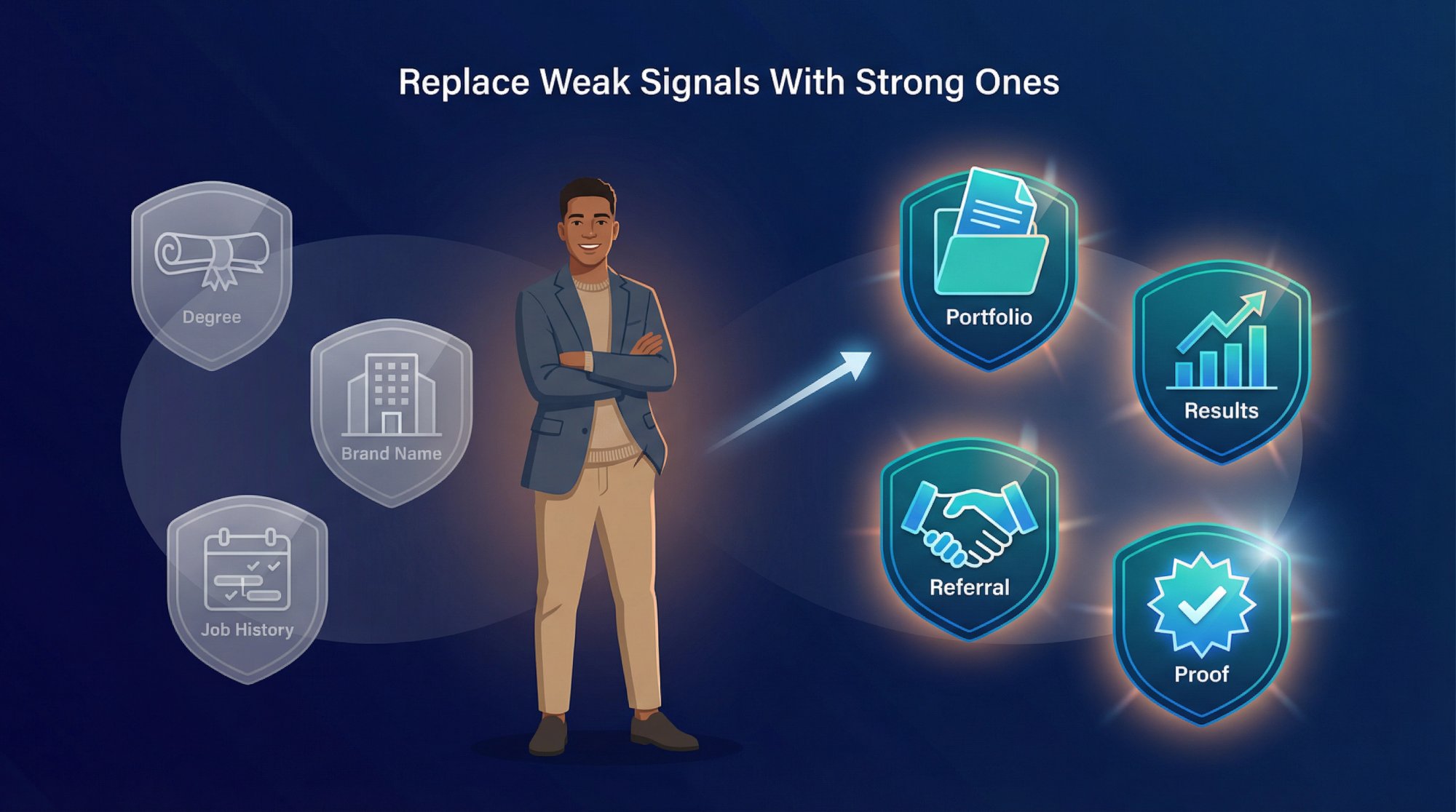
So they use shortcuts. These shortcuts are called signals.
Past job titles are a signal. Brand-name employers are a signal. A degree is a signal. Referrals are a signal. A portfolio is a signal. Measurable results are a signal.
When you have "no experience," what you really lack is trusted signals. You're not incompetent. You're just unproven in ways that matter to them. Your job, then, isn't to somehow manufacture five years of history you don't have. It's to replace weak signals with strong ones.
That's the whole game.
The Evidence-First Rule: You don't need a job to create evidence. You need evidence to get a job.
Once you accept that, everything becomes tactical. You stop feeling sorry for yourself and start asking: what can I build this week that proves I can do this work?
And in 2026, that mindset matters more than it ever has. Data from Adzuna reported by The Guardian shows UK job vacancy ads fell below 700,000 in early 2026, with competition running at roughly 2.4 jobseekers per vacancy. The "spray and pray" approach doesn't work in this market. Strategy does.
Step 1: Pick a Role You Can Actually Win Right Now
Most people fail at the very first step. They aim wrong.
The three traps:
Too broad: "I'll take anything." (Anything doesn't get you anything.)
Too high: "Entry-level product manager" (which often isn't entry-level at all).
Too vague: "Something in tech." or "Something in business." (This isn't a target; it's a direction.)
3 Questions to Ask Before Targeting Your First Job
① Can I create proof for this role without anyone's permission?
Roles like marketing, data analysis, and customer support all let you build evidence from scratch using public tools and information. Roles that require two years inside someone's proprietary system don't.
② Do employers actually hire beginners into this role regularly?
Look for keywords in job ads: "training provided," "junior," "graduate," "apprenticeship," "trainee," "no experience required," "we'll teach you." These signals tell you the company has already figured out how to onboard someone like you.
③ Could I be genuinely useful by day 10?
If the learning curve is steep enough that you'd be a liability for three months, that's a hard wedge for a no-experience candidate. Shorter proof cycles are friendlier to beginners.
What Is a Wedge Role (and How to Use It)
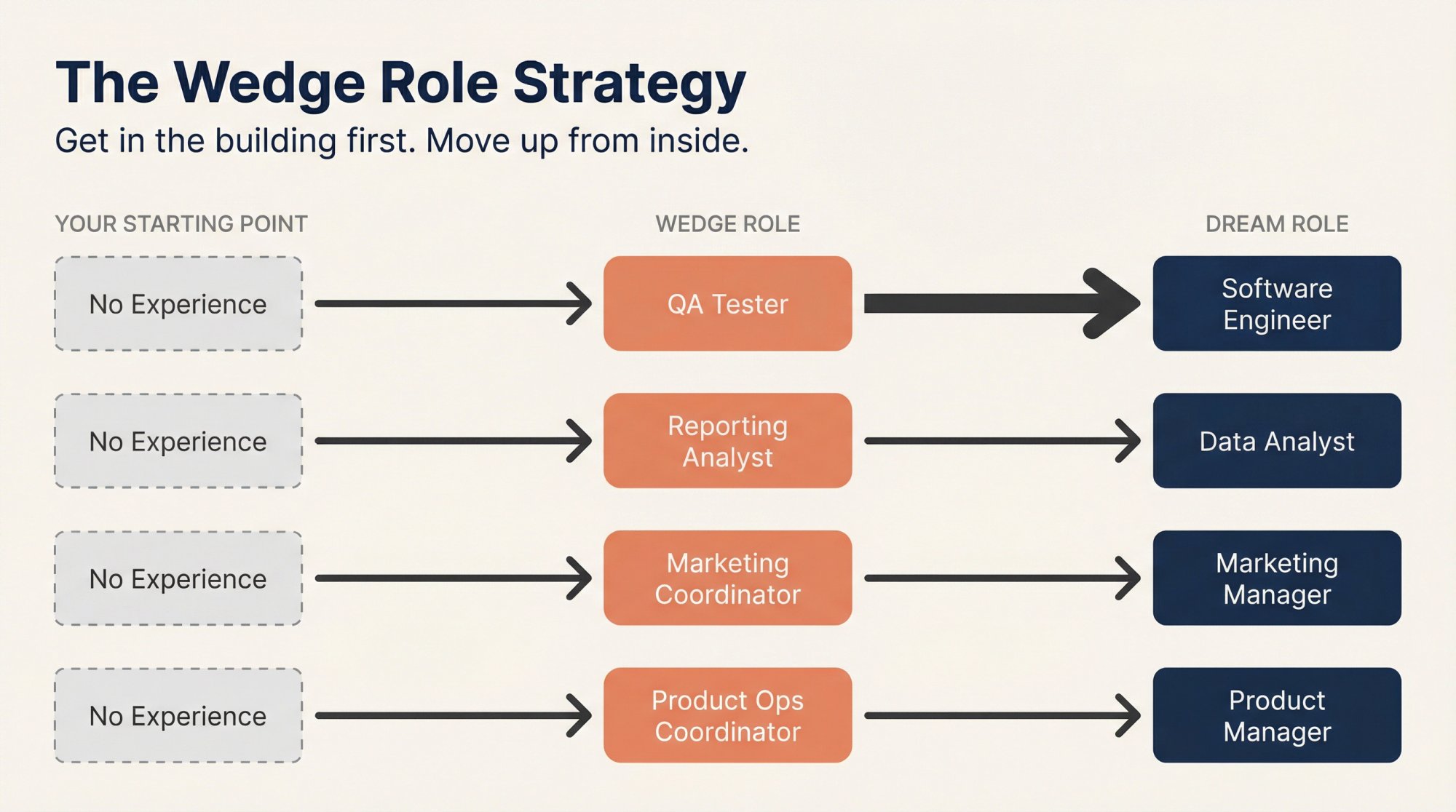
Instead of aiming directly for your dream role from zero, aim for a role that gets you into the building and close to the work. These are called wedge roles, and they're one of the smartest moves a first-time jobseeker can make.
Wedge roles reduce employer risk. They have clearer training, tighter scope, and faster proof cycles. Once you're in, your next move is an internal one, which is almost always easier than breaking in from outside.
Step 2: How to Read Job Descriptions to Get Hired With No Experience
Stop reading job ads like someone who needs a favor. Start reading them like someone trying to understand a problem and design a solution.
How to Build a Proof Map in 15 Minutes
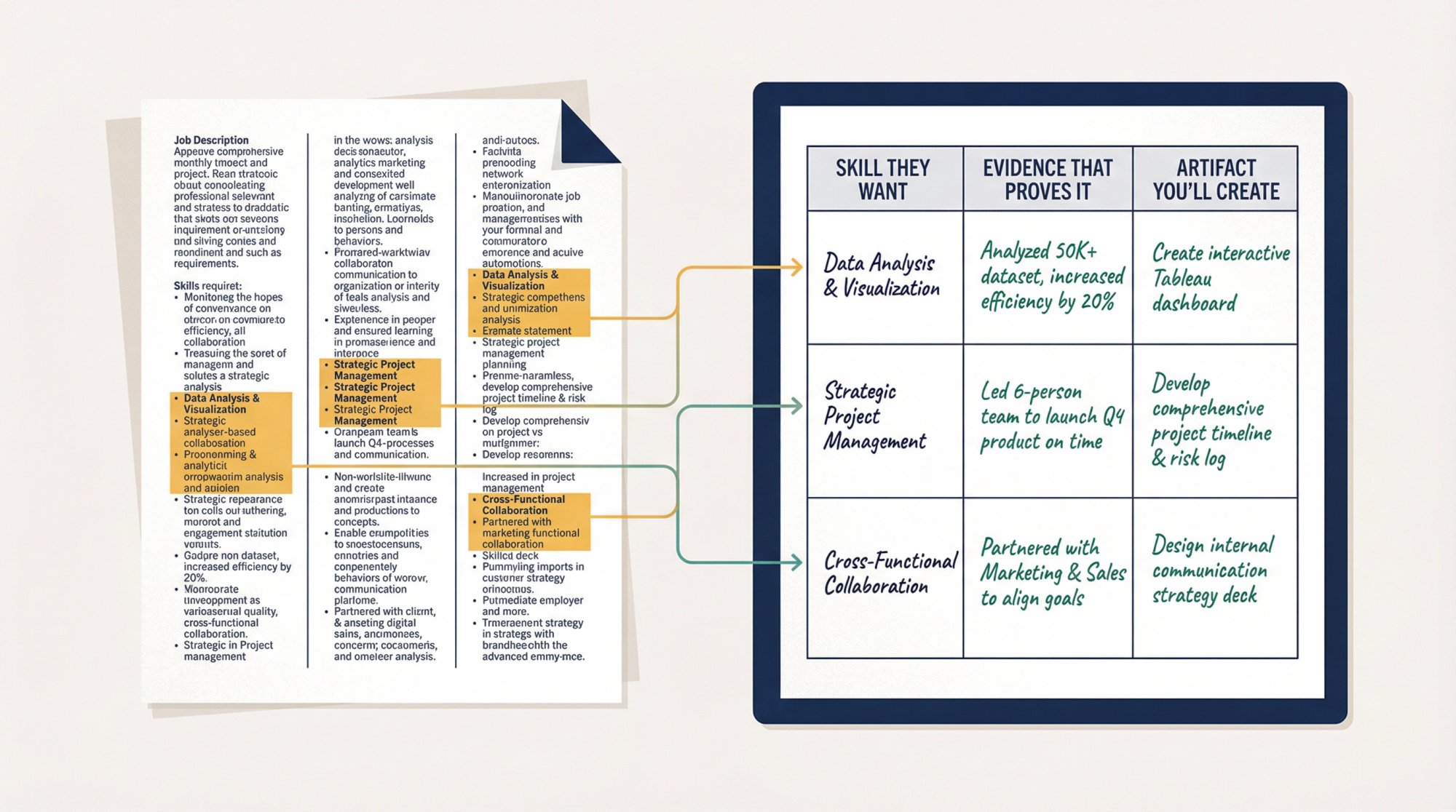
① Pick 5 job postings for the same target role. Copy the repeated requirements into a document.
② Create three columns:
The mental shift here is real. You go from "I don't have experience" to "I can build artifacts that prove ability." That's not cheating. That's exactly what experienced candidates are doing, except they're pointing to stuff they built on the clock. You'll build yours on your own time. Once you know what skills the market wants, use AIApply's skills gap analysis to identify where your biggest gaps are before you start building.
Step 3: How to Build a Portfolio With No Work Experience
A portfolio isn't just for designers and developers. In 2026, a portfolio is a small set of artifacts that prove you can do the work. Any role, any field.
Your proof portfolio needs to do three things:
→ Match the job's reality (right tools, right format, right constraints)
→ Show outcomes, even small ones (with numbers wherever possible)
→ Show thinking (how you reason through a problem, not just what you delivered)
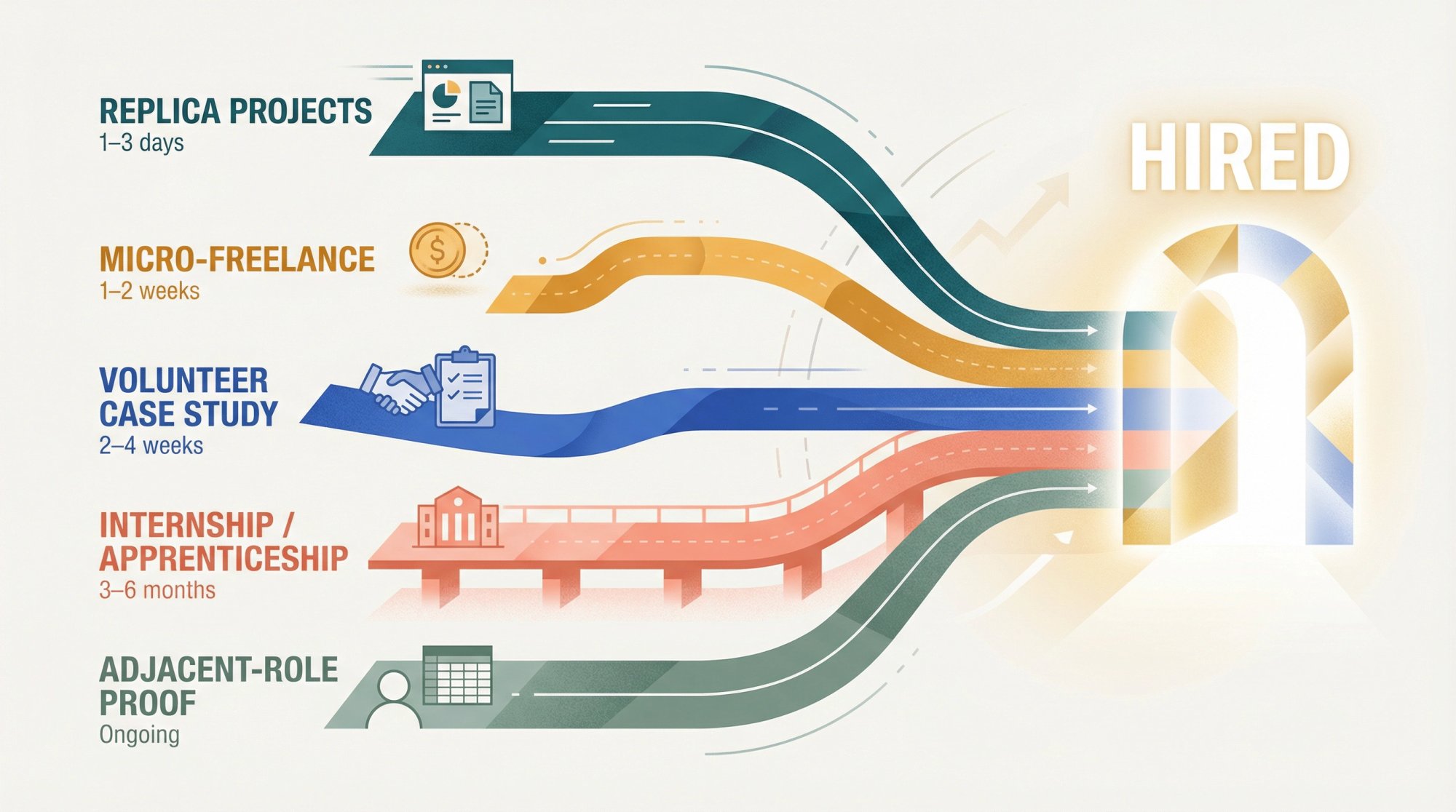
5 Ways to Create Proof Without a Job
Pick one or two. Trying to do all five at once is a recipe for burnout.
Here's how each approach works and when it makes the most sense:
① Replica Projects (Fastest Start)
Recreate the kind of work the job would require, using public information and tools.
Customer support: Write macros, a help-center article, and escalation rules for a hypothetical company
Sales: Build a prospect list, email sequence, and call script
Data: Analyze a public dataset, build a dashboard, write an insights memo
Ops: Map a process, identify bottlenecks, propose fixes
Marketing: Design a campaign with realistic metrics assumptions (label them as projections)
② Volunteer-to-Case-Study (Best Credibility)
Volunteer for a real organization, a club, a local charity, or a small business. Do real work. Then write it up as a case study with before/after results and, if possible, a quote from the stakeholder.
A real stakeholder name and before/after screenshot beats a stack of course certificates almost every time.
Learning how to showcase transferable skills is essential when your experience comes from volunteer work or non-traditional backgrounds.
③ Micro-Freelance (Short Contracts)
Do small paid gigs. Even $50 projects count. Payment is a surprisingly powerful signal because it means someone trusted you enough to part with actual money. One Fiverr or Upwork gig with a positive review is worth three lines on a resume.
④ Internships and Apprenticeships (Structured On-Ramps)
These remain among the cleanest bridges from "no experience" to "hired." According to NACE hiring data, employers extended full-time job offers to 62% of their 2024 interns, and that rate climbs to 72% for in-person internships (vs. 56% for hybrid).
In the UK, apprenticeships are a paid pathway. The UK government's published wage rates set the apprentice minimum wage at £8.00/hour from April 2026, making them a legitimate income source while you build experience. If you're applying to internships, a strong cover letter matters. AIApply's internship cover letter tool is built specifically for applicants without a formal work history.
⑤ Adjacent-Role Proof (Smart Career Change)
Already working somewhere? Build proof from where you are.
You work retail but want data? Track inventory or sales trends in a spreadsheet. Analyze the patterns. Write up what you'd recommend changing and why. Now you have a business-relevant data story you can point to in any interview. If you're making a career change, this kind of adjacent-role proof is often more convincing than a blank slate portfolio.
Step 4: How to Write a Resume With No Work Experience
A resume has exactly one job: get you to the interview by proving you can do this specific role.
Not to tell your life story. Not to list every class you've taken. Not to impress someone with a pretty header. Get you to the interview.
Best Resume Structure for First-Time Job Seekers
Use this order (it matters):
Headline + Summary (2-3 lines, tailored to the specific role)
Skills (only ones you can actually demonstrate)
Projects / Relevant Experience (this is your experience section)
Work Experience (include unrelated jobs, but frame them for transferable skills)
Education + Certifications
Optional: Volunteering, Awards, Leadership
The critical move here is putting projects above unrelated work history. A hiring manager scanning a resume will spend about six seconds on it. You want your most relevant stuff at the top. Not sure which resume format works best for a no-experience candidate? The reverse chronological structure is standard, but a skills-forward layout often works better when your work history is thin.
How to Write Resume Bullet Points With No Experience
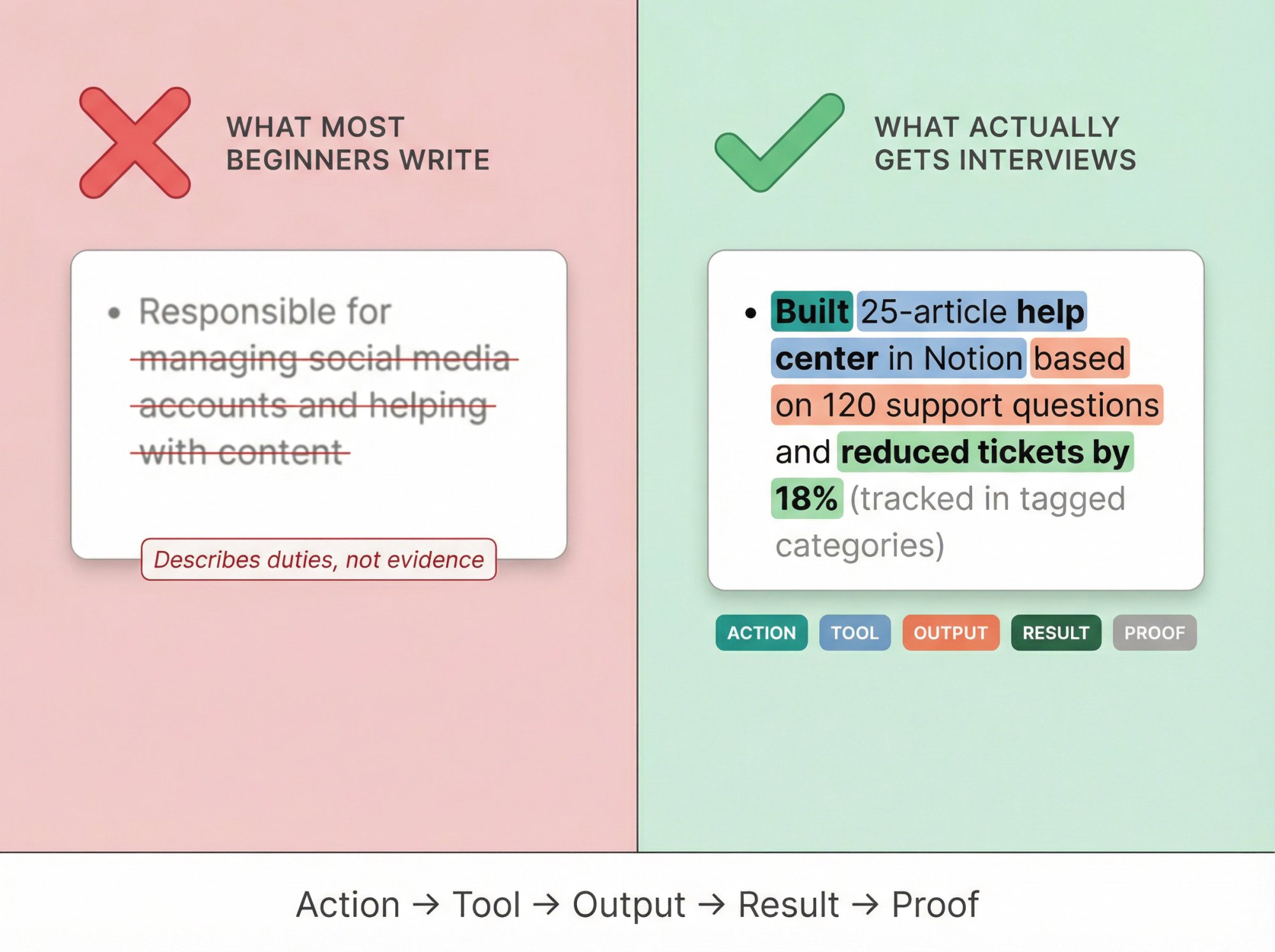
Most first-time job seekers write bullets that say "responsible for..." or "helped with..." These create zero trust because they describe duties, not evidence.
Use this formula instead:
Action → Tool/Method → Output → Result → Proof
Example for a customer support project:
Built a 25-article help center in Notion based on 120 common support questions, reducing repeat "how do I..." tickets in a test inbox by 18% over two weeks (tracked in tagged categories).
No job title needed. That bullet has a tool, a number, a result, and a tracking method. It's evidence. See more resume bullet point examples that demonstrate results rather than duties.
How ATS Systems Filter Resumes (and How to Pass Them)
Many large employers route applications through applicant tracking systems before a human ever sees them. Clean structure, standard headings, and keyword alignment matter more than clever formatting. If you've never thought about ATS optimization before, ATS-friendly resume templates can show you what properly structured resumes look like at a glance.
This is where AIApply tools genuinely save time. The AI Resume Builder generates job-tailored resume drafts in minutes using ATS-friendly templates (including a Harvard-inspired format). It won't do your thinking for you, but it compresses hours of formatting and guessing into minutes.
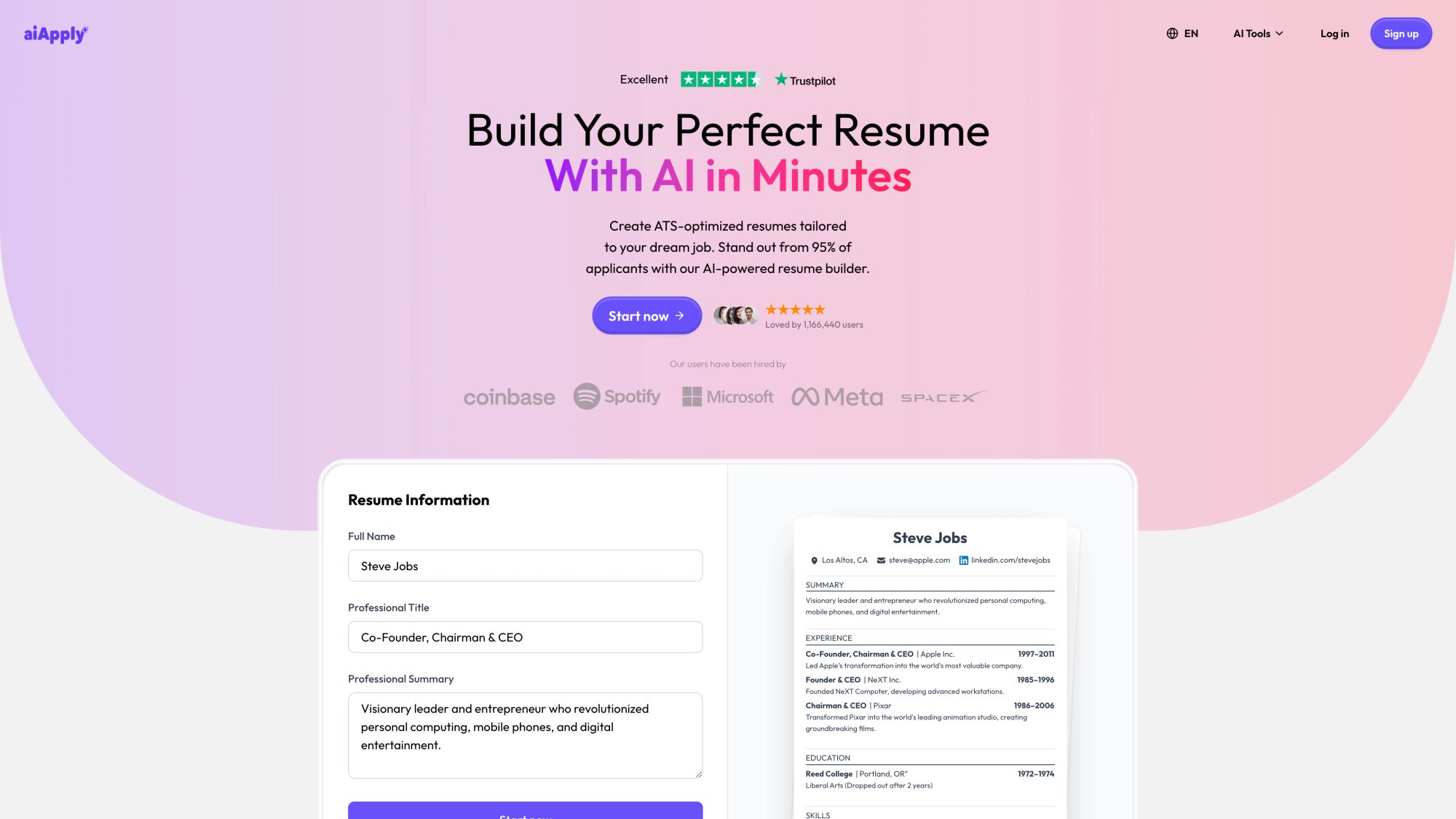
The Resume Scanner also checks your resume against 50+ ATS systems to flag keyword gaps before you submit.
One important rule: never submit anything you can't confidently defend in the interview. These tools draft and optimize; you still own the substance.
Step 5: How to Apply for Jobs With No Experience
Cold applying online isn't dead, but it is the hardest channel when you're starting out. You're entering a queue where everyone looks roughly similar on paper, and employers don't know you from anyone else.
So you either need better targeting with stronger proof, or a warm introduction, or ideally both.
Why Connections Get You Hired Faster Than Cold Applying
LinkedIn's January 2026 labor market data found that applicants are 3.6x more likely to be hired if they're already connected to someone at the company, compared to cold applying. The same report noted that applicants overall are up 12% since 2023, which helps explain why the cold channel feels harder every year.
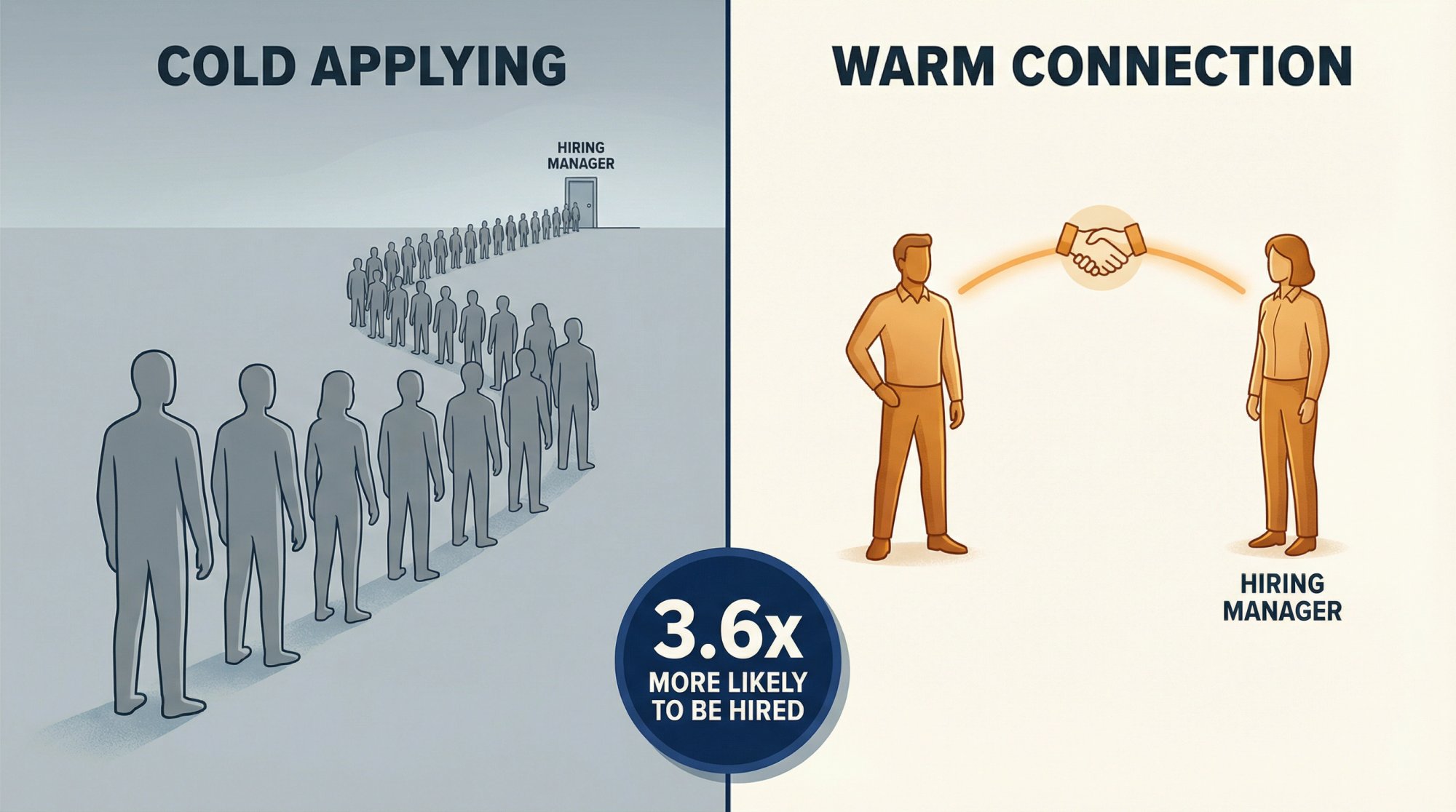
Being known reduces risk. That's not networking as a social performance. It's networking as a hiring strategy.
How to Organize Your Job Applications for Maximum Results
Run these simultaneously:
→ Channel A: High-Intent Targeted Applications (10-15/week)
For roles you genuinely want. Each one gets a tailored resume, a specific cover letter, and at least one warm outreach message to someone at the company (recruiter, hiring manager, or a team member).
→ Channel B: Volume Applications (to keep momentum)
For "good enough" roles that still move your career forward. Quality can be slightly lower here because volume is the point.
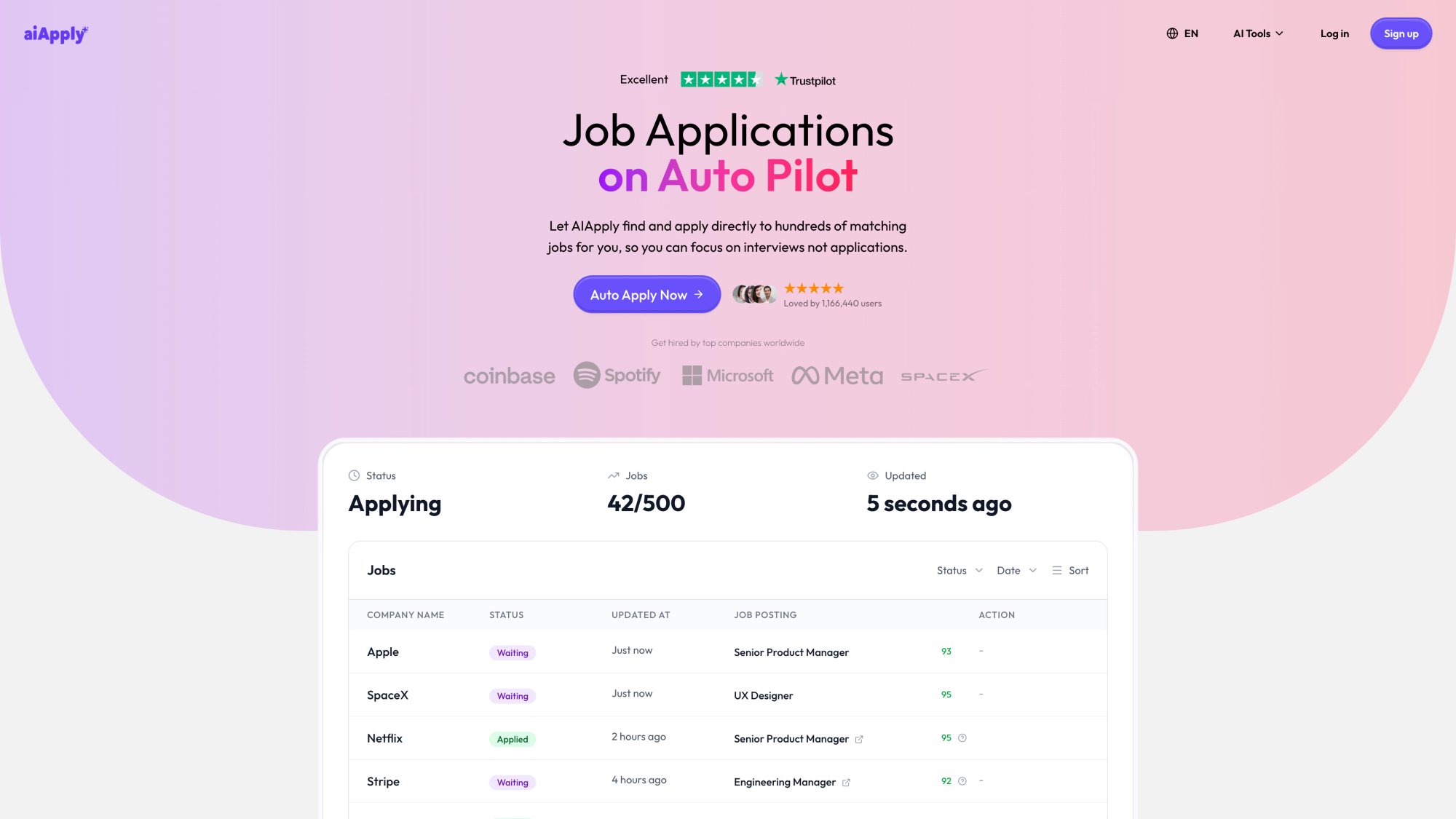
This is where automation helps without hurting you. AIApply's Auto Apply handles the repetitive submission work across 1M+ postings while using your existing resume and cover letter inputs, so you can put your energy into Channel A while Channel B runs in the background. You can also use a structured job search strategy to prioritize which roles to target first.
One critical warning: if you scale volume before your proof is strong, you're scaling failure. Fix the proof first, then open the throttle.
Step 6: How to Write a Cover Letter With No Experience
Most cover letters fall into one of two traps:
A boring summary of everything already on the resume (wasted space)
An apologetic explanation of why you lack experience (actively harmful)
Neither one gets you the interview. Both telegraph that you're not sure you deserve the role.
How to Structure a Cover Letter With No Work History
Keep it tight. Four paragraphs maximum.
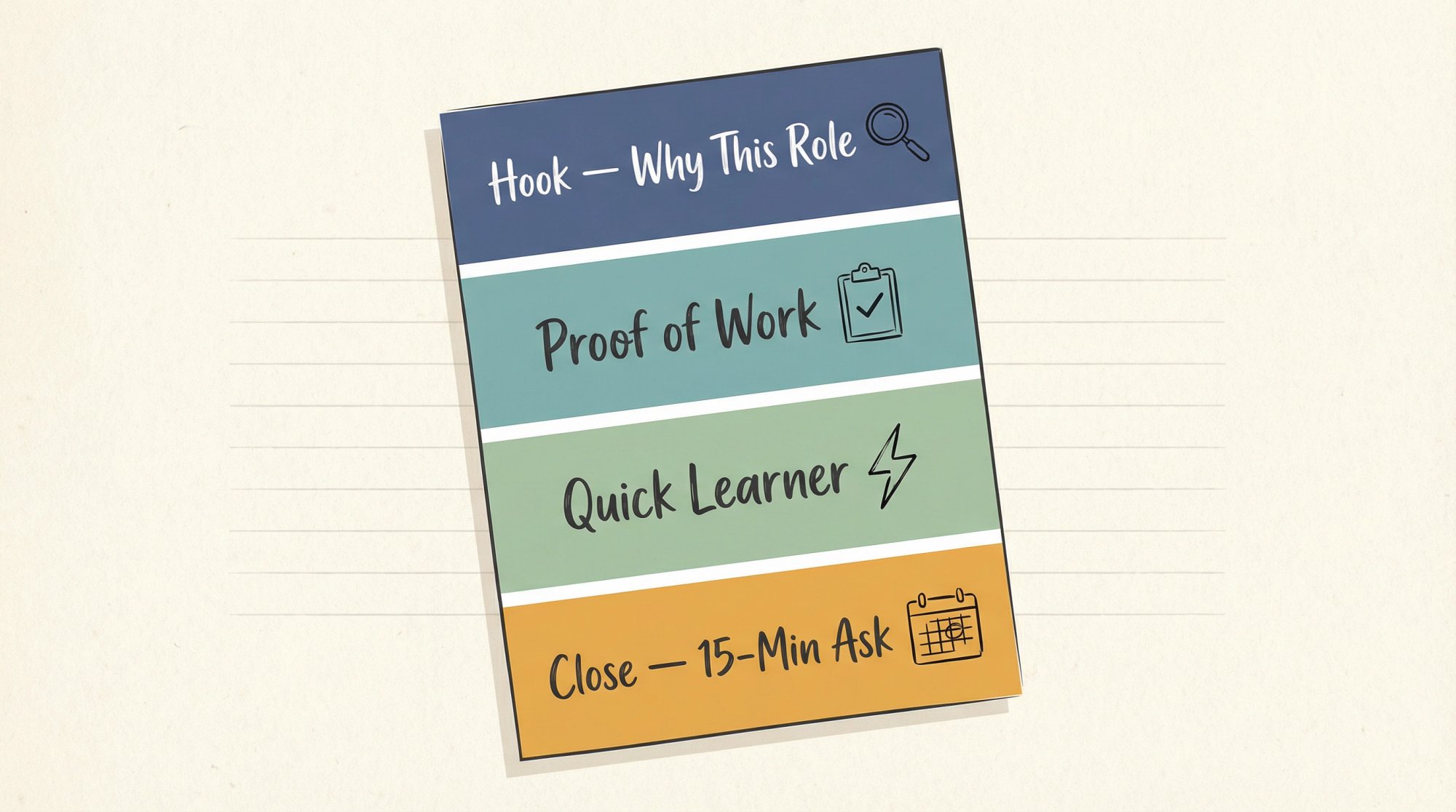
Template:
Hi [Name],
I'm applying for the [Role] position. I'm excited about it because [specific reason tied to their product, mission, or a recent company announcement].
Even though I'm early in my career, I've already done work that maps directly to this role: [Project/Volunteer work] where I [did X using Y tool] and achieved [measurable result].
I learn fast. Recently I taught myself [tool or skill], then used it to [output], which led to [result].
I have a one-page portfolio with the artifacts and full context if that's useful. Would a 15-minute call this week be worth your time?
[Your name]
If writing is the bottleneck, AIApply's Cover Letter Generator can produce a role-specific draft quickly. The Cover Letter for No Experience section specifically addresses how to frame a compelling letter without a traditional work history. Edit the output until it sounds like you, not like AI.
Step 7: How to Network for a Job When You're Just Starting Out
Bad networking is vague. "Can you help me get a job?" creates awkward pressure and gives the other person nothing they can actually do. Good networking is specific. It respects the other person's time and gives them an easy way to respond.
The trick is micro-asks: small, specific requests that feel reasonable to fulfill.
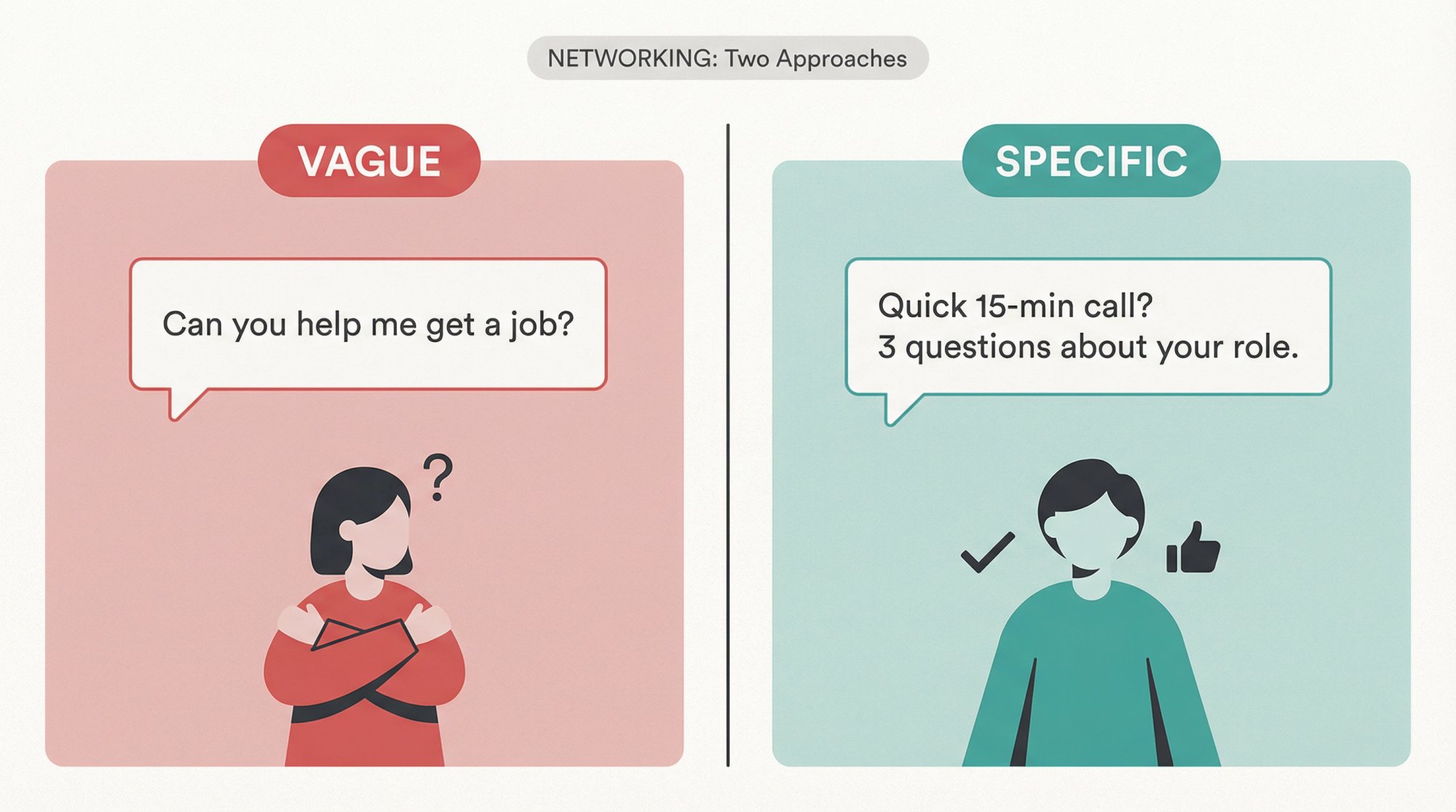
3 Networking Messages That Get Responses
Message 1: The Informational Interview Ask (Low Pressure)
Hi [Name], I'm trying to break into [role]. I saw you moved from [their previous role] into [their current position] and I'm building a small proof portfolio.
Could I ask you 3 questions over a 15-minute call about what matters most in [role] at [company/industry]? No pitch. I just want to learn.
Message 2: The Proof-First Message (Show, Don't Tell)
Hi [Name], I'm applying to [company] for [role]. I built a short artifact that mirrors the job: [one-sentence description].
If you're open to it, I'd love a quick sanity check: does this look like the kind of work your team values?
Message 3: The Hiring Manager Value Memo (Advanced, High Win Rate)
This is a one-page document you send after a short outreach:
What you noticed about their product or process
Two or three specific problems or opportunities
How you'd approach them in the first 30 days
You're doing a tiny piece of the job before you're even hired. That's extraordinarily rare, and hiring managers notice. Learn how to send a message to a hiring manager in a way that gets a reply without feeling intrusive.
AIApply's free tools include networking email generators and skills gap analyzers that can help you draft these messages and figure out where you still need to build proof.
Step 8: How to Ace a Job Interview With No Work Experience
Interviewers aren't really asking "have you done this exact job before?" They're asking four deeper questions:
Can you learn fast?
Can you communicate clearly?
Can we trust you with real work?
Will you freeze when things go wrong?
You can answer all four without a single year of professional experience, as long as you have a framework.
How to Answer Interview Questions With No Experience
For almost any interview question, structure your answer around three components:
Potential: What you're genuinely good at (a strength, honestly described)
Proof: A specific story from a project, volunteer role, class, or even a personal challenge
Plan: How you'd apply that in this specific role
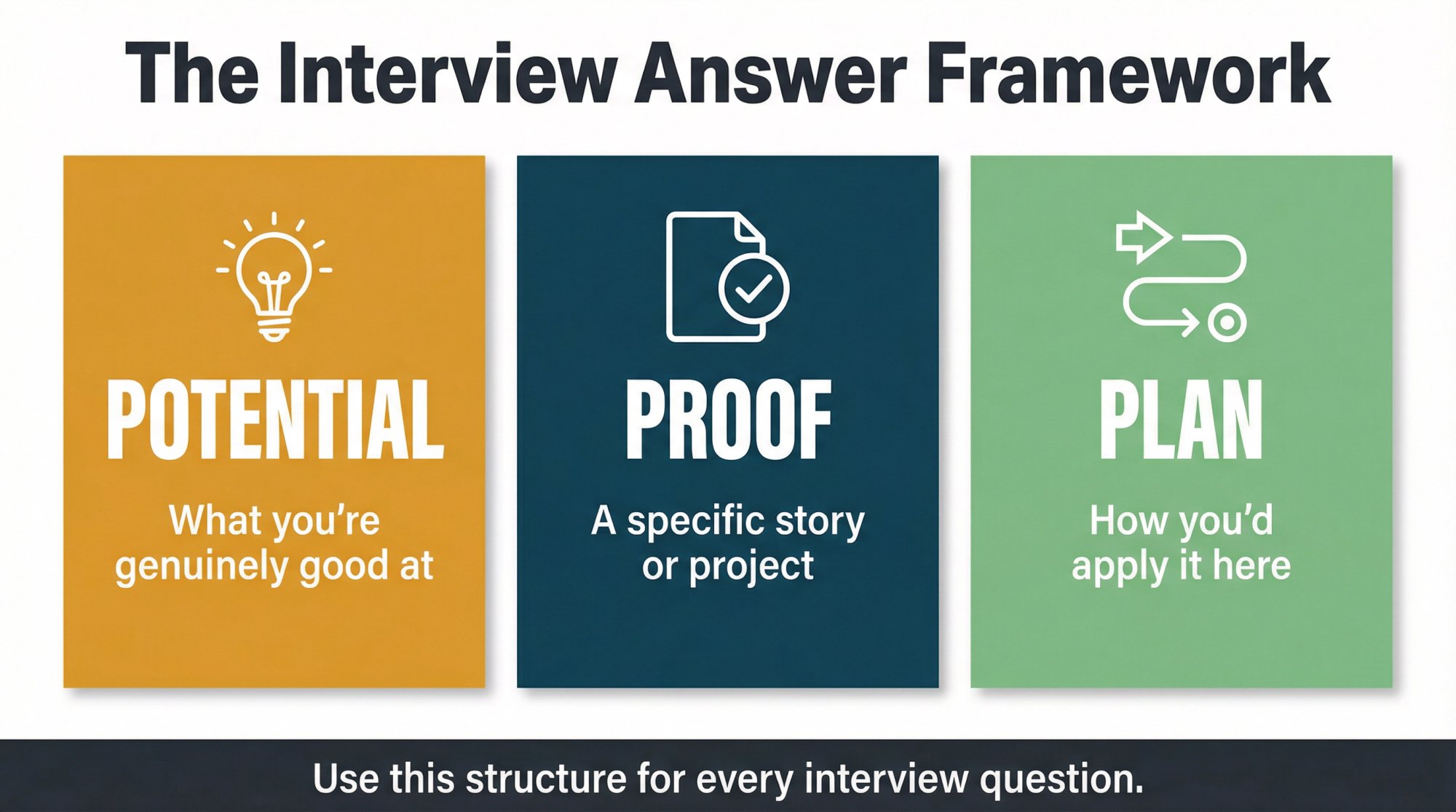
Example for "Tell me about yourself":
"I'm strong at structured problem-solving and turning messy information into something clear and useful. I built [X project] where I [did X using Y], which improved [result] by [number]. In this role, I'd use the same approach to [specific job responsibility from the job description]."
That answer works whether you have zero years of experience or five. Preparing a strong answer to tell me about yourself in a job interview is one of the most valuable things you can do before any interview.
How to Practice for a Job Interview
If the first time you answer interview questions is in the actual interview, you're training on match day. That's too late.
AIApply's Mock Interview Simulator lets you paste in any job description and immediately get a set of tailored interview questions generated by GPT-4, with instant feedback on your answers. A full practice session takes 15-30 minutes and works for any role. The Interview Buddy Chrome extension provides real-time on-screen coaching during live video interviews, visible only to you, helping you stay composed when an unexpected question lands.
For entry-level interview preparation, it helps to practice behavioral interview questions specifically, since these come up in almost every first-job interview regardless of the role.
Ethics note: Use practice tools freely. For live interviews, follow the employer's specific policies and never misrepresent your abilities. Use real-time coaching tools for support, not as a substitute for genuine preparation.
What Skills-Based Hiring Actually Means for No-Experience Candidates
You've probably heard companies are "dropping degree requirements" and hiring based on skills now. There's truth to this, but there's a trap in it too.
Yes, some companies have removed formal degree requirements from job postings. But removing a requirement from a job ad doesn't necessarily change who actually gets hired.
A major study by the Burning Glass Institute and Harvard Business School found that despite the hype, skills-based hiring increased opportunity for candidates without degrees in "not even 1 in 700 hires," with a net effect of about 0.14% on actual hiring outcomes.
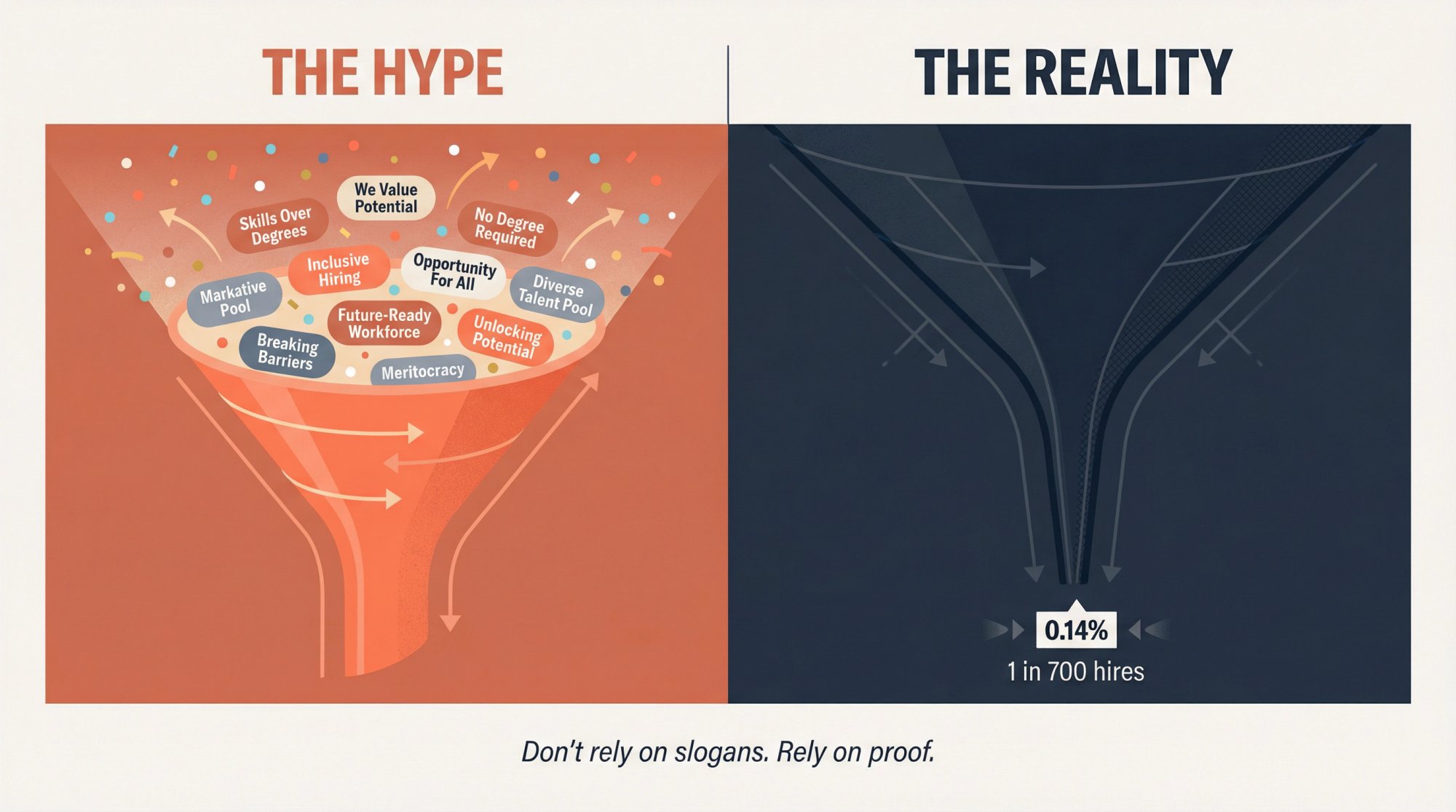
So what do you do with that?
Don't rely on slogans. Rely on proof.
Skills-based hiring does help you if you can demonstrate skills. The mechanisms are the same: projects, work samples, referrals, specific interview stories. The label changed; the evidence requirement didn't.
Also worth knowing: industry data on US tech job postings shows that the share asking for 5+ years of experience rose from 37% in Q2 2022 to 42% by Q2 2025. Only 18% of those postings were open to candidates with one year or less of experience. Tech is hiring, but the bar has moved. Understanding what skills employers actually look for in your target role is the starting point for knowing what to build.
30-Day Plan to Get Your First Job With No Experience
When motivation dips, this is what you follow.
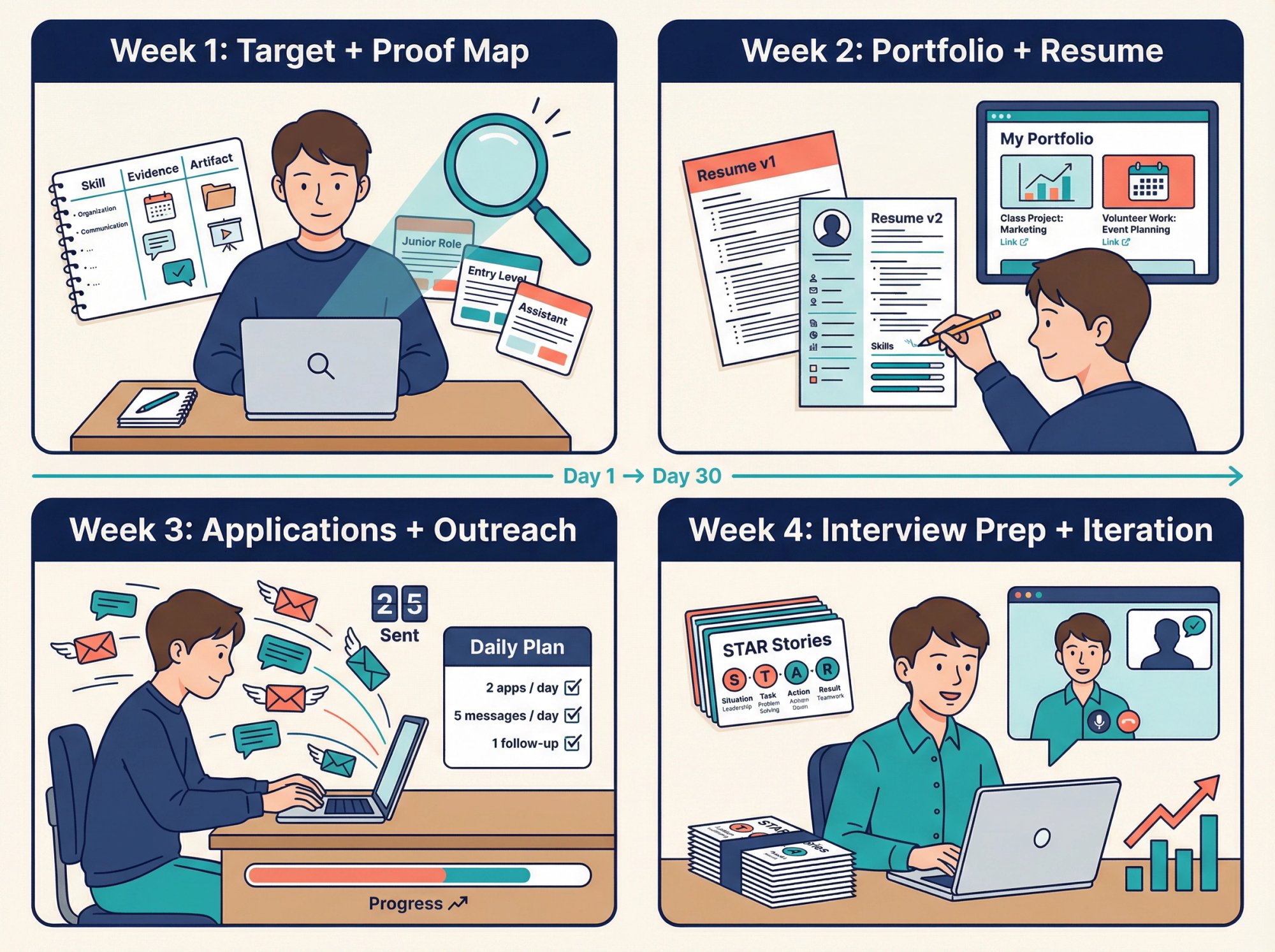
Week 1 Breakdown
Days 1-2: Pick your primary target role and your wedge role. Collect at least 15 job ads and save them.
Day 3: Build your Proof Map (three columns: skill, evidence, artifact) from the patterns you spotted.
Days 4-7: Start your first replica project. Set up a simple portfolio page (Notion or Google Doc works fine at this stage). A professional portfolio guide can help you decide what to include and how to present it.
Week 2 Breakdown
Finish your second project (ideally one with a real stakeholder, even if it's volunteer work). Write 6-10 resume bullets using the Action + Tool + Output + Result formula. Create two resume versions: one for your target role, one for your wedge role.
AIApply's Resume Builder is useful here for generating fast tailored drafts, and the Resume Scanner will flag any keyword gaps before you start sending applications. If you're writing your first resume from scratch, these resume summary examples for students show how to open your resume when you don't have years of experience to lean on.
Week 3 Breakdown
Daily minimum:
2 targeted applications (Channel A)
5 outreach messages (informational ask or proof-first)
1 follow-up on previous outreach
Weekly goal: 10-15 targeted applications, 25-35 outreach messages, 2 informational conversations booked.
Use a job application tracker to stay on top of where you've applied, who you've messaged, and what's due for follow-up. It takes five minutes to set up and eliminates the mental overhead of keeping it all in your head.
Week 4 Breakdown
Practice interview answers for 30 minutes every day. Build a bank of 8 STAR stories (Situation, Task, Action, Result) drawn from your projects and volunteer work. Keep applying, but start paying attention to feedback patterns: no callbacks means your resume or proof needs work. Callbacks but no offers means your interview answers need work.
Job Search Mistakes to Avoid When You Have No Experience
These aren't obvious. If they were, everyone would avoid them.
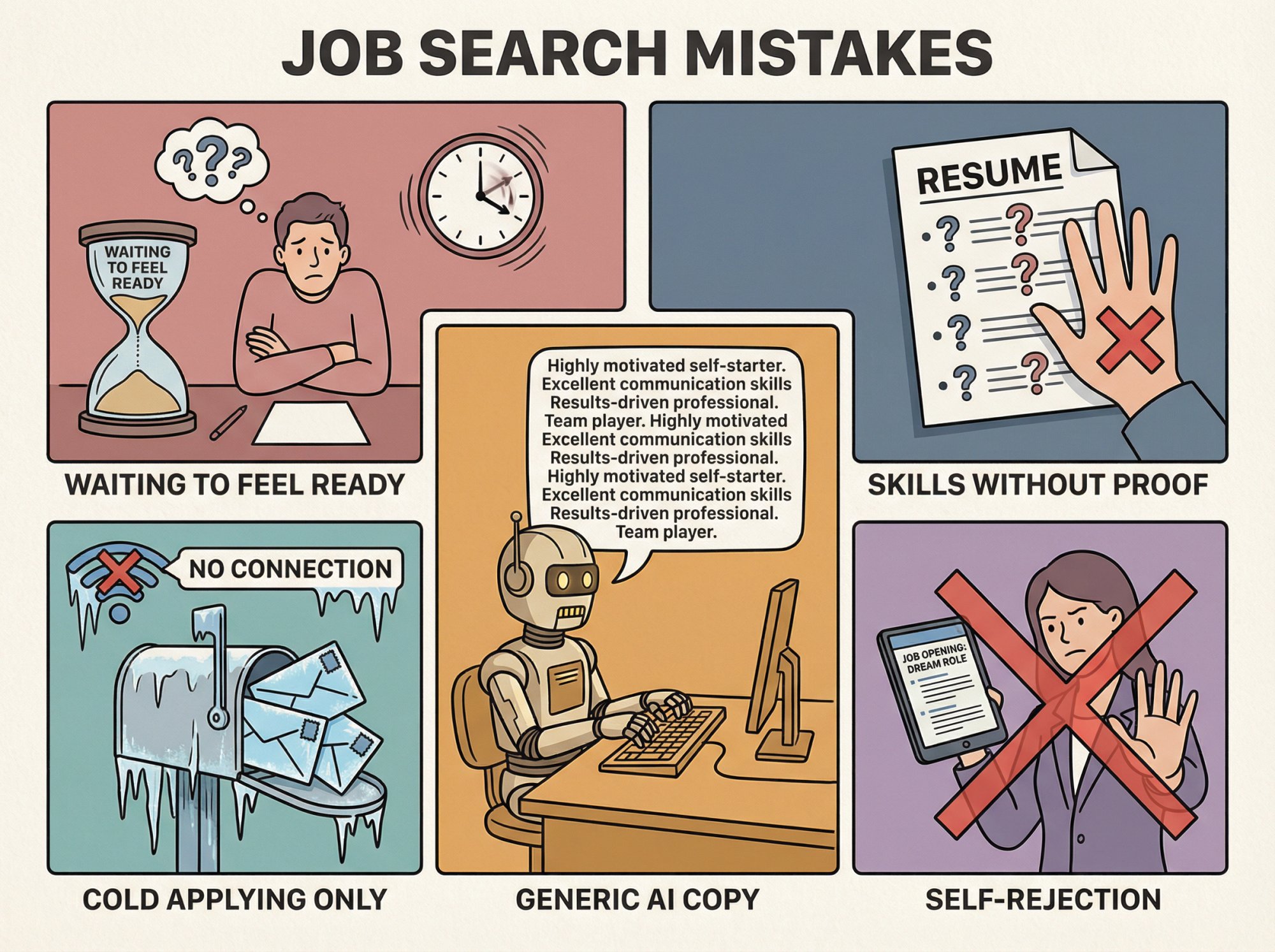
① Waiting until you "feel ready"
Readiness isn't a feeling you arrive at one day. It's what you build through proof and repetition. The people who wait for confidence before starting almost always wait longer than the people who start uncomfortable and build confidence through doing.
② Listing skills with no artifacts
If your resume says "Excel" but you can't immediately share something you built in Excel, you've created a trust problem. Skills without evidence are just claims. Hiring managers have seen thousands of claims. They remember evidence. Check this skills for resume list to see which skills are actually valued in your target field, then make sure you can demonstrate each one you claim.
③ Using AI to sound impressive instead of being specific
Generic sounds exactly like every other application. Specific gets remembered. When you let an AI tool write your cover letter and submit it without editing, you lose the specificity that makes you stand out.
Use AI to draft; use your brain to make it specific.
④ Cold applying only
Remember the LinkedIn data: 3.6x more likely to be hired when connected. Being known changes everything. Cold applying should never be your only channel.
⑤ Self-rejecting based on job requirements
Job ads are wishlists, not contracts. Companies routinely list "5 years of experience" for roles where they'd happily hire someone with two strong years and a great portfolio. If you can do the core tasks and can prove it, apply. The worst they can say is no.
Frequently Asked Questions: Getting a Job With No Experience

What jobs can you actually get with no experience?
Jobs with shorter training cycles and clearer outputs tend to be friendliest to beginners. Think: customer service representative, administrative assistant, entry-level sales rep, data entry specialist, marketing assistant, warehouse and logistics roles, apprenticeships, and trainee programs. Your best fit depends on your specific strengths and constraints, so use the role-selection criteria from Step 1 to narrow it down for your situation.
How do I write a resume when I have nothing to put on it?
Replace the "work experience" section with a "projects" or "relevant experience" section that lists artifacts you've built (replica projects, volunteer case studies, class work, freelance gigs). Use the Action + Tool + Output + Result bullet formula. Put this section above any unrelated jobs. See how to write a resume for your first job with no work history, or use an ATS-optimized template from AIApply's Resume Builder to structure it properly.
Should I apply even if I don't meet all the requirements?
Yes, with one condition: you should be able to demonstrate the core requirements. Job ads are wishlists. If you meet 60-70% of the listed requirements and can build or show proof for the most important ones, apply. Don't self-reject for requirements that are clearly nice-to-haves.
Are internships worth doing in 2026?
Yes, especially if you can get in-person ones. NACE data from 2024 shows 62% of interns received full-time job offers, and that rate was 72% for in-person internships. The time cost of an internship is real, but the conversion rate makes it one of the most reliable paths from no experience to employed.
Are apprenticeships paid?
In many countries, yes. In the UK, the government's published minimum wage rates set the apprentice wage at £8.00/hour from April 2026. Rates vary by country and by your age (once you complete your first year, you may qualify for higher rates), so check current rates close to your start date.
Is it possible to get hired without any networking?
Technically, yes. Practically, it's much harder. Cold applying alone means you're competing in the most crowded channel with the least amount of context working in your favor. You don't have to become a relentless networker, but even one or two genuine connections inside a company can shift your odds dramatically.
What if I have a degree but no work experience?
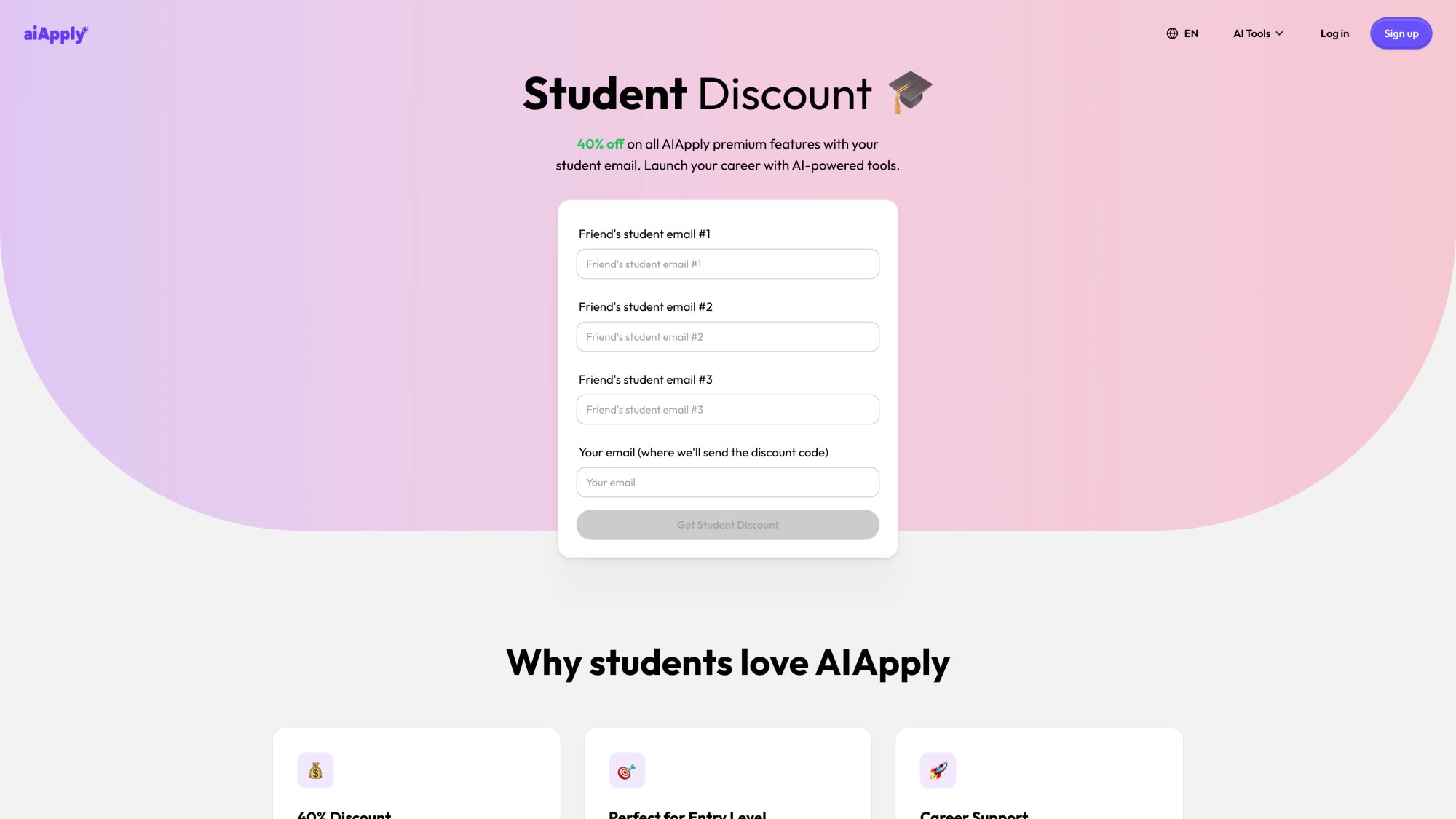
Your degree counts as a signal, but it's not enough on its own. Pair it with proof: projects, relevant coursework with deliverables, volunteer work, anything that shows you can translate knowledge into outputs. Also, many of our users at AIApply are recent graduates who use the students page for a 40% discount on Pro features, which is worth checking out if you're in that category.
How do I know if my resume is being filtered out by ATS?
Run it through AIApply's free Resume Scanner before you submit anything. It checks your resume against 50+ ATS systems and gives you specific keyword recommendations based on your industry and target roles. It also flags formatting problems that prevent proper parsing, which is something most people don't even know to check.
How long does it realistically take to get a job with no experience?
Honest answer: it varies widely. People who follow a structured approach (clear target, proof portfolio, two-channel applications, active networking) typically start landing interviews within 30-60 days. People who cold apply without proof or outreach often go months without results. The 30-day plan in this article is designed to get you into your first conversations within a month.
What's the most important thing to focus on first?
Build one concrete artifact this week. Not a plan. Not a course. An actual piece of work that proves you can do the job you're targeting. Everything else in this guide amplifies that artifact: the resume showcases it, the cover letter explains it, the networking shares it, the interview tells the story behind it.
Next Steps: How to Start Getting a Job With No Experience
The no-experience loop isn't unbreakable. It just requires a different entry point than most people think.
You build proof, then distribute proof. You replace weak signals with strong ones. You pick a wedge role, get in, and move from there. You stop waiting to feel ready and start building evidence that makes you ready.
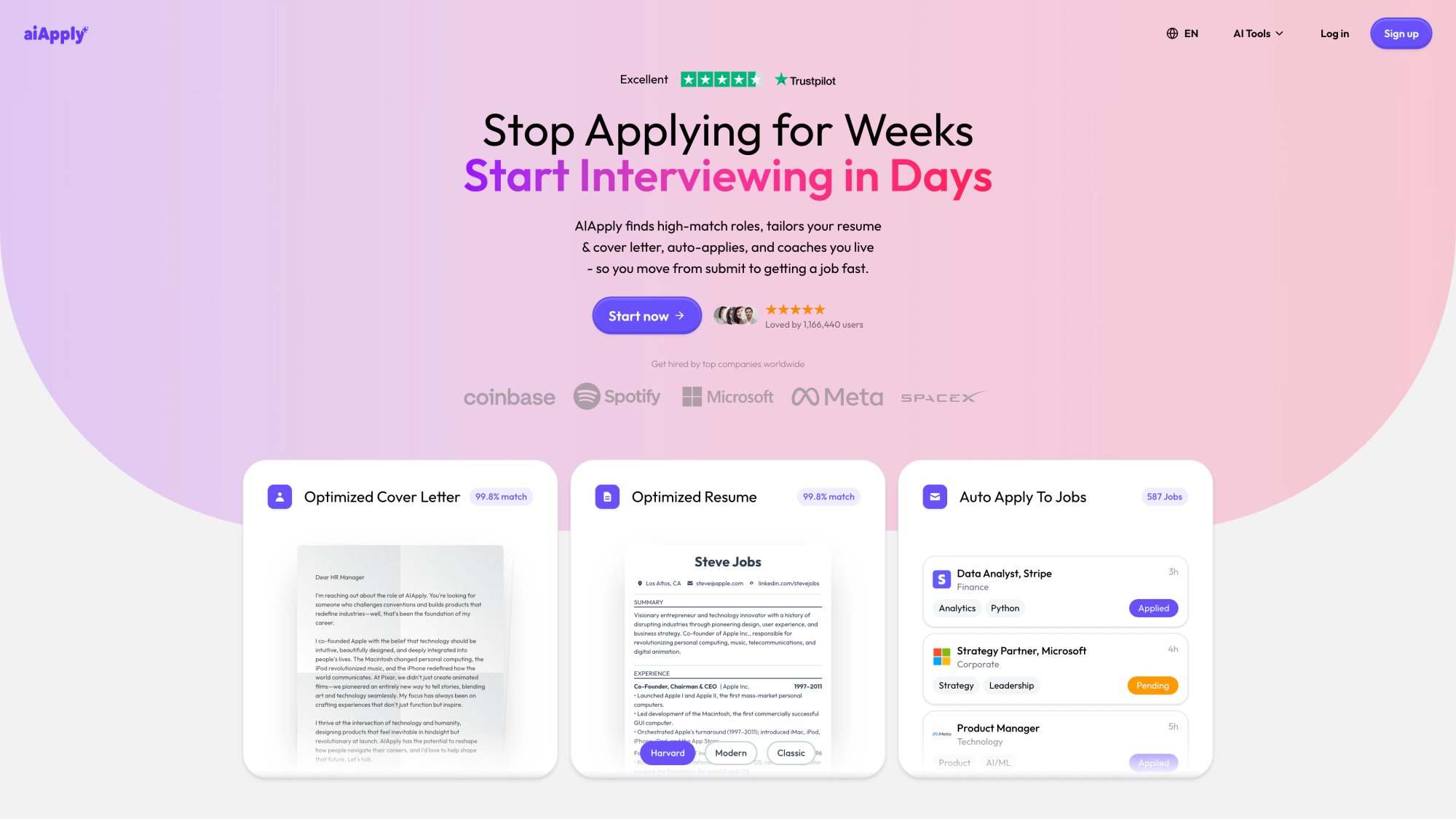
If you want to compress the busywork so you can focus on what actually matters, AIApply is built exactly for this:
The AI Resume Builder gets your resume ATS-ready in minutes
The Resume Scanner catches gaps before hiring managers do
The Cover Letter Generator turns a blank page into a role-specific first draft
The Auto Apply feature handles volume applications so you can put your energy into targeted outreach
The Mock Interview Simulator and Interview Buddy make sure you're sharp when the interview invite actually lands
Over 1.1 million job seekers have used the platform, and users are 80% more likely to get hired faster. If you're a student, there's a 40% discount available through your student email.
Build one artifact this week. Start there. The rest follows.
All statistics and policy figures in this guide are based on sources published or updated in 2025-2026. Hiring markets and wage rates change, so verify region-specific details close to your application date.
You know the loop. You've probably been stuck in it.
"I can't get a job without experience."
"I can't get experience without a job."
It's not a personal failure. It's a structural problem baked into how hiring works, and once you understand it at its roots, the path forward becomes much clearer than it probably feels right now.
This guide gives you a complete, practical system: how to pick the right role, build real proof fast, write a resume that actually gets read, network without being awkward about it, and interview confidently, even when your background is thin. We've also built a step-by-step 30-day plan at the end so you always know exactly what to do next.
Why Getting a Job With No Experience Feels Impossible
Before you can fix the problem, you need to understand what's actually going on.
When a company hires someone, they're not doing you a favor. They're managing risk. They need a business problem solved (more sales, fewer bugs, smoother operations) and they're betting money and time that you can solve it. The trouble is they can't see inside your head. They don't know if you can actually do the work.
So they use shortcuts. These shortcuts are called signals.
Past job titles are a signal. Brand-name employers are a signal. A degree is a signal. Referrals are a signal. A portfolio is a signal. Measurable results are a signal.
When you have "no experience," what you really lack is trusted signals. You're not incompetent. You're just unproven in ways that matter to them. Your job, then, isn't to somehow manufacture five years of history you don't have. It's to replace weak signals with strong ones.
That's the whole game.
The Evidence-First Rule: You don't need a job to create evidence. You need evidence to get a job.
Once you accept that, everything becomes tactical. You stop feeling sorry for yourself and start asking: what can I build this week that proves I can do this work?
And in 2026, that mindset matters more than it ever has. Data from Adzuna reported by The Guardian shows UK job vacancy ads fell below 700,000 in early 2026, with competition running at roughly 2.4 jobseekers per vacancy. The "spray and pray" approach doesn't work in this market. Strategy does.
Step 1: Pick a Role You Can Actually Win Right Now
Most people fail at the very first step. They aim wrong.
The three traps:
Too broad: "I'll take anything." (Anything doesn't get you anything.)
Too high: "Entry-level product manager" (which often isn't entry-level at all).
Too vague: "Something in tech." or "Something in business." (This isn't a target; it's a direction.)
3 Questions to Ask Before Targeting Your First Job
① Can I create proof for this role without anyone's permission?
Roles like marketing, data analysis, and customer support all let you build evidence from scratch using public tools and information. Roles that require two years inside someone's proprietary system don't.
② Do employers actually hire beginners into this role regularly?
Look for keywords in job ads: "training provided," "junior," "graduate," "apprenticeship," "trainee," "no experience required," "we'll teach you." These signals tell you the company has already figured out how to onboard someone like you.
③ Could I be genuinely useful by day 10?
If the learning curve is steep enough that you'd be a liability for three months, that's a hard wedge for a no-experience candidate. Shorter proof cycles are friendlier to beginners.
What Is a Wedge Role (and How to Use It)
Instead of aiming directly for your dream role from zero, aim for a role that gets you into the building and close to the work. These are called wedge roles, and they're one of the smartest moves a first-time jobseeker can make.
Wedge roles reduce employer risk. They have clearer training, tighter scope, and faster proof cycles. Once you're in, your next move is an internal one, which is almost always easier than breaking in from outside.
Step 2: How to Read Job Descriptions to Get Hired With No Experience
Stop reading job ads like someone who needs a favor. Start reading them like someone trying to understand a problem and design a solution.
How to Build a Proof Map in 15 Minutes
① Pick 5 job postings for the same target role. Copy the repeated requirements into a document.
② Create three columns:
The mental shift here is real. You go from "I don't have experience" to "I can build artifacts that prove ability." That's not cheating. That's exactly what experienced candidates are doing, except they're pointing to stuff they built on the clock. You'll build yours on your own time. Once you know what skills the market wants, use AIApply's skills gap analysis to identify where your biggest gaps are before you start building.
Step 3: How to Build a Portfolio With No Work Experience
A portfolio isn't just for designers and developers. In 2026, a portfolio is a small set of artifacts that prove you can do the work. Any role, any field.
Your proof portfolio needs to do three things:
→ Match the job's reality (right tools, right format, right constraints)
→ Show outcomes, even small ones (with numbers wherever possible)
→ Show thinking (how you reason through a problem, not just what you delivered)
5 Ways to Create Proof Without a Job
Pick one or two. Trying to do all five at once is a recipe for burnout.
Here's how each approach works and when it makes the most sense:
① Replica Projects (Fastest Start)
Recreate the kind of work the job would require, using public information and tools.
Customer support: Write macros, a help-center article, and escalation rules for a hypothetical company
Sales: Build a prospect list, email sequence, and call script
Data: Analyze a public dataset, build a dashboard, write an insights memo
Ops: Map a process, identify bottlenecks, propose fixes
Marketing: Design a campaign with realistic metrics assumptions (label them as projections)
② Volunteer-to-Case-Study (Best Credibility)
Volunteer for a real organization, a club, a local charity, or a small business. Do real work. Then write it up as a case study with before/after results and, if possible, a quote from the stakeholder.
A real stakeholder name and before/after screenshot beats a stack of course certificates almost every time.
Learning how to showcase transferable skills is essential when your experience comes from volunteer work or non-traditional backgrounds.
③ Micro-Freelance (Short Contracts)
Do small paid gigs. Even $50 projects count. Payment is a surprisingly powerful signal because it means someone trusted you enough to part with actual money. One Fiverr or Upwork gig with a positive review is worth three lines on a resume.
④ Internships and Apprenticeships (Structured On-Ramps)
These remain among the cleanest bridges from "no experience" to "hired." According to NACE hiring data, employers extended full-time job offers to 62% of their 2024 interns, and that rate climbs to 72% for in-person internships (vs. 56% for hybrid).
In the UK, apprenticeships are a paid pathway. The UK government's published wage rates set the apprentice minimum wage at £8.00/hour from April 2026, making them a legitimate income source while you build experience. If you're applying to internships, a strong cover letter matters. AIApply's internship cover letter tool is built specifically for applicants without a formal work history.
⑤ Adjacent-Role Proof (Smart Career Change)
Already working somewhere? Build proof from where you are.
You work retail but want data? Track inventory or sales trends in a spreadsheet. Analyze the patterns. Write up what you'd recommend changing and why. Now you have a business-relevant data story you can point to in any interview. If you're making a career change, this kind of adjacent-role proof is often more convincing than a blank slate portfolio.
Step 4: How to Write a Resume With No Work Experience
A resume has exactly one job: get you to the interview by proving you can do this specific role.
Not to tell your life story. Not to list every class you've taken. Not to impress someone with a pretty header. Get you to the interview.
Best Resume Structure for First-Time Job Seekers
Use this order (it matters):
Headline + Summary (2-3 lines, tailored to the specific role)
Skills (only ones you can actually demonstrate)
Projects / Relevant Experience (this is your experience section)
Work Experience (include unrelated jobs, but frame them for transferable skills)
Education + Certifications
Optional: Volunteering, Awards, Leadership
The critical move here is putting projects above unrelated work history. A hiring manager scanning a resume will spend about six seconds on it. You want your most relevant stuff at the top. Not sure which resume format works best for a no-experience candidate? The reverse chronological structure is standard, but a skills-forward layout often works better when your work history is thin.
How to Write Resume Bullet Points With No Experience
Most first-time job seekers write bullets that say "responsible for..." or "helped with..." These create zero trust because they describe duties, not evidence.
Use this formula instead:
Action → Tool/Method → Output → Result → Proof
Example for a customer support project:
Built a 25-article help center in Notion based on 120 common support questions, reducing repeat "how do I..." tickets in a test inbox by 18% over two weeks (tracked in tagged categories).
No job title needed. That bullet has a tool, a number, a result, and a tracking method. It's evidence. See more resume bullet point examples that demonstrate results rather than duties.
How ATS Systems Filter Resumes (and How to Pass Them)
Many large employers route applications through applicant tracking systems before a human ever sees them. Clean structure, standard headings, and keyword alignment matter more than clever formatting. If you've never thought about ATS optimization before, ATS-friendly resume templates can show you what properly structured resumes look like at a glance.
This is where AIApply tools genuinely save time. The AI Resume Builder generates job-tailored resume drafts in minutes using ATS-friendly templates (including a Harvard-inspired format). It won't do your thinking for you, but it compresses hours of formatting and guessing into minutes.
The Resume Scanner also checks your resume against 50+ ATS systems to flag keyword gaps before you submit.
One important rule: never submit anything you can't confidently defend in the interview. These tools draft and optimize; you still own the substance.
Step 5: How to Apply for Jobs With No Experience
Cold applying online isn't dead, but it is the hardest channel when you're starting out. You're entering a queue where everyone looks roughly similar on paper, and employers don't know you from anyone else.
So you either need better targeting with stronger proof, or a warm introduction, or ideally both.
Why Connections Get You Hired Faster Than Cold Applying
LinkedIn's January 2026 labor market data found that applicants are 3.6x more likely to be hired if they're already connected to someone at the company, compared to cold applying. The same report noted that applicants overall are up 12% since 2023, which helps explain why the cold channel feels harder every year.
Being known reduces risk. That's not networking as a social performance. It's networking as a hiring strategy.
How to Organize Your Job Applications for Maximum Results
Run these simultaneously:
→ Channel A: High-Intent Targeted Applications (10-15/week)
For roles you genuinely want. Each one gets a tailored resume, a specific cover letter, and at least one warm outreach message to someone at the company (recruiter, hiring manager, or a team member).
→ Channel B: Volume Applications (to keep momentum)
For "good enough" roles that still move your career forward. Quality can be slightly lower here because volume is the point.
This is where automation helps without hurting you. AIApply's Auto Apply handles the repetitive submission work across 1M+ postings while using your existing resume and cover letter inputs, so you can put your energy into Channel A while Channel B runs in the background. You can also use a structured job search strategy to prioritize which roles to target first.
One critical warning: if you scale volume before your proof is strong, you're scaling failure. Fix the proof first, then open the throttle.
Step 6: How to Write a Cover Letter With No Experience
Most cover letters fall into one of two traps:
A boring summary of everything already on the resume (wasted space)
An apologetic explanation of why you lack experience (actively harmful)
Neither one gets you the interview. Both telegraph that you're not sure you deserve the role.
How to Structure a Cover Letter With No Work History
Keep it tight. Four paragraphs maximum.
Template:
Hi [Name],
I'm applying for the [Role] position. I'm excited about it because [specific reason tied to their product, mission, or a recent company announcement].
Even though I'm early in my career, I've already done work that maps directly to this role: [Project/Volunteer work] where I [did X using Y tool] and achieved [measurable result].
I learn fast. Recently I taught myself [tool or skill], then used it to [output], which led to [result].
I have a one-page portfolio with the artifacts and full context if that's useful. Would a 15-minute call this week be worth your time?
[Your name]
If writing is the bottleneck, AIApply's Cover Letter Generator can produce a role-specific draft quickly. The Cover Letter for No Experience section specifically addresses how to frame a compelling letter without a traditional work history. Edit the output until it sounds like you, not like AI.
Step 7: How to Network for a Job When You're Just Starting Out
Bad networking is vague. "Can you help me get a job?" creates awkward pressure and gives the other person nothing they can actually do. Good networking is specific. It respects the other person's time and gives them an easy way to respond.
The trick is micro-asks: small, specific requests that feel reasonable to fulfill.
3 Networking Messages That Get Responses
Message 1: The Informational Interview Ask (Low Pressure)
Hi [Name], I'm trying to break into [role]. I saw you moved from [their previous role] into [their current position] and I'm building a small proof portfolio.
Could I ask you 3 questions over a 15-minute call about what matters most in [role] at [company/industry]? No pitch. I just want to learn.
Message 2: The Proof-First Message (Show, Don't Tell)
Hi [Name], I'm applying to [company] for [role]. I built a short artifact that mirrors the job: [one-sentence description].
If you're open to it, I'd love a quick sanity check: does this look like the kind of work your team values?
Message 3: The Hiring Manager Value Memo (Advanced, High Win Rate)
This is a one-page document you send after a short outreach:
What you noticed about their product or process
Two or three specific problems or opportunities
How you'd approach them in the first 30 days
You're doing a tiny piece of the job before you're even hired. That's extraordinarily rare, and hiring managers notice. Learn how to send a message to a hiring manager in a way that gets a reply without feeling intrusive.
AIApply's free tools include networking email generators and skills gap analyzers that can help you draft these messages and figure out where you still need to build proof.
Step 8: How to Ace a Job Interview With No Work Experience
Interviewers aren't really asking "have you done this exact job before?" They're asking four deeper questions:
Can you learn fast?
Can you communicate clearly?
Can we trust you with real work?
Will you freeze when things go wrong?
You can answer all four without a single year of professional experience, as long as you have a framework.
How to Answer Interview Questions With No Experience
For almost any interview question, structure your answer around three components:
Potential: What you're genuinely good at (a strength, honestly described)
Proof: A specific story from a project, volunteer role, class, or even a personal challenge
Plan: How you'd apply that in this specific role
Example for "Tell me about yourself":
"I'm strong at structured problem-solving and turning messy information into something clear and useful. I built [X project] where I [did X using Y], which improved [result] by [number]. In this role, I'd use the same approach to [specific job responsibility from the job description]."
That answer works whether you have zero years of experience or five. Preparing a strong answer to tell me about yourself in a job interview is one of the most valuable things you can do before any interview.
How to Practice for a Job Interview
If the first time you answer interview questions is in the actual interview, you're training on match day. That's too late.
AIApply's Mock Interview Simulator lets you paste in any job description and immediately get a set of tailored interview questions generated by GPT-4, with instant feedback on your answers. A full practice session takes 15-30 minutes and works for any role. The Interview Buddy Chrome extension provides real-time on-screen coaching during live video interviews, visible only to you, helping you stay composed when an unexpected question lands.
For entry-level interview preparation, it helps to practice behavioral interview questions specifically, since these come up in almost every first-job interview regardless of the role.
Ethics note: Use practice tools freely. For live interviews, follow the employer's specific policies and never misrepresent your abilities. Use real-time coaching tools for support, not as a substitute for genuine preparation.
What Skills-Based Hiring Actually Means for No-Experience Candidates
You've probably heard companies are "dropping degree requirements" and hiring based on skills now. There's truth to this, but there's a trap in it too.
Yes, some companies have removed formal degree requirements from job postings. But removing a requirement from a job ad doesn't necessarily change who actually gets hired.
A major study by the Burning Glass Institute and Harvard Business School found that despite the hype, skills-based hiring increased opportunity for candidates without degrees in "not even 1 in 700 hires," with a net effect of about 0.14% on actual hiring outcomes.
So what do you do with that?
Don't rely on slogans. Rely on proof.
Skills-based hiring does help you if you can demonstrate skills. The mechanisms are the same: projects, work samples, referrals, specific interview stories. The label changed; the evidence requirement didn't.
Also worth knowing: industry data on US tech job postings shows that the share asking for 5+ years of experience rose from 37% in Q2 2022 to 42% by Q2 2025. Only 18% of those postings were open to candidates with one year or less of experience. Tech is hiring, but the bar has moved. Understanding what skills employers actually look for in your target role is the starting point for knowing what to build.
30-Day Plan to Get Your First Job With No Experience
When motivation dips, this is what you follow.
Week 1 Breakdown
Days 1-2: Pick your primary target role and your wedge role. Collect at least 15 job ads and save them.
Day 3: Build your Proof Map (three columns: skill, evidence, artifact) from the patterns you spotted.
Days 4-7: Start your first replica project. Set up a simple portfolio page (Notion or Google Doc works fine at this stage). A professional portfolio guide can help you decide what to include and how to present it.
Week 2 Breakdown
Finish your second project (ideally one with a real stakeholder, even if it's volunteer work). Write 6-10 resume bullets using the Action + Tool + Output + Result formula. Create two resume versions: one for your target role, one for your wedge role.
AIApply's Resume Builder is useful here for generating fast tailored drafts, and the Resume Scanner will flag any keyword gaps before you start sending applications. If you're writing your first resume from scratch, these resume summary examples for students show how to open your resume when you don't have years of experience to lean on.
Week 3 Breakdown
Daily minimum:
2 targeted applications (Channel A)
5 outreach messages (informational ask or proof-first)
1 follow-up on previous outreach
Weekly goal: 10-15 targeted applications, 25-35 outreach messages, 2 informational conversations booked.
Use a job application tracker to stay on top of where you've applied, who you've messaged, and what's due for follow-up. It takes five minutes to set up and eliminates the mental overhead of keeping it all in your head.
Week 4 Breakdown
Practice interview answers for 30 minutes every day. Build a bank of 8 STAR stories (Situation, Task, Action, Result) drawn from your projects and volunteer work. Keep applying, but start paying attention to feedback patterns: no callbacks means your resume or proof needs work. Callbacks but no offers means your interview answers need work.
Job Search Mistakes to Avoid When You Have No Experience
These aren't obvious. If they were, everyone would avoid them.
① Waiting until you "feel ready"
Readiness isn't a feeling you arrive at one day. It's what you build through proof and repetition. The people who wait for confidence before starting almost always wait longer than the people who start uncomfortable and build confidence through doing.
② Listing skills with no artifacts
If your resume says "Excel" but you can't immediately share something you built in Excel, you've created a trust problem. Skills without evidence are just claims. Hiring managers have seen thousands of claims. They remember evidence. Check this skills for resume list to see which skills are actually valued in your target field, then make sure you can demonstrate each one you claim.
③ Using AI to sound impressive instead of being specific
Generic sounds exactly like every other application. Specific gets remembered. When you let an AI tool write your cover letter and submit it without editing, you lose the specificity that makes you stand out.
Use AI to draft; use your brain to make it specific.
④ Cold applying only
Remember the LinkedIn data: 3.6x more likely to be hired when connected. Being known changes everything. Cold applying should never be your only channel.
⑤ Self-rejecting based on job requirements
Job ads are wishlists, not contracts. Companies routinely list "5 years of experience" for roles where they'd happily hire someone with two strong years and a great portfolio. If you can do the core tasks and can prove it, apply. The worst they can say is no.
Frequently Asked Questions: Getting a Job With No Experience
What jobs can you actually get with no experience?
Jobs with shorter training cycles and clearer outputs tend to be friendliest to beginners. Think: customer service representative, administrative assistant, entry-level sales rep, data entry specialist, marketing assistant, warehouse and logistics roles, apprenticeships, and trainee programs. Your best fit depends on your specific strengths and constraints, so use the role-selection criteria from Step 1 to narrow it down for your situation.
How do I write a resume when I have nothing to put on it?
Replace the "work experience" section with a "projects" or "relevant experience" section that lists artifacts you've built (replica projects, volunteer case studies, class work, freelance gigs). Use the Action + Tool + Output + Result bullet formula. Put this section above any unrelated jobs. See how to write a resume for your first job with no work history, or use an ATS-optimized template from AIApply's Resume Builder to structure it properly.
Should I apply even if I don't meet all the requirements?
Yes, with one condition: you should be able to demonstrate the core requirements. Job ads are wishlists. If you meet 60-70% of the listed requirements and can build or show proof for the most important ones, apply. Don't self-reject for requirements that are clearly nice-to-haves.
Are internships worth doing in 2026?
Yes, especially if you can get in-person ones. NACE data from 2024 shows 62% of interns received full-time job offers, and that rate was 72% for in-person internships. The time cost of an internship is real, but the conversion rate makes it one of the most reliable paths from no experience to employed.
Are apprenticeships paid?
In many countries, yes. In the UK, the government's published minimum wage rates set the apprentice wage at £8.00/hour from April 2026. Rates vary by country and by your age (once you complete your first year, you may qualify for higher rates), so check current rates close to your start date.
Is it possible to get hired without any networking?
Technically, yes. Practically, it's much harder. Cold applying alone means you're competing in the most crowded channel with the least amount of context working in your favor. You don't have to become a relentless networker, but even one or two genuine connections inside a company can shift your odds dramatically.
What if I have a degree but no work experience?
Your degree counts as a signal, but it's not enough on its own. Pair it with proof: projects, relevant coursework with deliverables, volunteer work, anything that shows you can translate knowledge into outputs. Also, many of our users at AIApply are recent graduates who use the students page for a 40% discount on Pro features, which is worth checking out if you're in that category.
How do I know if my resume is being filtered out by ATS?
Run it through AIApply's free Resume Scanner before you submit anything. It checks your resume against 50+ ATS systems and gives you specific keyword recommendations based on your industry and target roles. It also flags formatting problems that prevent proper parsing, which is something most people don't even know to check.
How long does it realistically take to get a job with no experience?
Honest answer: it varies widely. People who follow a structured approach (clear target, proof portfolio, two-channel applications, active networking) typically start landing interviews within 30-60 days. People who cold apply without proof or outreach often go months without results. The 30-day plan in this article is designed to get you into your first conversations within a month.
What's the most important thing to focus on first?
Build one concrete artifact this week. Not a plan. Not a course. An actual piece of work that proves you can do the job you're targeting. Everything else in this guide amplifies that artifact: the resume showcases it, the cover letter explains it, the networking shares it, the interview tells the story behind it.
Next Steps: How to Start Getting a Job With No Experience
The no-experience loop isn't unbreakable. It just requires a different entry point than most people think.
You build proof, then distribute proof. You replace weak signals with strong ones. You pick a wedge role, get in, and move from there. You stop waiting to feel ready and start building evidence that makes you ready.
If you want to compress the busywork so you can focus on what actually matters, AIApply is built exactly for this:
The AI Resume Builder gets your resume ATS-ready in minutes
The Resume Scanner catches gaps before hiring managers do
The Cover Letter Generator turns a blank page into a role-specific first draft
The Auto Apply feature handles volume applications so you can put your energy into targeted outreach
The Mock Interview Simulator and Interview Buddy make sure you're sharp when the interview invite actually lands
Over 1.1 million job seekers have used the platform, and users are 80% more likely to get hired faster. If you're a student, there's a 40% discount available through your student email.
Build one artifact this week. Start there. The rest follows.
All statistics and policy figures in this guide are based on sources published or updated in 2025-2026. Hiring markets and wage rates change, so verify region-specific details close to your application date.
.webp)
%20(1).webp)
.webp)
Don't miss out on
your next opportunity.
Create and send applications in seconds, not hours.


