
50 Informational Interview Questions That Work (2026)

.webp)
An informational interview is one of the smartest, lowest-risk moves you can make in a job search. Instead of spending weeks guessing what a role, company, or industry is really like, you borrow 20 to 30 minutes from someone who already lives inside that world. You're not trying to impress them. You're not sneaking into the hiring process. You're reducing uncertainty, and that's incredibly valuable. Career centers at Berkeley, UCI, UC Riverside, UMGC, USC, MIT, and others consistently frame informational interviews this way: short, research-driven conversations meant to help you understand reality, not ask for a job.
Understanding that reality matters a lot right now. NACE's 2025 Student Survey found that the Class of 2025 submitted a median of 10 applications, up from 6 for the Class of 2024, while receiving fewer offers. Then NACE's February 2026 Job Outlook update reported that 70% of employers were using skills-based hiring. In plain English, sending more applications isn't cutting it anymore. You need sharper information about what teams actually value, and what evidence makes them believe a candidate is ready.
There's also a networking gap that doesn't get enough attention. A 2025 survey of 1,000 U.S. workers found that 54% said they'd landed a job through a connection, yet only 1 in 10 said they reached out to multiple contacts weekly. That gap isn't magic. It's mostly behavior.

This guide is built to help you close it. You'll get 50 tested informational interview questions, a framework for using them, templates for outreach and follow-up, and a system for turning what you learn into stronger applications and interviews. Tools like AIApply can help you act on what you learn by translating your new insights into polished, tailored application materials.
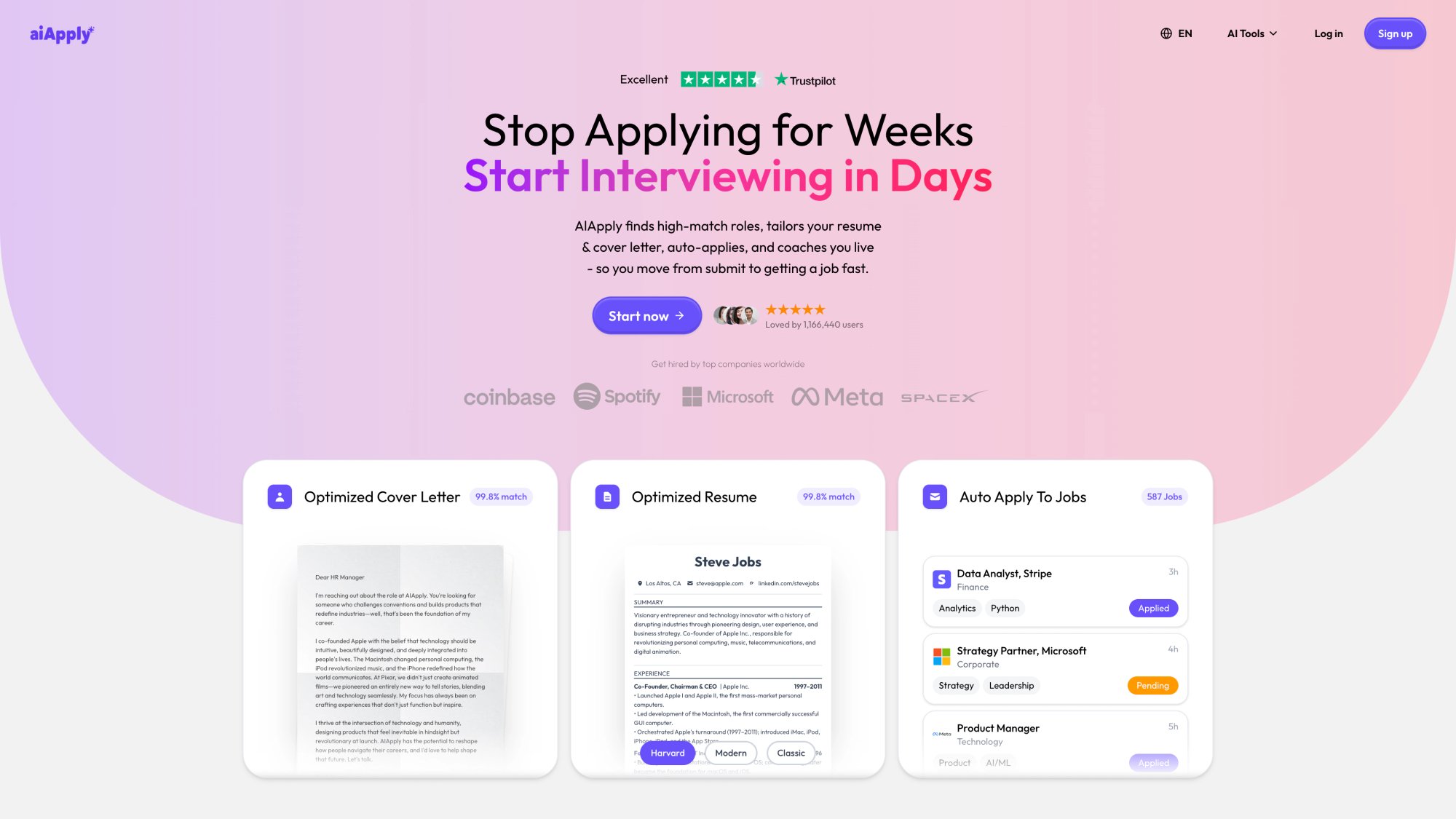
AIApply brings together resume building, cover letter generation, mock interview practice, and auto-apply in a single platform — so every insight you gather from an informational interview can move straight into action.
What Makes a Good Informational Interview Question?
A good question does at least one of three things: it reveals reality, surfaces evidence, or opens a next step.
Bad questions usually fail in two ways. They're too searchable (which wastes the other person's time) or too vague (which gets you generic advice you could've found anywhere). Good questions are open-ended, specific, and tied to a decision you actually need to make. Career guidance on this is consistent: the point is to learn and build connection, not collect yes-or-no answers.
A quick reality check before you read the list: don't ask all 50 questions.
For a typical 20 to 30 minute conversation, 6 to 10 questions is plenty. Start broad, get specific, and end with next steps. A strong informational interview should leave you with three things:
① One belief that changed
② One concrete action to take
③ One new person to talk to
Walk away with those three, and the conversation was a success.

10 Best Informational Interview Questions for a Short Meeting
If you're short on time or just want the strongest questions to start with, these 10 consistently produce the most useful answers:
How did you get into this line of work?
What does a normal day or week actually look like?
What part of the job looks different from the outside than it feels on the inside?
What skills matter most in this role right now?
When you see people get hired, what evidence usually convinces the team?
What do people underestimate about breaking into this field?
What are the most common mistakes early-career people make here?
What changes in the industry are affecting this role most right now?
Based on what you've heard about my background, what would you improve first?
Is there anyone else you think I should talk to?

Customize based on your goal. If you're exploring a new role, lean toward questions about day-to-day reality, skills, and common mistakes (questions 7, 8, 12, 15, 21, 23, 36, and 47 from the full list). If you're targeting a specific company, focus on culture, hiring signals, and internal dynamics (4, 17, 18, 29, 31, 33, 35, 47). If you're navigating a career change, prioritize transferable skills and realistic bridge steps (5, 19, 21, 42, 43, 44, 46, 49).
Use the exact wording only as a starting point. Replace "this role" with your target function, company, or industry, and make it sound like you.
The Complete List of 50 Informational Interview Questions
The full list below pulls together the strongest recurring themes from recent 2025-2026 guidance from university career centers and job search resources, then pushes them further by focusing on what each question actually helps you learn.

Opening Questions to Start Strong
1. How did you get into this kind of work?
This gets people telling a story, and stories reveal the real entry path, not the neat version on their LinkedIn.
2. What were you doing right before this role, and what pushed you toward this move?
Great for understanding transitions that are actually possible, not just theoretical career pivots. If you're mid-transition yourself, our guide on how to pivot careers can help you frame your own story once you've gathered enough insider context.
3. Looking back, what part of your background helped you more than you expected?
This uncovers transferable strengths you may already have but haven't thought to highlight.
4. What made you choose this company or team over other options?
Useful when you're targeting the same employer or comparing companies. Their decision criteria will tell you a lot about what the company actually offers versus what its careers page says.
5. When people misunderstand your role, what do they usually get wrong?
Excellent for clearing up false assumptions quickly. Almost every role has a public-facing misconception, and this question surfaces it in seconds.
6. What would surprise someone new about how this role creates value for the company?
This helps you understand how the work connects to outcomes that matter, which is exactly the framing you want for your own resume and cover letter later.
Questions About Day-to-Day Reality
7. What does a normal day look like when nothing is on fire?
This gets you the baseline version of the job. Not just the exciting crisis mode that shows up in job descriptions.
8. What does a busy or high-pressure week look like?
Helpful for understanding pace, deadlines, and the kind of stress you'd actually be signing up for.
9. Which part of the job takes more time than outsiders expect?
This exposes invisible work: the meetings, the admin, the documentation, the things nobody puts on a job posting.
10. What part of the work is most energizing for you?
Good for measuring fit. If the parts they love are the parts you dread, that's a useful signal.
11. What part is most draining, repetitive, or frustrating?
Every role has a tax. You want to know what it is before you chase it. If their "draining" is your "don't mind," that's a strong compatibility indicator.
12. What problems are you trusted to solve in this role?
This tells you what the job is in terms of outcomes, which is how strong candidates think about work. It's also the kind of language you can borrow for your own applications.
13. How do you know you had a good week in this role?
A smart way to surface performance signals without asking for a formal KPI sheet.
14. Where do people usually struggle in their first six months?
This shows you what reality shocks new hires, and gives you something concrete to prepare for.
Questions About Skills, Hiring, and Breaking In
15. What skills matter most in this role right now?
Start here if you're trying to build a sharper preparation plan. The word "right now" forces a current answer, not something recycled from three years ago. Once you know what skills matter, check out the skills required for product managers or the specific role you're targeting to see how your experience compares.
16. Which of those skills are easiest to learn from courses or books, and which only really grow on the job?
This helps you avoid the trap of trying to solve everything with more online content. Some things genuinely require reps.
17. When you see people get hired, what evidence usually convinces the team?
One of the best questions in a skills-based market because it gets at proof, not buzzwords. You're asking what makes hiring managers actually believe someone can do the work.
18. What separates average applicants from the people who really stand out?
Strong for uncovering patterns in judgment that you won't find in any job posting. For a complementary perspective from the hiring manager's side, our guide to questions to ask hiring managers shows you how this dynamic works in both directions.
19. What experiences, projects, or signals make someone look ready even before they have the exact title?
Perfect for career changers and early-career candidates who need to know what "close enough" looks like.
20. Which tools, workflows, or technical habits should a newcomer learn first?
Helps you sequence your preparation instead of trying to learn everything at once. Priorities from an insider are worth more than any "top 10 skills" article.
21. What do people underestimate about breaking into this field?
This often surfaces the hidden bottleneck, the thing that doesn't show up in job descriptions but trips people up constantly.
22. If you were screening entry-level candidates today, what would make you think, "This person gets it"?
This invites the person to reveal the mental model behind hiring decisions. It's basically asking them to show you the rubric.

Questions About Career Path and Growth
23. What does progression usually look like from this role over the next two to five years?
Useful for seeing whether the path actually goes where you want, or whether you'd plateau after 18 months. Our career development plan guide can help you map out what you learn here into a concrete roadmap.
24. What are the most common mistakes early-career people make in this work?
This helps you fail on paper instead of in real life. People love answering this question, and the answers are usually very specific.
25. What did you have to get good at to move to your current level?
Great for understanding the jump from beginner to trusted operator. The gap is rarely just "more experience."
26. At what point do people plateau in this field, and why?
This tells you what ceilings look like before you hit them, and sometimes reveals that the ceiling is actually a deliberate choice people make.
27. Which moves tend to accelerate growth here?
Ask this when you want an edge, not just survival. The answers often include things like cross-functional projects, specific certifications, or geographic moves.
28. If you could redo your first two years in this industry, what would you do differently?
This often produces the most honest, most practical advice of the whole conversation. People wish they'd had someone ask them this earlier.
Questions About Team, Company, and Culture
29. How would you describe the team culture when work gets stressful?
Culture shows up most clearly under pressure, not during the holiday party. This question cuts through the employer branding straight to lived experience.
30. What traits make someone effective on your team beyond the job description?
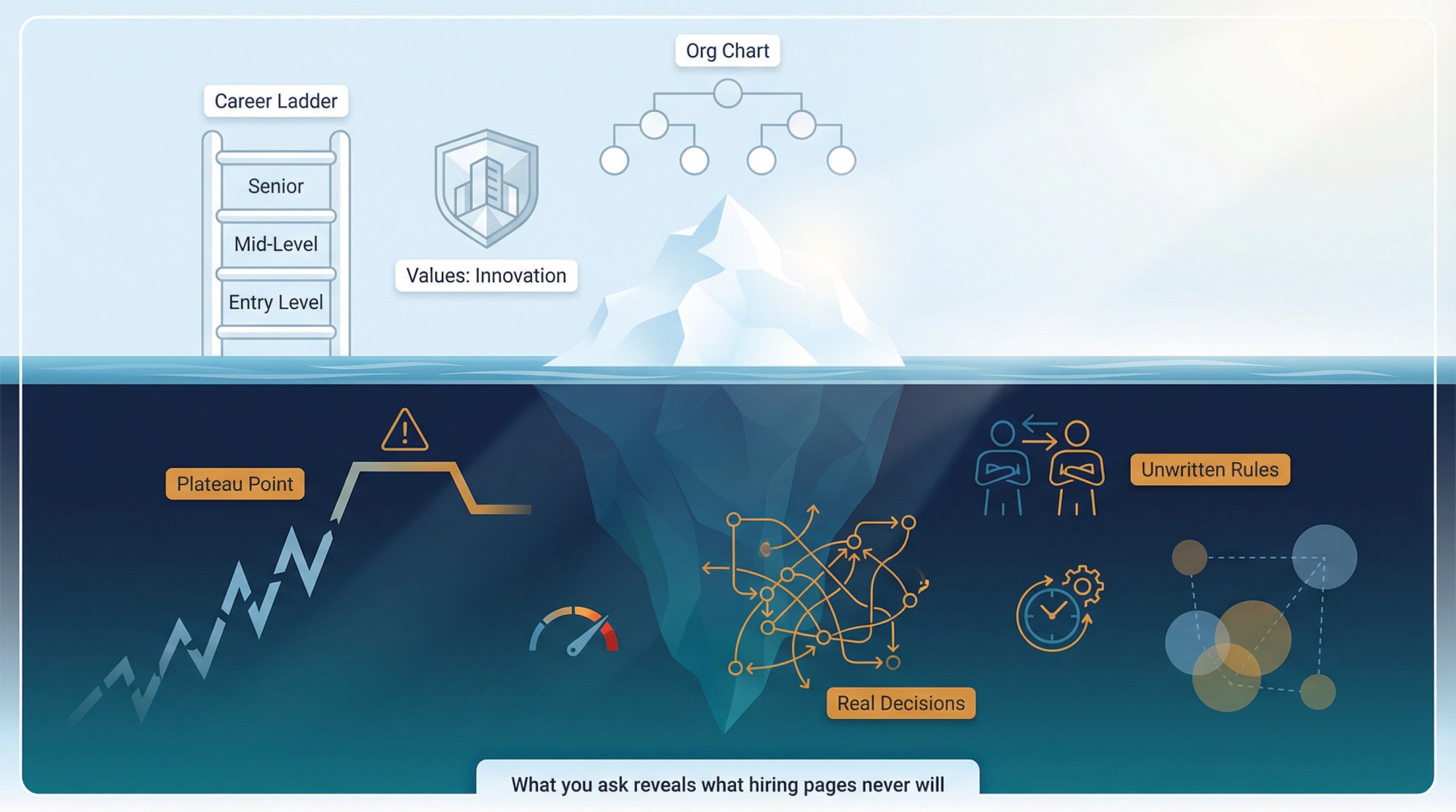
This gets at unwritten rules. Maybe it's deep Slack fluency, or knowing when to speak up in meetings, or being comfortable with ambiguity. You won't find this on Glassdoor.
31. What does this company reward that outsiders might miss?
Good for spotting cultural reality rather than brand messaging. If the company says "innovation" but actually rewards consistency, this question will reveal it.
32. Where do new hires usually struggle to adapt here?
Strong for uncovering the real learning curve, not the one in the onboarding deck.
33. How are decisions really made on your team or in your company?
This tells you a lot about politics, speed, and autonomy. Some companies say "flat hierarchy" and mean it. Others say it and absolutely don't.
34. What is the relationship between this role and neighboring teams?
Helpful for understanding collaboration, dependencies, and friction. If the role lives at the intersection of two departments that don't get along, you want to know that going in.
35. When people compare roles in this field, what tends to drive differences in compensation and growth?
The smart version of a salary question, because it asks about the market, not their personal number. You're gathering intelligence, not asking them to share their paycheck. To benchmark what you learn, you can look up product manager salaries or the salary range for whatever role you're targeting.
Questions About Industry Trends and Staying Relevant

36. What changes in the industry are affecting this role most right now?
This keeps your research current instead of frozen in last year's assumptions.
37. Which skills are becoming more valuable, and which are becoming less valuable?
Great for avoiding dead-end effort. If they tell you the skill you planned to learn is declining, that's a conversation that just saved you months.
38. What do you think will feel different about this job two years from now?
This surfaces future-readiness, not just present-day requirements.
39. Where do you see demand growing inside this function or industry?
Useful for choosing where to specialize rather than spreading yourself across everything.
40. What signals tell you a company or team is ahead of the curve?
Helpful when you're comparing employers and want to assess which ones are investing in the future.
41. If a smart beginner wanted to stay relevant, what would you tell them to keep learning?
Strong because it forces a practical answer. You're asking for a reading list and action plan, not a motivational speech.
Questions for Career Changers, Students, and New Grads
42. If someone is coming from a different background, what part of their experience can usually transfer well?
This helps you stop underselling your existing experience. Career changers consistently undervalue what they already bring. If you're making a transition, our best jobs for career change guide shows which fields are most welcoming to people pivoting from other backgrounds.
43. What would you recommend to someone who has interest but not direct experience yet?
Great for uncovering realistic bridge steps: the freelance projects, the volunteer work, the portfolio pieces that actually move the needle.
44. What is the best low-risk way to test whether this field is actually a fit?
This can save you from expensive, time-consuming mistakes. A two-week experiment is better than a two-year commitment you regret.
45. For students or new grads, what matters most here right now: internships, projects, portfolio, referrals, coursework, or something else?
One of the most practical prioritization questions you can ask, because it forces them to rank what actually moves the needle rather than giving you a generic "everything matters" answer. Students can get a head start on their materials with AIApply's student tools, which include resume and cover letter builders designed specifically for early-career candidates.
46. What is one credible first step someone could take in the next 30 days?
Useful because it forces advice into action. If you can't do something with the answer in the next month, the advice wasn't specific enough.
Closing Questions to Build Momentum
47. Is there anyone else you think I should talk to for a different perspective?
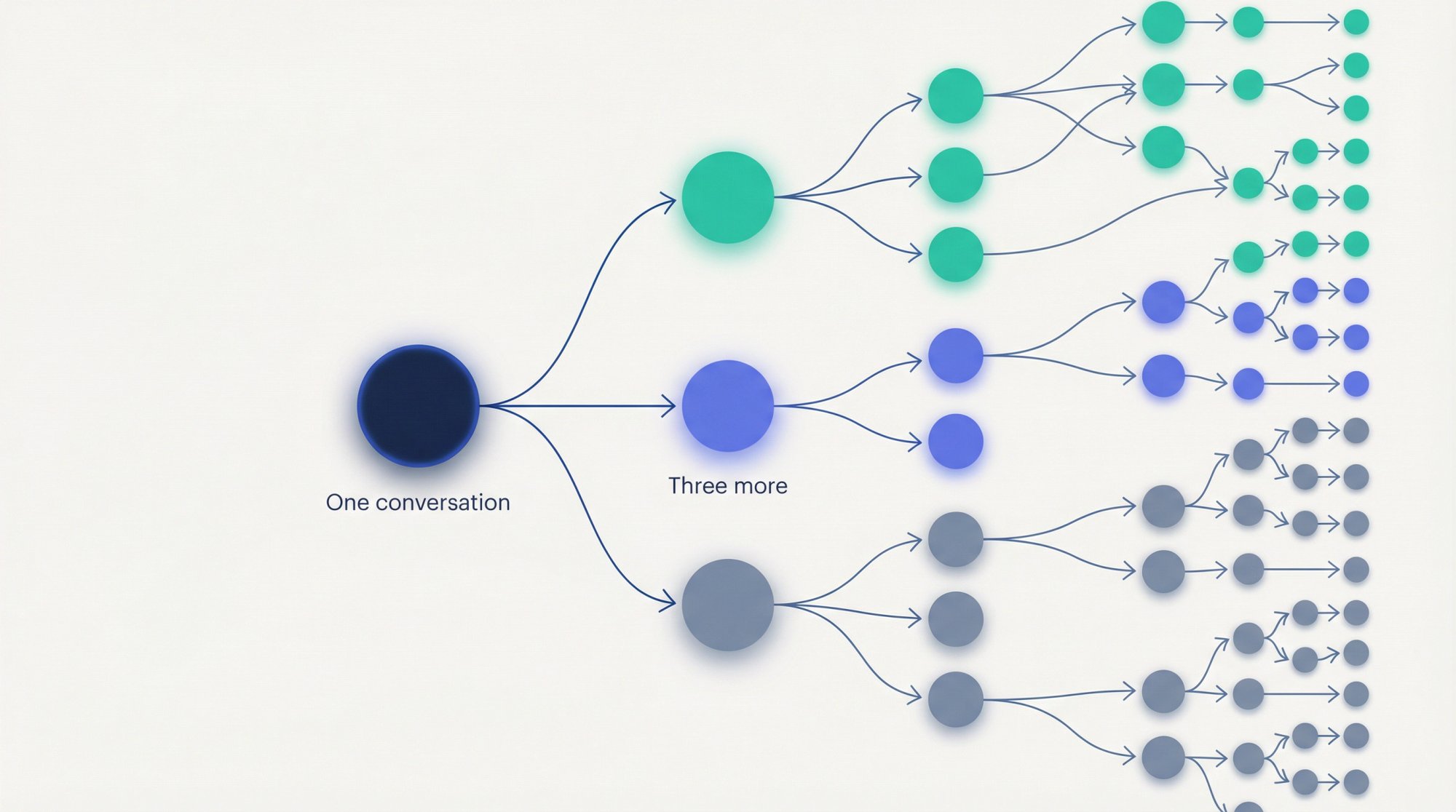
One of the highest-value questions in this entire guide. Career resources at MIT, NYU, and UC Riverside all emphasize referral-style questions, and UC Riverside's guide explicitly says to always ask them. One conversation that leads to three more conversations is how real networks get built.
48. What question do you wish more people asked about this work?
This often produces the most original answer of the whole conversation, because it lets them share something they actually want to talk about.
49. Based on what you've heard about my background, what would you improve first?
Great for turning vague encouragement into usable feedback. Most people will sugarcoat things unless you give them explicit permission to be direct. When you take that feedback and apply it to your resume, our AI Resume Rewriter can help you quickly incorporate the specific language and framing they suggest.
50. Would it be alright if I kept you posted on what I do with your advice?
A light, respectful way to keep the relationship alive. It signals that you're going to act on what they said, which makes them more likely to stay engaged.
Follow-Up Prompts That Get You Deeper Answers
Sometimes you'll ask a question and get a surface-level answer. That's normal. These four prompts help you go deeper without making the conversation feel like an interrogation:
→ "Could you give me a concrete example?"
→ "What did that look like in practice?"
→ "How would someone new notice that early?"
→ "Has that changed in the last year or two?"

Use them sparingly. The goal is to deepen the best parts of the conversation, not to press on every answer. When someone lights up about a topic, that's your cue to follow up.
What Not to Ask in an Informational Interview
Some questions fail because they're rude. Others fail because they expose the wrong goal. Here are five to avoid, and what to ask instead.
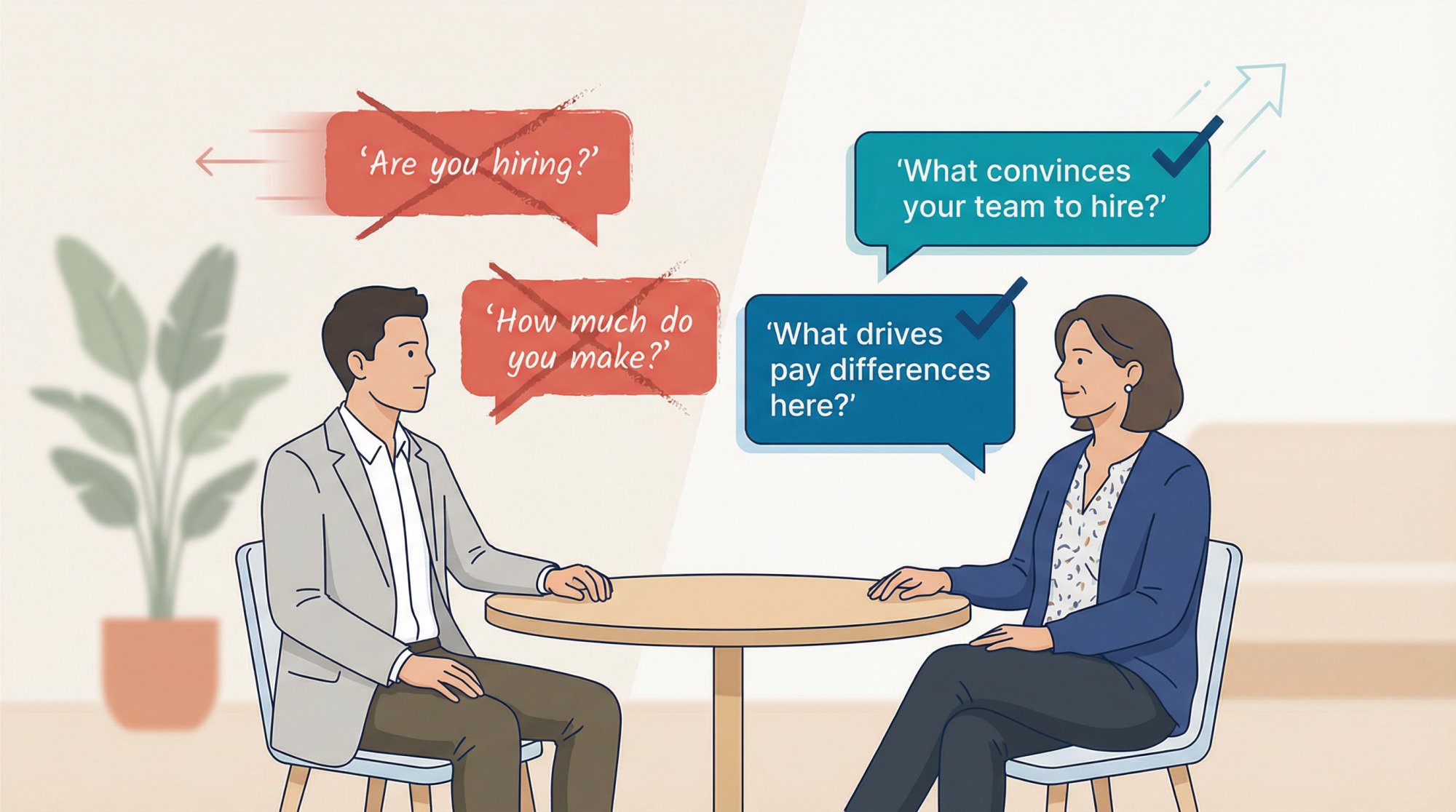
"Are you hiring?"
Current career-center guidance is blunt on this. Informational interviews are for learning, not for turning the conversation into a disguised job ask. That doesn't mean a job can never come out of it. It means you shouldn't lead with that agenda.
"How much money do you make?"
Too personal. Berkeley's guidance suggests asking about typical salary ranges for the field after doing research, not their personal compensation.
Anything you could answer with a five-second search
UC Riverside's 2025 guide specifically warns against asking for information that's already easy to find online. Use the conversation for judgment, nuance, and lived reality.
Questions that are really just self-promotion in disguise
Example: "I got a 4.0 and led three clubs. Do you think that makes me a strong candidate?" That isn't curiosity. It's a pitch. UC Riverside warns against this directly.
Gossip questions
Career advisors consistently warn against asking about their relationship with their boss, coworkers, or other personal boundary-crossing topics. Keep it professional.
Simple rule: Replace blunt questions with smarter versions. Instead of "Are you hiring?" ask question 17 or 22. Instead of "How much do you make?" ask question 35. Instead of "What does your company do?" ask question 31 or 33.
| Bad Question | Why It Fails | Smarter Alternative |
|---|---|---|
| "Are you hiring?" | Makes it transactional | Q17: "What evidence convinces the team to hire?" |
| "How much do you make?" | Too personal | Q35: "What drives compensation differences?" |
| "What does your company do?" | Shows zero research | Q31: "What does this company reward that outsiders miss?" |
| "I have a 4.0 GPA, am I qualified?" | Self-promotion, not curiosity | Q49: "What would you improve first about my background?" |
| "What's your boss like?" | Gossip territory | Q29: "How would you describe team culture under stress?" |
How to Structure a 30-Minute Informational Interview
Recent guidance from Berkeley, UCI, USC, and UMGC is pretty aligned on the basics: research the person first, be clear that you want perspective rather than a job, keep the meeting within the time you requested, and follow up quickly after.
Here's a practical flow that keeps the conversation natural:
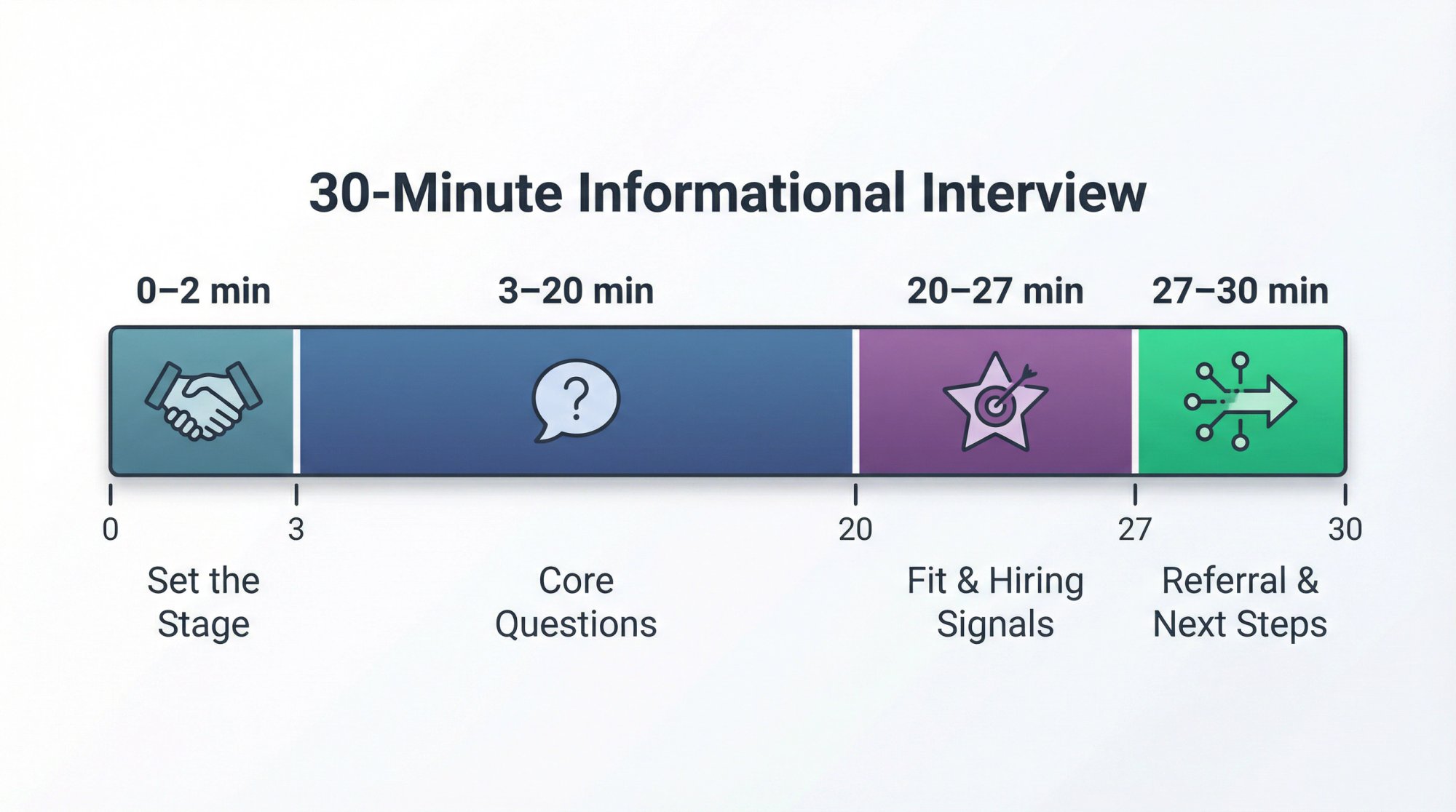
Minutes 0 to 2: Set the stage.
Thank them, state your goal, and show that you did your homework.
"Thanks again for making time. I'm exploring product marketing roles in B2B SaaS, and I was especially curious about your move from agency work into in-house growth."
Minutes 3 to 20: Ask your best 5 to 7 questions.
Start broad (questions 1-6 territory), then narrow toward specifics. Don't machine-gun the whole list. Follow interesting threads. If they mention something surprising, use one of the follow-up prompts to go deeper.
Minutes 20 to 27: Move into fit, advice, and hiring signals.
This is where questions 17, 22, 28, 45, and 49 do real work. You're now asking about what separates great candidates, what they'd do differently, and what you should work on.
Minutes 27 to 30: End with referral and follow-up questions.
Always leave time for question 47 ("Is there anyone else I should talk to?") and question 50 ("Would it be alright if I kept you posted?"). These two questions are what turn a one-off conversation into ongoing momentum.
How to Request an Informational Interview (With Template)
University career centers recommend keeping the ask short, respectful, and explicit that you're seeking information, not a job.
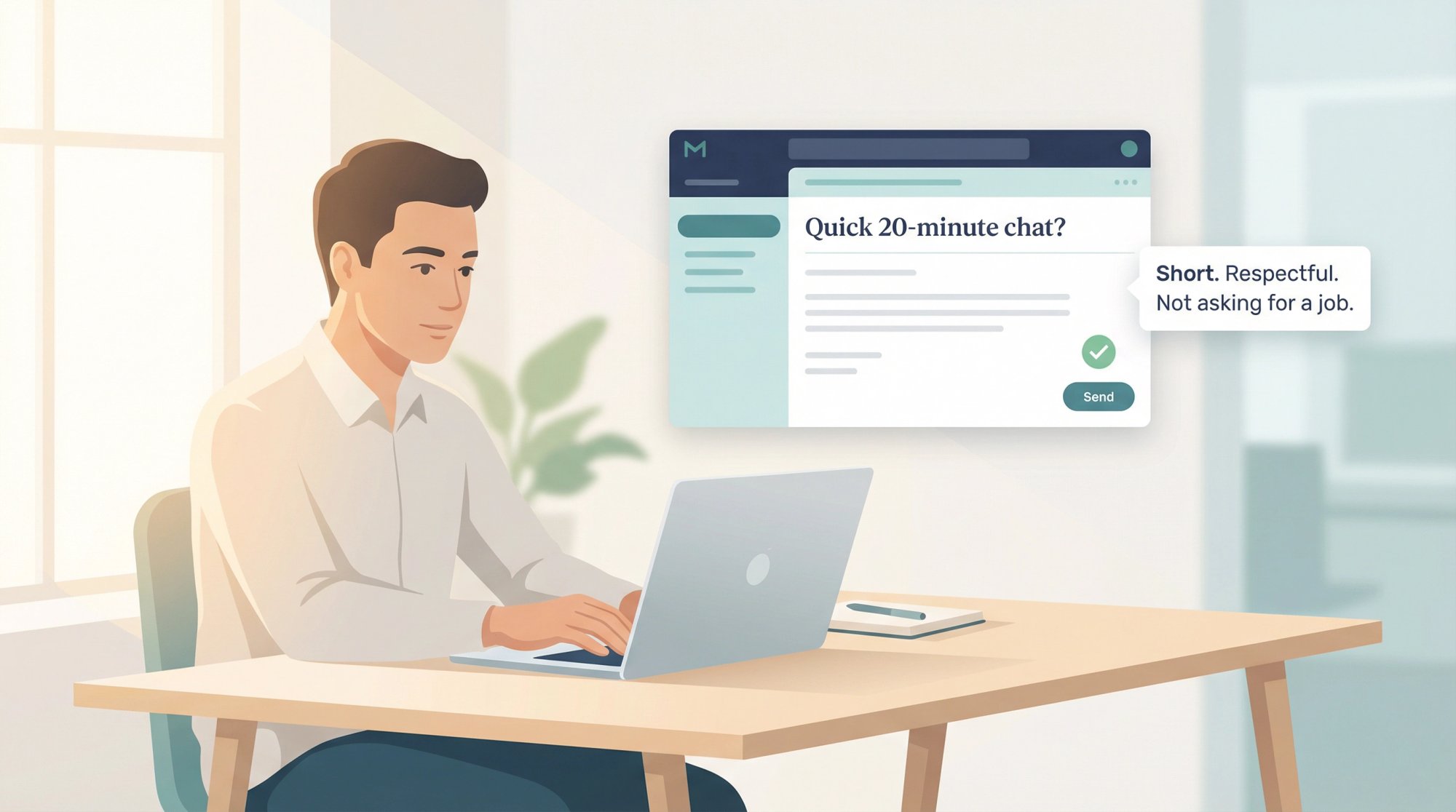
Here's a template that works:
Subject: Quick 20-minute chat about [role or field]?
Hi [Name],
I'm exploring [field or role], and your path from [relevant background] to [current role] caught my attention. I'm not reaching out to ask for a job. I'd love to ask a few questions about what the work is really like and what skills matter most right now.
If you're open to it, I'd be grateful for a 20-minute conversation sometime next week. I'm happy to work around your schedule.
Thanks,
[Your Name]
If you want to speed up the process, our free Networking Email Generator drafts a personalized networking email and subject line based on your goal. You type in the context, and it gives you a solid first draft in seconds. We also have a guide with professional email examples for networking and follow-up situations.
How to Write a Thank-You Email After an Informational Interview
Multiple career centers recommend sending a thank-you within 24 hours, and they all suggest mentioning one specific takeaway rather than sending a vague "thanks for your time."
Here's a template:
Subject: Thank you
Hi [Name],
Thanks again for speaking with me today. One point that really stuck with me was your advice about [specific insight].
Based on what you shared, I'm going to [specific action]. I also appreciated your suggestion to learn more about [team, skill, project, or contact].
Thanks again. I'll keep you posted on how it goes.
Best,
[Your Name]
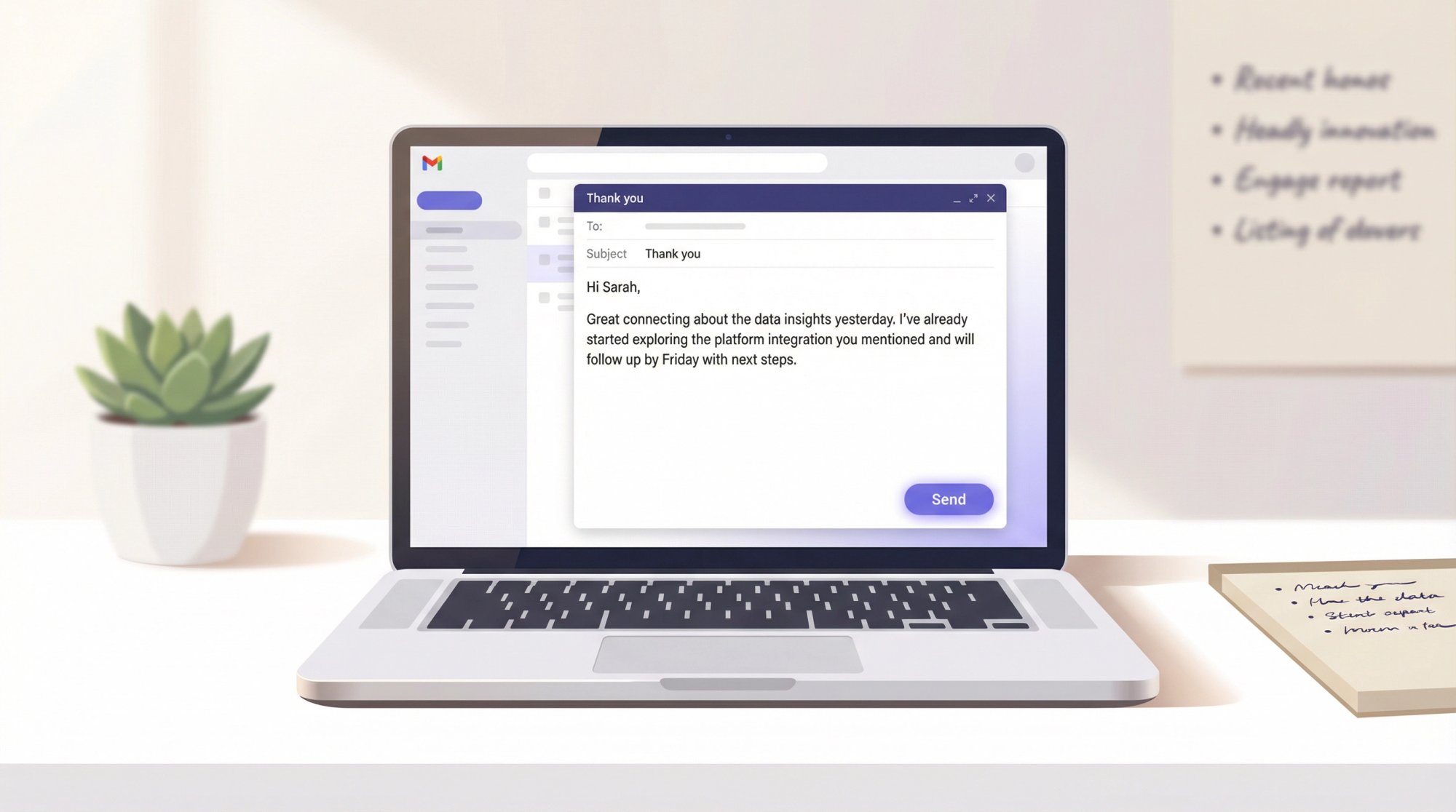
The key is specificity. Mentioning the exact advice that resonated shows you were actually listening, and it makes the person feel like their time was well spent. That's how you build the kind of relationship where they'll think of you when they hear about an opening. We've put together a practical guide to thank-you emails with current examples if you want to see more variations. You can also explore best practices for follow-up emails after an interview for templates that work across multiple stages of the job search.
Should You Bring Your Resume to an Informational Interview?
This is one area where the guidance is nuanced. UCI recommends bringing a resume copy, Berkeley suggests taking one but not leading with it, and NYU Wagner says not to offer it unless asked.
The best synthesis is simple: have it ready, but don't make it the center of the meeting. Share it if they ask, or if you reach a point in the conversation where targeted feedback would be genuinely useful, like after question 49 ("What would you improve first about my background?"). If you do share it, make sure it's polished. A messy resume at the wrong moment can undo the good impression you've been building. Our AI Resume Builder can help you create a clean, ATS-friendly version tailored to the specific role you're exploring, so you're always ready if the conversation leads there.
How to Turn Informational Interviews Into Better Applications
An informational interview isn't valuable because it felt good. It's valuable because it changes your next move.
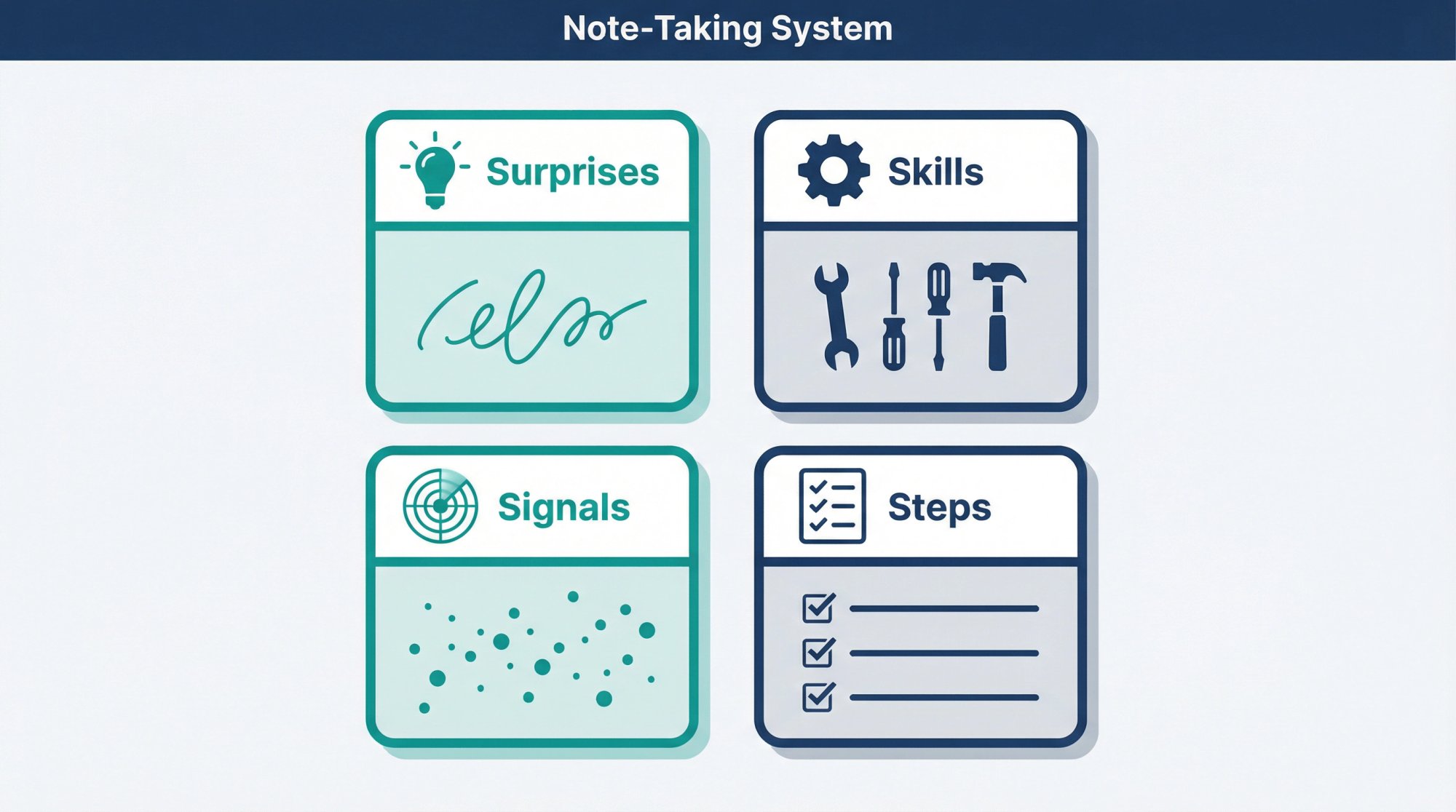
A Note-Taking System That Actually Works
Random bullet points don't cut it. Instead, use four buckets during (or right after) the conversation:
| Bucket | What to Capture | Example |
|---|---|---|
| Surprises | What changed your mind about the role or field? | "Didn't realize 60% of the work is stakeholder management" |
| Skills | What abilities kept coming up? | "SQL and storytelling with data mentioned three times" |
| Signals | What proof seemed to matter in hiring or performance? | "They value portfolio projects over certifications" |
| Steps | What will you do in the next 7 days? | "Reach out to the two people they recommended" |
This keeps the conversation from turning into passive note collection. Each bucket connects directly to an action you can take.
How to Apply What You Learn to Your Resume and Applications
Write down the exact phrases they used for problems, tools, and success signals. Then separate what's universal from what's specific to their company. If three different conversations mention stakeholder communication, experimentation, SQL, portfolio quality, or decision-making under ambiguity, and you have real examples of those things, they belong in your story.
Update your resume and LinkedIn with truthful evidence, not keyword stuffing. Our Resume Scanner lets you compare your resume against a target job description and spot keyword, formatting, and ATS gaps. It checks against 50+ ATS systems and it's free to use. Once you know what's missing, our Resume Builder can help you create ATS-friendly, job-specific versions that reflect what you've actually learned from these conversations.
And when those informational interviews lead to actual interview invitations (they often do), our Mock Interview Simulator lets you paste a job description and rehearse tailored questions with AI feedback. You can run a complete practice session in 15 to 30 minutes, get scored on your answers, and refine before the real thing.
Can AI Help You Prepare for Informational Interviews?
Yes, but use it as support, not as a mask.
NYU Wagner's October 2025 networking guide recommends using generative AI to draft outreach messages, identify shared context, tailor questions, and rehearse introductions. It also warns you to verify accuracy, protect privacy, and keep the interaction authentic. That's exactly the right boundary. Use AI to think better and prepare faster. Don't use it to sound fake.
That's where our tools can be genuinely useful. The Networking Email Generator is good for first drafts of outreach messages. Our free AI Interview Simulator helps you rehearse answers in a realistic setting, covering any role across all industries and experience levels. It gives you immediate feedback after each response and a comprehensive performance summary. And the Resume Scanner helps you translate what you learned from informational interviews into sharper job targeting by identifying keyword and formatting gaps.
The important thing is to use these tools for preparation, not performance. The informational interview itself should be a genuine conversation between two people, not a scripted exchange.
Frequently Asked Questions About Informational Interviews
How Many Questions Should I Ask in One Informational Interview?
For a 20 to 30 minute conversation, 6 to 10 is usually enough. UMGC's career guidance treats these as short meetings, and trying to force 20 questions into 25 minutes makes the interaction feel interrogative, not useful. Pick your best questions based on your goal, and let the conversation guide which ones you actually ask.
Can Informational Interviews Lead to Jobs?
Yes, sometimes. But don't treat them as a hidden application. Statistical data on converting an informational interview directly into a job offer is rare. The bigger value is learning faster, building genuine connection, and making smarter decisions with better information. Jobs sometimes follow, but they're a byproduct, not the point. When an opportunity does emerge, having a polished cover letter ready to send quickly can make all the difference.
Can You Ask About Salary in an Informational Interview?
You can ask about compensation carefully. Better phrasing is about market ranges and what drives variation across companies, levels, locations, bonus structures, or commissions. Don't ask the person for their personal salary number unless they volunteer it. Berkeley recommends researching ranges first and then asking if those ranges feel directionally right. You can also use our salary pages to benchmark market data before the conversation so you're already grounded in realistic numbers.
What Is the Single Most Important Question to End With?
Usually: "Is there anyone else you think I should talk to?" Referral questions are repeatedly recommended in career-center guidance because they turn one conversation into a network, not just a one-off interaction. This single question is responsible for more networking momentum than any other.
How Long Should an Informational Interview Last?
Request 20 minutes. Most people will say yes to 20 minutes, and the conversation often runs slightly longer naturally. If they seem engaged and willing to continue, it's fine to let it go to 30. But respect the time you originally asked for, and offer to wrap up at the 20-minute mark. Ending on time (or early) builds trust for future conversations.
What If the Person Doesn't Respond to My Outreach?
It happens. Don't take it personally. Send one polite follow-up about a week later, then move on. Some people are genuinely too busy, and others miss messages. If your initial outreach was clear, short, and respectful, you did everything right. Focus your energy on the people who do respond.
Should I Send an Informational Interview Request on LinkedIn or via Email?
Both work, but email tends to feel more professional and less crowded. If you can find their work email (or a personal email they've shared publicly), go with that. LinkedIn messages work well when you don't have their email, or when you share a mutual connection you can reference. Either way, keep the message short and make it clear you're seeking perspective, not asking for a job.
How Soon After an Informational Interview Should I Follow Up?
Send your thank-you email within 24 hours. Same day is ideal if the conversation happened in the morning or afternoon. Reference something specific they said, mention the action you plan to take, and thank them genuinely. Then, if you said you'd keep them posted, do it. A brief update a few weeks or months later keeps the relationship alive without being pushy. Our interview follow-up message guide has specific language for keeping conversations warm over time.
What Should I Do With My Notes After an Informational Interview?
Don't let them sit. Within 24 hours, review your four-bucket notes and identify one concrete action. If a new skill came up repeatedly, check the skills page for that role to understand what employers in that space are actually looking for. If specific resume gaps emerged, run your resume through our free Resume Scanner to identify what to fix before your next application.
Am I Ready for an Informational Interview If I'm a Student or New Grad?
Absolutely. In fact, informational interviews are especially powerful at the start of a career, when you have the most uncertainty and the most to gain from insider information. Entry-level interview preparation resources can also help you practice how you present yourself before and after these conversations. And if you're a student, AIApply's student plan includes a 40% discount on all premium tools, making it easy to act on what you learn without the full price tag.

Informational interviews don't require charisma or a perfect network. They require curiosity, a short list of sharp questions, and the discipline to turn answers into action.
The mistake most people make is treating these conversations like networking theater. Something to perform, check off, and move past. The better approach is to treat them like field research. Ask questions that uncover reality. Look for evidence. Notice patterns. End with next steps.
Then use what you learned to write a better resume, tell a better story, and aim at better opportunities. AIApply gives you the tools to do exactly that, from tailoring your resume and cover letter to rehearsing answers with our Mock Interview Simulator. That's how a 20-minute conversation with a stranger becomes one of the most valuable things you do in your entire job search.
An informational interview is one of the smartest, lowest-risk moves you can make in a job search. Instead of spending weeks guessing what a role, company, or industry is really like, you borrow 20 to 30 minutes from someone who already lives inside that world. You're not trying to impress them. You're not sneaking into the hiring process. You're reducing uncertainty, and that's incredibly valuable. Career centers at Berkeley, UCI, UC Riverside, UMGC, USC, MIT, and others consistently frame informational interviews this way: short, research-driven conversations meant to help you understand reality, not ask for a job.
Understanding that reality matters a lot right now. NACE's 2025 Student Survey found that the Class of 2025 submitted a median of 10 applications, up from 6 for the Class of 2024, while receiving fewer offers. Then NACE's February 2026 Job Outlook update reported that 70% of employers were using skills-based hiring. In plain English, sending more applications isn't cutting it anymore. You need sharper information about what teams actually value, and what evidence makes them believe a candidate is ready.
There's also a networking gap that doesn't get enough attention. A 2025 survey of 1,000 U.S. workers found that 54% said they'd landed a job through a connection, yet only 1 in 10 said they reached out to multiple contacts weekly. That gap isn't magic. It's mostly behavior.
This guide is built to help you close it. You'll get 50 tested informational interview questions, a framework for using them, templates for outreach and follow-up, and a system for turning what you learn into stronger applications and interviews. Tools like AIApply can help you act on what you learn by translating your new insights into polished, tailored application materials.
AIApply brings together resume building, cover letter generation, mock interview practice, and auto-apply in a single platform — so every insight you gather from an informational interview can move straight into action.
What Makes a Good Informational Interview Question?
A good question does at least one of three things: it reveals reality, surfaces evidence, or opens a next step.
Bad questions usually fail in two ways. They're too searchable (which wastes the other person's time) or too vague (which gets you generic advice you could've found anywhere). Good questions are open-ended, specific, and tied to a decision you actually need to make. Career guidance on this is consistent: the point is to learn and build connection, not collect yes-or-no answers.
A quick reality check before you read the list: don't ask all 50 questions.
For a typical 20 to 30 minute conversation, 6 to 10 questions is plenty. Start broad, get specific, and end with next steps. A strong informational interview should leave you with three things:
① One belief that changed
② One concrete action to take
③ One new person to talk to
Walk away with those three, and the conversation was a success.
10 Best Informational Interview Questions for a Short Meeting
If you're short on time or just want the strongest questions to start with, these 10 consistently produce the most useful answers:
How did you get into this line of work?
What does a normal day or week actually look like?
What part of the job looks different from the outside than it feels on the inside?
What skills matter most in this role right now?
When you see people get hired, what evidence usually convinces the team?
What do people underestimate about breaking into this field?
What are the most common mistakes early-career people make here?
What changes in the industry are affecting this role most right now?
Based on what you've heard about my background, what would you improve first?
Is there anyone else you think I should talk to?
Customize based on your goal. If you're exploring a new role, lean toward questions about day-to-day reality, skills, and common mistakes (questions 7, 8, 12, 15, 21, 23, 36, and 47 from the full list). If you're targeting a specific company, focus on culture, hiring signals, and internal dynamics (4, 17, 18, 29, 31, 33, 35, 47). If you're navigating a career change, prioritize transferable skills and realistic bridge steps (5, 19, 21, 42, 43, 44, 46, 49).
Use the exact wording only as a starting point. Replace "this role" with your target function, company, or industry, and make it sound like you.
The Complete List of 50 Informational Interview Questions
The full list below pulls together the strongest recurring themes from recent 2025-2026 guidance from university career centers and job search resources, then pushes them further by focusing on what each question actually helps you learn.
Opening Questions to Start Strong
1. How did you get into this kind of work?
This gets people telling a story, and stories reveal the real entry path, not the neat version on their LinkedIn.
2. What were you doing right before this role, and what pushed you toward this move?
Great for understanding transitions that are actually possible, not just theoretical career pivots. If you're mid-transition yourself, our guide on how to pivot careers can help you frame your own story once you've gathered enough insider context.
3. Looking back, what part of your background helped you more than you expected?
This uncovers transferable strengths you may already have but haven't thought to highlight.
4. What made you choose this company or team over other options?
Useful when you're targeting the same employer or comparing companies. Their decision criteria will tell you a lot about what the company actually offers versus what its careers page says.
5. When people misunderstand your role, what do they usually get wrong?
Excellent for clearing up false assumptions quickly. Almost every role has a public-facing misconception, and this question surfaces it in seconds.
6. What would surprise someone new about how this role creates value for the company?
This helps you understand how the work connects to outcomes that matter, which is exactly the framing you want for your own resume and cover letter later.
Questions About Day-to-Day Reality
7. What does a normal day look like when nothing is on fire?
This gets you the baseline version of the job. Not just the exciting crisis mode that shows up in job descriptions.
8. What does a busy or high-pressure week look like?
Helpful for understanding pace, deadlines, and the kind of stress you'd actually be signing up for.
9. Which part of the job takes more time than outsiders expect?
This exposes invisible work: the meetings, the admin, the documentation, the things nobody puts on a job posting.
10. What part of the work is most energizing for you?
Good for measuring fit. If the parts they love are the parts you dread, that's a useful signal.
11. What part is most draining, repetitive, or frustrating?
Every role has a tax. You want to know what it is before you chase it. If their "draining" is your "don't mind," that's a strong compatibility indicator.
12. What problems are you trusted to solve in this role?
This tells you what the job is in terms of outcomes, which is how strong candidates think about work. It's also the kind of language you can borrow for your own applications.
13. How do you know you had a good week in this role?
A smart way to surface performance signals without asking for a formal KPI sheet.
14. Where do people usually struggle in their first six months?
This shows you what reality shocks new hires, and gives you something concrete to prepare for.
Questions About Skills, Hiring, and Breaking In
15. What skills matter most in this role right now?
Start here if you're trying to build a sharper preparation plan. The word "right now" forces a current answer, not something recycled from three years ago. Once you know what skills matter, check out the skills required for product managers or the specific role you're targeting to see how your experience compares.
16. Which of those skills are easiest to learn from courses or books, and which only really grow on the job?
This helps you avoid the trap of trying to solve everything with more online content. Some things genuinely require reps.
17. When you see people get hired, what evidence usually convinces the team?
One of the best questions in a skills-based market because it gets at proof, not buzzwords. You're asking what makes hiring managers actually believe someone can do the work.
18. What separates average applicants from the people who really stand out?
Strong for uncovering patterns in judgment that you won't find in any job posting. For a complementary perspective from the hiring manager's side, our guide to questions to ask hiring managers shows you how this dynamic works in both directions.
19. What experiences, projects, or signals make someone look ready even before they have the exact title?
Perfect for career changers and early-career candidates who need to know what "close enough" looks like.
20. Which tools, workflows, or technical habits should a newcomer learn first?
Helps you sequence your preparation instead of trying to learn everything at once. Priorities from an insider are worth more than any "top 10 skills" article.
21. What do people underestimate about breaking into this field?
This often surfaces the hidden bottleneck, the thing that doesn't show up in job descriptions but trips people up constantly.
22. If you were screening entry-level candidates today, what would make you think, "This person gets it"?
This invites the person to reveal the mental model behind hiring decisions. It's basically asking them to show you the rubric.
Questions About Career Path and Growth
23. What does progression usually look like from this role over the next two to five years?
Useful for seeing whether the path actually goes where you want, or whether you'd plateau after 18 months. Our career development plan guide can help you map out what you learn here into a concrete roadmap.
24. What are the most common mistakes early-career people make in this work?
This helps you fail on paper instead of in real life. People love answering this question, and the answers are usually very specific.
25. What did you have to get good at to move to your current level?
Great for understanding the jump from beginner to trusted operator. The gap is rarely just "more experience."
26. At what point do people plateau in this field, and why?
This tells you what ceilings look like before you hit them, and sometimes reveals that the ceiling is actually a deliberate choice people make.
27. Which moves tend to accelerate growth here?
Ask this when you want an edge, not just survival. The answers often include things like cross-functional projects, specific certifications, or geographic moves.
28. If you could redo your first two years in this industry, what would you do differently?
This often produces the most honest, most practical advice of the whole conversation. People wish they'd had someone ask them this earlier.
Questions About Team, Company, and Culture
29. How would you describe the team culture when work gets stressful?
Culture shows up most clearly under pressure, not during the holiday party. This question cuts through the employer branding straight to lived experience.
30. What traits make someone effective on your team beyond the job description?
This gets at unwritten rules. Maybe it's deep Slack fluency, or knowing when to speak up in meetings, or being comfortable with ambiguity. You won't find this on Glassdoor.
31. What does this company reward that outsiders might miss?
Good for spotting cultural reality rather than brand messaging. If the company says "innovation" but actually rewards consistency, this question will reveal it.
32. Where do new hires usually struggle to adapt here?
Strong for uncovering the real learning curve, not the one in the onboarding deck.
33. How are decisions really made on your team or in your company?
This tells you a lot about politics, speed, and autonomy. Some companies say "flat hierarchy" and mean it. Others say it and absolutely don't.
34. What is the relationship between this role and neighboring teams?
Helpful for understanding collaboration, dependencies, and friction. If the role lives at the intersection of two departments that don't get along, you want to know that going in.
35. When people compare roles in this field, what tends to drive differences in compensation and growth?
The smart version of a salary question, because it asks about the market, not their personal number. You're gathering intelligence, not asking them to share their paycheck. To benchmark what you learn, you can look up product manager salaries or the salary range for whatever role you're targeting.
Questions About Industry Trends and Staying Relevant
36. What changes in the industry are affecting this role most right now?
This keeps your research current instead of frozen in last year's assumptions.
37. Which skills are becoming more valuable, and which are becoming less valuable?
Great for avoiding dead-end effort. If they tell you the skill you planned to learn is declining, that's a conversation that just saved you months.
38. What do you think will feel different about this job two years from now?
This surfaces future-readiness, not just present-day requirements.
39. Where do you see demand growing inside this function or industry?
Useful for choosing where to specialize rather than spreading yourself across everything.
40. What signals tell you a company or team is ahead of the curve?
Helpful when you're comparing employers and want to assess which ones are investing in the future.
41. If a smart beginner wanted to stay relevant, what would you tell them to keep learning?
Strong because it forces a practical answer. You're asking for a reading list and action plan, not a motivational speech.
Questions for Career Changers, Students, and New Grads
42. If someone is coming from a different background, what part of their experience can usually transfer well?
This helps you stop underselling your existing experience. Career changers consistently undervalue what they already bring. If you're making a transition, our best jobs for career change guide shows which fields are most welcoming to people pivoting from other backgrounds.
43. What would you recommend to someone who has interest but not direct experience yet?
Great for uncovering realistic bridge steps: the freelance projects, the volunteer work, the portfolio pieces that actually move the needle.
44. What is the best low-risk way to test whether this field is actually a fit?
This can save you from expensive, time-consuming mistakes. A two-week experiment is better than a two-year commitment you regret.
45. For students or new grads, what matters most here right now: internships, projects, portfolio, referrals, coursework, or something else?
One of the most practical prioritization questions you can ask, because it forces them to rank what actually moves the needle rather than giving you a generic "everything matters" answer. Students can get a head start on their materials with AIApply's student tools, which include resume and cover letter builders designed specifically for early-career candidates.
46. What is one credible first step someone could take in the next 30 days?
Useful because it forces advice into action. If you can't do something with the answer in the next month, the advice wasn't specific enough.
Closing Questions to Build Momentum
47. Is there anyone else you think I should talk to for a different perspective?
One of the highest-value questions in this entire guide. Career resources at MIT, NYU, and UC Riverside all emphasize referral-style questions, and UC Riverside's guide explicitly says to always ask them. One conversation that leads to three more conversations is how real networks get built.
48. What question do you wish more people asked about this work?
This often produces the most original answer of the whole conversation, because it lets them share something they actually want to talk about.
49. Based on what you've heard about my background, what would you improve first?
Great for turning vague encouragement into usable feedback. Most people will sugarcoat things unless you give them explicit permission to be direct. When you take that feedback and apply it to your resume, our AI Resume Rewriter can help you quickly incorporate the specific language and framing they suggest.
50. Would it be alright if I kept you posted on what I do with your advice?
A light, respectful way to keep the relationship alive. It signals that you're going to act on what they said, which makes them more likely to stay engaged.
Follow-Up Prompts That Get You Deeper Answers
Sometimes you'll ask a question and get a surface-level answer. That's normal. These four prompts help you go deeper without making the conversation feel like an interrogation:
→ "Could you give me a concrete example?"
→ "What did that look like in practice?"
→ "How would someone new notice that early?"
→ "Has that changed in the last year or two?"
Use them sparingly. The goal is to deepen the best parts of the conversation, not to press on every answer. When someone lights up about a topic, that's your cue to follow up.
What Not to Ask in an Informational Interview
Some questions fail because they're rude. Others fail because they expose the wrong goal. Here are five to avoid, and what to ask instead.
"Are you hiring?"
Current career-center guidance is blunt on this. Informational interviews are for learning, not for turning the conversation into a disguised job ask. That doesn't mean a job can never come out of it. It means you shouldn't lead with that agenda.
"How much money do you make?"
Too personal. Berkeley's guidance suggests asking about typical salary ranges for the field after doing research, not their personal compensation.
Anything you could answer with a five-second search
UC Riverside's 2025 guide specifically warns against asking for information that's already easy to find online. Use the conversation for judgment, nuance, and lived reality.
Questions that are really just self-promotion in disguise
Example: "I got a 4.0 and led three clubs. Do you think that makes me a strong candidate?" That isn't curiosity. It's a pitch. UC Riverside warns against this directly.
Gossip questions
Career advisors consistently warn against asking about their relationship with their boss, coworkers, or other personal boundary-crossing topics. Keep it professional.
Simple rule: Replace blunt questions with smarter versions. Instead of "Are you hiring?" ask question 17 or 22. Instead of "How much do you make?" ask question 35. Instead of "What does your company do?" ask question 31 or 33.
| Bad Question | Why It Fails | Smarter Alternative |
|---|---|---|
| "Are you hiring?" | Makes it transactional | Q17: "What evidence convinces the team to hire?" |
| "How much do you make?" | Too personal | Q35: "What drives compensation differences?" |
| "What does your company do?" | Shows zero research | Q31: "What does this company reward that outsiders miss?" |
| "I have a 4.0 GPA, am I qualified?" | Self-promotion, not curiosity | Q49: "What would you improve first about my background?" |
| "What's your boss like?" | Gossip territory | Q29: "How would you describe team culture under stress?" |
How to Structure a 30-Minute Informational Interview
Recent guidance from Berkeley, UCI, USC, and UMGC is pretty aligned on the basics: research the person first, be clear that you want perspective rather than a job, keep the meeting within the time you requested, and follow up quickly after.
Here's a practical flow that keeps the conversation natural:
Minutes 0 to 2: Set the stage.
Thank them, state your goal, and show that you did your homework.
"Thanks again for making time. I'm exploring product marketing roles in B2B SaaS, and I was especially curious about your move from agency work into in-house growth."
Minutes 3 to 20: Ask your best 5 to 7 questions.
Start broad (questions 1-6 territory), then narrow toward specifics. Don't machine-gun the whole list. Follow interesting threads. If they mention something surprising, use one of the follow-up prompts to go deeper.
Minutes 20 to 27: Move into fit, advice, and hiring signals.
This is where questions 17, 22, 28, 45, and 49 do real work. You're now asking about what separates great candidates, what they'd do differently, and what you should work on.
Minutes 27 to 30: End with referral and follow-up questions.
Always leave time for question 47 ("Is there anyone else I should talk to?") and question 50 ("Would it be alright if I kept you posted?"). These two questions are what turn a one-off conversation into ongoing momentum.
How to Request an Informational Interview (With Template)
University career centers recommend keeping the ask short, respectful, and explicit that you're seeking information, not a job.
Here's a template that works:
Subject: Quick 20-minute chat about [role or field]?
Hi [Name],
I'm exploring [field or role], and your path from [relevant background] to [current role] caught my attention. I'm not reaching out to ask for a job. I'd love to ask a few questions about what the work is really like and what skills matter most right now.
If you're open to it, I'd be grateful for a 20-minute conversation sometime next week. I'm happy to work around your schedule.
Thanks,
[Your Name]
If you want to speed up the process, our free Networking Email Generator drafts a personalized networking email and subject line based on your goal. You type in the context, and it gives you a solid first draft in seconds. We also have a guide with professional email examples for networking and follow-up situations.
How to Write a Thank-You Email After an Informational Interview
Multiple career centers recommend sending a thank-you within 24 hours, and they all suggest mentioning one specific takeaway rather than sending a vague "thanks for your time."
Here's a template:
Subject: Thank you
Hi [Name],
Thanks again for speaking with me today. One point that really stuck with me was your advice about [specific insight].
Based on what you shared, I'm going to [specific action]. I also appreciated your suggestion to learn more about [team, skill, project, or contact].
Thanks again. I'll keep you posted on how it goes.
Best,
[Your Name]
The key is specificity. Mentioning the exact advice that resonated shows you were actually listening, and it makes the person feel like their time was well spent. That's how you build the kind of relationship where they'll think of you when they hear about an opening. We've put together a practical guide to thank-you emails with current examples if you want to see more variations. You can also explore best practices for follow-up emails after an interview for templates that work across multiple stages of the job search.
Should You Bring Your Resume to an Informational Interview?
This is one area where the guidance is nuanced. UCI recommends bringing a resume copy, Berkeley suggests taking one but not leading with it, and NYU Wagner says not to offer it unless asked.
The best synthesis is simple: have it ready, but don't make it the center of the meeting. Share it if they ask, or if you reach a point in the conversation where targeted feedback would be genuinely useful, like after question 49 ("What would you improve first about my background?"). If you do share it, make sure it's polished. A messy resume at the wrong moment can undo the good impression you've been building. Our AI Resume Builder can help you create a clean, ATS-friendly version tailored to the specific role you're exploring, so you're always ready if the conversation leads there.
How to Turn Informational Interviews Into Better Applications
An informational interview isn't valuable because it felt good. It's valuable because it changes your next move.
A Note-Taking System That Actually Works
Random bullet points don't cut it. Instead, use four buckets during (or right after) the conversation:
| Bucket | What to Capture | Example |
|---|---|---|
| Surprises | What changed your mind about the role or field? | "Didn't realize 60% of the work is stakeholder management" |
| Skills | What abilities kept coming up? | "SQL and storytelling with data mentioned three times" |
| Signals | What proof seemed to matter in hiring or performance? | "They value portfolio projects over certifications" |
| Steps | What will you do in the next 7 days? | "Reach out to the two people they recommended" |
This keeps the conversation from turning into passive note collection. Each bucket connects directly to an action you can take.
How to Apply What You Learn to Your Resume and Applications
Write down the exact phrases they used for problems, tools, and success signals. Then separate what's universal from what's specific to their company. If three different conversations mention stakeholder communication, experimentation, SQL, portfolio quality, or decision-making under ambiguity, and you have real examples of those things, they belong in your story.
Update your resume and LinkedIn with truthful evidence, not keyword stuffing. Our Resume Scanner lets you compare your resume against a target job description and spot keyword, formatting, and ATS gaps. It checks against 50+ ATS systems and it's free to use. Once you know what's missing, our Resume Builder can help you create ATS-friendly, job-specific versions that reflect what you've actually learned from these conversations.
And when those informational interviews lead to actual interview invitations (they often do), our Mock Interview Simulator lets you paste a job description and rehearse tailored questions with AI feedback. You can run a complete practice session in 15 to 30 minutes, get scored on your answers, and refine before the real thing.
Can AI Help You Prepare for Informational Interviews?
Yes, but use it as support, not as a mask.
NYU Wagner's October 2025 networking guide recommends using generative AI to draft outreach messages, identify shared context, tailor questions, and rehearse introductions. It also warns you to verify accuracy, protect privacy, and keep the interaction authentic. That's exactly the right boundary. Use AI to think better and prepare faster. Don't use it to sound fake.
That's where our tools can be genuinely useful. The Networking Email Generator is good for first drafts of outreach messages. Our free AI Interview Simulator helps you rehearse answers in a realistic setting, covering any role across all industries and experience levels. It gives you immediate feedback after each response and a comprehensive performance summary. And the Resume Scanner helps you translate what you learned from informational interviews into sharper job targeting by identifying keyword and formatting gaps.
The important thing is to use these tools for preparation, not performance. The informational interview itself should be a genuine conversation between two people, not a scripted exchange.
Frequently Asked Questions About Informational Interviews
How Many Questions Should I Ask in One Informational Interview?
For a 20 to 30 minute conversation, 6 to 10 is usually enough. UMGC's career guidance treats these as short meetings, and trying to force 20 questions into 25 minutes makes the interaction feel interrogative, not useful. Pick your best questions based on your goal, and let the conversation guide which ones you actually ask.
Can Informational Interviews Lead to Jobs?
Yes, sometimes. But don't treat them as a hidden application. Statistical data on converting an informational interview directly into a job offer is rare. The bigger value is learning faster, building genuine connection, and making smarter decisions with better information. Jobs sometimes follow, but they're a byproduct, not the point. When an opportunity does emerge, having a polished cover letter ready to send quickly can make all the difference.
Can You Ask About Salary in an Informational Interview?
You can ask about compensation carefully. Better phrasing is about market ranges and what drives variation across companies, levels, locations, bonus structures, or commissions. Don't ask the person for their personal salary number unless they volunteer it. Berkeley recommends researching ranges first and then asking if those ranges feel directionally right. You can also use our salary pages to benchmark market data before the conversation so you're already grounded in realistic numbers.
What Is the Single Most Important Question to End With?
Usually: "Is there anyone else you think I should talk to?" Referral questions are repeatedly recommended in career-center guidance because they turn one conversation into a network, not just a one-off interaction. This single question is responsible for more networking momentum than any other.
How Long Should an Informational Interview Last?
Request 20 minutes. Most people will say yes to 20 minutes, and the conversation often runs slightly longer naturally. If they seem engaged and willing to continue, it's fine to let it go to 30. But respect the time you originally asked for, and offer to wrap up at the 20-minute mark. Ending on time (or early) builds trust for future conversations.
What If the Person Doesn't Respond to My Outreach?
It happens. Don't take it personally. Send one polite follow-up about a week later, then move on. Some people are genuinely too busy, and others miss messages. If your initial outreach was clear, short, and respectful, you did everything right. Focus your energy on the people who do respond.
Should I Send an Informational Interview Request on LinkedIn or via Email?
Both work, but email tends to feel more professional and less crowded. If you can find their work email (or a personal email they've shared publicly), go with that. LinkedIn messages work well when you don't have their email, or when you share a mutual connection you can reference. Either way, keep the message short and make it clear you're seeking perspective, not asking for a job.
How Soon After an Informational Interview Should I Follow Up?
Send your thank-you email within 24 hours. Same day is ideal if the conversation happened in the morning or afternoon. Reference something specific they said, mention the action you plan to take, and thank them genuinely. Then, if you said you'd keep them posted, do it. A brief update a few weeks or months later keeps the relationship alive without being pushy. Our interview follow-up message guide has specific language for keeping conversations warm over time.
What Should I Do With My Notes After an Informational Interview?
Don't let them sit. Within 24 hours, review your four-bucket notes and identify one concrete action. If a new skill came up repeatedly, check the skills page for that role to understand what employers in that space are actually looking for. If specific resume gaps emerged, run your resume through our free Resume Scanner to identify what to fix before your next application.
Am I Ready for an Informational Interview If I'm a Student or New Grad?
Absolutely. In fact, informational interviews are especially powerful at the start of a career, when you have the most uncertainty and the most to gain from insider information. Entry-level interview preparation resources can also help you practice how you present yourself before and after these conversations. And if you're a student, AIApply's student plan includes a 40% discount on all premium tools, making it easy to act on what you learn without the full price tag.
Informational interviews don't require charisma or a perfect network. They require curiosity, a short list of sharp questions, and the discipline to turn answers into action.
The mistake most people make is treating these conversations like networking theater. Something to perform, check off, and move past. The better approach is to treat them like field research. Ask questions that uncover reality. Look for evidence. Notice patterns. End with next steps.
Then use what you learned to write a better resume, tell a better story, and aim at better opportunities. AIApply gives you the tools to do exactly that, from tailoring your resume and cover letter to rehearsing answers with our Mock Interview Simulator. That's how a 20-minute conversation with a stranger becomes one of the most valuable things you do in your entire job search.
.webp)
.webp)
Don't miss out on
your next opportunity.
Create and send applications in seconds, not hours.


