
How to Get a Job Without a Degree in 2026

.webp)
You're not reading this because you want a pep talk about how "degrees don't matter." You're here because you need something much more specific: a way to get an employer to trust you with money and responsibility when you don't have the credential they normally use as a shortcut.
That's a solvable problem. But it takes a real strategy, not just optimism.
Most "jobs without a degree" articles give you a list of 50 roles and call it a day. That's fine if you just want to browse. But if you want to actually get hired, you need to understand how hiring works from the ground up, then build a system that replaces the degree signal with something stronger.
That's what this guide does. By the time you finish reading, you'll have:
A realistic target role (or two) that fits your situation
A proof portfolio plan you can build in weeks, not years
A resume and application approach that survives ATS filters
Networking scripts that don't feel awkward or forced
Interview strategies that turn "no degree" into a non-issue
A 30-60-90 day execution plan you can start today
Time to get into it.
Do Degrees Still Matter for Jobs in 2026?
Two truths are running side by side right now, and you need both of them to avoid wasting months chasing the wrong jobs.
Truth #1: Most job postings don't actually require a bachelor's degree.
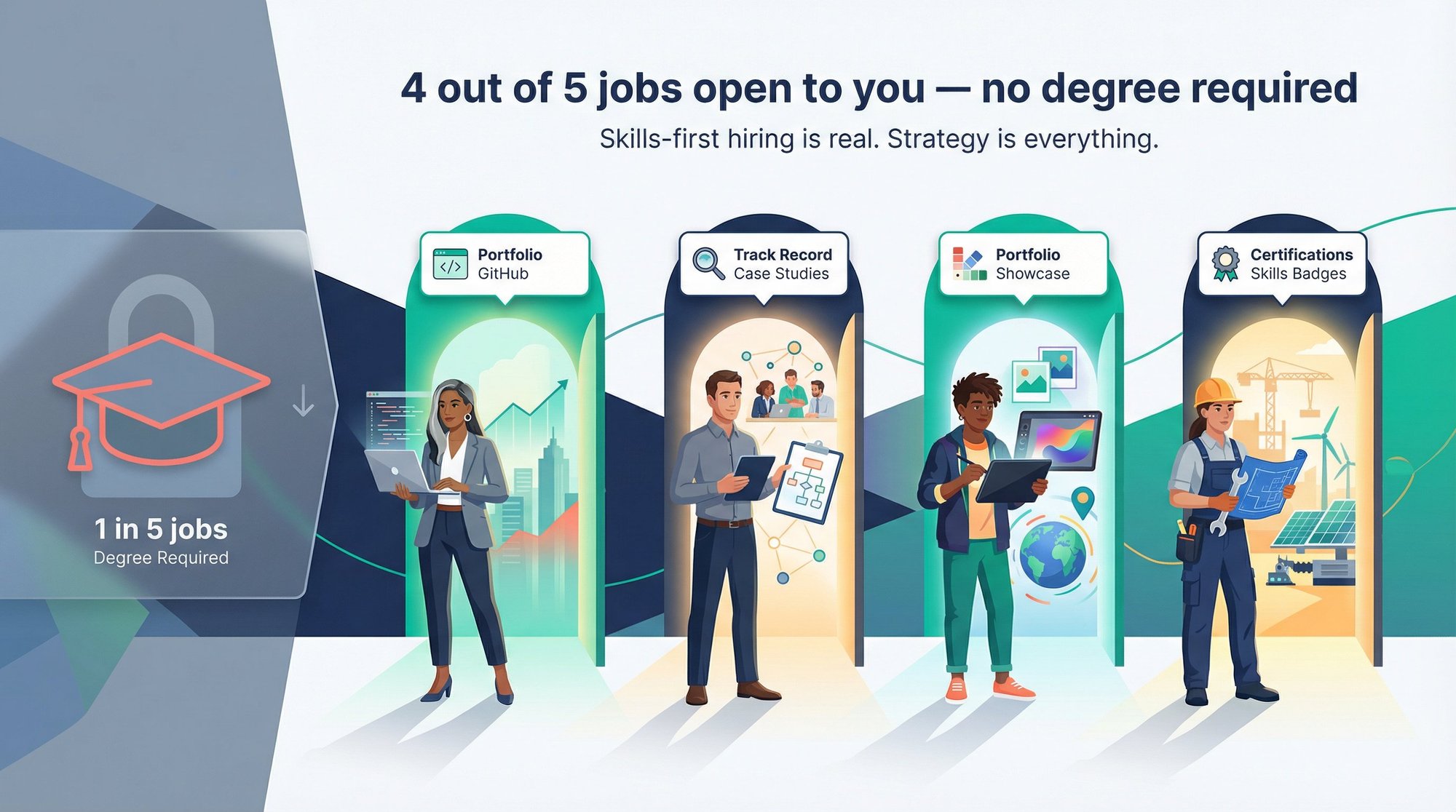
According to Indeed Hiring Lab (January 2026), about 19.3% of job postings on Indeed required a bachelor's degree or higher as of November 2025. That means roughly 4 out of 5 postings either require something else (an associate degree, trade certification, etc.) or list no education requirement at all.
It varies wildly depending on where you live and what industry you're targeting. Indeed's analysis also shows that degree requirements are significantly higher in regions with more white-collar roles, with big differences across states and metro areas.
Truth #2: "Skills-first hiring" is real, but unevenly applied.
You've probably heard companies say they hire based on skills, not credentials. And plenty do. But when the market gets tight and recruiters are drowning in applications, many fall back to the easiest filter available: the degree checkbox. A major analysis from Harvard Business School and the Burning Glass Institute (February 2024) found that despite all the "skills-first" talk, the actual shift in hiring outcomes has been modest.
So what does this mean for you?
You can absolutely get hired without a degree in 2026. But you need a strategy that works even when the system defaults to lazy shortcuts.
That strategy boils down to this: replace the "degree signal" with a stronger "proof signal," then deliver it to the right people.
Why Employers Require Degrees (And How to Get Hired Without One)
Before you start applying anywhere, it helps to understand why companies ask for degrees in the first place. Once you see the logic, the whole game becomes predictable.
Employers hire to reduce risk. That's the entire equation. A hiring manager is making a bet every time they extend an offer:
If you work out, the team gets output and results.
If you don't, they lose time, money, morale, and sometimes customers.
They use signals to reduce the downside risk of that bet. A degree is one signal. Not because it magically creates competence, but because it implies a few things:
Persistence: You can finish a multi-year project.
Learning ability: You can absorb structured material and pass assessments.
Professional functioning: You can navigate institutional systems, deadlines, and expectations.
External vetting: Someone else (the university) already evaluated and approved you.
That's it. A degree is a convenience filter. Every single one of those signals can be replaced with something more relevant to the job.
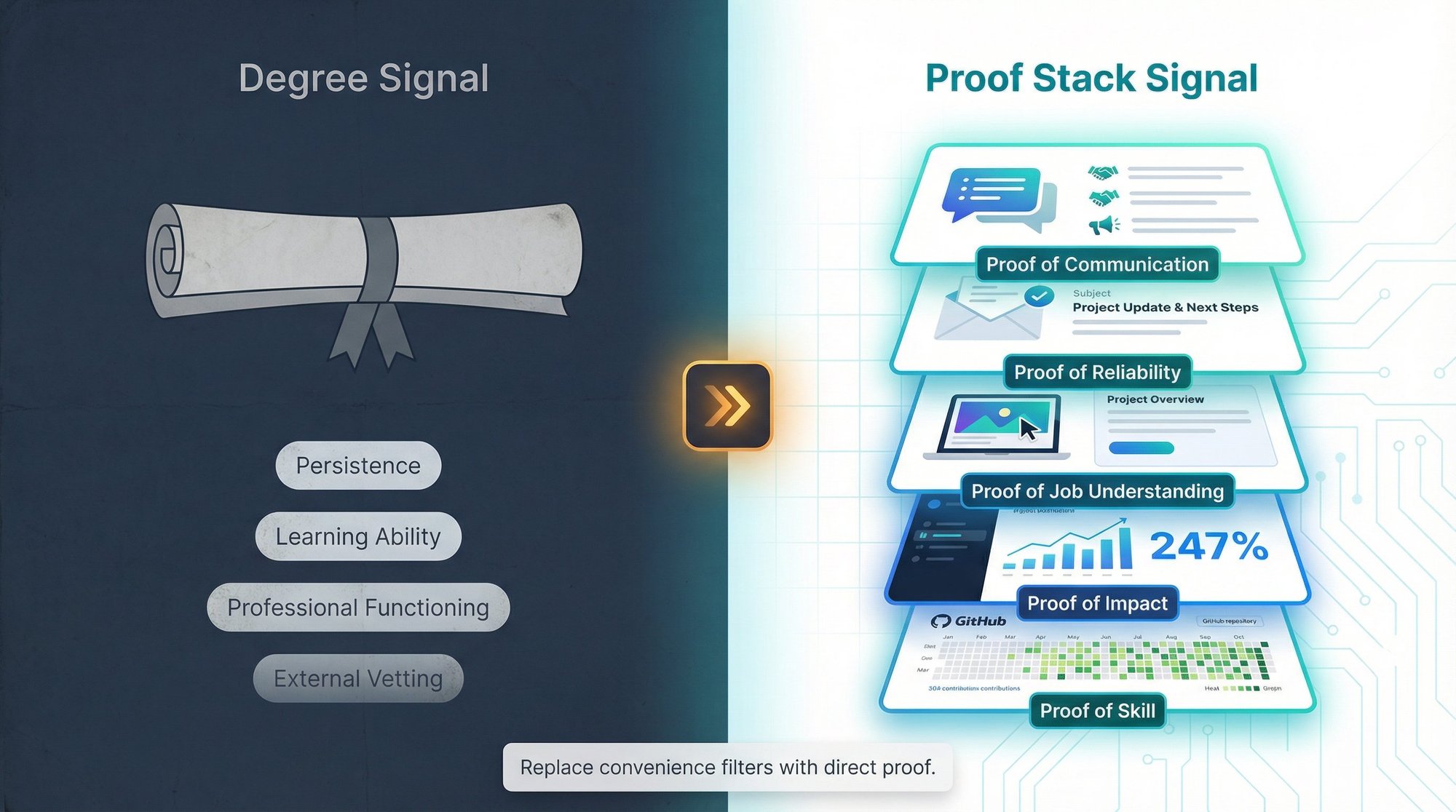
How to Build Your Proof Stack Instead of a Degree
Your job is to create proof signals that are more directly tied to the work than a degree ever could be. Understanding what are transferable skills is the first step, because these are the abilities you already have that map directly to what employers need:
When your signal stack is strong enough, the degree stops mattering for most roles. That's not wishful thinking. It's how hiring actually works for the people who get past the gate.
Jobs That Actually Require a Degree (Non-Negotiable Roles)
Before we go further, a quick reality check. Some roles are legally locked behind a degree or professional license. Spending months trying to brute-force your way into these positions is a waste of energy.
Roles that are typically degree-locked or license-locked (varies by country): doctor, dentist, pharmacist, lawyer, chartered engineer in regulated contexts, and many clinical healthcare roles. Even if you could technically do the work, the law or professional bodies may block you.
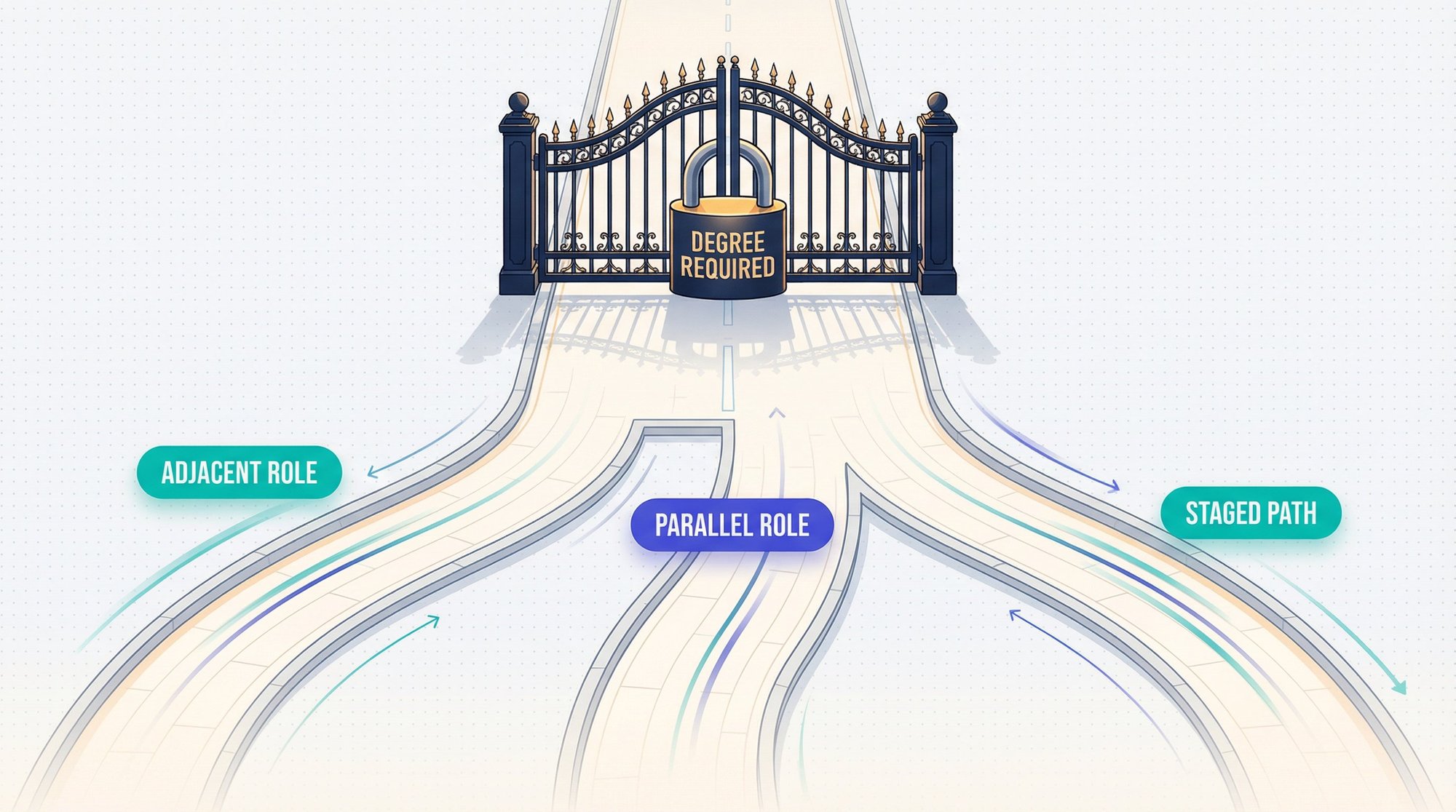
If your dream career falls into one of these categories, you have three smart options:
Choose an adjacent role that isn't gated and grow into your target over time
Choose a parallel role that uses similar skills under different regulations
Choose a staged path: earn money while you learn through apprenticeships or part-time programs
This guide focuses on roles where the degree is a preference, not a legal requirement. That's where the opportunity is widest.
How to Choose the Right Job to Target Without a Degree
Most "no degree" career advice fails right at this step. It tells you to "pick something you're passionate about." That's incomplete. Passion is nice, but you also need a role where employers can actually evaluate you without a transcript.
You need a role that fits these four constraints:
1. Skills are visible. You can show proof of your ability without being employed first. Think: portfolios, project outputs, documented work.
2. Skills are testable quickly. The employer can evaluate you with a task or work sample, not just a credential.
3. The work is modular. You can do smaller pieces as projects, freelance gigs, or volunteer work before landing a full-time role.
4. The role has multiple entry ramps. Apprenticeships, junior positions, traineeships, internal transfers. More than one way in.
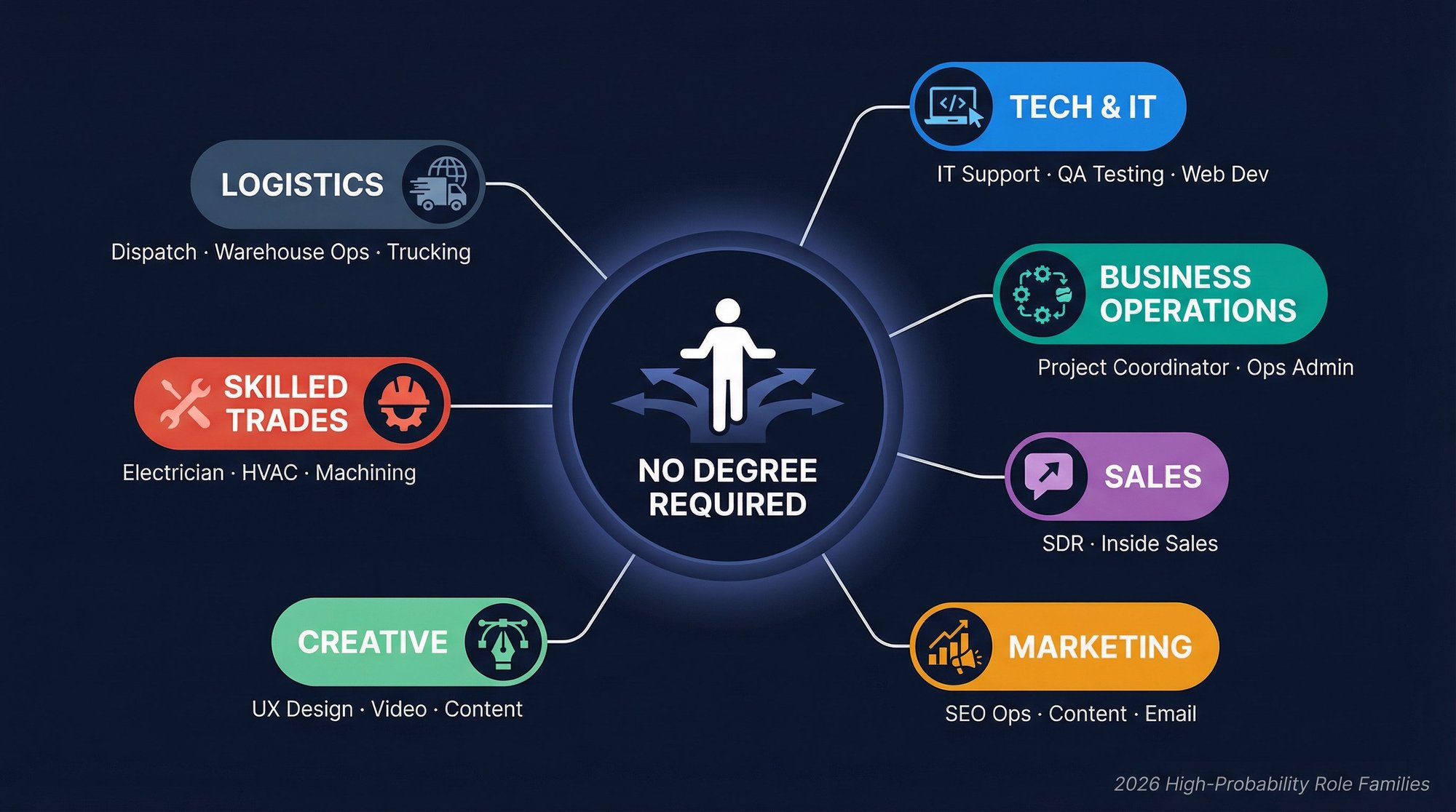
High-Probability Role Families in 2026
These aren't guarantees. They're families where degree-less entry is common if you bring proof:
→ Tech and IT: IT support specialist, QA testing, junior web developer roles, data analyst positions (market-dependent), cybersecurity analyst entry paths
→ Business operations: Project coordinator, operations coordinator, supply chain coordinator, admin ops
→ Sales: SDR/BDR (Sales Development Representative), inside sales, account support
→ Marketing: Performance marketing assistant, SEO/content ops, lifecycle and email operations
→ Creative: UX/UI designer (portfolio-heavy), video editing, design, content creation
→ Skilled trades: Electrician, HVAC, plumbing, machining (often via apprenticeships)
→ Logistics: Dispatch, warehouse ops leadership track, trucking (license-based, not degree-based)
How to Test Whether a Role Is Right for You Without a Degree
Take 10 job postings for the role you're considering and check:
Does the posting say "degree required" or "degree preferred"?
Does it accept "or equivalent experience"?
What tools show up repeatedly?
What outputs do they care about (reports, tickets closed, revenue, campaign performance, uptime)?
If 7 out of 10 postings genuinely require a degree, you've picked a hard target. Either narrow down to employers that explicitly hire skills-first, or choose a better entry-level role in the same family.
How to Build a Portfolio That Replaces a Degree
This is the core of the entire playbook. If you take one thing from this article, make it this section.
The Minimum Viable Proof Portfolio
You need 3 proofs. Not 12. Not 1. Three.
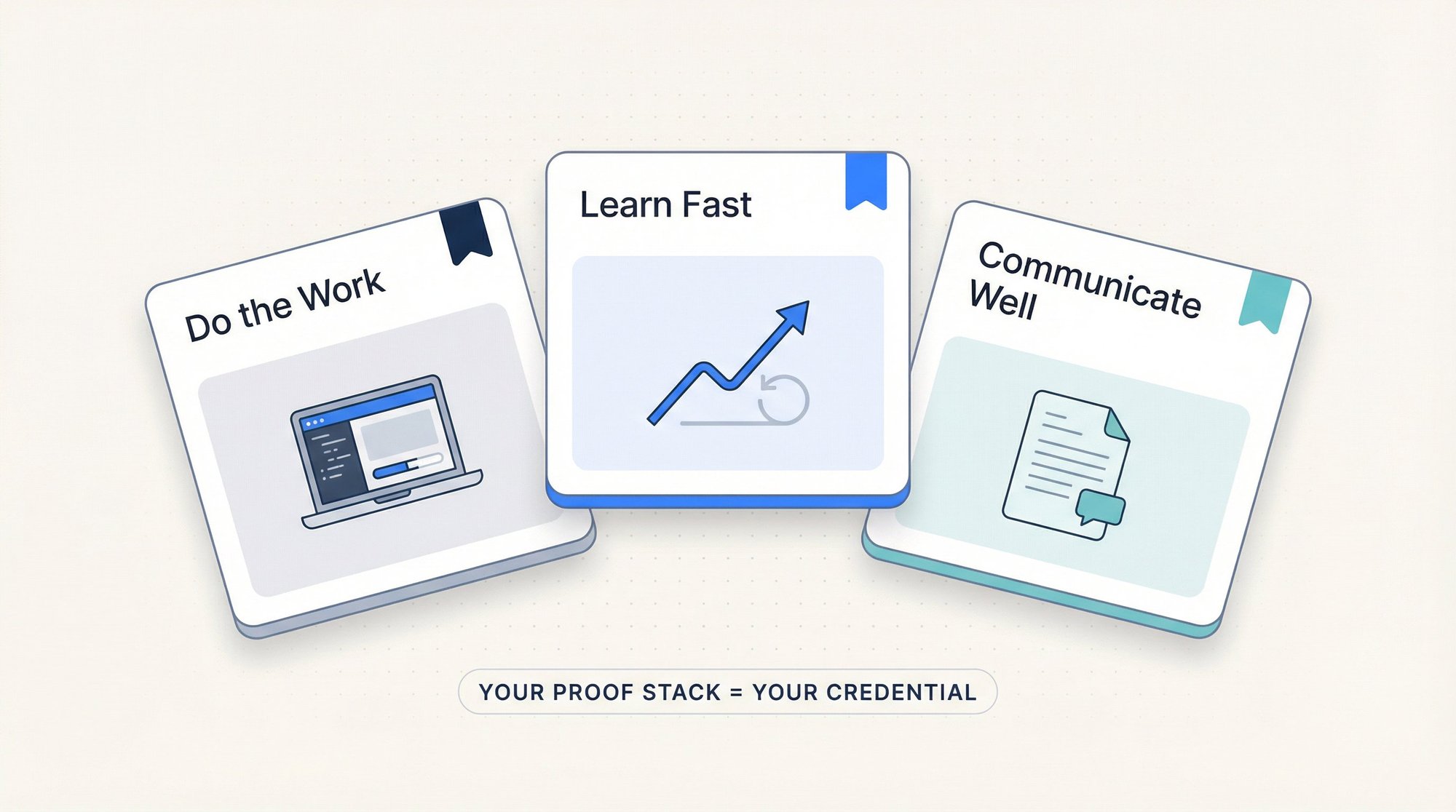
Each proof should map to one of these buckets:
Proof you can do the day-to-day work of the target role
Proof you can learn fast and self-correct when things go wrong
Proof you can communicate like a professional (writing, presenting, structuring ideas)
Learning how to create a professional portfolio that employers can actually verify is the difference between looking like a serious candidate and being lost in a pile of applications.
Proof Project Examples for Every Career Field
How to Make Your Portfolio Projects Verifiable
Hiring managers have seen too many fake "projects." Your proof has to be verifiable. That means each piece should include:
A link or artifact (portfolio site, PDF, repo, live dashboard)
Your reasoning (why you made the decisions you did)
Your result (even if it's a learning outcome, that counts)
Your next improvement (this shows maturity and self-awareness)
If your application looks generic, recruiters assume you're one of 300 people spraying resumes everywhere. Proof makes you look like one of 5 serious candidates. That's the difference between getting ignored and getting an interview.
How to Get Work Experience Without Being Hired First
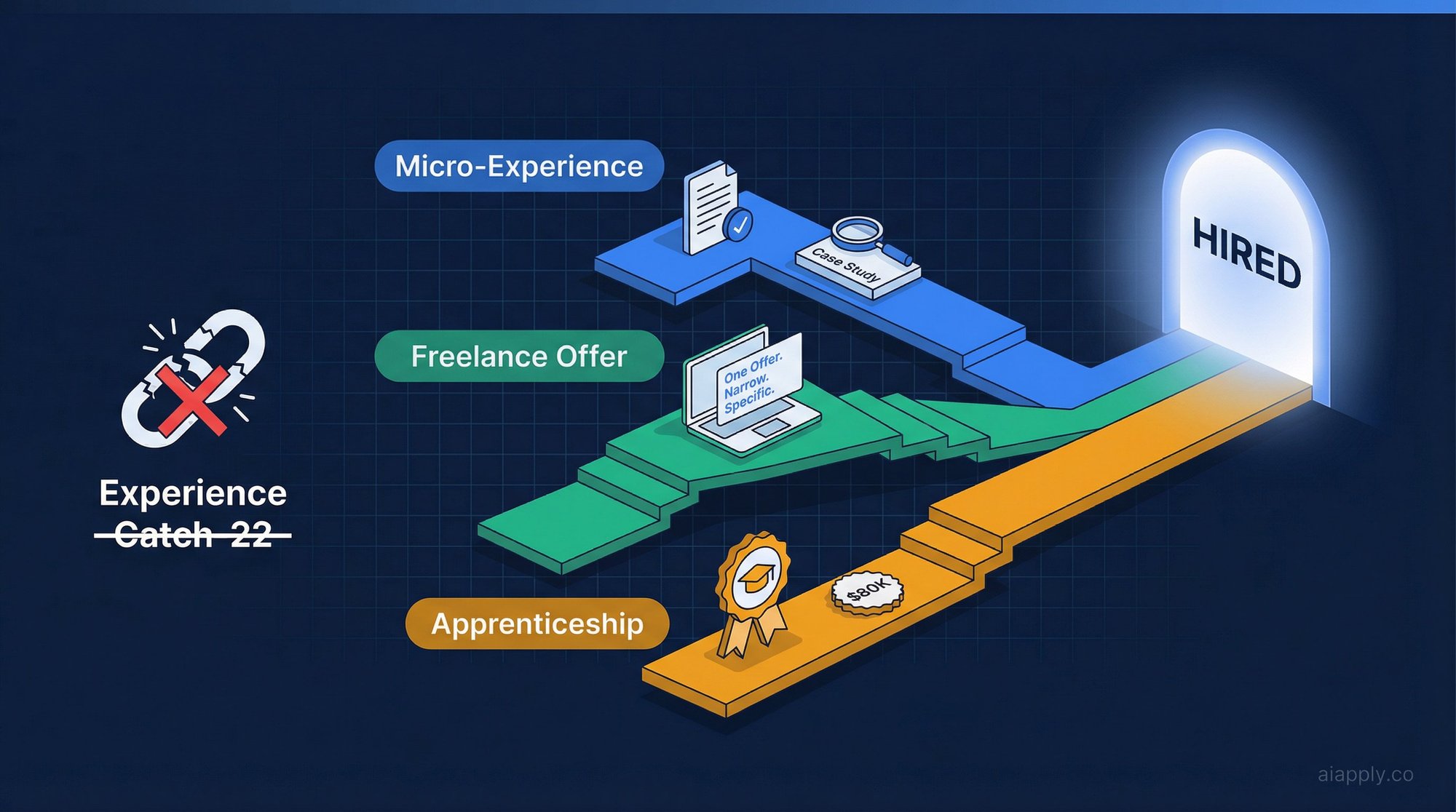
"You need experience to get hired, but you need to get hired to get experience." You've heard that catch-22 before. But it's only true if you define "experience" as "someone paid me a salary." Employers don't actually care about the paycheck part. They care about evidence that you've dealt with real constraints.
Here are the fastest ways to create that evidence:
Option A: Micro-Experience (2-20 Hours)
Volunteer one deliverable for a local business or nonprofit
Improve a small workflow for someone you know, then document it
Do a mock project using public data and real tools
Your goal isn't charity. It's a credible case study with your name on it.
Option B: Freelance "Productized" Starter Offers
Instead of saying "hire me for anything," offer one narrow, specific service:
"I will set up a basic CRM pipeline + email templates."
"I will build a KPI dashboard from your spreadsheet."
"I will audit your website for SEO basics and fix the top 10 issues."
Narrow offers reduce buyer risk. That's the same principle behind why employers prefer candidates who specialize.
Option C: Apprenticeships and Earn-While-You-Learn Routes
If you want the most structured "degree alternative" pathway:
UK: The Government's Find an Apprenticeship service is the starting point for searching and applying.
US: Registered Apprenticeships via apprenticeship.gov are a major pathway with federal backing.
And here's a data point that might surprise you: the U.S. Government Accountability Office (GAO) reported in April 2025 that Registered Apprenticeship completers in two recent cohorts earned about $80,000 in average annual wages in the first year after completing their program. That's based on Department of Labor data for April 2022 and March 2023 completers.
That doesn't mean every apprenticeship pays $80k. But it does mean apprenticeships can be a serious career pathway, not just "cheap labor."
Which Certifications Help You Get Hired Without a Degree
Credentials can help you clear automated screening filters. But a lot of people misuse them by collecting certificates like they're badges in a video game, without ever building proof of what they can actually do.
Which Credentials Actually Matter for Getting Hired
From strongest signal to weakest:
① Work samples with outcomes
② References from credible people
③ Proctored certifications with real exams
④ Well-known professional certificates with attached projects
⑤ Random course completions
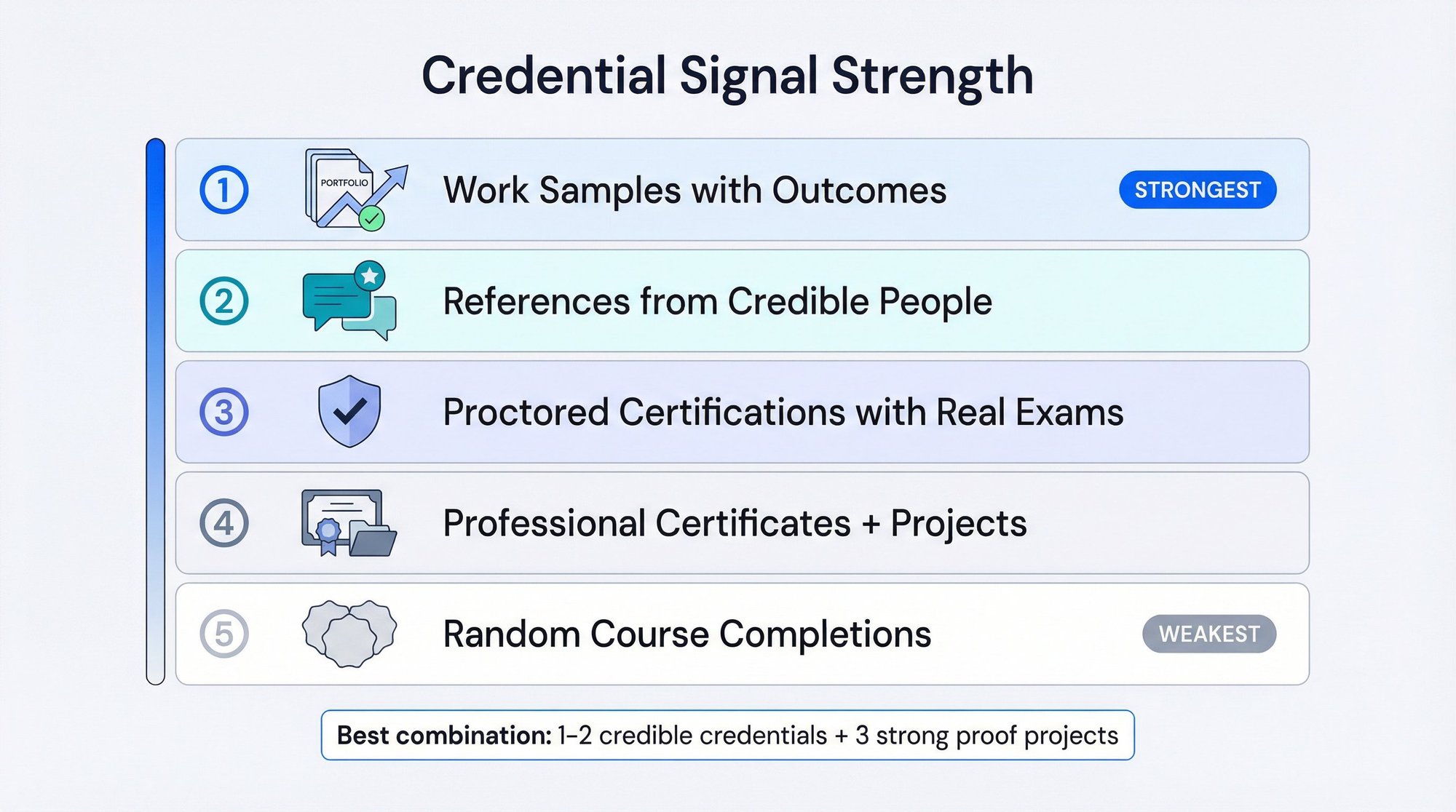
If you don't have a degree, your best combination is usually 1-2 credible credentials plus 3 strong proof projects. Not 12 certificates and zero proof.
What Credible Credentials Cost in 2026
These prices can change, so treat them as current-as-of-now references:
Google Career Certificates on Coursera: Coursera lists $49/month in the U.S. and Canada after a 7-day trial, and many learners finish in under 6 months (often under ~$300 total if you move steadily).
AWS Certified AI Practitioner: AWS lists the exam at $100 USD on the official page (cost can vary by region and taxes).
CompTIA A+ (IT support entry point): CompTIA's current version (220-1201/220-1202) launched March 25, 2025 and requires passing two exams (Core 1 and Core 2).
How to Choose the Right Certification for Your Job Target
Pick credentials that:
Show up in the job postings you're targeting
Map to real tasks you'll do in your first week on the job
Can be demonstrated through a portfolio project
If you can't build a project from the credential, it's probably not worth leading with.
How to Write a Resume When You Don't Have a Degree
What most people miss about resumes: your resume is not your life story. It's an evidence packet.
A recruiter scanning your resume is asking three questions:
Do you match the role?
Is your experience credible?
Is it easy for me to say "yes" and move you forward?
If the answer to all three is yes, your education section barely matters.
The Best Resume Format Without a Degree in 2026
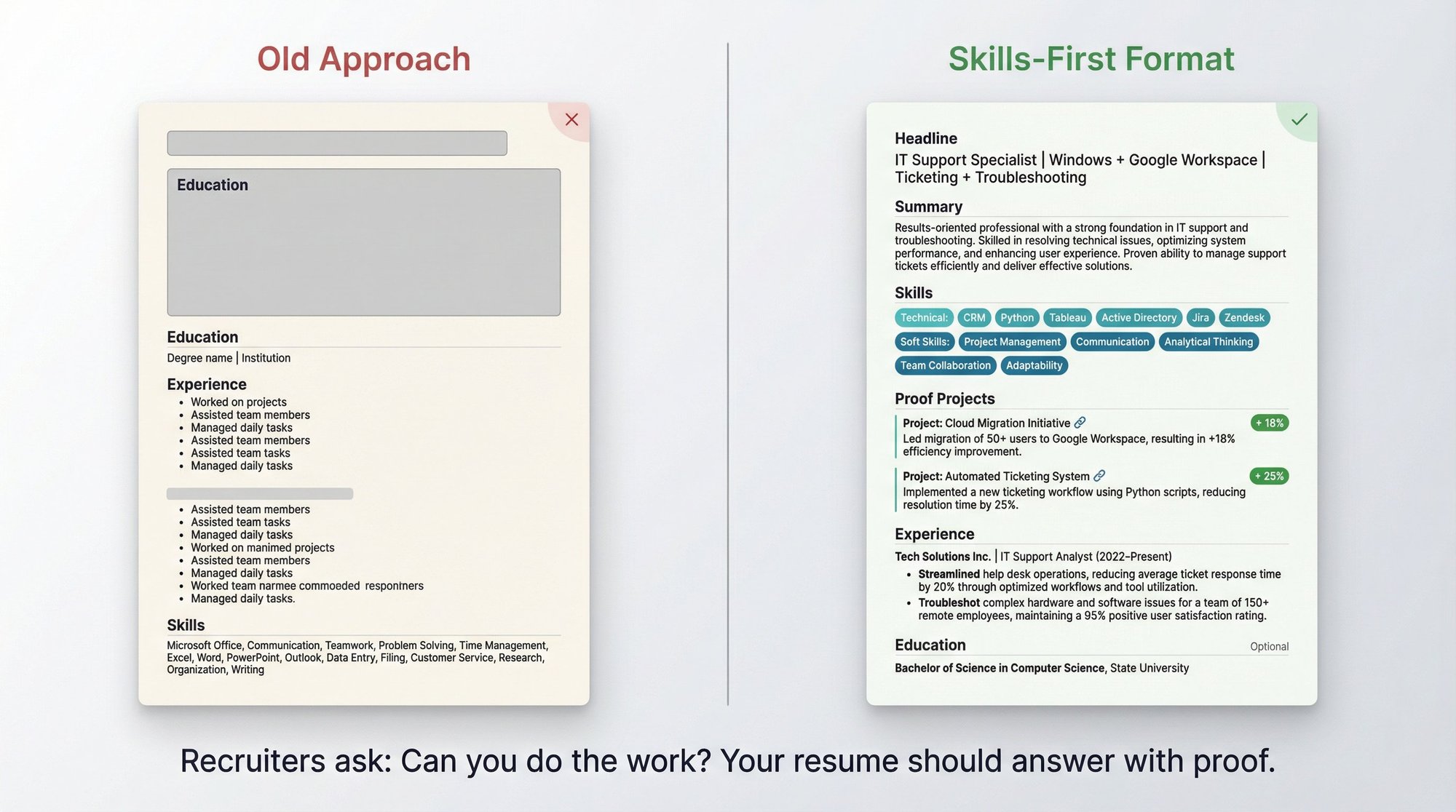
Use a skills-first structure. Understanding effective resume formats will help you choose the right approach for your specific situation:
Headline: Target role + specialty
Example: "IT Support Specialist | Windows + Google Workspace | Ticketing + Troubleshooting"
Summary (3-5 lines): What you do, what tools you use, what outcomes you've driven, and where to find your proof.
Skills (grouped): Tools, systems, and workflows relevant to the role. See our guide to skills for your resume for a comprehensive breakdown of what to include.
Proof Projects: 2-4 projects with links and measurable outcomes.
Experience: Even non-traditional experience counts. Translate it into job-relevant impact.
Education: Optional. If you have partial college or relevant coursework, list it honestly.
How to Write Resume Bullets That Make Any Experience Count
Use this structure for every bullet point:
Action + Tool + Scope + Result
Example: "Resolved 25+ weekly device and account issues using structured triage, reducing repeat tickets by 18%."
Even if that came from volunteering for a friend's small business, it reads like professional experience because it focuses on the work and the outcome. See our resume bullet point examples for more templates you can adapt directly.
How to Handle the Degree Question
Don't hide it. Don't lie.
If an application form asks "Do you have a degree?" and you don't, answer honestly. Your strategy isn't about tricking the ATS. It's about:
Targeting jobs where the degree isn't a hard requirement
Attaching proof so a human wants you anyway
Using networking to get past automatic filters when possible
How to Use AI Tools to Speed Up Your Job Applications
This is where AIApply fits into your resume workflow. Our tools are designed for exactly this problem: converting "I can do the work" into documents that match what the job ad is looking for.
AI Resume Builder: Creates ATS-optimized resumes with job-description tailoring and support for multiple versions, so you can customize without starting from scratch each time.
AI Resume Scanner: Checks your resume against 50+ ATS systems for compatibility, keyword coverage, and formatting issues before a recruiter ever sees it.
AI Cover Letter Generator: Generates a tailored cover letter quickly, so you can keep every application specific instead of sending the same generic letter everywhere.
One important rule: Use AI to clarify and tailor your materials. Never use it to invent employers, degrees, or results you don't have. In 2026, background checks are faster than ever.
How to Apply for Jobs Without a Degree and Not Get Filtered Out
The biggest blind spot for candidates without degrees isn't a lack of skills. It's applying to the wrong jobs in the wrong order.
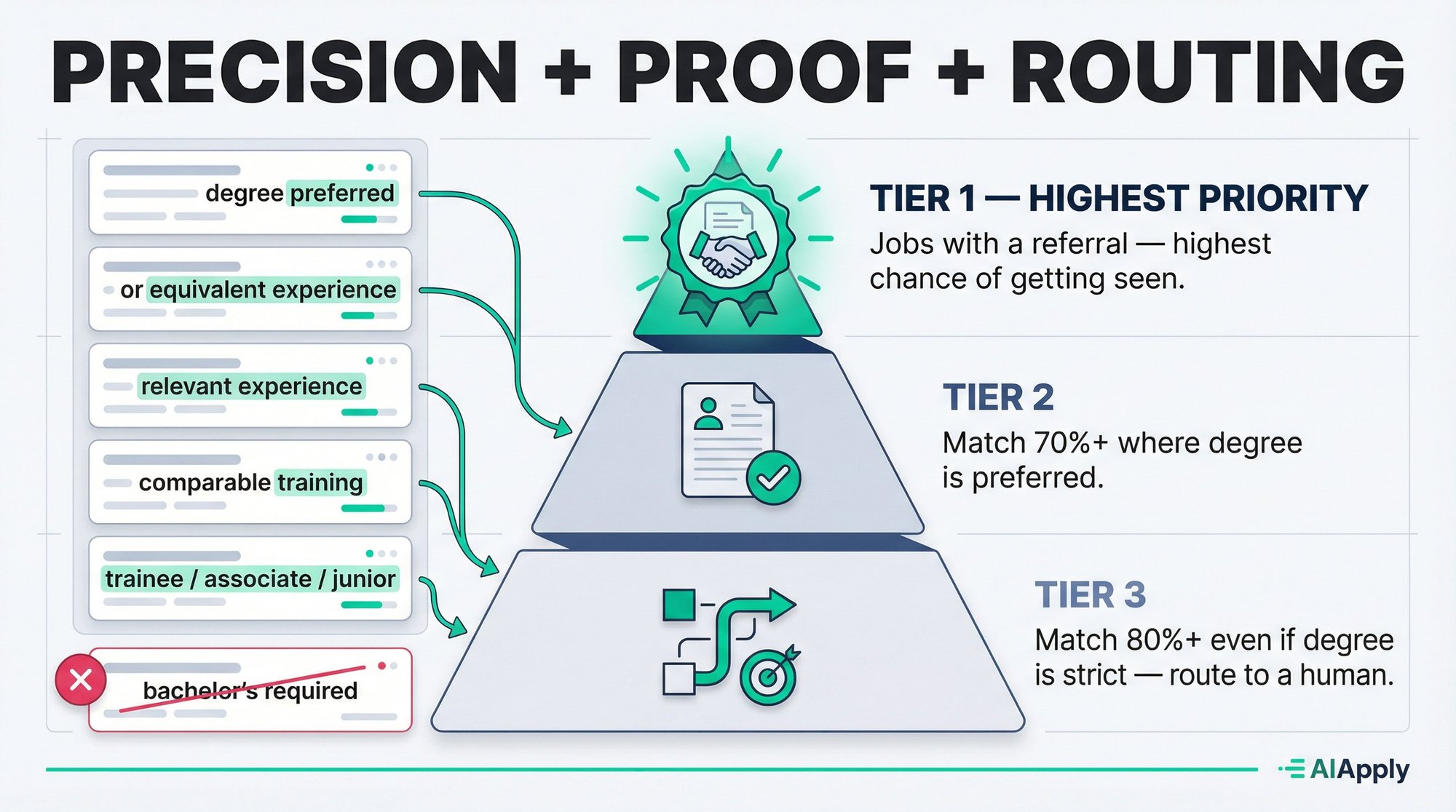
Without a degree, you need precision + proof + routing. Spraying 500 generic applications won't work. Understanding how to use ATS-friendly resume templates is essential, because these systems screen your application before any human ever sees it.
How to Find Degree-Optional Postings Faster
Look for these phrases in job listings:
"Degree preferred" (not required)
"Or equivalent experience"
"Relevant experience"
"Or comparable training"
"Apprentice," "trainee," "associate," "junior"
Avoid postings that say "bachelor's required" unless you have a warm referral and your proof portfolio is exceptional.
The Right Order to Submit Job Applications Without a Degree
Not all applications are equal. Prioritize like this:
Jobs where you have a referral (highest chance of getting seen)
Jobs where you match 70%+ and the degree is "preferred"
Jobs where you match 80%+ even if the degree line is strict (only if you can route your application to a human)
How to Lead With Your Portfolio to Get Past Degree Filters
In your cover letter and the opening lines of your resume summary, mention your proof immediately:
"Portfolio: 3 role-relevant projects (ticketing lab, troubleshooting playbook, KPI dashboard)."
Make it effortless for a recruiter to verify you're worth a closer look. Tailoring your resume to the job description is equally important, because a generic resume is the fastest way to get filtered out.
Scale Applications Without Losing Quality
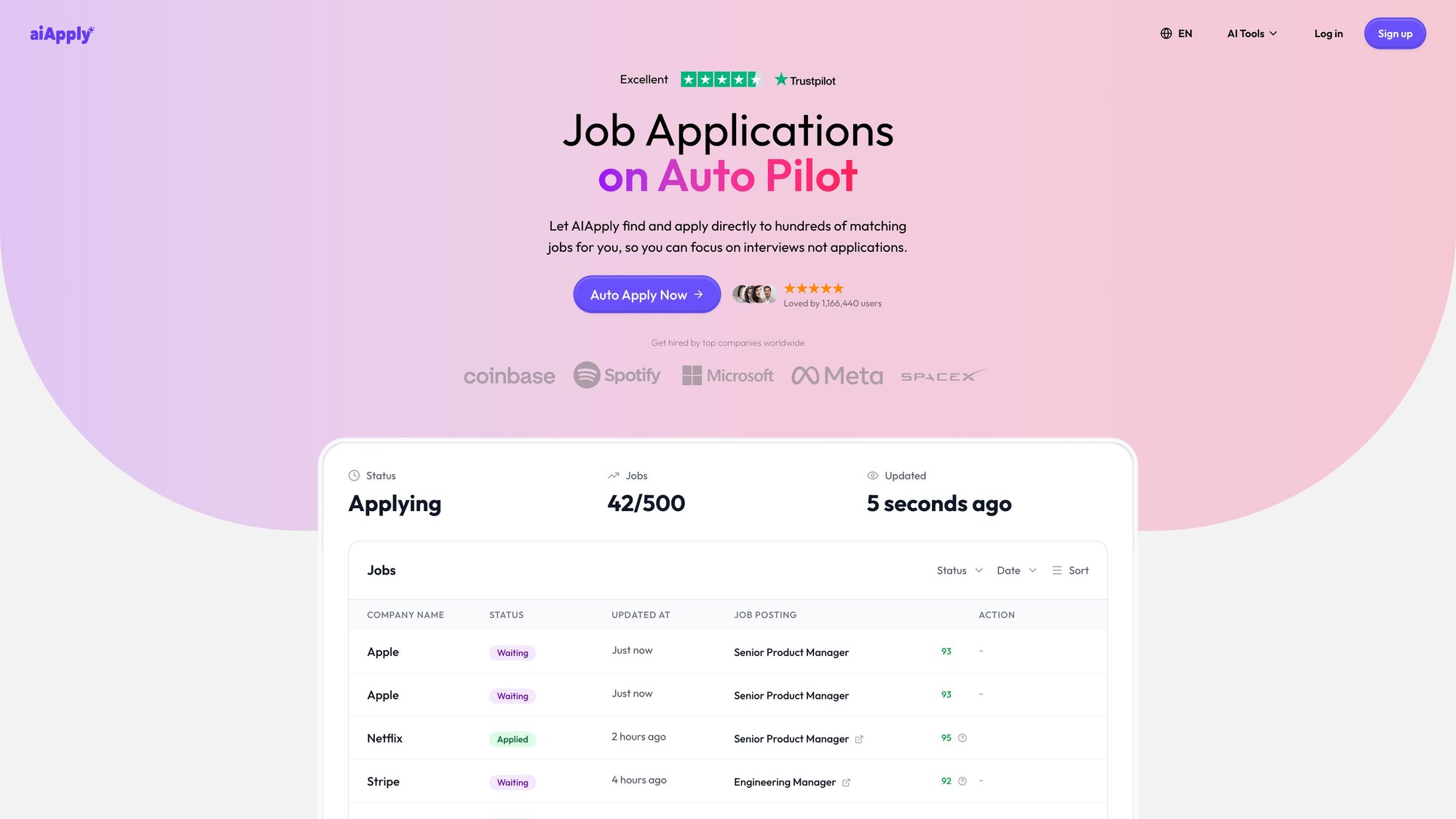
If you're applying at volume, you still need personalization. AIApply's Auto Apply is built to automate the repetitive parts of the application process while matching roles to your preferences and using your tailored resume and cover letter.
One caution worth keeping in mind: high-volume applying can burn employer goodwill if you're not actually a strong fit for the roles you're targeting. Set strict filters and review what's being sent on your behalf. Automation should amplify a good strategy, not replace one.
How to Network Your Way Into a Job Without a Degree
This is the single most powerful lever in a no-degree job search, and most people avoid it because it feels uncomfortable.
A better way to think about it: networking isn't "using people." It's reducing uncertainty on both sides. A referral tells a hiring manager "this person is real," and it tells you "this company actually values what I bring."
Read our guide on how to attract job recruiters for a deeper look at positioning yourself to be found, not just to apply.

The 15-Minute Proof-Based Outreach Script
Copy this, personalize it, and send it:
Hi [Name], I'm breaking into [role] and noticed you work at [company/team].
I don't have a [degree type], so I'm building proof instead: [one sentence about your portfolio/project].
If you have 15 minutes, I'd love your feedback on what skills matter most for [role] at [company] and what would make a candidate stand out.
Either way, appreciate your work on [specific thing you noticed].
This works because it's specific, respectful, and it signals that you're serious enough to have built something real. You're not asking for a job. You're asking for feedback.
The Follow-Up That Gets You Interviews
After the conversation, send them:
Your one-page proof summary (projects, skills, links)
The ask: "Would it be reasonable for me to apply to [role link]? If so, is there someone I should mention or a best way to route my application?"
This is how you bypass degree filters without begging for a favor. You're offering proof and asking for a routing recommendation.
How to Interview for a Job When You Don't Have a Degree
When you walk into an interview without a degree, the conversation isn't really about convincing someone you're smart. It's about proving you're safe to hire.
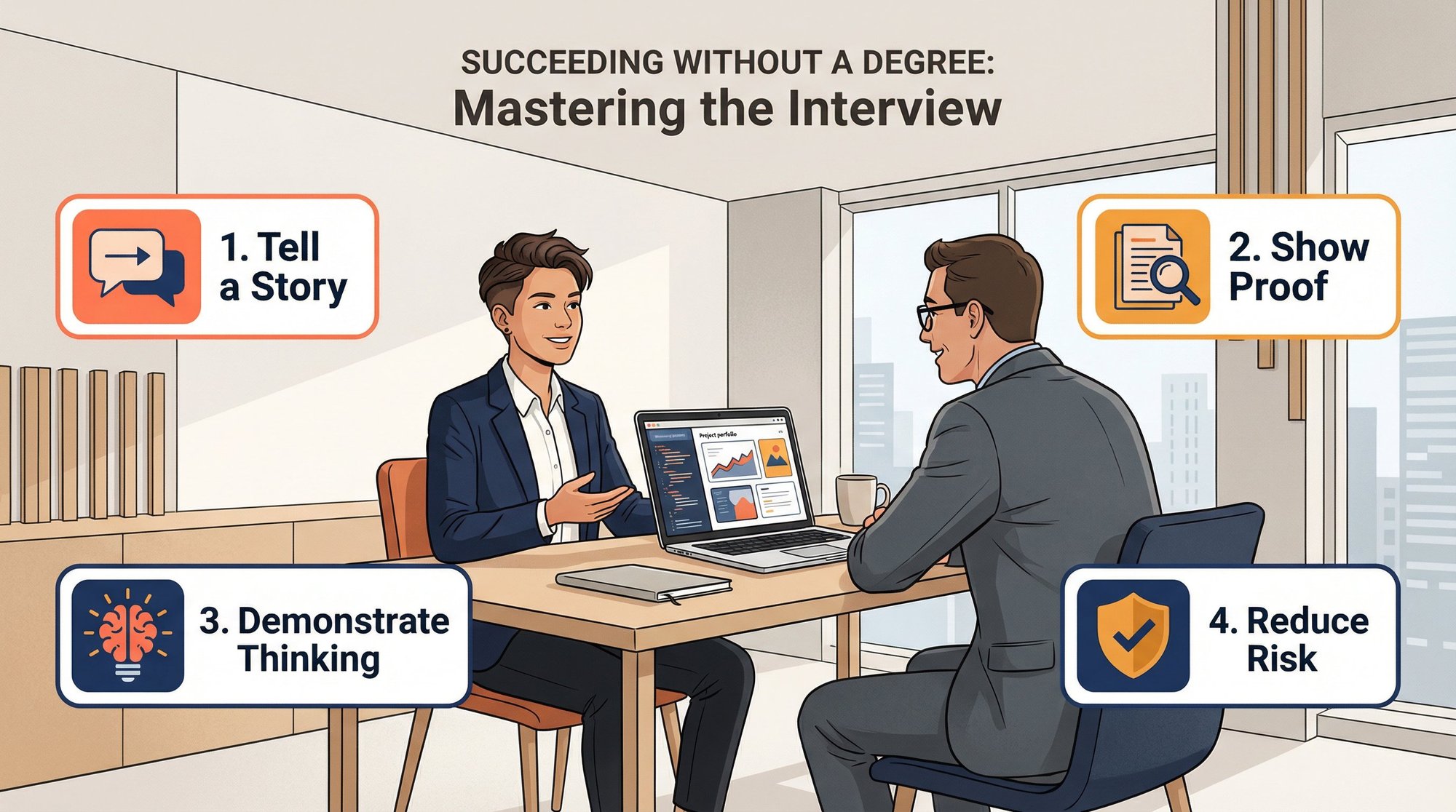
A 4-Part Strategy for Job Interviews Without a Degree
1. Tell a coherent story. Why this role, why now, and why you'll stick around. Interviewers want to see intention, not desperation.
2. Show proof. Bring your portfolio. Walk through a project. Show real output. Don't just talk about what you could do.
3. Demonstrate thinking. Explain tradeoffs, constraints, and how you debug problems. Employers want to see how your brain works, not just what it's memorized.
4. Reduce risk. Talk about how you learn new things, how you take feedback, and how you communicate when you're stuck. This is what actually calms a hiring manager's nerves.
Handling "Why Don't You Have a Degree?"
When this question comes up (and it might), use a calm, non-defensive answer:
"I chose an alternative route. Instead of spending 3-4 years on a broad program, I built role-specific skills and proof. Here are the projects and outcomes that match your job requirements."
Then show proof. Always redirect to the evidence.
The degree question is a test of composure as much as explanation. A confident, proof-backed answer almost always lands better than a defensive one.
How to Practice for Job Interviews Without Formal Training
Use mock interviews with the actual job description, not generic question lists. AIApply's Mock Interview tool lets you paste a job description and practice role-specific questions with AI-powered feedback, so you're rehearsing for the exact conversation you'll have.
For entry-level interview questions that frequently come up when you're breaking into a new field, we've compiled the most common ones with sample answers. And for behavioral questions specifically, we've put together a STAR Method Interview Examples guide that's a solid reference for building a story bank and practicing structured answers.
AIApply also offers an Interview Answer Buddy for real-time interview assistance. If you do use real-time help, be aware that some employers consider it a policy violation. Use it ethically, and prefer using it for practice unless you have explicit permission.
How to Succeed in Your First Job Without a Degree
Getting hired isn't the finish line. It's the first rung.
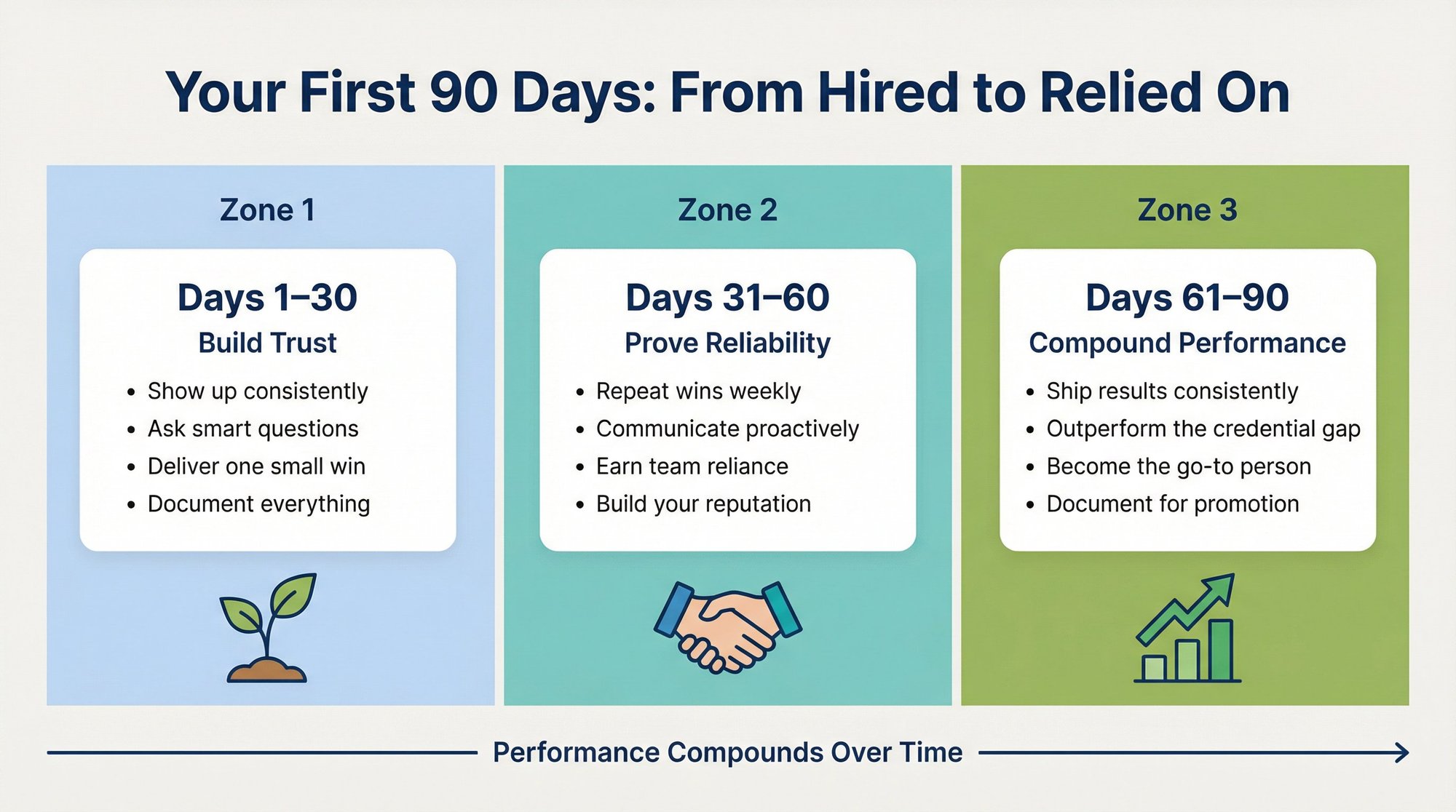
Your goal in the first 90 days on the job is straightforward: become someone the team relies on. That means:
Show up consistently (this sounds basic, but it matters more than you'd think)
Communicate clearly when things are going well and when they aren't
Deliver small wins fast before trying to change the world
Ask good questions instead of pretending to know everything
Document what you learn (this becomes your promotion ammunition later)
Performance compounds over time. A person who ships results every week for a year builds a reputation that no degree can match. That's how you outrun the "degree disadvantage" permanently. Having a career development plan from day one gives you a roadmap for those early milestones.
Your 30-60-90 Day Plan to Get Hired Without a Degree
If you're starting from zero, here's a practical timeline you can follow.
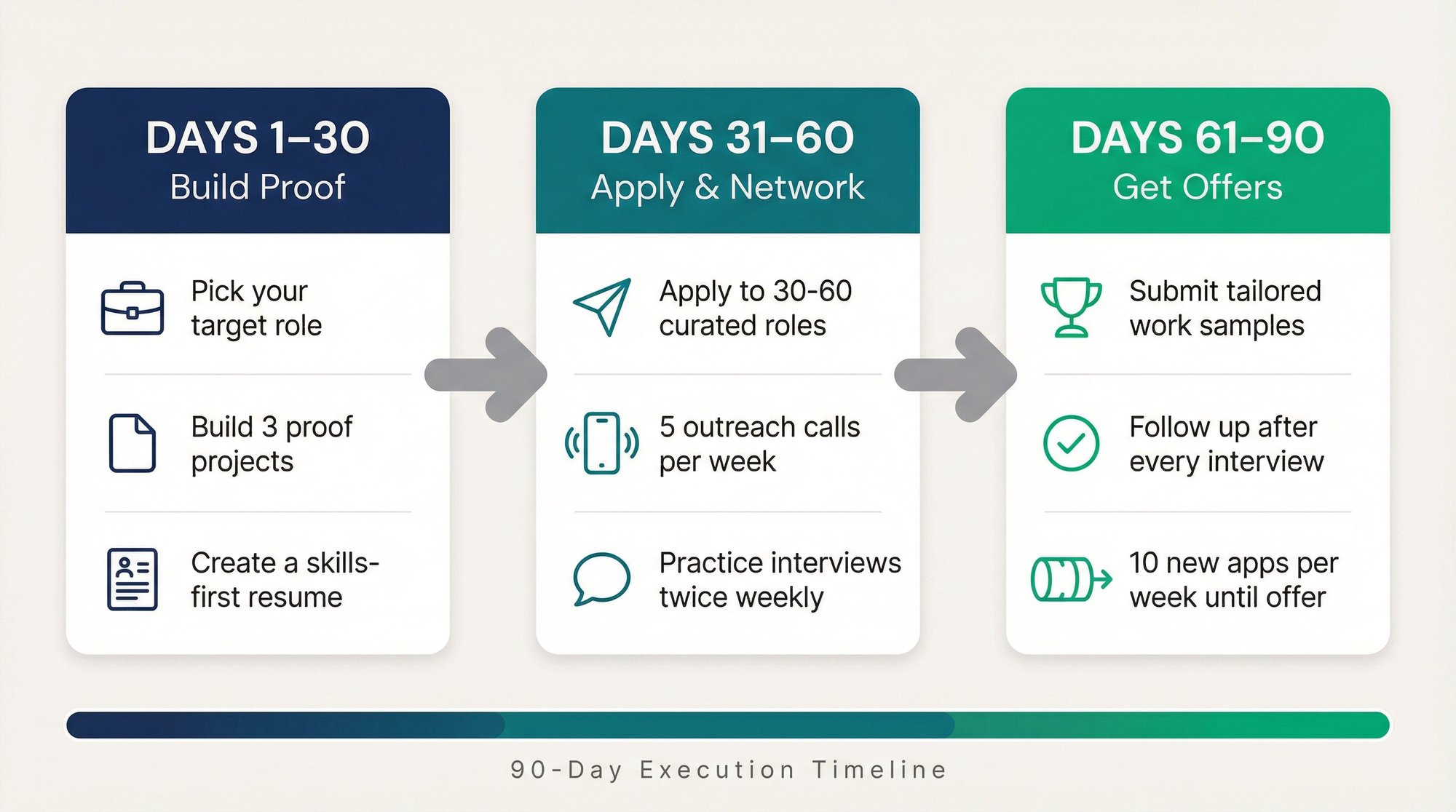
Days 1-30: Build Proof and Your Target Narrative
Pick 1 target role and 1 backup role
Collect 30 job postings for both. Extract the top 15 skills that keep showing up
Build 3 proof projects that map directly to those skills
Create a skills-first resume + one tailored version for your top 10 target jobs
Set up a simple tracking system (we offer a free job search tracker that works well for this)
Output at Day 30: A portfolio, a resume that matches real jobs, and tangible proof you can show to anyone.
Days 31-60: Apply and Get in Front of Real People
→ Apply to 30-60 carefully selected roles (quality over volume)
→ Do 5 informational calls per week using the outreach script above
→ Ask for 2 referrals per week (only after you've shown your proof)
→ Practice interviews twice per week (mock sessions + building your story bank)
Days 61-90: Convert Interviews Into Offers
① Build a tailored "work sample" for each interview loop
② Follow up with a short proof recap after every interview
③ Keep your pipeline alive: 10 new applications per week until you sign an offer
Common Mistakes That Kill No-Degree Job Searches
Trap: Collecting Certificates Instead of Building Proof
Fix: Every credential you pursue must produce a portfolio artifact. If you can't build a project from it, it's not adding real value to your candidacy.
Trap: Applying to Everything
Fix: Pick a role family and dominate it with role-specific proof. Being a generalist with no degree is the hardest path. Being a focused candidate with targeted evidence is the easiest.
Trap: Hiding or Lying About Your Education
Fix: Be honest. Replace the missing degree signal with stronger signals. Lying on a resume in 2026 is a career-ending risk that's simply not worth taking.
Trap: Assuming Rejection Means You're Not Good Enough
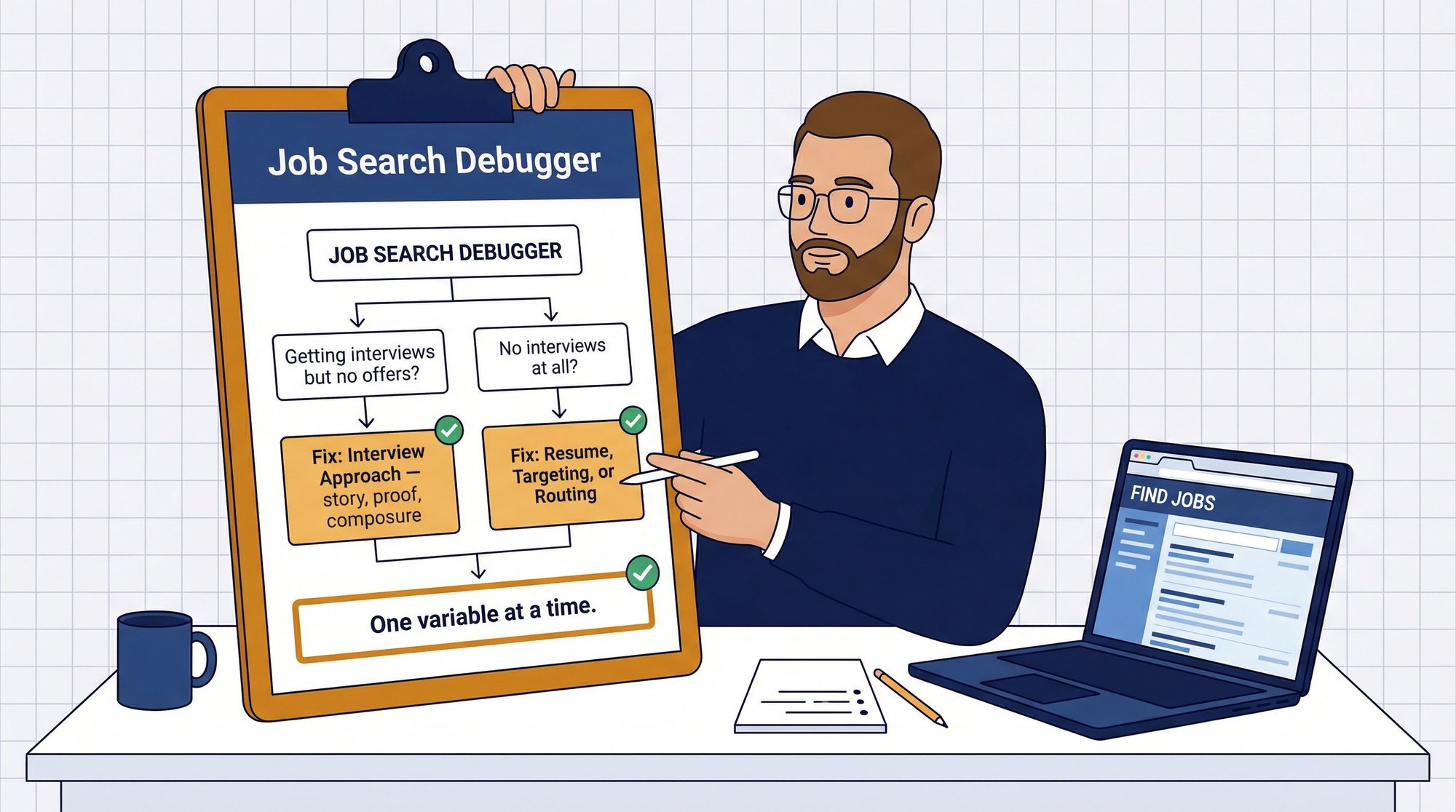
Fix: Treat job searching like debugging software. Change one variable at a time. If you're getting interviews but no offers, the problem is likely in your interview approach. If you're not getting interviews at all, the problem is in your resume, targeting, or routing.
Most job search problems are diagnostic, not personal. Changing one variable at a time is how you find what's actually blocking you.
AI Tools That Speed Up Your No-Degree Job Search
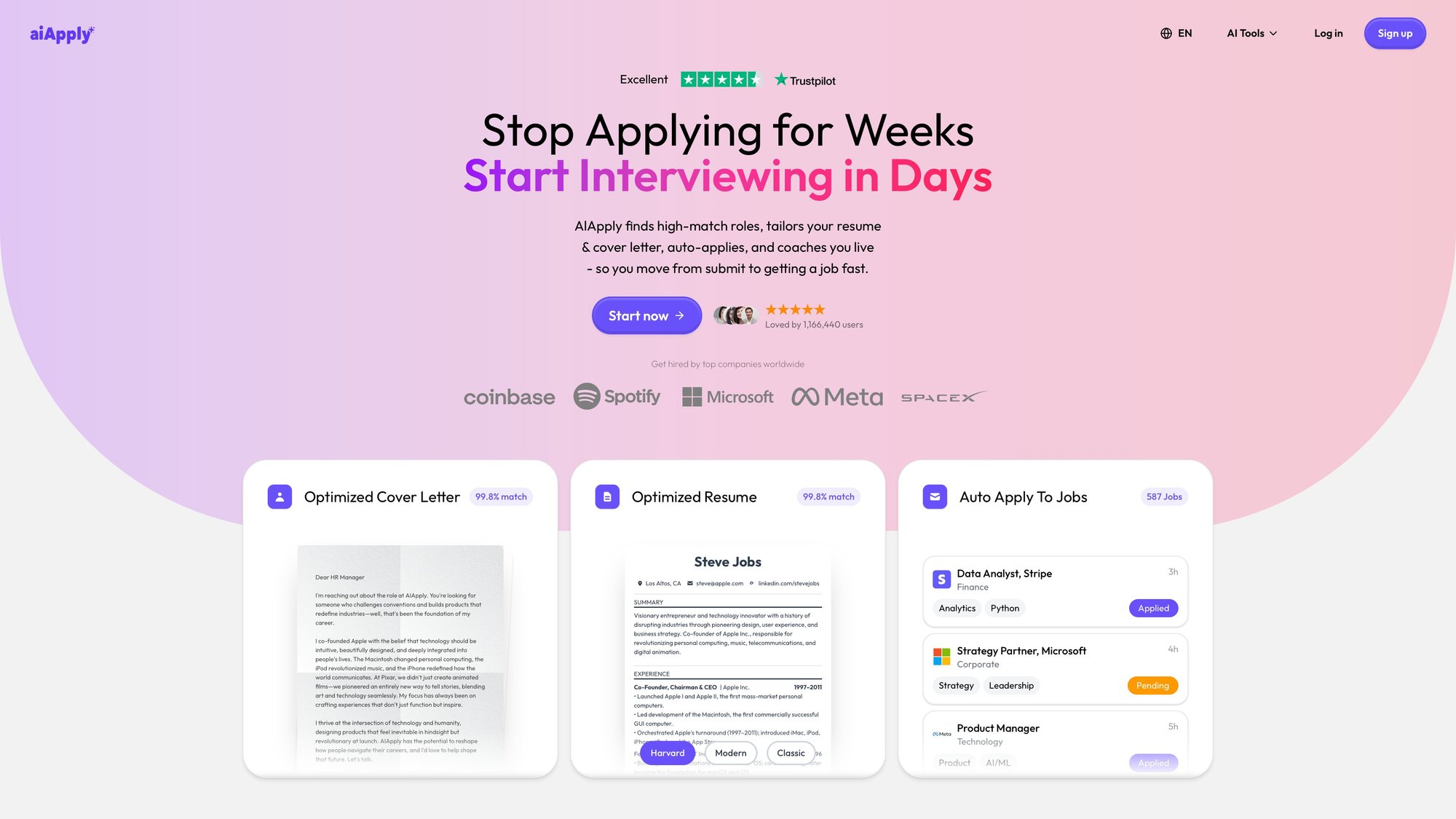
AIApply is most useful when you already have your strategy and proof in place, and you need speed and precision in the execution phase:
→ Turn your proof into job-matched resumes: AI Resume Builder creates tailored, ATS-optimized resumes quickly, so you can customize per role without spending hours.
→ Catch ATS issues before recruiters do: AI Resume Scanner checks compatibility against 50+ ATS systems and flags keyword gaps and formatting problems.
→ Keep cover letters specific without spending hours: AI Cover Letter Generator generates role-specific letters that sound natural, so every application stays personalized.
→ Scale applications without drowning in forms: Auto Apply handles the repetitive submission work while matching roles to your preferences.
→ Practice and refine interviews quickly: Mock Interview lets you rehearse with role-specific questions before the real thing.
The point of AIApply is to remove friction from the process. Not to replace the work of building proof and strategy. Use it to execute faster, not to shortcut honesty.
Frequently Asked Questions: Getting a Job Without a Degree

Do I Need to Pick a Tech Job to Succeed Without a Degree?
No. Tech is one category where proof happens to be easy to demonstrate (you can build and show things digitally), but it's far from the only option. Sales, operations, marketing, skilled trades, and logistics can all be equally viable depending on your local job market. The key isn't the industry. It's whether the role has visible, testable skills and multiple entry ramps.
Will ATS Automatically Reject Me for Not Having a Degree?
Sometimes, yes. If an employer sets a hard filter for a bachelor's degree, your application may get screened out before a human sees it. But this doesn't happen universally. Indeed Hiring Lab's analysis (January 2026) shows that degree requirements exist but are not universal, and they vary significantly by region and job type. Your best defense is a three-part approach: target better postings, route your application to a human when possible, and attach proof.
What's the Fastest Path if I Need Income Right Now?
Look for roles with fast hiring cycles and on-the-job training: operations, customer support, sales (especially SDR roles), and entry-level admin positions. These roles often hire within 1-2 weeks. You can build your proof portfolio and pivot to a higher-paying role while earning income. Check IT support specialist salary data and sales development representative salary data to understand realistic earning expectations as you plan your path.
Should I Do an Apprenticeship or Get an Online Certificate?
If you can get into an apprenticeship, it's hard to beat. Apprenticeships combine paid work experience with structured training, which means you're earning, learning, and building your resume at the same time. The GAO reported in April 2025 that Registered Apprenticeship completers earned about $80,000 in average annual wages during their first year after completing the program. Certificates can help too, especially when paired with proof projects, but they don't carry the same weight alone.
How Many Jobs Should I Apply to Per Week?
Quality beats volume every time. During the active application phase (Days 31-60 of the plan above), aim for 30-60 carefully selected roles total, not 30-60 per week. Each application should be targeted, with a tailored resume and a cover letter that references your proof. Our guide on how many applications you need to send to get a job breaks down realistic expectations. If you're using AIApply's Auto Apply, set strict filters to make sure every submission is a genuine fit.
What if I Have Some College but Didn't Finish?
List it honestly on your resume. "Completed 60 credits toward B.S. in Business Administration, [University Name]" is a perfectly valid entry. Partial college still shows initiative and some structured learning. Combine it with your proof portfolio and certifications, and many employers will view it favorably. Don't leave the education section blank or pretend the coursework didn't happen.
How Do I Explain Gaps in My Resume?
Focus on what you did during the gap, not on the gap itself. If you were building proof projects, freelancing, caring for family, or teaching yourself new skills, say so. The format is simple: "During [time period], I [specific thing you did] which resulted in [outcome or artifact]." Our guide to explaining employment gaps in resumes and interviews has specific language you can adapt. Hiring managers are far more interested in what you can do now than in whether you had a seamless employment history.
Is Networking Really Necessary, or Can I Just Apply Online?
You can get hired through online applications alone, but networking dramatically improves your odds, especially without a degree. A referral signals to the hiring manager that you're a real, vetted human being, not just another name in a stack of 300. According to LinkedIn data, 87% of recruiters actively use the platform for hiring, and referred candidates typically move through the process faster. If networking feels uncomfortable, use the outreach script in this guide. It's designed to be low-pressure and proof-focused.
Can AI Tools Help Me if I Have No Experience at All?
Yes, but only if you use them correctly. Tools like AIApply can help you build a professional resume, generate strong cover letters, and practice interviews. But they can't create experience out of thin air. Start by building your 3 proof projects (Section "Build Proof That Beats a Degree" above), then use AI tools to translate those projects into polished application materials. The combination of real proof + professional documents is what gets results.
What Credentials Are Most Respected by Employers in 2026?
It depends on the role, but some widely recognized options include Google Career Certificates (popular for IT, data analytics, project management, and UX design), AWS certifications (strong for cloud and tech roles), and CompTIA A+ (the standard entry point for IT support). The rule of thumb: choose credentials that show up repeatedly in the job postings you're targeting and that you can demonstrate through a hands-on project. Browse the skills required for an IT support specialist to understand exactly what employers look for before you invest in a certification.
You're not reading this because you want a pep talk about how "degrees don't matter." You're here because you need something much more specific: a way to get an employer to trust you with money and responsibility when you don't have the credential they normally use as a shortcut.
That's a solvable problem. But it takes a real strategy, not just optimism.
Most "jobs without a degree" articles give you a list of 50 roles and call it a day. That's fine if you just want to browse. But if you want to actually get hired, you need to understand how hiring works from the ground up, then build a system that replaces the degree signal with something stronger.
That's what this guide does. By the time you finish reading, you'll have:
A realistic target role (or two) that fits your situation
A proof portfolio plan you can build in weeks, not years
A resume and application approach that survives ATS filters
Networking scripts that don't feel awkward or forced
Interview strategies that turn "no degree" into a non-issue
A 30-60-90 day execution plan you can start today
Time to get into it.
Do Degrees Still Matter for Jobs in 2026?
Two truths are running side by side right now, and you need both of them to avoid wasting months chasing the wrong jobs.
Truth #1: Most job postings don't actually require a bachelor's degree.
According to Indeed Hiring Lab (January 2026), about 19.3% of job postings on Indeed required a bachelor's degree or higher as of November 2025. That means roughly 4 out of 5 postings either require something else (an associate degree, trade certification, etc.) or list no education requirement at all.
It varies wildly depending on where you live and what industry you're targeting. Indeed's analysis also shows that degree requirements are significantly higher in regions with more white-collar roles, with big differences across states and metro areas.
Truth #2: "Skills-first hiring" is real, but unevenly applied.
You've probably heard companies say they hire based on skills, not credentials. And plenty do. But when the market gets tight and recruiters are drowning in applications, many fall back to the easiest filter available: the degree checkbox. A major analysis from Harvard Business School and the Burning Glass Institute (February 2024) found that despite all the "skills-first" talk, the actual shift in hiring outcomes has been modest.
So what does this mean for you?
You can absolutely get hired without a degree in 2026. But you need a strategy that works even when the system defaults to lazy shortcuts.
That strategy boils down to this: replace the "degree signal" with a stronger "proof signal," then deliver it to the right people.
Why Employers Require Degrees (And How to Get Hired Without One)
Before you start applying anywhere, it helps to understand why companies ask for degrees in the first place. Once you see the logic, the whole game becomes predictable.
Employers hire to reduce risk. That's the entire equation. A hiring manager is making a bet every time they extend an offer:
If you work out, the team gets output and results.
If you don't, they lose time, money, morale, and sometimes customers.
They use signals to reduce the downside risk of that bet. A degree is one signal. Not because it magically creates competence, but because it implies a few things:
Persistence: You can finish a multi-year project.
Learning ability: You can absorb structured material and pass assessments.
Professional functioning: You can navigate institutional systems, deadlines, and expectations.
External vetting: Someone else (the university) already evaluated and approved you.
That's it. A degree is a convenience filter. Every single one of those signals can be replaced with something more relevant to the job.
How to Build Your Proof Stack Instead of a Degree
Your job is to create proof signals that are more directly tied to the work than a degree ever could be. Understanding what are transferable skills is the first step, because these are the abilities you already have that map directly to what employers need:
When your signal stack is strong enough, the degree stops mattering for most roles. That's not wishful thinking. It's how hiring actually works for the people who get past the gate.
Jobs That Actually Require a Degree (Non-Negotiable Roles)
Before we go further, a quick reality check. Some roles are legally locked behind a degree or professional license. Spending months trying to brute-force your way into these positions is a waste of energy.
Roles that are typically degree-locked or license-locked (varies by country): doctor, dentist, pharmacist, lawyer, chartered engineer in regulated contexts, and many clinical healthcare roles. Even if you could technically do the work, the law or professional bodies may block you.
If your dream career falls into one of these categories, you have three smart options:
Choose an adjacent role that isn't gated and grow into your target over time
Choose a parallel role that uses similar skills under different regulations
Choose a staged path: earn money while you learn through apprenticeships or part-time programs
This guide focuses on roles where the degree is a preference, not a legal requirement. That's where the opportunity is widest.
How to Choose the Right Job to Target Without a Degree
Most "no degree" career advice fails right at this step. It tells you to "pick something you're passionate about." That's incomplete. Passion is nice, but you also need a role where employers can actually evaluate you without a transcript.
You need a role that fits these four constraints:
1. Skills are visible. You can show proof of your ability without being employed first. Think: portfolios, project outputs, documented work.
2. Skills are testable quickly. The employer can evaluate you with a task or work sample, not just a credential.
3. The work is modular. You can do smaller pieces as projects, freelance gigs, or volunteer work before landing a full-time role.
4. The role has multiple entry ramps. Apprenticeships, junior positions, traineeships, internal transfers. More than one way in.
High-Probability Role Families in 2026
These aren't guarantees. They're families where degree-less entry is common if you bring proof:
→ Tech and IT: IT support specialist, QA testing, junior web developer roles, data analyst positions (market-dependent), cybersecurity analyst entry paths
→ Business operations: Project coordinator, operations coordinator, supply chain coordinator, admin ops
→ Sales: SDR/BDR (Sales Development Representative), inside sales, account support
→ Marketing: Performance marketing assistant, SEO/content ops, lifecycle and email operations
→ Creative: UX/UI designer (portfolio-heavy), video editing, design, content creation
→ Skilled trades: Electrician, HVAC, plumbing, machining (often via apprenticeships)
→ Logistics: Dispatch, warehouse ops leadership track, trucking (license-based, not degree-based)
How to Test Whether a Role Is Right for You Without a Degree
Take 10 job postings for the role you're considering and check:
Does the posting say "degree required" or "degree preferred"?
Does it accept "or equivalent experience"?
What tools show up repeatedly?
What outputs do they care about (reports, tickets closed, revenue, campaign performance, uptime)?
If 7 out of 10 postings genuinely require a degree, you've picked a hard target. Either narrow down to employers that explicitly hire skills-first, or choose a better entry-level role in the same family.
How to Build a Portfolio That Replaces a Degree
This is the core of the entire playbook. If you take one thing from this article, make it this section.
The Minimum Viable Proof Portfolio
You need 3 proofs. Not 12. Not 1. Three.
Each proof should map to one of these buckets:
Proof you can do the day-to-day work of the target role
Proof you can learn fast and self-correct when things go wrong
Proof you can communicate like a professional (writing, presenting, structuring ideas)
Learning how to create a professional portfolio that employers can actually verify is the difference between looking like a serious candidate and being lost in a pile of applications.
Proof Project Examples for Every Career Field
How to Make Your Portfolio Projects Verifiable
Hiring managers have seen too many fake "projects." Your proof has to be verifiable. That means each piece should include:
A link or artifact (portfolio site, PDF, repo, live dashboard)
Your reasoning (why you made the decisions you did)
Your result (even if it's a learning outcome, that counts)
Your next improvement (this shows maturity and self-awareness)
If your application looks generic, recruiters assume you're one of 300 people spraying resumes everywhere. Proof makes you look like one of 5 serious candidates. That's the difference between getting ignored and getting an interview.
How to Get Work Experience Without Being Hired First
"You need experience to get hired, but you need to get hired to get experience." You've heard that catch-22 before. But it's only true if you define "experience" as "someone paid me a salary." Employers don't actually care about the paycheck part. They care about evidence that you've dealt with real constraints.
Here are the fastest ways to create that evidence:
Option A: Micro-Experience (2-20 Hours)
Volunteer one deliverable for a local business or nonprofit
Improve a small workflow for someone you know, then document it
Do a mock project using public data and real tools
Your goal isn't charity. It's a credible case study with your name on it.
Option B: Freelance "Productized" Starter Offers
Instead of saying "hire me for anything," offer one narrow, specific service:
"I will set up a basic CRM pipeline + email templates."
"I will build a KPI dashboard from your spreadsheet."
"I will audit your website for SEO basics and fix the top 10 issues."
Narrow offers reduce buyer risk. That's the same principle behind why employers prefer candidates who specialize.
Option C: Apprenticeships and Earn-While-You-Learn Routes
If you want the most structured "degree alternative" pathway:
UK: The Government's Find an Apprenticeship service is the starting point for searching and applying.
US: Registered Apprenticeships via apprenticeship.gov are a major pathway with federal backing.
And here's a data point that might surprise you: the U.S. Government Accountability Office (GAO) reported in April 2025 that Registered Apprenticeship completers in two recent cohorts earned about $80,000 in average annual wages in the first year after completing their program. That's based on Department of Labor data for April 2022 and March 2023 completers.
That doesn't mean every apprenticeship pays $80k. But it does mean apprenticeships can be a serious career pathway, not just "cheap labor."
Which Certifications Help You Get Hired Without a Degree
Credentials can help you clear automated screening filters. But a lot of people misuse them by collecting certificates like they're badges in a video game, without ever building proof of what they can actually do.
Which Credentials Actually Matter for Getting Hired
From strongest signal to weakest:
① Work samples with outcomes
② References from credible people
③ Proctored certifications with real exams
④ Well-known professional certificates with attached projects
⑤ Random course completions
If you don't have a degree, your best combination is usually 1-2 credible credentials plus 3 strong proof projects. Not 12 certificates and zero proof.
What Credible Credentials Cost in 2026
These prices can change, so treat them as current-as-of-now references:
Google Career Certificates on Coursera: Coursera lists $49/month in the U.S. and Canada after a 7-day trial, and many learners finish in under 6 months (often under ~$300 total if you move steadily).
AWS Certified AI Practitioner: AWS lists the exam at $100 USD on the official page (cost can vary by region and taxes).
CompTIA A+ (IT support entry point): CompTIA's current version (220-1201/220-1202) launched March 25, 2025 and requires passing two exams (Core 1 and Core 2).
How to Choose the Right Certification for Your Job Target
Pick credentials that:
Show up in the job postings you're targeting
Map to real tasks you'll do in your first week on the job
Can be demonstrated through a portfolio project
If you can't build a project from the credential, it's probably not worth leading with.
How to Write a Resume When You Don't Have a Degree
What most people miss about resumes: your resume is not your life story. It's an evidence packet.
A recruiter scanning your resume is asking three questions:
Do you match the role?
Is your experience credible?
Is it easy for me to say "yes" and move you forward?
If the answer to all three is yes, your education section barely matters.
The Best Resume Format Without a Degree in 2026
Use a skills-first structure. Understanding effective resume formats will help you choose the right approach for your specific situation:
Headline: Target role + specialty
Example: "IT Support Specialist | Windows + Google Workspace | Ticketing + Troubleshooting"
Summary (3-5 lines): What you do, what tools you use, what outcomes you've driven, and where to find your proof.
Skills (grouped): Tools, systems, and workflows relevant to the role. See our guide to skills for your resume for a comprehensive breakdown of what to include.
Proof Projects: 2-4 projects with links and measurable outcomes.
Experience: Even non-traditional experience counts. Translate it into job-relevant impact.
Education: Optional. If you have partial college or relevant coursework, list it honestly.
How to Write Resume Bullets That Make Any Experience Count
Use this structure for every bullet point:
Action + Tool + Scope + Result
Example: "Resolved 25+ weekly device and account issues using structured triage, reducing repeat tickets by 18%."
Even if that came from volunteering for a friend's small business, it reads like professional experience because it focuses on the work and the outcome. See our resume bullet point examples for more templates you can adapt directly.
How to Handle the Degree Question
Don't hide it. Don't lie.
If an application form asks "Do you have a degree?" and you don't, answer honestly. Your strategy isn't about tricking the ATS. It's about:
Targeting jobs where the degree isn't a hard requirement
Attaching proof so a human wants you anyway
Using networking to get past automatic filters when possible
How to Use AI Tools to Speed Up Your Job Applications
This is where AIApply fits into your resume workflow. Our tools are designed for exactly this problem: converting "I can do the work" into documents that match what the job ad is looking for.
AI Resume Builder: Creates ATS-optimized resumes with job-description tailoring and support for multiple versions, so you can customize without starting from scratch each time.
AI Resume Scanner: Checks your resume against 50+ ATS systems for compatibility, keyword coverage, and formatting issues before a recruiter ever sees it.
AI Cover Letter Generator: Generates a tailored cover letter quickly, so you can keep every application specific instead of sending the same generic letter everywhere.
One important rule: Use AI to clarify and tailor your materials. Never use it to invent employers, degrees, or results you don't have. In 2026, background checks are faster than ever.
How to Apply for Jobs Without a Degree and Not Get Filtered Out
The biggest blind spot for candidates without degrees isn't a lack of skills. It's applying to the wrong jobs in the wrong order.
Without a degree, you need precision + proof + routing. Spraying 500 generic applications won't work. Understanding how to use ATS-friendly resume templates is essential, because these systems screen your application before any human ever sees it.
How to Find Degree-Optional Postings Faster
Look for these phrases in job listings:
"Degree preferred" (not required)
"Or equivalent experience"
"Relevant experience"
"Or comparable training"
"Apprentice," "trainee," "associate," "junior"
Avoid postings that say "bachelor's required" unless you have a warm referral and your proof portfolio is exceptional.
The Right Order to Submit Job Applications Without a Degree
Not all applications are equal. Prioritize like this:
Jobs where you have a referral (highest chance of getting seen)
Jobs where you match 70%+ and the degree is "preferred"
Jobs where you match 80%+ even if the degree line is strict (only if you can route your application to a human)
How to Lead With Your Portfolio to Get Past Degree Filters
In your cover letter and the opening lines of your resume summary, mention your proof immediately:
"Portfolio: 3 role-relevant projects (ticketing lab, troubleshooting playbook, KPI dashboard)."
Make it effortless for a recruiter to verify you're worth a closer look. Tailoring your resume to the job description is equally important, because a generic resume is the fastest way to get filtered out.
Scale Applications Without Losing Quality
If you're applying at volume, you still need personalization. AIApply's Auto Apply is built to automate the repetitive parts of the application process while matching roles to your preferences and using your tailored resume and cover letter.
One caution worth keeping in mind: high-volume applying can burn employer goodwill if you're not actually a strong fit for the roles you're targeting. Set strict filters and review what's being sent on your behalf. Automation should amplify a good strategy, not replace one.
How to Network Your Way Into a Job Without a Degree
This is the single most powerful lever in a no-degree job search, and most people avoid it because it feels uncomfortable.
A better way to think about it: networking isn't "using people." It's reducing uncertainty on both sides. A referral tells a hiring manager "this person is real," and it tells you "this company actually values what I bring."
Read our guide on how to attract job recruiters for a deeper look at positioning yourself to be found, not just to apply.
The 15-Minute Proof-Based Outreach Script
Copy this, personalize it, and send it:
Hi [Name], I'm breaking into [role] and noticed you work at [company/team].
I don't have a [degree type], so I'm building proof instead: [one sentence about your portfolio/project].
If you have 15 minutes, I'd love your feedback on what skills matter most for [role] at [company] and what would make a candidate stand out.
Either way, appreciate your work on [specific thing you noticed].
This works because it's specific, respectful, and it signals that you're serious enough to have built something real. You're not asking for a job. You're asking for feedback.
The Follow-Up That Gets You Interviews
After the conversation, send them:
Your one-page proof summary (projects, skills, links)
The ask: "Would it be reasonable for me to apply to [role link]? If so, is there someone I should mention or a best way to route my application?"
This is how you bypass degree filters without begging for a favor. You're offering proof and asking for a routing recommendation.
How to Interview for a Job When You Don't Have a Degree
When you walk into an interview without a degree, the conversation isn't really about convincing someone you're smart. It's about proving you're safe to hire.
A 4-Part Strategy for Job Interviews Without a Degree
1. Tell a coherent story. Why this role, why now, and why you'll stick around. Interviewers want to see intention, not desperation.
2. Show proof. Bring your portfolio. Walk through a project. Show real output. Don't just talk about what you could do.
3. Demonstrate thinking. Explain tradeoffs, constraints, and how you debug problems. Employers want to see how your brain works, not just what it's memorized.
4. Reduce risk. Talk about how you learn new things, how you take feedback, and how you communicate when you're stuck. This is what actually calms a hiring manager's nerves.
Handling "Why Don't You Have a Degree?"
When this question comes up (and it might), use a calm, non-defensive answer:
"I chose an alternative route. Instead of spending 3-4 years on a broad program, I built role-specific skills and proof. Here are the projects and outcomes that match your job requirements."
Then show proof. Always redirect to the evidence.
The degree question is a test of composure as much as explanation. A confident, proof-backed answer almost always lands better than a defensive one.
How to Practice for Job Interviews Without Formal Training
Use mock interviews with the actual job description, not generic question lists. AIApply's Mock Interview tool lets you paste a job description and practice role-specific questions with AI-powered feedback, so you're rehearsing for the exact conversation you'll have.
For entry-level interview questions that frequently come up when you're breaking into a new field, we've compiled the most common ones with sample answers. And for behavioral questions specifically, we've put together a STAR Method Interview Examples guide that's a solid reference for building a story bank and practicing structured answers.
AIApply also offers an Interview Answer Buddy for real-time interview assistance. If you do use real-time help, be aware that some employers consider it a policy violation. Use it ethically, and prefer using it for practice unless you have explicit permission.
How to Succeed in Your First Job Without a Degree
Getting hired isn't the finish line. It's the first rung.
Your goal in the first 90 days on the job is straightforward: become someone the team relies on. That means:
Show up consistently (this sounds basic, but it matters more than you'd think)
Communicate clearly when things are going well and when they aren't
Deliver small wins fast before trying to change the world
Ask good questions instead of pretending to know everything
Document what you learn (this becomes your promotion ammunition later)
Performance compounds over time. A person who ships results every week for a year builds a reputation that no degree can match. That's how you outrun the "degree disadvantage" permanently. Having a career development plan from day one gives you a roadmap for those early milestones.
Your 30-60-90 Day Plan to Get Hired Without a Degree
If you're starting from zero, here's a practical timeline you can follow.
Days 1-30: Build Proof and Your Target Narrative
Pick 1 target role and 1 backup role
Collect 30 job postings for both. Extract the top 15 skills that keep showing up
Build 3 proof projects that map directly to those skills
Create a skills-first resume + one tailored version for your top 10 target jobs
Set up a simple tracking system (we offer a free job search tracker that works well for this)
Output at Day 30: A portfolio, a resume that matches real jobs, and tangible proof you can show to anyone.
Days 31-60: Apply and Get in Front of Real People
→ Apply to 30-60 carefully selected roles (quality over volume)
→ Do 5 informational calls per week using the outreach script above
→ Ask for 2 referrals per week (only after you've shown your proof)
→ Practice interviews twice per week (mock sessions + building your story bank)
Days 61-90: Convert Interviews Into Offers
① Build a tailored "work sample" for each interview loop
② Follow up with a short proof recap after every interview
③ Keep your pipeline alive: 10 new applications per week until you sign an offer
Common Mistakes That Kill No-Degree Job Searches
Trap: Collecting Certificates Instead of Building Proof
Fix: Every credential you pursue must produce a portfolio artifact. If you can't build a project from it, it's not adding real value to your candidacy.
Trap: Applying to Everything
Fix: Pick a role family and dominate it with role-specific proof. Being a generalist with no degree is the hardest path. Being a focused candidate with targeted evidence is the easiest.
Trap: Hiding or Lying About Your Education
Fix: Be honest. Replace the missing degree signal with stronger signals. Lying on a resume in 2026 is a career-ending risk that's simply not worth taking.
Trap: Assuming Rejection Means You're Not Good Enough
Fix: Treat job searching like debugging software. Change one variable at a time. If you're getting interviews but no offers, the problem is likely in your interview approach. If you're not getting interviews at all, the problem is in your resume, targeting, or routing.
Most job search problems are diagnostic, not personal. Changing one variable at a time is how you find what's actually blocking you.
AI Tools That Speed Up Your No-Degree Job Search
AIApply is most useful when you already have your strategy and proof in place, and you need speed and precision in the execution phase:
→ Turn your proof into job-matched resumes: AI Resume Builder creates tailored, ATS-optimized resumes quickly, so you can customize per role without spending hours.
→ Catch ATS issues before recruiters do: AI Resume Scanner checks compatibility against 50+ ATS systems and flags keyword gaps and formatting problems.
→ Keep cover letters specific without spending hours: AI Cover Letter Generator generates role-specific letters that sound natural, so every application stays personalized.
→ Scale applications without drowning in forms: Auto Apply handles the repetitive submission work while matching roles to your preferences.
→ Practice and refine interviews quickly: Mock Interview lets you rehearse with role-specific questions before the real thing.
The point of AIApply is to remove friction from the process. Not to replace the work of building proof and strategy. Use it to execute faster, not to shortcut honesty.
Frequently Asked Questions: Getting a Job Without a Degree
Do I Need to Pick a Tech Job to Succeed Without a Degree?
No. Tech is one category where proof happens to be easy to demonstrate (you can build and show things digitally), but it's far from the only option. Sales, operations, marketing, skilled trades, and logistics can all be equally viable depending on your local job market. The key isn't the industry. It's whether the role has visible, testable skills and multiple entry ramps.
Will ATS Automatically Reject Me for Not Having a Degree?
Sometimes, yes. If an employer sets a hard filter for a bachelor's degree, your application may get screened out before a human sees it. But this doesn't happen universally. Indeed Hiring Lab's analysis (January 2026) shows that degree requirements exist but are not universal, and they vary significantly by region and job type. Your best defense is a three-part approach: target better postings, route your application to a human when possible, and attach proof.
What's the Fastest Path if I Need Income Right Now?
Look for roles with fast hiring cycles and on-the-job training: operations, customer support, sales (especially SDR roles), and entry-level admin positions. These roles often hire within 1-2 weeks. You can build your proof portfolio and pivot to a higher-paying role while earning income. Check IT support specialist salary data and sales development representative salary data to understand realistic earning expectations as you plan your path.
Should I Do an Apprenticeship or Get an Online Certificate?
If you can get into an apprenticeship, it's hard to beat. Apprenticeships combine paid work experience with structured training, which means you're earning, learning, and building your resume at the same time. The GAO reported in April 2025 that Registered Apprenticeship completers earned about $80,000 in average annual wages during their first year after completing the program. Certificates can help too, especially when paired with proof projects, but they don't carry the same weight alone.
How Many Jobs Should I Apply to Per Week?
Quality beats volume every time. During the active application phase (Days 31-60 of the plan above), aim for 30-60 carefully selected roles total, not 30-60 per week. Each application should be targeted, with a tailored resume and a cover letter that references your proof. Our guide on how many applications you need to send to get a job breaks down realistic expectations. If you're using AIApply's Auto Apply, set strict filters to make sure every submission is a genuine fit.
What if I Have Some College but Didn't Finish?
List it honestly on your resume. "Completed 60 credits toward B.S. in Business Administration, [University Name]" is a perfectly valid entry. Partial college still shows initiative and some structured learning. Combine it with your proof portfolio and certifications, and many employers will view it favorably. Don't leave the education section blank or pretend the coursework didn't happen.
How Do I Explain Gaps in My Resume?
Focus on what you did during the gap, not on the gap itself. If you were building proof projects, freelancing, caring for family, or teaching yourself new skills, say so. The format is simple: "During [time period], I [specific thing you did] which resulted in [outcome or artifact]." Our guide to explaining employment gaps in resumes and interviews has specific language you can adapt. Hiring managers are far more interested in what you can do now than in whether you had a seamless employment history.
Is Networking Really Necessary, or Can I Just Apply Online?
You can get hired through online applications alone, but networking dramatically improves your odds, especially without a degree. A referral signals to the hiring manager that you're a real, vetted human being, not just another name in a stack of 300. According to LinkedIn data, 87% of recruiters actively use the platform for hiring, and referred candidates typically move through the process faster. If networking feels uncomfortable, use the outreach script in this guide. It's designed to be low-pressure and proof-focused.
Can AI Tools Help Me if I Have No Experience at All?
Yes, but only if you use them correctly. Tools like AIApply can help you build a professional resume, generate strong cover letters, and practice interviews. But they can't create experience out of thin air. Start by building your 3 proof projects (Section "Build Proof That Beats a Degree" above), then use AI tools to translate those projects into polished application materials. The combination of real proof + professional documents is what gets results.
What Credentials Are Most Respected by Employers in 2026?
It depends on the role, but some widely recognized options include Google Career Certificates (popular for IT, data analytics, project management, and UX design), AWS certifications (strong for cloud and tech roles), and CompTIA A+ (the standard entry point for IT support). The rule of thumb: choose credentials that show up repeatedly in the job postings you're targeting and that you can demonstrate through a hands-on project. Browse the skills required for an IT support specialist to understand exactly what employers look for before you invest in a certification.
.webp)
%20(1).webp)
.webp)
Don't miss out on
your next opportunity.
Create and send applications in seconds, not hours.


