
How To Negotiate Remote Work In Job Offers (2026)


Remote work didn't die. It just got harder to secure.
Large cross-country surveys of college-educated workers across 40 countries show work-from-home levels have plateaued since 2023, averaging about 1.23 paid days per week at home in late 2024 and early 2025. That's roughly 25% of your workweek.
But here's what makes remote work tricky: demand from job seekers is far higher than supply.
LinkedIn's research from July 2025 found that remote roles made up just 8.5% of job postings in the United States, while 40.2% of applications by women and 36.1% by men went to those remote positions.
The reality: Remote work is still a top preference for job seekers, and it's still a competitive advantage for the companies that offer it. But you can't just ask nicely and hope for the best.
You need to approach it like a real negotiation.
This guide gives you everything: what to ask for, when to ask, exactly what to say (word-for-word scripts), how to handle pushback, what you can trade without tanking the offer, and how to lock your remote arrangement into the contract so it doesn't disappear after you start.
What Are You Really Negotiating? (It's Not Just Remote)
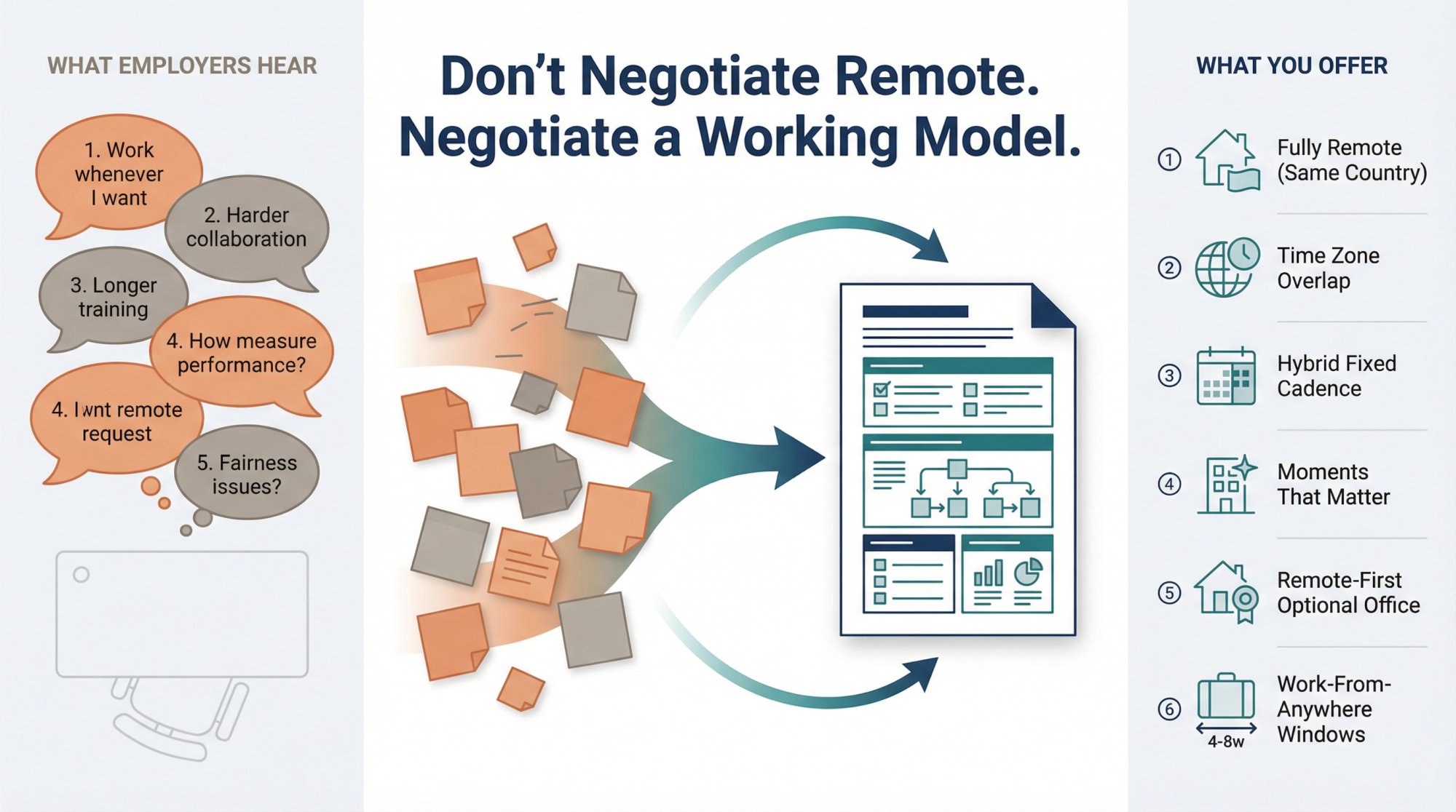
When candidates say "I want remote work," employers often hear:
"I want to work whenever I want."
"Collaboration will be harder."
"Training will take longer."
"How will we measure performance?"
"Will this create fairness issues across the team?"
So don't negotiate "remote." Negotiate a working model.
There are at least 6 different remote outcomes people mean when they say they want flexibility:
① Fully remote (same country)
You work from home permanently, staying within the same country for tax and payroll purposes.
② Fully remote (specific time zone overlap)
You can work from anywhere, but you're required to maintain certain core hours that overlap with the team.
③ Hybrid with a fixed cadence
For example: 2 days in the office, 3 days at home. The schedule is predictable and consistent.
④ Hybrid with "moments that matter"
You're in the office for planning sessions, product launches, quarterly offsites, or other high-collaboration events. The rest is remote.
⑤ Remote-first with optional office access
The default is remote, but you can use office space if you want it. No requirement to show up.
⑥ Work-from-anywhere windows
You work from a primary location most of the year, but you're allowed 4-8 weeks abroad or in a different city.
The most successful negotiators don't ask for "remote." They ask for a structure.
They specify:
• Where they'll work
• When they'll overlap with the team
• How they'll communicate
• How performance will be measured
• When they'll be in person
• What equipment and security standards they'll follow
That turns "remote work" from a vague preference into an operational plan the employer can actually say yes to.
Remote Work Statistics 2026: What The Data Shows
A lot of companies have tightened flexibility over the past couple of years, especially around hybrid expectations. Here's what the numbers actually show.
UK Hybrid Work: How Many Office Days Are Required?
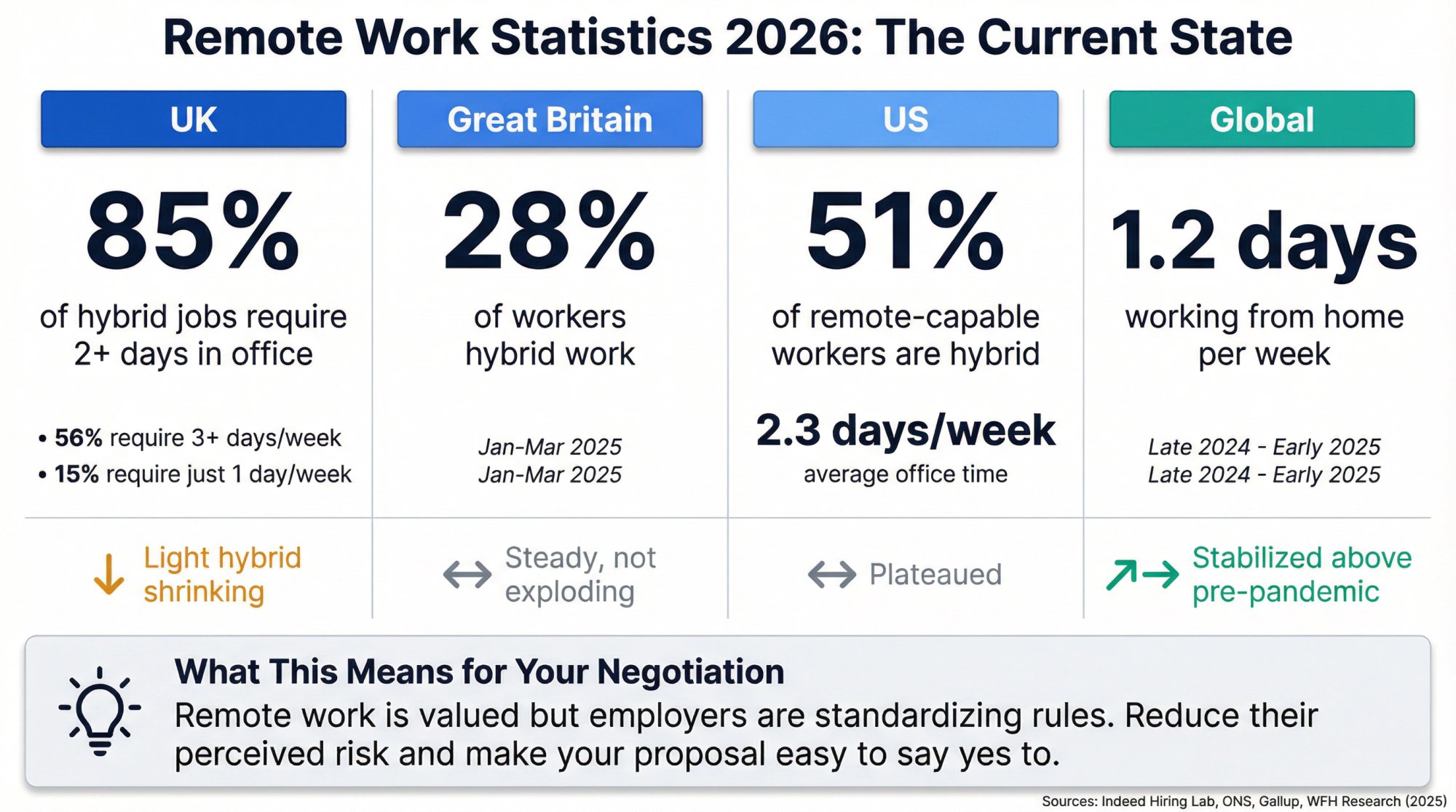
Data from Indeed Hiring Lab (September 2025) analyzed UK hybrid job ads and found that most now require 2-3 days per week in the office.
Specifically:
85% of hybrid postings specified a minimum of 2+ days/week in the office
56% specified 3+ days/week
Only 15% required just 1 day/week
About 15% didn't specify a minimum number of office days
Great Britain Remote Work Percentage: How Many Work Hybrid?
The UK Office for National Statistics reported that 28% of working adults in Great Britain hybrid worked between January and March 2025.
US Hybrid Work Statistics: How Many Days In Office?
Gallup's September 2025 update shows the hybrid model is still holding, but it's not getting more flexible:
Hybrid among remote-capable U.S. employees dipped slightly from 55% to 51% over two quarters
Hybrid workers spend 46% of their workweek in the office (about 2.3 days/week)
Gallup reports no significant movement in the past year
Global Work From Home Statistics: How Common Is Remote?
The global survey evidence suggests work-from-home has "bottomed out" at a materially higher level than pre-pandemic, averaging roughly 1.2 days per week from home in late 2024 and early 2025.
What Remote Work Statistics Mean For Your Negotiation
What This Means for Your Negotiation
Remote work is still valued. But many employers are now trying to:
• Standardize rules (to reduce manager-by-manager inconsistency)
• Protect onboarding and company culture
• Reduce perceived "coordination drag"
• Avoid setting a precedent they can't scale across the organization
The winning move? Reduce their perceived risk and make your proposal easy to say yes to.
Can This Job Be Done Remotely? (3 Tests Before You Ask)
Only negotiate remote work after you've answered this question:
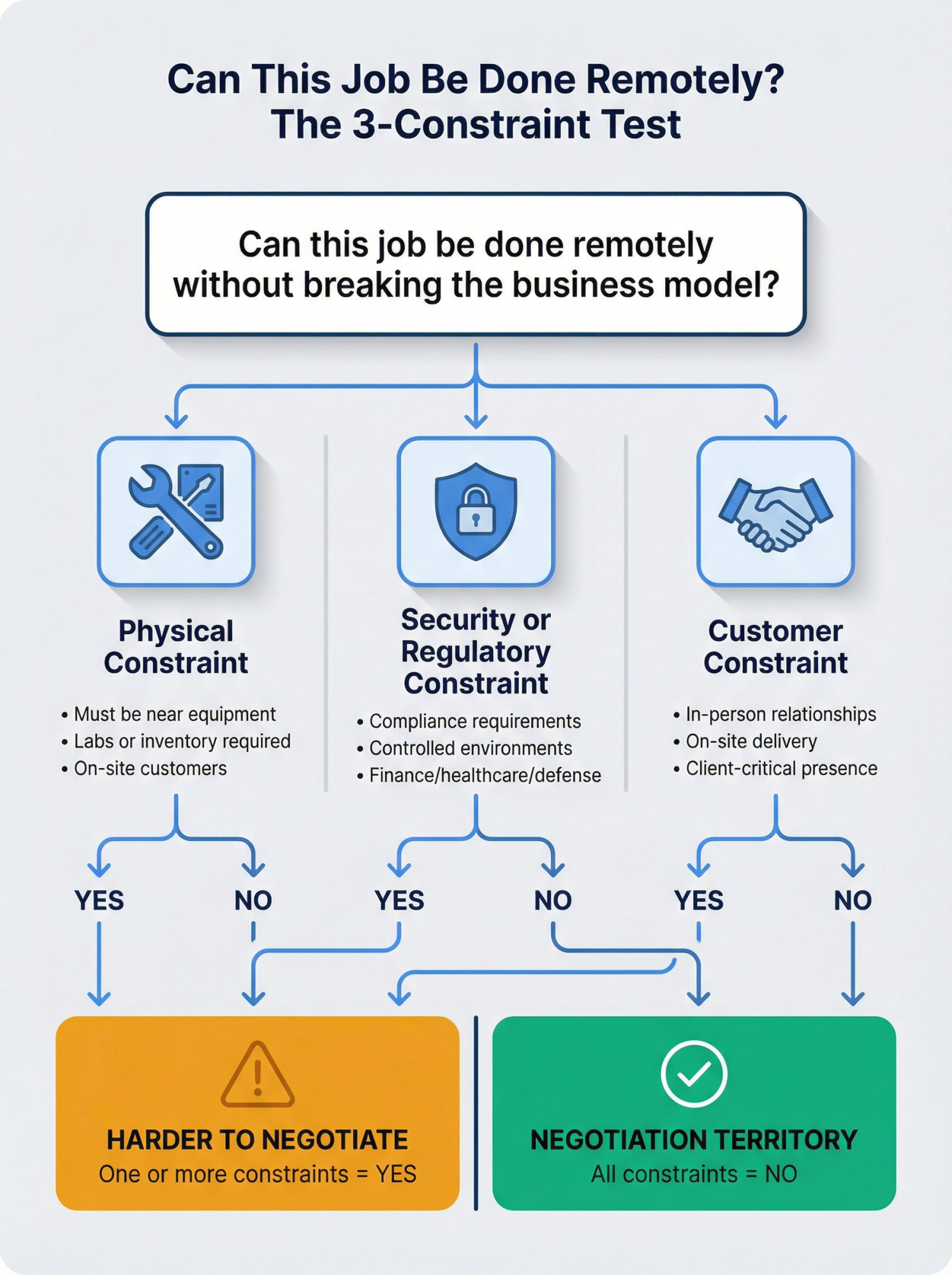
"Can this job be done remotely without breaking the business model?"
Fast Test: The 3 Constraints
If any of these are "yes," remote work will be harder to negotiate:
1. Physical constraint
You must be near equipment, labs, inventory, patients, or on-site customers.
2. Security or regulatory constraint
The company's compliance requirements demand controlled environments (think finance, healthcare, defense).
3. Customer constraint
The role is built around in-person relationships or on-site delivery.
If none of these apply, you're in negotiation territory.
Remote Work Job Description Signals: What To Look For
Positive signals:
• "Distributed team," "remote-first," "async," "time zone overlap"
• Results-based language: "deliver," "own," "ship," "metrics"
• Written communication emphasized
Negative signals:
• "In-office collaboration is essential"
• "Must be local" or "must be within commuting distance"
• "On-site presence required" for routine responsibilities
Questions To Ask Before The Offer (Without Looking Demanding)
Use this wording during your job interviews:
"How does the team collaborate day-to-day? More async docs, or mostly meetings?"
"What does success in the first 60-90 days look like?"
"How often is the team together in person, and for what activities?"
"Is this role tied to a specific office for tax or payroll reasons, or is location flexible?"
These questions do two things:
1. Gather the constraints that will shape your proposal later
2. Normalize flexibility as an operational discussion, not a perk request
How Strong Is Your Remote Work Negotiation Position?
Remote work is a non-wage amenity. And like salary, it's negotiated most successfully when you have leverage.
LinkedIn's research explicitly frames remote work as something workers and firms bargain over in the labor market.
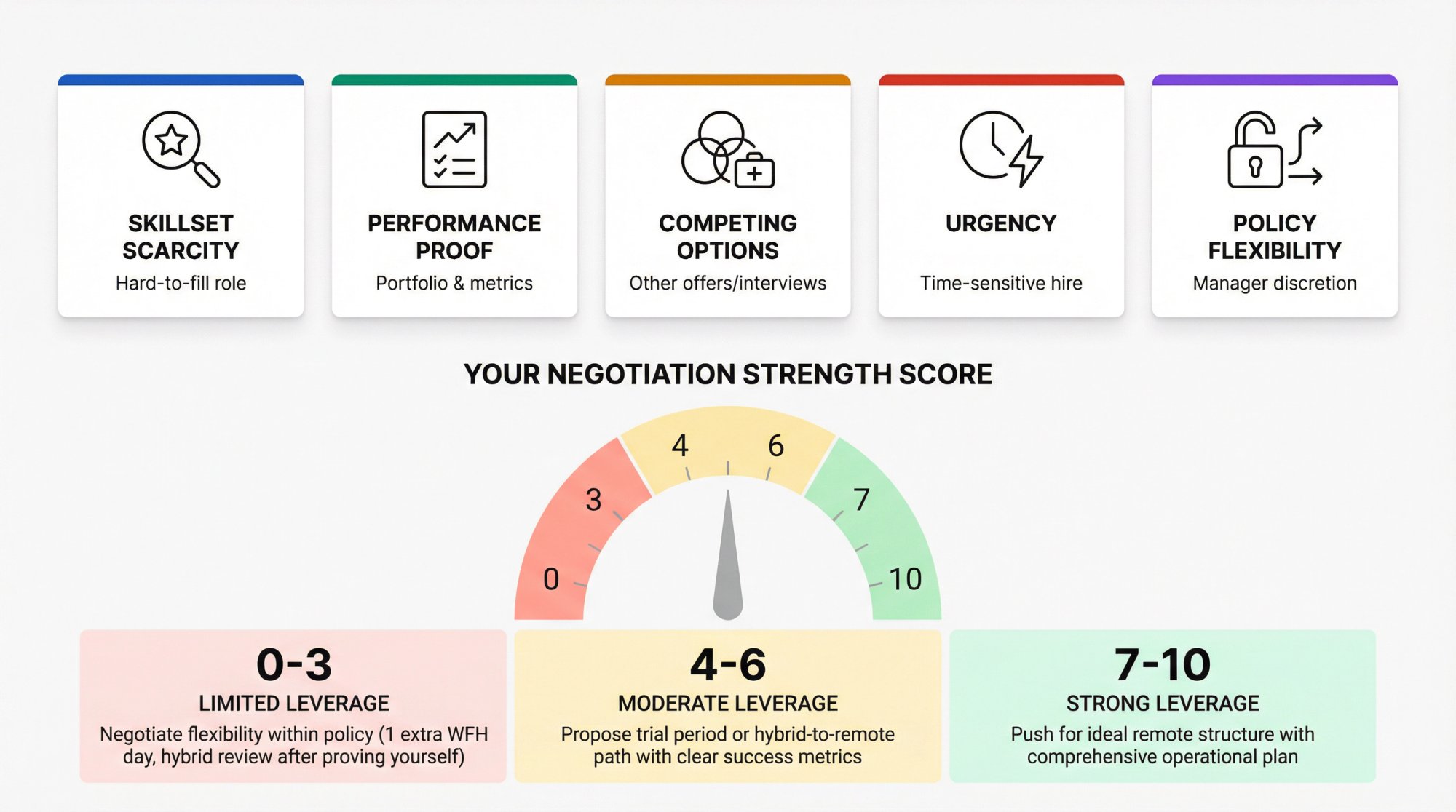
5 Sources Of Remote Work Negotiation Leverage
1. Scarcity of your skillset (hard-to-fill role)
If they've been searching for months or the role requires rare expertise, you have power.
2. Evidence you'll perform fast (portfolio, metrics, proof)
Show concrete results from past work. Numbers speak louder than promises. Use tools like AIApply's Resume Builder to highlight your remote-ready accomplishments with quantifiable metrics.
3. Competing options (another offer, late-stage pipeline)
If you have other interviews in final stages or another offer on the table, you're negotiating from strength. Learn how to find jobs quickly to build your pipeline.
4. Employer's need for speed (urgent hire, project deadline)
If they need someone to start immediately or solve a pressing problem, that's leverage.
5. Company policy flexibility (some managers can approve exceptions)
If the hiring manager has decision power (not purely HR policy), exceptions are possible.
How To Assess Your Remote Work Negotiation Strength
Give yourself 1 point for each that's true:
Your Score Interpretation:
• 7-10 points: Push for your ideal remote structure (with a strong operational plan)
• 4-6 points: Propose a trial or a hybrid-to-remote path
• 0-3 points: Negotiate for flexibility that doesn't break policy (e.g., 1 extra WFH day, "moments that matter" hybrid, or a future review after you prove yourself)
When To Negotiate Remote Work In A Job Offer
Best Time: After The Offer, Before You Accept
The best time is after you receive the offer (or a verbal offer), when the company has made an emotional and logistical commitment. But it's before the paperwork is finalized.
At this point:
• They've already decided you're the one
• They've invested time and energy
• They don't want to start the search over
• But nothing is locked yet
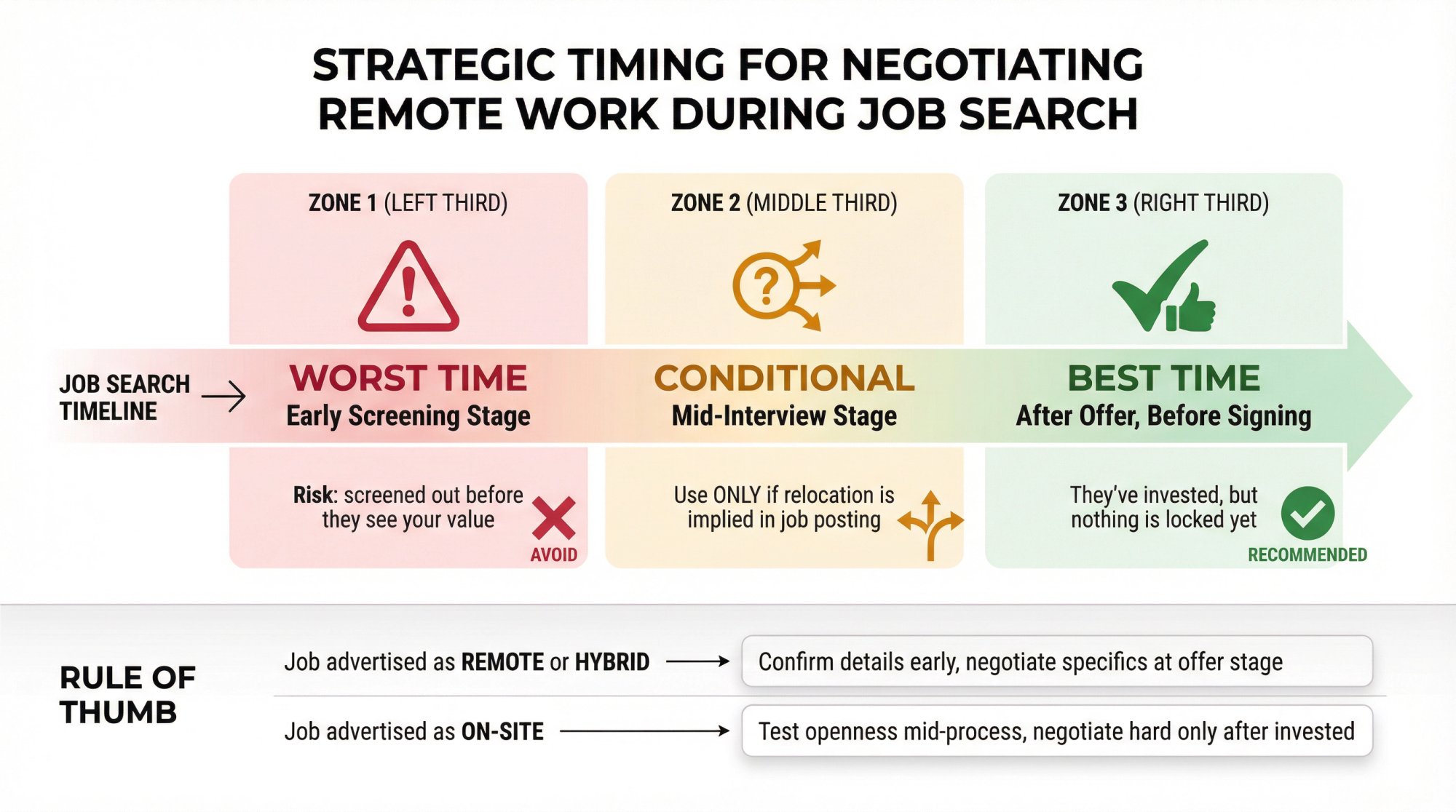
When To Bring Up Remote Work During Interviews
If you're in another city or country and relocation is implied in the job posting, raise remote work before they draft an offer. Otherwise, they may feel blindsided when you bring it up later.
Worst Time To Ask For Remote Work: Early Screening
Early remote demands can get you screened out before they see your value. Wait until they're invested.
Rule of thumb:
• If the job is advertised as remote or hybrid → confirm details early, negotiate specifics at the offer stage.
• If the job is advertised as on-site → test openness mid-process, negotiate hard only after they're invested in you.
How To Negotiate Remote Work: 7-Step Framework
This is the structure you want. It's calm, professional, and positions remote work as a business solution (not a personal preference).
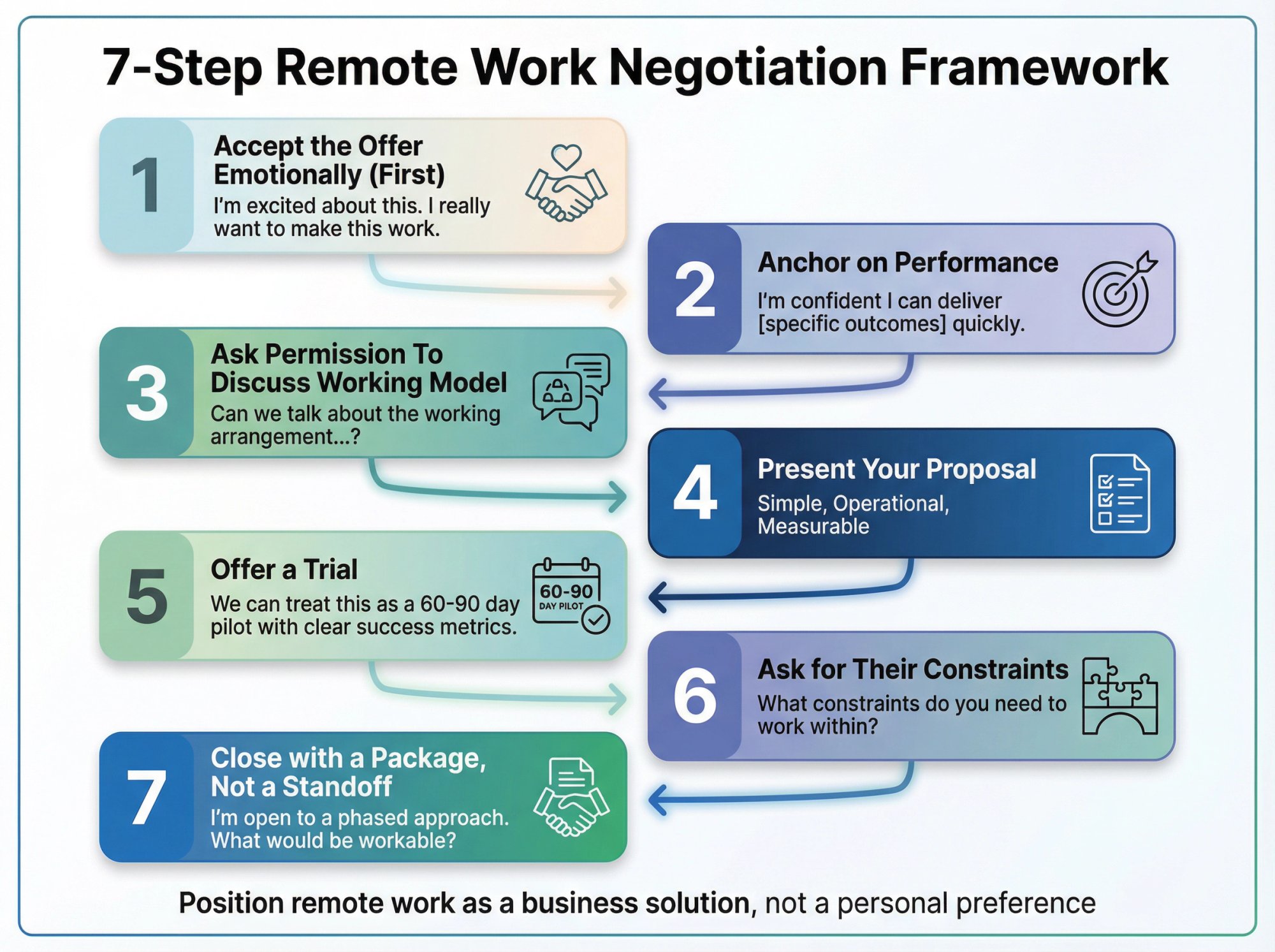
Step 1: Accept the Offer Emotionally (First)
Start with enthusiasm.
"I'm excited about this. I really want to make this work."
This shows good faith and reduces defensiveness.
Step 2: Anchor on Performance
Frame everything around outcomes, not convenience.
"I'm confident I can deliver [specific outcomes] quickly."
Use real examples from your past work if possible. If you need help articulating your value, AIApply's Resume Builder can help you identify and quantify your strongest achievements.
Step 3: Ask Permission To Discuss Working Model
Make it collaborative, not confrontational.
"Can we talk about the working arrangement so I can set myself up to deliver those outcomes?"
This positions the conversation as problem-solving, not demands.
Step 4: Present Your Proposal (Simple, Operational, Measurable)
Don't say "I want remote."
Instead, lay out:
• Core hours and overlap with the team
• Cadence for in-person moments (if hybrid)
• Your onboarding plan
• Communication system you'll use
• Performance checkpoints
Example:
"I'm proposing fully remote with core hours from 10 AM to 4 PM Eastern for overlap. I'll join planning sessions in person quarterly, and we can use weekly written updates plus a standing 1:1 to stay aligned. After 90 days, we can review based on deliverables and stakeholder feedback."
Step 5: Offer a Trial (Reduces Risk)
Give them an easy way to say yes without committing forever.
"If helpful, we can treat this as a 60-90 day pilot with clear success metrics."
Trials work because they reduce the employer's perceived risk.
Step 6: Ask for Their Constraints (Turn It Into Problem-Solving)
This is where you flip from "selling" to "solving."
"What constraints do you need to work within? Policy, client needs, security, or something else?"
When you ask this, you're showing that you understand their side. You're not being difficult. You're trying to find a solution that works for both of you.
Step 7: Close with a Package, Not a Standoff
If they push back, don't dig in. Pivot to options.
"If full remote isn't possible immediately, I'm open to a phased approach. What would be workable from your side?"
This is the mindset shift: You're not requesting permission. You're designing a model that makes success easier for everyone.
Remote Work Objections: How To Handle 12 Common Concerns
Use these like building blocks. Don't dump them all at once. Pick the ones that match what you're hearing.
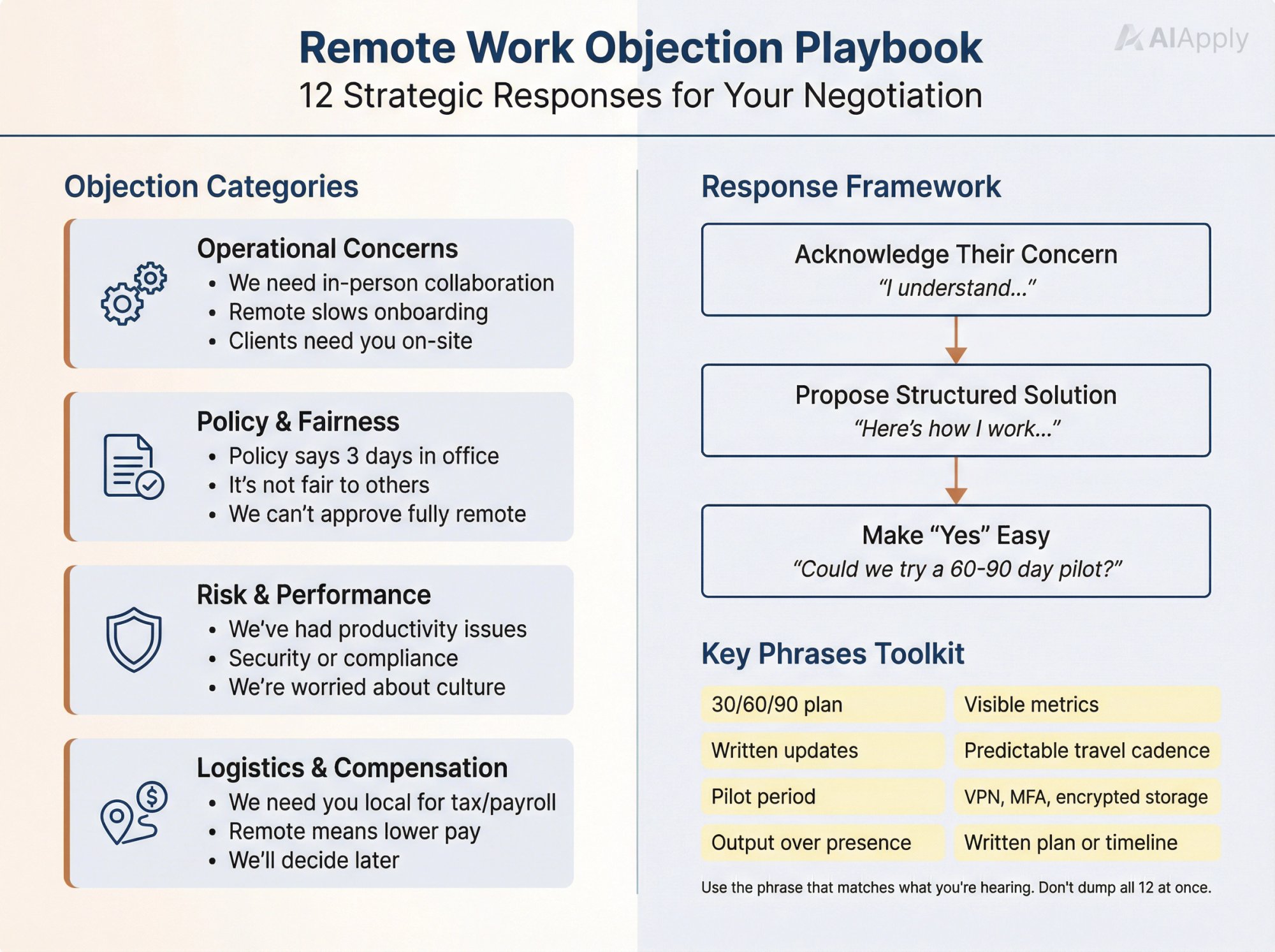
Objection 1: "We need in-person collaboration."
Your answer:
"I agree collaboration matters. That's why I'm proposing structured in-person time for the activities that truly benefit from it (planning, retros, workshops, stakeholder alignment) while keeping heads-down execution remote. I'll also document decisions so everyone stays aligned."
Objection 2: "Remote slows onboarding."
Your answer:
"I can make onboarding easier by creating a written 30/60/90 plan, scheduling weekly check-ins, and maintaining a shared doc of questions and progress. I've ramped remotely before and can show how I stay accountable."
Objection 3: "It's not fair to others."
Your answer:
"I respect internal fairness. If exceptions are difficult, we can frame this as a role-based arrangement tied to outcomes and responsibilities, plus a pilot period. I want this to be sustainable for the team, not a one-off problem."
Objection 4: "Policy says 3 days in the office."
Your answer: "I understand. If the full policy can't change, could we explore flexibility on which days, or a phased plan? For example: 3 days during onboarding, then reassess after 90 days based on outcomes."
Objection 5: "We've had productivity issues with remote."
Your answer:
"That makes sense. Remote doesn't work without systems. Here's how I work: written updates, clear deliverables, visible metrics, and proactive communication. If we define output metrics, it's easier to manage than hours in a chair."
Objection 6: "Clients need you on-site."
Your answer: "I'm happy to be on-site for client moments that truly require it. Could we map which meetings or activities are client-critical and build a predictable travel cadence into the role?"
Objection 7: "Security or compliance."
Your answer:
"I'm comfortable following strict requirements: company device only, VPN, MFA, encrypted storage, private workspace. If needed, I can work from a coworking space that meets your standards."
Objection 8: "We're worried about culture."
Your answer: "Culture is built through clarity and connection, not only proximity. I'm happy to participate in team rituals, occasional on-sites, and structured bonding time while keeping execution remote."
Objection 9: "We need you local for tax or payroll."
Your answer:
"Totally fair. If cross-border is hard, I can align to a specific hiring entity location, or we can define remote within [country/state] with occasional travel."
Objection 10: "We can't approve fully remote, but hybrid is possible."
Your answer: "Great. If we set hybrid, can we clarify the cadence (days per week), the purpose of in-person days, and whether we can revisit after the first performance review?"
Objection 11: "Remote means lower pay."
Your answer:
"I'm open to discussing total package and pay philosophy. If location-based bands are fixed, maybe we can balance with another lever: sign-on bonus, equity, extra PTO, travel budget, or home-office support."
Learn more about how to answer salary expectations.
Objection 12: "We'll decide later."
Your answer: "I want to avoid ambiguity so we both feel good moving forward. Could we define a written plan now (either the agreement, or a timeline for a formal review after X weeks)?"
Remote Work Objection Response Guide
What To Trade For Remote Work (Without Hurting The Offer)
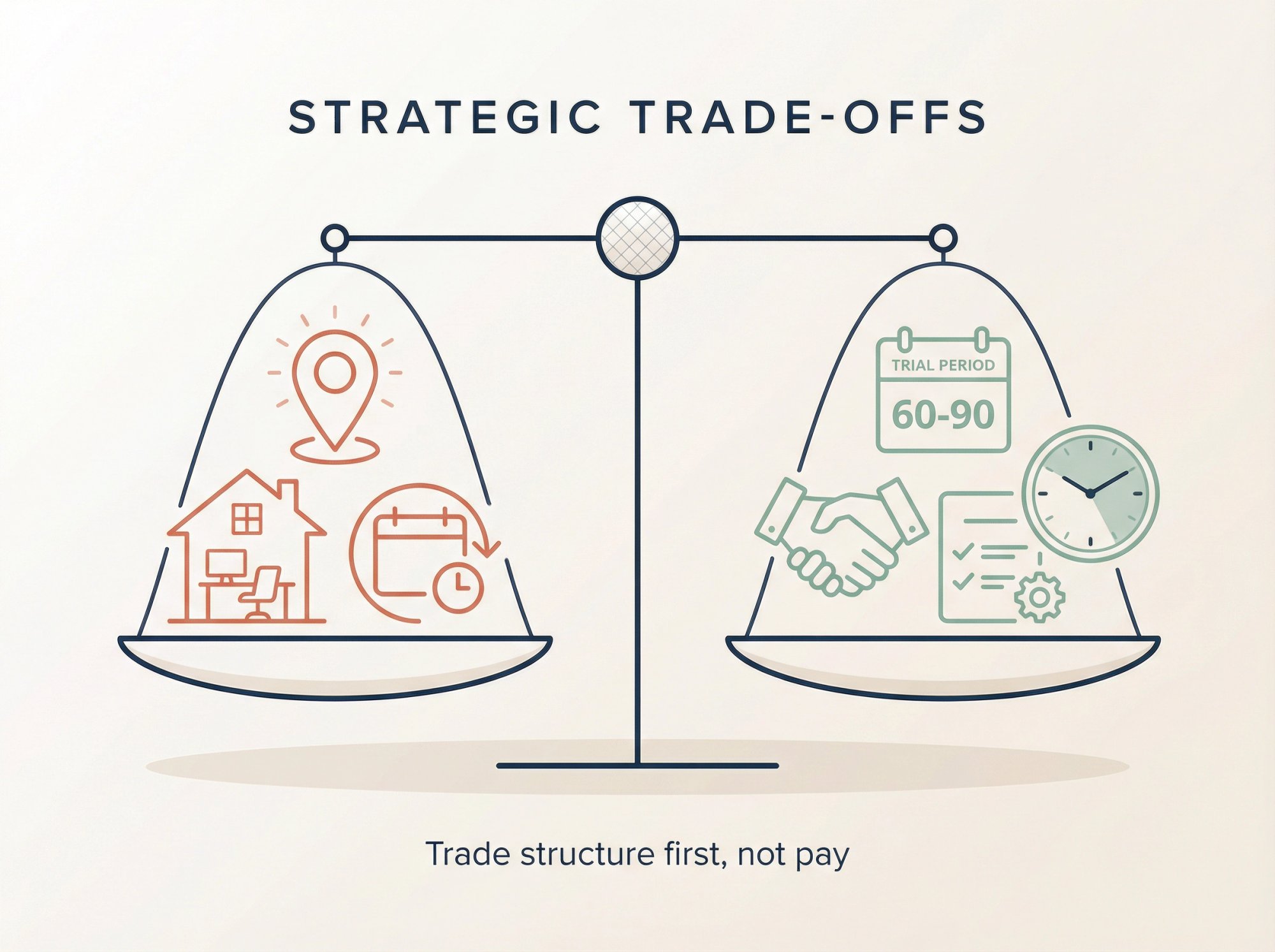
Remote work is one lever in a bigger package. Treat the offer like a negotiation bundle, not a single point.
Remote Work Negotiation Trade-Offs That Work
Trial period
Offer a 60-90 day remote or hybrid pilot with clear success metrics. This reduces the employer's risk and gives you a chance to prove it works.
Defined in-person moments
Commit to quarterly offsites, monthly planning days, or first-week on-site onboarding. This shows you're not trying to avoid the team.
Core hours overlap
Guarantee 4-6 hours per day of overlap with the team's time zone. This addresses coordination concerns.
Travel flexibility
You cover occasional travel days (or flex your schedule around them), while the company covers costs.
Deliverable-based evaluation
Propose "output over presence" metrics. Show them exactly how you'll measure success.
Remote Work Trade-Offs To Consider Carefully
Lower base salary
Sometimes acceptable if you're gaining significant lifestyle flexibility, but don't do it casually. Remote work is valuable, but so is fair pay. Understand the full landscape with our guide on salary negotiation.
Relocation "later"
This can become a trap. If you agree to remote now and relocate later, define the criteria and timeline clearly in writing.
Vague "flexibility"
If it's not written down, it can vanish after you start. Always get specifics.
Remote Work Trade-Off Comparison
Best practice: Trade structure and accountability first, not pay.
Remote Work Agreement Checklist: Get It In Writing
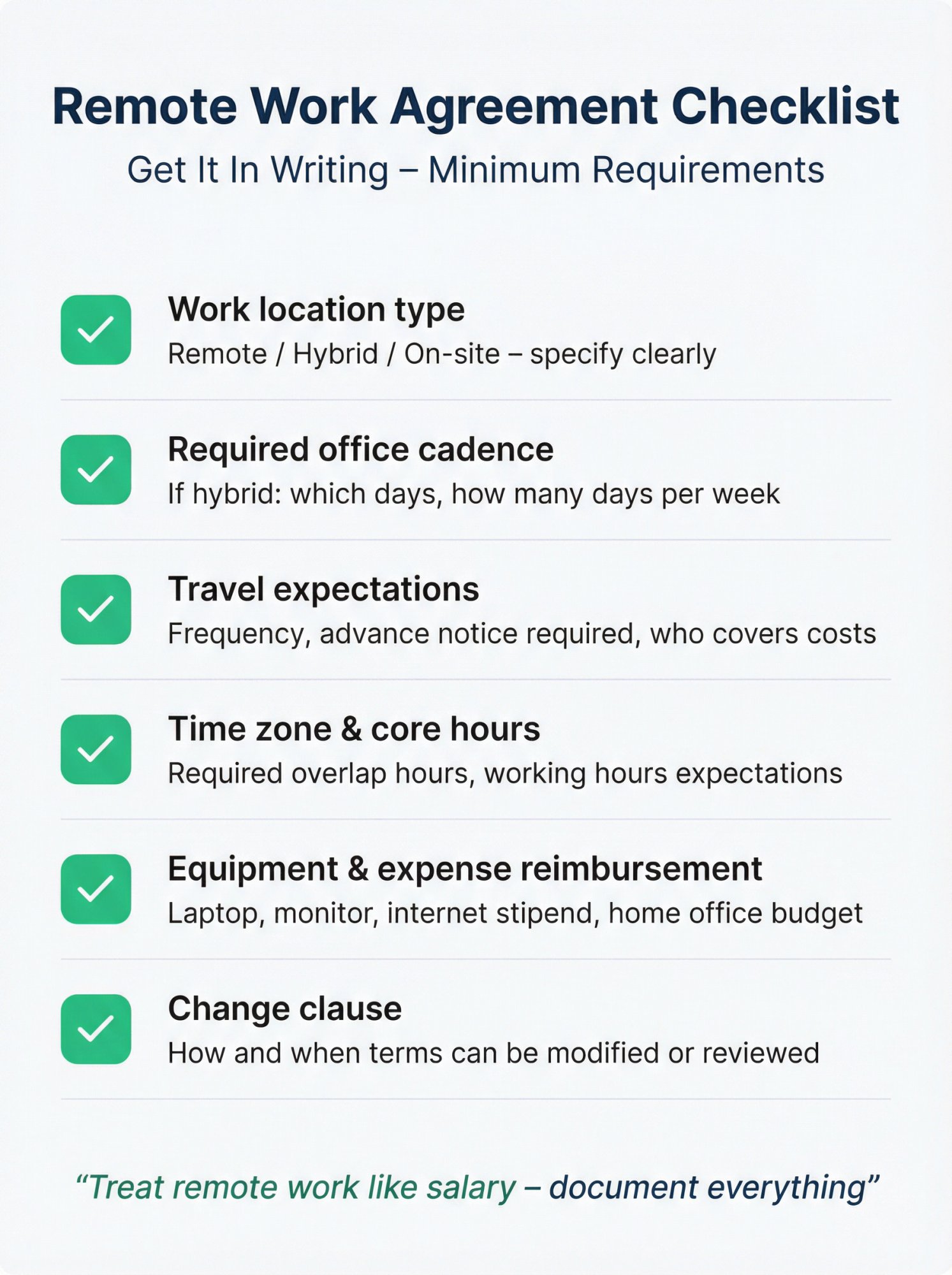
If remote work matters to you, treat it like salary. It must be documented.
At minimum, you want written clarity on:
• Work location type (remote / hybrid / on-site)
• Required office cadence (if hybrid)
• Travel expectations (frequency + who pays)
• Time zone and core hours
• Equipment and expense reimbursements
• Whether terms can be changed (and how)
UK Flexible Working Rights 2024: What Changed
If you're UK-based, the legal baseline changed recently:
From 6 April 2024, employees can request flexible working from day one, can make two requests in 12 months, and employers must respond within two months.
Employers are expected to consult before rejecting, and employees no longer need to explain in the request how the change would affect the employer.
Employers can refuse requests for defined business reasons (e.g., cost burden, inability to reorganize work, impact on quality or performance, meeting customer demand, structural changes).
That said: a statutory request process is different from offer negotiation.
The cleanest move is still to negotiate remote terms into the offer up front, before you sign anything. If you need help understanding your legal rights, consult UK government guidance on flexible working.
Special Remote Work Scenarios: How To Handle Each
Case A: The Offer Expects Relocation, But You Want Remote
Your goal: prevent "remote" from being interpreted as "not committed."
Position it like this:
• "I'm committed to the role and outcomes."
• "Relocation would slow my start and create unnecessary cost."
• "Remote lets me deliver faster."
• "I'm open to periodic travel for the right moments."
Then offer a compromise: remote now, reassess after 6 months based on measurable outcomes.
Frame it as a smart business decision, not a lifestyle choice.
Case B: You Want To Work from Another Country ("Digital Nomad Remote")
This is where negotiations often fail, because employers fear:
• Tax and payroll compliance issues
• Permanent establishment risk
• Data and privacy concerns
• Employment law obligations
• Time zone drift
A smarter ask:
• "Remote within [home country], plus up to X weeks per year abroad"
• Define the countries (or exclude high-risk ones)
• Define time zone overlap requirements
• Define security requirements
• Define who approves and how much notice is needed
This reduces compliance risk while still giving you some flexibility.
Case C: Caregiving or Disability
You can absolutely mention your needs, but don't over-explain personal details. Keep it professional:
• "I'm seeking a working arrangement that supports consistent high performance."
• "Here's the structure that allows me to deliver."
If you're requesting remote work as a reasonable accommodation, consider a separate HR process and get advice relevant to your jurisdiction.
Don't mix accommodation requests with standard offer negotiation unless you're comfortable doing so.
Remote Work Negotiation Email Templates (Copy And Use)
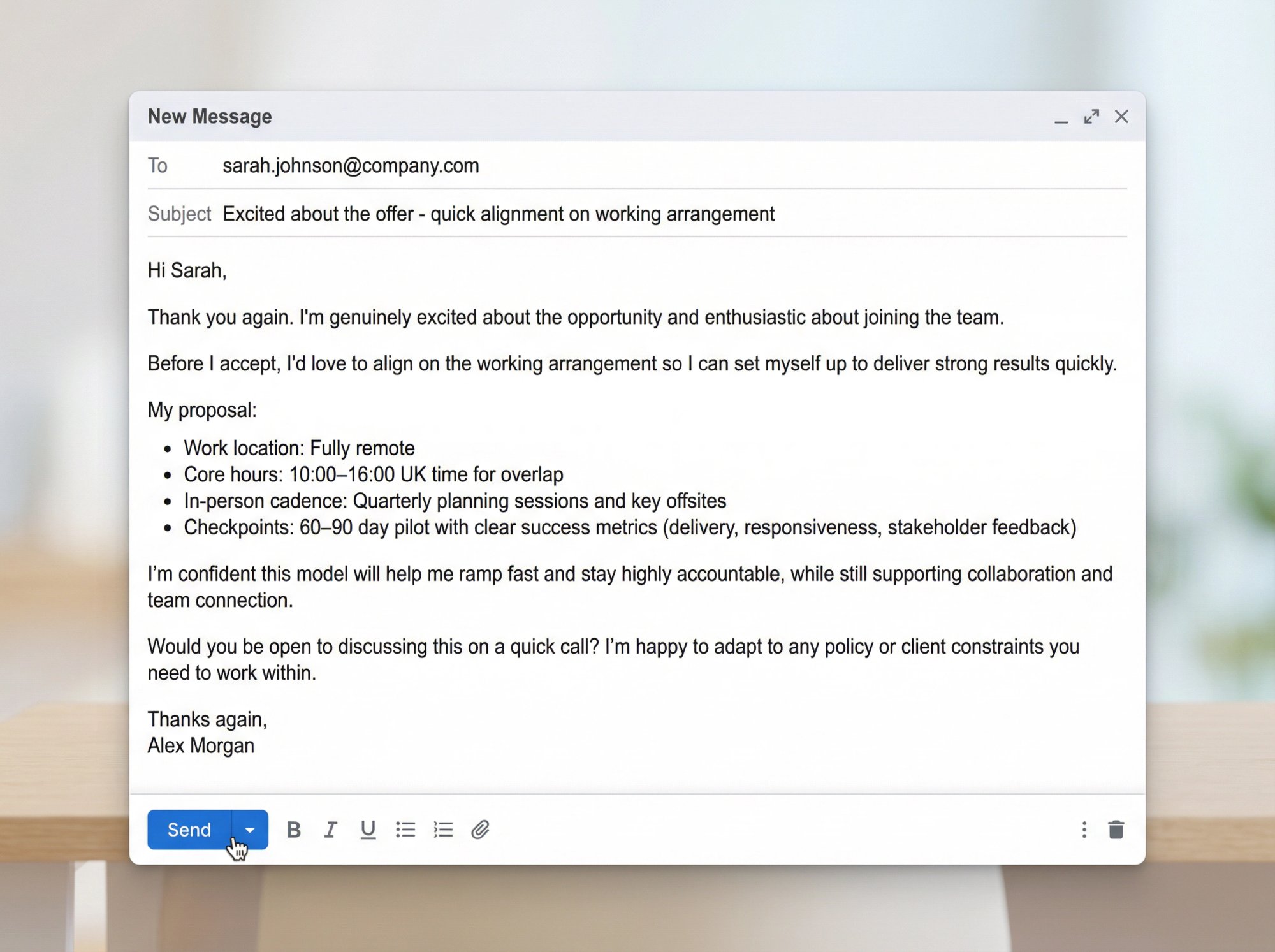
Template 1: Email After a Verbal Offer (Best All-Purpose)
Use AIApply's AI Email Generator to customize this template with your specific details:
Subject: Excited about the offer - quick alignment on working arrangementHi [Name],Thank you again. I'm genuinely excited about the opportunity and enthusiastic about joining the team.Before I accept, I'd love to align on the working arrangement so I can set myself up to deliver strong results quickly.My proposal:- Work location: [fully remote / hybrid]- Core hours: [e.g., 10:00–16:00 UK time] for overlap- In-person cadence: [e.g., 1–2 days/month OR quarterly planning/offsites]- Checkpoints: a 60–90 day pilot with clear success metrics (delivery, responsiveness, stakeholder feedback)I'm confident this model will help me ramp fast and stay highly accountable, while still supporting collaboration and team connection.Would you be open to discussing this on a quick call? I'm happy to adapt to any policy or client constraints you need to work within.Thanks again,[Your Name]Template 2: If They Say "Policy Is 3 Days/Week in Office"
I understand the policy. If full flexibility isn't possible immediately, could we take a phased approach?For example:- First 6–8 weeks: follow the standard cadence to support onboarding- After 90 days: revisit based on outcomes and team needsIf there's room for flexibility, I'd also love to discuss whether the in-office days can be aligned to the highest-collaboration activities (planning, workshops, stakeholder sessions).Template 3: One-Page Remote Work Proposal (The "Yes Is Easy" Doc)
Use this structure as a one-pager you can attach to your email:
REMOTE / HYBRID WORKING PROPOSAL - [Your Name]Goal:Deliver [key outcomes] quickly while maintaining strong collaboration and visibility.Proposed working model:- Location: [Remote / Hybrid]- Core hours overlap: [X–Y time zone]- Office cadence (if hybrid): [e.g., Tue/Wed weekly OR monthly/quarterly]- Travel: [X times/quarter], company-paid (or clarify expectations)How I'll stay aligned:- Weekly written status update (priorities, progress, blockers)- Daily async check-in in [Slack/Teams]- Standing 1:1 with manager [weekly/biweekly]- Documentation-first: decisions captured in [Notion/Confluence/Docs]How success will be measured (first 90 days):- Deliverables shipped: [list]- Stakeholder feedback: [who]- Response SLAs: [e.g., <24h on weekdays]- Collaboration: participation in [rituals]Risk controls:- Security: company device, VPN/MFA, private workspace- Availability: defined overlap hours- Pilot: 60–90 day review checkpointTemplate 4: Remote-Work Addendum Checklist (What HR Should Capture)
Not legal advice. This is a practical checklist for what should be documented:
REMOTE / HYBRID WORK ARRANGEMENT - OFFER ADDENDUM CHECKLIST1) Work location type: Remote / Hybrid / On-site2) Primary work location address (if required for payroll/tax)3) Required office days (if hybrid): number + which days + how enforced4) Travel expectations: frequency + notice + reimbursement5) Time zone and core hours expectations6) Equipment provided: laptop/monitor/headset/etc.7) Expense policy: internet stipend, coworking, home office8) Security requirements: VPN/MFA/device rules9) Performance measurement: deliverables/OKRs + review cadence10) Change clause: how/when the arrangement can be modifiedHow AIApply Helps You Win Remote Work Offers
Remote work negotiation is easier when:
1. You're clearly a top candidate
2. You can prove you'll perform remotely
3. You can articulate your plan cleanly
AIApply supports that entire chain.
Tailor your résumé to remote-ready signals like async communication, self-management, and cross-time-zone collaboration using AIApply's Resume Builder.
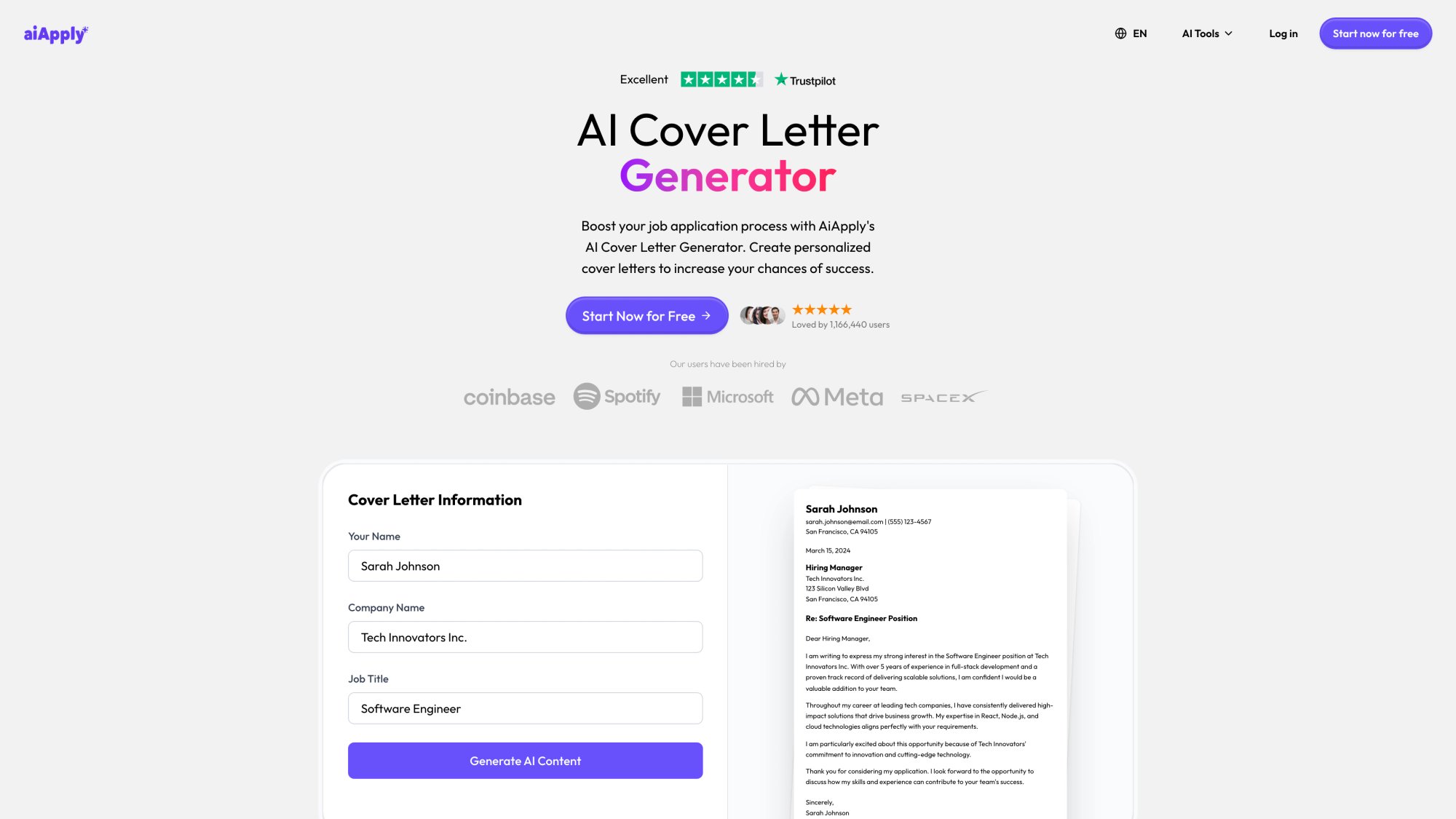
Craft a professional, low-risk negotiation tone in follow-up emails using AIApply's Cover Letter Generator as a writing assistant.
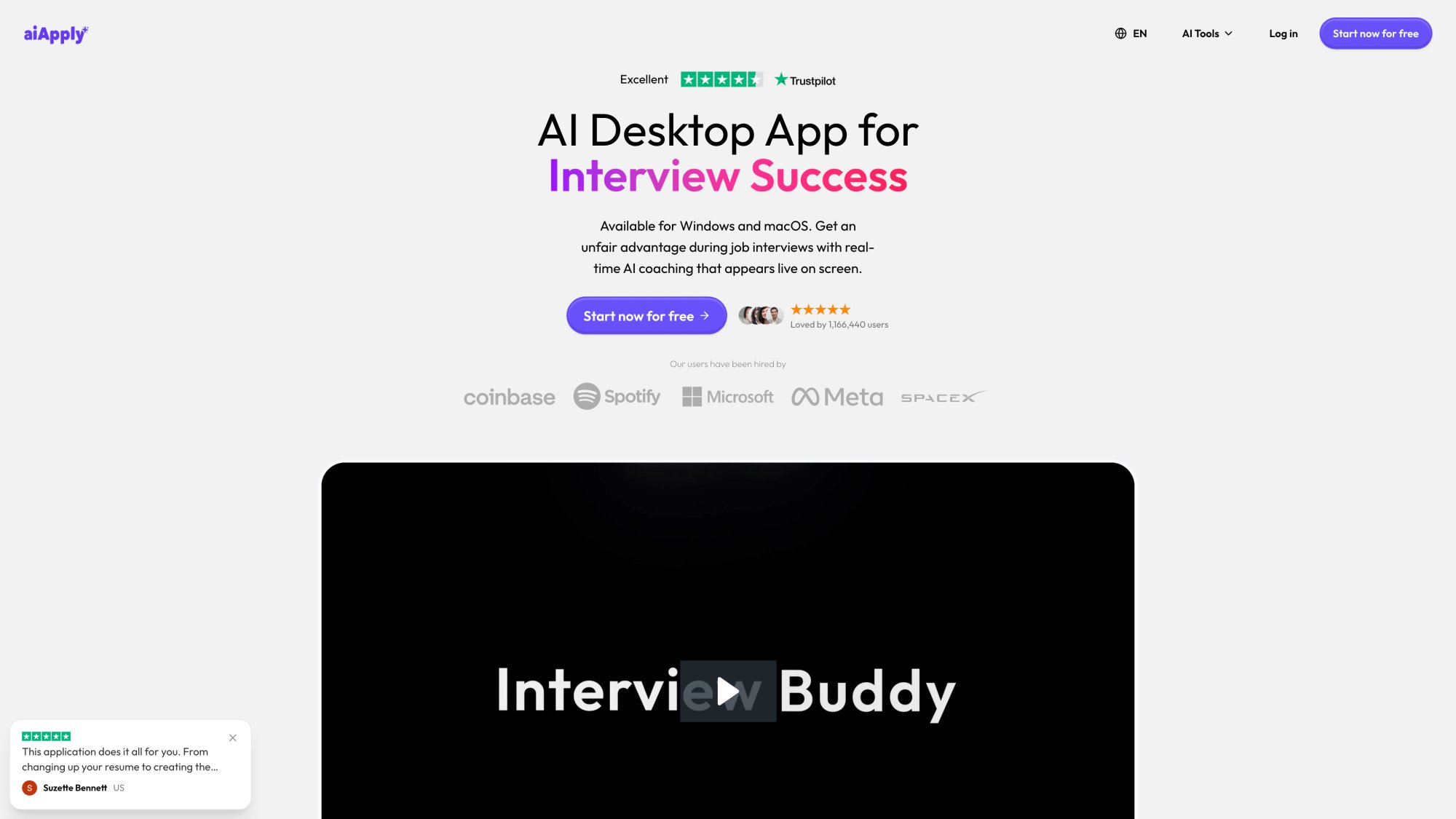
Rehearse the negotiation live (especially if you freeze under pressure) with AIApply's Interview Answer Buddy. You can practice objection handling and get real-time feedback on your delivery.
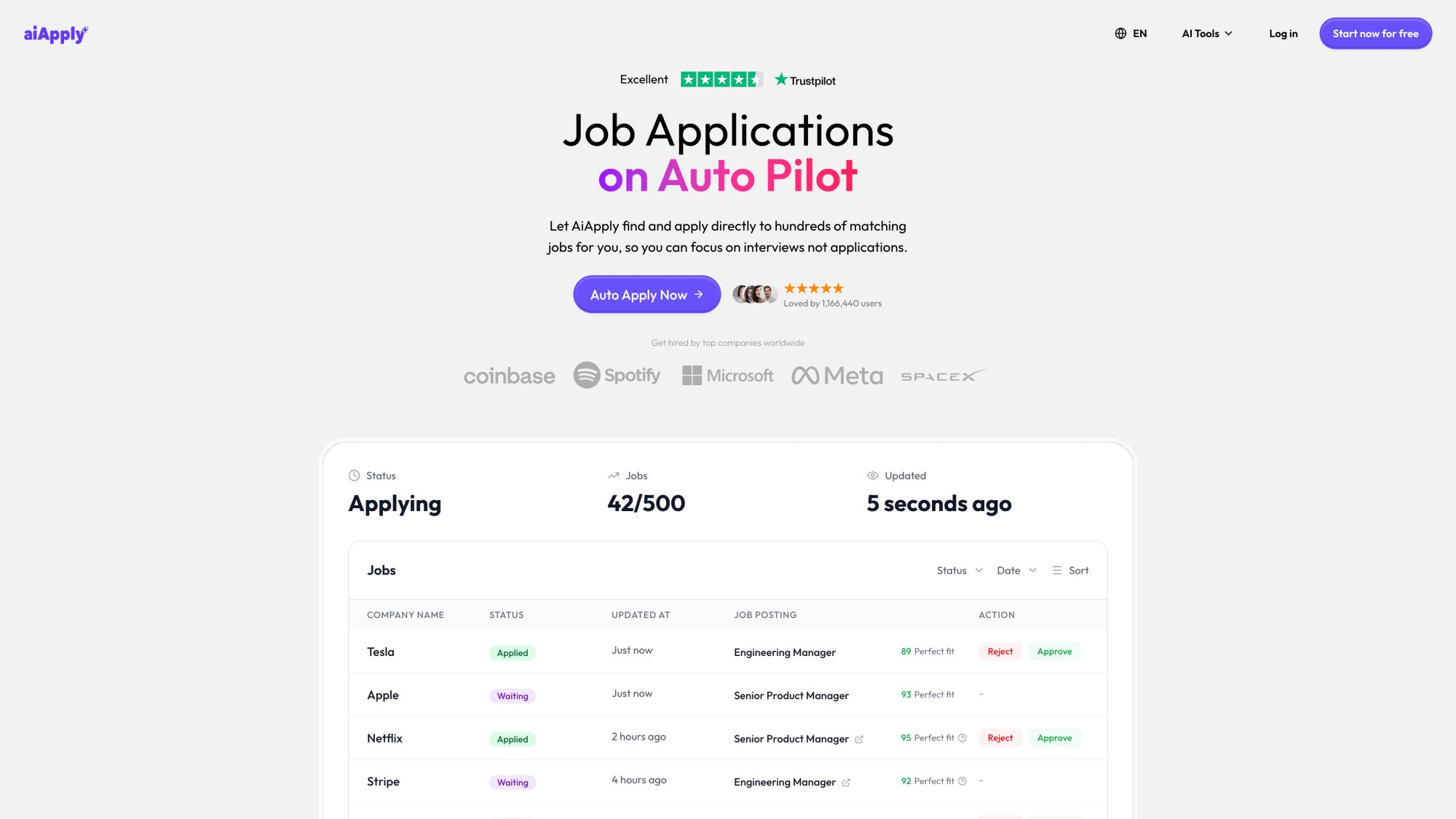
Find more remote-friendly opportunities faster so you have leverage (and options) via AIApply's Auto Apply. When you have multiple interviews in your pipeline, your negotiating position gets stronger.
For negotiation fundamentals, AIApply's guide on salary expectations can help you package tradeoffs intelligently when discussing remote work and total compensation together.
Remote Work Negotiation FAQs
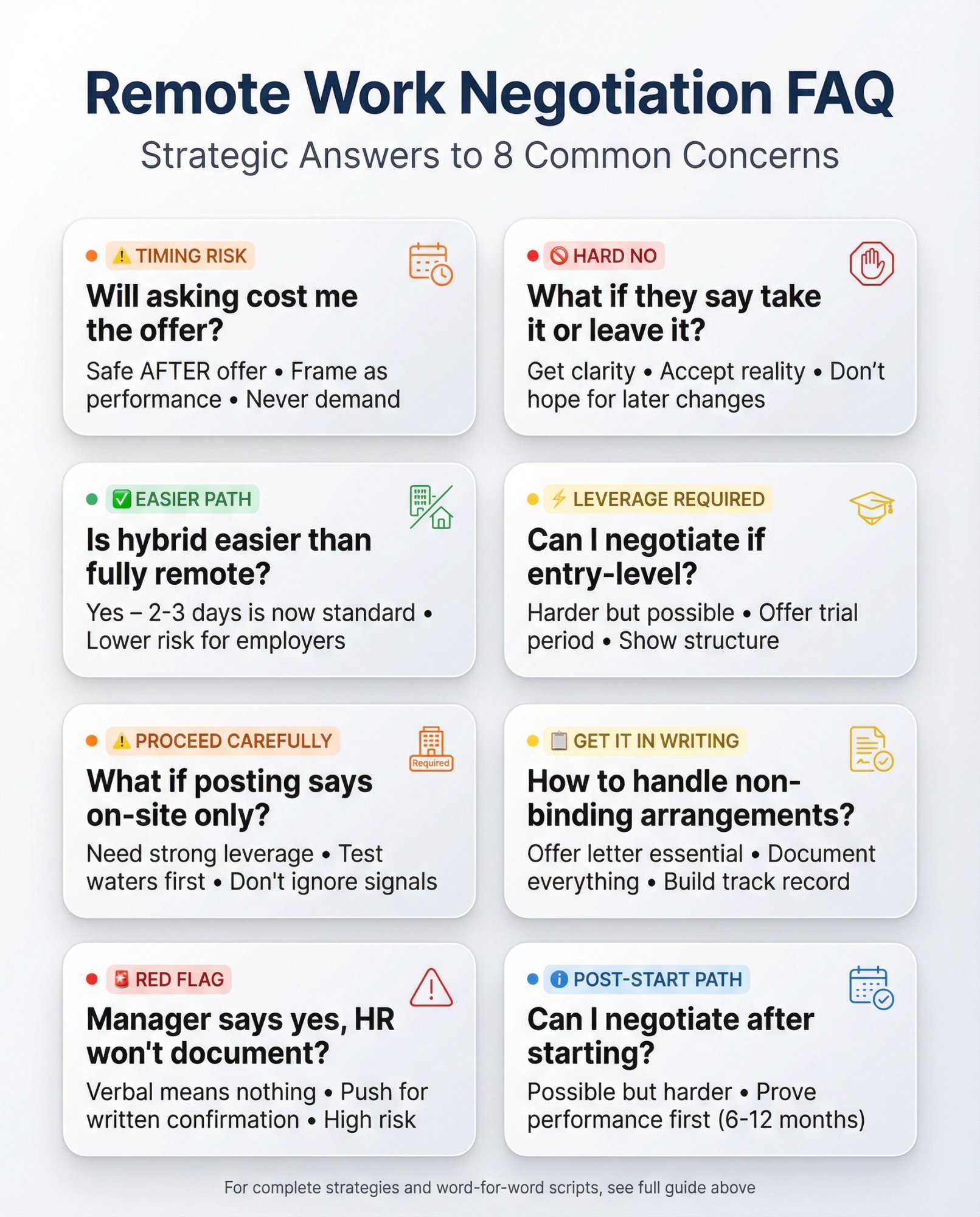
Will asking for remote work cost me the offer?
It can, if you ask too early, frame it as a demand, or ignore the employer's constraints.
But if you ask after the offer, anchor on performance, and present a structured operational plan, many employers will negotiate. Even if it becomes a phased approach or a trial period.
The key is how you position it. If you make it about your convenience, it's risky. If you make it about delivering results efficiently, it's much safer.
Learn more about how to accept an offer while negotiating effectively.
What if they say "no remote, take it or leave it"?
Then you have clarity. Decide whether:
• The role is still worth it on-site
• You can accept short-term on-site with a written review date (e.g., reassess after 6 months based on performance)
• You should walk away (especially if remote is a non-negotiable life constraint for you)
Don't take a job expecting to change the terms later. Get it in writing now, or accept what's offered.
Is hybrid easier to negotiate than fully remote?
Yes. In many markets, hybrid is now the default compromise, especially with employers standardizing 2-3 office days per week.
Hybrid gives the employer more control and visibility, which reduces their perceived risk. It's often the middle ground that gets both sides to "yes."
If your goal is fully remote, you may need stronger leverage or a proven track record of remote success to make that case.
Can I negotiate remote work if I'm entry-level?
It's harder, but not impossible. Entry-level candidates typically have less leverage because they don't have a proven track record.
But you can still make a case if:
• The role is explicitly remote or hybrid in the job posting
• You have internship or school project experience working remotely
• You're willing to accept a trial period with clear performance metrics
• The company already has a remote-first culture
Focus on reducing their risk by proposing structure, accountability, and frequent check-ins. Check out our entry-level salary negotiation guide for more tips.
Should I negotiate remote work if the job posting says "on-site only"?
Only if you have strong leverage (they're struggling to fill the role, you're a perfect match, or you have competing offers).
Otherwise, you risk looking like you didn't read the posting or don't respect their needs.
A safer approach: ask smart questions during interviews about how the team currently works and whether there's any flexibility for proven performers. Test the waters before you negotiate hard at the offer stage.
How do I handle a remote work arrangement that's not legally binding?
In many countries (including the US), employment is "at will," meaning terms can change unless you have a formal contract.
Your best protection:
• Get remote work terms in the offer letter or employment contract
• Include a "change clause" that specifies how and when terms can be modified (e.g., 90 days' notice, performance-based review)
• Document everything in writing (emails, Slack, etc.)
• Build a track record of strong performance so changing your arrangement becomes harder to justify
If you're in a jurisdiction with stronger employment protections (like parts of Europe), consult local employment law to understand your rights.
What if my manager verbally agrees to remote work but HR won't put it in the offer?
This is a red flag. Verbal agreements can evaporate.
Push back politely:
"I appreciate the flexibility. To make sure we're aligned and avoid any confusion later, could we add a line to the offer letter confirming the remote arrangement we discussed?"
If they refuse, assume the remote arrangement isn't guaranteed. You'll need to decide if you're comfortable with that risk.
Can I negotiate remote work after I've already started the job?
Yes, but it's harder. You no longer have the leverage of "we're trying to close this hire."
Your best approach:
• Build a strong performance track record first (6-12 months)
• Demonstrate remote-ready skills (async communication, self-management, measurable results)
• Propose a trial period with clear metrics
• Frame it as a retention strategy (if you're a top performer, they don't want to lose you)
In the UK, remember that you can make a statutory flexible working request from day one as of April 2024.
Remote Work Negotiation Action Plan (Next 48 Hours)
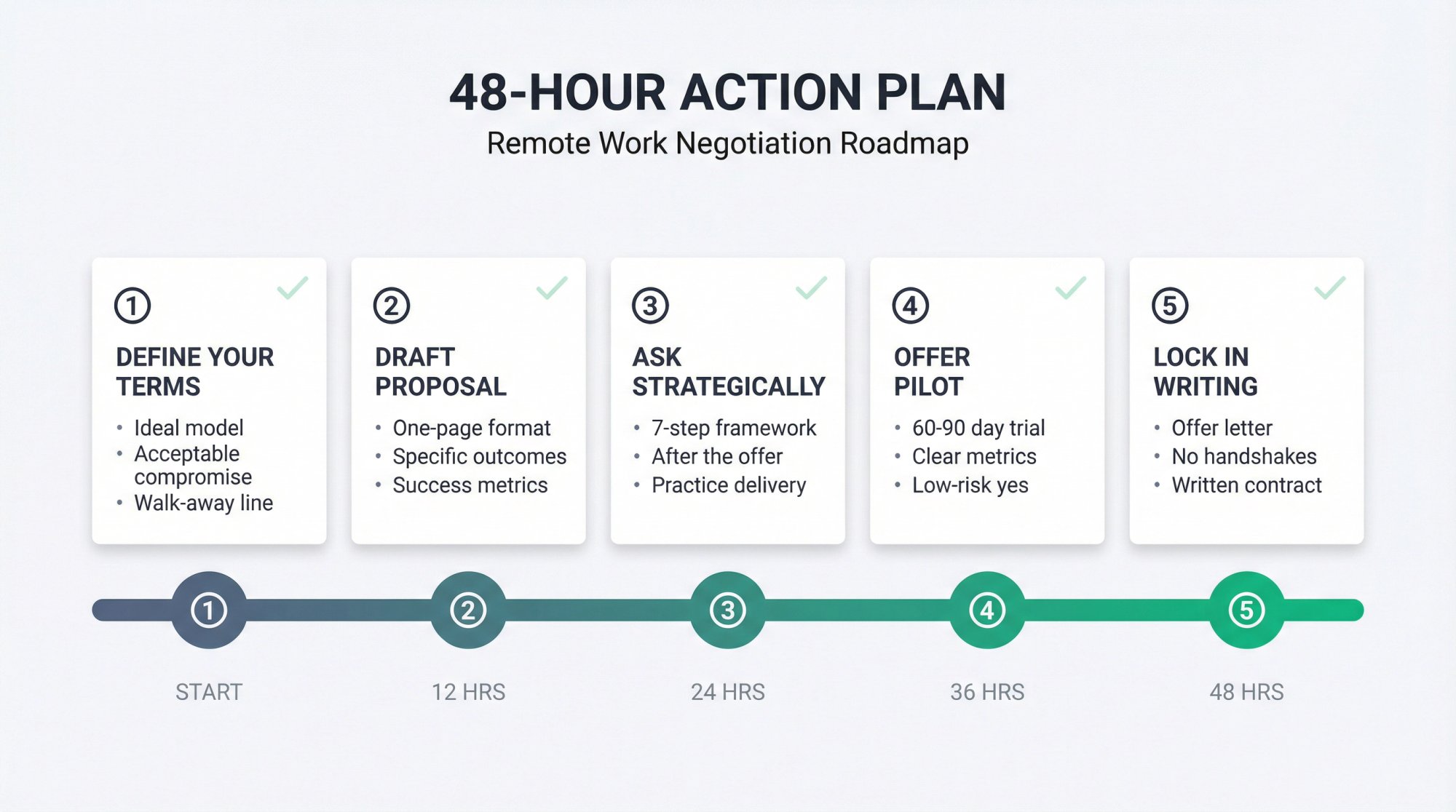
① Define your ideal, acceptable, and walk-away working model.
Be honest with yourself. What do you actually need? What would be a good compromise? What's a dealbreaker?
② Draft the one-page proposal using the template above.
Tailor it to the specific role. Include the exact outcomes you'll deliver and how you'll measure success.
③ Ask after the offer using the 7-step framework.
Don't wing it. Follow the structure. Practice it out loud if you need to.
④ Offer a pilot + metrics (make "yes" low-risk).
Give them an easy way to say yes without committing forever.
⑤ Lock the agreement into writing before you accept.
No handshake deals. Get it in the offer letter or contract.
If you're using AIApply to accelerate your job search, you're already ahead. Use the Resume Builder to highlight remote-ready skills, the Cover Letter Generator to craft negotiation emails, and the Interview Buddy to rehearse this conversation until you're confident.
Need to build a stronger pipeline? Learn how to get hired fast or discover the best way to apply for jobs to maximize your options.
Remote work didn't die. It just got harder to secure.
Large cross-country surveys of college-educated workers across 40 countries show work-from-home levels have plateaued since 2023, averaging about 1.23 paid days per week at home in late 2024 and early 2025. That's roughly 25% of your workweek.
But here's what makes remote work tricky: demand from job seekers is far higher than supply.
LinkedIn's research from July 2025 found that remote roles made up just 8.5% of job postings in the United States, while 40.2% of applications by women and 36.1% by men went to those remote positions.
The reality: Remote work is still a top preference for job seekers, and it's still a competitive advantage for the companies that offer it. But you can't just ask nicely and hope for the best.
You need to approach it like a real negotiation.
This guide gives you everything: what to ask for, when to ask, exactly what to say (word-for-word scripts), how to handle pushback, what you can trade without tanking the offer, and how to lock your remote arrangement into the contract so it doesn't disappear after you start.
What Are You Really Negotiating? (It's Not Just Remote)
When candidates say "I want remote work," employers often hear:
"I want to work whenever I want."
"Collaboration will be harder."
"Training will take longer."
"How will we measure performance?"
"Will this create fairness issues across the team?"
So don't negotiate "remote." Negotiate a working model.
There are at least 6 different remote outcomes people mean when they say they want flexibility:
① Fully remote (same country)
You work from home permanently, staying within the same country for tax and payroll purposes.
② Fully remote (specific time zone overlap)
You can work from anywhere, but you're required to maintain certain core hours that overlap with the team.
③ Hybrid with a fixed cadence
For example: 2 days in the office, 3 days at home. The schedule is predictable and consistent.
④ Hybrid with "moments that matter"
You're in the office for planning sessions, product launches, quarterly offsites, or other high-collaboration events. The rest is remote.
⑤ Remote-first with optional office access
The default is remote, but you can use office space if you want it. No requirement to show up.
⑥ Work-from-anywhere windows
You work from a primary location most of the year, but you're allowed 4-8 weeks abroad or in a different city.
The most successful negotiators don't ask for "remote." They ask for a structure.
They specify:
• Where they'll work
• When they'll overlap with the team
• How they'll communicate
• How performance will be measured
• When they'll be in person
• What equipment and security standards they'll follow
That turns "remote work" from a vague preference into an operational plan the employer can actually say yes to.
Remote Work Statistics 2026: What The Data Shows
A lot of companies have tightened flexibility over the past couple of years, especially around hybrid expectations. Here's what the numbers actually show.
UK Hybrid Work: How Many Office Days Are Required?
Data from Indeed Hiring Lab (September 2025) analyzed UK hybrid job ads and found that most now require 2-3 days per week in the office.
Specifically:
85% of hybrid postings specified a minimum of 2+ days/week in the office
56% specified 3+ days/week
Only 15% required just 1 day/week
About 15% didn't specify a minimum number of office days
Great Britain Remote Work Percentage: How Many Work Hybrid?
The UK Office for National Statistics reported that 28% of working adults in Great Britain hybrid worked between January and March 2025.
US Hybrid Work Statistics: How Many Days In Office?
Gallup's September 2025 update shows the hybrid model is still holding, but it's not getting more flexible:
Hybrid among remote-capable U.S. employees dipped slightly from 55% to 51% over two quarters
Hybrid workers spend 46% of their workweek in the office (about 2.3 days/week)
Gallup reports no significant movement in the past year
Global Work From Home Statistics: How Common Is Remote?
The global survey evidence suggests work-from-home has "bottomed out" at a materially higher level than pre-pandemic, averaging roughly 1.2 days per week from home in late 2024 and early 2025.
What Remote Work Statistics Mean For Your Negotiation
What This Means for Your Negotiation
Remote work is still valued. But many employers are now trying to:
• Standardize rules (to reduce manager-by-manager inconsistency)
• Protect onboarding and company culture
• Reduce perceived "coordination drag"
• Avoid setting a precedent they can't scale across the organization
The winning move? Reduce their perceived risk and make your proposal easy to say yes to.
Can This Job Be Done Remotely? (3 Tests Before You Ask)
Only negotiate remote work after you've answered this question:
"Can this job be done remotely without breaking the business model?"
Fast Test: The 3 Constraints
If any of these are "yes," remote work will be harder to negotiate:
1. Physical constraint
You must be near equipment, labs, inventory, patients, or on-site customers.
2. Security or regulatory constraint
The company's compliance requirements demand controlled environments (think finance, healthcare, defense).
3. Customer constraint
The role is built around in-person relationships or on-site delivery.
If none of these apply, you're in negotiation territory.
Remote Work Job Description Signals: What To Look For
Positive signals:
• "Distributed team," "remote-first," "async," "time zone overlap"
• Results-based language: "deliver," "own," "ship," "metrics"
• Written communication emphasized
Negative signals:
• "In-office collaboration is essential"
• "Must be local" or "must be within commuting distance"
• "On-site presence required" for routine responsibilities
Questions To Ask Before The Offer (Without Looking Demanding)
Use this wording during your job interviews:
"How does the team collaborate day-to-day? More async docs, or mostly meetings?"
"What does success in the first 60-90 days look like?"
"How often is the team together in person, and for what activities?"
"Is this role tied to a specific office for tax or payroll reasons, or is location flexible?"
These questions do two things:
1. Gather the constraints that will shape your proposal later
2. Normalize flexibility as an operational discussion, not a perk request
How Strong Is Your Remote Work Negotiation Position?
Remote work is a non-wage amenity. And like salary, it's negotiated most successfully when you have leverage.
LinkedIn's research explicitly frames remote work as something workers and firms bargain over in the labor market.
5 Sources Of Remote Work Negotiation Leverage
1. Scarcity of your skillset (hard-to-fill role)
If they've been searching for months or the role requires rare expertise, you have power.
2. Evidence you'll perform fast (portfolio, metrics, proof)
Show concrete results from past work. Numbers speak louder than promises. Use tools like AIApply's Resume Builder to highlight your remote-ready accomplishments with quantifiable metrics.
3. Competing options (another offer, late-stage pipeline)
If you have other interviews in final stages or another offer on the table, you're negotiating from strength. Learn how to find jobs quickly to build your pipeline.
4. Employer's need for speed (urgent hire, project deadline)
If they need someone to start immediately or solve a pressing problem, that's leverage.
5. Company policy flexibility (some managers can approve exceptions)
If the hiring manager has decision power (not purely HR policy), exceptions are possible.
How To Assess Your Remote Work Negotiation Strength
Give yourself 1 point for each that's true:
Your Score Interpretation:
• 7-10 points: Push for your ideal remote structure (with a strong operational plan)
• 4-6 points: Propose a trial or a hybrid-to-remote path
• 0-3 points: Negotiate for flexibility that doesn't break policy (e.g., 1 extra WFH day, "moments that matter" hybrid, or a future review after you prove yourself)
When To Negotiate Remote Work In A Job Offer
Best Time: After The Offer, Before You Accept
The best time is after you receive the offer (or a verbal offer), when the company has made an emotional and logistical commitment. But it's before the paperwork is finalized.
At this point:
• They've already decided you're the one
• They've invested time and energy
• They don't want to start the search over
• But nothing is locked yet
When To Bring Up Remote Work During Interviews
If you're in another city or country and relocation is implied in the job posting, raise remote work before they draft an offer. Otherwise, they may feel blindsided when you bring it up later.
Worst Time To Ask For Remote Work: Early Screening
Early remote demands can get you screened out before they see your value. Wait until they're invested.
Rule of thumb:
• If the job is advertised as remote or hybrid → confirm details early, negotiate specifics at the offer stage.
• If the job is advertised as on-site → test openness mid-process, negotiate hard only after they're invested in you.
How To Negotiate Remote Work: 7-Step Framework
This is the structure you want. It's calm, professional, and positions remote work as a business solution (not a personal preference).
Step 1: Accept the Offer Emotionally (First)
Start with enthusiasm.
"I'm excited about this. I really want to make this work."
This shows good faith and reduces defensiveness.
Step 2: Anchor on Performance
Frame everything around outcomes, not convenience.
"I'm confident I can deliver [specific outcomes] quickly."
Use real examples from your past work if possible. If you need help articulating your value, AIApply's Resume Builder can help you identify and quantify your strongest achievements.
Step 3: Ask Permission To Discuss Working Model
Make it collaborative, not confrontational.
"Can we talk about the working arrangement so I can set myself up to deliver those outcomes?"
This positions the conversation as problem-solving, not demands.
Step 4: Present Your Proposal (Simple, Operational, Measurable)
Don't say "I want remote."
Instead, lay out:
• Core hours and overlap with the team
• Cadence for in-person moments (if hybrid)
• Your onboarding plan
• Communication system you'll use
• Performance checkpoints
Example:
"I'm proposing fully remote with core hours from 10 AM to 4 PM Eastern for overlap. I'll join planning sessions in person quarterly, and we can use weekly written updates plus a standing 1:1 to stay aligned. After 90 days, we can review based on deliverables and stakeholder feedback."
Step 5: Offer a Trial (Reduces Risk)
Give them an easy way to say yes without committing forever.
"If helpful, we can treat this as a 60-90 day pilot with clear success metrics."
Trials work because they reduce the employer's perceived risk.
Step 6: Ask for Their Constraints (Turn It Into Problem-Solving)
This is where you flip from "selling" to "solving."
"What constraints do you need to work within? Policy, client needs, security, or something else?"
When you ask this, you're showing that you understand their side. You're not being difficult. You're trying to find a solution that works for both of you.
Step 7: Close with a Package, Not a Standoff
If they push back, don't dig in. Pivot to options.
"If full remote isn't possible immediately, I'm open to a phased approach. What would be workable from your side?"
This is the mindset shift: You're not requesting permission. You're designing a model that makes success easier for everyone.
Remote Work Objections: How To Handle 12 Common Concerns
Use these like building blocks. Don't dump them all at once. Pick the ones that match what you're hearing.
Objection 1: "We need in-person collaboration."
Your answer:
"I agree collaboration matters. That's why I'm proposing structured in-person time for the activities that truly benefit from it (planning, retros, workshops, stakeholder alignment) while keeping heads-down execution remote. I'll also document decisions so everyone stays aligned."
Objection 2: "Remote slows onboarding."
Your answer:
"I can make onboarding easier by creating a written 30/60/90 plan, scheduling weekly check-ins, and maintaining a shared doc of questions and progress. I've ramped remotely before and can show how I stay accountable."
Objection 3: "It's not fair to others."
Your answer:
"I respect internal fairness. If exceptions are difficult, we can frame this as a role-based arrangement tied to outcomes and responsibilities, plus a pilot period. I want this to be sustainable for the team, not a one-off problem."
Objection 4: "Policy says 3 days in the office."
Your answer: "I understand. If the full policy can't change, could we explore flexibility on which days, or a phased plan? For example: 3 days during onboarding, then reassess after 90 days based on outcomes."
Objection 5: "We've had productivity issues with remote."
Your answer:
"That makes sense. Remote doesn't work without systems. Here's how I work: written updates, clear deliverables, visible metrics, and proactive communication. If we define output metrics, it's easier to manage than hours in a chair."
Objection 6: "Clients need you on-site."
Your answer: "I'm happy to be on-site for client moments that truly require it. Could we map which meetings or activities are client-critical and build a predictable travel cadence into the role?"
Objection 7: "Security or compliance."
Your answer:
"I'm comfortable following strict requirements: company device only, VPN, MFA, encrypted storage, private workspace. If needed, I can work from a coworking space that meets your standards."
Objection 8: "We're worried about culture."
Your answer: "Culture is built through clarity and connection, not only proximity. I'm happy to participate in team rituals, occasional on-sites, and structured bonding time while keeping execution remote."
Objection 9: "We need you local for tax or payroll."
Your answer:
"Totally fair. If cross-border is hard, I can align to a specific hiring entity location, or we can define remote within [country/state] with occasional travel."
Objection 10: "We can't approve fully remote, but hybrid is possible."
Your answer: "Great. If we set hybrid, can we clarify the cadence (days per week), the purpose of in-person days, and whether we can revisit after the first performance review?"
Objection 11: "Remote means lower pay."
Your answer:
"I'm open to discussing total package and pay philosophy. If location-based bands are fixed, maybe we can balance with another lever: sign-on bonus, equity, extra PTO, travel budget, or home-office support."
Learn more about how to answer salary expectations.
Objection 12: "We'll decide later."
Your answer: "I want to avoid ambiguity so we both feel good moving forward. Could we define a written plan now (either the agreement, or a timeline for a formal review after X weeks)?"
Remote Work Objection Response Guide
What To Trade For Remote Work (Without Hurting The Offer)
Remote work is one lever in a bigger package. Treat the offer like a negotiation bundle, not a single point.
Remote Work Negotiation Trade-Offs That Work
Trial period
Offer a 60-90 day remote or hybrid pilot with clear success metrics. This reduces the employer's risk and gives you a chance to prove it works.
Defined in-person moments
Commit to quarterly offsites, monthly planning days, or first-week on-site onboarding. This shows you're not trying to avoid the team.
Core hours overlap
Guarantee 4-6 hours per day of overlap with the team's time zone. This addresses coordination concerns.
Travel flexibility
You cover occasional travel days (or flex your schedule around them), while the company covers costs.
Deliverable-based evaluation
Propose "output over presence" metrics. Show them exactly how you'll measure success.
Remote Work Trade-Offs To Consider Carefully
Lower base salary
Sometimes acceptable if you're gaining significant lifestyle flexibility, but don't do it casually. Remote work is valuable, but so is fair pay. Understand the full landscape with our guide on salary negotiation.
Relocation "later"
This can become a trap. If you agree to remote now and relocate later, define the criteria and timeline clearly in writing.
Vague "flexibility"
If it's not written down, it can vanish after you start. Always get specifics.
Remote Work Trade-Off Comparison
Best practice: Trade structure and accountability first, not pay.
Remote Work Agreement Checklist: Get It In Writing
If remote work matters to you, treat it like salary. It must be documented.
At minimum, you want written clarity on:
• Work location type (remote / hybrid / on-site)
• Required office cadence (if hybrid)
• Travel expectations (frequency + who pays)
• Time zone and core hours
• Equipment and expense reimbursements
• Whether terms can be changed (and how)
UK Flexible Working Rights 2024: What Changed
If you're UK-based, the legal baseline changed recently:
From 6 April 2024, employees can request flexible working from day one, can make two requests in 12 months, and employers must respond within two months.
Employers are expected to consult before rejecting, and employees no longer need to explain in the request how the change would affect the employer.
Employers can refuse requests for defined business reasons (e.g., cost burden, inability to reorganize work, impact on quality or performance, meeting customer demand, structural changes).
That said: a statutory request process is different from offer negotiation.
The cleanest move is still to negotiate remote terms into the offer up front, before you sign anything. If you need help understanding your legal rights, consult UK government guidance on flexible working.
Special Remote Work Scenarios: How To Handle Each
Case A: The Offer Expects Relocation, But You Want Remote
Your goal: prevent "remote" from being interpreted as "not committed."
Position it like this:
• "I'm committed to the role and outcomes."
• "Relocation would slow my start and create unnecessary cost."
• "Remote lets me deliver faster."
• "I'm open to periodic travel for the right moments."
Then offer a compromise: remote now, reassess after 6 months based on measurable outcomes.
Frame it as a smart business decision, not a lifestyle choice.
Case B: You Want To Work from Another Country ("Digital Nomad Remote")
This is where negotiations often fail, because employers fear:
• Tax and payroll compliance issues
• Permanent establishment risk
• Data and privacy concerns
• Employment law obligations
• Time zone drift
A smarter ask:
• "Remote within [home country], plus up to X weeks per year abroad"
• Define the countries (or exclude high-risk ones)
• Define time zone overlap requirements
• Define security requirements
• Define who approves and how much notice is needed
This reduces compliance risk while still giving you some flexibility.
Case C: Caregiving or Disability
You can absolutely mention your needs, but don't over-explain personal details. Keep it professional:
• "I'm seeking a working arrangement that supports consistent high performance."
• "Here's the structure that allows me to deliver."
If you're requesting remote work as a reasonable accommodation, consider a separate HR process and get advice relevant to your jurisdiction.
Don't mix accommodation requests with standard offer negotiation unless you're comfortable doing so.
Remote Work Negotiation Email Templates (Copy And Use)
Template 1: Email After a Verbal Offer (Best All-Purpose)
Use AIApply's AI Email Generator to customize this template with your specific details:
Subject: Excited about the offer - quick alignment on working arrangementHi [Name],Thank you again. I'm genuinely excited about the opportunity and enthusiastic about joining the team.Before I accept, I'd love to align on the working arrangement so I can set myself up to deliver strong results quickly.My proposal:- Work location: [fully remote / hybrid]- Core hours: [e.g., 10:00–16:00 UK time] for overlap- In-person cadence: [e.g., 1–2 days/month OR quarterly planning/offsites]- Checkpoints: a 60–90 day pilot with clear success metrics (delivery, responsiveness, stakeholder feedback)I'm confident this model will help me ramp fast and stay highly accountable, while still supporting collaboration and team connection.Would you be open to discussing this on a quick call? I'm happy to adapt to any policy or client constraints you need to work within.Thanks again,[Your Name]Template 2: If They Say "Policy Is 3 Days/Week in Office"
I understand the policy. If full flexibility isn't possible immediately, could we take a phased approach?For example:- First 6–8 weeks: follow the standard cadence to support onboarding- After 90 days: revisit based on outcomes and team needsIf there's room for flexibility, I'd also love to discuss whether the in-office days can be aligned to the highest-collaboration activities (planning, workshops, stakeholder sessions).Template 3: One-Page Remote Work Proposal (The "Yes Is Easy" Doc)
Use this structure as a one-pager you can attach to your email:
REMOTE / HYBRID WORKING PROPOSAL - [Your Name]Goal:Deliver [key outcomes] quickly while maintaining strong collaboration and visibility.Proposed working model:- Location: [Remote / Hybrid]- Core hours overlap: [X–Y time zone]- Office cadence (if hybrid): [e.g., Tue/Wed weekly OR monthly/quarterly]- Travel: [X times/quarter], company-paid (or clarify expectations)How I'll stay aligned:- Weekly written status update (priorities, progress, blockers)- Daily async check-in in [Slack/Teams]- Standing 1:1 with manager [weekly/biweekly]- Documentation-first: decisions captured in [Notion/Confluence/Docs]How success will be measured (first 90 days):- Deliverables shipped: [list]- Stakeholder feedback: [who]- Response SLAs: [e.g., <24h on weekdays]- Collaboration: participation in [rituals]Risk controls:- Security: company device, VPN/MFA, private workspace- Availability: defined overlap hours- Pilot: 60–90 day review checkpointTemplate 4: Remote-Work Addendum Checklist (What HR Should Capture)
Not legal advice. This is a practical checklist for what should be documented:
REMOTE / HYBRID WORK ARRANGEMENT - OFFER ADDENDUM CHECKLIST1) Work location type: Remote / Hybrid / On-site2) Primary work location address (if required for payroll/tax)3) Required office days (if hybrid): number + which days + how enforced4) Travel expectations: frequency + notice + reimbursement5) Time zone and core hours expectations6) Equipment provided: laptop/monitor/headset/etc.7) Expense policy: internet stipend, coworking, home office8) Security requirements: VPN/MFA/device rules9) Performance measurement: deliverables/OKRs + review cadence10) Change clause: how/when the arrangement can be modifiedHow AIApply Helps You Win Remote Work Offers
Remote work negotiation is easier when:
1. You're clearly a top candidate
2. You can prove you'll perform remotely
3. You can articulate your plan cleanly
AIApply supports that entire chain.
Tailor your résumé to remote-ready signals like async communication, self-management, and cross-time-zone collaboration using AIApply's Resume Builder.
Craft a professional, low-risk negotiation tone in follow-up emails using AIApply's Cover Letter Generator as a writing assistant.
Rehearse the negotiation live (especially if you freeze under pressure) with AIApply's Interview Answer Buddy. You can practice objection handling and get real-time feedback on your delivery.
Find more remote-friendly opportunities faster so you have leverage (and options) via AIApply's Auto Apply. When you have multiple interviews in your pipeline, your negotiating position gets stronger.
For negotiation fundamentals, AIApply's guide on salary expectations can help you package tradeoffs intelligently when discussing remote work and total compensation together.
Remote Work Negotiation FAQs
Will asking for remote work cost me the offer?
It can, if you ask too early, frame it as a demand, or ignore the employer's constraints.
But if you ask after the offer, anchor on performance, and present a structured operational plan, many employers will negotiate. Even if it becomes a phased approach or a trial period.
The key is how you position it. If you make it about your convenience, it's risky. If you make it about delivering results efficiently, it's much safer.
Learn more about how to accept an offer while negotiating effectively.
What if they say "no remote, take it or leave it"?
Then you have clarity. Decide whether:
• The role is still worth it on-site
• You can accept short-term on-site with a written review date (e.g., reassess after 6 months based on performance)
• You should walk away (especially if remote is a non-negotiable life constraint for you)
Don't take a job expecting to change the terms later. Get it in writing now, or accept what's offered.
Is hybrid easier to negotiate than fully remote?
Yes. In many markets, hybrid is now the default compromise, especially with employers standardizing 2-3 office days per week.
Hybrid gives the employer more control and visibility, which reduces their perceived risk. It's often the middle ground that gets both sides to "yes."
If your goal is fully remote, you may need stronger leverage or a proven track record of remote success to make that case.
Can I negotiate remote work if I'm entry-level?
It's harder, but not impossible. Entry-level candidates typically have less leverage because they don't have a proven track record.
But you can still make a case if:
• The role is explicitly remote or hybrid in the job posting
• You have internship or school project experience working remotely
• You're willing to accept a trial period with clear performance metrics
• The company already has a remote-first culture
Focus on reducing their risk by proposing structure, accountability, and frequent check-ins. Check out our entry-level salary negotiation guide for more tips.
Should I negotiate remote work if the job posting says "on-site only"?
Only if you have strong leverage (they're struggling to fill the role, you're a perfect match, or you have competing offers).
Otherwise, you risk looking like you didn't read the posting or don't respect their needs.
A safer approach: ask smart questions during interviews about how the team currently works and whether there's any flexibility for proven performers. Test the waters before you negotiate hard at the offer stage.
How do I handle a remote work arrangement that's not legally binding?
In many countries (including the US), employment is "at will," meaning terms can change unless you have a formal contract.
Your best protection:
• Get remote work terms in the offer letter or employment contract
• Include a "change clause" that specifies how and when terms can be modified (e.g., 90 days' notice, performance-based review)
• Document everything in writing (emails, Slack, etc.)
• Build a track record of strong performance so changing your arrangement becomes harder to justify
If you're in a jurisdiction with stronger employment protections (like parts of Europe), consult local employment law to understand your rights.
What if my manager verbally agrees to remote work but HR won't put it in the offer?
This is a red flag. Verbal agreements can evaporate.
Push back politely:
"I appreciate the flexibility. To make sure we're aligned and avoid any confusion later, could we add a line to the offer letter confirming the remote arrangement we discussed?"
If they refuse, assume the remote arrangement isn't guaranteed. You'll need to decide if you're comfortable with that risk.
Can I negotiate remote work after I've already started the job?
Yes, but it's harder. You no longer have the leverage of "we're trying to close this hire."
Your best approach:
• Build a strong performance track record first (6-12 months)
• Demonstrate remote-ready skills (async communication, self-management, measurable results)
• Propose a trial period with clear metrics
• Frame it as a retention strategy (if you're a top performer, they don't want to lose you)
In the UK, remember that you can make a statutory flexible working request from day one as of April 2024.
Remote Work Negotiation Action Plan (Next 48 Hours)
① Define your ideal, acceptable, and walk-away working model.
Be honest with yourself. What do you actually need? What would be a good compromise? What's a dealbreaker?
② Draft the one-page proposal using the template above.
Tailor it to the specific role. Include the exact outcomes you'll deliver and how you'll measure success.
③ Ask after the offer using the 7-step framework.
Don't wing it. Follow the structure. Practice it out loud if you need to.
④ Offer a pilot + metrics (make "yes" low-risk).
Give them an easy way to say yes without committing forever.
⑤ Lock the agreement into writing before you accept.
No handshake deals. Get it in the offer letter or contract.
If you're using AIApply to accelerate your job search, you're already ahead. Use the Resume Builder to highlight remote-ready skills, the Cover Letter Generator to craft negotiation emails, and the Interview Buddy to rehearse this conversation until you're confident.
Need to build a stronger pipeline? Learn how to get hired fast or discover the best way to apply for jobs to maximize your options.
.webp)
%20(1).webp)
.webp)
Don't miss out on
your next opportunity.
Create and send applications in seconds, not hours.


