
Can Employer Find Out I Was Fired? (2026)

If you're searching "can employer find out I was fired," you're probably dealing with three urgent concerns right now. First, you want to avoid a surprise that torpedoes your chances late in the hiring process (when they call your references or run a background check). Second, you need to know exactly what to say on applications and in interviews without sabotaging yourself. Third, you're trying to recover your narrative so one bad ending doesn't define your entire career story.
We built this guide to remove the uncertainty. You'll learn exactly how employers might discover a past termination, what they usually can't see, the specific situations where it will show up, and practical scripts plus strategies to handle it with confidence. AIApply can help you rebuild your career narrative after a termination, starting with a resume that positions you for the role you want, not the one you left.
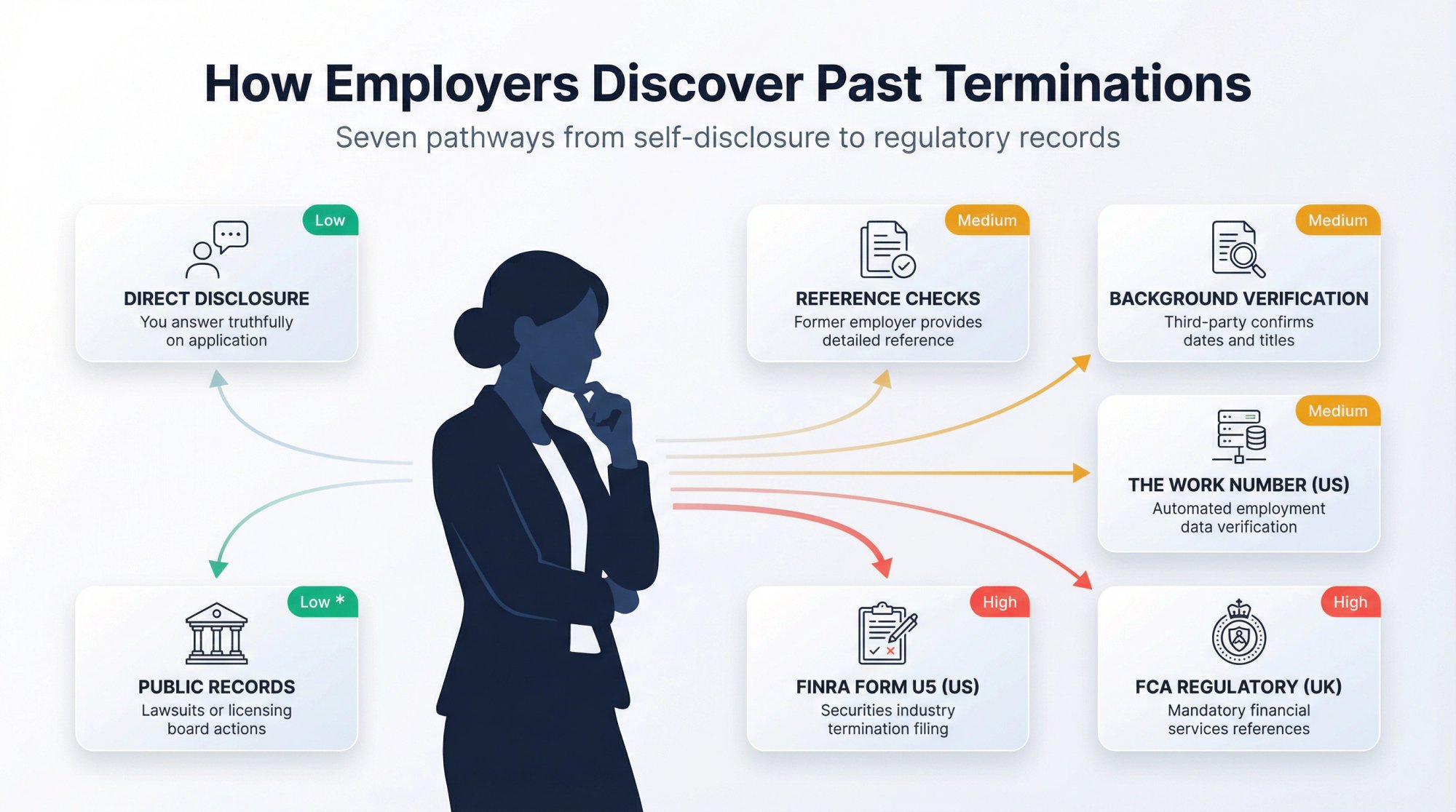
How Do Employers Find Out You Were Fired?
Yes, a prospective employer can find out you were fired, but it's not automatic and the method matters.
What you need to know:
Most standard background checks don't say "fired." Many employment background checks focus on criminal records, identity verification, and credit history. When they do include employment verification, they typically confirm dates and titles. Whether "termination" is revealed often depends on what your former employer chooses to share.
References are the most common pathway. When a new employer asks your former employer for a detailed reference that includes "reasons for leaving," the truth can surface. In the UK, official ACAS guidance (last reviewed November 29, 2024) notes that a reference can include performance details and whether you were dismissed, as long as it's fair and accurate.
Certain regulated industries create unavoidable paper trails. If you work in UK financial services (FCA regulatory references under SYSC 22) or US broker-dealer roles (FINRA Form U5), your termination gets documented in ways that are hard to hide.
Your biggest risk isn't the firing itself. It's consistency. You say you resigned, but a verification shows you were "discharged." Or you claim you still work there, but verification reveals an end date. That mismatch is what kills trust.
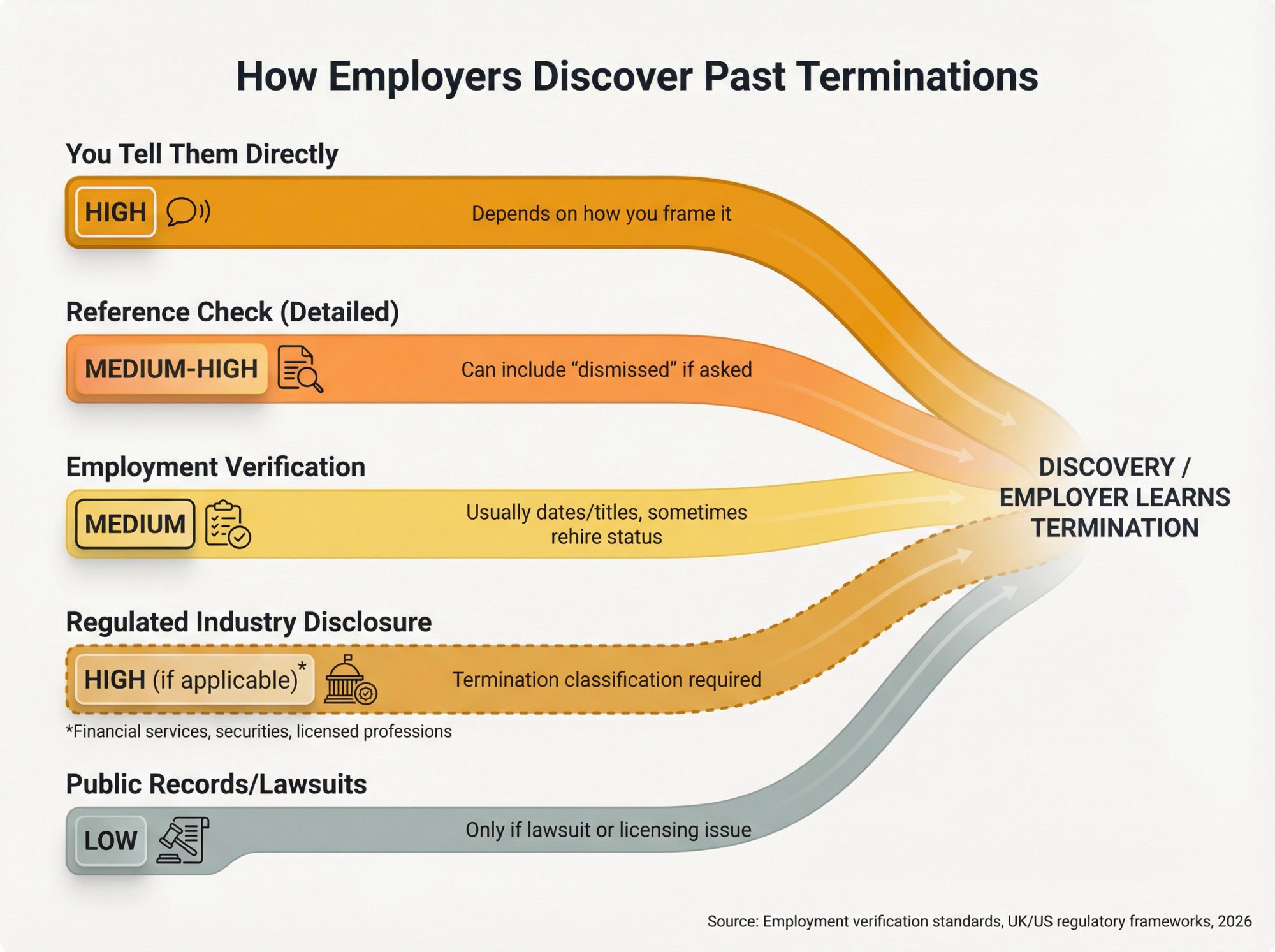
7 Ways Employers Discover Past Terminations
Think in channels. Employers don't have magic databases. They learn things through specific pathways.
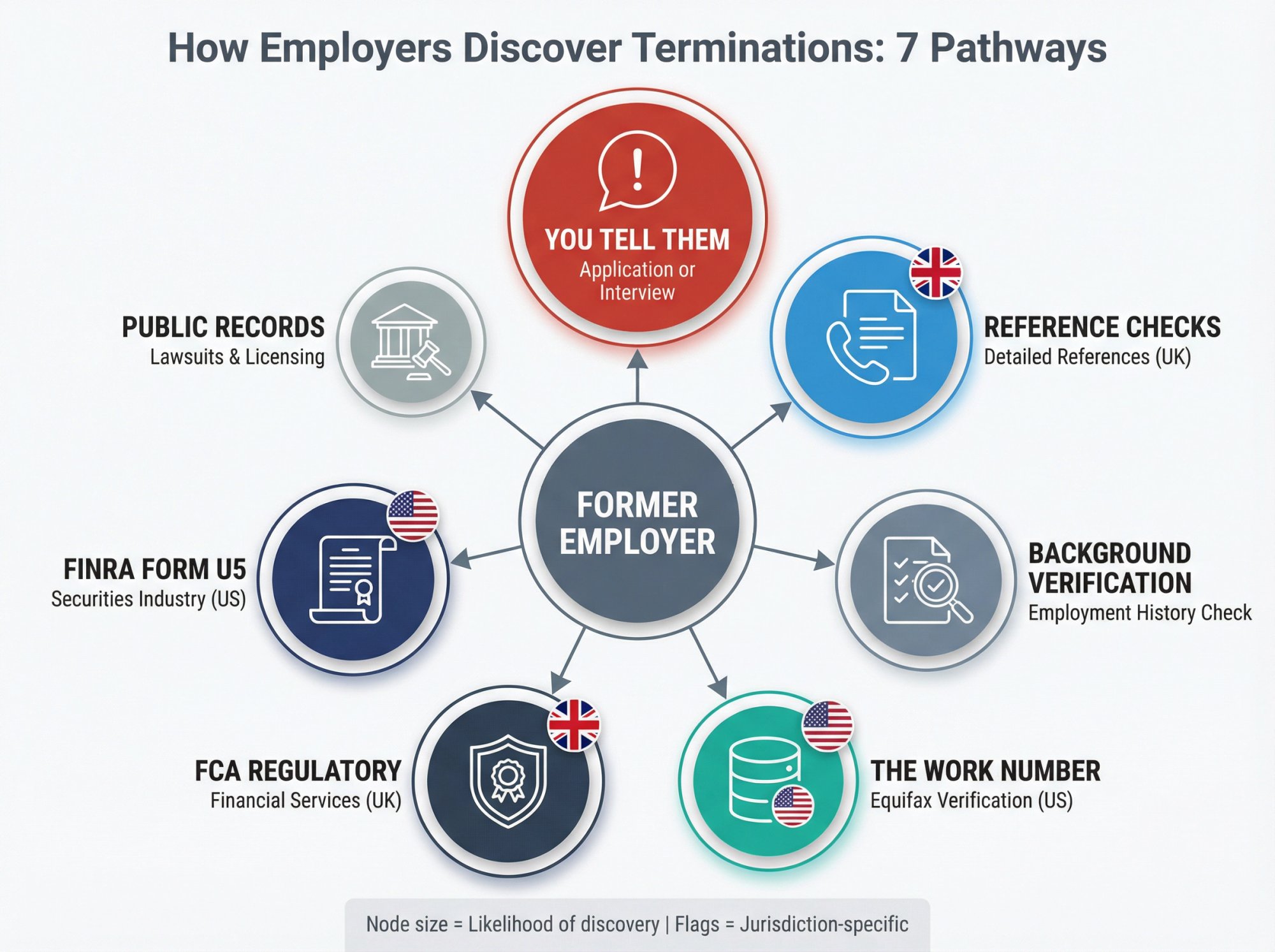
1. You Tell Them Directly (Application or Interview)
This includes application questions like "Have you ever been terminated?", interview questions like "Why did you leave?", and inconsistencies in dates, titles, or gaps that don't add up.
Most candidates accidentally reveal the story by over-explaining, getting defensive, or contradicting their own paperwork later. If you've ever started an explanation with "Well, what really happened was..." and then talked for three minutes, you know what we mean.
2. Reference Checks Reveal Dismissal (UK)
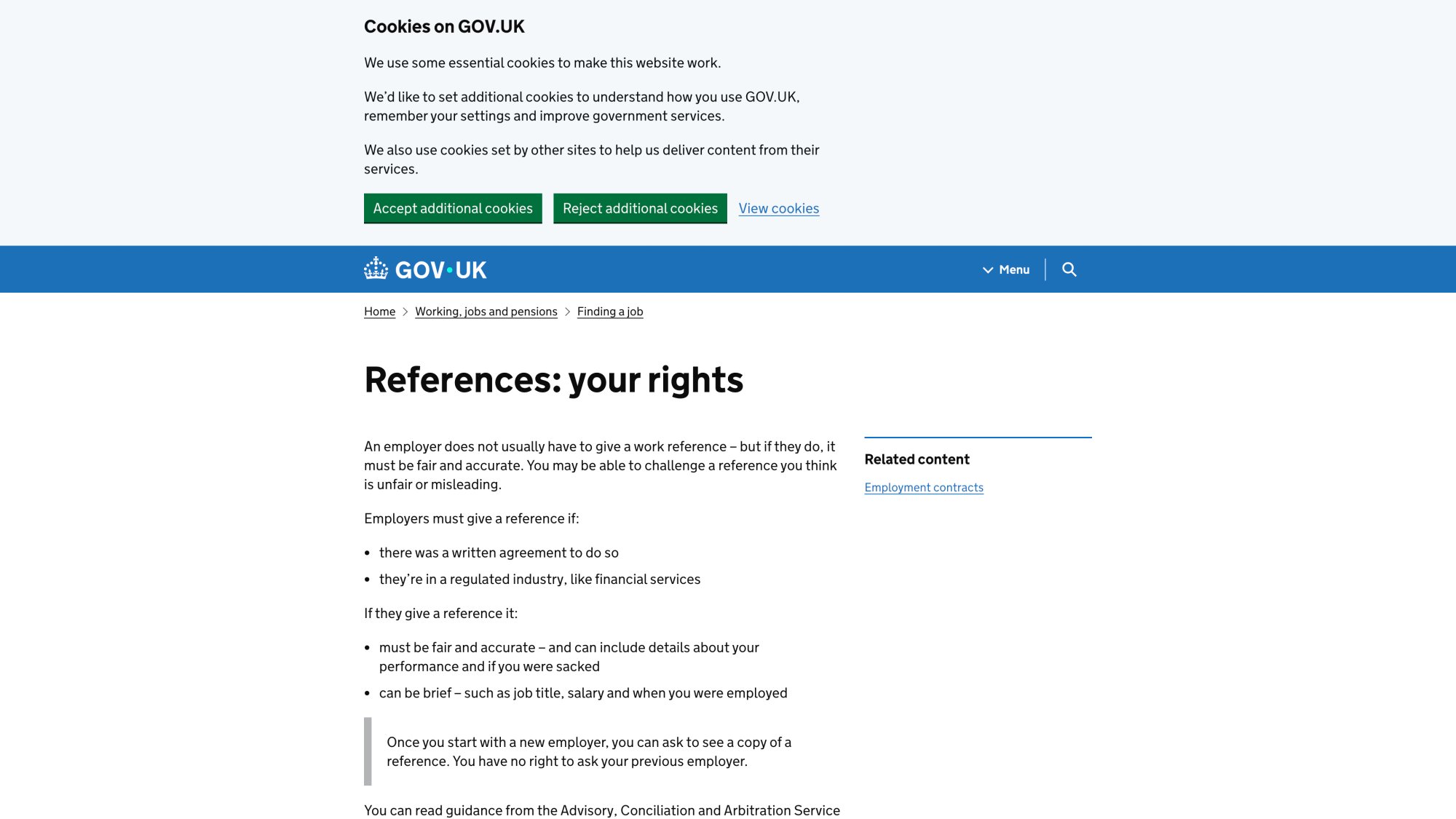
In the UK, government guidance explains that employers don't usually have to give a reference, but if they do it must be fair and accurate, and it can include details about performance and whether you were sacked.
ACAS distinguishes between:
• Basic (factual) reference: typically just job title and employment dates
• Detailed reference: may include skills, ability, relevant disciplinary records, and reasons for leaving
If a new employer requests a detailed reference, "dismissed" or "terminated" can appear, especially if your former employer chooses to disclose it and the information is accurate.
3. Background Checks Verify Employment History
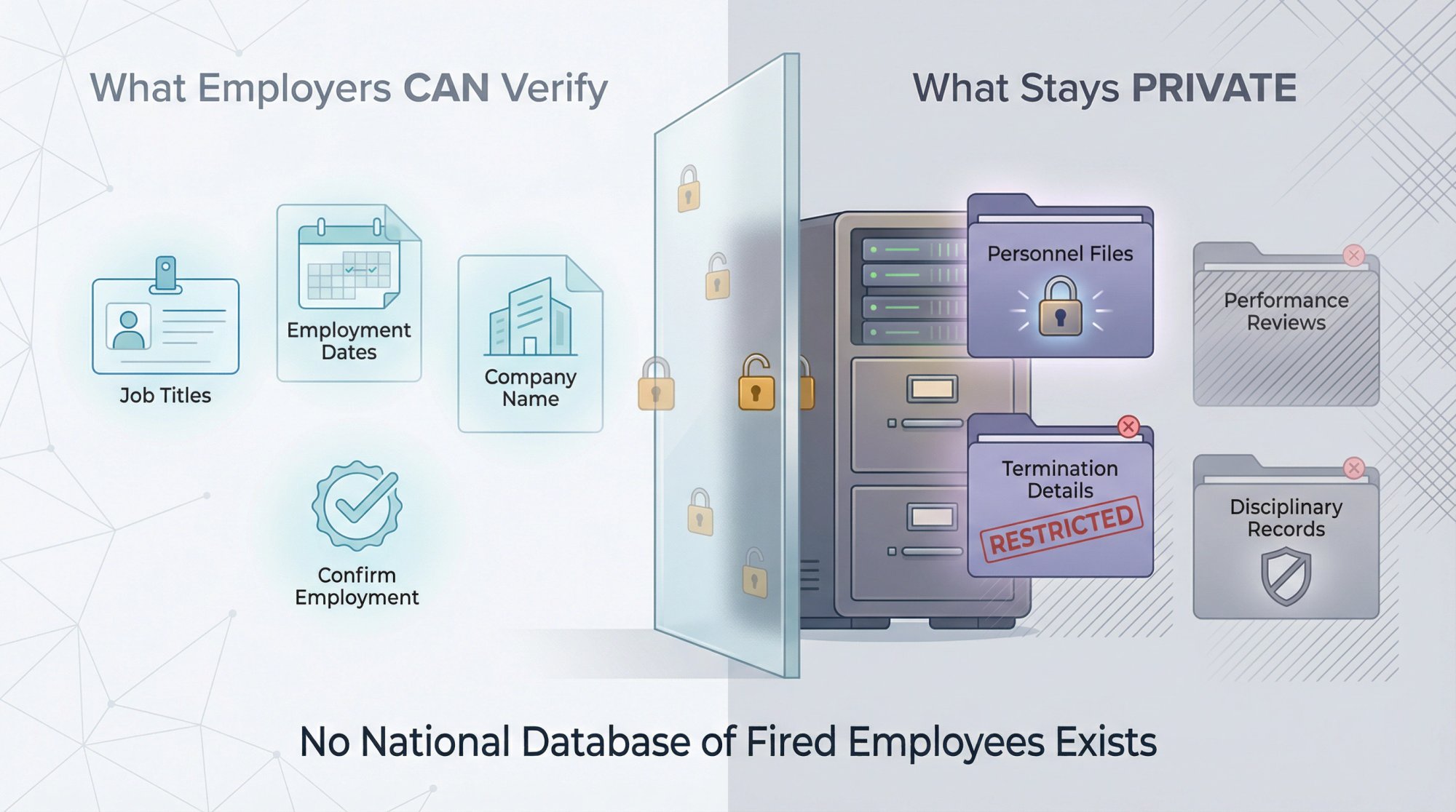
Many background screening packages include employment verification. Major US screening companies note that employment verifications typically confirm employer name, dates of employment, and position titles, and their employment verifications do not provide information about a candidate's departure.
So even when a background check verifies your job history, it often confirms facts (dates and titles), not drama (why you left).
But there's a catch. If the employer or screening company asks your former employer about rehire eligibility or reason for separation, and the former employer answers, that can surface the termination.
4. The Work Number Exposes Employment Gaps (US)
In the US, some employers and screeners use The Work Number (Equifax Workforce Solutions) for automated employment and income verification. The Work Number:
→ Provides employment and income information collected from employers and payroll processors
→ Allows you to request a free report of your own data
→ Will freeze your consumer report if you request it
Separate employer and employee documentation commonly describes an Employment Data Report (EDR) that can show your employment and income information, who accessed it, and includes dispute and freeze options.
The important nuance: even if an automated verification confirms an end date, that doesn't automatically mean "fired." But it can expose inconsistencies. If you told an interviewer you're still employed and verification shows you left six months ago, that's a problem.
5. FCA Regulatory References (UK Financial Services)
If you're applying for certain roles in UK financial services, regulatory references are mandatory and highly structured. The FCA's SYSC 22 requirements (updated February 24, 2025) are designed so firms request and provide references covering a defined lookback period (commonly six years) for relevant roles, and they must include fitness and propriety-related information.
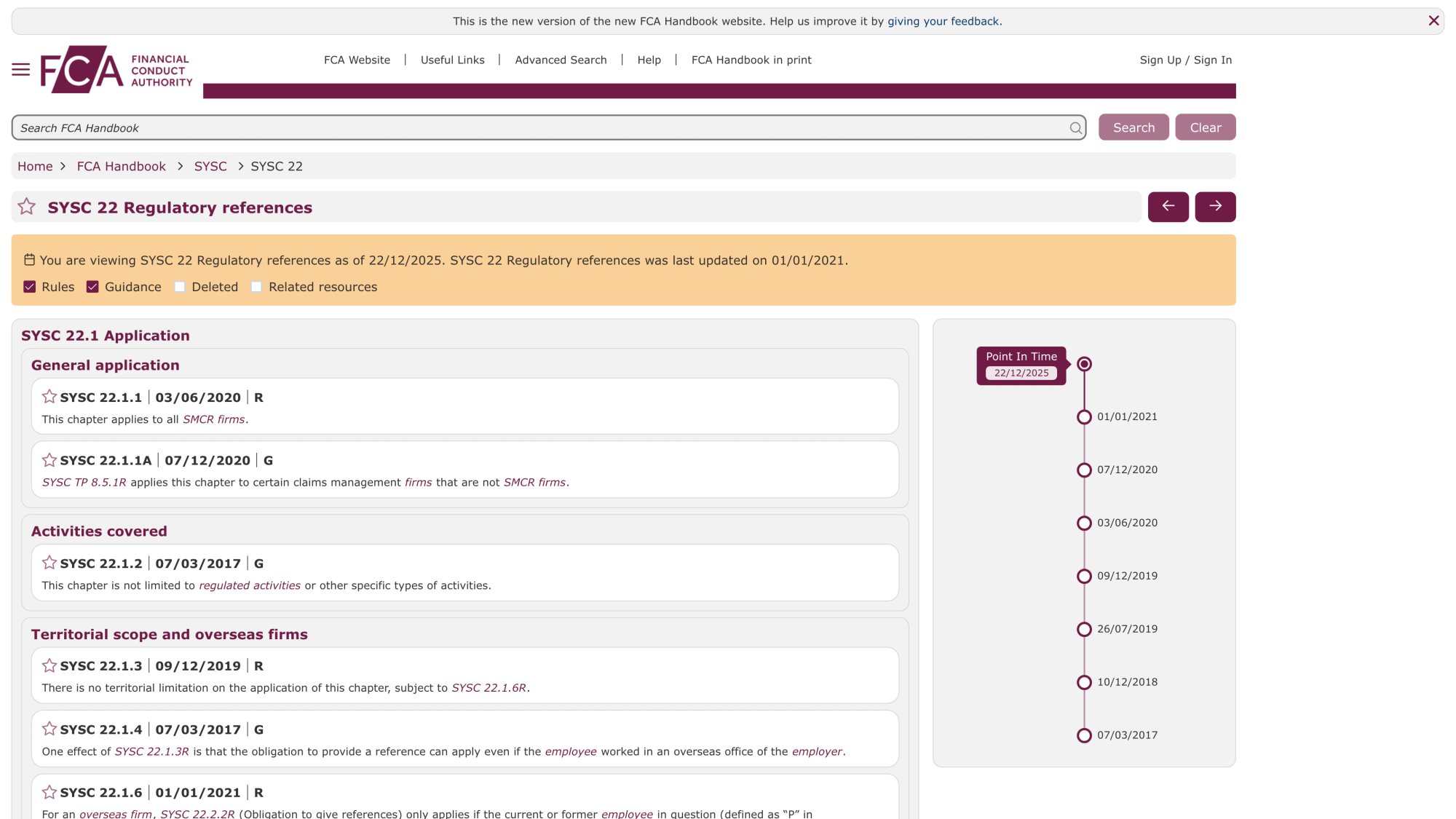
This is a situation where a quiet exit is much less likely.
6. FINRA Form U5 Creates Permanent Records (US)
FINRA requires firms to file Form U5 when a registered representative leaves. The form includes how firms must classify the termination (for example, "discharged"). Firms generally have 30 calendar days to file after termination.
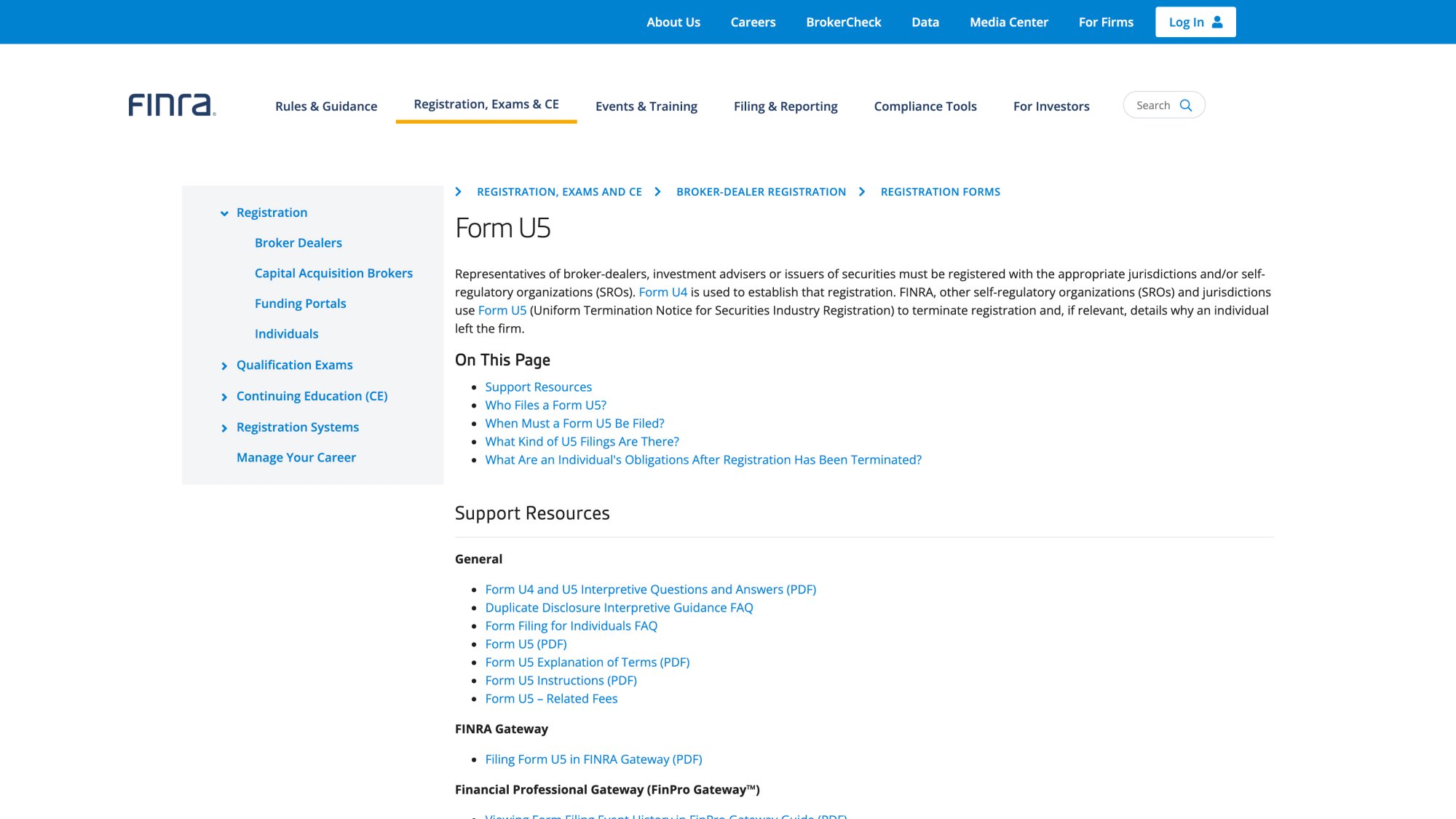
In broker-dealer contexts, your separation reason can become visible within industry systems and can follow you to your next role.
7. Public Records and Licensing Boards
This is less common, but it matters when:
→ You were terminated and there's a public lawsuit (wrongful dismissal litigation, for example)
→ You work in a licensed field with public disciplinary records
→ You're applying for high-trust roles with deeper investigations
Most people won't be affected by this, but if you work in regulated professions, treat this section as critical.
What Background Checks Don't Show About Terminations
There's No National "Fired Employee" Database
Your termination is documented internally by your former employer, but there's generally no single national database that says "this person was fired" that's accessible to all employers. (With notable exceptions in regulated roles, as we covered above.)
Your Former Employer Can't Just Share Your Personnel File
In the UK, references must be fair and accurate, and they're often brief. In the US, while there's no single rule that forces "dates only," privacy concerns, defamation risk, and internal company policy often restrict what employers disclose to outside parties.
The idea that every recruiter can pull your full personnel file is a myth. What happens in practice is much more limited.
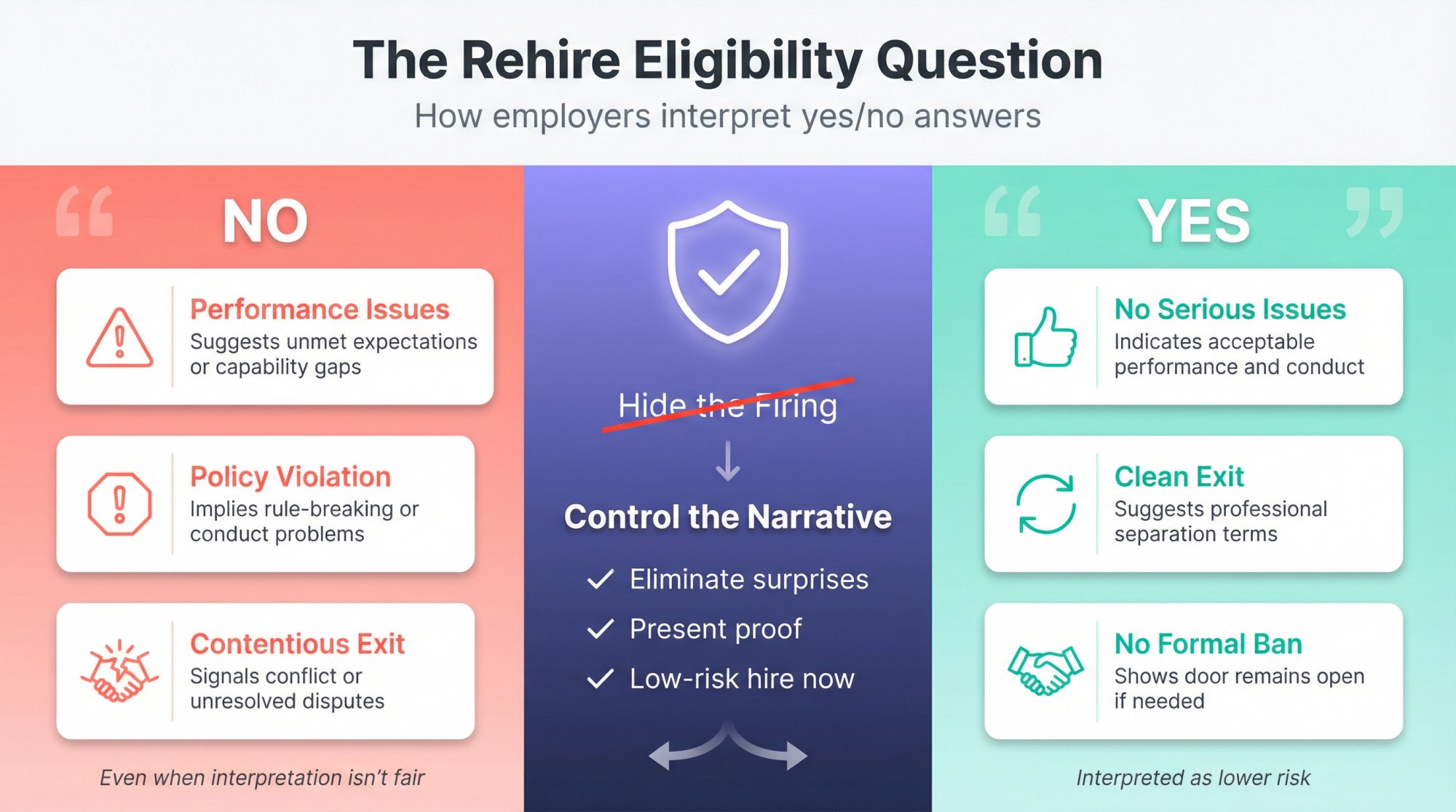
Why "Eligible for Rehire?" Is the Question That Matters Most
Even when companies officially limit references to "title and dates," many employers will still answer (or imply) rehire eligibility.
Why this matters:
A "no" can be interpreted as: performance issues, policy violation, or a contentious separation (even if that interpretation isn't fair)
A "yes" can be interpreted as: nothing too serious, or at least no formal ban
This is why your strategy shouldn't be "hide the firing."
It should be: Control the narrative. Eliminate surprises. Present credible, job-relevant proof that you're a low-risk hire now.
Do You Have to Disclose Being Fired on Applications?
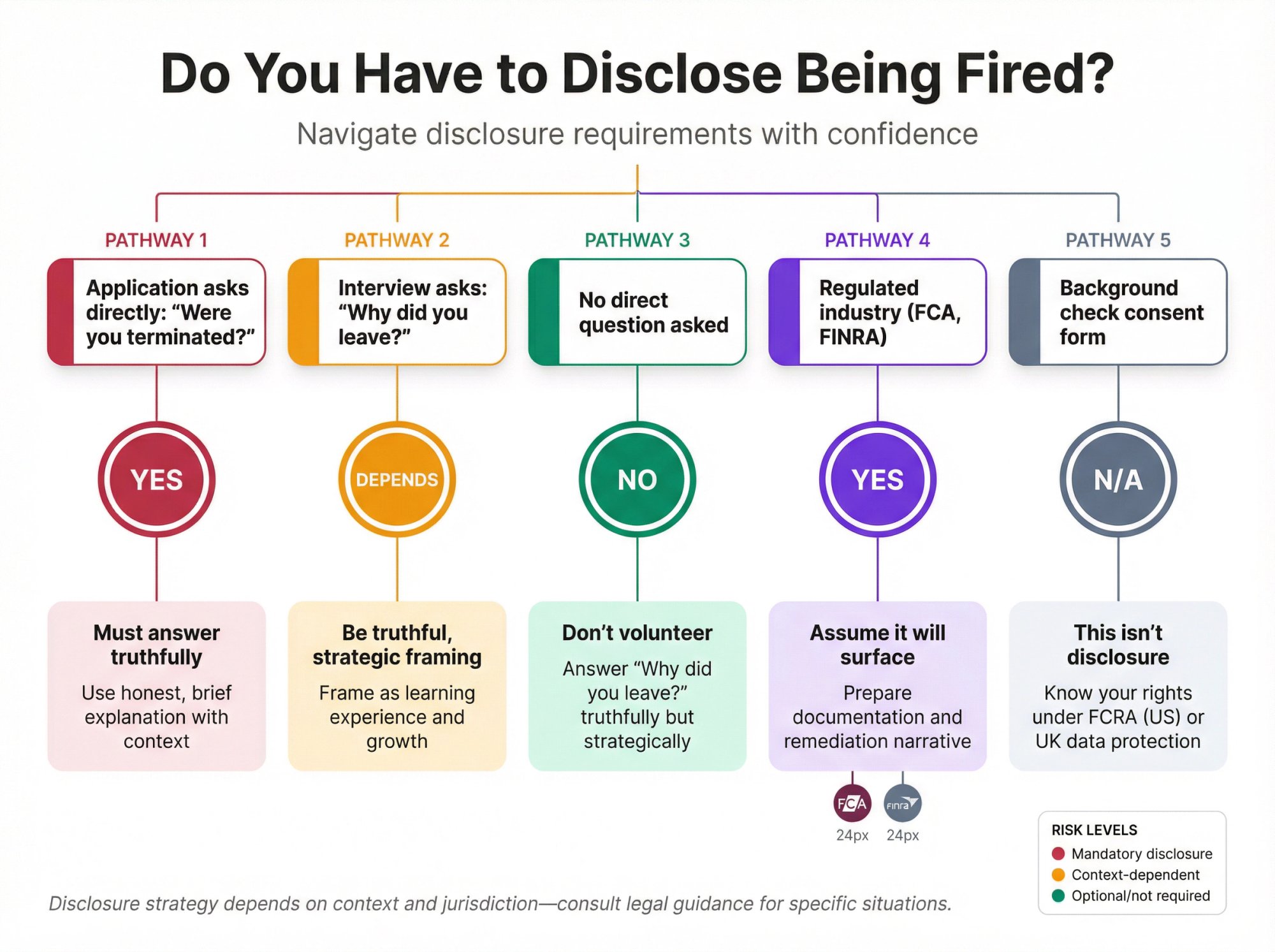
When Disclosure Is Required vs Optional
If Application Asks "Were You Terminated?" - Tell the Truth
If an application or interview explicitly asks "Were you fired or terminated?" and you say "no," you create a high-risk mismatch if your former employer discloses the truth or a regulated record exists.
Lying here can disqualify you immediately. Honesty with context wins.
If Not Asked Directly - You Don't Need to Volunteer
A lot of hiring processes never ask directly. You can answer "Why did you leave?" truthfully without using the most loaded word in your vocabulary.
What UK Employment Law Says About References
UK government guidance notes that references can include performance details and whether you were sacked, and references must be fair and accurate. So in the UK, it's wise to assume termination can surface via references, especially if the new employer asks for detail.
Your Rights Under FCRA (US Background Checks)
If an employer uses a background reporting company, the FTC explains you have rights under the Fair Credit Reporting Act (FCRA), including:
• The employer must get your written permission
• The disclosure must be in a standalone document (not buried in the job application)
If information in a consumer report could lead to rejecting you, employers have obligations around pre-adverse and adverse action notices, including giving you a copy of the report and a summary of your rights, including the Summary of Consumer Rights that outlines what you're entitled to if a background check plays a role in hiring decisions.
What to Say When Asked "Why Did You Leave?"
The framework that consistently works well:
The Four-Part Response Framework:
① One sentence: what happened (truthfully, without a courtroom speech)
② Ownership: what you learned and what you changed
③ Proof: evidence you're a safer bet now
④ Relevance: why you're a strong fit for this job
Script: Performance Issue or Didn't Meet Expectations
"My employment ended because I wasn't meeting the role's expectations quickly enough. I took that seriously, got specific feedback, and since then I've strengthened [skill X] through [training/project/metrics]. In my last [project/role], I delivered [result], and I'm confident this role aligns much better with my strengths in [A/B/C]."
Script: Culture Fit or Leadership Change
"The role ended after a change in priorities and leadership expectations. I learned a lot about the environment where I do my best work: clear goals, measurable outcomes, and regular feedback. That's why I'm excited about this role. The way your team measures success and operates matches how I deliver results."
Script: Policy Violation
"I was terminated after a policy-related issue. I'm not going to minimize it. I took accountability, I understand the standard expected, and I've put safeguards in place so it doesn't happen again. What I can show you is the quality of my work: [portfolio/result], and strong references from people who've seen me perform."
Rule: Never volunteer graphic details. Share enough to signal honesty and maturity, then pivot to value.
How to Build References That Won't Backfire
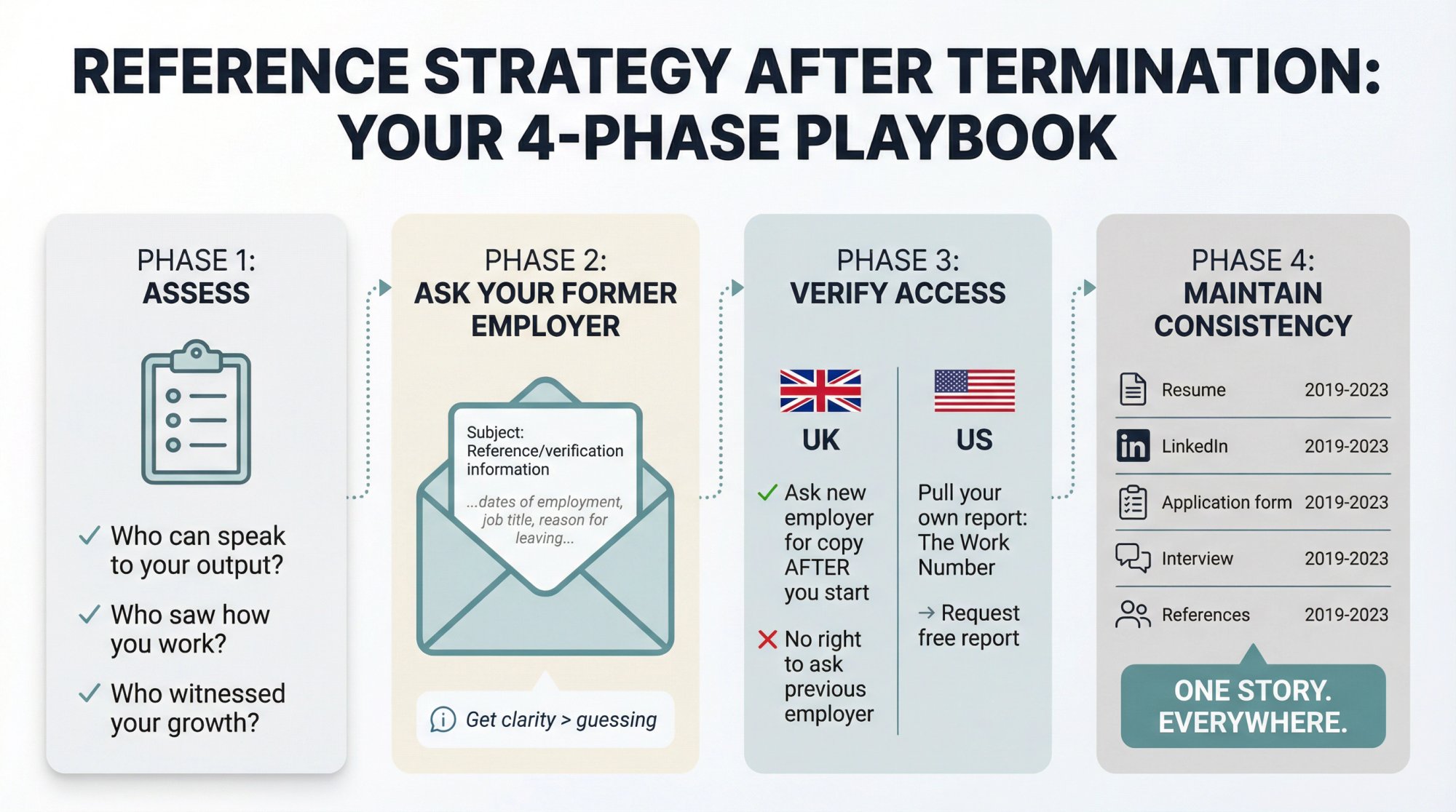
Who Should You List as References After Being Fired?
A great reference is someone who can speak to:
• Your output (results, reliability)
• How you work (communication, ownership)
• How you've grown since the termination
AIApply can help you build a reference plan that actually supports your story instead of creating new problems.
Ask Your Former Employer What They'll Say
In the UK, many employers choose to give only a basic reference, but they can provide a more detailed one, including reasons for leaving. Getting clarity matters more than guessing.
Email template to HR:
Subject: Reference/verification informationHi [Name],Could you please confirm what information the company provides in employment verifications or references? Specifically: dates of employment, job title, and whether any information about reason for leaving or rehire eligibility is shared.Thank you,[Your name]What You Can See About Your References (UK)
UK government guidance says:
• You can ask your new employer to see a copy of a reference after you start
• You have no right to ask your previous employer for it
Also, the ICO (Information Commissioner's Office) notes that confidential references can be exempt from subject access disclosure under UK GDPR when provided in confidence, and this guidance is being reviewed in light of the Data (Use and Access) Act coming into law on 19 June 2025.
Practical implication: You might not be able to see exactly what was said, so prevention (agreed reference, reference choice, narrative prep) matters more than trying to find out after the fact.
How to Pull Your Own Employment Report (US)
If The Work Number could be used in your industry, consider requesting your report and reviewing it for accuracy. The Work Number provides employment and income information and allows you to request a free report and request a freeze.
Important: Do not use a freeze to misrepresent your history. Use it for privacy and accuracy control, and be ready to provide alternative documentation if a verifier can't access it.
Keep Your Termination Story Consistent Everywhere
Your story must be consistent across:
• Resume dates
• LinkedIn dates
• Application answers
• Interview answers
• References
If you need help handling gaps created by a termination, AIApply's Resume Builder can help you frame gaps without creating new red flags.
What to Do If You Get a Bad or Misleading Reference
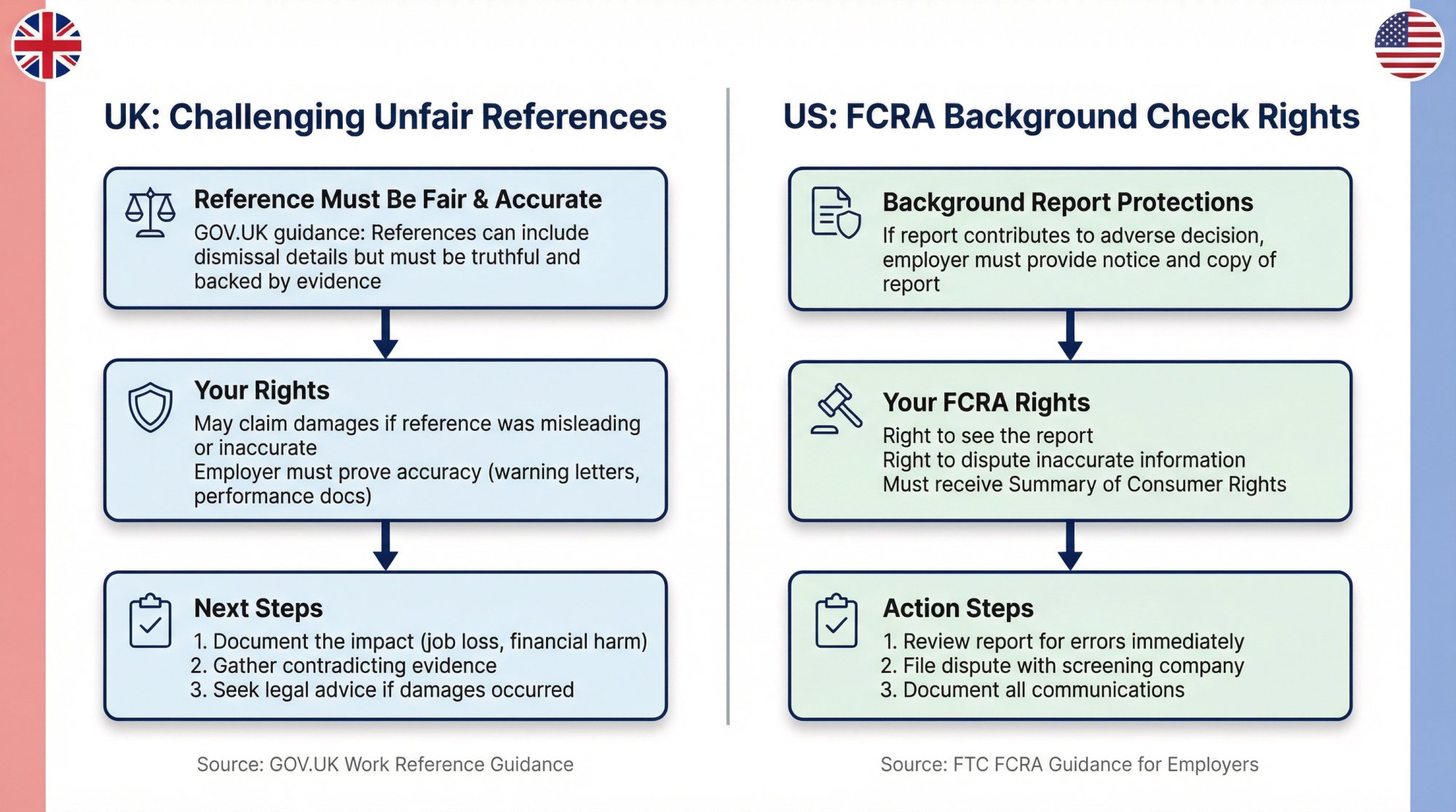
UK: How to Challenge Unfair References
The GOV.UK guidance explains that if you believe you received an unfair or misleading reference, you may be able to claim damages, and the previous employer must be able to back up what they said (for example, with warning letters or documented performance issues).
US: Your Rights Under FCRA for Background Checks
If a background report contributes to an adverse decision, you generally have rights to:
• See the report
• Dispute inaccurate information
The FTC explains the permission and disclosure requirements and the broader FCRA protections around employer background checks.
When Being Fired Will Follow You to Your Next Job
Most generic articles stop at "references and background checks." But if you want the real edge, focus here.
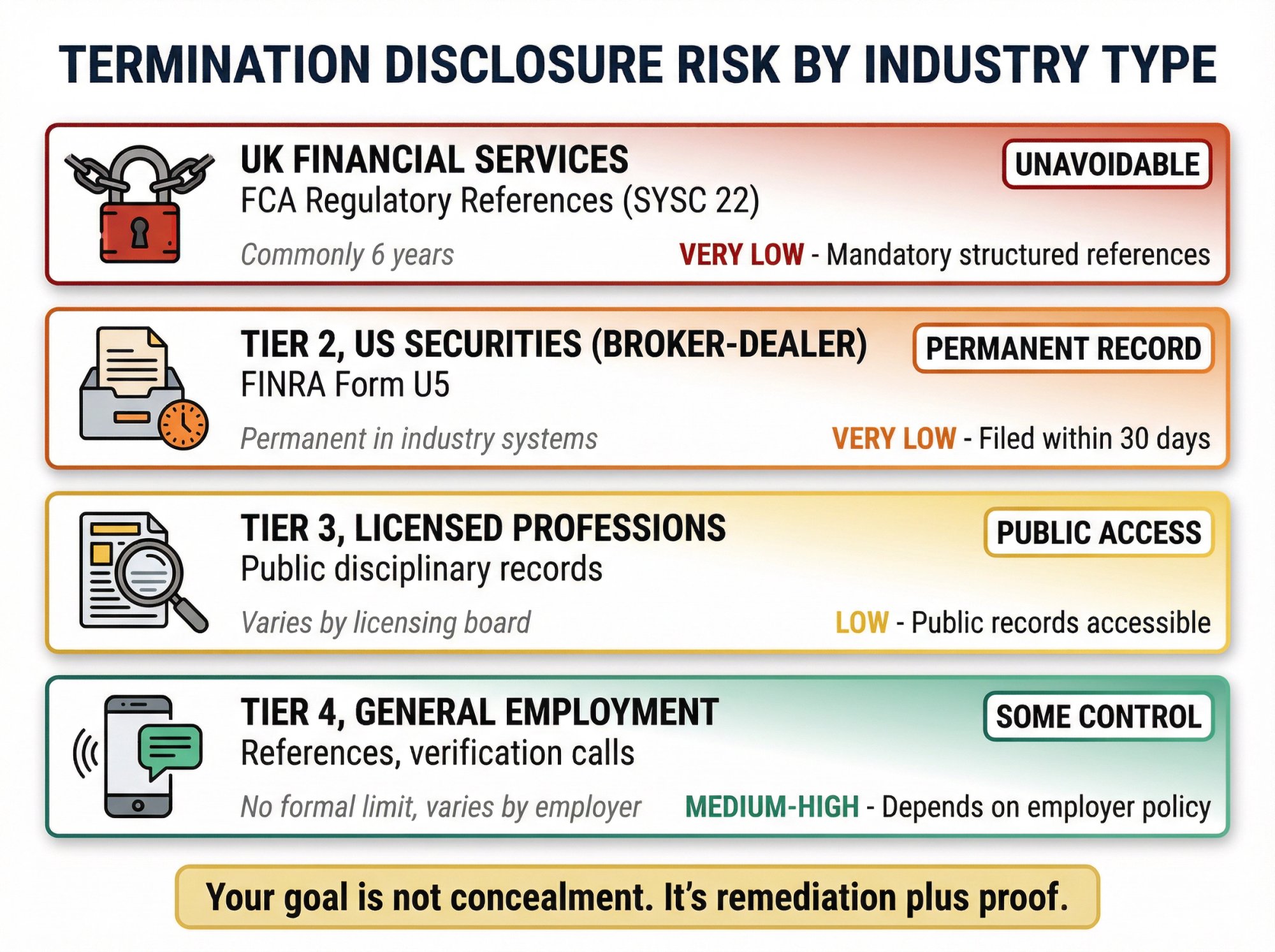
Regulated industries often require mandatory reference and disclosure frameworks:
→ UK financial services: FCA regulatory references under SYSC 22
→ US securities: FINRA Form U5 and termination classifications
Employment and income verification networks can expose dates (and sometimes payroll detail), which can reveal inconsistencies even if they don't explicitly say "fired."
If you're in one of these categories, your goal is not concealment.
It's remediation plus proof.
How AIApply Helps You Recover After Being Fired
Being fired creates two risks. You lose confidence, and your story gets messy. We help you fix both, fast.
Tailor your resume to the job you're applying for so your past doesn't dominate your future. Use our Resume Builder and Resume Scanner to make sure each application positions you for the role you actually want, not the one you just left.
Write a cover letter that frames your value and addresses "why you're a fit now" without spiraling into the termination story. Cover letters are where calm, confident reframing wins. Our Cover Letter Builder helps you do exactly that.
Practice the termination question using our Mock Interview workflows so your answer becomes stable, short, and credible before the real interview. You'll know exactly what to say, how to say it, and when to stop talking.
Get real-time support during interviews with our Interview Buddy, which provides on-screen coaching visible only to you when tough questions come up.
Build a reference plan (who, when, how) using AIApply's reference guidance.
If you're trying to move quickly, we also publish up-to-date tactical job search guidance (like how to get hired fast) so you can turn this setback into your next opportunity without wasting months.
And if you want a closely related explainer, we already have one: "When You Get Terminated From a Job Does It Go on Your Record?" (published June 18, 2025). Use it as a companion piece, then link back here for the deeper "how they find out and what to do" playbook.
Frequently Asked Questions
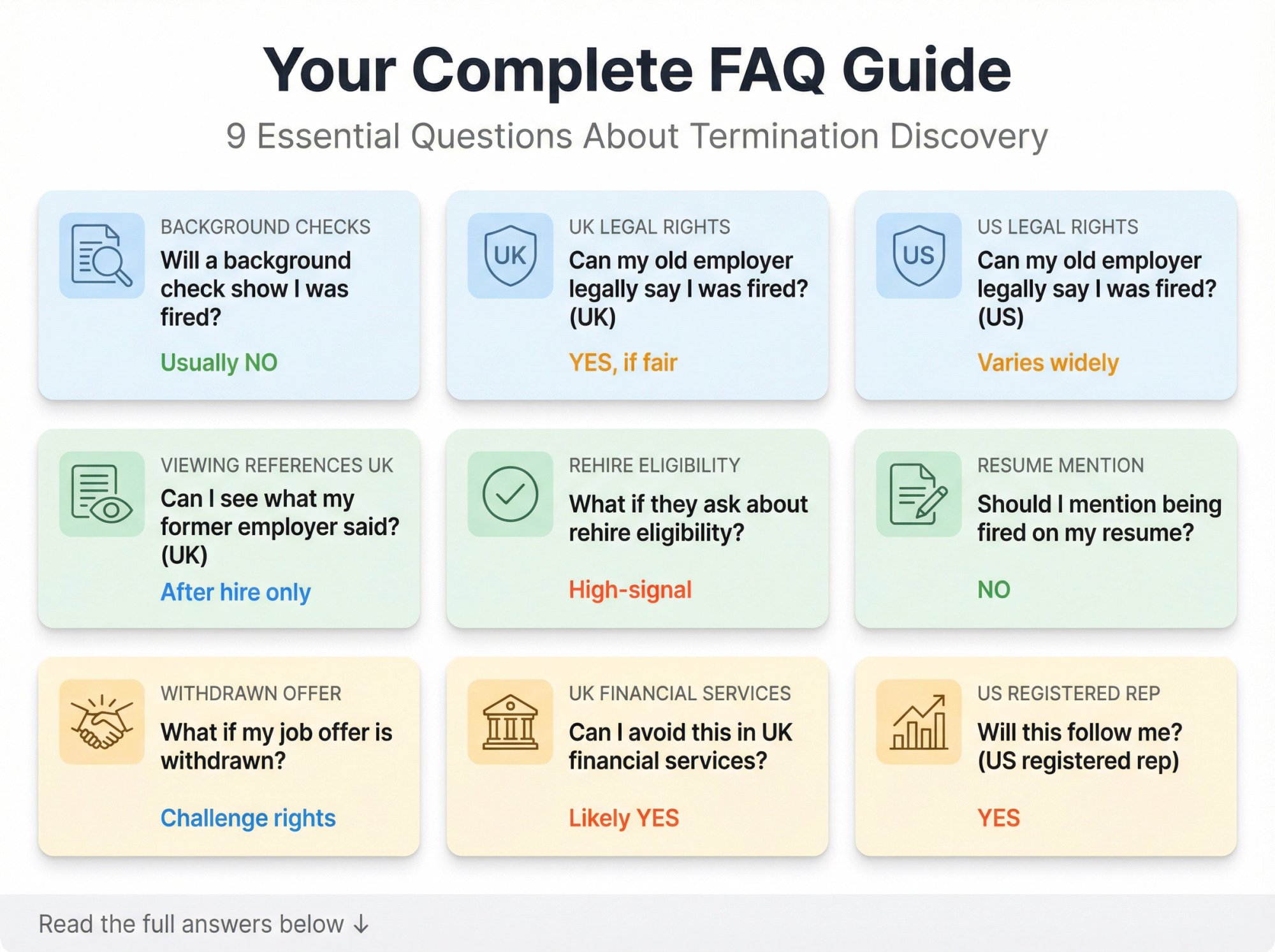
Will a background check show I was fired?
Often no, not explicitly. Many employment verifications focus on dates and titles, and some screening providers state they do not include departure information. But a reference check, or a regulated-industry process, can surface termination.
Can my old employer legally say I was fired (UK)?
UK guidance states a reference must be fair and accurate and can include performance details and whether you were sacked.
Can my old employer legally say I was fired (US)?
In general, employers can share truthful information, but practices vary widely and many companies restrict what they disclose. If a third-party background report is used, the process is governed by the FCRA.
Can I see what my former employer said in a reference (UK)?
UK guidance says once you start with a new employer you can ask to see a copy of a reference, but you have no right to ask your previous employer for it. Also, confidential references can be exempt from subject access disclosure depending on how they're handled.
What if they ask "Are you eligible for rehire?"
Treat it as a high-signal question and prepare for it. If your answer is "no," keep the focus on what you learned, what changed, and why you're right for this role now.
Should I mention being fired on my resume?
Usually no. Your resume is a marketing document for your skills and results. Handle the separation in interviews and application forms if asked. (Never falsify dates.)
What if my job offer is withdrawn because of a reference?
In the UK, you may be able to challenge misleading or unfair references and seek damages if you suffered a loss and the reference was inaccurate or misleading. In the US, if a consumer report contributed, you may have dispute rights under FCRA.
I'm in UK financial services. Can I avoid this coming up?
Assume it can surface. FCA regulatory references are structured and required for certain roles. Your best play is documentation and fit-and-proper remediation.
I'm a registered representative in the US. Will this follow me?
Form U5 termination classifications exist for registered contexts, and firms generally file within 30 days. Treat your narrative and documentation as mission-critical.
Bottom line: Yes, employers can find out you were fired. But the method matters, your industry matters, and your preparation matters most. Control your narrative, build your proof, and use tools like AIApply to turn a termination into your next career chapter instead of a permanent roadblock.
If you're searching "can employer find out I was fired," you're probably dealing with three urgent concerns right now. First, you want to avoid a surprise that torpedoes your chances late in the hiring process (when they call your references or run a background check). Second, you need to know exactly what to say on applications and in interviews without sabotaging yourself. Third, you're trying to recover your narrative so one bad ending doesn't define your entire career story.
We built this guide to remove the uncertainty. You'll learn exactly how employers might discover a past termination, what they usually can't see, the specific situations where it will show up, and practical scripts plus strategies to handle it with confidence. AIApply can help you rebuild your career narrative after a termination, starting with a resume that positions you for the role you want, not the one you left.
How Do Employers Find Out You Were Fired?
Yes, a prospective employer can find out you were fired, but it's not automatic and the method matters.
What you need to know:
Most standard background checks don't say "fired." Many employment background checks focus on criminal records, identity verification, and credit history. When they do include employment verification, they typically confirm dates and titles. Whether "termination" is revealed often depends on what your former employer chooses to share.
References are the most common pathway. When a new employer asks your former employer for a detailed reference that includes "reasons for leaving," the truth can surface. In the UK, official ACAS guidance (last reviewed November 29, 2024) notes that a reference can include performance details and whether you were dismissed, as long as it's fair and accurate.
Certain regulated industries create unavoidable paper trails. If you work in UK financial services (FCA regulatory references under SYSC 22) or US broker-dealer roles (FINRA Form U5), your termination gets documented in ways that are hard to hide.
Your biggest risk isn't the firing itself. It's consistency. You say you resigned, but a verification shows you were "discharged." Or you claim you still work there, but verification reveals an end date. That mismatch is what kills trust.
7 Ways Employers Discover Past Terminations
Think in channels. Employers don't have magic databases. They learn things through specific pathways.
1. You Tell Them Directly (Application or Interview)
This includes application questions like "Have you ever been terminated?", interview questions like "Why did you leave?", and inconsistencies in dates, titles, or gaps that don't add up.
Most candidates accidentally reveal the story by over-explaining, getting defensive, or contradicting their own paperwork later. If you've ever started an explanation with "Well, what really happened was..." and then talked for three minutes, you know what we mean.
2. Reference Checks Reveal Dismissal (UK)
In the UK, government guidance explains that employers don't usually have to give a reference, but if they do it must be fair and accurate, and it can include details about performance and whether you were sacked.
ACAS distinguishes between:
• Basic (factual) reference: typically just job title and employment dates
• Detailed reference: may include skills, ability, relevant disciplinary records, and reasons for leaving
If a new employer requests a detailed reference, "dismissed" or "terminated" can appear, especially if your former employer chooses to disclose it and the information is accurate.
3. Background Checks Verify Employment History
Many background screening packages include employment verification. Major US screening companies note that employment verifications typically confirm employer name, dates of employment, and position titles, and their employment verifications do not provide information about a candidate's departure.
So even when a background check verifies your job history, it often confirms facts (dates and titles), not drama (why you left).
But there's a catch. If the employer or screening company asks your former employer about rehire eligibility or reason for separation, and the former employer answers, that can surface the termination.
4. The Work Number Exposes Employment Gaps (US)
In the US, some employers and screeners use The Work Number (Equifax Workforce Solutions) for automated employment and income verification. The Work Number:
→ Provides employment and income information collected from employers and payroll processors
→ Allows you to request a free report of your own data
→ Will freeze your consumer report if you request it
Separate employer and employee documentation commonly describes an Employment Data Report (EDR) that can show your employment and income information, who accessed it, and includes dispute and freeze options.
The important nuance: even if an automated verification confirms an end date, that doesn't automatically mean "fired." But it can expose inconsistencies. If you told an interviewer you're still employed and verification shows you left six months ago, that's a problem.
5. FCA Regulatory References (UK Financial Services)
If you're applying for certain roles in UK financial services, regulatory references are mandatory and highly structured. The FCA's SYSC 22 requirements (updated February 24, 2025) are designed so firms request and provide references covering a defined lookback period (commonly six years) for relevant roles, and they must include fitness and propriety-related information.
This is a situation where a quiet exit is much less likely.
6. FINRA Form U5 Creates Permanent Records (US)
FINRA requires firms to file Form U5 when a registered representative leaves. The form includes how firms must classify the termination (for example, "discharged"). Firms generally have 30 calendar days to file after termination.
In broker-dealer contexts, your separation reason can become visible within industry systems and can follow you to your next role.
7. Public Records and Licensing Boards
This is less common, but it matters when:
→ You were terminated and there's a public lawsuit (wrongful dismissal litigation, for example)
→ You work in a licensed field with public disciplinary records
→ You're applying for high-trust roles with deeper investigations
Most people won't be affected by this, but if you work in regulated professions, treat this section as critical.
What Background Checks Don't Show About Terminations
There's No National "Fired Employee" Database
Your termination is documented internally by your former employer, but there's generally no single national database that says "this person was fired" that's accessible to all employers. (With notable exceptions in regulated roles, as we covered above.)
Your Former Employer Can't Just Share Your Personnel File
In the UK, references must be fair and accurate, and they're often brief. In the US, while there's no single rule that forces "dates only," privacy concerns, defamation risk, and internal company policy often restrict what employers disclose to outside parties.
The idea that every recruiter can pull your full personnel file is a myth. What happens in practice is much more limited.
Why "Eligible for Rehire?" Is the Question That Matters Most
Even when companies officially limit references to "title and dates," many employers will still answer (or imply) rehire eligibility.
Why this matters:
A "no" can be interpreted as: performance issues, policy violation, or a contentious separation (even if that interpretation isn't fair)
A "yes" can be interpreted as: nothing too serious, or at least no formal ban
This is why your strategy shouldn't be "hide the firing."
It should be: Control the narrative. Eliminate surprises. Present credible, job-relevant proof that you're a low-risk hire now.
Do You Have to Disclose Being Fired on Applications?
When Disclosure Is Required vs Optional
If Application Asks "Were You Terminated?" - Tell the Truth
If an application or interview explicitly asks "Were you fired or terminated?" and you say "no," you create a high-risk mismatch if your former employer discloses the truth or a regulated record exists.
Lying here can disqualify you immediately. Honesty with context wins.
If Not Asked Directly - You Don't Need to Volunteer
A lot of hiring processes never ask directly. You can answer "Why did you leave?" truthfully without using the most loaded word in your vocabulary.
What UK Employment Law Says About References
UK government guidance notes that references can include performance details and whether you were sacked, and references must be fair and accurate. So in the UK, it's wise to assume termination can surface via references, especially if the new employer asks for detail.
Your Rights Under FCRA (US Background Checks)
If an employer uses a background reporting company, the FTC explains you have rights under the Fair Credit Reporting Act (FCRA), including:
• The employer must get your written permission
• The disclosure must be in a standalone document (not buried in the job application)
If information in a consumer report could lead to rejecting you, employers have obligations around pre-adverse and adverse action notices, including giving you a copy of the report and a summary of your rights, including the Summary of Consumer Rights that outlines what you're entitled to if a background check plays a role in hiring decisions.
What to Say When Asked "Why Did You Leave?"
The framework that consistently works well:
The Four-Part Response Framework:
① One sentence: what happened (truthfully, without a courtroom speech)
② Ownership: what you learned and what you changed
③ Proof: evidence you're a safer bet now
④ Relevance: why you're a strong fit for this job
Script: Performance Issue or Didn't Meet Expectations
"My employment ended because I wasn't meeting the role's expectations quickly enough. I took that seriously, got specific feedback, and since then I've strengthened [skill X] through [training/project/metrics]. In my last [project/role], I delivered [result], and I'm confident this role aligns much better with my strengths in [A/B/C]."
Script: Culture Fit or Leadership Change
"The role ended after a change in priorities and leadership expectations. I learned a lot about the environment where I do my best work: clear goals, measurable outcomes, and regular feedback. That's why I'm excited about this role. The way your team measures success and operates matches how I deliver results."
Script: Policy Violation
"I was terminated after a policy-related issue. I'm not going to minimize it. I took accountability, I understand the standard expected, and I've put safeguards in place so it doesn't happen again. What I can show you is the quality of my work: [portfolio/result], and strong references from people who've seen me perform."
Rule: Never volunteer graphic details. Share enough to signal honesty and maturity, then pivot to value.
How to Build References That Won't Backfire
Who Should You List as References After Being Fired?
A great reference is someone who can speak to:
• Your output (results, reliability)
• How you work (communication, ownership)
• How you've grown since the termination
AIApply can help you build a reference plan that actually supports your story instead of creating new problems.
Ask Your Former Employer What They'll Say
In the UK, many employers choose to give only a basic reference, but they can provide a more detailed one, including reasons for leaving. Getting clarity matters more than guessing.
Email template to HR:
Subject: Reference/verification informationHi [Name],Could you please confirm what information the company provides in employment verifications or references? Specifically: dates of employment, job title, and whether any information about reason for leaving or rehire eligibility is shared.Thank you,[Your name]What You Can See About Your References (UK)
UK government guidance says:
• You can ask your new employer to see a copy of a reference after you start
• You have no right to ask your previous employer for it
Also, the ICO (Information Commissioner's Office) notes that confidential references can be exempt from subject access disclosure under UK GDPR when provided in confidence, and this guidance is being reviewed in light of the Data (Use and Access) Act coming into law on 19 June 2025.
Practical implication: You might not be able to see exactly what was said, so prevention (agreed reference, reference choice, narrative prep) matters more than trying to find out after the fact.
How to Pull Your Own Employment Report (US)
If The Work Number could be used in your industry, consider requesting your report and reviewing it for accuracy. The Work Number provides employment and income information and allows you to request a free report and request a freeze.
Important: Do not use a freeze to misrepresent your history. Use it for privacy and accuracy control, and be ready to provide alternative documentation if a verifier can't access it.
Keep Your Termination Story Consistent Everywhere
Your story must be consistent across:
• Resume dates
• LinkedIn dates
• Application answers
• Interview answers
• References
If you need help handling gaps created by a termination, AIApply's Resume Builder can help you frame gaps without creating new red flags.
What to Do If You Get a Bad or Misleading Reference
UK: How to Challenge Unfair References
The GOV.UK guidance explains that if you believe you received an unfair or misleading reference, you may be able to claim damages, and the previous employer must be able to back up what they said (for example, with warning letters or documented performance issues).
US: Your Rights Under FCRA for Background Checks
If a background report contributes to an adverse decision, you generally have rights to:
• See the report
• Dispute inaccurate information
The FTC explains the permission and disclosure requirements and the broader FCRA protections around employer background checks.
When Being Fired Will Follow You to Your Next Job
Most generic articles stop at "references and background checks." But if you want the real edge, focus here.
Regulated industries often require mandatory reference and disclosure frameworks:
→ UK financial services: FCA regulatory references under SYSC 22
→ US securities: FINRA Form U5 and termination classifications
Employment and income verification networks can expose dates (and sometimes payroll detail), which can reveal inconsistencies even if they don't explicitly say "fired."
If you're in one of these categories, your goal is not concealment.
It's remediation plus proof.
How AIApply Helps You Recover After Being Fired
Being fired creates two risks. You lose confidence, and your story gets messy. We help you fix both, fast.
Tailor your resume to the job you're applying for so your past doesn't dominate your future. Use our Resume Builder and Resume Scanner to make sure each application positions you for the role you actually want, not the one you just left.
Write a cover letter that frames your value and addresses "why you're a fit now" without spiraling into the termination story. Cover letters are where calm, confident reframing wins. Our Cover Letter Builder helps you do exactly that.
Practice the termination question using our Mock Interview workflows so your answer becomes stable, short, and credible before the real interview. You'll know exactly what to say, how to say it, and when to stop talking.
Get real-time support during interviews with our Interview Buddy, which provides on-screen coaching visible only to you when tough questions come up.
Build a reference plan (who, when, how) using AIApply's reference guidance.
If you're trying to move quickly, we also publish up-to-date tactical job search guidance (like how to get hired fast) so you can turn this setback into your next opportunity without wasting months.
And if you want a closely related explainer, we already have one: "When You Get Terminated From a Job Does It Go on Your Record?" (published June 18, 2025). Use it as a companion piece, then link back here for the deeper "how they find out and what to do" playbook.
Frequently Asked Questions
Will a background check show I was fired?
Often no, not explicitly. Many employment verifications focus on dates and titles, and some screening providers state they do not include departure information. But a reference check, or a regulated-industry process, can surface termination.
Can my old employer legally say I was fired (UK)?
UK guidance states a reference must be fair and accurate and can include performance details and whether you were sacked.
Can my old employer legally say I was fired (US)?
In general, employers can share truthful information, but practices vary widely and many companies restrict what they disclose. If a third-party background report is used, the process is governed by the FCRA.
Can I see what my former employer said in a reference (UK)?
UK guidance says once you start with a new employer you can ask to see a copy of a reference, but you have no right to ask your previous employer for it. Also, confidential references can be exempt from subject access disclosure depending on how they're handled.
What if they ask "Are you eligible for rehire?"
Treat it as a high-signal question and prepare for it. If your answer is "no," keep the focus on what you learned, what changed, and why you're right for this role now.
Should I mention being fired on my resume?
Usually no. Your resume is a marketing document for your skills and results. Handle the separation in interviews and application forms if asked. (Never falsify dates.)
What if my job offer is withdrawn because of a reference?
In the UK, you may be able to challenge misleading or unfair references and seek damages if you suffered a loss and the reference was inaccurate or misleading. In the US, if a consumer report contributed, you may have dispute rights under FCRA.
I'm in UK financial services. Can I avoid this coming up?
Assume it can surface. FCA regulatory references are structured and required for certain roles. Your best play is documentation and fit-and-proper remediation.
I'm a registered representative in the US. Will this follow me?
Form U5 termination classifications exist for registered contexts, and firms generally file within 30 days. Treat your narrative and documentation as mission-critical.
Bottom line: Yes, employers can find out you were fired. But the method matters, your industry matters, and your preparation matters most. Control your narrative, build your proof, and use tools like AIApply to turn a termination into your next career chapter instead of a permanent roadblock.
.webp)
%20(1).webp)
.webp)
Don't miss out on
your next opportunity.
Create and send applications in seconds, not hours.


