
27 Signs Your Interview Went Well (2026 Guide)

You just walked out of an interview and now your brain won't stop replaying every single moment.
"They smiled a lot. Does that actually mean anything?"
"The call went 10 minutes over. Is that good or bad?"
"They haven't replied in 4 days. Should I be worried?"
This guide exists to do two things: help you separate real indicators (the ones that actually correlate with moving forward) from feel-good moments (the ones you can't rely on), and give you a clear post-interview plan so you know exactly what to send, when to send it, and how to stay in control while the company takes its sweet time deciding.
Quick reality check before we start: hiring moves slower than it used to. In 2024, 60% of organizations reported that time-to-hire increased, with interview cancellations and reschedules named as a top bottleneck. That means "waiting" is often just a sign of scheduling chaos, not rejection.
The Only Framework You Need: Hard Signals vs. Soft Signals
Most articles treat all "signs" as if they're equally meaningful. They're not.
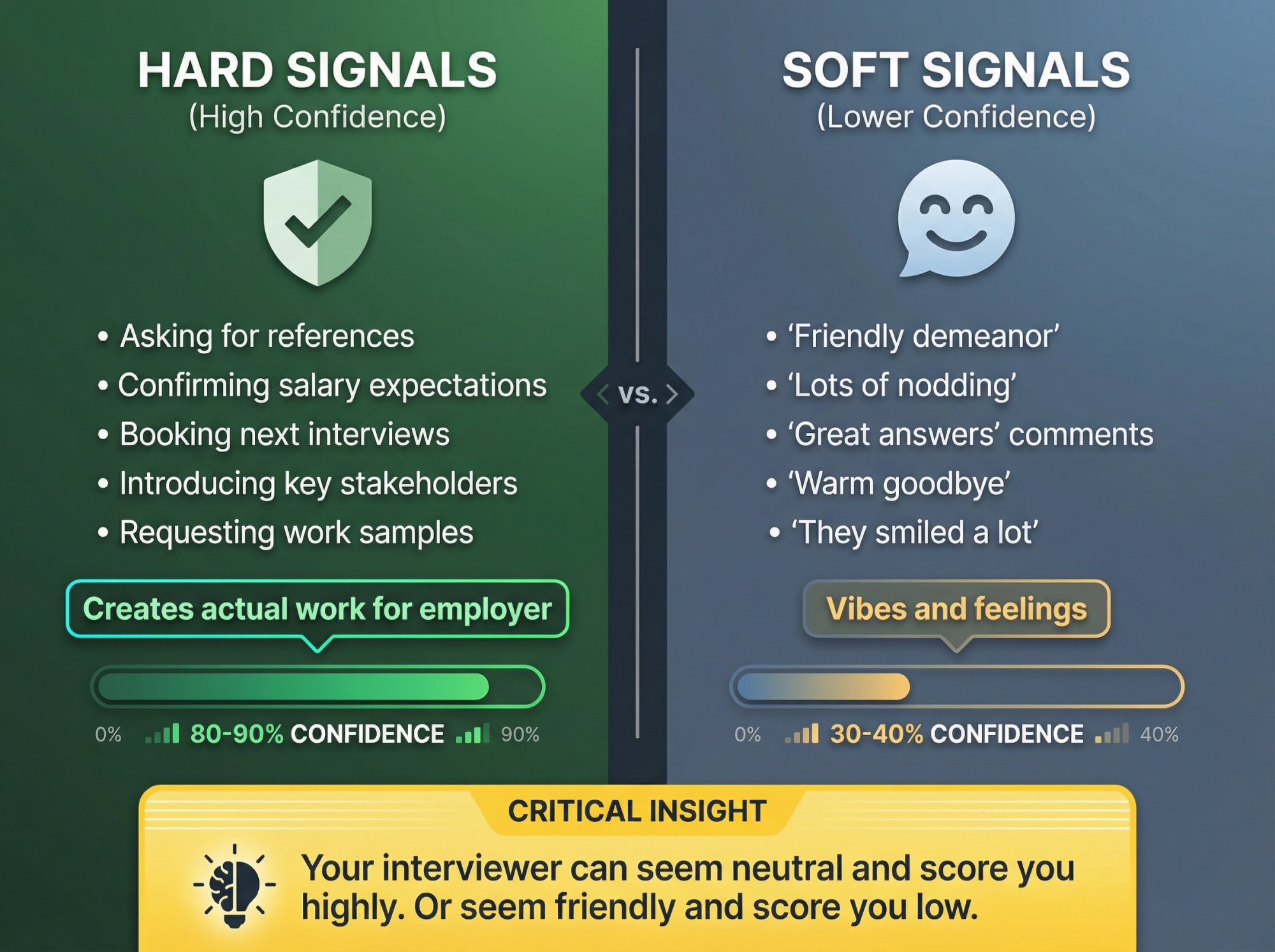
Hard signals (high confidence): These are actions that create actual work for the employer or require internal alignment. Think: asking for references, confirming salary expectations, booking next interviews, introducing you to key stakeholders.
Soft signals (lower confidence): These are vibes. Examples: friendly interviewer, lots of nodding, "great answers," a warm goodbye.
Soft signals can feel nice, but hard signals are what you want to weight heavily (especially in 2026 where structured interviews and scorecards are becoming standard practice).
Google's re:Work guidance explains that structured interviewing involves asking consistent questions, grading responses on the same scale, and making decisions against predetermined qualifications. Research notes that interview scorecards are used to evaluate candidates consistently and objectively.
Critical insight: Your interviewer can seem completely neutral and still score you highly. They can seem super friendly and still score you low.
The 9 Strongest Signs Your Interview Went Well
These are the "green lights" that tend to mean: they can realistically picture you in the role.
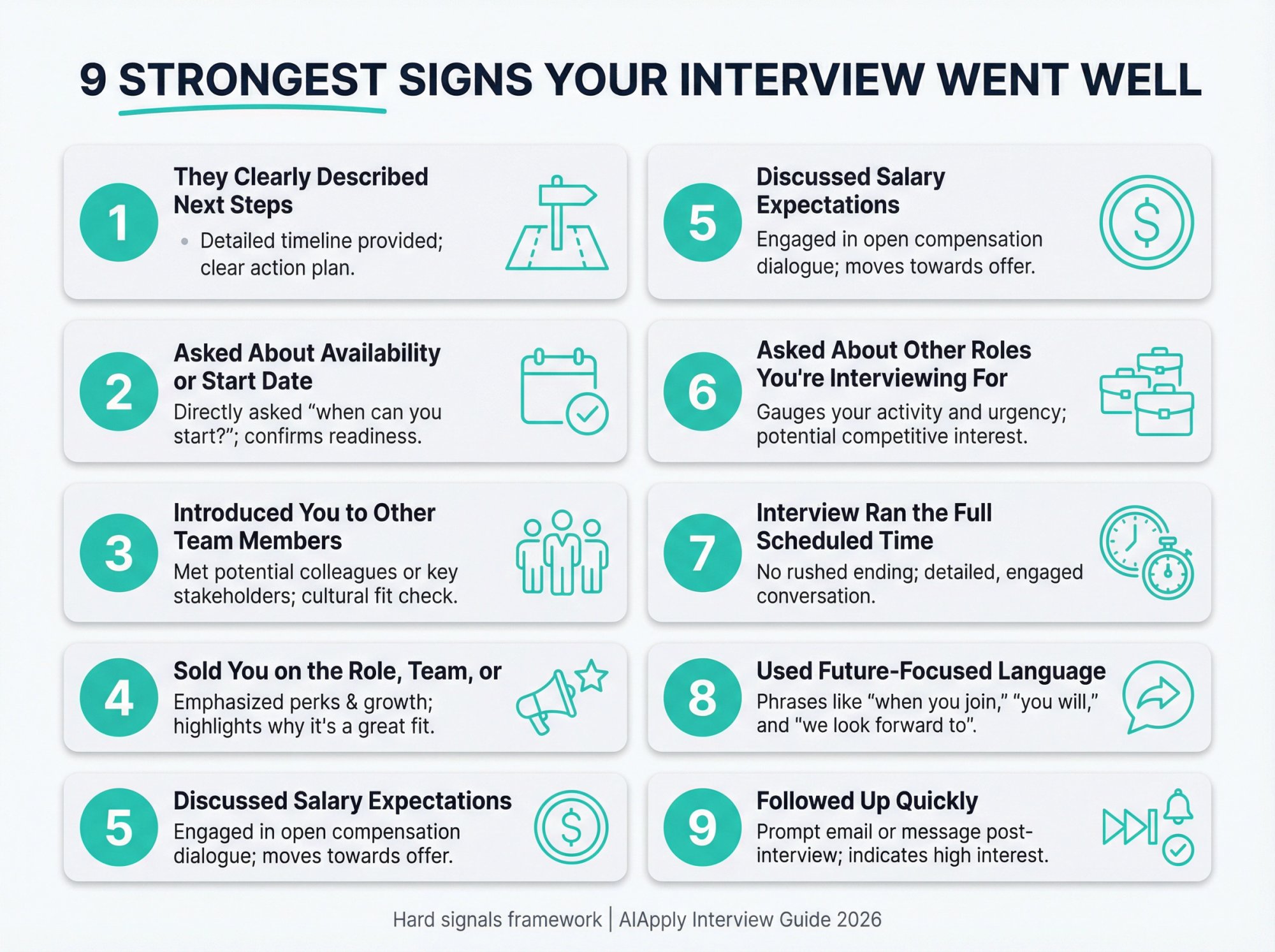
1) They Clearly Described Next Steps
If the interviewer outlines what happens next (who you'll meet, what stage you're at, what the decision timeline looks like), that's one of the clearest positive indicators.
Career experts list "discussing next steps in the hiring process" as a sign the interview went well. Reviewing next steps is highlighted as a positive sign at the end of an interview.
High-signal wording to listen for:
• "Next, you'll meet our Head of ___."
• "We're finishing final interviews by Friday, then debriefing Monday."
• "I'm going to recommend you move forward."
What to do immediately:
Write down the timeline they gave you. You'll use it for your follow-up schedule later. AIApply's Interview Answer Buddy can help you prepare for these next-stage interviews with real-time guidance.
2) They Asked About Your Availability or Start Date
This is classic "process progression." Being asked about availability (and sometimes start date) is a sign you're being seriously considered. Questions about notice periods and availability are very positive signals.
Interpretation:
They're checking whether you can actually accept the job if offered, or whether you'd be unable to start in the window they need.
How to answer well (without sounding desperate):
• Give a clear date range.
• Mention any notice period constraints.
• Stay flexible where you can.
3) They Introduced You to Other Team Members
Introductions to other team members are a common sign the interview went well. Introductions and tours can be a positive indicator (even if sometimes they're standard practice).
Why it matters:
Introductions take time and coordination. Often the hidden goal is: "Can this person work with us day-to-day?"
Nuance:
In some companies, tours and introductions are routine for all candidates. It's stronger if they introduced you to:
→ A direct manager you weren't scheduled to meet
→ A cross-functional partner (sales, product, legal)
→ Someone senior who must approve hires
4) They Sold You on the Role, Team, or Benefits
This is a subtle shift: the interview stops being "Are you good enough?" and becomes "Are we good enough for you?"
Career research suggests that when interviewers try to get you excited about the role and the company, it's a positive sign.
What it usually means:
They believe you could be a top candidate, and they don't want you to drop out.
Strong versions of this sign:
• Sharing internal success stories
• Talking about growth paths or promotions
• Explaining how they'd set you up for success (30/60/90 days, onboarding, priorities)
5) They Discussed Salary Expectations
If a hiring manager brings up salary expectations late in the process, it can be a sign they're getting serious about an offer.
Important nuance:
Salary can be discussed early (especially via recruiter screens) to confirm alignment. But when it comes up late with a hiring manager, it can signal they're doing feasibility checks before pushing you forward.
Before your interview, make sure your resume is optimized to match the job requirements and salary expectations for your target role.
6) They Asked About Other Roles You're Interviewing For
Being asked about other positions can be a sign of interest. Sometimes they're trying to understand competition and timing.
Interpretation:
They may be calibrating speed ("Do we need to move fast?") or confirming whether you're in demand.
If you're juggling multiple interview processes, AIApply's Auto Apply can help you maintain momentum across hundreds of applications while you wait for responses.
7) Your Interview Ran the Full Scheduled Time
Strong interviews often last the full scheduled time and may run long if they keep asking questions. Longer-than-scheduled interviews can be a positive sign, assuming nothing unusual happened.
High-signal version:
It ran long because they were exploring specifics:
• "Walk me through exactly how you'd do X."
• "How would you handle this scenario?"
Low-signal version:
It ran long because they're disorganized or went off-topic.
8) They Used Future-Focused Language
Language like "when you join our team" is highlighted as a positive sign. The interviewer referring to you as part of the team suggests they're already picturing you in the role.
Interpretation:
Sometimes people naturally speak this way. But combined with other hard signals, it's meaningful.
9) They Followed Up Quickly
Receiving a follow-up email or call within a day or two can be a positive sign. A quick response to your thank-you email is a possible indicator you're on their mind.
But don't overrate it:
Sometimes recruiters follow up quickly with everyone. Use this as a supporting sign, not the main one.
12 More Signs Your Interview Went Well
These are common patterns, but they need context.
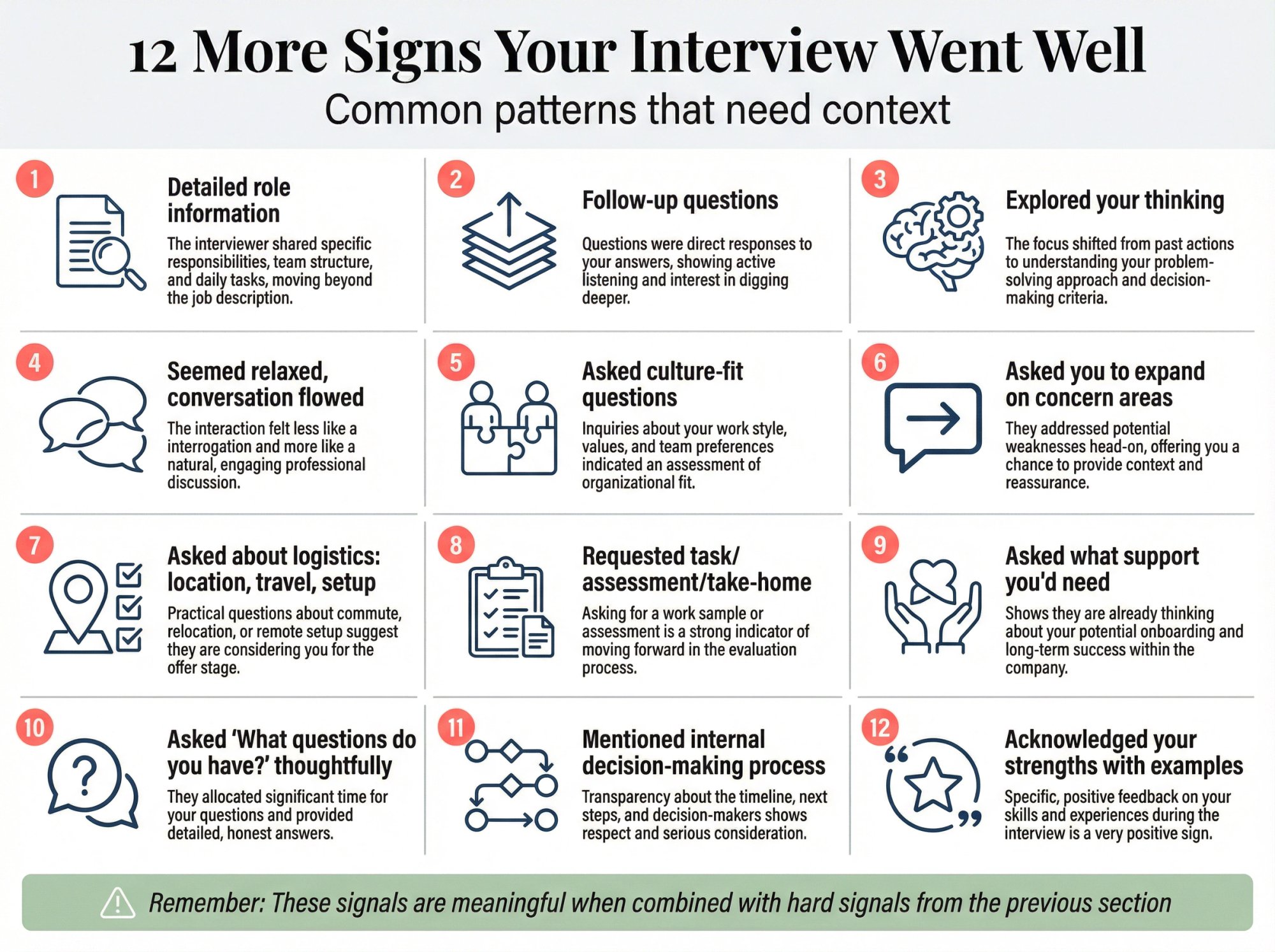
① The interviewer gave detailed, role-specific information
Learning ample information about the role and company is a positive sign. It often means they're trying to help you realistically picture the work.
② They asked follow-up questions that went deeper than your resume
Interviewer attentiveness can show up as extra questions and prompts to elaborate. Make sure your resume highlights your key achievements before the interview.
③ They explored how you think, not just what you've done
This is common in structured interviews: interviewers may be assessing your process, tradeoffs, and reasoning (not looking for a "perfect" answer). Practice with AIApply's Mock Interview tool to prepare for behavioral questions.
④ They seemed relaxed (conversation flowed)
Connecting with the hiring manager and the interviewer seeming relaxed or energized are positive signs.
⑤ They asked "culture fit" questions (collaboration, feedback, conflict)
Interviewers may try to understand fit beyond skills and experience.
⑥ They asked you to expand on a "concern area" (and stayed engaged)
This can be a good sign. If you were failing, many interviewers would simply move on.
⑦ They asked about logistics: location, travel, remote setup, right-to-work, notice period
These checks often happen before moving you forward.
⑧ They asked you to complete a task, assessment, or take-home
Not always fun, but it usually means you're still in contention.
⑨ They asked what support you'd need to succeed
That's often "onboarding thinking."
⑩ They asked "What questions do you have for us?" and gave thoughtful answers
It's normal to ask. The positive sign is: they answered in depth and made time.
⑪ They mentioned internal decision-making ("We'll compare candidates in debrief")
This indicates a real process is happening, not just a courtesy interview.
⑫ They acknowledged your strengths explicitly (with examples)
Compliments are weak alone. But specific compliments can matter:
"That's exactly the type of stakeholder management we need."
6 Good Signs That Are Often Misleading
If you want to stop spiraling, memorize this section.
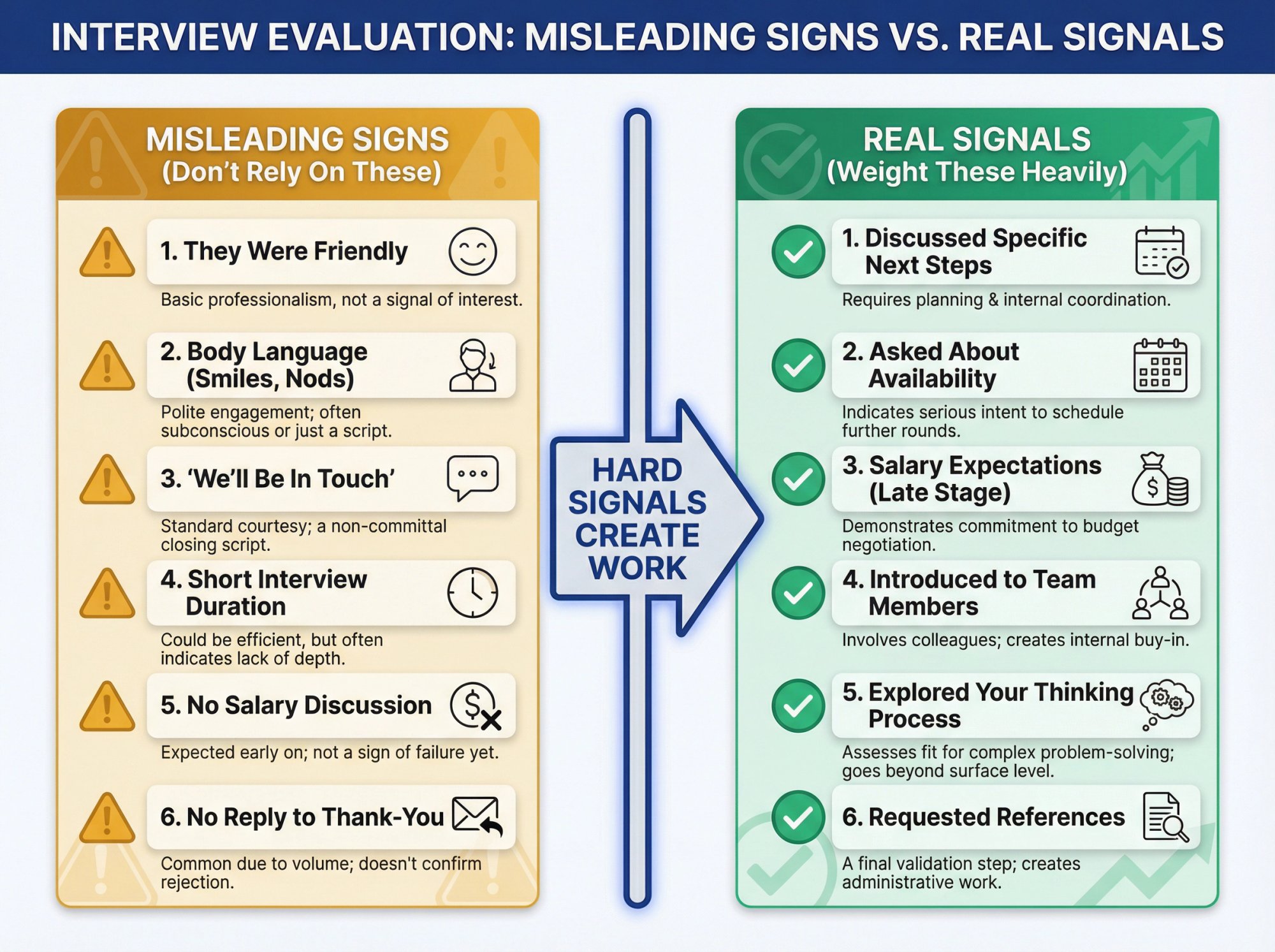
1) They Were Friendly
Friendly is good. Friendly is also basic professionalism. Weight it lightly unless paired with hard signals.
2) They Smiled, Nodded, or Leaned In
Body language can matter, but it's culturally variable, personality-dependent, and often influenced by note-taking.
Research shows interviewers may use scorecards and structured criteria to evaluate candidates consistently. That can reduce eye contact (not because you did badly, but because they're documenting).
3) They Said We'll Be in Touch
That's a script.
4) The Interview Was Short
Sometimes short is bad. Sometimes the interviewer had a crisis, or the company uses structured interviews that are timeboxed.
Even career experts note that a short interview can happen for reasons not tied to your performance.
5) They Didn't Ask About Salary
Not necessarily bad. Some companies handle comp centrally, later.
6) They Didn't Respond to Your Thank-You Email
You're not guaranteed a reply even if it's good practice to send one.
What's Happening After You Leave
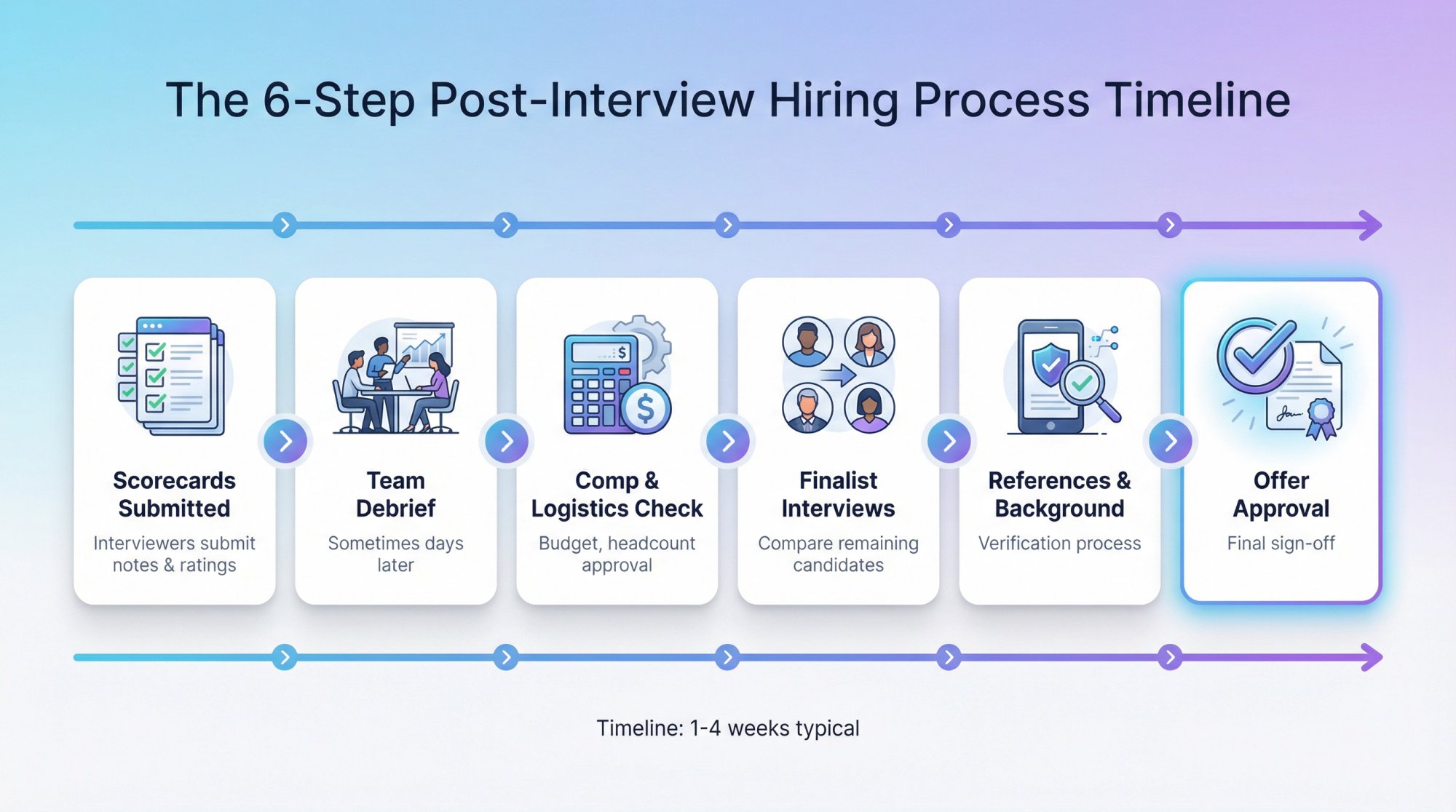
Most candidates imagine the hiring manager instantly decides. Real life looks more like:
① Interviewers submit notes and scorecards
② A debrief happens (sometimes days later)
③ Recruiter checks compensation band, headcount approval, and scheduling
④ They finish interviewing other finalists
⑤ They may run references or background checks
⑥ Offer approvals happen
Structured interviewing is designed to reduce gut feel and use consistent rubrics and predetermined qualifications. Research on scoring sheets similarly emphasizes consistent criteria and a structured approach to keep evaluations objective.
Critical insight: You can have amazing rapport and still lose on the rubric. Or have neutral rapport and win because your evidence and examples scored higher.
How Long Does It Take to Hear Back After an Interview in 2026?
The honest answer: it varies wildly. But we can ground expectations with recent data and common practice.
Hiring is slower than many candidates expect:
• Recent hiring insights (last updated Jan 28, 2025) report 60% of organizations saw time-to-hire increase in 2024, and highlights interview cancellations and reschedules as a major bottleneck.
• 2025 Talent Trends reporting (Jan 7, 2025) found that in 2024, teams interviewed ~40% more candidates per hire than in 2021 (meaning more evaluation effort per hire).
What you can do: anchor to a follow-up rule
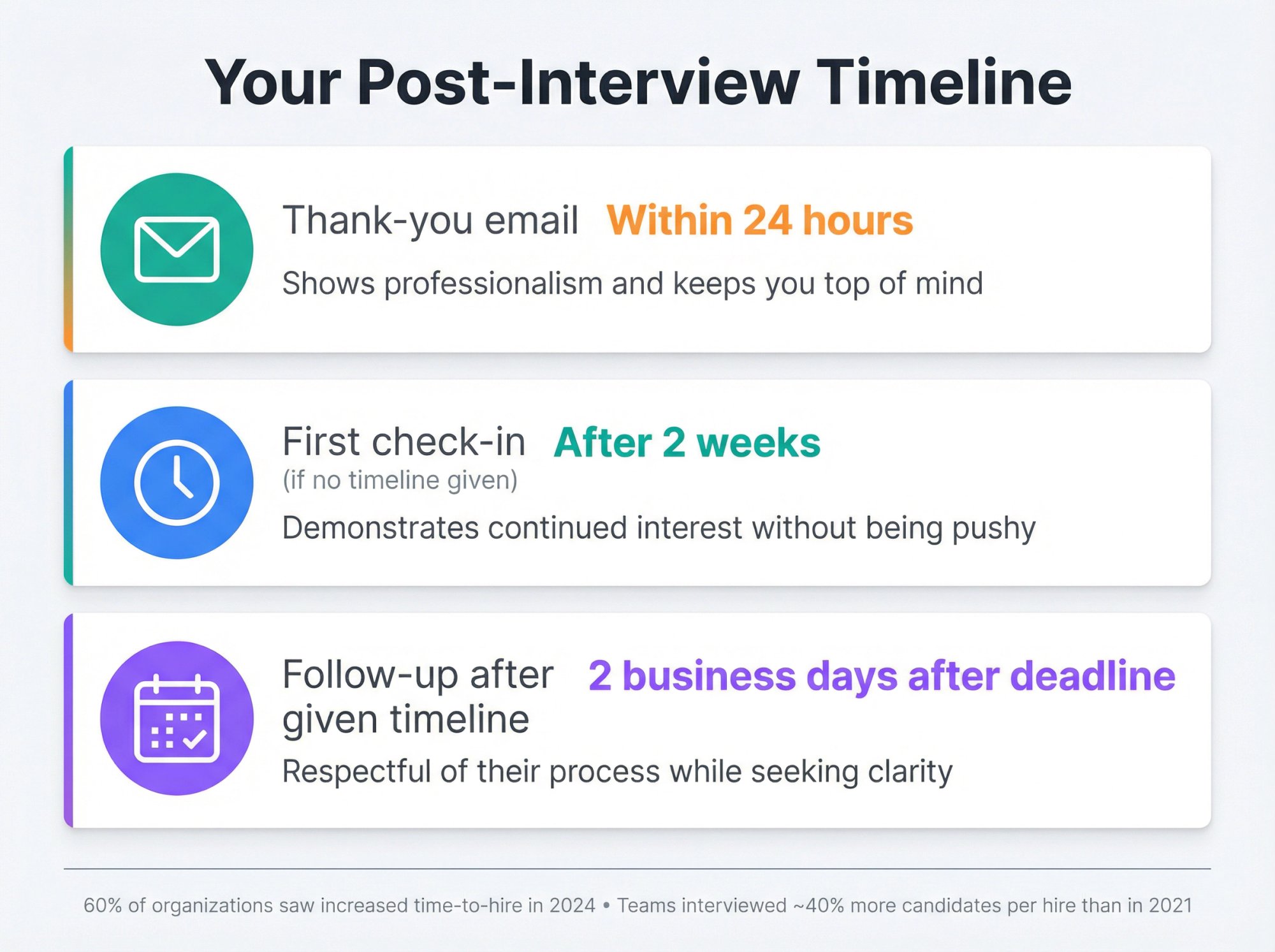
A strong, widely used guideline:
Career guidance explicitly advises: send the thank-you follow-up within 24 hours, and if you haven't heard back after two weeks, send a "checking in" email.
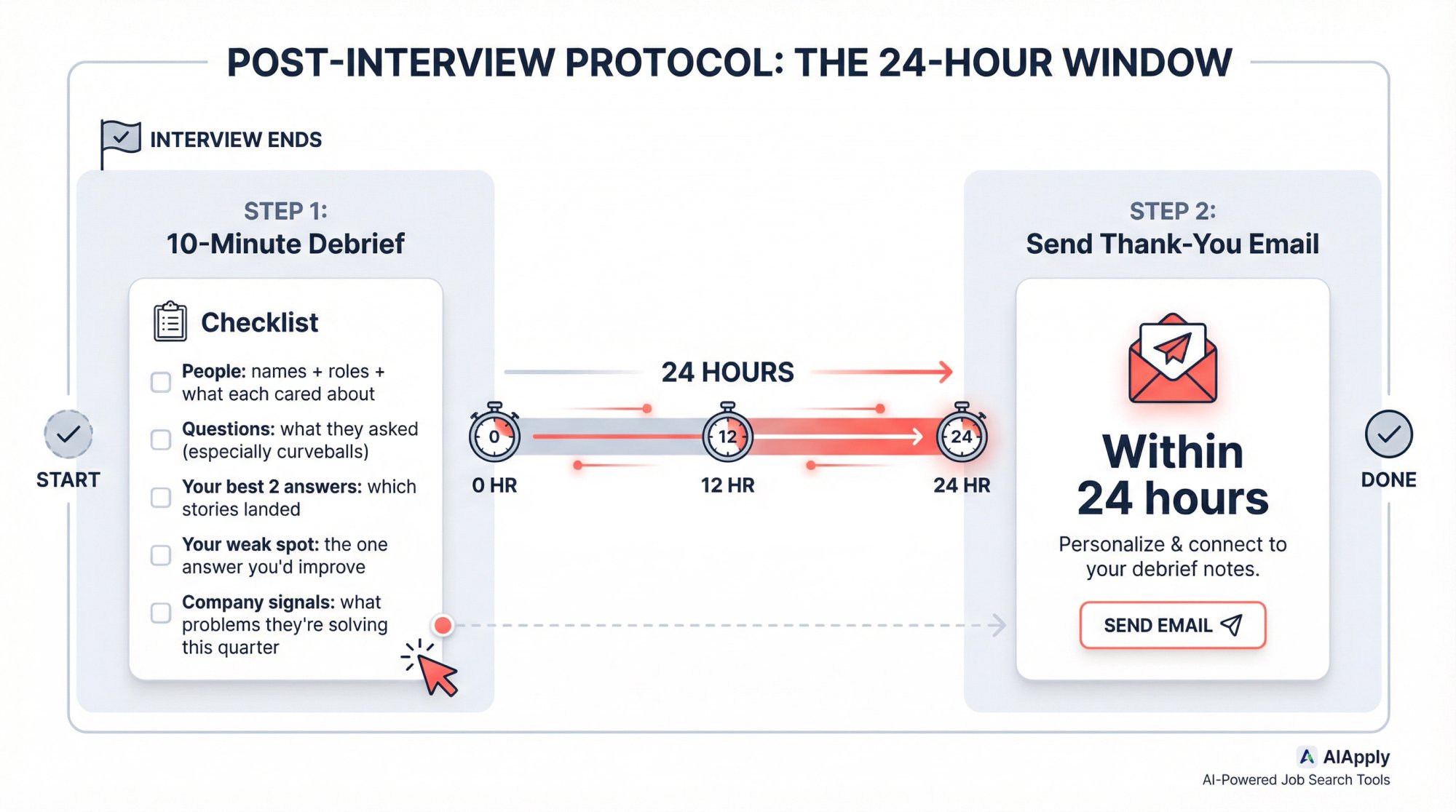
The Post-Interview Protocol: What to Do in the Next 24 Hours
This is how you turn "I think it went well" into "I'm the obvious choice."
Step 1: Do a 10-Minute Debrief
Open a note and capture:
People: names + roles + what each cared about
Questions: what they asked (especially curveballs)
Your best 2 answers: which stories landed
Your weak spot: the one answer you'd improve
Company signals: what problems they're solving this quarter
This will make your follow-up email specific, which is how you stand out. Use AIApply's AI Email Generator to craft a perfectly tailored follow-up message.
Step 2: Send a Thank-You Email Within 24 Hours
Career experts call a post-interview thank-you email "good practice" and suggest sending it around 24 hours after the interview. Professional guidance also recommends sending a follow-up thank-you email within 24 hours.
Copy-paste thank-you email template (short)
Subject: Thank you: [Role] interviewHi [Name],Thank you again for taking the time to speak with me today about the [Role]. I enjoyed our conversation, especially the part about [specific topic you discussed].The role feels like a strong fit because [1-2 sentence alignment: skill + outcome]. If helpful, I'm happy to share [portfolio link / example / quick doc] related to [topic].Thanks again, and I'm looking forward to the next steps.Best,[Your name][Phone] | [LinkedIn]Copy-paste thank-you email template (value-add)
Use this when you want to "win the debrief" by giving them something to forward internally.
Subject: Quick follow-up: [Role] interviewHi [Name],Thank you for your time today. I'm excited about the [Role] and the chance to contribute to [team/company goal].Based on what you shared about [problem], here's a quick idea I'd explore in my first 30 days:- [Bullet 1: insight]- [Bullet 2: approach]- [Bullet 3: measurable outcome]If it's useful, I can outline this in a 1-page doc.Appreciate the conversation, and I look forward to next steps.Best,[Your name]Pro tip: Keep it short enough to be forwarded. Hiring managers love forwardable. AIApply's AI Email Generator can help you create professional, personalized follow-up emails in seconds.
The Follow-Up Schedule: What to Send and When
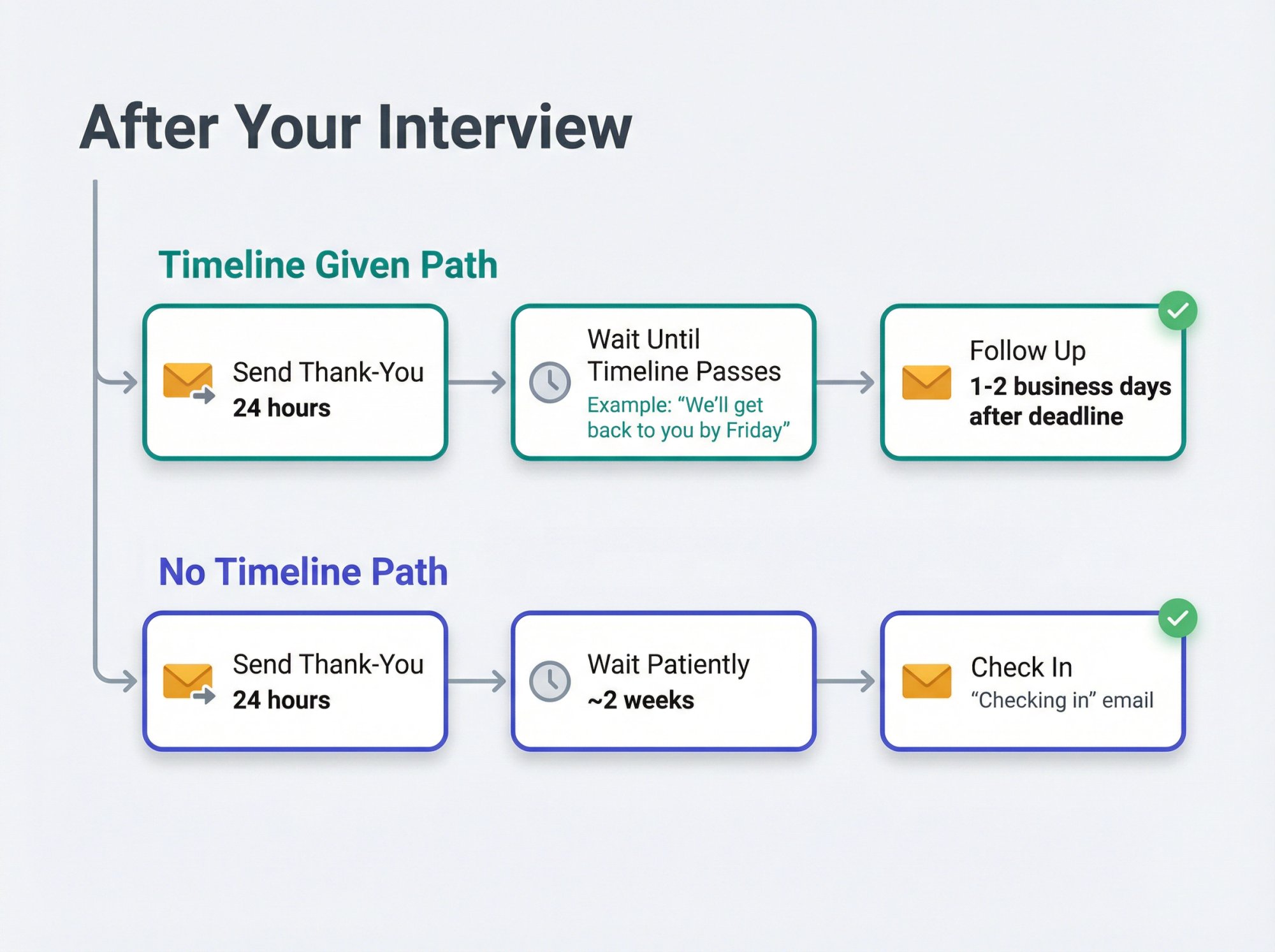
If They Gave You a Timeline
Example: "We'll get back to you next Friday."
Wait until the timeline passes
Then follow up 1-2 business days later
Career guidance notes that if you were told a different time period, you should follow up a few days after that timeline has passed.
If They Gave No Timeline
A good standard is:
Thank-you within 24 hours
Check-in at around two weeks
Professional guidance explicitly recommends a "checking in" email if you haven't heard back after two weeks since your interview.
Copy-paste "checking in" email (after ~2 weeks)
Subject: Checking in: [Role] interviewHi [Recruiter/Hiring Manager Name],Hope you're doing well. I'm checking in regarding the [Role] interview on [date]. I remain very interested in the position and enjoyed speaking with the team.Is there any update you can share on next steps or timing? Happy to provide anything else that would be helpful.Thanks again,[Your name]The Interview Confidence Score
If you want an honest read, score your interview using hard-signal weighting.
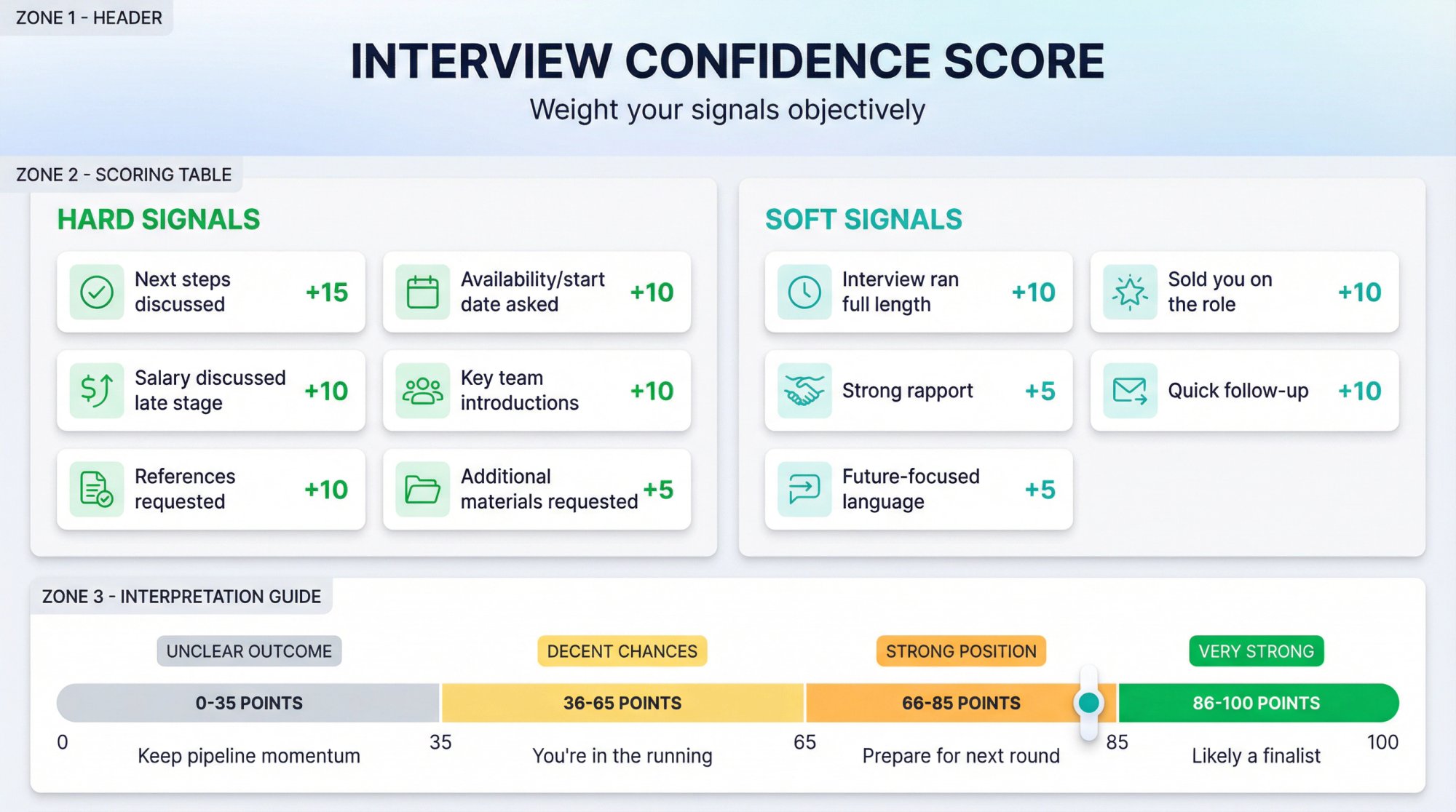
Give yourself points based on what actually happened:
How to interpret your score:
What to Do While You Wait
Career advice is blunt and correct: until you have a firm offer, keep applying and keep interviewing.
Strategic version:
① Keep your pipeline full (reduces anxiety + increases leverage) - Use AIApply's Auto Apply to submit up to 500 tailored applications per month
② Prepare for the next round using your debrief notes (you now know what they care about) - Practice with AIApply's Mock Interview tool
③ Patch weak answers while they're fresh in your mind
Browse AIApply's Job Board with over 1 million open positions to keep your options open while you wait for a response.
How AIApply Fits Into This
If your interview went well, the best move is to behave like a pro: crisp follow-up, better prep for round two, and no wasted time.
AIApply's tools map directly to the highest leverage moments:
Resume optimization: AIApply's AI Resume Builder creates ATS-friendly resumes tailored to each job in under 2 minutes. Use the Resume Scanner to score your ATS readiness before applying.
Cover letter creation: AIApply's AI Cover Letter Generator crafts role-specific letters that sound human and pass AI detection tools.
Mock interview practice: AIApply's AI job interview tool lets you paste a job description and generate a tailored mock interview for practice. Get instant feedback on your answers and improve before the real thing.
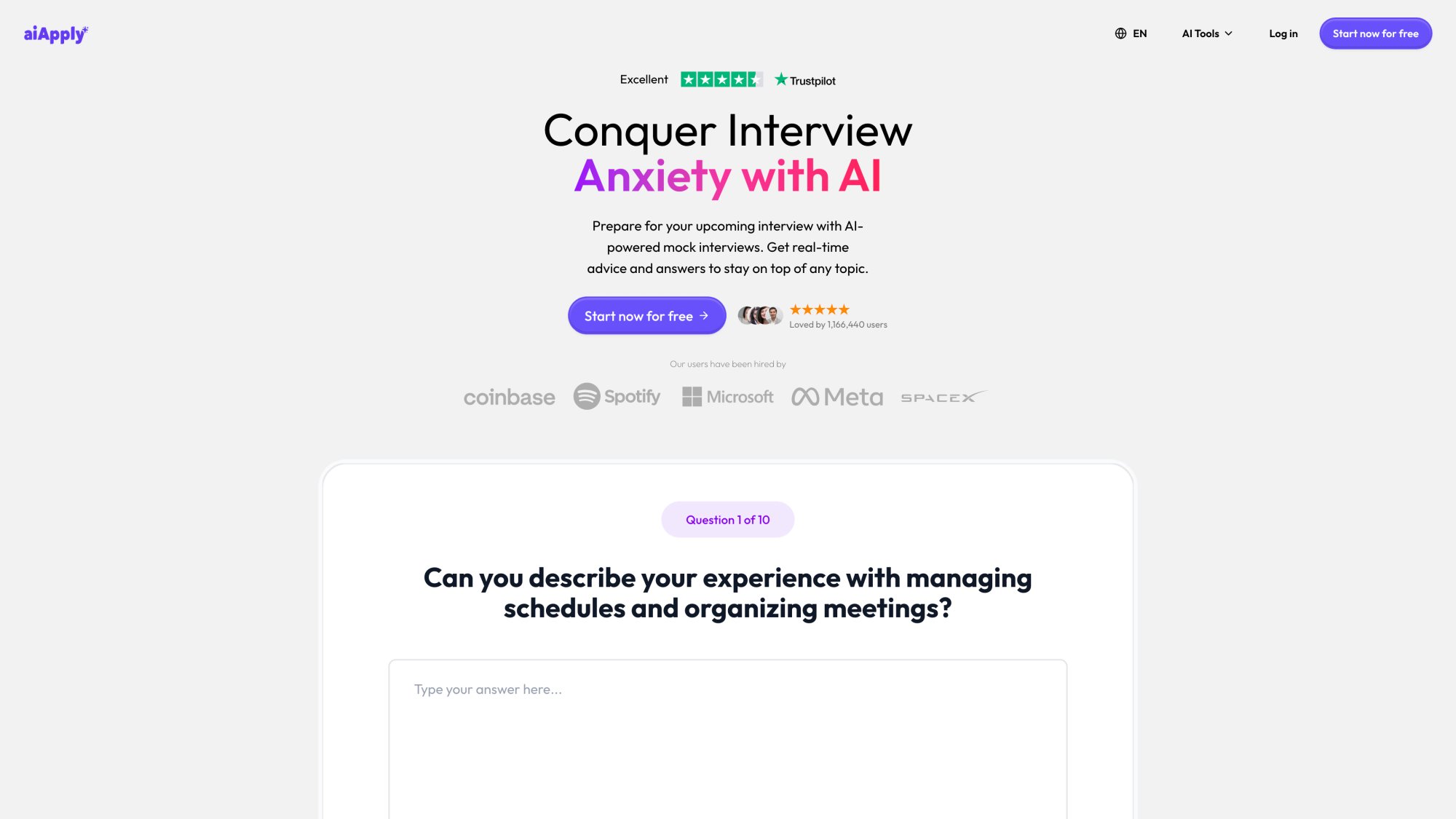
Real-time support (if you use it): AIApply's Interview Answer Buddy is designed to provide real-time transcripts and on-the-spot guidance during interviews. The Chrome extension listens to live questions and suggests strong answers.
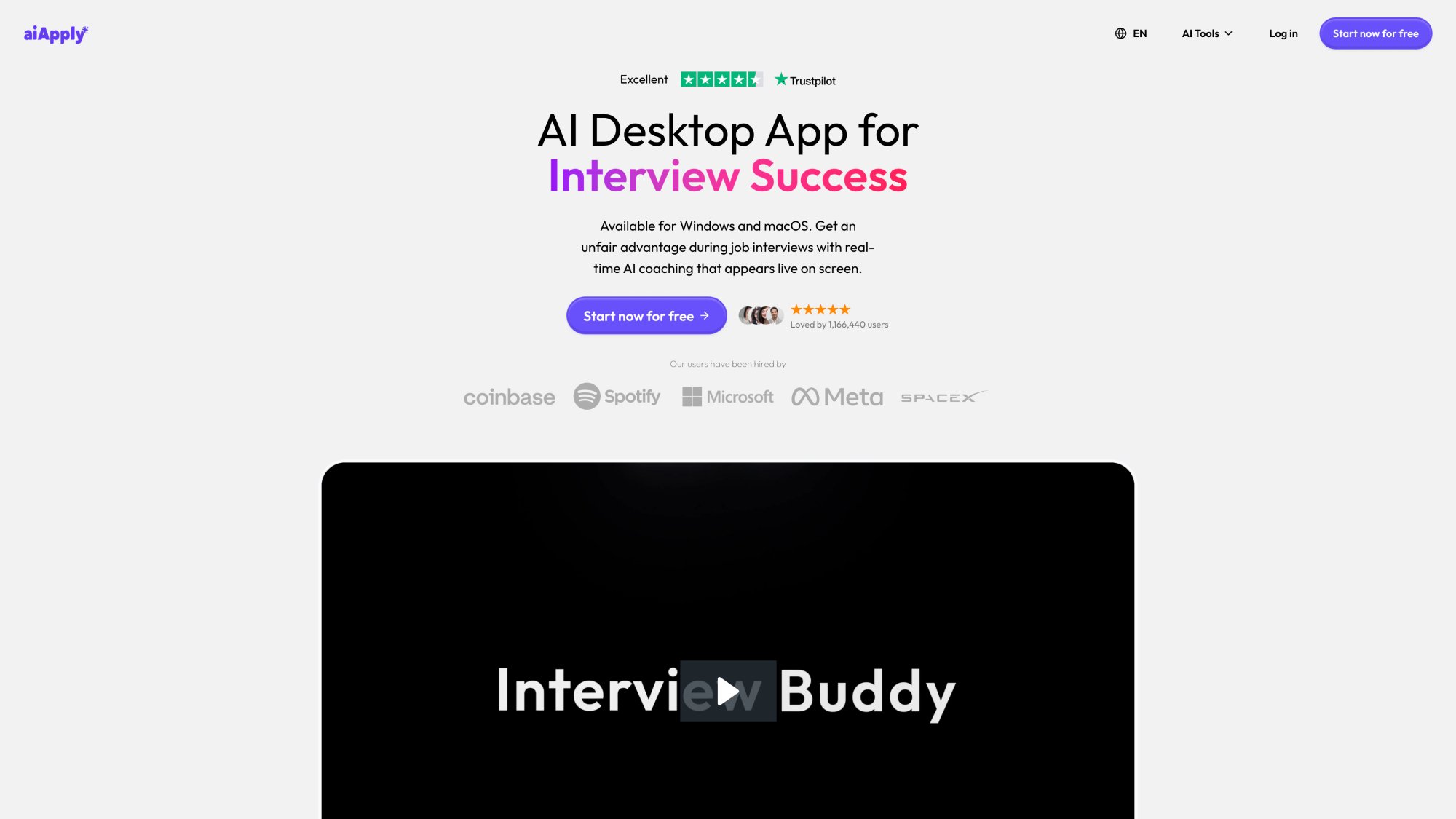
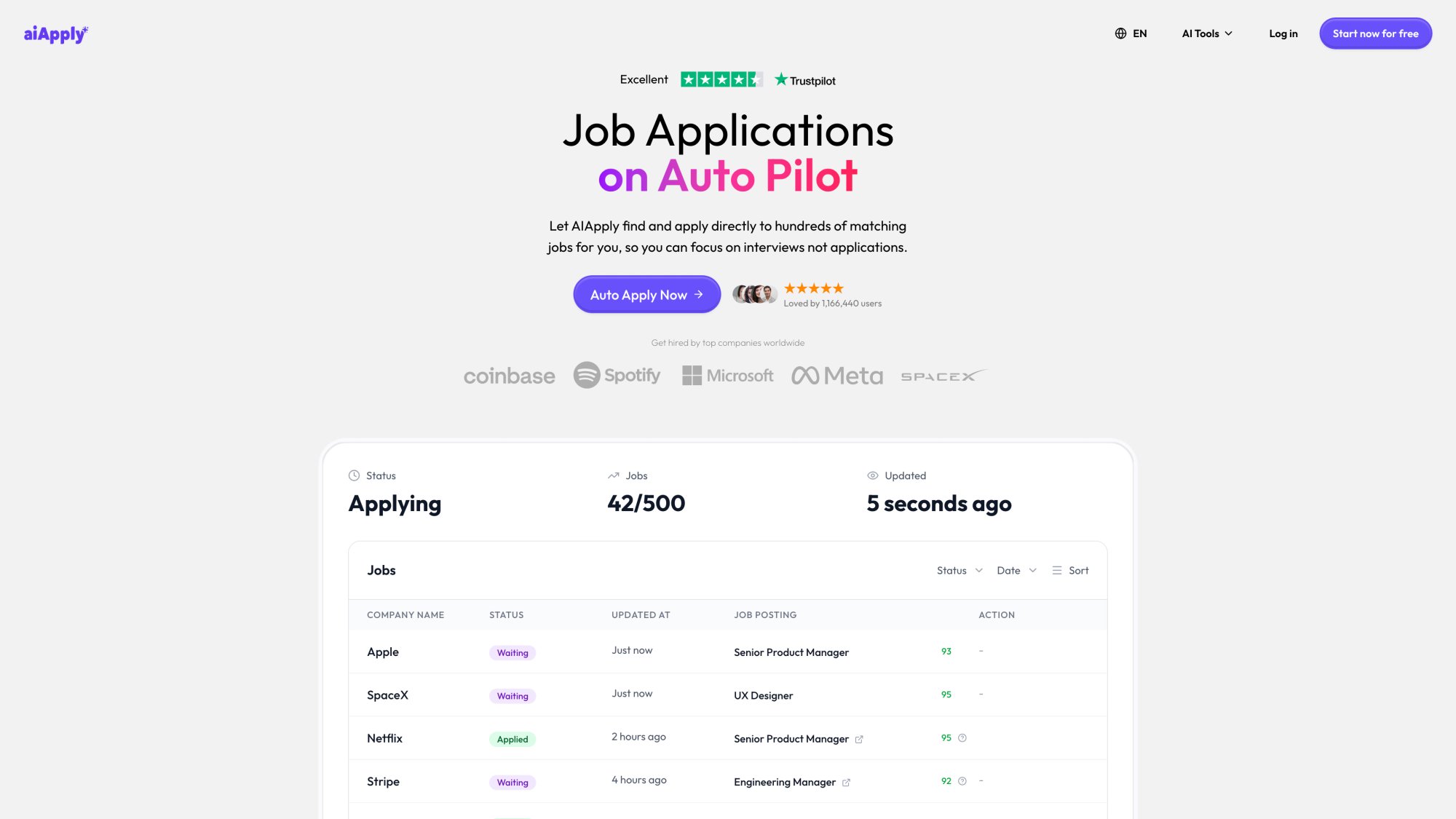
Application automation: AIApply's Auto Apply crawls 1M+ postings and submits up to 500 tailored applications per month, keeping your pipeline full while you wait for responses.
Ethics note (important): AI can help you prepare, structure thoughts, and reduce stress, but it should never be used to misrepresent your experience. The goal is clarity and confidence, not deception.
Frequently Asked Questions
How do you know if you got the job after an interview?
You never know with certainty until there's an offer. But the strongest signs include: clear next steps, availability checks, salary discussions, references, and quick scheduling movement. Make sure your resume is up-to-date and ready for any follow-up requests.
Is it a good sign if they ask about availability?
Usually yes. It implies they can picture you moving forward and need to confirm logistics.
Is it a good sign if the interview went long?
Often yes, if it ran long because they kept digging deeper and exploring specifics (not because they were disorganized).
Should you send a thank-you email?
Yes. Generally within 24 hours. Use AIApply's AI Email Generator to craft a professional, personalized message quickly.
When should you follow up if you haven't heard back?
A common guideline is about two weeks after a final interview (or a few days after any timeline they gave you passes).
Why does hiring take so long now?
Recent TA data suggests increased interview complexity and delays: 60% of organizations reported time-to-hire increased in 2024, and interview cancellations and reschedules were cited as a major bottleneck. Also, teams interviewed ~40% more candidates per hire in 2024 than in 2021.
What are the most reliable signs an interview went well?
The most reliable signs are hard signals: specific next steps discussed, availability or start date questions, salary discussions late in the process, introductions to key team members, and requests for references or additional materials.
Can an interviewer seem friendly but still reject you?
Yes. Structured interviews use scorecards and rubrics to evaluate candidates consistently. Your interviewer can have great rapport with you personally but still score you lower on the predetermined criteria.
How can I prepare for my next interview round?
Use your 10-minute debrief notes from the first round to understand what the company cares about. Practice your weak answers, prepare deeper examples for the topics they explored, and research the people you'll meet next. Tools like AIApply's Mock Interview can help you rehearse using the actual job description. The Interview Answer Buddy provides real-time support during live interviews.
Should I keep applying to other jobs while waiting to hear back?
Absolutely. Until you have a firm offer, keep your pipeline active. It reduces anxiety, maintains momentum, and gives you leverage if multiple offers come in. AIApply's Auto Apply makes it easy to submit hundreds of applications while you wait.
How can I improve my resume for better interview success?
Use AIApply's Resume Builder to create ATS-optimized resumes that match job requirements. The Resume Scanner identifies keyword gaps and scores your ATS readiness. You can also translate your resume into 12+ languages with the Resume Translator.
Final Takeaway
If you remember one thing:
Don't judge your interview by vibes. Judge it by actions.
Hard signals (next steps, availability, references, comp alignment, stakeholder introductions) are your best indicators. Soft signals are nice, but unreliable.
Then do the only move that's always in your control:
• Debrief (capture what happened before you forget)
• Follow up on the timeline (professional, not pushy)
• Keep your pipeline moving (momentum = confidence) - Let AIApply's Auto Apply handle the volume
You just walked out of an interview and now your brain won't stop replaying every single moment.
"They smiled a lot. Does that actually mean anything?"
"The call went 10 minutes over. Is that good or bad?"
"They haven't replied in 4 days. Should I be worried?"
This guide exists to do two things: help you separate real indicators (the ones that actually correlate with moving forward) from feel-good moments (the ones you can't rely on), and give you a clear post-interview plan so you know exactly what to send, when to send it, and how to stay in control while the company takes its sweet time deciding.
Quick reality check before we start: hiring moves slower than it used to. In 2024, 60% of organizations reported that time-to-hire increased, with interview cancellations and reschedules named as a top bottleneck. That means "waiting" is often just a sign of scheduling chaos, not rejection.
The Only Framework You Need: Hard Signals vs. Soft Signals
Most articles treat all "signs" as if they're equally meaningful. They're not.
Hard signals (high confidence): These are actions that create actual work for the employer or require internal alignment. Think: asking for references, confirming salary expectations, booking next interviews, introducing you to key stakeholders.
Soft signals (lower confidence): These are vibes. Examples: friendly interviewer, lots of nodding, "great answers," a warm goodbye.
Soft signals can feel nice, but hard signals are what you want to weight heavily (especially in 2026 where structured interviews and scorecards are becoming standard practice).
Google's re:Work guidance explains that structured interviewing involves asking consistent questions, grading responses on the same scale, and making decisions against predetermined qualifications. Research notes that interview scorecards are used to evaluate candidates consistently and objectively.
Critical insight: Your interviewer can seem completely neutral and still score you highly. They can seem super friendly and still score you low.
The 9 Strongest Signs Your Interview Went Well
These are the "green lights" that tend to mean: they can realistically picture you in the role.
1) They Clearly Described Next Steps
If the interviewer outlines what happens next (who you'll meet, what stage you're at, what the decision timeline looks like), that's one of the clearest positive indicators.
Career experts list "discussing next steps in the hiring process" as a sign the interview went well. Reviewing next steps is highlighted as a positive sign at the end of an interview.
High-signal wording to listen for:
• "Next, you'll meet our Head of ___."
• "We're finishing final interviews by Friday, then debriefing Monday."
• "I'm going to recommend you move forward."
What to do immediately:
Write down the timeline they gave you. You'll use it for your follow-up schedule later. AIApply's Interview Answer Buddy can help you prepare for these next-stage interviews with real-time guidance.
2) They Asked About Your Availability or Start Date
This is classic "process progression." Being asked about availability (and sometimes start date) is a sign you're being seriously considered. Questions about notice periods and availability are very positive signals.
Interpretation:
They're checking whether you can actually accept the job if offered, or whether you'd be unable to start in the window they need.
How to answer well (without sounding desperate):
• Give a clear date range.
• Mention any notice period constraints.
• Stay flexible where you can.
3) They Introduced You to Other Team Members
Introductions to other team members are a common sign the interview went well. Introductions and tours can be a positive indicator (even if sometimes they're standard practice).
Why it matters:
Introductions take time and coordination. Often the hidden goal is: "Can this person work with us day-to-day?"
Nuance:
In some companies, tours and introductions are routine for all candidates. It's stronger if they introduced you to:
→ A direct manager you weren't scheduled to meet
→ A cross-functional partner (sales, product, legal)
→ Someone senior who must approve hires
4) They Sold You on the Role, Team, or Benefits
This is a subtle shift: the interview stops being "Are you good enough?" and becomes "Are we good enough for you?"
Career research suggests that when interviewers try to get you excited about the role and the company, it's a positive sign.
What it usually means:
They believe you could be a top candidate, and they don't want you to drop out.
Strong versions of this sign:
• Sharing internal success stories
• Talking about growth paths or promotions
• Explaining how they'd set you up for success (30/60/90 days, onboarding, priorities)
5) They Discussed Salary Expectations
If a hiring manager brings up salary expectations late in the process, it can be a sign they're getting serious about an offer.
Important nuance:
Salary can be discussed early (especially via recruiter screens) to confirm alignment. But when it comes up late with a hiring manager, it can signal they're doing feasibility checks before pushing you forward.
Before your interview, make sure your resume is optimized to match the job requirements and salary expectations for your target role.
6) They Asked About Other Roles You're Interviewing For
Being asked about other positions can be a sign of interest. Sometimes they're trying to understand competition and timing.
Interpretation:
They may be calibrating speed ("Do we need to move fast?") or confirming whether you're in demand.
If you're juggling multiple interview processes, AIApply's Auto Apply can help you maintain momentum across hundreds of applications while you wait for responses.
7) Your Interview Ran the Full Scheduled Time
Strong interviews often last the full scheduled time and may run long if they keep asking questions. Longer-than-scheduled interviews can be a positive sign, assuming nothing unusual happened.
High-signal version:
It ran long because they were exploring specifics:
• "Walk me through exactly how you'd do X."
• "How would you handle this scenario?"
Low-signal version:
It ran long because they're disorganized or went off-topic.
8) They Used Future-Focused Language
Language like "when you join our team" is highlighted as a positive sign. The interviewer referring to you as part of the team suggests they're already picturing you in the role.
Interpretation:
Sometimes people naturally speak this way. But combined with other hard signals, it's meaningful.
9) They Followed Up Quickly
Receiving a follow-up email or call within a day or two can be a positive sign. A quick response to your thank-you email is a possible indicator you're on their mind.
But don't overrate it:
Sometimes recruiters follow up quickly with everyone. Use this as a supporting sign, not the main one.
12 More Signs Your Interview Went Well
These are common patterns, but they need context.
① The interviewer gave detailed, role-specific information
Learning ample information about the role and company is a positive sign. It often means they're trying to help you realistically picture the work.
② They asked follow-up questions that went deeper than your resume
Interviewer attentiveness can show up as extra questions and prompts to elaborate. Make sure your resume highlights your key achievements before the interview.
③ They explored how you think, not just what you've done
This is common in structured interviews: interviewers may be assessing your process, tradeoffs, and reasoning (not looking for a "perfect" answer). Practice with AIApply's Mock Interview tool to prepare for behavioral questions.
④ They seemed relaxed (conversation flowed)
Connecting with the hiring manager and the interviewer seeming relaxed or energized are positive signs.
⑤ They asked "culture fit" questions (collaboration, feedback, conflict)
Interviewers may try to understand fit beyond skills and experience.
⑥ They asked you to expand on a "concern area" (and stayed engaged)
This can be a good sign. If you were failing, many interviewers would simply move on.
⑦ They asked about logistics: location, travel, remote setup, right-to-work, notice period
These checks often happen before moving you forward.
⑧ They asked you to complete a task, assessment, or take-home
Not always fun, but it usually means you're still in contention.
⑨ They asked what support you'd need to succeed
That's often "onboarding thinking."
⑩ They asked "What questions do you have for us?" and gave thoughtful answers
It's normal to ask. The positive sign is: they answered in depth and made time.
⑪ They mentioned internal decision-making ("We'll compare candidates in debrief")
This indicates a real process is happening, not just a courtesy interview.
⑫ They acknowledged your strengths explicitly (with examples)
Compliments are weak alone. But specific compliments can matter:
"That's exactly the type of stakeholder management we need."
6 Good Signs That Are Often Misleading
If you want to stop spiraling, memorize this section.
1) They Were Friendly
Friendly is good. Friendly is also basic professionalism. Weight it lightly unless paired with hard signals.
2) They Smiled, Nodded, or Leaned In
Body language can matter, but it's culturally variable, personality-dependent, and often influenced by note-taking.
Research shows interviewers may use scorecards and structured criteria to evaluate candidates consistently. That can reduce eye contact (not because you did badly, but because they're documenting).
3) They Said We'll Be in Touch
That's a script.
4) The Interview Was Short
Sometimes short is bad. Sometimes the interviewer had a crisis, or the company uses structured interviews that are timeboxed.
Even career experts note that a short interview can happen for reasons not tied to your performance.
5) They Didn't Ask About Salary
Not necessarily bad. Some companies handle comp centrally, later.
6) They Didn't Respond to Your Thank-You Email
You're not guaranteed a reply even if it's good practice to send one.
What's Happening After You Leave
Most candidates imagine the hiring manager instantly decides. Real life looks more like:
① Interviewers submit notes and scorecards
② A debrief happens (sometimes days later)
③ Recruiter checks compensation band, headcount approval, and scheduling
④ They finish interviewing other finalists
⑤ They may run references or background checks
⑥ Offer approvals happen
Structured interviewing is designed to reduce gut feel and use consistent rubrics and predetermined qualifications. Research on scoring sheets similarly emphasizes consistent criteria and a structured approach to keep evaluations objective.
Critical insight: You can have amazing rapport and still lose on the rubric. Or have neutral rapport and win because your evidence and examples scored higher.
How Long Does It Take to Hear Back After an Interview in 2026?
The honest answer: it varies wildly. But we can ground expectations with recent data and common practice.
Hiring is slower than many candidates expect:
• Recent hiring insights (last updated Jan 28, 2025) report 60% of organizations saw time-to-hire increase in 2024, and highlights interview cancellations and reschedules as a major bottleneck.
• 2025 Talent Trends reporting (Jan 7, 2025) found that in 2024, teams interviewed ~40% more candidates per hire than in 2021 (meaning more evaluation effort per hire).
What you can do: anchor to a follow-up rule
A strong, widely used guideline:
Career guidance explicitly advises: send the thank-you follow-up within 24 hours, and if you haven't heard back after two weeks, send a "checking in" email.
The Post-Interview Protocol: What to Do in the Next 24 Hours
This is how you turn "I think it went well" into "I'm the obvious choice."
Step 1: Do a 10-Minute Debrief
Open a note and capture:
People: names + roles + what each cared about
Questions: what they asked (especially curveballs)
Your best 2 answers: which stories landed
Your weak spot: the one answer you'd improve
Company signals: what problems they're solving this quarter
This will make your follow-up email specific, which is how you stand out. Use AIApply's AI Email Generator to craft a perfectly tailored follow-up message.
Step 2: Send a Thank-You Email Within 24 Hours
Career experts call a post-interview thank-you email "good practice" and suggest sending it around 24 hours after the interview. Professional guidance also recommends sending a follow-up thank-you email within 24 hours.
Copy-paste thank-you email template (short)
Subject: Thank you: [Role] interviewHi [Name],Thank you again for taking the time to speak with me today about the [Role]. I enjoyed our conversation, especially the part about [specific topic you discussed].The role feels like a strong fit because [1-2 sentence alignment: skill + outcome]. If helpful, I'm happy to share [portfolio link / example / quick doc] related to [topic].Thanks again, and I'm looking forward to the next steps.Best,[Your name][Phone] | [LinkedIn]Copy-paste thank-you email template (value-add)
Use this when you want to "win the debrief" by giving them something to forward internally.
Subject: Quick follow-up: [Role] interviewHi [Name],Thank you for your time today. I'm excited about the [Role] and the chance to contribute to [team/company goal].Based on what you shared about [problem], here's a quick idea I'd explore in my first 30 days:- [Bullet 1: insight]- [Bullet 2: approach]- [Bullet 3: measurable outcome]If it's useful, I can outline this in a 1-page doc.Appreciate the conversation, and I look forward to next steps.Best,[Your name]Pro tip: Keep it short enough to be forwarded. Hiring managers love forwardable. AIApply's AI Email Generator can help you create professional, personalized follow-up emails in seconds.
The Follow-Up Schedule: What to Send and When
If They Gave You a Timeline
Example: "We'll get back to you next Friday."
Wait until the timeline passes
Then follow up 1-2 business days later
Career guidance notes that if you were told a different time period, you should follow up a few days after that timeline has passed.
If They Gave No Timeline
A good standard is:
Thank-you within 24 hours
Check-in at around two weeks
Professional guidance explicitly recommends a "checking in" email if you haven't heard back after two weeks since your interview.
Copy-paste "checking in" email (after ~2 weeks)
Subject: Checking in: [Role] interviewHi [Recruiter/Hiring Manager Name],Hope you're doing well. I'm checking in regarding the [Role] interview on [date]. I remain very interested in the position and enjoyed speaking with the team.Is there any update you can share on next steps or timing? Happy to provide anything else that would be helpful.Thanks again,[Your name]The Interview Confidence Score
If you want an honest read, score your interview using hard-signal weighting.
Give yourself points based on what actually happened:
How to interpret your score:
What to Do While You Wait
Career advice is blunt and correct: until you have a firm offer, keep applying and keep interviewing.
Strategic version:
① Keep your pipeline full (reduces anxiety + increases leverage) - Use AIApply's Auto Apply to submit up to 500 tailored applications per month
② Prepare for the next round using your debrief notes (you now know what they care about) - Practice with AIApply's Mock Interview tool
③ Patch weak answers while they're fresh in your mind
Browse AIApply's Job Board with over 1 million open positions to keep your options open while you wait for a response.
How AIApply Fits Into This
If your interview went well, the best move is to behave like a pro: crisp follow-up, better prep for round two, and no wasted time.
AIApply's tools map directly to the highest leverage moments:
Resume optimization: AIApply's AI Resume Builder creates ATS-friendly resumes tailored to each job in under 2 minutes. Use the Resume Scanner to score your ATS readiness before applying.
Cover letter creation: AIApply's AI Cover Letter Generator crafts role-specific letters that sound human and pass AI detection tools.
Mock interview practice: AIApply's AI job interview tool lets you paste a job description and generate a tailored mock interview for practice. Get instant feedback on your answers and improve before the real thing.
Real-time support (if you use it): AIApply's Interview Answer Buddy is designed to provide real-time transcripts and on-the-spot guidance during interviews. The Chrome extension listens to live questions and suggests strong answers.
Application automation: AIApply's Auto Apply crawls 1M+ postings and submits up to 500 tailored applications per month, keeping your pipeline full while you wait for responses.
Ethics note (important): AI can help you prepare, structure thoughts, and reduce stress, but it should never be used to misrepresent your experience. The goal is clarity and confidence, not deception.
Frequently Asked Questions
How do you know if you got the job after an interview?
You never know with certainty until there's an offer. But the strongest signs include: clear next steps, availability checks, salary discussions, references, and quick scheduling movement. Make sure your resume is up-to-date and ready for any follow-up requests.
Is it a good sign if they ask about availability?
Usually yes. It implies they can picture you moving forward and need to confirm logistics.
Is it a good sign if the interview went long?
Often yes, if it ran long because they kept digging deeper and exploring specifics (not because they were disorganized).
Should you send a thank-you email?
Yes. Generally within 24 hours. Use AIApply's AI Email Generator to craft a professional, personalized message quickly.
When should you follow up if you haven't heard back?
A common guideline is about two weeks after a final interview (or a few days after any timeline they gave you passes).
Why does hiring take so long now?
Recent TA data suggests increased interview complexity and delays: 60% of organizations reported time-to-hire increased in 2024, and interview cancellations and reschedules were cited as a major bottleneck. Also, teams interviewed ~40% more candidates per hire in 2024 than in 2021.
What are the most reliable signs an interview went well?
The most reliable signs are hard signals: specific next steps discussed, availability or start date questions, salary discussions late in the process, introductions to key team members, and requests for references or additional materials.
Can an interviewer seem friendly but still reject you?
Yes. Structured interviews use scorecards and rubrics to evaluate candidates consistently. Your interviewer can have great rapport with you personally but still score you lower on the predetermined criteria.
How can I prepare for my next interview round?
Use your 10-minute debrief notes from the first round to understand what the company cares about. Practice your weak answers, prepare deeper examples for the topics they explored, and research the people you'll meet next. Tools like AIApply's Mock Interview can help you rehearse using the actual job description. The Interview Answer Buddy provides real-time support during live interviews.
Should I keep applying to other jobs while waiting to hear back?
Absolutely. Until you have a firm offer, keep your pipeline active. It reduces anxiety, maintains momentum, and gives you leverage if multiple offers come in. AIApply's Auto Apply makes it easy to submit hundreds of applications while you wait.
How can I improve my resume for better interview success?
Use AIApply's Resume Builder to create ATS-optimized resumes that match job requirements. The Resume Scanner identifies keyword gaps and scores your ATS readiness. You can also translate your resume into 12+ languages with the Resume Translator.
Final Takeaway
If you remember one thing:
Don't judge your interview by vibes. Judge it by actions.
Hard signals (next steps, availability, references, comp alignment, stakeholder introductions) are your best indicators. Soft signals are nice, but unreliable.
Then do the only move that's always in your control:
• Debrief (capture what happened before you forget)
• Follow up on the timeline (professional, not pushy)
• Keep your pipeline moving (momentum = confidence) - Let AIApply's Auto Apply handle the volume
.webp)
%20(1).webp)
.webp)
Don't miss out on
your next opportunity.
Create and send applications in seconds, not hours.


