
Jobs AI Can't Replace in 2026: Complete Career Guide

.webp)
If you're searching for "jobs AI can't replace," you're not looking for a cute list. You're trying to pick a career (or plan a pivot) that won't be automated away by software.
Here's the honest framing.
AI won't "replace jobs" so much as it replaces chunks of tasks inside jobs. The safest careers aren't "no-AI" careers. They're human-advantage careers: roles where the core value comes from what machines still struggle to do in the real world, or what society won't let machines do without a human in the loop.
And yes, the labor market is already shifting. The World Economic Forum expects 170 million jobs created and 92 million displaced between 2025 and 2030 (net +78 million), and says 39% of skills will be transformed or outdated in that period.
This guide gives you:
• A first-principles model for what's "replaceable"
• A scorecard you can run on any job
• 30+ job families AI struggles to replace (with "what AI will change" inside each)
• A step-by-step pivot plan for landing these roles
• A clear way to use AIApply to land these roles without turning into an "AI-generated candidate"
What Tasks Can AI Actually Replace?
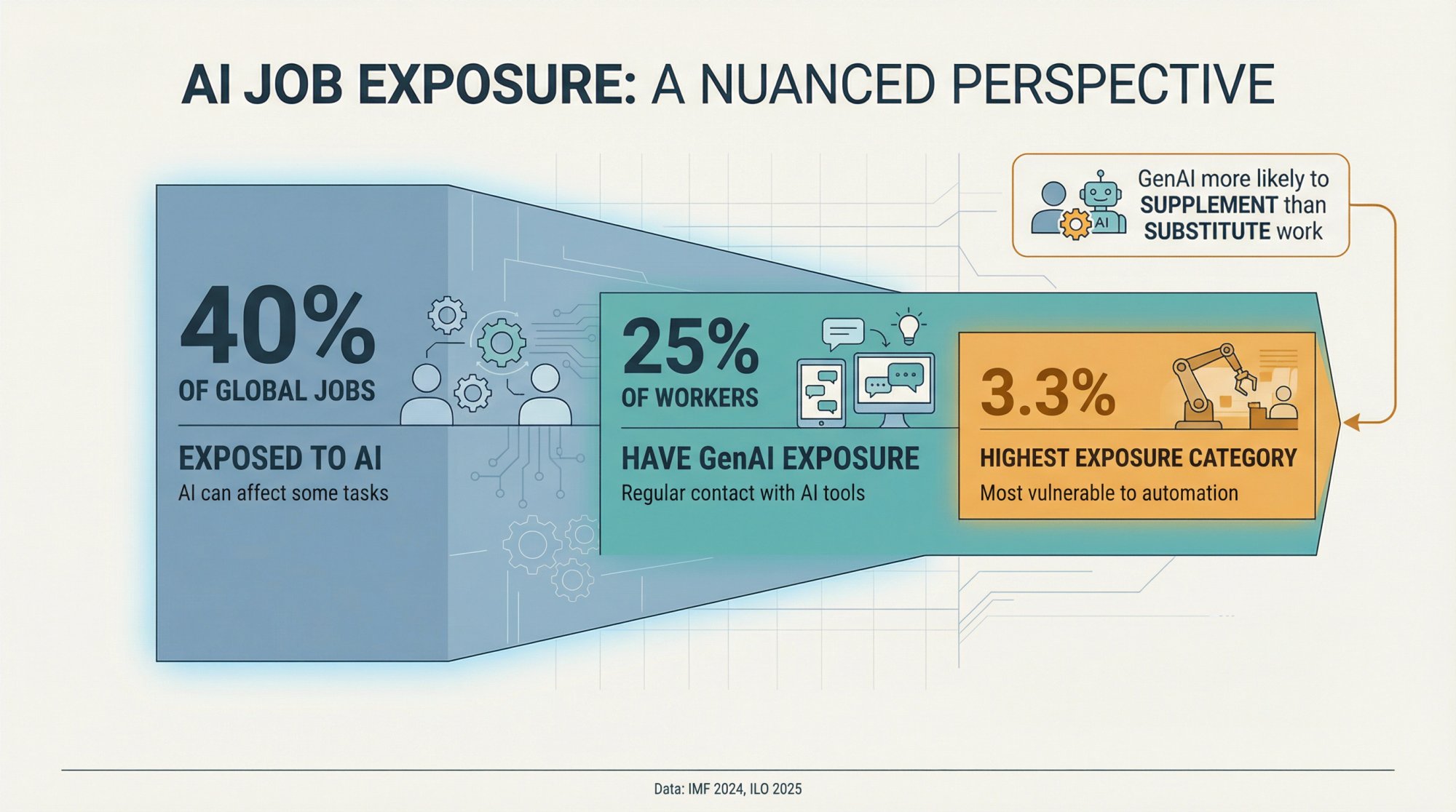
The IMF's 2024 analysis is a good starting signal: about 40% of global employment is exposed to AI (meaning AI can affect tasks), and in advanced economies about 60% of jobs may be impacted (some enhanced, some reduced).
The ILO's more recent deep dive (May 2025) says something even more useful for job seekers: 1 in 4 workers globally have some GenAI exposure, but only 3.3% are in the highest-exposure category. And "in most cases," GenAI is more likely to supplement than fully substitute work.
Translation: your goal isn't to find a magical "AI-proof job." It's to find work where the core tasks are hard to automate and where demand is strong.
Why AI Can't Replace Certain Jobs: The 3 Protection Factors
If you strip it down to first principles, AI replaces work when it can do the job reliably, cheaply, legally, and socially acceptably.
Jobs resist automation when they have one (or more) of these moats.
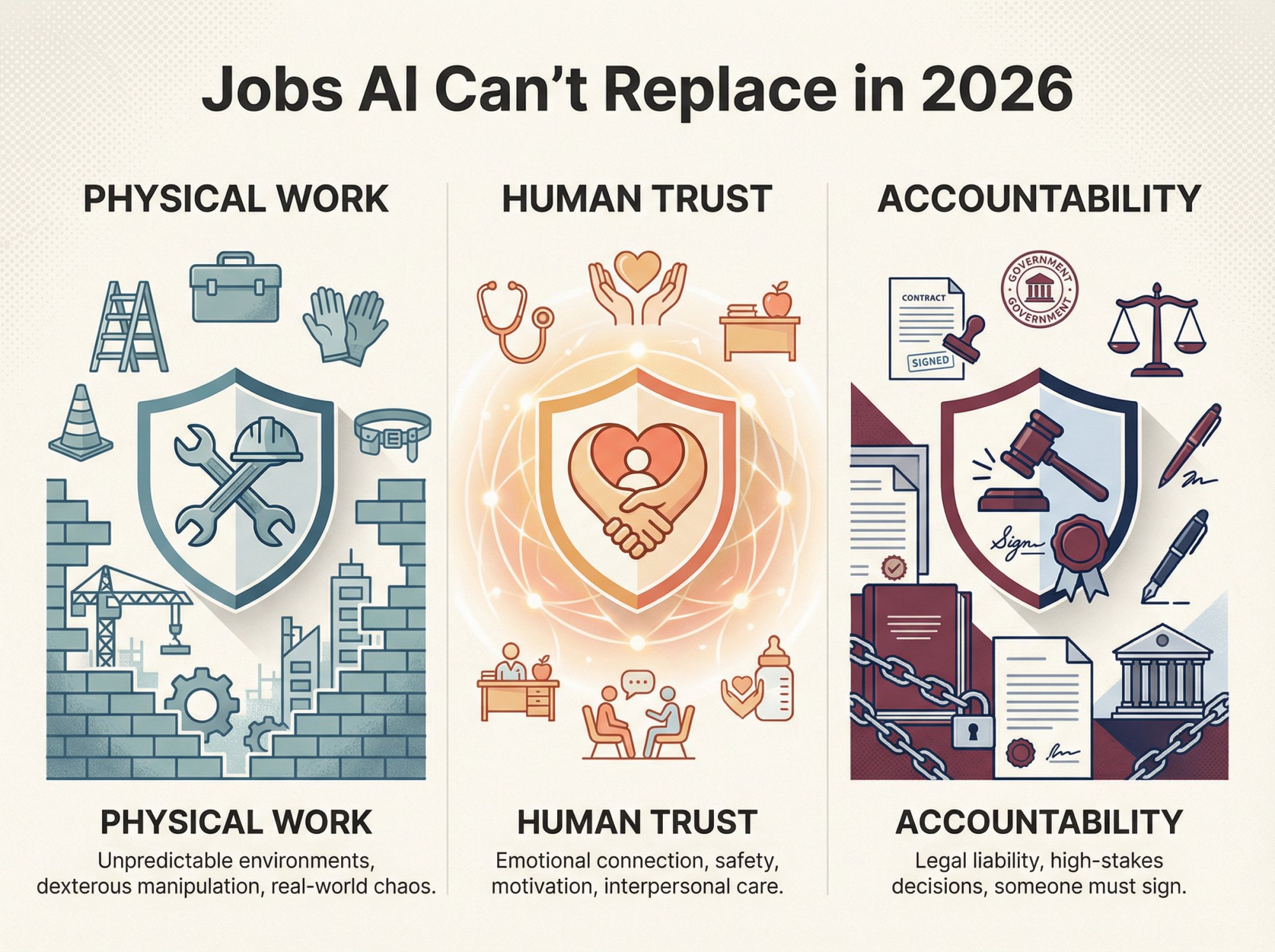
Physical Work in Unpredictable Environments
AI is great in digital space. The real world? It's a chaotic physics engine.
Robots still struggle with:
• Operating safely around humans
• Dexterous manipulation across "infinite" object variations
• Perception plus action in dynamic, unstructured environments
Research on robotics explicitly centers the challenge of mobility, dexterity, perception, and safe operation in dynamic and unstructured environments because that's the hard part.
Research on humanoids in construction lists core blockers like perceptual robustness, adaptive locomotion, human-level dexterity, continual learning, and the fact that construction sites are unstructured and unpredictable.
So: trades, field service, and many on-site roles stay human longer than "office-only" roles.
Jobs Requiring Human Trust and Emotional Connection
When the "product" is a human feeling safe, understood, motivated, or supported, replacing the human with a machine often breaks the product.
Think therapy, nursing, teaching, coaching, social work, complex customer situations.
Healthcare research notes that AI tools like ChatGPT can't replace one-on-one human interaction or the interpersonal skills that health care professionals possess. Doctors and nurses provide bedside care, comfort, and ethical judgment that keep people as "an essential part of health care."
Roles Where Someone Must Be Legally Accountable
Even if AI can draft, predict, and recommend, someone still has to be the accountable signer when stakes are high (health, safety, law, money, governance).
Society doesn't just ask "can the machine do it?" It asks "who's liable when it goes wrong?"
How to Know If Your Job Is AI-Resistant: 10-Point Scorecard
Score each question 0 to 2 (0 = no, 1 = some, 2 = yes). 12+ points = strong human advantage.
If your target role scores low, you're not doomed. But you need a plan to shift toward higher-moat tasks.
AI Job Market Statistics: What's Actually Happening in 2026
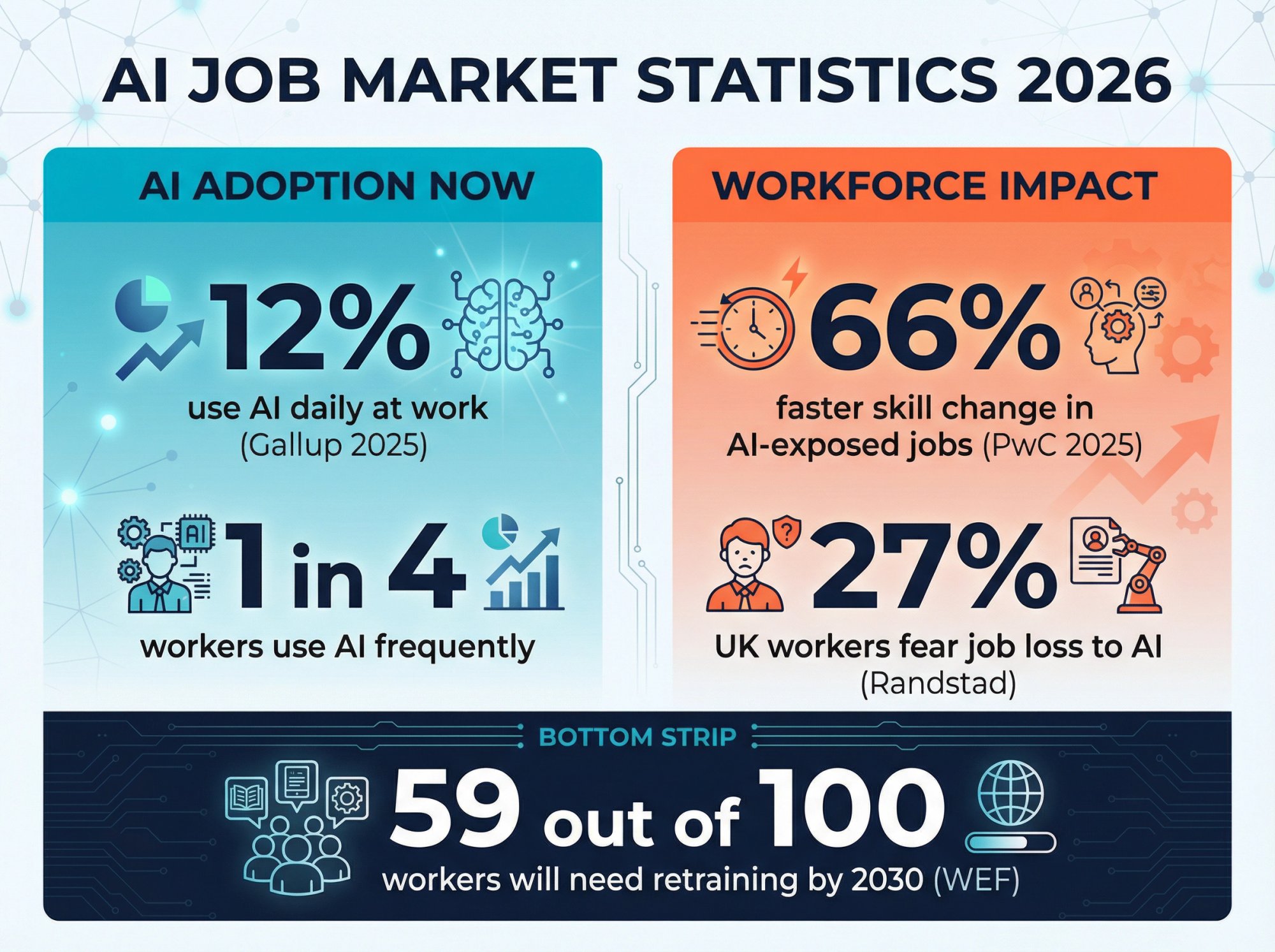
A Gallup workforce survey (Oct 30 to Nov 13, 2025; about 22,000 U.S. workers) found 12% use AI daily, and about 1 in 4 use it frequently (a few times per week).
PwC's 2025 AI Jobs Barometer reports that skills in the most AI-exposed occupations are changing 66% faster than in the least exposed ones, and that AI-related roles often show a wage premium.
A Randstad survey reported by The Guardian says 27% of UK workers worry their jobs could disappear in the next five years due to AI, while 66% of UK employers invested in AI in the last 12 months.
The big shift is training. WEF expects that by 2030, 59 out of 100 workers will need training. Employers plan to upskill, hire new skills, and (in many cases) reduce headcount where AI automates tasks.
So the goal isn't "avoid AI." It's choose a moat plus upgrade your skill stack.
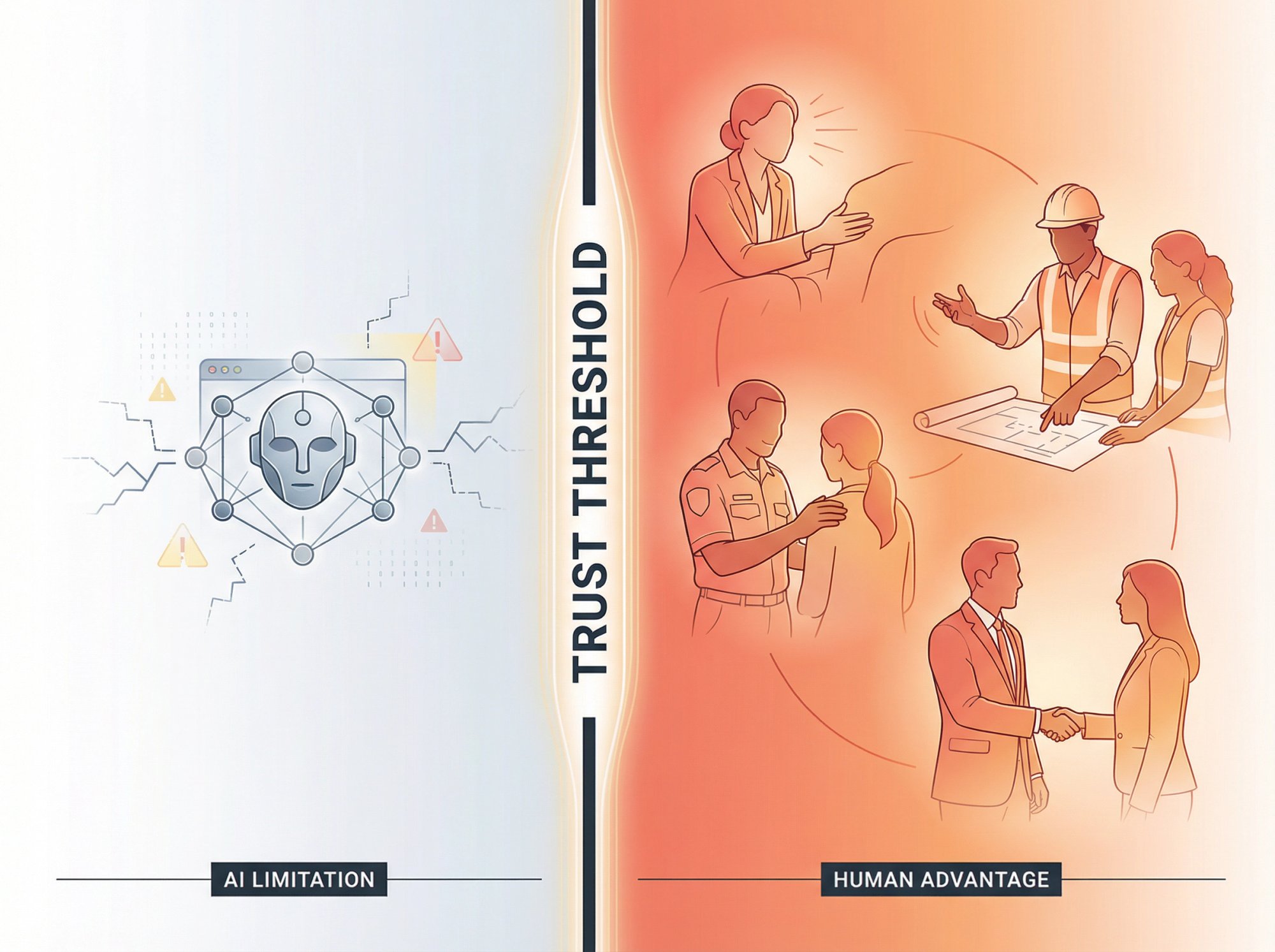
The moment of truth: which jobs actually hold up?
30+ Careers AI Can't Replace: Complete List With Entry Paths
Below are job families with strong moats today (January 2026). For each, I'll tell you why it's resilient, what AI will still change inside the job, and how to enter.
1) Skilled Trades That Touch Critical Infrastructure
Examples: Electrician, plumber/pipefitter, HVAC technician, elevator tech, industrial maintenance, lineworker, refrigeration tech, instrumentation tech, solar installer, wind turbine tech.
Why It's Resilient
Messy physical environments plus safety plus local licensing. You can't "ChatGPT" a breaker panel replacement in a flooded basement. Research shows that AI chatbot might be able to tell you how to fix a leaky pipe, but it can't carry out the necessary tasks or be relied on for real-time, hands-on problem-solving.
Huge replacement demand as experienced workers retire (varies by region).
Demand Signals (U.S. Example)
① Electricians: $62,350 median pay (May 2024); 9% projected growth (2024 to 2034); about 81,000 openings per year
② Plumbers/pipefitters/steamfitters: $62,970 median pay (May 2024)
③ HVAC: $59,810 median pay (May 2024); 8% growth; about 40,100 openings per year
What AI Changes
Faster diagnostics, parts identification, scheduling, quoting. Less paperwork; more productivity per tech. More competition from tech-enabled contractors, so customer communication matters.
Fast Entry Paths
Apprenticeships, trade school plus on-the-job hours. Stack safety plus compliance credentials (varies by country).
How to Win Hiring
Show: safety record, troubleshooting, customer explanations, job-site coordination. Use AIApply's AI Resume Builder to highlight hands-on experience and craft a targeted cover letter for engineering roles.
2) Healthcare Practitioners + Clinical Judgment Roles
Examples: Registered nurse, nurse practitioner, physician assistant, paramedic, radiologic technologist, dental hygienist, occupational therapist, physical therapist, respiratory therapist.
Why It's Resilient
Accountability plus human trust plus high-stakes decisions. Lots of physical interaction plus unpredictable patients.
Healthcare jobs in the U.S. are projected to grow about 13% from 2021 to 2031, adding about 2 million new positions. Nurse practitioners topped one list with expected 45% growth by 2032 while performing duties "that would be very difficult to replicate with a robot or AI."
Demand Signals (U.S. Example)
Healthcare occupations overall: about 1.9 million openings per year (2024 to 2034); practitioners/technical median $83,090 (May 2024).

What AI Changes
Charting, documentation, triage support, imaging assistance. But humans remain accountable for care decisions plus bedside trust.
Fast Entry Paths
Community college to nursing or allied health. Bridge programs (e.g., LPN to RN) depending on region.
How to Win Hiring
Show: patient communication, teamwork under pressure, safety protocols, evidence-based care. Explore salary expectations for registered nurses and use AIApply's resume examples to structure your application.
3) Care Economy and Support Roles (Massive Demand, Strong Human Moat)

Examples: Home health aide, personal care aide, nursing assistant, disability support worker, elder care coordinator.
Why It's Resilient
Humans need humans for dignity, safety, and daily care. Physical plus emotional work in unstructured settings.
Demand Signals (U.S. Example)
Home health and personal care aides: $34,900 median pay (May 2024); 17% growth (2024 to 2034); about 765,800 openings per year; 4.35 million jobs (2024).
What AI Changes
Scheduling, care plans, documentation, translation and communications. Not the core human relationship and physical support.
Fast Entry Paths
Short training plus certifications (varies by region). Start part-time; build references fast.
How to Win Hiring
Show: reliability, empathy, safety, calm handling of difficult moments. Check CNA salary data and review nursing assistant resume examples for application guidance.
4) Education, Mentoring, and Special Needs Support
Examples: Early childhood educator, special education teacher, classroom teacher, vocational instructor, learning support assistant, speech-language support.
Why It's Resilient
Teaching is behavior change plus trust plus motivation, not information delivery. Kids aren't spreadsheets; classrooms are chaotic multi-agent systems.
During the COVID-19 pandemic, we learned that pure online or AI-mediated learning isn't a panacea. Many students struggled without in-person guidance, showing the limits of tech as a substitute for teachers.
What AI Changes
Lesson planning drafts, grading support, parent communications, individualized practice. But a human still manages the room, relationships, and safety.
Fast Entry Paths
Teaching assistant to certification. Vocational education if you already have a trade.
How to Win Hiring
Show: classroom management, student outcomes, parent collaboration, safeguarding. Browse teacher resume examples and special education teacher cover letters for positioning ideas.
5) Mental Health, Therapy, Social Work, and Recovery
Examples: Therapist/counselor, clinical social worker, addiction counselor, grief support, community outreach coordinator.
Why It's Resilient
The "deliverable" is trust plus co-regulation plus ethical responsibility. AI can be a tool, but many people won't accept it as the primary relationship.
What AI Changes
Note drafting, psychoeducation material, admin triage. More demand for humans as AI increases stress and isolation.
Fast Entry Paths
Peer support roles to certifications to formal programs.
How to Win Hiring
Show: boundaries, ethics, crisis handling, real outcomes. Explore social worker career paths and check counselor salary ranges to understand market positioning.
6) Emergency Response and Public Safety
Examples: Firefighter, EMT, disaster response coordinator, fire inspector, search and rescue.
Why It's Resilient
Real-time physical risk plus messy environments plus moral decisions. Accountability is non-negotiable.
Research notes that "Comforting a child in crisis" requires a human, while AI is ready for tasks like "mapping fire hydrant locations."
Demand Signals (U.S. Example)
Firefighters: $59,530 median pay (May 2024); about 27,100 openings per year.
What AI Changes
Dispatch optimization, situational awareness, training sims, predictive maintenance. Not the physical response plus judgment in chaos.
7) On-Site Operations Leadership (Where "the Work" is Coordination)
Examples: Construction manager, site supervisor, facilities manager, logistics supervisor, event operations lead, restaurant general manager.
Why It's Resilient
Humans coordinating humans plus vendors plus constraints plus politics. Constant exceptions; "the plan is wrong every morning."
What AI Changes
Forecasting, schedules, inventory predictions, reporting. But humans still make tradeoffs and manage people.
Fast Entry Paths
Start as coordinator/assistant; own a painful process; get promoted.
How to Win Hiring
Show: cost/time wins, incident reduction, vendor negotiation, team performance. Review operations manager resume examples and facilities manager skills requirements.
8) Complex B2B Sales, Partnerships, and Negotiation-Heavy Roles
Examples: Enterprise account executive, strategic partnerships, procurement lead, customer success for high-stakes accounts, fundraising.
Why It's Resilient
Persuasion plus trust plus multi-stakeholder negotiation. Deals die on relationships, not information.
What AI Changes
Research, proposal drafts, call notes, account planning. Top performers become "human plus AI" closers.
Fast Entry Paths
Move from support to inside sales to strategic roles. Learn one industry deeply.
How to Win Hiring
Show: pipeline, retention, negotiation outcomes, stakeholder management. Check account executive salary data and browse sales manager career paths.
9) Skilled Repair + Maintenance in the "Real Stuff" Economy
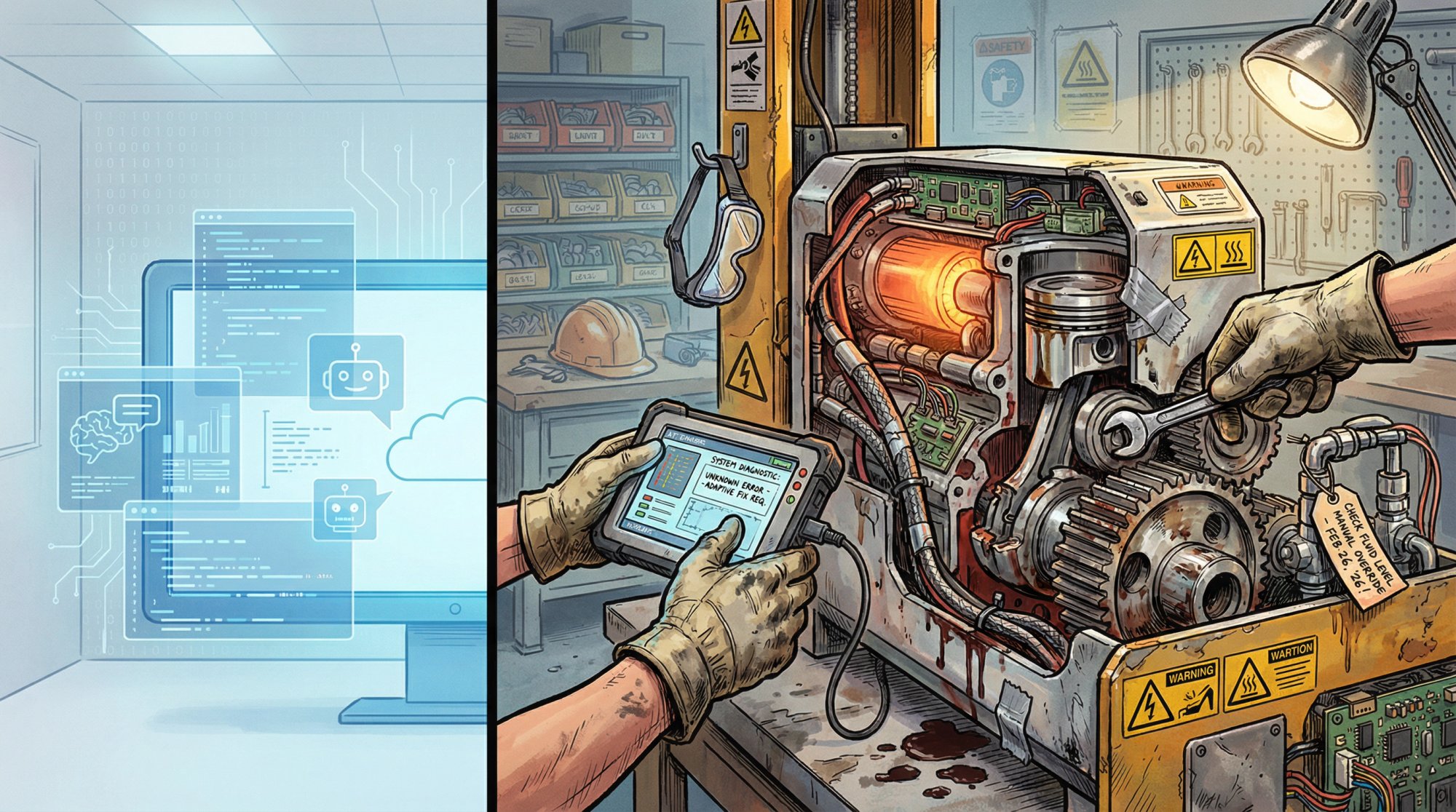
Examples: Automotive technician, aircraft mechanic (licensed), appliance repair, biomedical equipment tech, field service engineer.
Why It's Resilient
Physical diagnostics plus weird edge cases plus safety. You're debugging reality, not code.
What AI Changes
Faster troubleshooting trees, parts matching, remote assist. More demand as devices get more complex.
10) Culinary, Hospitality, and Craftsmanship Where Taste + Experience Matter
Examples: Chef, baker, hair stylist/barber, massage therapist, tattoo artist, sommelier, custom furniture maker.
Why It's Resilient
Humans pay for taste, vibe, care, experience. Physical work plus human preference loops.
Research explains that even with AI helping to develop recipe ideas, "a trained human professional will still need to be the one sautéing, icing, taste testing, distilling" in the kitchen. That blend of "dexterity, adaptability, and good taste" only human hands (and senses) can provide.
What AI Changes
Marketing, scheduling, menu iteration, trend research. Not the human artistry plus customer connection.
How to Win Hiring
Portfolio (photos, reviews), repeat customers, hygiene/safety compliance.
11) High-Accountability Compliance and Governance (Including AI Governance)
Examples: Compliance officer, risk manager, audit lead, safety officer, quality assurance manager, AI governance/model risk (where regulated).
Why It's Resilient
Accountability plus regulation plus ethics. AI can analyze, but humans sign off and defend decisions.
What AI Changes
Faster reviews, automated evidence gathering, drafting policies. Raises the bar on judgment and communication.
Fast Entry Paths
Start in operations plus learn controls. Certifications depending on domain (finance, healthcare, safety).
12) Research That Touches Physical Reality (Not Just "Reading Papers")
Examples: Lab technician, clinical trial coordinator, field researcher, environmental technician, materials testing.
Why It's Resilient
Physical experiments plus protocols plus unexpected results. You can't run a wet lab through a chatbot.
Research analysis notes that AI "isn't able to find new information (or conduct an archaeological dig, for that matter)." Field ecologists go to the jungle to see what species might be there. An AI can't decide to do that, though it might help crunch numbers after observations are collected.
What AI Changes
Literature review, experiment planning, data analysis. Still need humans to execute and interpret reality.
13) Human-Centered Design Roles (The "Taste + Truth" Layer)
Examples: UX researcher, service designer, product designer, brand strategist, creative director.
Why It's Resilient (When Done Right)
AI generates options; humans choose what actually fits people, context, and business constraints. Stakeholders trust humans to own decisions.
Creative work showcases what human imagination can do. While AI can produce impressive outputs, these are fundamentally derivative. AI models learn from existing works and then recombine elements in statistically likely ways. They do not create something truly new from nothing, nor do they imbue meaning from lived experience.
What AI Changes
Faster prototyping, copy drafts, ideation. Juniors who only "make assets" are at risk; people who can run discovery plus strategy get stronger.
These job families aren't fantasy. But the market is shifting fast.
Jobs AI Will Replace: What to Avoid in 2026
WEF lists the biggest absolute declines in clerical and secretarial work, including:
That doesn't mean "never work in an office." It means: if your job is mostly routine digital paperwork, you need to either:
① Move up into judgment/coordination, or
② Move sideways into a role with physical/trust/accountability moats
Why AI-Resistant Jobs Still Need AI Skills
Counterintuitive but true: AI-resistant careers still benefit from AI (often massively).
PwC's data shows that jobs exposed to AI are seeing faster skill churn and wage dynamics. The IMF's 2026 update shows job postings increasingly demand "new skills," and postings with new skills can pay more (UK and US examples).
The winning move: Pick a human-advantage domain, then become the person who uses AI to deliver better outcomes inside that domain.
Real-World Examples:
① Electrician who uses AI to speed diagnostics plus quoting (but still does safe installs)
② Nurse who uses AI to reduce charting time and spend more time with patients
③ Construction supervisor who uses AI for planning but wins via people plus safety plus execution
How to Choose an AI-Proof Career (4-Step Framework)
Use these 4 filters in order.
Filter 1: Does It Have at Least One Moat?
Run the scorecard.
Filter 2: Does Demand Have Tailwinds?
Look for demographic, infrastructure, regulation, or climate drivers. WEF explicitly calls out aging populations driving healthcare growth, and climate transition driving demand in green roles.
Filter 3: Can You Enter Within Your Time/Cost Constraints?
Some paths are fast (trades, care support). Some take longer (clinical practitioner).
Filter 4: Will You Actually Enjoy the Day-to-Day?
"AI-proof" is worthless if you hate the work and burn out.
Quick matching cheat:
• You like hands-on problem solving: trades/repair
• You like helping people: care/health/education
• You like chaos plus adrenaline: emergency response
• You like coordination plus leadership: ops management
• You like persuasion plus relationships: B2B sales/partnerships
How to Switch Careers: 4-Step Action Plan
This is the practical playbook.
Step 1: Choose 1 Target Job Family + 10 Target Job Titles
Don't pick "healthcare." Pick "registered nurse in outpatient clinic" or "HVAC apprentice" or "personal care aide."
Browse AIApply's career directory to explore specific roles and understand requirements.
Step 2: Build a Proof Bank (This Is What Your Resume Must Be Made Of)
A proof bank is just:
→ 10 to 15 projects/tasks you've done
→ The result (time saved, errors reduced, customers helped, revenue, safety)
→ Tools used
→ Constraints (tight deadline, difficult client, messy environment)
You can do this even if you're early-career through volunteer shifts, mock projects, shadowing, or hands-on practice logs (especially for trades).
Step 3: Convert Your Proof Bank Into "Moat Bullets"
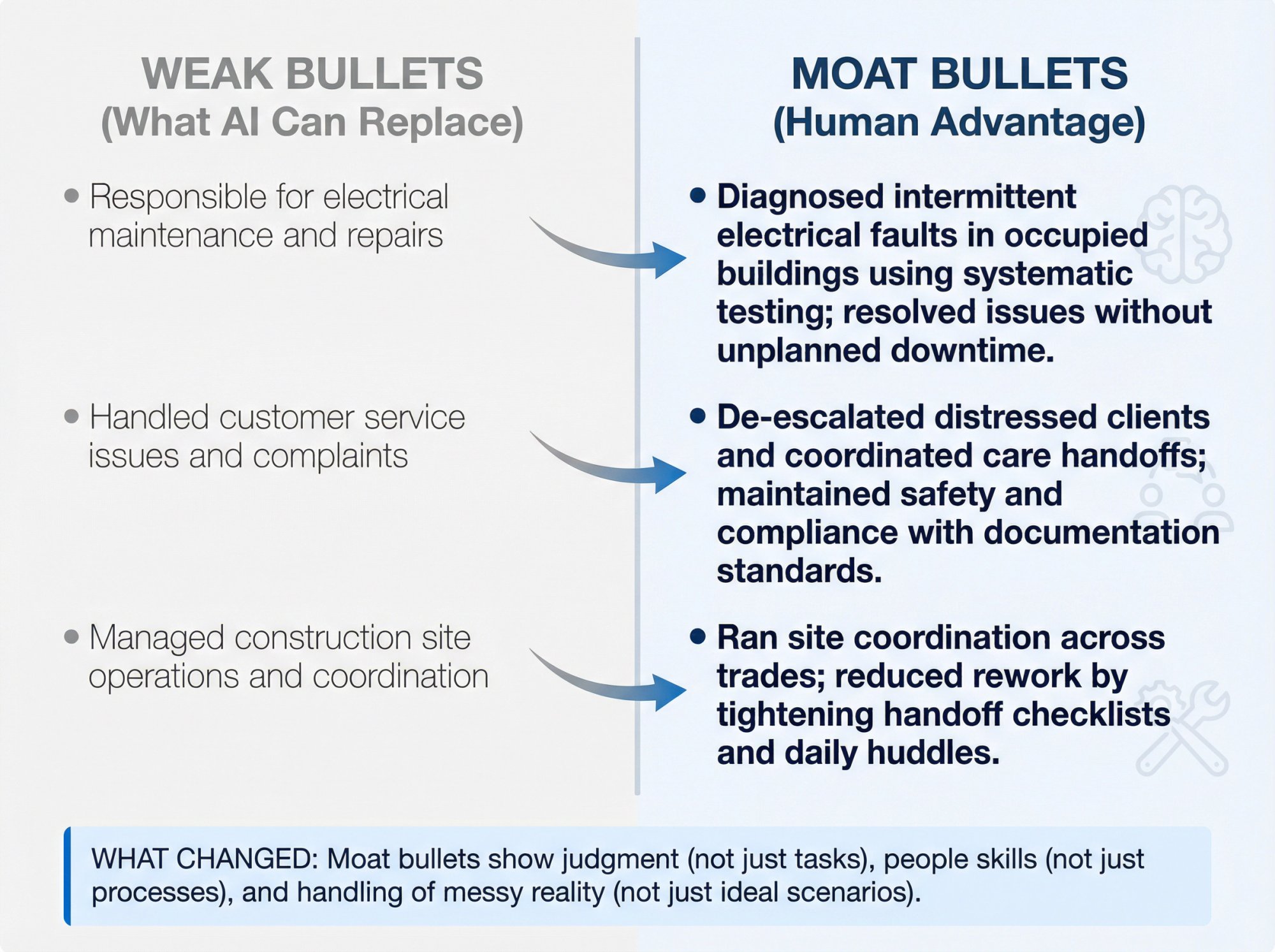
Examples of moat-style bullets (copy the pattern):
• "Diagnosed intermittent electrical faults in occupied buildings using systematic testing; resolved issues without unplanned downtime."
• "De-escalated distressed clients and coordinated care handoffs; maintained safety and compliance with documentation standards."
• "Ran site coordination across trades; reduced rework by tightening handoff checklists and daily huddles."
Notice: these aren't "responsible for..." bullets. They show judgment, people, and messy reality.
Learn how to craft compelling bullets by reviewing resume writing best practices and avoiding cliche resume buzzwords.
Step 4: Apply With High Signal, Not Just High Volume
If the job is high-trust (care, teaching, leadership), low-quality spam applications backfire.
How to Use AIApply to Land These Roles (Without Looking Fake)
AIApply is built for the part AI should do: turning your real experience into job-aligned applications, fast.
Here's the clean workflow:
① Find roles fast using the AIApply job board (so you're not scraping the internet manually).
② Tailor your resume to the posting using the AI Resume Builder (structure plus ATS alignment).
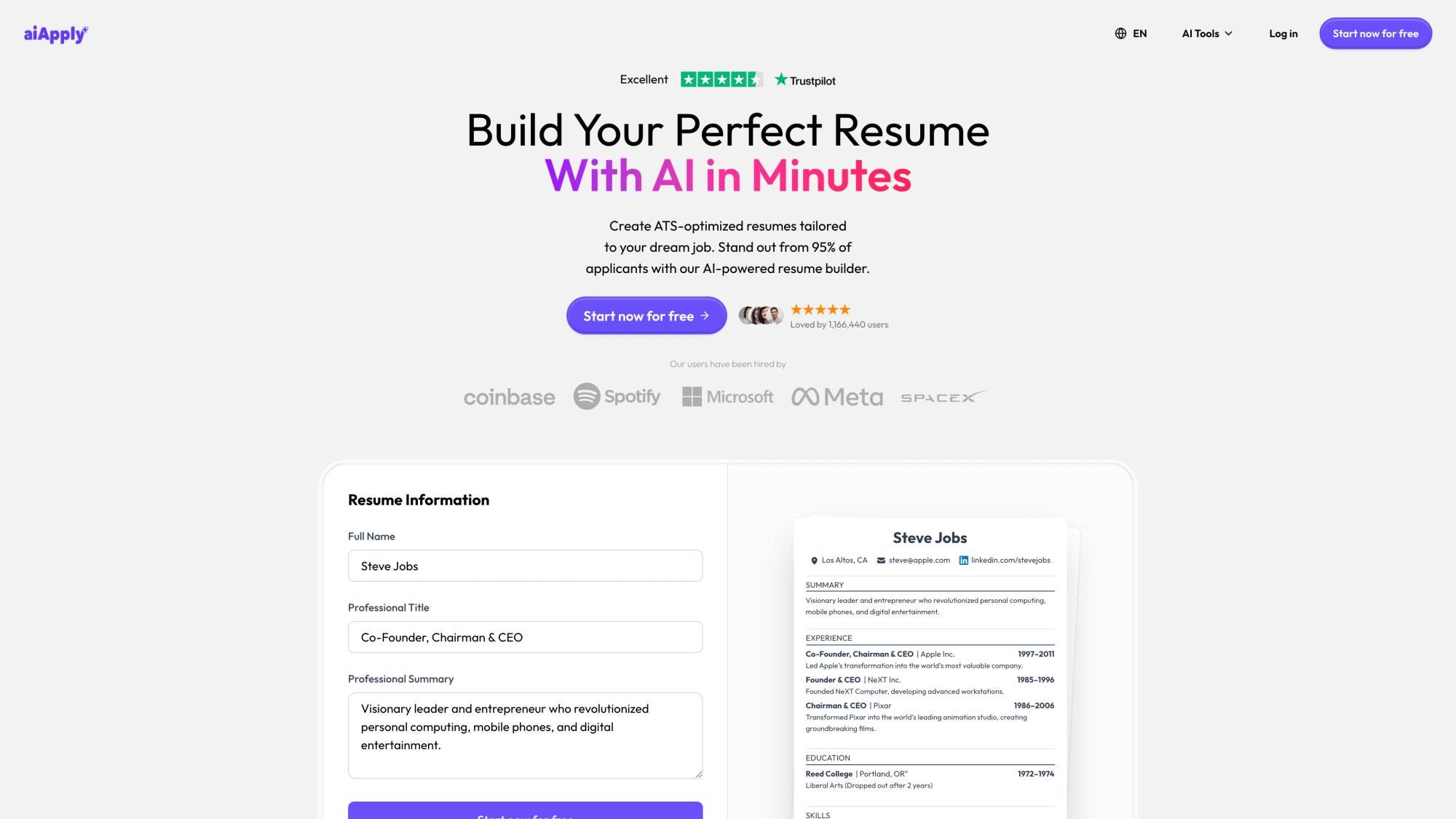
③ Run the resume scanner and fix gaps (keywords plus formatting).
④ Generate a cover letter that proves the moat, not generic enthusiasm, using the AI Cover Letter Generator. See what to include in cover letters for guidance.
⑤ If you're applying across countries, use the Resume Translator (AIApply's site currently claims 50+ languages on the homepage).
⑥ Once interviews start, use Interview Buddy or mock interviews to drill scenario questions (especially for care/trades/ops). Prepare with behavioral interview questions and answers.
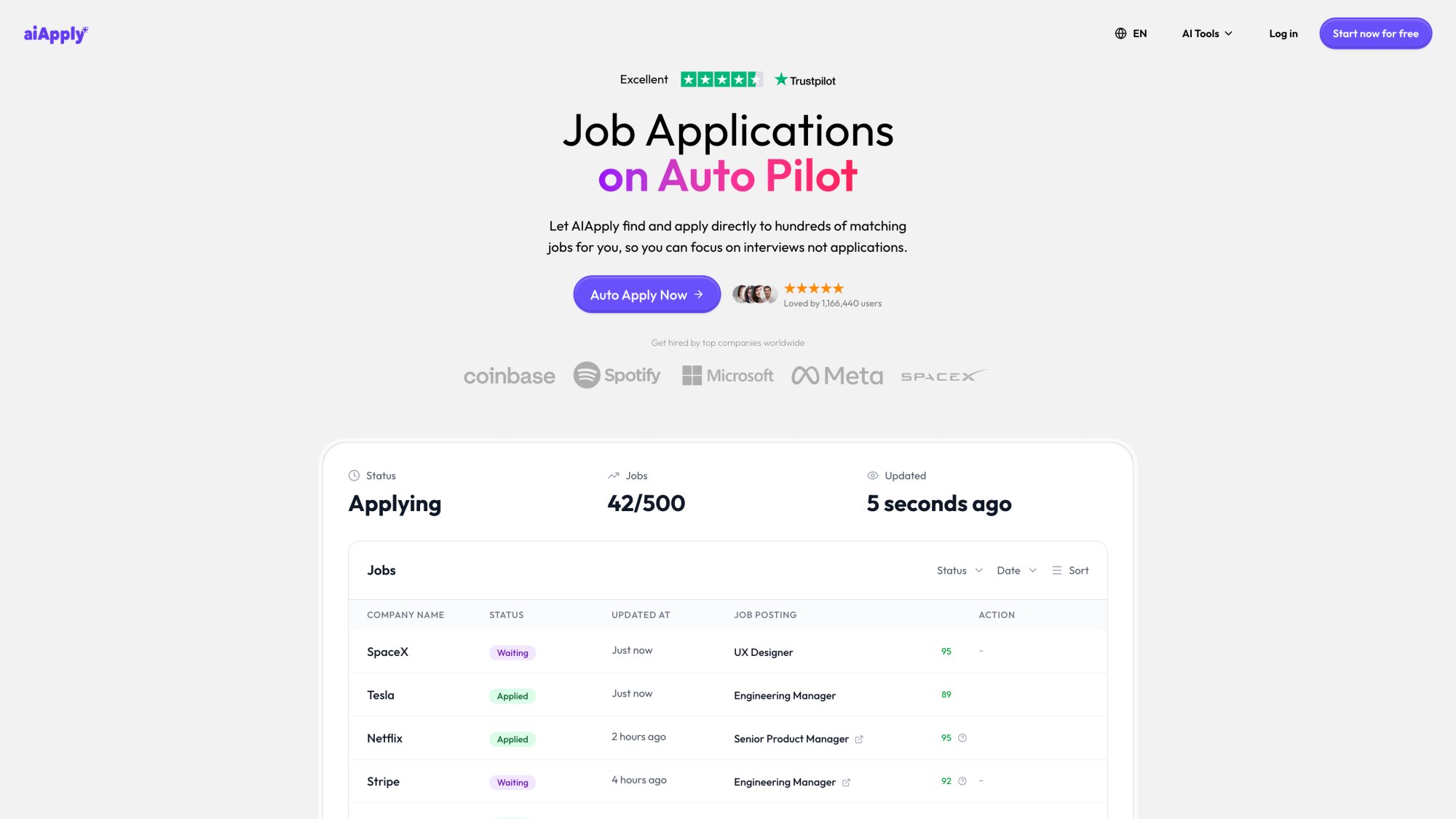
⑦ Use Auto Apply when it makes sense (high-volume roles), but keep relevance high. AIApply's Auto Apply page claims an "80% more likely" outcome. Treat that as a platform claim, not a law of physics, and still keep your inputs truthful.
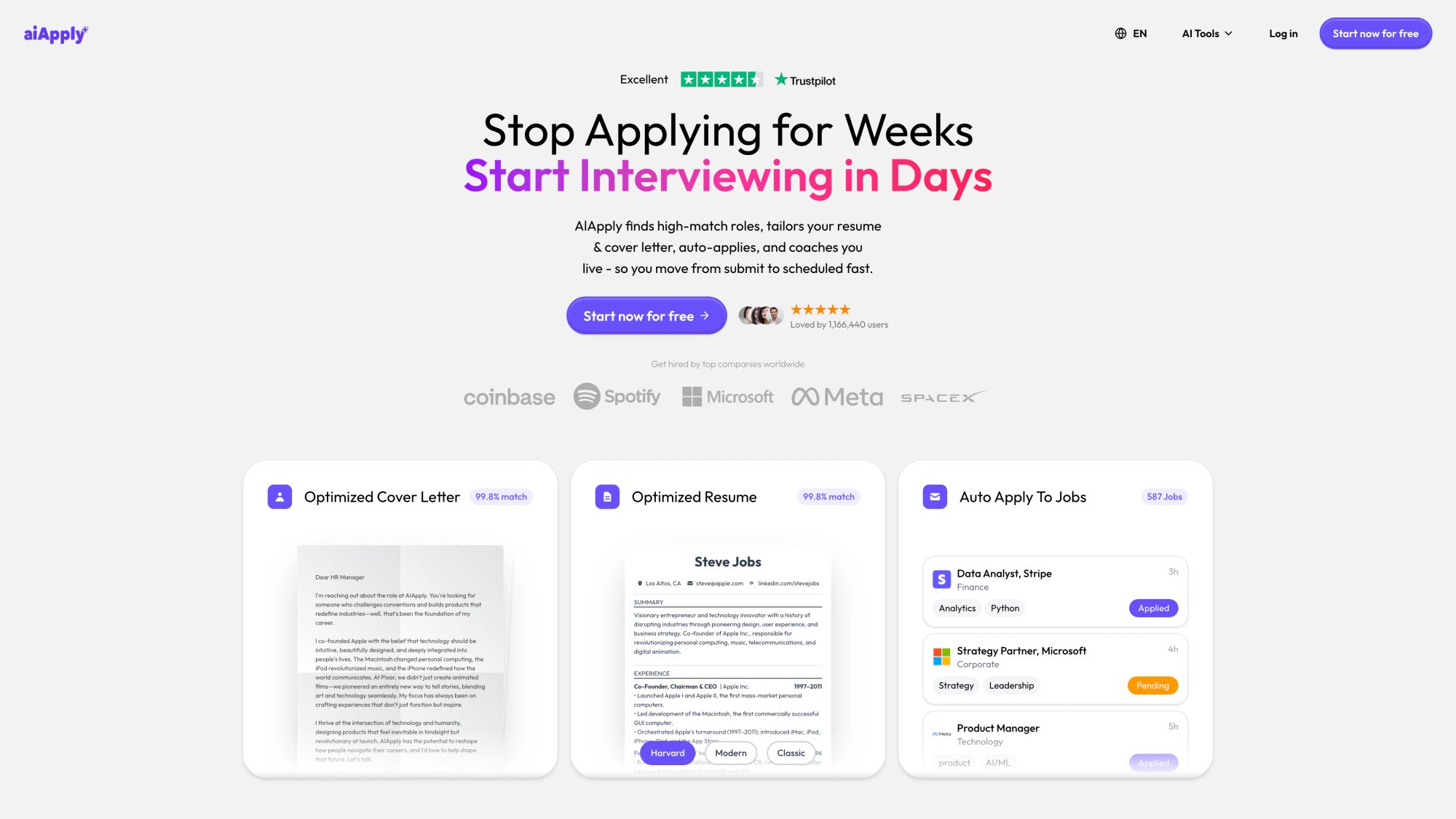
The non-negotiable rule (because it works): Feed it truth. AI tools amplify signal; they also amplify lies.
Frequently Asked Questions
"Will AI replace programmers?"
It will replace a lot of junior coding tasks and routine work. But building software in the real world is still loaded with ambiguity, product tradeoffs, and accountability. The risk is being the person who only converts tickets into code. The moat is product thinking, systems design, owning outcomes.
WEF even expects tech roles to be among the fastest-growing in percentage terms (big data, AI/ML, software dev), while simultaneously expecting workforce reductions where AI automates tasks. That means: demand exists, but the bar rises.
Explore software engineer career paths, AI consultant roles, and machine learning engineer positions to understand the evolving landscape.
"Will AI replace doctors or nurses?"
AI will change documentation, triage, and decision support. But healthcare is high-accountability plus human trust plus physical reality. The job evolves; it doesn't vanish.
Explore physician assistant opportunities and healthcare administrator positions for adjacent roles.
"Will AI replace teachers?"
AI can tutor content. Teaching is still behavior change plus classroom management plus safeguarding plus motivation.
Check elementary teacher positions, ESL teacher roles, and education program manager opportunities for various education career paths.
"What's the single safest job?"
There isn't one. But if you want a clean heuristic: care work plus trades plus emergency response plus on-site ops leadership tend to have the strongest combined moats in 2026.
"Should I avoid all office jobs?"
No. But if your office job is mostly routine digital paperwork with no human coordination or judgment, you need to shift toward moat tasks. Focus on roles where you coordinate people, make judgment calls, or build trust with clients.
Consider business analyst positions, project manager roles, or operations analyst opportunities that emphasize coordination and strategic thinking.
"How do I know if my current job is at risk?"
Run it through the scorecard. If it scores below 12 points, start building skills in higher-moat areas now. Look for projects that involve more human interaction, physical work, or accountability.
"Can I combine AI skills with a moat job?"
Absolutely. That's actually the sweet spot. Being the nurse who masters AI-assisted charting, the electrician who uses AI diagnostics, or the teacher who leverages AI for lesson planning makes you more valuable, not less.
Explore AI product manager roles and AI marketing specialist positions to understand how AI skills can enhance traditional careers.
Key Takeaways: Your Next Steps
"Jobs AI can't replace" is really a question about where humans still have structural advantage.
Your best bet isn't hiding from AI. It's picking a role where:
→ The core work is physical, human, or accountable
→ Demand is rising
→ And you're willing to use AI to become more effective, not replaceable
You can literally copy the scorecard above and run it on any job you're considering. It's a better compass than any generic list.
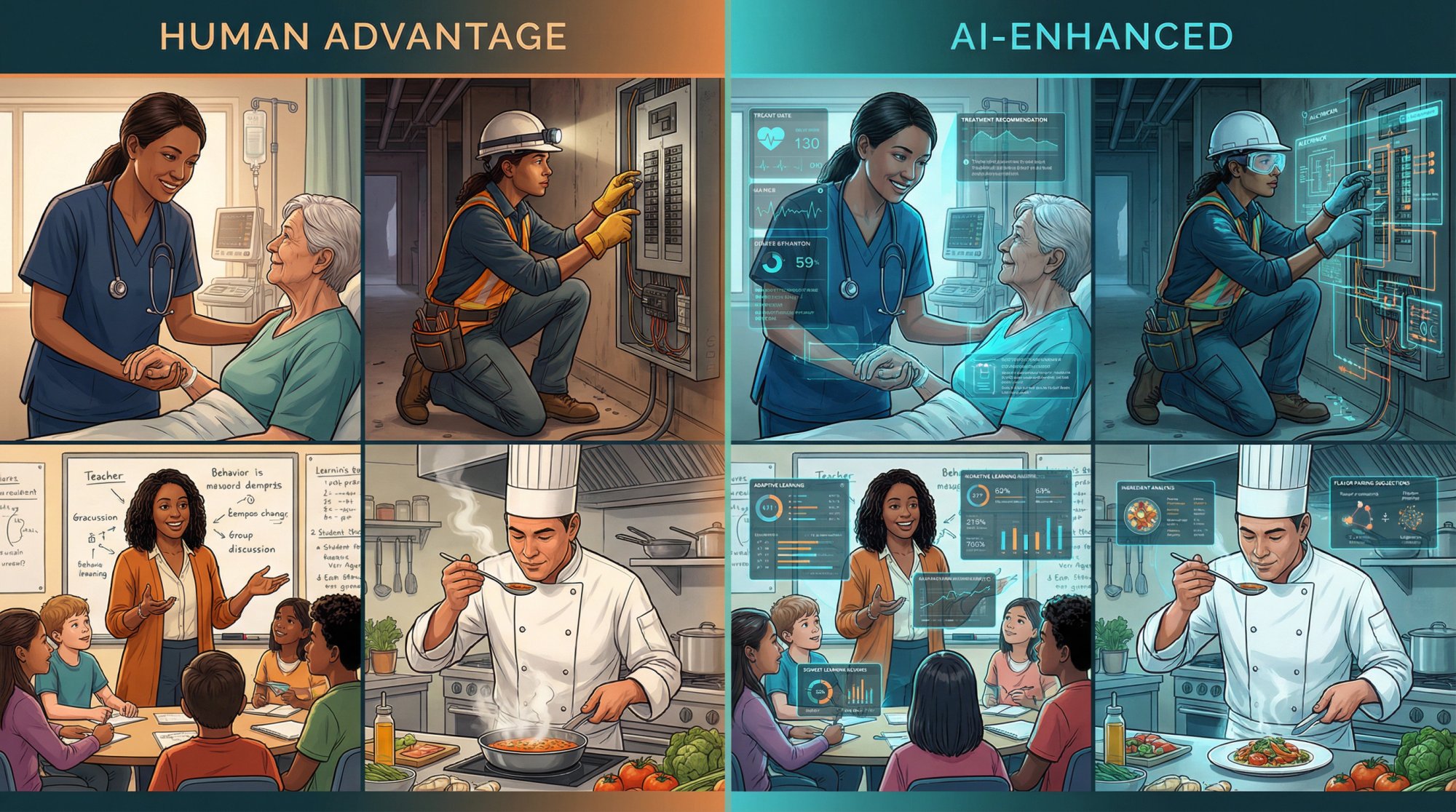
Want help landing one of these roles? AIApply handles the tedious parts (resume tailoring, application tracking, interview prep) so you can focus on the human parts that actually land jobs: networking, authentic conversations, and showcasing your unique value.
Wondering when to follow up on a job application or how to answer "Why should we hire you?" Start with AIApply's comprehensive job search resources for expert guidance.
If you're searching for "jobs AI can't replace," you're not looking for a cute list. You're trying to pick a career (or plan a pivot) that won't be automated away by software.
Here's the honest framing.
AI won't "replace jobs" so much as it replaces chunks of tasks inside jobs. The safest careers aren't "no-AI" careers. They're human-advantage careers: roles where the core value comes from what machines still struggle to do in the real world, or what society won't let machines do without a human in the loop.
And yes, the labor market is already shifting. The World Economic Forum expects 170 million jobs created and 92 million displaced between 2025 and 2030 (net +78 million), and says 39% of skills will be transformed or outdated in that period.
This guide gives you:
• A first-principles model for what's "replaceable"
• A scorecard you can run on any job
• 30+ job families AI struggles to replace (with "what AI will change" inside each)
• A step-by-step pivot plan for landing these roles
• A clear way to use AIApply to land these roles without turning into an "AI-generated candidate"
What Tasks Can AI Actually Replace?
The IMF's 2024 analysis is a good starting signal: about 40% of global employment is exposed to AI (meaning AI can affect tasks), and in advanced economies about 60% of jobs may be impacted (some enhanced, some reduced).
The ILO's more recent deep dive (May 2025) says something even more useful for job seekers: 1 in 4 workers globally have some GenAI exposure, but only 3.3% are in the highest-exposure category. And "in most cases," GenAI is more likely to supplement than fully substitute work.
Translation: your goal isn't to find a magical "AI-proof job." It's to find work where the core tasks are hard to automate and where demand is strong.
Why AI Can't Replace Certain Jobs: The 3 Protection Factors
If you strip it down to first principles, AI replaces work when it can do the job reliably, cheaply, legally, and socially acceptably.
Jobs resist automation when they have one (or more) of these moats.
Physical Work in Unpredictable Environments
AI is great in digital space. The real world? It's a chaotic physics engine.
Robots still struggle with:
• Operating safely around humans
• Dexterous manipulation across "infinite" object variations
• Perception plus action in dynamic, unstructured environments
Research on robotics explicitly centers the challenge of mobility, dexterity, perception, and safe operation in dynamic and unstructured environments because that's the hard part.
Research on humanoids in construction lists core blockers like perceptual robustness, adaptive locomotion, human-level dexterity, continual learning, and the fact that construction sites are unstructured and unpredictable.
So: trades, field service, and many on-site roles stay human longer than "office-only" roles.
Jobs Requiring Human Trust and Emotional Connection
When the "product" is a human feeling safe, understood, motivated, or supported, replacing the human with a machine often breaks the product.
Think therapy, nursing, teaching, coaching, social work, complex customer situations.
Healthcare research notes that AI tools like ChatGPT can't replace one-on-one human interaction or the interpersonal skills that health care professionals possess. Doctors and nurses provide bedside care, comfort, and ethical judgment that keep people as "an essential part of health care."
Roles Where Someone Must Be Legally Accountable
Even if AI can draft, predict, and recommend, someone still has to be the accountable signer when stakes are high (health, safety, law, money, governance).
Society doesn't just ask "can the machine do it?" It asks "who's liable when it goes wrong?"
How to Know If Your Job Is AI-Resistant: 10-Point Scorecard
Score each question 0 to 2 (0 = no, 1 = some, 2 = yes). 12+ points = strong human advantage.
If your target role scores low, you're not doomed. But you need a plan to shift toward higher-moat tasks.
AI Job Market Statistics: What's Actually Happening in 2026
A Gallup workforce survey (Oct 30 to Nov 13, 2025; about 22,000 U.S. workers) found 12% use AI daily, and about 1 in 4 use it frequently (a few times per week).
PwC's 2025 AI Jobs Barometer reports that skills in the most AI-exposed occupations are changing 66% faster than in the least exposed ones, and that AI-related roles often show a wage premium.
A Randstad survey reported by The Guardian says 27% of UK workers worry their jobs could disappear in the next five years due to AI, while 66% of UK employers invested in AI in the last 12 months.
The big shift is training. WEF expects that by 2030, 59 out of 100 workers will need training. Employers plan to upskill, hire new skills, and (in many cases) reduce headcount where AI automates tasks.
So the goal isn't "avoid AI." It's choose a moat plus upgrade your skill stack.
The moment of truth: which jobs actually hold up?
30+ Careers AI Can't Replace: Complete List With Entry Paths
Below are job families with strong moats today (January 2026). For each, I'll tell you why it's resilient, what AI will still change inside the job, and how to enter.
1) Skilled Trades That Touch Critical Infrastructure
Examples: Electrician, plumber/pipefitter, HVAC technician, elevator tech, industrial maintenance, lineworker, refrigeration tech, instrumentation tech, solar installer, wind turbine tech.
Why It's Resilient
Messy physical environments plus safety plus local licensing. You can't "ChatGPT" a breaker panel replacement in a flooded basement. Research shows that AI chatbot might be able to tell you how to fix a leaky pipe, but it can't carry out the necessary tasks or be relied on for real-time, hands-on problem-solving.
Huge replacement demand as experienced workers retire (varies by region).
Demand Signals (U.S. Example)
① Electricians: $62,350 median pay (May 2024); 9% projected growth (2024 to 2034); about 81,000 openings per year
② Plumbers/pipefitters/steamfitters: $62,970 median pay (May 2024)
③ HVAC: $59,810 median pay (May 2024); 8% growth; about 40,100 openings per year
What AI Changes
Faster diagnostics, parts identification, scheduling, quoting. Less paperwork; more productivity per tech. More competition from tech-enabled contractors, so customer communication matters.
Fast Entry Paths
Apprenticeships, trade school plus on-the-job hours. Stack safety plus compliance credentials (varies by country).
How to Win Hiring
Show: safety record, troubleshooting, customer explanations, job-site coordination. Use AIApply's AI Resume Builder to highlight hands-on experience and craft a targeted cover letter for engineering roles.
2) Healthcare Practitioners + Clinical Judgment Roles
Examples: Registered nurse, nurse practitioner, physician assistant, paramedic, radiologic technologist, dental hygienist, occupational therapist, physical therapist, respiratory therapist.
Why It's Resilient
Accountability plus human trust plus high-stakes decisions. Lots of physical interaction plus unpredictable patients.
Healthcare jobs in the U.S. are projected to grow about 13% from 2021 to 2031, adding about 2 million new positions. Nurse practitioners topped one list with expected 45% growth by 2032 while performing duties "that would be very difficult to replicate with a robot or AI."
Demand Signals (U.S. Example)
Healthcare occupations overall: about 1.9 million openings per year (2024 to 2034); practitioners/technical median $83,090 (May 2024).
What AI Changes
Charting, documentation, triage support, imaging assistance. But humans remain accountable for care decisions plus bedside trust.
Fast Entry Paths
Community college to nursing or allied health. Bridge programs (e.g., LPN to RN) depending on region.
How to Win Hiring
Show: patient communication, teamwork under pressure, safety protocols, evidence-based care. Explore salary expectations for registered nurses and use AIApply's resume examples to structure your application.
3) Care Economy and Support Roles (Massive Demand, Strong Human Moat)
Examples: Home health aide, personal care aide, nursing assistant, disability support worker, elder care coordinator.
Why It's Resilient
Humans need humans for dignity, safety, and daily care. Physical plus emotional work in unstructured settings.
Demand Signals (U.S. Example)
Home health and personal care aides: $34,900 median pay (May 2024); 17% growth (2024 to 2034); about 765,800 openings per year; 4.35 million jobs (2024).
What AI Changes
Scheduling, care plans, documentation, translation and communications. Not the core human relationship and physical support.
Fast Entry Paths
Short training plus certifications (varies by region). Start part-time; build references fast.
How to Win Hiring
Show: reliability, empathy, safety, calm handling of difficult moments. Check CNA salary data and review nursing assistant resume examples for application guidance.
4) Education, Mentoring, and Special Needs Support
Examples: Early childhood educator, special education teacher, classroom teacher, vocational instructor, learning support assistant, speech-language support.
Why It's Resilient
Teaching is behavior change plus trust plus motivation, not information delivery. Kids aren't spreadsheets; classrooms are chaotic multi-agent systems.
During the COVID-19 pandemic, we learned that pure online or AI-mediated learning isn't a panacea. Many students struggled without in-person guidance, showing the limits of tech as a substitute for teachers.
What AI Changes
Lesson planning drafts, grading support, parent communications, individualized practice. But a human still manages the room, relationships, and safety.
Fast Entry Paths
Teaching assistant to certification. Vocational education if you already have a trade.
How to Win Hiring
Show: classroom management, student outcomes, parent collaboration, safeguarding. Browse teacher resume examples and special education teacher cover letters for positioning ideas.
5) Mental Health, Therapy, Social Work, and Recovery
Examples: Therapist/counselor, clinical social worker, addiction counselor, grief support, community outreach coordinator.
Why It's Resilient
The "deliverable" is trust plus co-regulation plus ethical responsibility. AI can be a tool, but many people won't accept it as the primary relationship.
What AI Changes
Note drafting, psychoeducation material, admin triage. More demand for humans as AI increases stress and isolation.
Fast Entry Paths
Peer support roles to certifications to formal programs.
How to Win Hiring
Show: boundaries, ethics, crisis handling, real outcomes. Explore social worker career paths and check counselor salary ranges to understand market positioning.
6) Emergency Response and Public Safety
Examples: Firefighter, EMT, disaster response coordinator, fire inspector, search and rescue.
Why It's Resilient
Real-time physical risk plus messy environments plus moral decisions. Accountability is non-negotiable.
Research notes that "Comforting a child in crisis" requires a human, while AI is ready for tasks like "mapping fire hydrant locations."
Demand Signals (U.S. Example)
Firefighters: $59,530 median pay (May 2024); about 27,100 openings per year.
What AI Changes
Dispatch optimization, situational awareness, training sims, predictive maintenance. Not the physical response plus judgment in chaos.
7) On-Site Operations Leadership (Where "the Work" is Coordination)
Examples: Construction manager, site supervisor, facilities manager, logistics supervisor, event operations lead, restaurant general manager.
Why It's Resilient
Humans coordinating humans plus vendors plus constraints plus politics. Constant exceptions; "the plan is wrong every morning."
What AI Changes
Forecasting, schedules, inventory predictions, reporting. But humans still make tradeoffs and manage people.
Fast Entry Paths
Start as coordinator/assistant; own a painful process; get promoted.
How to Win Hiring
Show: cost/time wins, incident reduction, vendor negotiation, team performance. Review operations manager resume examples and facilities manager skills requirements.
8) Complex B2B Sales, Partnerships, and Negotiation-Heavy Roles
Examples: Enterprise account executive, strategic partnerships, procurement lead, customer success for high-stakes accounts, fundraising.
Why It's Resilient
Persuasion plus trust plus multi-stakeholder negotiation. Deals die on relationships, not information.
What AI Changes
Research, proposal drafts, call notes, account planning. Top performers become "human plus AI" closers.
Fast Entry Paths
Move from support to inside sales to strategic roles. Learn one industry deeply.
How to Win Hiring
Show: pipeline, retention, negotiation outcomes, stakeholder management. Check account executive salary data and browse sales manager career paths.
9) Skilled Repair + Maintenance in the "Real Stuff" Economy
Examples: Automotive technician, aircraft mechanic (licensed), appliance repair, biomedical equipment tech, field service engineer.
Why It's Resilient
Physical diagnostics plus weird edge cases plus safety. You're debugging reality, not code.
What AI Changes
Faster troubleshooting trees, parts matching, remote assist. More demand as devices get more complex.
10) Culinary, Hospitality, and Craftsmanship Where Taste + Experience Matter
Examples: Chef, baker, hair stylist/barber, massage therapist, tattoo artist, sommelier, custom furniture maker.
Why It's Resilient
Humans pay for taste, vibe, care, experience. Physical work plus human preference loops.
Research explains that even with AI helping to develop recipe ideas, "a trained human professional will still need to be the one sautéing, icing, taste testing, distilling" in the kitchen. That blend of "dexterity, adaptability, and good taste" only human hands (and senses) can provide.
What AI Changes
Marketing, scheduling, menu iteration, trend research. Not the human artistry plus customer connection.
How to Win Hiring
Portfolio (photos, reviews), repeat customers, hygiene/safety compliance.
11) High-Accountability Compliance and Governance (Including AI Governance)
Examples: Compliance officer, risk manager, audit lead, safety officer, quality assurance manager, AI governance/model risk (where regulated).
Why It's Resilient
Accountability plus regulation plus ethics. AI can analyze, but humans sign off and defend decisions.
What AI Changes
Faster reviews, automated evidence gathering, drafting policies. Raises the bar on judgment and communication.
Fast Entry Paths
Start in operations plus learn controls. Certifications depending on domain (finance, healthcare, safety).
12) Research That Touches Physical Reality (Not Just "Reading Papers")
Examples: Lab technician, clinical trial coordinator, field researcher, environmental technician, materials testing.
Why It's Resilient
Physical experiments plus protocols plus unexpected results. You can't run a wet lab through a chatbot.
Research analysis notes that AI "isn't able to find new information (or conduct an archaeological dig, for that matter)." Field ecologists go to the jungle to see what species might be there. An AI can't decide to do that, though it might help crunch numbers after observations are collected.
What AI Changes
Literature review, experiment planning, data analysis. Still need humans to execute and interpret reality.
13) Human-Centered Design Roles (The "Taste + Truth" Layer)
Examples: UX researcher, service designer, product designer, brand strategist, creative director.
Why It's Resilient (When Done Right)
AI generates options; humans choose what actually fits people, context, and business constraints. Stakeholders trust humans to own decisions.
Creative work showcases what human imagination can do. While AI can produce impressive outputs, these are fundamentally derivative. AI models learn from existing works and then recombine elements in statistically likely ways. They do not create something truly new from nothing, nor do they imbue meaning from lived experience.
What AI Changes
Faster prototyping, copy drafts, ideation. Juniors who only "make assets" are at risk; people who can run discovery plus strategy get stronger.
These job families aren't fantasy. But the market is shifting fast.
Jobs AI Will Replace: What to Avoid in 2026
WEF lists the biggest absolute declines in clerical and secretarial work, including:
That doesn't mean "never work in an office." It means: if your job is mostly routine digital paperwork, you need to either:
① Move up into judgment/coordination, or
② Move sideways into a role with physical/trust/accountability moats
Why AI-Resistant Jobs Still Need AI Skills
Counterintuitive but true: AI-resistant careers still benefit from AI (often massively).
PwC's data shows that jobs exposed to AI are seeing faster skill churn and wage dynamics. The IMF's 2026 update shows job postings increasingly demand "new skills," and postings with new skills can pay more (UK and US examples).
The winning move: Pick a human-advantage domain, then become the person who uses AI to deliver better outcomes inside that domain.
Real-World Examples:
① Electrician who uses AI to speed diagnostics plus quoting (but still does safe installs)
② Nurse who uses AI to reduce charting time and spend more time with patients
③ Construction supervisor who uses AI for planning but wins via people plus safety plus execution
How to Choose an AI-Proof Career (4-Step Framework)
Use these 4 filters in order.
Filter 1: Does It Have at Least One Moat?
Run the scorecard.
Filter 2: Does Demand Have Tailwinds?
Look for demographic, infrastructure, regulation, or climate drivers. WEF explicitly calls out aging populations driving healthcare growth, and climate transition driving demand in green roles.
Filter 3: Can You Enter Within Your Time/Cost Constraints?
Some paths are fast (trades, care support). Some take longer (clinical practitioner).
Filter 4: Will You Actually Enjoy the Day-to-Day?
"AI-proof" is worthless if you hate the work and burn out.
Quick matching cheat:
• You like hands-on problem solving: trades/repair
• You like helping people: care/health/education
• You like chaos plus adrenaline: emergency response
• You like coordination plus leadership: ops management
• You like persuasion plus relationships: B2B sales/partnerships
How to Switch Careers: 4-Step Action Plan
This is the practical playbook.
Step 1: Choose 1 Target Job Family + 10 Target Job Titles
Don't pick "healthcare." Pick "registered nurse in outpatient clinic" or "HVAC apprentice" or "personal care aide."
Browse AIApply's career directory to explore specific roles and understand requirements.
Step 2: Build a Proof Bank (This Is What Your Resume Must Be Made Of)
A proof bank is just:
→ 10 to 15 projects/tasks you've done
→ The result (time saved, errors reduced, customers helped, revenue, safety)
→ Tools used
→ Constraints (tight deadline, difficult client, messy environment)
You can do this even if you're early-career through volunteer shifts, mock projects, shadowing, or hands-on practice logs (especially for trades).
Step 3: Convert Your Proof Bank Into "Moat Bullets"
Examples of moat-style bullets (copy the pattern):
• "Diagnosed intermittent electrical faults in occupied buildings using systematic testing; resolved issues without unplanned downtime."
• "De-escalated distressed clients and coordinated care handoffs; maintained safety and compliance with documentation standards."
• "Ran site coordination across trades; reduced rework by tightening handoff checklists and daily huddles."
Notice: these aren't "responsible for..." bullets. They show judgment, people, and messy reality.
Learn how to craft compelling bullets by reviewing resume writing best practices and avoiding cliche resume buzzwords.
Step 4: Apply With High Signal, Not Just High Volume
If the job is high-trust (care, teaching, leadership), low-quality spam applications backfire.
How to Use AIApply to Land These Roles (Without Looking Fake)
AIApply is built for the part AI should do: turning your real experience into job-aligned applications, fast.
Here's the clean workflow:
① Find roles fast using the AIApply job board (so you're not scraping the internet manually).
② Tailor your resume to the posting using the AI Resume Builder (structure plus ATS alignment).
③ Run the resume scanner and fix gaps (keywords plus formatting).
④ Generate a cover letter that proves the moat, not generic enthusiasm, using the AI Cover Letter Generator. See what to include in cover letters for guidance.
⑤ If you're applying across countries, use the Resume Translator (AIApply's site currently claims 50+ languages on the homepage).
⑥ Once interviews start, use Interview Buddy or mock interviews to drill scenario questions (especially for care/trades/ops). Prepare with behavioral interview questions and answers.
⑦ Use Auto Apply when it makes sense (high-volume roles), but keep relevance high. AIApply's Auto Apply page claims an "80% more likely" outcome. Treat that as a platform claim, not a law of physics, and still keep your inputs truthful.
The non-negotiable rule (because it works): Feed it truth. AI tools amplify signal; they also amplify lies.
Frequently Asked Questions
"Will AI replace programmers?"
It will replace a lot of junior coding tasks and routine work. But building software in the real world is still loaded with ambiguity, product tradeoffs, and accountability. The risk is being the person who only converts tickets into code. The moat is product thinking, systems design, owning outcomes.
WEF even expects tech roles to be among the fastest-growing in percentage terms (big data, AI/ML, software dev), while simultaneously expecting workforce reductions where AI automates tasks. That means: demand exists, but the bar rises.
Explore software engineer career paths, AI consultant roles, and machine learning engineer positions to understand the evolving landscape.
"Will AI replace doctors or nurses?"
AI will change documentation, triage, and decision support. But healthcare is high-accountability plus human trust plus physical reality. The job evolves; it doesn't vanish.
Explore physician assistant opportunities and healthcare administrator positions for adjacent roles.
"Will AI replace teachers?"
AI can tutor content. Teaching is still behavior change plus classroom management plus safeguarding plus motivation.
Check elementary teacher positions, ESL teacher roles, and education program manager opportunities for various education career paths.
"What's the single safest job?"
There isn't one. But if you want a clean heuristic: care work plus trades plus emergency response plus on-site ops leadership tend to have the strongest combined moats in 2026.
"Should I avoid all office jobs?"
No. But if your office job is mostly routine digital paperwork with no human coordination or judgment, you need to shift toward moat tasks. Focus on roles where you coordinate people, make judgment calls, or build trust with clients.
Consider business analyst positions, project manager roles, or operations analyst opportunities that emphasize coordination and strategic thinking.
"How do I know if my current job is at risk?"
Run it through the scorecard. If it scores below 12 points, start building skills in higher-moat areas now. Look for projects that involve more human interaction, physical work, or accountability.
"Can I combine AI skills with a moat job?"
Absolutely. That's actually the sweet spot. Being the nurse who masters AI-assisted charting, the electrician who uses AI diagnostics, or the teacher who leverages AI for lesson planning makes you more valuable, not less.
Explore AI product manager roles and AI marketing specialist positions to understand how AI skills can enhance traditional careers.
Key Takeaways: Your Next Steps
"Jobs AI can't replace" is really a question about where humans still have structural advantage.
Your best bet isn't hiding from AI. It's picking a role where:
→ The core work is physical, human, or accountable
→ Demand is rising
→ And you're willing to use AI to become more effective, not replaceable
You can literally copy the scorecard above and run it on any job you're considering. It's a better compass than any generic list.
Want help landing one of these roles? AIApply handles the tedious parts (resume tailoring, application tracking, interview prep) so you can focus on the human parts that actually land jobs: networking, authentic conversations, and showcasing your unique value.
Wondering when to follow up on a job application or how to answer "Why should we hire you?" Start with AIApply's comprehensive job search resources for expert guidance.
%20(1).webp)
.webp)
.webp)
Don't miss out on
your next opportunity.
Create and send applications in seconds, not hours.


