
How to Prepare for a Final Interview (2026 Guide)

.webp)
You made it to the final round. Congratulations.
Most candidates don't realize this: the final interview isn't the "almost done" stage. It's the decision room.
At this point, they already know you can do the job. What they're really deciding is:
Do we trust you with real responsibility (and the people around it)?
Will you make our work lives easier or harder once you start?
Are there any risks we can't accept (skills gaps, poor judgment, culture misfit, communication issues)?
Do you actually want us enough to say yes when we extend the offer?
Research shows that final interviews typically involve senior management and focus more on fit, relationships, and behavioral judgment than re-checking your resume. At smaller companies, you might even meet the CEO.
This guide gives you a complete system to walk in calm, sharp, and ready to close. No fluff, no filler. Just what actually works.
What Does Success Look Like in a Final Interview?
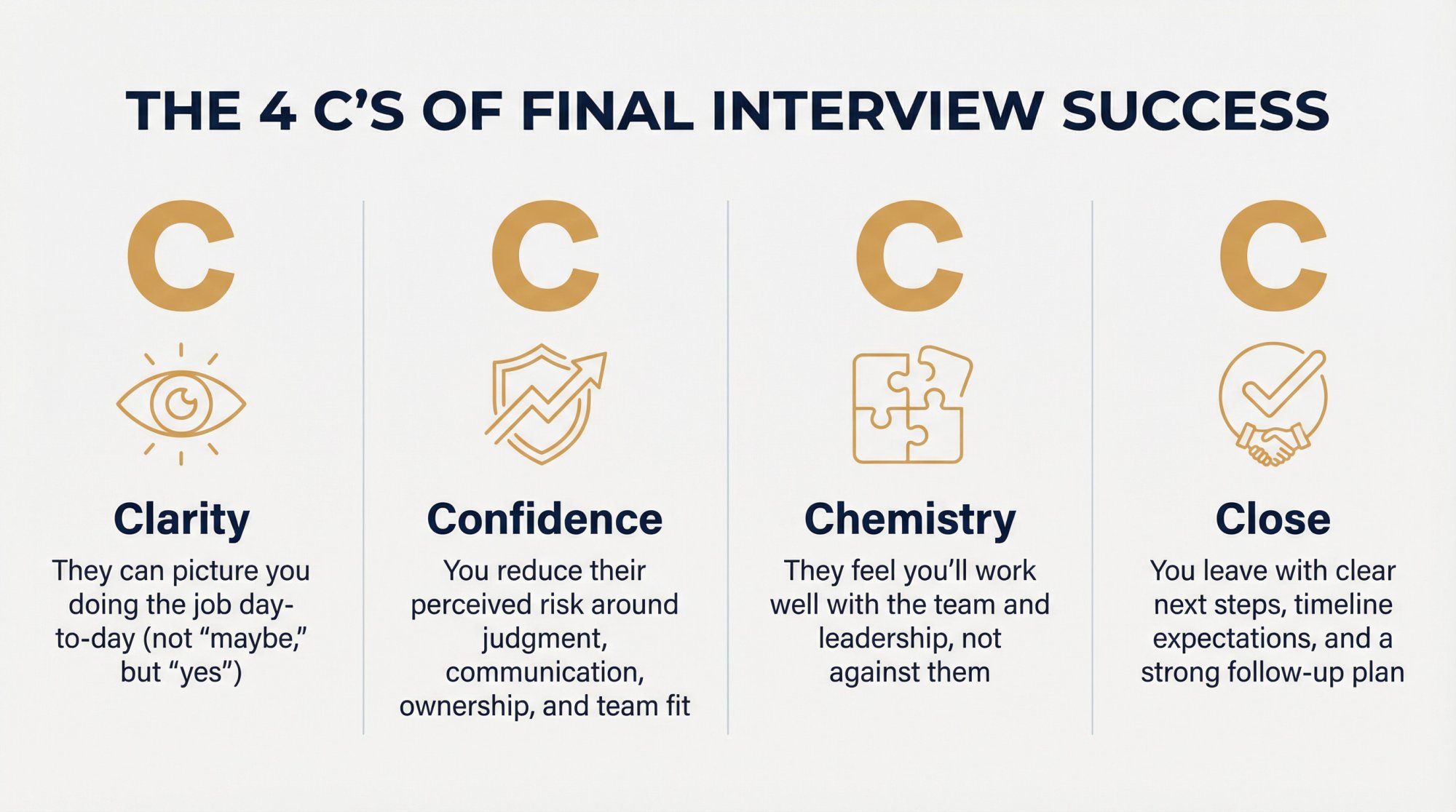
You win when you achieve all four of these outcomes:
Industry research points out that at this stage, candidates often have similar technical competence. The decision comes down to team fit, vision alignment, ambition, and subtle distinctions.
What Are Final Interview Questions Really Testing?
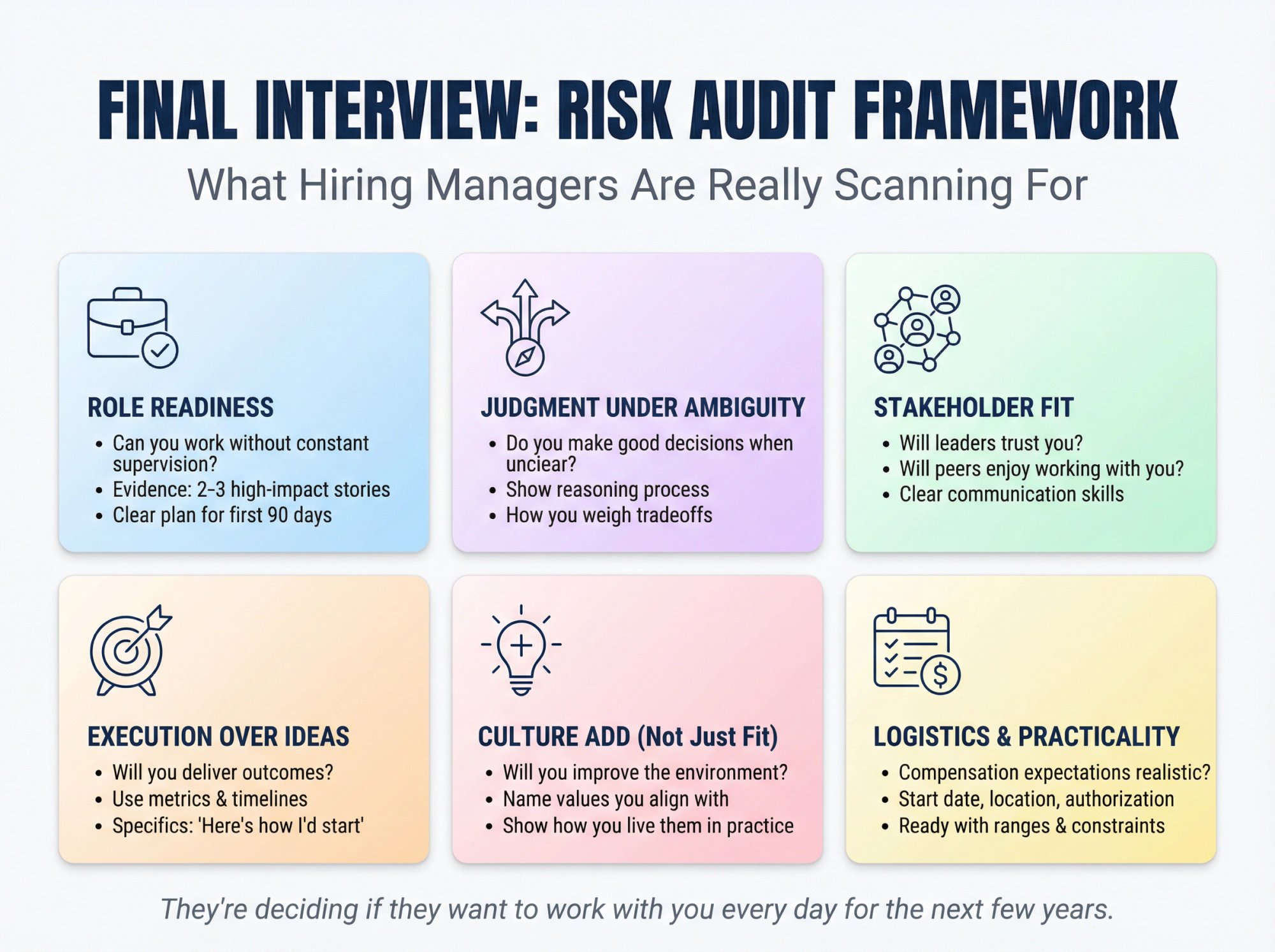
Think of the final interview as a risk audit. They're scanning for evidence across these critical areas:
Role Readiness
Can you do the work without constant supervision? Prove it with 2-3 high-impact stories and a clear plan for your first 90 days.
Judgment Under Ambiguity
Do you make good decisions when the path isn't clear? Show your reasoning process, how you weigh tradeoffs, and what you learned from past mistakes.
Stakeholder Fit
Will leaders trust you? Will peers enjoy working with you? Demonstrate clear communication and genuine collaboration skills.
Execution Over Ideas
Will you deliver outcomes or just talk about possibilities? Use metrics, timelines, and specifics like "here's how I'd start."
Culture Add (Not Just Fit)
Will you improve the environment? Name the values you align with and show how you live them in practice.
They're not just checking if you can do the job. They're deciding if they want to work with you every day for the next few years.
Logistics & Practicality
Are your compensation expectations, start date, location, and work authorization realistic? Be ready with ranges and constraints.
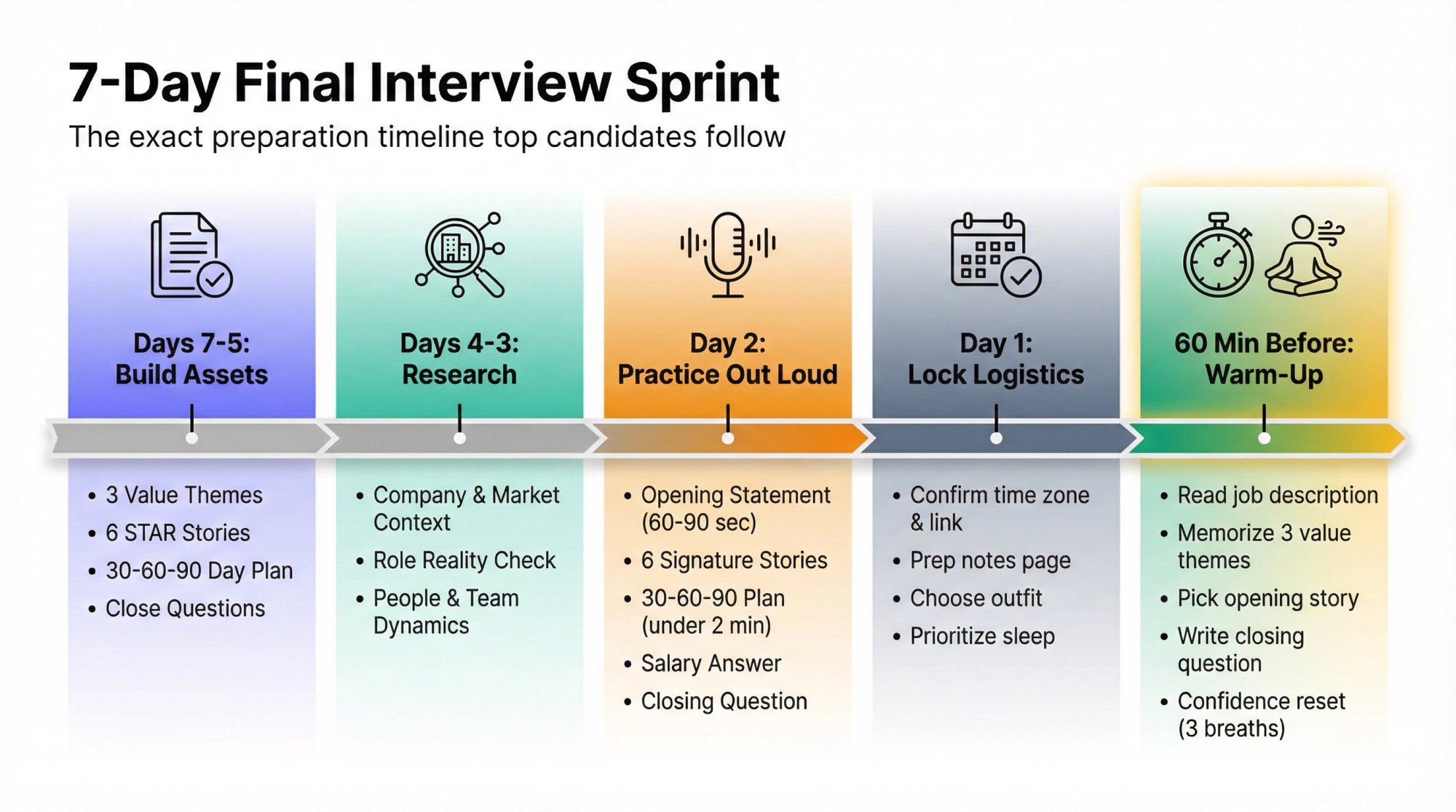
How to Prepare for a Final Interview: 7-Day Sprint
Here's the exact preparation timeline top candidates follow. Adapt it if you have less time.
7-5 Days Before: Build Your Final Interview Assets
You need four assets written down in a single document:
1) Your 3 Value Themes (your "why you" in 3 bullets)
Example:
I turn messy systems into simple, scalable workflows (operational clarity)
I drive measurable growth outcomes (revenue and retention)
I build trust across teams (stakeholder alignment)
2) Your 6 Signature Stories (using STAR format, mapped to job requirements)
→ 2 "wins" with results and metrics
→ 1 "failure or learning moment" (shows humility and growth)
→ 1 "conflict resolution" (demonstrates maturity and collaboration)
→ 1 "high-pressure situation" (proves you stay calm)
→ 1 "leadership or ownership story" (shows initiative)
3) Your 30-60-90 Day Plan (high-level roadmap)
A 30-60-90 plan outlines your priorities and measurable goals for your first three months. It's often used in late-stage interviews to show you understand the role and can ramp quickly.
4) Your Close List (the final 5 questions you'll ask them)
4-3 Days Before: Research Like a Future Teammate
Don't research like a student preparing for a test. Research like someone who's about to be responsible for actual outcomes.
Company & Market Context
• What do they sell, to whom, and why does it matter right now?
• What's their business model and current growth trajectory?
• What changed recently? (New product launches, executive hires, strategic shifts)
Role Reality Check
• What does success look like in 90 days? Six months? One year?
• What constraints exist? (Budget limits, headcount freezes, technical debt, process bottlenecks)
People & Team Dynamics
• Who will be interviewing you and what do they care about most?
• What's the "unspoken job" of this role? (Risk reduction, speed, stability, innovation)
2 Days Before: Practice the Hard Parts Out Loud
Final interviews punish "silent prep." Your brain needs actual speaking reps to perform under pressure.
Practice these out loud:
① Your opening statement (60-90 seconds)
② All 6 signature stories
③ Your 30-60-90 plan explanation (keep it under 2 minutes)
④ Your salary answer (clear, calm, non-defensive)
⑤ Your closing question: "Do you have any concerns about my fit for this role?"
Record yourself at least once. You'll immediately spot filler words, rambling, rushed pacing, or unclear stories.
If you want structured practice with real interview questions generated from the job description, AIApply's Mock Interview tool can help you rehearse responses until they sound natural.
24 Hours Before: Lock Logistics and Messaging
→ Confirm time zone, meeting link or address, and interviewer names
→ Prep a clean notes page with: value themes, stories, questions, plan
→ Choose an outfit that matches the role level and company culture
→ Prioritize sleep and hydration over one extra hour of cramming
60 Minutes Before: Final Interview Warm-Up
Do this exactly:
Read the job description once (slowly). Circle the top 5 priorities.
Read your 3 value themes out loud and memorize them.
Pick your opening story (strongest, most relevant to their needs).
Write your closing question so you don't forget it under pressure.
One confidence reset: Roll your shoulders back, take three slow breaths, and set a steady mental pace.
How to Open a Final Interview (60-Second Framework)
Most candidates waste the opener with a boring career timeline. Instead, deliver a positioning statement that sets a high bar immediately.
This structure makes every answer afterward easier because you've already framed your value clearly.
Final Interview Questions and Best Answers
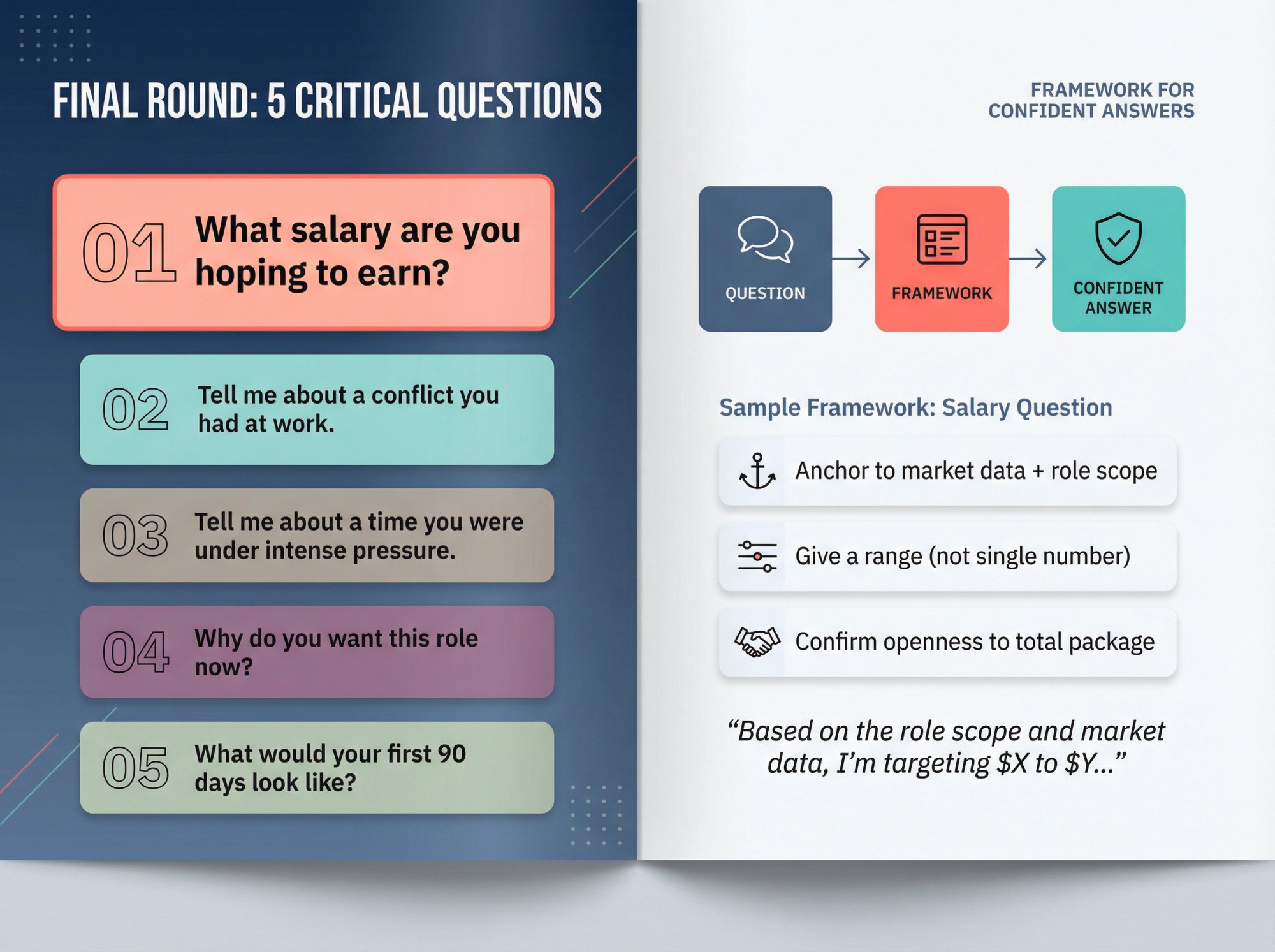
Salary, conflict, and stress/pressure are common final interview topics. Below are the versions that show up at senior or late-stage rounds, with frameworks that actually work.
1) "What salary are you hoping to earn?"
Goal: Show professionalism, preparedness, and flexibility without underselling yourself.
Best Structure:
Anchor to market data and role scope
Give a range (not a single number)
Confirm you're open to discussing the total package
Script:
"Based on the role scope and market data for [title] in [location], I'm targeting a range of $X to $Y. I'm flexible depending on the full package, including bonus, equity, benefits, and growth opportunities. What range has been budgeted for this role?"
If you're not ready to give numbers, you can delay slightly in earlier rounds. But by the final interview, you should be prepared to discuss compensation clearly.
2) "Tell me about a conflict you had at work."
Goal: Prove you're safe to work with and won't create drama.
The real test? Whether you can acknowledge your part, communicate respectfully, and reach a constructive outcome.
Framework:
Key move: Show accountability and calm, professional communication. Never blame others or get defensive.
For more examples of behavioral interview questions and answers, check out our comprehensive guide.
3) "Tell me about a time you were under intense pressure."
Goal: Prove you don't panic, blame others, or collapse under stress.
Framework:
• What made it high pressure?
• How did you prioritize when everything felt urgent?
• How did you communicate with stakeholders?
• How did you protect quality while moving fast?
• What was the result, and what did you learn?
4) "Why do you want this role now?"
Goal: Show motivation that isn't vague or generic.
Best Answer Uses Three Layers:
Mission: What excites you about their direction or problem space
Role Fit: Why your strengths match their specific needs
Timing: Why you're ready today (not "someday when I feel like it")
5) "If we hire you, what would your first 90 days look like?"
This is where you can really stand out.
Use a high-level 30-60-90 plan to show you understand the role deeply and can contribute early.
Template (Simple and Credible):
Important: Don't pretend you know everything already. Make it clear you'll validate assumptions once you're inside.
What Questions Should You Ask in a Final Interview?
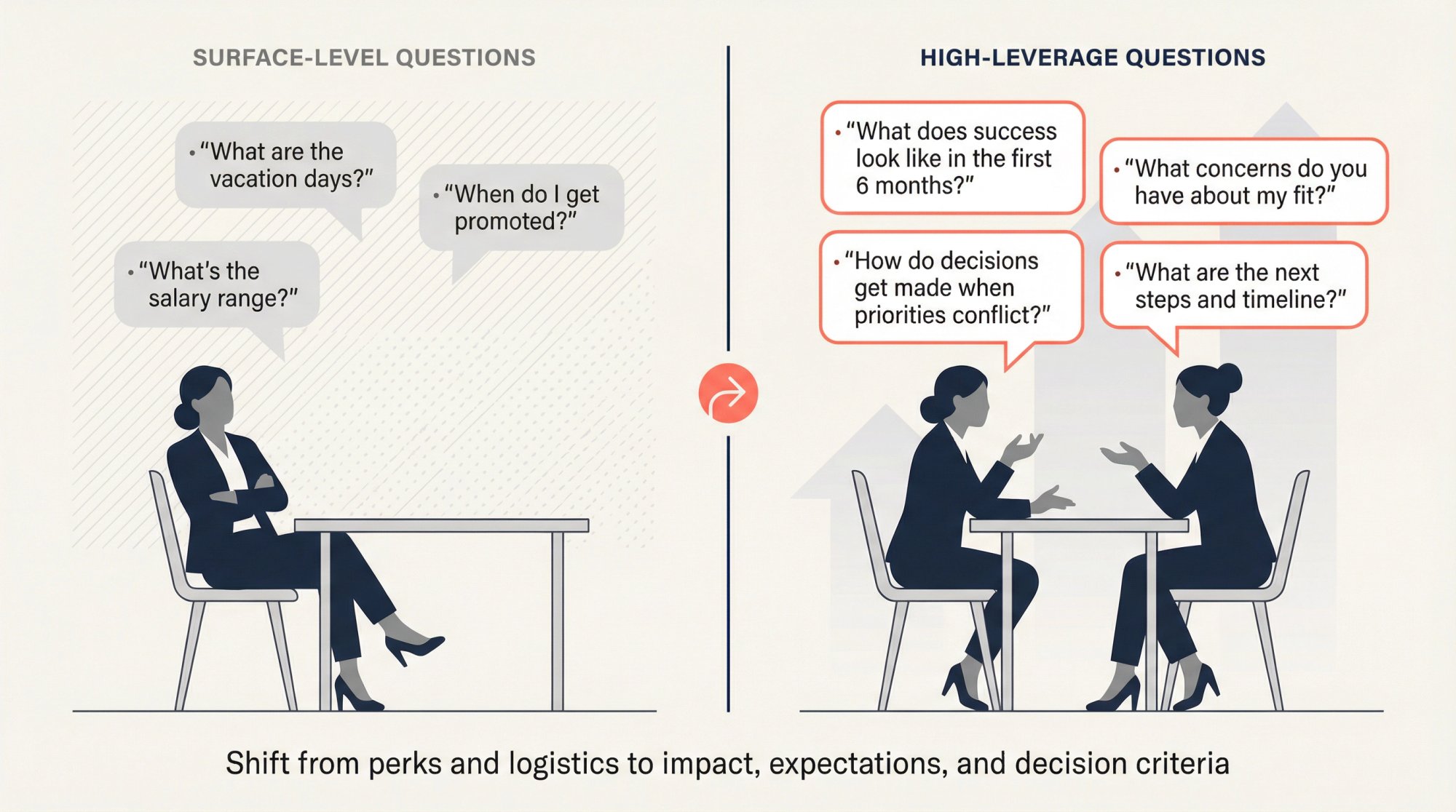
Bad final-round questions focus on perks too early. Great final-round questions focus on impact, expectations, and decision criteria.
Here are high-leverage options. Pick 3-5:
Role Clarity
"What does success look like in the first 6 months, and how will it be measured?"
"What are the top 2 problems you need this hire to solve immediately?"
Decision Criteria
"What would make someone not successful in this role?"
"What concerns, if any, do you still have about my fit?"
Team and Leadership Dynamics
"How do decisions get made when priorities conflict across teams?"
"What does strong collaboration look like between functions here?"
Offer and Timeline
"What are the next steps and decision timeline?"
"If things go well, when would you ideally want someone to start?"
For more strategic questions, explore our guide on killer questions to ask at the end of an interview.
How to Close a Final Interview Without Sounding Desperate
You're allowed to be direct. It signals confidence and genuine interest.
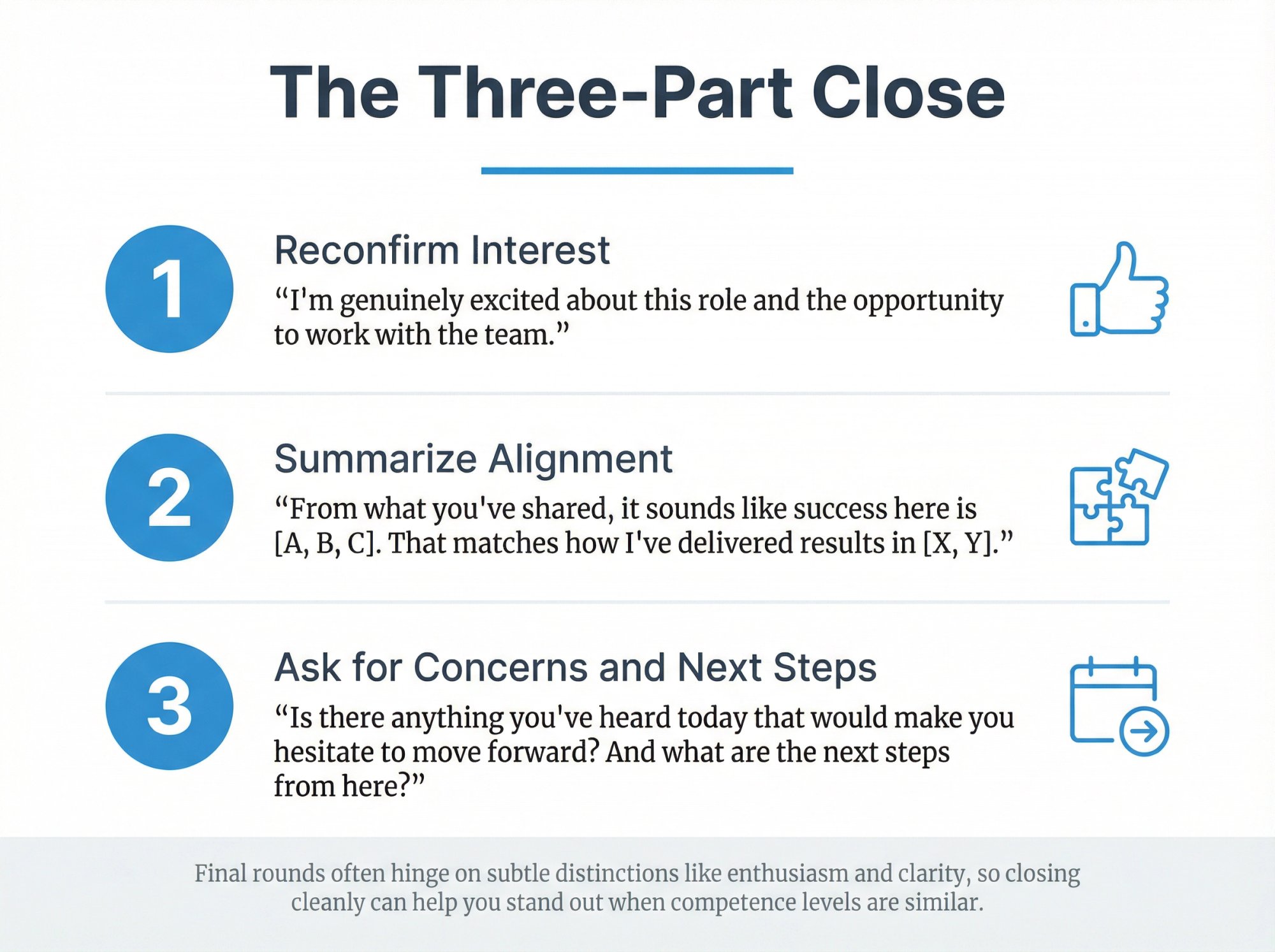
Use this three-part close:
1) Reconfirm Interest
"I'm genuinely excited about this role and the opportunity to work with the team."
2) Summarize Alignment
"From what you've shared, it sounds like success here is [A, B, C]. That matches how I've delivered results in [X, Y]."
3) Ask for Concerns and Next Steps
"Is there anything you've heard today that would make you hesitate to move forward? And what are the next steps from here?"
Final rounds often hinge on subtle distinctions like enthusiasm and clarity, so closing cleanly can help you stand out when competence levels are similar.
What to Do After a Final Interview: Follow-Up System
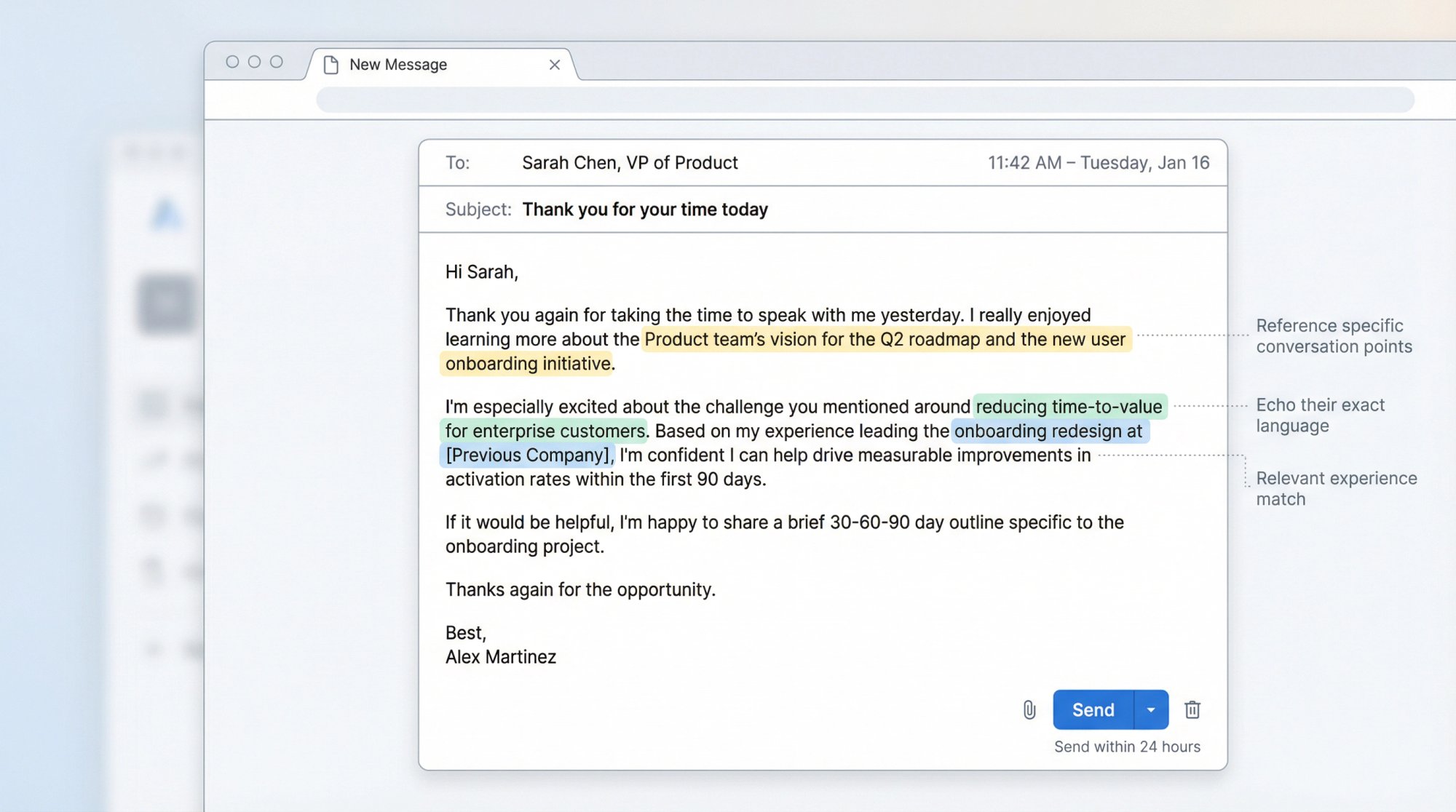
Send a Thank-You Note Within 24 Hours
Professional etiquette strongly recommends sending a thank-you note after interviews as part of relationship-building.
Our guide on best follow-up email after interview recommends sending a concise, personalized thank-you email within 24 hours. Reference specific conversation points to make it meaningful.
Template You Can Copy:
Subject: Thank you for your time todayHi [Name],Thank you again for taking the time to speak with me today. I really enjoyed learning more about [specific team, product, or priority they mentioned].I'm especially excited about [specific challenge they brought up]. Based on my experience with [relevant example], I'm confident I can help drive [outcome they care about].If it would be helpful, I'm happy to share [portfolio piece, work sample, or brief 30-60-90 outline].Thanks again for the opportunity.Best,[Your Name]Optional: Value-Add Follow-Up (Only If Genuinely Useful)
Send one short insight. Not a mini-essay.
Examples:
A relevant case study or article link
A 5-bullet plan for a challenge they discussed
A short portfolio artifact that maps directly to their pain point
How to Negotiate a Job Offer After Your Final Interview
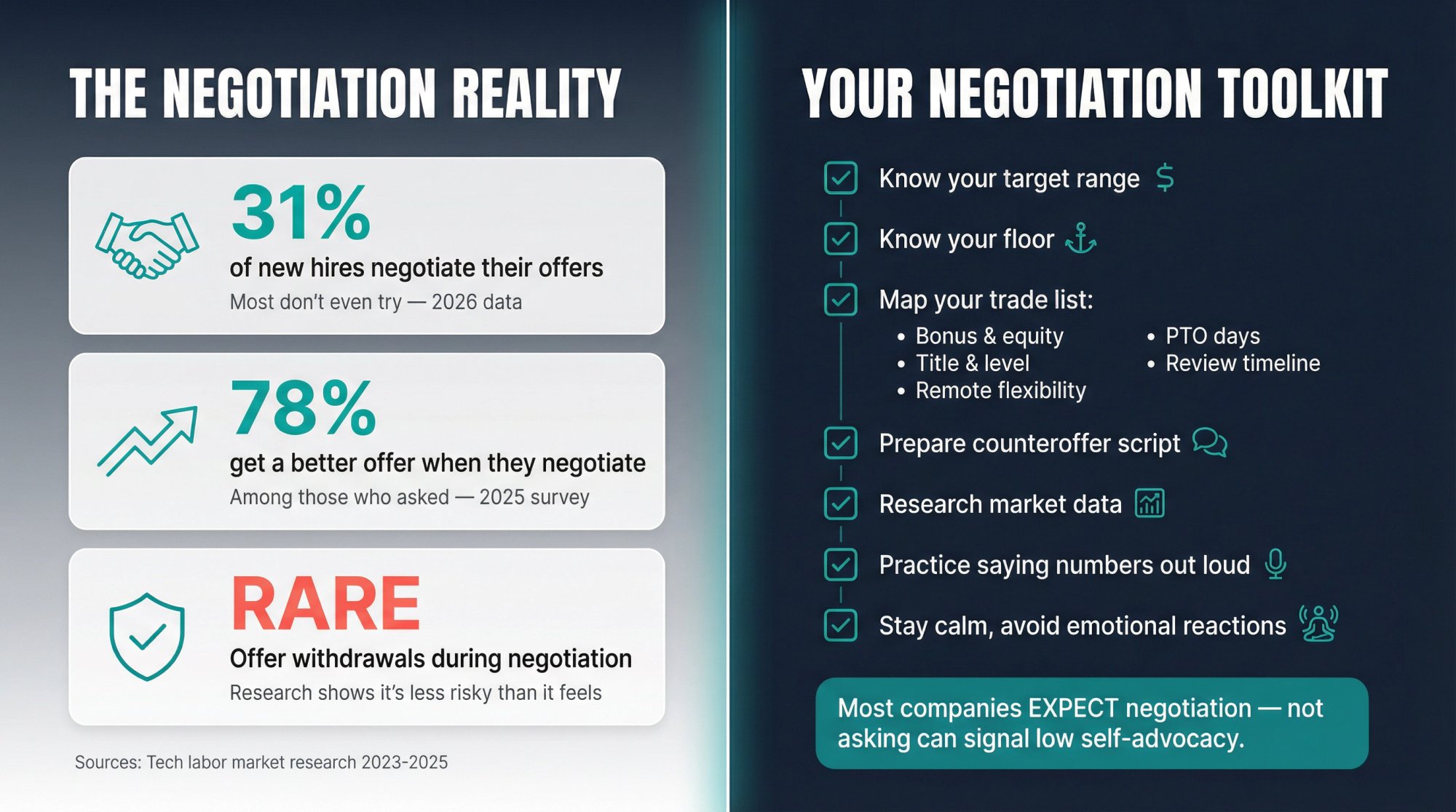
Final interview prep should include negotiation prep because offers can move fast once they decide.
The Reality in 2026: Many People Still Don't Negotiate
Recent data shows:
• Recent research reports that the share of new hires who negotiated offers slipped to 31%.
• Survey data from 2025 found 45% negotiated while 55% didn't. Among those who negotiated, 78% reported getting a better offer.
• Analysis from 2023 found most workers did not ask for higher pay the last time they were hired. Among those who did ask, outcomes varied (some got what they asked for, others got partial improvements).
Negotiation Is Usually Less Risky Than It Feels
Research with tech job seekers notes that negotiation fears can be inflated. It also discusses how written vs. verbal offers can affect perceived risk, and cites research showing that offer withdrawals during negotiation are treated as rare in academic work.
Reality check: Most companies expect negotiation. Not negotiating can actually signal lack of business acumen or low self-advocacy.
Your Negotiation Prep Checklist
Before the offer arrives, decide:
Your target range (what you're aiming for)
Your floor (minimum you'll accept)
Your trade list (what matters besides base salary):
Bonus and equity
Title or level
Remote/hybrid flexibility
Start date timing
PTO days
Learning and development budget
Review timeline (e.g., 6-month comp review)
Professional guidance emphasizes preparation, avoiding emotional reactions, and evaluating the entire package. It also warns against unethical behavior during negotiations.
A Clean Counteroffer Script
"I'm excited to move forward with this opportunity. Based on the role scope and market data, I was expecting something closer to $X. Is there flexibility to get to that number, or to close the gap through bonus, equity, or a compensation review at [specific timeframe]?"
If they say "best and final," you can still negotiate something (title, flexibility, review timeline). Recent labor-market reporting indicates that "best and final" language has become more common in some contexts, but you still have room to discuss non-salary components.
Special Final Interview Situations
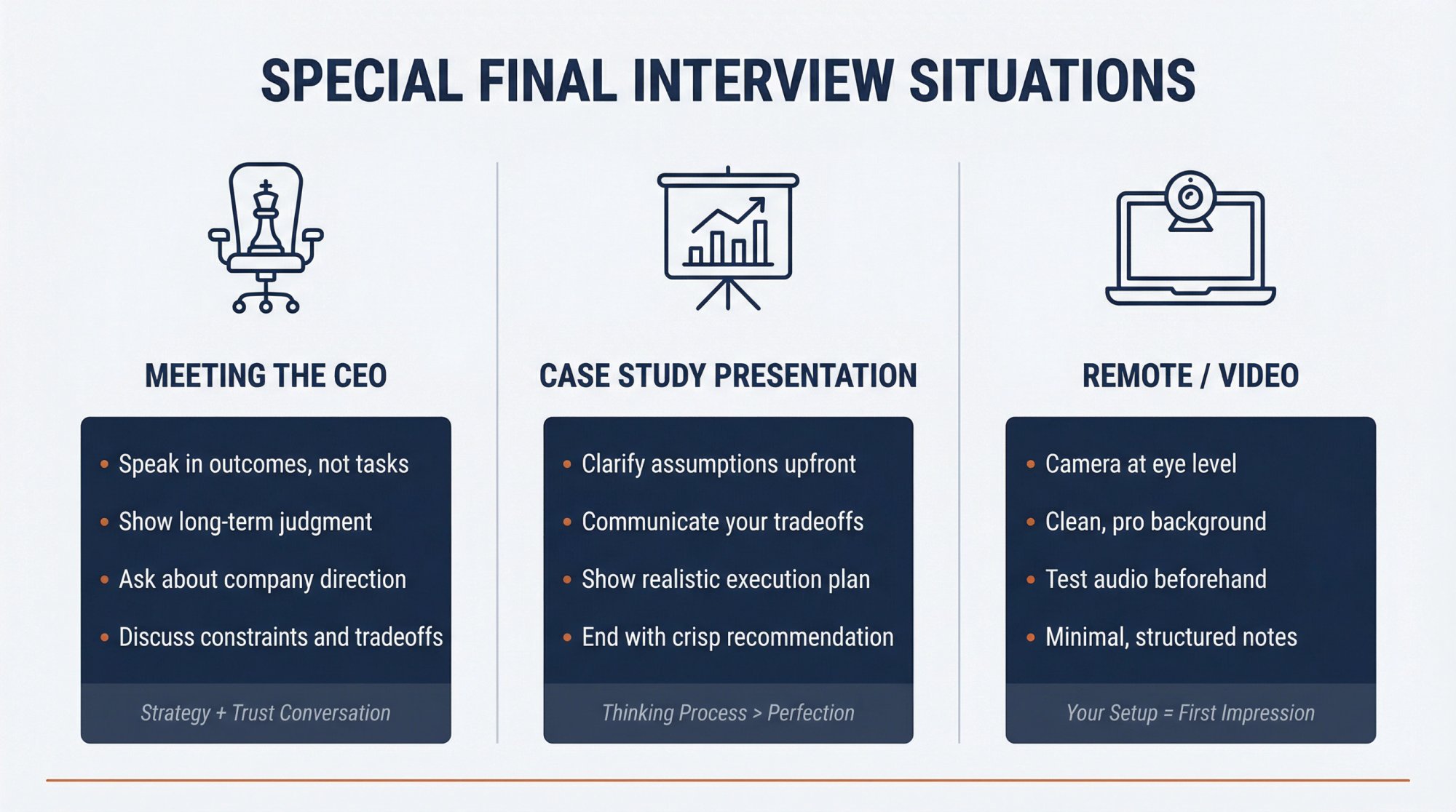
If You're Meeting the CEO
Treat it like a strategy and trust conversation:
Speak in outcomes, tradeoffs, and priorities (not just task lists)
Show judgment and long-term thinking
Ask about company direction, current constraints, and what success would unlock for the team
In smaller companies, final interviews may include senior leaders like a CEO.
If You're Presenting a Case Study
Your goal isn't perfection. It's showing how you think and decide.
Clarify your assumptions upfront
Communicate the tradeoffs you're weighing
Show how you'd execute the plan in reality
End with a crisp "here's what I'd do first" recommendation
If It's Remote or Video
Treat your setup like your first impression.
Technical Setup:
→ Camera at eye level
→ Clean, professional background
→ Stable audio (test beforehand)
→ Keep notes minimal and structured so you're not reading off a script
For nonverbal presence tips that translate well to video, check out our body language for interviews guide.
How AIApply Can Help You Prepare (Without Adding Fluff)
If you want a streamlined workflow that actually makes sense, here's how to use AIApply ethically and effectively:
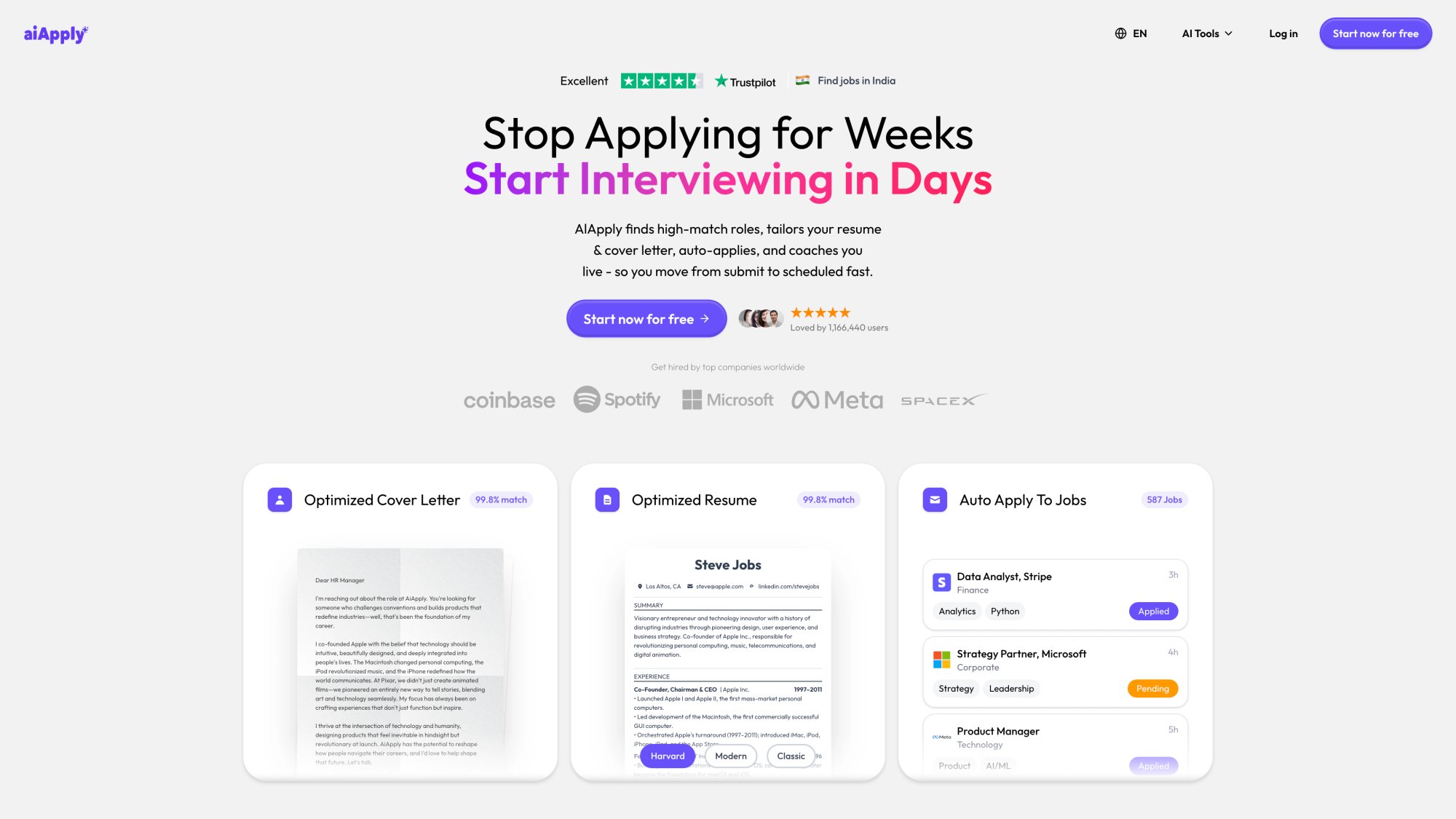
AIApply brings together every tool you need for final interview success—from resume optimization to live coaching—in one integrated platform.
1) Align Your Story to the Role
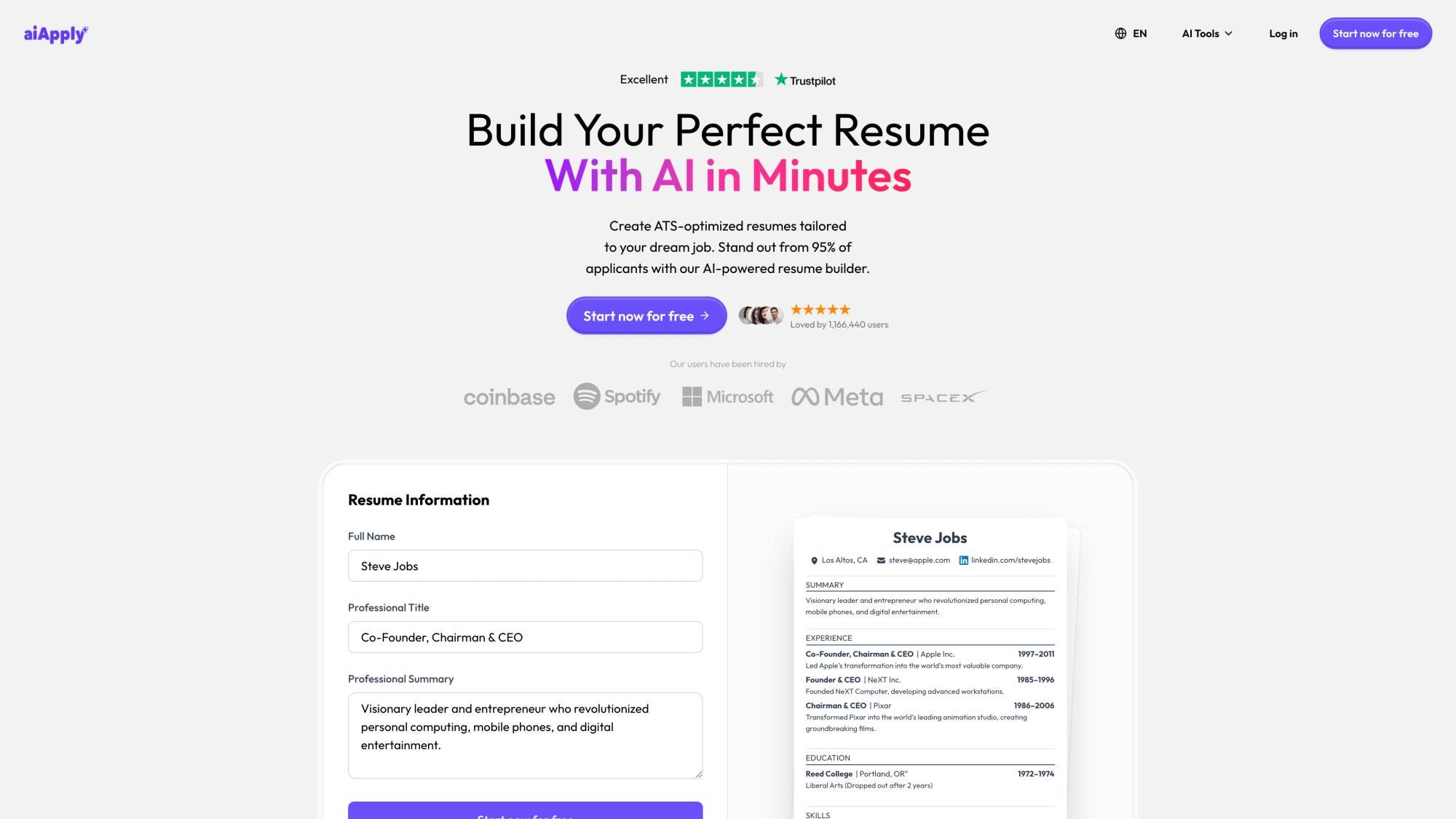
Use AIApply's Resume Builder to ensure your achievements and keywords match the job's real requirements. When your resume aligns with what they hired for, your interview stories will too.
2) Practice Like It's Game Day
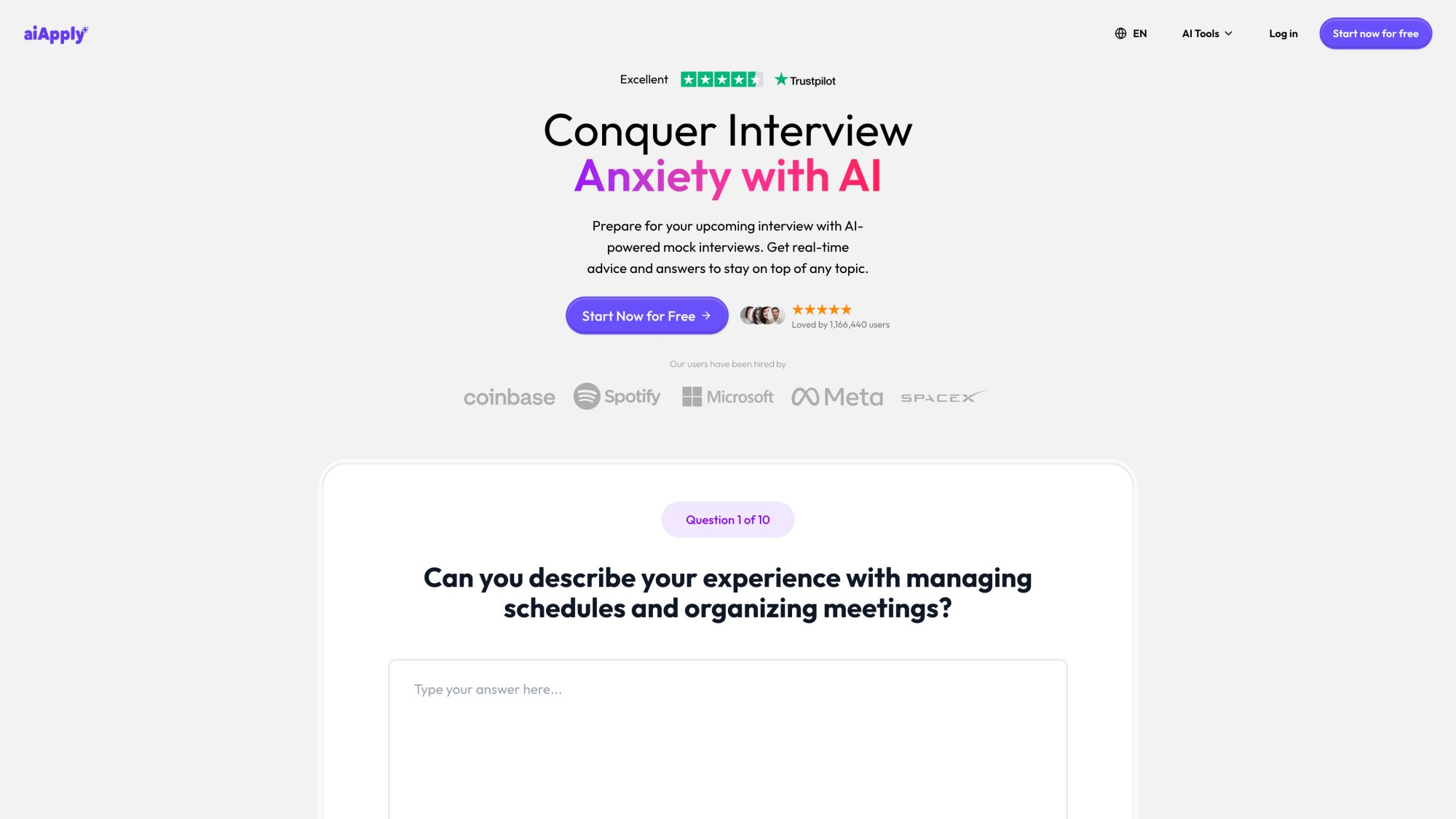
Use AIApply's Mock Interview feature to generate questions from the job description and rehearse answers until they sound natural and confident.
3) Post-Interview Follow-Up
Craft a clean, personalized thank-you note using our proven follow-up email templates that reference your actual conversation.
4) Real-Time Coaching (Use Responsibly)
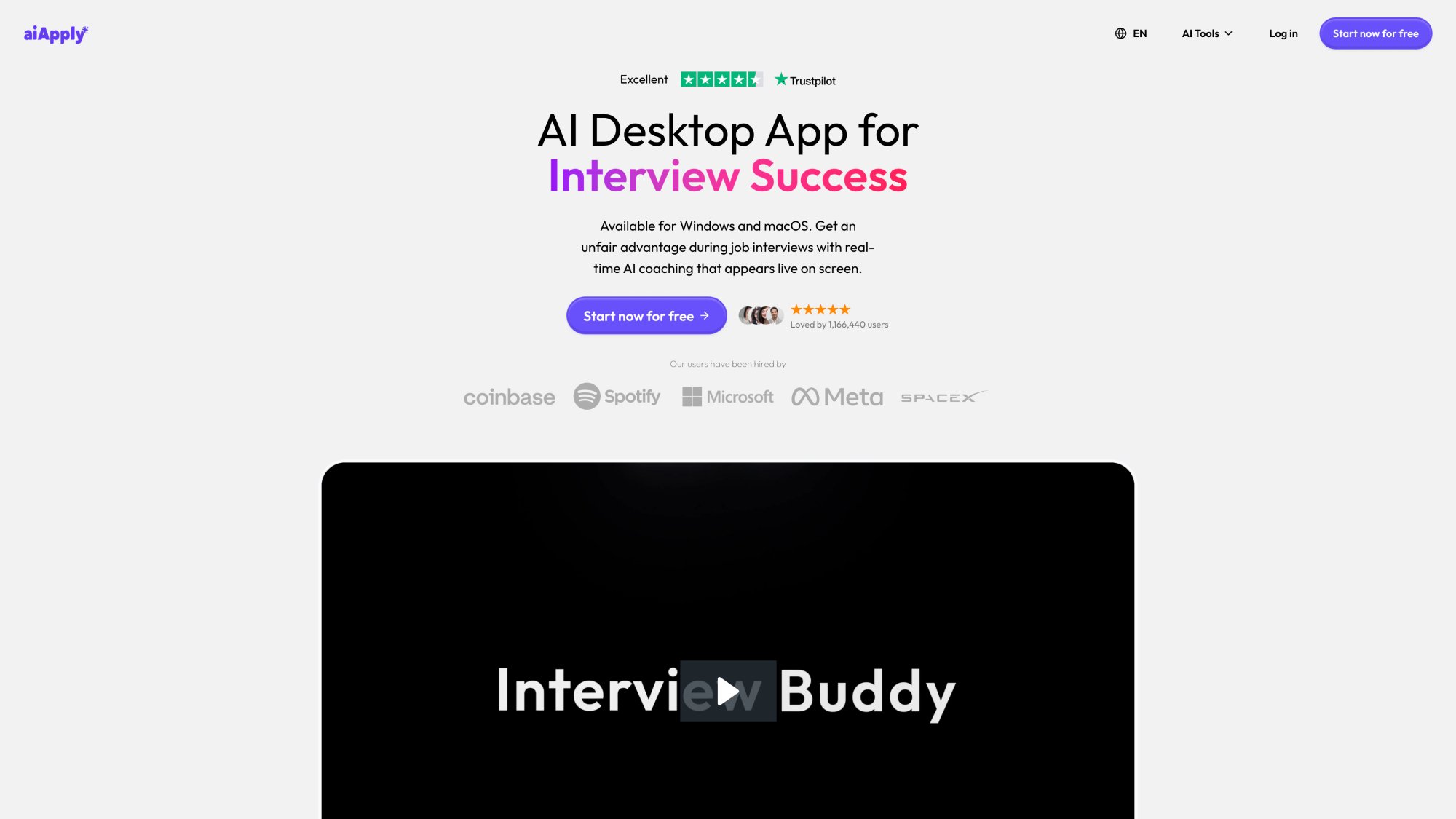
AIApply's Interview Buddy provides live on-screen coaching during interviews. If you use any real-time tool, do it in a way that stays truthful and respects the interview process. Never fabricate experience or misrepresent your work.
5) Streamline Your Job Search
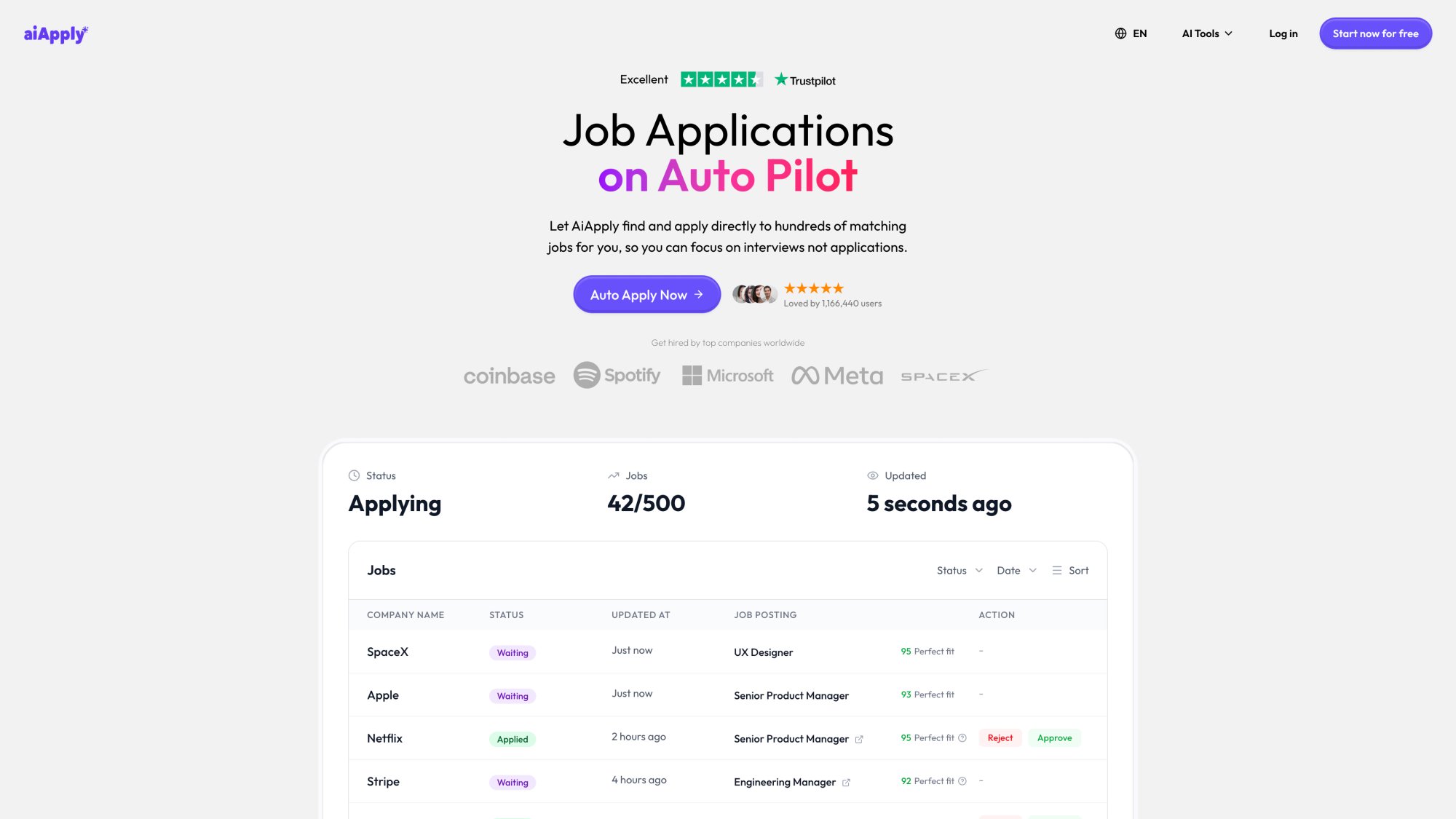
Looking for more opportunities while you wait for final interview results? AIApply's Auto Apply can help you maintain momentum by submitting tailored applications to relevant positions.
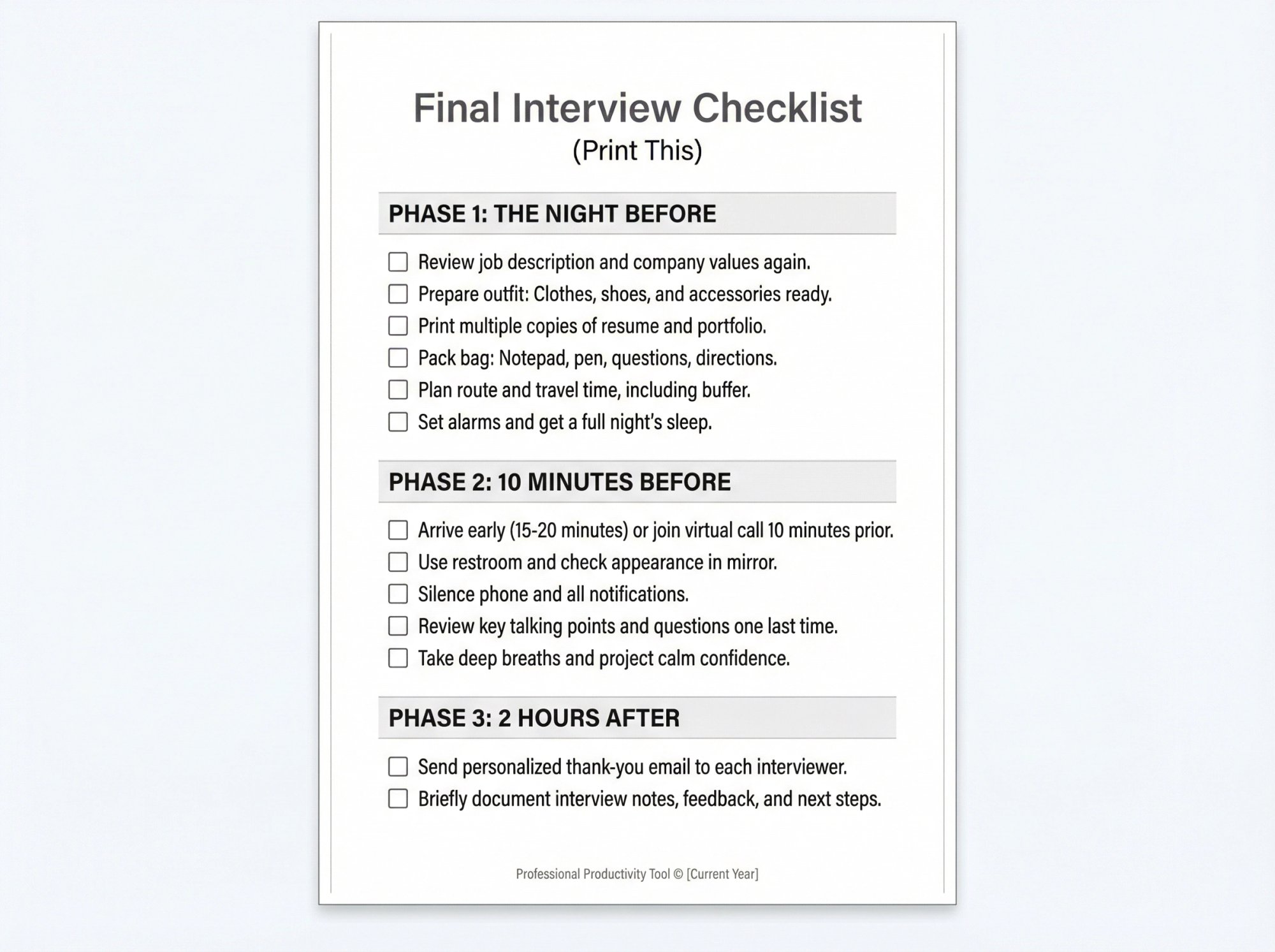
Final Interview Checklist (Print This)
Frequently Asked Questions
Is a final interview basically a guaranteed offer?
No. A final interview is a strong signal that you're a top candidate, but it's not a formality. Final rounds exist to confirm fit, reduce perceived risk, and choose between strong contenders. That's why you must treat it as the most important conversation, not just a checkbox.
Even at the final stage, subtle distinctions matter a lot.
Should I negotiate salary in the final interview?
Usually, you should be ready for salary questions (they may ask during the final round), but formal negotiation typically happens after an offer is extended. Prepare your range and trade list so you don't get caught off-guard. Salary discussions can come up in final interviews, but the real negotiation often follows the offer.
What's the biggest mistake candidates make in final interviews?
They stop "selling." Many assume their earlier rounds did all the work. But final interviews often come down to subtle distinctions like clarity, confidence, enthusiasm, team fit, and how cleanly you close the conversation. When competence is similar across candidates, these softer factors become the deciding criteria.
How long should a final interview typically last?
Final interviews can range from 30 minutes to several hours, depending on the company and role. Some organizations do panel interviews with multiple stakeholders; others schedule back-to-back one-on-ones. If you're unsure, ask your recruiter or HR contact what to expect so you can manage your energy and preparation accordingly.
What if I don't have a 30-60-90 day plan ready?
If you're asked about your first 90 days and don't have a plan, don't panic. Focus on these three things:
(1) what you'd need to learn first
(2) what quick wins you'd target based on what you know so far
(3) how you'd validate your assumptions with the team
Honesty and clear thinking are better than a generic template answer.
Should I bring questions about company culture to a final interview?
Yes, but make them specific and thoughtful. Instead of "What's the culture like?" ask "How do teams handle disagreements when priorities conflict?" or "What does strong collaboration look like between [department A] and [department B]?"
Culture questions that focus on behavior and decision-making show you're thinking like an insider.
Can I ask about work-life balance in a final interview?
Yes, but frame it around how the team manages workload and priorities, not just hours. For example: "How does the team handle urgent requests when people are already at capacity?" or "What does a typical week look like during peak season?"
This shows you care about sustainability without sounding like you're not committed.
What if the interviewer asks about my weaknesses in the final round?
Choose a real area you're working on (not a fake weakness), explain what you're doing to improve, and show progress. For example:
"I've historically struggled with delegating because I want to ensure quality, but I've been intentionally coaching team members and creating clearer ownership structures. It's still a work in progress, but I'm seeing better outcomes."
How soon should I follow up if I don't hear back after the final interview?
Send your thank-you email within 24 hours. If they gave you a timeline (e.g., "We'll get back to you by Friday"), wait until that deadline passes before following up. If they didn't give a timeline, it's reasonable to check in after 5-7 business days with a polite, brief email asking for an update.
Is it okay to bring notes to a final interview?
Yes, especially for virtual interviews. Keep notes minimal and structured (value themes, stories, questions). Don't read from them word-for-word. In-person interviews give you less cover, so if you bring notes, keep them brief and refer to them naturally, not constantly.
What if I'm asked to do a presentation or case study in the final round?
Clarify expectations early: format, time limit, audience, evaluation criteria. Focus on demonstrating how you think, not just what you know. Show your assumptions, explain tradeoffs, communicate your reasoning clearly, and end with a concrete recommendation.
Practice out loud at least twice before the real thing.
Should I send separate thank-you notes to everyone who interviewed me?
If you met with multiple people individually, yes. Personalize each note by referencing something specific from your conversation with that person. If it was a panel interview, you can send one group email or individual emails depending on the dynamics and your rapport with each person.
If you want personalized help, tell us the role you're interviewing for (job title plus a link or pasted description). We can generate:
Your 3 value themes tailored to the role
A 6-story bank mapped directly to the job requirements
A 30-60-90 day plan outline specific to the position
A tailored final interview question set based on likely stakeholders
You've got this. Now go close the deal.
You made it to the final round. Congratulations.
Most candidates don't realize this: the final interview isn't the "almost done" stage. It's the decision room.
At this point, they already know you can do the job. What they're really deciding is:
Do we trust you with real responsibility (and the people around it)?
Will you make our work lives easier or harder once you start?
Are there any risks we can't accept (skills gaps, poor judgment, culture misfit, communication issues)?
Do you actually want us enough to say yes when we extend the offer?
Research shows that final interviews typically involve senior management and focus more on fit, relationships, and behavioral judgment than re-checking your resume. At smaller companies, you might even meet the CEO.
This guide gives you a complete system to walk in calm, sharp, and ready to close. No fluff, no filler. Just what actually works.
What Does Success Look Like in a Final Interview?
You win when you achieve all four of these outcomes:
Industry research points out that at this stage, candidates often have similar technical competence. The decision comes down to team fit, vision alignment, ambition, and subtle distinctions.
What Are Final Interview Questions Really Testing?
Think of the final interview as a risk audit. They're scanning for evidence across these critical areas:
Role Readiness
Can you do the work without constant supervision? Prove it with 2-3 high-impact stories and a clear plan for your first 90 days.
Judgment Under Ambiguity
Do you make good decisions when the path isn't clear? Show your reasoning process, how you weigh tradeoffs, and what you learned from past mistakes.
Stakeholder Fit
Will leaders trust you? Will peers enjoy working with you? Demonstrate clear communication and genuine collaboration skills.
Execution Over Ideas
Will you deliver outcomes or just talk about possibilities? Use metrics, timelines, and specifics like "here's how I'd start."
Culture Add (Not Just Fit)
Will you improve the environment? Name the values you align with and show how you live them in practice.
They're not just checking if you can do the job. They're deciding if they want to work with you every day for the next few years.
Logistics & Practicality
Are your compensation expectations, start date, location, and work authorization realistic? Be ready with ranges and constraints.
How to Prepare for a Final Interview: 7-Day Sprint
Here's the exact preparation timeline top candidates follow. Adapt it if you have less time.
7-5 Days Before: Build Your Final Interview Assets
You need four assets written down in a single document:
1) Your 3 Value Themes (your "why you" in 3 bullets)
Example:
I turn messy systems into simple, scalable workflows (operational clarity)
I drive measurable growth outcomes (revenue and retention)
I build trust across teams (stakeholder alignment)
2) Your 6 Signature Stories (using STAR format, mapped to job requirements)
→ 2 "wins" with results and metrics
→ 1 "failure or learning moment" (shows humility and growth)
→ 1 "conflict resolution" (demonstrates maturity and collaboration)
→ 1 "high-pressure situation" (proves you stay calm)
→ 1 "leadership or ownership story" (shows initiative)
3) Your 30-60-90 Day Plan (high-level roadmap)
A 30-60-90 plan outlines your priorities and measurable goals for your first three months. It's often used in late-stage interviews to show you understand the role and can ramp quickly.
4) Your Close List (the final 5 questions you'll ask them)
4-3 Days Before: Research Like a Future Teammate
Don't research like a student preparing for a test. Research like someone who's about to be responsible for actual outcomes.
Company & Market Context
• What do they sell, to whom, and why does it matter right now?
• What's their business model and current growth trajectory?
• What changed recently? (New product launches, executive hires, strategic shifts)
Role Reality Check
• What does success look like in 90 days? Six months? One year?
• What constraints exist? (Budget limits, headcount freezes, technical debt, process bottlenecks)
People & Team Dynamics
• Who will be interviewing you and what do they care about most?
• What's the "unspoken job" of this role? (Risk reduction, speed, stability, innovation)
2 Days Before: Practice the Hard Parts Out Loud
Final interviews punish "silent prep." Your brain needs actual speaking reps to perform under pressure.
Practice these out loud:
① Your opening statement (60-90 seconds)
② All 6 signature stories
③ Your 30-60-90 plan explanation (keep it under 2 minutes)
④ Your salary answer (clear, calm, non-defensive)
⑤ Your closing question: "Do you have any concerns about my fit for this role?"
Record yourself at least once. You'll immediately spot filler words, rambling, rushed pacing, or unclear stories.
If you want structured practice with real interview questions generated from the job description, AIApply's Mock Interview tool can help you rehearse responses until they sound natural.
24 Hours Before: Lock Logistics and Messaging
→ Confirm time zone, meeting link or address, and interviewer names
→ Prep a clean notes page with: value themes, stories, questions, plan
→ Choose an outfit that matches the role level and company culture
→ Prioritize sleep and hydration over one extra hour of cramming
60 Minutes Before: Final Interview Warm-Up
Do this exactly:
Read the job description once (slowly). Circle the top 5 priorities.
Read your 3 value themes out loud and memorize them.
Pick your opening story (strongest, most relevant to their needs).
Write your closing question so you don't forget it under pressure.
One confidence reset: Roll your shoulders back, take three slow breaths, and set a steady mental pace.
How to Open a Final Interview (60-Second Framework)
Most candidates waste the opener with a boring career timeline. Instead, deliver a positioning statement that sets a high bar immediately.
This structure makes every answer afterward easier because you've already framed your value clearly.
Final Interview Questions and Best Answers
Salary, conflict, and stress/pressure are common final interview topics. Below are the versions that show up at senior or late-stage rounds, with frameworks that actually work.
1) "What salary are you hoping to earn?"
Goal: Show professionalism, preparedness, and flexibility without underselling yourself.
Best Structure:
Anchor to market data and role scope
Give a range (not a single number)
Confirm you're open to discussing the total package
Script:
"Based on the role scope and market data for [title] in [location], I'm targeting a range of $X to $Y. I'm flexible depending on the full package, including bonus, equity, benefits, and growth opportunities. What range has been budgeted for this role?"
If you're not ready to give numbers, you can delay slightly in earlier rounds. But by the final interview, you should be prepared to discuss compensation clearly.
2) "Tell me about a conflict you had at work."
Goal: Prove you're safe to work with and won't create drama.
The real test? Whether you can acknowledge your part, communicate respectfully, and reach a constructive outcome.
Framework:
Key move: Show accountability and calm, professional communication. Never blame others or get defensive.
For more examples of behavioral interview questions and answers, check out our comprehensive guide.
3) "Tell me about a time you were under intense pressure."
Goal: Prove you don't panic, blame others, or collapse under stress.
Framework:
• What made it high pressure?
• How did you prioritize when everything felt urgent?
• How did you communicate with stakeholders?
• How did you protect quality while moving fast?
• What was the result, and what did you learn?
4) "Why do you want this role now?"
Goal: Show motivation that isn't vague or generic.
Best Answer Uses Three Layers:
Mission: What excites you about their direction or problem space
Role Fit: Why your strengths match their specific needs
Timing: Why you're ready today (not "someday when I feel like it")
5) "If we hire you, what would your first 90 days look like?"
This is where you can really stand out.
Use a high-level 30-60-90 plan to show you understand the role deeply and can contribute early.
Template (Simple and Credible):
Important: Don't pretend you know everything already. Make it clear you'll validate assumptions once you're inside.
What Questions Should You Ask in a Final Interview?
Bad final-round questions focus on perks too early. Great final-round questions focus on impact, expectations, and decision criteria.
Here are high-leverage options. Pick 3-5:
Role Clarity
"What does success look like in the first 6 months, and how will it be measured?"
"What are the top 2 problems you need this hire to solve immediately?"
Decision Criteria
"What would make someone not successful in this role?"
"What concerns, if any, do you still have about my fit?"
Team and Leadership Dynamics
"How do decisions get made when priorities conflict across teams?"
"What does strong collaboration look like between functions here?"
Offer and Timeline
"What are the next steps and decision timeline?"
"If things go well, when would you ideally want someone to start?"
For more strategic questions, explore our guide on killer questions to ask at the end of an interview.
How to Close a Final Interview Without Sounding Desperate
You're allowed to be direct. It signals confidence and genuine interest.
Use this three-part close:
1) Reconfirm Interest
"I'm genuinely excited about this role and the opportunity to work with the team."
2) Summarize Alignment
"From what you've shared, it sounds like success here is [A, B, C]. That matches how I've delivered results in [X, Y]."
3) Ask for Concerns and Next Steps
"Is there anything you've heard today that would make you hesitate to move forward? And what are the next steps from here?"
Final rounds often hinge on subtle distinctions like enthusiasm and clarity, so closing cleanly can help you stand out when competence levels are similar.
What to Do After a Final Interview: Follow-Up System
Send a Thank-You Note Within 24 Hours
Professional etiquette strongly recommends sending a thank-you note after interviews as part of relationship-building.
Our guide on best follow-up email after interview recommends sending a concise, personalized thank-you email within 24 hours. Reference specific conversation points to make it meaningful.
Template You Can Copy:
Subject: Thank you for your time todayHi [Name],Thank you again for taking the time to speak with me today. I really enjoyed learning more about [specific team, product, or priority they mentioned].I'm especially excited about [specific challenge they brought up]. Based on my experience with [relevant example], I'm confident I can help drive [outcome they care about].If it would be helpful, I'm happy to share [portfolio piece, work sample, or brief 30-60-90 outline].Thanks again for the opportunity.Best,[Your Name]Optional: Value-Add Follow-Up (Only If Genuinely Useful)
Send one short insight. Not a mini-essay.
Examples:
A relevant case study or article link
A 5-bullet plan for a challenge they discussed
A short portfolio artifact that maps directly to their pain point
How to Negotiate a Job Offer After Your Final Interview
Final interview prep should include negotiation prep because offers can move fast once they decide.
The Reality in 2026: Many People Still Don't Negotiate
Recent data shows:
• Recent research reports that the share of new hires who negotiated offers slipped to 31%.
• Survey data from 2025 found 45% negotiated while 55% didn't. Among those who negotiated, 78% reported getting a better offer.
• Analysis from 2023 found most workers did not ask for higher pay the last time they were hired. Among those who did ask, outcomes varied (some got what they asked for, others got partial improvements).
Negotiation Is Usually Less Risky Than It Feels
Research with tech job seekers notes that negotiation fears can be inflated. It also discusses how written vs. verbal offers can affect perceived risk, and cites research showing that offer withdrawals during negotiation are treated as rare in academic work.
Reality check: Most companies expect negotiation. Not negotiating can actually signal lack of business acumen or low self-advocacy.
Your Negotiation Prep Checklist
Before the offer arrives, decide:
Your target range (what you're aiming for)
Your floor (minimum you'll accept)
Your trade list (what matters besides base salary):
Bonus and equity
Title or level
Remote/hybrid flexibility
Start date timing
PTO days
Learning and development budget
Review timeline (e.g., 6-month comp review)
Professional guidance emphasizes preparation, avoiding emotional reactions, and evaluating the entire package. It also warns against unethical behavior during negotiations.
A Clean Counteroffer Script
"I'm excited to move forward with this opportunity. Based on the role scope and market data, I was expecting something closer to $X. Is there flexibility to get to that number, or to close the gap through bonus, equity, or a compensation review at [specific timeframe]?"
If they say "best and final," you can still negotiate something (title, flexibility, review timeline). Recent labor-market reporting indicates that "best and final" language has become more common in some contexts, but you still have room to discuss non-salary components.
Special Final Interview Situations
If You're Meeting the CEO
Treat it like a strategy and trust conversation:
Speak in outcomes, tradeoffs, and priorities (not just task lists)
Show judgment and long-term thinking
Ask about company direction, current constraints, and what success would unlock for the team
In smaller companies, final interviews may include senior leaders like a CEO.
If You're Presenting a Case Study
Your goal isn't perfection. It's showing how you think and decide.
Clarify your assumptions upfront
Communicate the tradeoffs you're weighing
Show how you'd execute the plan in reality
End with a crisp "here's what I'd do first" recommendation
If It's Remote or Video
Treat your setup like your first impression.
Technical Setup:
→ Camera at eye level
→ Clean, professional background
→ Stable audio (test beforehand)
→ Keep notes minimal and structured so you're not reading off a script
For nonverbal presence tips that translate well to video, check out our body language for interviews guide.
How AIApply Can Help You Prepare (Without Adding Fluff)
If you want a streamlined workflow that actually makes sense, here's how to use AIApply ethically and effectively:
AIApply brings together every tool you need for final interview success—from resume optimization to live coaching—in one integrated platform.
1) Align Your Story to the Role
Use AIApply's Resume Builder to ensure your achievements and keywords match the job's real requirements. When your resume aligns with what they hired for, your interview stories will too.
2) Practice Like It's Game Day
Use AIApply's Mock Interview feature to generate questions from the job description and rehearse answers until they sound natural and confident.
3) Post-Interview Follow-Up
Craft a clean, personalized thank-you note using our proven follow-up email templates that reference your actual conversation.
4) Real-Time Coaching (Use Responsibly)
AIApply's Interview Buddy provides live on-screen coaching during interviews. If you use any real-time tool, do it in a way that stays truthful and respects the interview process. Never fabricate experience or misrepresent your work.
5) Streamline Your Job Search
Looking for more opportunities while you wait for final interview results? AIApply's Auto Apply can help you maintain momentum by submitting tailored applications to relevant positions.
Final Interview Checklist (Print This)
Frequently Asked Questions
Is a final interview basically a guaranteed offer?
No. A final interview is a strong signal that you're a top candidate, but it's not a formality. Final rounds exist to confirm fit, reduce perceived risk, and choose between strong contenders. That's why you must treat it as the most important conversation, not just a checkbox.
Even at the final stage, subtle distinctions matter a lot.
Should I negotiate salary in the final interview?
Usually, you should be ready for salary questions (they may ask during the final round), but formal negotiation typically happens after an offer is extended. Prepare your range and trade list so you don't get caught off-guard. Salary discussions can come up in final interviews, but the real negotiation often follows the offer.
What's the biggest mistake candidates make in final interviews?
They stop "selling." Many assume their earlier rounds did all the work. But final interviews often come down to subtle distinctions like clarity, confidence, enthusiasm, team fit, and how cleanly you close the conversation. When competence is similar across candidates, these softer factors become the deciding criteria.
How long should a final interview typically last?
Final interviews can range from 30 minutes to several hours, depending on the company and role. Some organizations do panel interviews with multiple stakeholders; others schedule back-to-back one-on-ones. If you're unsure, ask your recruiter or HR contact what to expect so you can manage your energy and preparation accordingly.
What if I don't have a 30-60-90 day plan ready?
If you're asked about your first 90 days and don't have a plan, don't panic. Focus on these three things:
(1) what you'd need to learn first
(2) what quick wins you'd target based on what you know so far
(3) how you'd validate your assumptions with the team
Honesty and clear thinking are better than a generic template answer.
Should I bring questions about company culture to a final interview?
Yes, but make them specific and thoughtful. Instead of "What's the culture like?" ask "How do teams handle disagreements when priorities conflict?" or "What does strong collaboration look like between [department A] and [department B]?"
Culture questions that focus on behavior and decision-making show you're thinking like an insider.
Can I ask about work-life balance in a final interview?
Yes, but frame it around how the team manages workload and priorities, not just hours. For example: "How does the team handle urgent requests when people are already at capacity?" or "What does a typical week look like during peak season?"
This shows you care about sustainability without sounding like you're not committed.
What if the interviewer asks about my weaknesses in the final round?
Choose a real area you're working on (not a fake weakness), explain what you're doing to improve, and show progress. For example:
"I've historically struggled with delegating because I want to ensure quality, but I've been intentionally coaching team members and creating clearer ownership structures. It's still a work in progress, but I'm seeing better outcomes."
How soon should I follow up if I don't hear back after the final interview?
Send your thank-you email within 24 hours. If they gave you a timeline (e.g., "We'll get back to you by Friday"), wait until that deadline passes before following up. If they didn't give a timeline, it's reasonable to check in after 5-7 business days with a polite, brief email asking for an update.
Is it okay to bring notes to a final interview?
Yes, especially for virtual interviews. Keep notes minimal and structured (value themes, stories, questions). Don't read from them word-for-word. In-person interviews give you less cover, so if you bring notes, keep them brief and refer to them naturally, not constantly.
What if I'm asked to do a presentation or case study in the final round?
Clarify expectations early: format, time limit, audience, evaluation criteria. Focus on demonstrating how you think, not just what you know. Show your assumptions, explain tradeoffs, communicate your reasoning clearly, and end with a concrete recommendation.
Practice out loud at least twice before the real thing.
Should I send separate thank-you notes to everyone who interviewed me?
If you met with multiple people individually, yes. Personalize each note by referencing something specific from your conversation with that person. If it was a panel interview, you can send one group email or individual emails depending on the dynamics and your rapport with each person.
If you want personalized help, tell us the role you're interviewing for (job title plus a link or pasted description). We can generate:
Your 3 value themes tailored to the role
A 6-story bank mapped directly to the job requirements
A 30-60-90 day plan outline specific to the position
A tailored final interview question set based on likely stakeholders
You've got this. Now go close the deal.
.webp)
%20(1).webp)
.webp)
Don't miss out on
your next opportunity.
Create and send applications in seconds, not hours.


